The subject of South African pass laws makes me think of the GOP’s Agenda 47, and Project 2025…
August 9, 1943 Franz Jägerstätter, an Austrian conscientious objector who reported for induction but refused to serve in the army of the Third Reich, was executed by guillotine at Brandenburg-Gorden prison. An American, Gordon Zahn, wrote about Jägerstätter while researching the subject of German Roman Catholics’ response to Hitler. Zahn’s book, In Solitary Witness, influenced Daniel Ellsberg’s decision to stand against the Vietnam War by bringing the previously secret Pentagon Papers to public attention.Against the Stream by Erna Putz, the story of the courage of Franz Jägerstätter: https://www.c3.hu/~bocs/jager-a.htm August 9, 1945 The second atomic bomb, “Fatman,” was dropped on the arms-manufacturing and key port city of Nagasaki. The plan to drop a second bomb was to test a different design rather than one of military necessity. The Hiroshima weapon was a gun type, the Nagasaki weapon an implosion type, and the War Department wanted to know which was the more effective design.Responsibility for the timing of the second bombing had been delegated by President Harry Truman before the Hiroshima attack to Colonel Paul W. Tibbets, the commander of the 509th Composite Group on Tinian, one of the Northern Mariana Islands in the western Pacific. Scheduled for August 11 against Kokura, the raid was moved forward to avoid a five-day period of bad weather forecast to begin on August 10. English translation of leaflet air-dropped over Japan after the first bomb [excerpt]:“We are in possession of the most destructive explosive ever devised by man. A single one of our newly developed atomic bombs is actually the equivalent in explosive power to what 2000 of our giant B-29s can carry on a single mission. This awful fact is one for you to ponder and we solemnly assure you it is grimly accurate.”Of the 195,000 population of the city (many of its children had been evacuated due to bombing in the days just prior), 39,000 died and 25,000 were injured, and 40% of all residences were damaged or destroyed.“What on earth has happened?” said my mother, holding her baby tightly in her arms. “Is it the end of the world?” Sachiko Yamaguchi (nine years old at the time of the bombing).Hear an eyewitness account of this terrrible eventPhotographic exhibit of the aftermath August 9, 1956 20,000 women demonstrated against the pass laws in Pretoria, South Africa. Pass laws required that Africans carry identity documents with them at all times. These books had to contain stamps providing official proof the person in question had permission to be in a particular town at a given time. Initially, only men were forced to carry these books, but soon the law also compelled women to carry the documents. August 9, 1966 Two hundred people sat in at the New York City offices of Dow Chemical Company to protest the widespread use in Vietnam of Dow’s flammable defoliant Napalm. Napalm in use in Vietnam Read more about Dow Chemical and the use of napalm: https://thevietnamwar.info/napalm-vietnam-war/
August 9, 1987 Hundreds were arrested in an all-day blockade of the Rocky Flats nuclear weapons plant in Golden, Colorado. Protests at Rocky Flats had been going on for some years.
(Long post, but jam-packed even if you don’t click through on anything.)
INSIDE: Donald Trump … Kamala Harris … Nancy Pelosi Read on Substack
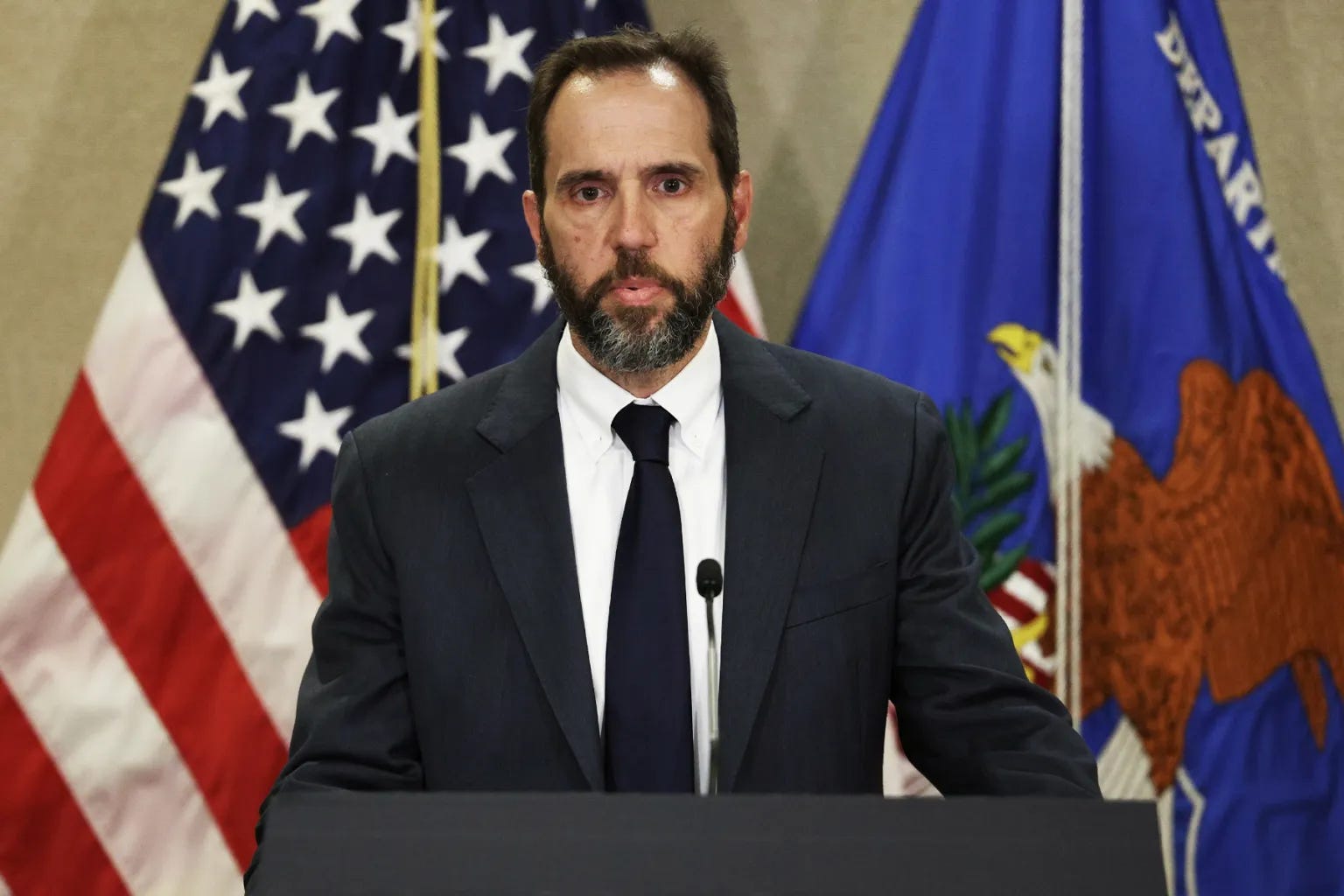
Special Counsel Jack Smith.
A lot of things happened. Here are some of the things. This is TPM’s Morning Memo.
Hurry Up And Wait
Today was the deadline set by U.S. District Judge Tanya Chutkan for Special Counsel Jack Smith and Donald Trump to propose a schedule for pretrial matters as she resumes the Jan. 6 case following the Supreme Court’s horrendous ruling on presidential immunity.
But Smith, in a bit of a surprise move, asked Chutkan in a filing late yesterday to provide more time for him and other DOJ components to sort out the implications of the Supreme Court decision. Trump, the king of delay, did not oppose Smith’s request for more time.
Smith wants another three weeks – until Aug. 30 – to confer with Trump and submit the proposed scheduling order. Smith also asked Chutkan to delay the status conference originally scheduled for next Friday, Aug. 16, until after Aug. 30.
Typically, you would expect the judge to be amenable to this kind of request, but Chutkan was clearly ready to move when the case was finally returned to her, so it’ll be interesting to see how she reacts. I still doubt she’ll force the issue, but nothing about this case is routine.
What does it all mean?
This case was already not going to trial before the election, so it doesn’t change those odds. It reduces the window available for holding any kind of evidentiary hearing on the immunity issue, making it less likely that that will happen before the election (for what it’s worth, I was having trouble getting excited about that as any kind of real pre-election accountability moment for Trump anyway). Whether the case goes to trial after November depends almost entirely on whether Trump loses the election, so Smith’s desired delay wouldn’t really change that either.
Beyond that, we’re left to speculate about what Smith is grappling with internally. It’s all speculation at this point. But before I get into the more tenuous speculation, the simplest and most obvious answer is that the implications of the Supreme Court immunity decision are in fact difficult to parse and to apply to the facts of this case. The high court didn’t give a clear road map on all of the legal issues involved, as Politico explains extensively this morning. And there are a lot of legal issues involved, as this Just Security project published this week outlines in great detail.
Beyond that, the speculation about the delay ranges from internal disputes at DOJ about how to move forward to more mundane bureaucratic slowness in dotting i’s and crossing t’s to one possibility that I’ve tried to keep in mind all along … but again this is purely speculative: If you’re not going to get to try Trump before the election, does it make sense to change the strategy of a stripped-down indictment of only Trump and broaden the federal case to charge the full conspiracy, including all possible crimes committed by Trump, plus adding co-defendants and co-conspirators?
I mention this possibility because the whole point of the current approach was to keep things narrow and targeted, largely for judicial economy and speed. It didn’t work. Trump succeeded in dragging it out past the election. Given that the goal of the original strategy is no longer achievable, there’s a logic to changing the strategy. And remember: if Trump loses the election, Smith has all the time in the world.
What Can Be Done About The Georgia Election Board?
NBC News’ Lisa Rubin takes a closer look at the recent shenanigans of the MAGA-infused Georgia Election Board on behalf of Donald Trump.
That Crazy Trump Presser
Casual readers of other news outlets probably got the sense that Trump held a press conference at Mar-a-Lago yesterday where he proposed more presidential debates, dodged some abortion questions, and made preposterous claims about the size of his crowds. But it truly was the kind of performance that had it been anyone else, or even him eight years ago, would have produced a cacophony of stories asking what is wrong with this guy. If you missed it, perusing the TPM liveblog of the presser might be the best way to get a proper sense of how much we’ve collectively normalized the man.
Harris Campaign Unleashes Its Young And Very Online Staff
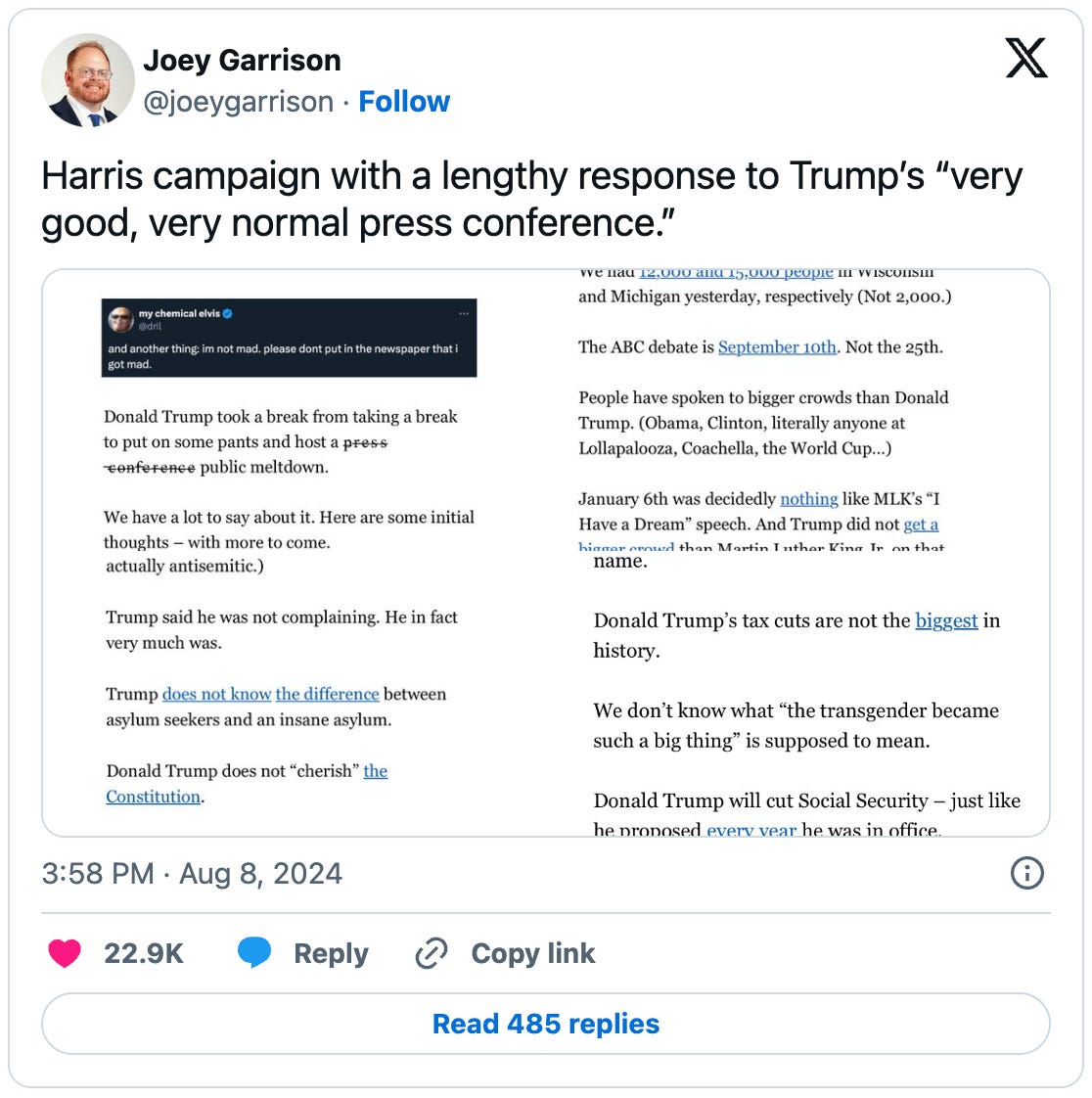
I’ve read a million campaign press releases over the years and at this point ignore most of them, so I’m not holding up this Harris campaign press release responding to Trump’s press conference yesterday as some kind of Rosetta stone of the current moment. And yet … if you want to see the difference in tone and tenor between the Biden and Harris campaigns, this is as good of an illustration as any:
Nancy Pelosi Is Having A Moment
The former speaker is on a roll since President Biden ended his re-election bid.
Here she is, telling the AP about her crusade against Trump: “‘How can I say this in the nicest possible way: My goal in life was that man would never step in the White House again,’ Pelosi said, slapping the table with every word.”
Here she is giving The New Yorker’s David Remnick her assessment of Biden’s campaign: “I’ve never been that impressed with his political operation. They won the White House. Bravo. But my concern was: this ain’t happening, and we have to make a decision for this to happen. The President has to make the decision for that to happen.”
Historical Context
Just gonna leave this right here:
Good Read
TPM’s Josh Kovensky: A Journey Through the Authoritarian New Right–A non-exhaustive look at the influencers behind Republicans’ recent turn toward the bizarre.
Reader Mailbag
TPM Reader AN checking in this week from the Paris Olympics:
Thanks for including that item about Armand Duplantis in the Morning Memo. My husband and I were there last night at the Stade de France, and it was absolute magic.
We are the biggest nerds in the world, totally un-sporty, never watch any sports, barely know what pole-vaulting is. Some friends gave us their extra tickets to Saturday night’s, and then last night’s, track and field event, so we thought, what the hell, it’s the Olympics, let’s go.
Well. We had a spectacularly good time watching all the events on both evenings: discus, shotput, long jump, high jump, sprints, relays and the men’s 10,000 meter final. But the pole-vault! It was just spectacularly entertaining, in large part thanks to the showmanship of the athletes, especially Sam Kendricks and Mondo himself. They had the crowd clapping in unison, they mugged for the camera, raced around, emoted, hugged each other between attempts.
It was crazy how much higher Mondo vaulted than the other guys–at the beginning, he was clearing the bar by probably half a meter. He seemed to be floating. When he had beat everyone else and won the gold at 6.10 meters, there was a pause. Then came the announcement that Mondo would go for the world record. The crowd went crazy and stayed that way until the very end. What a joy.
I’m not sure this experience has turned us into sports fans, but after this, we certainly get what all the fuss is about.
New laws may make it easier to pursue far-right activist over alleged role in spreading disinformation
(I think they are here, because of our Constitution. However, it’d be good to see this sort of activity controlled, and people safer. -A)
Images of Tommy Robinson using his phone while sunbathing in Cyprus as a Rotherham hotel housing asylum seekers was set alight have prompted outrage among those long concerned about his ability to inspire far-right action, even from a distance.
Yet while he has long seemed able to operate with impunity, events may finally be catching up with the man who first rose to prominence in 2009 as the de facto leader of the now defunct English Defence League (EDL).
Far from being powerless to pursue Robinson, new legislation means the authorities may be able to move more easily against those who share damaging information online that they know to be untrue.
Robinson, whose real name is Stephen Yaxley-Lennon, is already known to be among those who are being looked at by police for their alleged role in disseminating disinformation.
A former director of public prosecutions, Ken Macdonald KC, spelled out on Monday how he believed investigators would want to quickly identify individuals who are involved in “online organisation, online incitement and online conspiracies”.
“I think prosecutors will want to have a strategy to identify people who may have been involved in inciting and encouraging these events, and they will want to arrest them and build cases against them. These are, in one sense, the most important people,” Lord Macdonald told BBC Radio 4’s World at One.
While Robinson has been abroad since 28 July, when he fled the UK on the eve of a high court hearing over contempt of court proceedings, he has maintained a near constant commentary on events in the UK since the fatal stabbings of three young girls in Southport on 29 July, sharing claims that police have described as false.
While he has long been a prolific user of multiple social media platforms – benefiting in particular from the return of his X account after Elon Musk bought Twitter – going after him for his online output is not clear-cut.
Dominic Grieve, a former attorney general for England and Wales, told the Guardian: “It is an offence to incite violence on the grounds of race, belief or sexual orientation, and there is incitement to hatred. But it’s a grey area between the right to criticise and incitement to hatred and is a very difficult area to police.
“Quite simply, that’s why it is possible for people to play around with that area. Either you clamp down on it, in which case legitimate freedom of speech gets eliminated and breeds undesirable problems of its own, or you live with it and challenge those views through debate.”
Recent changes in the law open up other possibilities. Since January, an amendment to the Online Safety Act 2023 allows for the prosecution of those who convey information that they know to be false and “if the person intended the message, or the information in it, to cause non-trivial psychological or physical harm to a likely audience”.
Ashley Fairbrother, a senior prosecutor at the law firm Edmonds Marshall McMahon, said: “This now makes the circulation of damaging and false information online into an offence in its own right.” (snip-More)
The call to action comes as the issue has intensified in recent years, affecting students to public figures like Taylor Swift and AOC.
Originally published by The 19th Republished with their republish link.
“This is an issue that affects everybody — from celebrities to high school girls.”
That’s how Jen Klein, director of the White House Gender Policy Council, describes the pervasiveness of image-based sexual abuse, a problem that artificial intelligence (AI) has intensified in recent years, touching everyone from students to public figures like Taylor Swift and Rep. Alexandria Ocasio-Cortez.
In May, the Biden-Harris administration announced a call to action to curb such abuse, which disproportionately targets girls, women and LGBTQ+ people. Stopping these images, whether real or AI-generated, from being circulated and monetized requires not just the government to act, but tech companies to as well, according to the White House.
“We’re inviting technology companies and civil society to consider what steps they can take to prevent image-based sexual abuse, and there’s really a spectrum of actors who we hope will get involved in addressing the problem,” Klein said. “So that can be anything from the payment processors, to mobile app stores, to mobile app and operating system developers, cloud providers, search engines, etc. They all have a particular part of the sort of ecosystem in which this problem happens.”
Responding to the White House’s call to action, the Center for Democracy & Technology, the Cyber Civil Rights Initiative and the National Network to End Domestic Violence announced in June that they would form a working group to counteract the circulation and monetization of image-based sexual abuse. In late July, Meta, owner of Facebook and Instagram, removed 63,000 accounts linked to the “sextortion” of children and teens.
While older forms of this abuse include the leaking of intimate photos without the consent of all parties, the AI version includes face swapping, whereby the head of one individual is placed on another person’s naked body, Klein said. Both Swift and Ocasio-Cortez have been victims of this kind of sexual abuse. In March, Ocasio-Cortez introduced the Disrupt Explicit Forged Images and Non-Consensual Edits (DEFIANCE) Act of 2024. The legislation provides recourse for people, more than 90 percent of whom are women, who have had their likenesses used in intimate “digital forgery.” The Senate passed the DEFIANCE Act on July 23.
Such images have also garnered repeated headlines this year after spreading at schools. The White House’s appeal to tech companies follows the Biden-Harris administration’s recent updates to Title IX, the law that bars educational institutions that receive federal funds from engaging in sex discrimination. Under the new regulations that took effect Thursday, sex-based harassment includes sexually explicit deepfake images if they create a hostile school environment.
“We respectfully urge the Department of Education to issue guidance delineating Title IX procedures and protocols specifically tailored to addressing digital sexual harassment within educational institutions,” the letter states. “This guidance should provide clear direction on how schools can effectively handle cases of digital sexual harassment including support mechanisms for victims, investigation procedures, research and referrals, and prevention strategies.”
The Biden-Harris administration’s effort to prevent the proliferation of explicit deepfake images coincides with states taking action.
“There’s a patchwork of laws across the country, and there are 20 states that have passed laws penalizing the dissemination of nonconsensual AI-generated pornographic material,” Klein said. “But there’s a lot of work to be done, both at the state level and at the federal level to really make that work a whole quilt to continue the process.”
“It was pretty tricky because of the various First Amendment arguments that get raised,” he said. “The bill, to be honest, got watered down more than I wanted as it went through the process. But it has since been copied in other states, and then frankly, made stronger in other states.”
Berman decided to file legislation to prohibit child sex abuse deepfakes when the California District Attorneys Association informed his office that they’re increasingly catching people who are creating, disseminating or possessing such images.
“Their interpretation of California law currently is that it is not specifically illegal, because it doesn’t involve an image of an actual child — because AI takes thousands of images of real children and then spits out this artificial image,” Berman said. “So they said, ‘We need to close this loophole in California law and make sure that the law explicitly states that child sexual abuse material, even if it’s created by artificial intelligence, is illegal. I was shocked that people were even using AI to create this type of content, and then I found out just how pervasive it is, especially on the dark web. It’s terrifying.”
Possessing or distributing such images online may result in perpetrators sexually exploiting minors offline, making it all the more important to address AI-generated versions of this content before it spirals out of control and becomes a huge problem for the nation’s young people, Berman said.
Multiple schools in California have been rocked by deepfake scandals, often related to images created by students of their peers. In March, a Calabasas High School student accused her onetime friend of disseminating actual and AI-generated nudes of her to their peers. That same month, a Beverly Hills middle school expelled five students for allegedly circulating AI-generated nudes of their classmates.
Such incidents are one reason Berman believes students need to be taught to use AI responsibly. “AB 2876 will equip students with the skills and the training that they need to both harness the benefits of AI, but also to mitigate the dangers and the ethical considerations of using artificial intelligence,” he said.
The legislation has been ordered to a third reading, the bill’s final phase before it leaves the state assembly and moves to the senate. Meanwhile, his bill to prohibit child sex abuse deepfakes, AB 1831, has been referred to the suspense file, meaning that the bill’s potential fiscal impacts to the state are being reviewed. The legislation would take effect January 1 if enacted.
“It’d be great if Congress can pass some federal standards on this,” Berman said. “It’s always an ideal when it comes to legislation that really applies to every state and to kids in every state.”
Pending national legislation addressing the issue includes The SHIELD Act and The Kids Online Safety and Privacy Act (KOSA), which the Senate passed July 30, although it still awaits a vote in the House of Representatives. The former would make the non-consensual sharing of intimate images a federal offense, while the latter would require social media companies to take steps to prevent children and teens from being sexually exploited online, among other measures. KOSA, however, has sparked fears that lawmakers could use it to censor content they dislike, particularly LGBTQ+ content, under the guise of protecting children. Civil liberties groups like the ACLU said that the bill raises privacy concerns, may limit youth’s access to important online resources and could silence needed conversations.
Evan Greer, director at Fight for the Future, a nonprofit advocacy group focused on digital rights, objected to KOSA’s Senate passage in a statement. “We need legislation that addresses the harm of Big Tech and still lets young people fight for the type of world that they actually want to grow up in,” she said.
AI-generated image-based sexual abuse also affects college students, according to Tracey Vitchers, executive director of It’s On Us, a nonprofit that addresses college sexual assault. She called it an emerging issue on college campuses.
“It really started with the emergence of nonconsensual image-sharing involving an individual sharing a private photo with someone that they thought they could trust,” she said. “We are now starting to see this challenge come forward with AI and deepfakes, and unfortunately, many schools are not equipped to investigate gender-based harassment and violence that occurs as a result of deepfakes.”
Vitchers appreciates that the new Title IX regulations touch on the issue, but said that colleges need more guidance from the Department of Education about how to respond to these incidents, and students need more prevention education.
“It’s something that we have begun discussing with some of our partners, particularly those in the online dating space,” Vitchers said. “We are hearing that fear, among particularly young women on campus, about someone who can just take a picture of you from Instagram and use AI to superimpose it onto porn. Then it gets circulated and it feels impossible to get it removed from the internet.”
Some tech companies have already offered their support to the White House’s effort to stop image-based sexual abuse, Klein said, but she would like to hear from others. Although state and national lawmakers are working to enact legislation and regulations, Klein said that the Biden-Harris administration is calling on tech companies to intervene because they can take action now.
“Given the scale that image-based abuse has been rapidly proliferating with the advent of generative AI, we need to do this while we continue to work toward longer-term solutions,” she said.


 Scottie's Playtime