A Lab Test That Experts Liken to a Witch Trial Is Helping Send Women to Prison for Murder

https://www.propublica.org/article/is-lung-float-test-reliable-stillbirth-medical-examiners-murder


The “lung float” test claims to help determine if a baby was born alive or dead, but many medical examiners say it’s too unreliable. Yet the test is still being used to bring murder charges — and get convictions.

Credit:Illustration by Chantal Jahchan for ProPublica. Source images: Getty Images; “Knight’s Forensic Pathology”; “Forensic Pathology: Principles and Practice”; “The Pathology of Homicide”

Inside the medical examiner’s office, two pathologists removed a baby’s lungs from his chest, clamped them together and placed them in a container of water. Then they watched.

They were examining the suspicious death of the baby whose body was found in a Maryland home; his mother said he was stillborn.

If the lungs floated, the theory behind the test holds, the baby likely was born alive. If they sank, the baby likely was stillborn.

“A very simple premise,” the assistant medical examiner later testified.

The lungs floated — and the mother was charged with murder.

In investigations across the country, the lung float test has emerged as a barometer of sorts to help determine if a mother suffered the devastating loss of a stillbirth or if she murdered her baby who was born alive. The test has been used in at least 11 cases where women were charged criminally since 2013 and has helped put nine of them behind bars, a ProPublica review of court records and news reports found. Some of those women remain in prison. Some had their charges dropped and were released.

But the test is so deeply flawed that many medical examiners say it cannot be trusted. They put it in the same company as the discredited analysis of bite marks and bloodstain patterns911 calls and hair comparisons, all of which lack solid scientific foundations and have contributed to wrongful convictions.

It is pseudoscience masquerading as sound forensics, they say. Some even liken the test to witch trials, where courts decided if a woman was a witch based on whether she floated or sank.

“Basing something so enormous on a test that should not be used, that has been completely discredited, is absolutely wrong,” said Dr. Ranit Mishori, the senior medical adviser for the nonprofit Physicians for Human Rights, which has been studying the test, and a professor of family medicine at Georgetown University School of Medicine. “You can send a person who is innocent to prison for many years.”

Medical examiners who rely on the lung float test typically do so in cases where someone gives birth outside of a hospital, often at home and far from the watchful eyes of medical professionals. Absent those witnesses, doubt can overshadow the insistence that the baby was stillborn.

Since the Supreme Court struck down the constitutional right to abortion, legal experts and reproductive justice advocates have voiced fears that an increased reliance on the lung float test will lead to more prosecutions in a landscape where any pregnancy that doesn’t end with a living, breathing baby can be viewed with suspicion. In several cases, the fact that a woman had considered abortion was used against her. Black, brown and poor women, research shows, already disproportionately face pregnancy-related prosecutions. Black women also are more than two times as likely to have a stillbirth as white women.

Even medical examiners who perform the test as part of an autopsy acknowledge its shortcomings. They concede that there are several ways to perform it, undermining the standardization that many forensic disciplines demand. Yet judges have allowed prosecutors to use it as evidence in court.

Basing something so enormous on a test that should not be used, that has been completely discredited, is absolutely wrong.”

—Dr. Ranit Mishori, senior medical adviser for Physicians for Human Rights

ProPublica contacted the nation’s largest medical examiners’ offices to ask if they use the lung float test and discovered a patchwork of practices. Many offices said they just don’t trust it. The County of Los Angeles Department of Medical Examiner called its results “inaccurate.” The Harris County Institute of Forensic Sciences in Houston said it found the test to be “very unreliable” and “not supported by empirical evidence.”

In Cook County, home to Chicago, pathologists use it, but give more weight to “more reliable methods” including X-rays, microscopic examinations and autopsy findings to determine whether a birth was live or still. Others, like the Virginia Office of the Chief Medical Examiner, said the test may be useful only if a baby was not born into a toilet, CPR was not performed and decomposition was not present. None of the 12 largest offices by jurisdiction expressed full-throated support for the test.

And while the national organization that represents medical examiners said that it doesn’t have an official stance on the lung float test, it said it “strongly advocates using scientifically validated and evidence-based practices in forensic pathology.” The National Association of Medical Examiners called the lung float test “a single, dated test” that has not been subjected to the organization’s rigorous evaluation process.

Dr. Gregory Davis, a forensic pathologist at the University of Kentucky College of Medicine and a consultant to the office of the medical examiner in Kentucky, called the test “an outrageous breach of science.” He said he has personally observed the lungs of stillborn babies float and those of live-born babies sink.

The fundamental problem with the test, he said, is that there are many ways that air can enter the lungs of a stillborn child.

“There’s no way,” Davis said, “you can determine live birth versus stillbirth with this test.”


Moira Akers, the Maryland woman whose baby died, didn’t intend to get pregnant. She and her husband, Ian, already had two young children and the couple worried they wouldn’t be able to handle another child.

They struggled financially — she was a stay-at-home mom and he worked only a few days a week as a first mate on a dinner cruise. Her previous pregnancies — both ending in cesarean sections — were difficult, and challenges with her youngest child demanded much of her attention.

Due to Akers’ age, 37, and weight, her pregnancy was considered high risk. The couple decided to terminate, but they didn’t tell her family, who are Catholic and who she worried may not have approved. When Akers was a little girl, her mother said, she dreamed of being a mother, and as an adult she doted on her children.

After her appointment with a gynecologist around 15 weeks into her pregnancy, court records show that Akers thought that it was too late for her to have an abortion in Maryland. She decided she would carry the baby to term without letting anyone know she was still pregnant and give it up at a firehouse.

“I wanted the baby to have a good life,” Akers later told police. “I just knew we weren’t going to be able to provide that.”

Moira Akers Credit:Courtesy of Debra Saltz

She didn’t gain much weight and she told her husband early on that the pregnancy had been terminated. She also didn’t divulge the fact that she was pregnant to other family members, who were going through their own hardships, court records and interviews show. Her sister was being treated for cancer and feared she’d never be able to have children of her own. Her brother was recovering from an accident that had left him temporarily using a wheelchair. And the family had recently buried her grandmother and aunt.

Akers declined comment through her attorney. But the description of the case is based on police and court records, including a trial transcript, as well as interviews with her family and her lawyer.

On Nov. 1, 2018, in the family’s three-bedroom duplex in suburban Baltimore, Akers had been having contractions when she felt a strong urge to use the bathroom. She delivered her son into the toilet. She said he was not breathing. She grabbed her older son’s Star Wars towel to wrap the baby in, then carried him into the bedroom to get scissors and cut the umbilical cord.

“I didn’t hear anything,” Akers later told a detective. The baby, she said, didn’t move.

She didn’t know what to do next. Akers scanned the room and spotted a large Ziploc bag meant to store her daughter’s clothes. She placed her baby in the blue bag, and she put the bag in the closet.

Akers was bleeding heavily from the delivery. Blood soaked the carpet and smeared the bathroom floor. It stained the bathtub, closet door and hallway.

Her husband came upstairs. Alarmed by all the blood, he called the paramedics. When they arrived, they asked Akers questions as she sat on the couch with her husband and two children. She denied being pregnant.

It wasn’t until later, after Akers arrived at the hospital, that she told a nurse that she had “delivered a stillborn child” at home, police records show.

The doctors, who came in next, saw a protruding umbilical cord still attached and asked if the baby was alive. Akers said she had delivered a stillborn baby and told them about the bag and the closet.

Police launched an investigation. Akers described being in denial about the pregnancy and sad about the baby’s death.

The two Maryland doctors conducted an autopsy. The baby, they wrote in their report, appeared to be “well-developed” and “well-nourished” and had been delivered after about 41-42 weeks of pregnancy. He had blue eyes and straight brown hair.

Neither the external exam of the baby nor his bloodwork nor an X-ray revealed signs of foul play. But the narrative from police described a woman who hid her pregnancy from her family and paramedics, considered an abortion and placed the baby’s body in a closet. A microscopic view of the lungs, which were soft and pink in some areas, also appeared to show that some parts had air in them and others did not.

They also had the results of the lung float test.

“A flotation test and microscopic examination of the lungs was consistent with a live birth,” the autopsy read. The baby, the medical examiners concluded, died of asphyxia and exposure from being left in the closet.

Prosecutors charged Akers with child abuse and murder.


The lung float test’s simplicity — essentially unchanged over centuries — is both a feature and a flaw.

Some medical examiners take out one lung at a time. Some cut the lungs up and test pieces, and may even go so far as to squeeze them. Others clamp them together or put the heart and lungs in a jar. Some drop in the liver as a control. Others submerge the lungs in liquid formaldehyde instead of water.

As the assistant medical examiner in Akers’ case testified, “there’s a million ways” to conduct the test.

In theory, the test is meant to determine whether air has reached the microscopic air sacs inside the lungs. If it has, the sacs open and spread out. If it hasn’t, the sacs remain collapsed.

It is not always possible to reach a definitive conclusion, but that may be preferable to [a case] that is based on a problematic test.”

—Capt. Kyle Kennedy, Oregon State Police

But the problem with using aeration as a proxy for proof of life, many medical experts argue, is that babies don’t have to take a breath for air to enter their lungs. Air can be introduced when the baby’s chest is compressed as it squeezes through the birth canal. If there is an attempt to resuscitate a stillborn baby, that pressure can inflate the lungs. And if a body has started to decompose, gases from that process can cause the lungs to float in water. Even the ordinary handling of a stillborn baby can allow air to enter the lungs.

Doctors have long struggled with the best way to determine whether a baby was born alive in unattended births. Many experts agree that it’s nearly impossible without incontrovertible evidence such as milk in the baby’s stomach or signs of the umbilical cord stump beginning to heal where it was cut.

The uncertainty can be difficult for juries to accept, especially when prosecutors present what appears to be a scientific test that proves a baby was born alive and, as a result, was murdered.

“It is not always possible to reach a definitive conclusion, but that may be preferable to one that is based on a problematic test,” said Capt. Kyle Kennedy of the Oregon State Police department, of which the Oregon State Medical Examiner is a part.

The Oregon State Medical Examiner, he said, does not use the lung float test.

The test can produce correct results, said Dr. Christopher Milroy, a forensic pathologist with the Eastern Ontario Regional Forensic Pathology Unit and a professor at the University of Ottawa in Canada. But given that it also produces inaccurate results, he said it should not be used in criminal cases.

“It’s not like some of the things we do,” he said, “where we are going, ‘Well, did they die of diabetes or did they die of something else natural?’”

Milroy has studied the test and its history and has found references to its use in the 17th century, when witch trials were still occurring. But by the late 1700s, its reliability was questioned by doctors and lawyers. More than 200 years later, in 2016, the authors of a forensic medicine textbook wrote that there were too many recorded instances of stillborn lungs floating and live-born lungs sinking for the test to be used in a criminal trial.

No agency currently tracks how often the lung float test is used in criminal cases. But the 11 cases ProPublica identified are likely an undercount because some cases weren’t covered in news reports, and plea deals and acquittals often create less of a public record.

Still, the test has been cited in medical textbooks and is often included in forensic pathology training. Its defenders say that there aren’t any better alternatives, and they may be criticized for not doing their job if they don’t use it. Some also say they don’t rely solely on the test; they acknowledge its weaknesses but say it complements other exams. In addition, some people do, in fact, kill their babies.

Prosecutors have often turned to a 2013 academic study from Germany to support admitting the lung float test as evidence. “The study proves that for contemporary medicine, the lung floating test is still a reliable indicator of a newborn’s breathing,” the authors wrote.

But some experts have questioned that study, saying its results have not been reproduced, its 98% accuracy rate is misleading and it didn’t actually answer whether a baby was born alive because the births in the study had been attended by medical professionals, so there was never any real question about what happened.

The hospital affiliated with the study’s authors declined to comment.

The dearth of research around the test raises critical questions about whether it should be allowed as evidence, said Marvin Schechter, a New York criminal defense lawyer who served on the committee that wrote a groundbreaking National Academy of Sciences report in 2009 on strengthening forensic science in the United States. Schechter said the lung float test wasn’t included because the commission reviewed only the most frequently cited forensic tests.

His concerns with the test mirror many of the ones flagged in the report. For example, he said, the lack of standardization is evident in the fact that some medical examiners squeeze the lungs as part of the test.

“What is that? Your squeeze is different than my squeeze,” he said. “That’s not science.”

Schechter called for a national conference to evaluate the test and its admissibility in court.

“If you apply the rules and regulations that follow science to the lung float test, how does it pass muster?” Schechter said. “The research doesn’t exist, and if the research doesn’t exist, then you shouldn’t be doing it.”


Every so often, after the lung float test has been used to help put a woman behind bars, the questions around it set her free.

In 2006, Bridget Lee had hid her pregnancy after having an affair. She didn’t want anyone in the small Alabama community where she played piano at her church to know.

Bridget Lee at her home in Carrollton, Alabama, in 2009 Credit:Jay Reeves/AP

When she went into labor at home, she said her son was stillborn. She placed his body in a plastic container and put it in her SUV, where it sat for days.

The medical examiner used the lung float test and concluded that Lee’s son had been born alive. Lee was charged with murder, which in Alabama carried the possibility of the death penalty.

Lee’s lawyer called on Davis to review the autopsy report, which was the first time he saw the lung float test being used to support criminal charges against a mother. He concluded that the autopsy was filled with errors. It missed an infection in the umbilical cord and erroneously described decomposition as signs of injury.

Davis’ review led to the Alabama Department of Forensic Sciences to examine the case, and the agency ruled that not only had the medical examiner botched the autopsy, but the baby was stillborn. Neither the medical examiner nor the prosecutors responded to requests for comment.

Lee spent nine months in jail before prosecutors dropped the charges against her.

She later told reporters that she knows it’s hard for people to understand how she could put her baby’s body in a container and leave it in her car. But, she said, the best way to describe it was like having “an out-of-body experience.”

While individual reactions are hard to comprehend, mental health specialists say the shock and pain of delivering a stillborn baby at home can be so traumatic that people may detach or disassociate from reality, said Dr. Miriam Schultz, an associate clinical professor of psychiatry who specializes in reproductive psychiatry at Stanford Medicine Children’s Health.

“Sometimes a survival instinct will kick in to try to normalize what’s an absolutely incomprehensibly shocking and devastating reality,” Schultz said. “One could imagine possibly trying to make evidence of what just happened less visible and wanting to completely compartmentalize this traumatic event that just has occurred.”

Late one April night in 2017, Latice Fisher said she felt the urge to defecate. About three hours later, she delivered her son into the toilet at her home.

The medical examiner in Fisher’s case performed the lung float test, which revealed that parts of the lungs floated and parts didn’t. He ruled that the baby was born alive and died from asphyxiation. Police also found that Fisher had searched for abortion pills on her phone.

Yveka Pierre, senior litigation counsel with the reproductive justice nonprofit If/When/How, said the people who are prosecuted for their pregnancy outcomes are typically from marginalized communities. They’re Black, like Fisher; or they’re brown, like Purvi Patel, an Indiana woman who was sent to prison for feticide after self-inducing an abortion, a charge that was later vacated; or they face financial hurdles, like Akers.

“Some losses are tragedies, depending on your identity, and some losses are crimes, depending on your identity.” Pierre said. “That is not how we say the law should work.”

Pierre, who also worked on Akers’ case, said Fisher and her husband did what prosecutors say to do by calling 911, but Fisher was still arrested. Once the medical examiner’s investigation starts, she said, the office typically works in tandem with the police.

A grand jury indicted Fisher on second-degree murder charges in January 2018. But a few months later, a local group raised money to get her released on bond. The group also contacted a national nonprofit, now known as Pregnancy Justice, which helped connect Fisher with longtime criminal defense attorney Dan Arshack. He began researching the lung float test and came to an unmistakable conclusion.

“It should be permitted to the same extent that dunking a woman in water is permitted to determine if she’s a witch,” he said in an interview.

Some losses are tragedies, depending on your identity, and some losses are crimes, depending on your identity. That is not how we say the law should work.”

—Yveka Pierre, senior litigation counsel with If/When/How

Arshack asked Davis to review the autopsy, which he found troubling. Arshack also asked Aziza Ahmed, then a professor at Northeastern University School of Law, to focus specifically on the forensics of the lung float test.

By not requiring rigorous testing or proof of its accuracy, Ahmed wrote, the “courts themselves have played a key role in sustaining the inaccurate belief” that the test could reliably determine whether a child was born alive.

Arshack wrote letters to District Attorney Scott Colom explaining Davis and Ahmed’s findings, saying there was no “reasonable legal or scientific basis” to conclude that a crime occurred. He also explained that it wasn’t “good public policy to prosecute women for bad pregnancy outcomes, especially Black women in Mississippi,” who suffer higher rates of maternal mortality and stillbirth.

In May 2019, Colom announced that he had learned of concerns surrounding the reliability of the lung float test. Once the question of whether the child was born alive was scientifically in dispute, he said, he dismissed the charges against Fisher and sent the case to another grand jury armed with the details about the test.

“When you’re talking about a murder charge for a mother,” Colom said in an interview, “I felt that was crucial information because I certainly didn’t want to be prosecuting somebody for a stillborn death that could not be her fault.”

This time, the grand jury chose not to indict Fisher.


As Akers’ case made its way through court, Davis was asked to review the autopsy. He noted that Akers had classic risk factors for stillbirth: hypertension during pregnancy, obesity, advanced maternal age and previous pregnancies. She also was past her due date and reported not feeling the baby kick in the days leading up to the birth.

Dr. Gregory Davis at University of Kentucky College of Medicine Credit:Natosha Via for ProPublica

Davis agreed with the medical examiner, Dr. Nikki Mourtzinos, and the associate pathologist who conducted parts of the autopsy, that there were infections in the pancreas, placenta — the vital organ that provides the fetus with nutrients and oxygen — and the umbilical cord, which serves as the baby’s lifeline in the womb.

But what he found “perplexing,” he wrote, is that they did “not seem to take these critical findings into account regarding such findings being associated with stillbirth.” When it was his time to take the witness stand at trial, he said the infections in the placenta, umbilical cord and membranes were “a smoking gun association” with stillbirth.

An OB-GYN also testified that he believed Akers suffered from a placental abruption — a complication where the placenta separates from the wall of the uterus — which also can lead to a stillbirth and cause heavy bleeding.

Prosecutors said the case hinged on whether the baby was born alive. Among the evidence they pointed to were the results of the lung float test, the pinkish appearance of the lungs and lack of decomposition, malformation of the baby’s head or slippage of the skin.

“These lungs floated,” the prosecutor said during closing. “They floated because this child had breathed and was alive after he was delivered at home that day.”

The prosecution homed in on the fact that Akers had wanted an abortion, which was underscored by her cellphone search history. They said she never intended to have her baby live and breathe. When she didn’t get an abortion, they said, she chose to give birth at home and kill her son. They pointed out that she hadn’t received prenatal care and that she didn’t attempt to resuscitate the baby.

Akers told police she thought it was too late.

During closing arguments, prosecutors displayed an oversized photo of the baby on the screen and repeated that Akers put his body in a bag, using the word “bag” 26 times.

In April 2022, the jury found Akers guilty of second-degree murder and first-degree child abuse.

In response to questions from ProPublica, the state’s attorney declined to comment. Mourtzinos, the assistant medical examiner who testified in Akers’ case, did not respond to requests for comment. She’s no longer with the Maryland medical examiner’s office. The agency’s interim chief medical examiner said the office is accredited by the National Association of Medical Examiners and follows the organization’s autopsy performance standards. Any and all ancillary tests, she said, “are done on a case by case basis, at the discretion of the attending medical examiner” and interpreted in the context of the entire case.

When the verdict was read, Akers collapsed in her chair, dropped her head to the table and sobbed. Her family, who was seated behind her, filled the courtroom with their own cries.


Last summer, as much of the country awaited the aftermath of the Supreme Court’s Dobbs v. Jackson Women’s Health Organization decision, which eliminated a constitutional right to abortion, the New York-based nonprofit Pregnancy Justice released a guide for medical, legal and child welfare professionals on confronting pregnancy criminalization.

The organization advised defense attorneys and medical examiners to challenge the lung float test. In many cases, the authors wrote, criminal charges are based on “the erroneous assumption that a woman engaged in acts or omissions that harmed the fetus.”

The backdrop to the lung float test is the deeper issue of criminalizing pregnancy loss. That was already on the rise before the Dobbs decision, with data from Pregnancy Justice showing that nearly 1,400 pregnant women were arrested, prosecuted or sentenced between 2006 and the 2022 Dobbs decision, more than three times the total for the previous 33 years. Many of the charges were connected to drug use while pregnant.

Society often wants to hold someone responsible, said Dana Sussman, deputy executive director of Pregnancy Justice. Mothers are usually the easiest to blame.

One of the first things Pregnancy Justice lawyers now ask in a pregnancy loss case is whether the prosecutor is attempting to use the lung float test.

“It’s almost like an intake question,” Sussman said. “We will fight every attempt that we learn of to use that test because that is a life sentence based on unreliable information and unreliable science.”

The lack of understanding, research and education around stillbirth also contributes to the urge to assign blame. Every year in the U.S., more than 20,000 pregnancies end in stillbirth, defined as the death of an expected child at 20 weeks or more. But the public is often shocked to hear that number or learn that only a fraction of stillbirths are attributed to congenital abnormalities. Some babies died just minutes before they were born and were placed in their parents’ arms while they were warm to the touch and their cheeks were still rosy.

Davis, an affable man with a snow-white beard, has started to spread the word about the lung float test. At a post-Dobbs legal seminar in Tennessee over the summer, he told a room of lawyers about the test, one that many of them had not heard of but may soon encounter.

A lawyer sitting in the back told the crowd that the lung float test seemed to have the same validity as bite mark analysis, which for decades was accepted as evidence and now is considered junk science.

“What do you do when they say this test has been accepted in the past?” she asked.

Davis pointed her to a letter where he gathered signatures from more than two dozen forensic pathologists and medical examiners from around the world who declared that the lung float test is not a scientifically reliable test or indicator of live birth and “is not generally accepted within the forensic pathology community.”

He had submitted the letter in Akers’ case.


In July of last year, three months after the Akers verdict, prosecutors asked the judge to sentence her to 40 years. They said it was the “the most heinous of crimes that can be committed” and it was carried out by a woman who hid her pregnancy and took her baby’s life in a “detached and calculated manner.”

Akers’ family came to her defense. Her husband said that in their nearly 20 years together, Akers’ “devotion to her family defies description.” One of his greatest joys in life, he said, was seeing the way their kids light up anytime she enters a room.

Her lawyer, Debra Saltz, said Akers made “lapses in judgment” by not telling anyone she was pregnant, having the baby alone and then putting his body in the closet. But, she said, “There is in this life no way anybody will get me to believe that Moira Akers killed her baby. I believe Moira, and I believe the science, that this baby was stillborn.”

Before the judge imposed his sentence, Akers addressed him.

“My children are my entire world,” she said, “and I fell in love with my son as soon as I saw him.”

The judge, who acknowledged what an “extraordinarily difficult case” it was, said the charges against Akers were “particularly egregious because they were perpetrated against an innocent, helpless, newborn child.”

He sentenced her to 30 years in prison.

Akers’ appeal, now pending, focuses on the shortcomings of the lung float test.

As she waits for a ruling, she stays connected to her family from prison. Her mom, Mary Linehan, said most of their conversations revolve around the ordinary details of her children’s lives, their first day of school and their favorite new toys.

Akers’ mom, who retired from her job as an accountant at a Catholic church and school, helps watch her grandchildren. When they ask about their mom, she said, their dad tells them that she “got blamed for something she didn’t do, and we’re fighting to get her out.”


Gun deaths among US kids continue to rise; Southern states have worst rates

https://arstechnica.com/health/2023/09/gun-deaths-among-us-children-reached-new-record-high-in-2021-study-finds/

Guns remain the leading cause of death among American children and teens.

Students from Launch Charter School gather for a rally for National Gun Violence Awareness Day at Restoration Plaza on June 2, 2023, in the Crown Heights neighborhood of Brooklyn borough in New York City.
Enlarge / Students from Launch Charter School gather for a rally for National Gun Violence Awareness Day at Restoration Plaza on June 2, 2023, in the Crown Heights neighborhood of Brooklyn borough in New York City.

As the COVID-19 pandemic took hold in 2020, so did another grim reality: For the first time, guns became the leading cause of death for American children and teenagers, surpassing car accidents, the long-standing leader.

In 2021, youth firearm death rates did not fall to pre-pandemic levels as hoped, but instead continued a sharp rise to hit a new record high. That’s according to a recent study led by researchers in New York and published in the journal Pediatrics. The study was based on national mortality data from the Centers for Disease Control and Prevention.

Nationwide, there were 4,752 firearm deaths of American children and teens (ages 0 to 19) in 2021, translating to a rate of 5.8 gun deaths per 100,000 people. The deaths represent a nearly 9 percent increase from 2020 (4,368 or 5.4 deaths per 100,000).

The study looked for disparities and trends in the data. As before, firearm deaths were largely in older teens, with 83 percent of deaths in teens ages 15 to 19. Most were among males, who accounted for 85 percent of the deaths. Black children remained disproportionately affected, with the gap widening—50 percent of the deaths were among Black children. The death rate among Black children and teens increased from 16.6 per 100,000 in 2020 to 18.9 per 100,000, the largest increase among the racial categories.

As for intent, 64 percent of the 2021 firearm deaths were from homicides and 30 percent were from suicides, with the remainder from unintentional shootings. Homicide rates increased across all age groups, which was part of a multi-year trend. Between 2018 and 2021, homicides increased 66 percent in the 0–4 and 5–9 age groups. For kids ages 10–14, homicides increased 100 percent and 62 percent in teens 15–19.

The racial disparity in homicides was stark, with the rate of deaths among Black children being 11 times higher than that of white children. For suicides, white children accounted for 78 percent of the deaths.

Regarding where children and teens had the highest rates of firearm deaths, the study found that places where baseline death rates were already high got worse—namely in the South.

Pediatric firearm mortality rate by state and year from 2018 to 2021. States with absolute mortalities <20 are grayed out because of unreliable crude death rates (these include Arkansas, Delaware, Hawaii, Maine, Massachusetts, New Hampshire, North Dakota, Rhode Island, South Dakota, Vermont, West Virginia, Wyoming, and District of Columbia).
Enlarge / Pediatric firearm mortality rate by state and year from 2018 to 2021. States with absolute mortalities <20 are grayed out because of unreliable crude death rates (these include Arkansas, Delaware, Hawaii, Maine, Massachusetts, New Hampshire, North Dakota, Rhode Island, South Dakota, Vermont, West Virginia, Wyoming, and District of Columbia).

“In 2021, firearm mortalities were largely concentrated in Southern states,” the authors wrote. “Louisiana had the highest death rate per 100,000 persons (17.0), followed by Mississippi (14.8), Alabama (11.4), Montana (11.1), and South Carolina (10.2).”

The authors speculated that this could be due to “variability in social determinants of health, inequity, firearm access, legislation, and access to preventative strategies (violence intervention, suicide prevention, firearm safety).” State poverty levels were also tightly linked with pediatric firearm death rates, the study found.

In all, the authors called for more data to understand the deadly trend and develop prevention strategies.

“These findings highlight the necessity and urgency of real-time epidemiologic surveillance of this epidemic and implementation of evidence-informed strategies to prevent pediatric firearm fatalities among children and adolescents at highest risk,” the authors wrote.

This Rapping Preacher Is Selling Bleach to Parents Trying to ‘Treat’ Autism in Kids

https://www.vice.com/en/article/y3w5xw/this-rapping-preacher-is-selling-bleach-to-parents-trying-to-treat-autism-in-kids

This is horrendous.  It is caused by people who think they know more than the trained medical professionals because their favorite right wing talk show host tells them medical professionals are wrong.  Those hosts are in it for political reasons, and most of them got the vaccines so they know they are lying, but it doesn’t matter that people are dying because of their lies.  The people like this man selling bleach to cure autism are the same idiots that claim conversion therapy cures being gay.  Also I want to make as clear as possible, autism like being gay or trans is not something that needs a cure!  They are not diseases.  Now I don’t know much about the medical advice and special needs if any that autistic people need.  I do know many autistic people live happy productive lives while I have seen videos of kids in schools that need extra help.  The one to ask Is Barry.  Barry is a follower who comments often.  Barry is autistic.  He has helped me understand some of the bigotry, stigma, and torture done as treatment to neurodivergent people in an attempt to change them to act like others.  That type of conversion therapy is simply torture and won’t remove autism.  Again I did not know it was happening until Barry told me.  So if you have questions, hopefully Barry will see them and respond.  Hugs


YOUTUBE/JOE SALANT
 
Joe Salant, an evangelical pastor and rapper, is the new spokesman for Safrax, which makes bleach tablets that are popular with those who belief ingesting the industrial cleaner can cure a range of ailments.
 
David Gilbert
 

An evangelical pastor who briefly shot to fame in 2015 for recording a rap song in support of Sen. Ted Cruz is now selling industrial-strength bleach tablets to parents and has admitted that many of his customers are using the product  to treat autism in their children.

Joe Salant, who grew up in an affluent New Jersey family, became a born-again Christian after coming out of drug rehab when he was in his early twenties, having spent six months in jail for drug possession. Recently, he has become part of the American Renewal Project, which aims to have a pastor from “every church in America” run for elected office by 2024. Salant preaches a Christian nationalist ideology that positions the church at the heart of all aspects of American society. 

In his spare time he continues to release rap records with titles like “Human Sacrifices” and “Dies in Vain,” in which he raps about child trafficking.

In recent months he’s taken on a new role as the U.S representative for a company called Safrax, which markets chlorine dioxide tablets that are advertised on the company’s website as industrial products for odor removal, disinfection, and as cleaners for hot tubs and jacuzzis.

But over the phone, Salant said many people are using the treatments in an attempt to treat autism in children.  

“Autism? Yeah, I mean it’s a common treatment,” Salant said, according to a recording of a phone call obtained by Ireland-based activist Fiona O’Leary and shared with VICE News. “We’re not allowed to recommend [our products] for it specifically but yeah, the protocols in the Andreas Kalcker book [which] we have on our website… it’s commonly used for that.”

“Autism? Yeah, I mean it’s a common treatment. We’re not allowed to recommend [our products] for it specifically but yeah.”

Andreas Kalcker is one of the most notorious promoters of the pseudoscientific conspiracy theory that a form of bleach, known within that community as a miracle mineral solution (MMS) can be used as a treatment for a wide range of ailments, including cancer, HIV, and autism. In 2021, Argentinian authorities charged Kalcker with selling fake medicines to cure COVID-19 after a 5-year-old boy died from suspected chlorine dioxide poisoning. The case has yet to go to trial.

Safrax is the latest company to profit off the belief that ingesting industrial grade bleach can have health benefits, a conspiracy spread for years by conspiracy influencers like Kalcker and Jim Humble, who died earlier this month aged 99. Despite repeated warnings from the FDA about the dangers of using these so-called miracle mineral solutions (MMS), companies continue to cash in on vulnerable people searching for a cure for their ailments.

If you have any information about people using Safrax or any other type of chlorine dioxide to ‘treat’ ailments and would like to share the details with. VICE News, you can email david.gilbert@vice.com.

The Food and Drug Administration (FDA) and other public health bodies have repeatedly warned against the use of chlorine dioxide, labeling it “a powerful bleaching agent that has caused serious and potentially life-threatening side effects.”

“These bleachers are health terrorists, preying on the most vulnerable in our communities and making big profit poisoning people—the police, authorities must do more,” O’Leary, who has autistic children and has been campaigning against peddlers of chlorine dioxide for a decade, told VICE News. “Autistic children are being abused. Cancer patients are being poisoned and often walk away from scientifically proven treatments to ingest this lethal bleach. I watch these people die. It is heartbreaking.” 

“Autistic children are being abused. Cancer patients are being poisoned and often walk away from scientifically proven treatments to ingest this lethal bleach.”

But for the Delaware-registered Safrax, which is now being promoted on Facebook and Telegram channels dedicated to sharing information about chlorine dioxide, business is booming.

A message on the Safrax website informs customers that there is a 2-4 week delay in sending out orders specifically due to overwhelming demand for the product as a result of the tablets being featured on the radio show of pseudoscience conspiracist Mike Adams.

Adams, who calls himself the Health Ranger, founded the notorious fake health news website NaturalNews, and has links to far-right figure Alex Jones and the extremist groups the Oath Keepers.

Salant claimed on the customer phone call that Safrax has no official relationship with Adams, but added that “we’re fans” of his show. This is a claim backed up by Safrax owner Steve Dan, who told VICE News via email that he had never heard of Adams prior to his mentioning Safrax on his show.

However, it is easy to see the impact that Adams’ endorsement has had: Some Adams listeners reported on private Facebook groups dedicated to sharing information about using bleach as medication that they bought the product after hearing his show.

In a post reviewed by VICE News, one purchaser wrote that she had taken the Safrax tablets and was now feeling unwell. “I can’t find any information about the dosage of the tablets… and I am currently sick. I tried dissolving one in a gallon [of water] and it tastes like pure bleach. I just wanna get well.”

“I can’t find any information about the dosage of the tablets… and I am currently sick. I tried dissolving one in a gallon [of water] and it tastes like pure bleach. I just wanna get well.”

Another member of the group responded by linking to the Safrax website, where the company recommends adding 30 tablets to a gallon of water. However, the original poster pointed out this dosage was for industrial use, adding: “I just don’t want to kill myself by drinking too much.”

Safrax was founded in 2011 by Dan, a French national who is also known as Steve Jean-Paul Dan. In 2005 he was arrested on three counts of felony financial transaction card fraud the Dawson County Sheriff’s Office in Georgia confirmed to VICE News, and that case remains open to this day. Dan told VICE News he wasn’t aware the case was still open, and claimed he was arrested “merely because I was in the company of my friend who got arrested.” 

For the last decade, Safrax has sold its chlorine dioxide tablets, which are produced in China, wholesale, marketing them as industrial cleaning products. Despite the recent popularity of his products within the bleacher community, Dan claims the company is not suggesting people use their products to cure medical issues.

“We explicitly advise against using our chlorine dioxide tablets for the treatment of any diseases or medical conditions,” Dan said. “If any such claims were made by Mr. Salant, that would not represent the views or recommendations of Safrax. We will investigate this internally and make the proper corrections.”

However the presence of Kalcker’s book on the company’s website suggests otherwise. The book, “Forbidden Health,” is one of the most widely read publications in the bleacher community, and contains an exhaustive list of the ailments Kalcker claims can be cured with bleach.

Dan dismissed the book’s presence on the Safrax site, telling VICE News it was there as “an effective SEO tool to enhance our site’s visibility.” On the phone call with O’Leary, Salant said he had read Kalcker’s book and “appreciates his work.”

When questioned about the credibility of Safrax’s owners in the phone call with a customer, Salant defends his boss, calling him a “very reputable person.” However, as well as the arrest in Georgia in 2005, a court in Hong Kong last year found that Dan had acted fraudulently by misappropriating bitcoins belonging to someone else. Dan told VICE News that the ruling “occurred because I couldn’t afford to hire an attorney.” 

Salant said the company was planning on expanding its reach to Europe this month, but currently only ships to the United States and Canada. But, he said, many European customers are already circumventing this restriction by getting people living in the U.S. to purchase the tablets and mail them to Europe.

The tablets are stored in a distribution center in Green Bay, Wisconsin, according to Salant. But due to their recent increase in popularity among individuals rather than companies, he told VICE News, Safrax has found a new distribution center in Texas, which is due to open soon.

In an apparent attempt to make the company appear legitimate, Safrax has also sold its products with the logo of certification company NSF on its packaging, denoting that the brand has been accredited by the organization and is guaranteed safe. Dan claims that the company in the past had accreditation from NSF but had stopped in 2021 due to the high cost of maintaining it. 

When asked to provide evidence of this certification, Dan failed to produce it, though admitted the company should not still be selling products with the NSF logo on its website.

NSF didn’t respond to VICE News’ request for comment but a notice published on the NSF website last year warned Safrax to remove the logo from its packaging.

The FDA declined to comment when VICE News asked if the agency was investigating Safrax for selling chlorine dioxide to people using it to treat autism or other ailments.

Multiple phone numbers listed on the Safrax website went unanswered when VICE News attempted to contact Salant this week, playing a recorded message from Salant asking customers to leave a message or send an email.

Want the best of VICE News straight to your inbox? Sign up here. 


Um how does that not kill someone?

It’s a continuation of the long history of chemical and thermal burns being used to punish neuro-divergent children. Boy with development delays wets himself – – boiling water. Girl with ADHD touches herself – – apply lye. Kid’s been driven to the edge of catatonic schizophrenia by the abuse – – well, then they switch to nails and knives.

I remember a time when we didn’t have the warn the public to not ingest bleach.

It’s funny, parents who “child-proof” every cabinet with cleaning supplies would give their children…

“Sure my child still has autism, but he’s deodorized, disinfected, and smells like a Spring afternoon.”

Thumbnail
 

This isn’t funny; it’s child abuse. But because evangelical Christianity occupies such a privileged place in American society, no one will lay a finger on him.

Even worse, profiting from the abuse suffered by other people’s children through advocating the administration of sodium hypochlorite to treat (WTF?!?) an inherent characteristic as if it was, what, a symptom of something a little chlorox can clear up?

The arrogance of delusional Christ-o-freaks causes so much harm, yet seems quite lucrative to the predators with any influence over a malleable flock.

“That burning feeling from the bleach tabs is gawd’s love.” 🙄


We need to talk about maternal mortality rates…

The rates of maternal and neonatal death have been dropping around the world since 2000. That’s great news – but since 2016, rates of maternal deaths have remained stagnant. We have to do better. I’ve been invited by the @GatesFoundation to partner with them and attend the 2023 Goalkeepers conference, which focuses on neonatal and maternal health. Goalkeepers is an organization that keeps tabs on the 17 Sustainable Development Goals set by the United Nations in 2015 (links below), and this year’s report & conference is all about maternal and neonatal health. We’re not currently on track to meet the goals for maternal and neonatal mortality rates set out in 2015, but we can get there if we get the right tools to the right people.

Most Floridians see COVID vaccines as safe. But many also believe conspiracy theories — including microchips.

This is what happens when a governor and his hired henchmen, playing a public health official, constantly misinform, lie about, and work to spread harmful myths about the much-needed vaccine.  Florida’s death rate from Covid is much higher than states that pushed the vaccine.  This anti-science fundamentalism is head in the sand denial of facts and reality.  I am really not sure of DeathSantis motivation for his crusade to not protect the people in his state.  Is it religious fundamentalism, is it for political advantage with people that are unable to understand medical fact or is he a conspiracy believer?  Hugs


Most Floridians believe COVID-19 vaccines are safe and effective, but many also believe false information about the vaccines. There is a major divide between Democrats and Republicans. (Matt Rourke/Associated Press)
Matt Rourke/AP

 Most Floridians believe COVID-19 vaccines are safe and effective, but many also believe false information about the vaccines. There is a major divide between Democrats and Republicans. (Matt Rourke/Associated Press)

PUBLISHED:  | UPDATED: 
 

With COVID on the rise and new vaccines arriving in pharmacies and doctor’s offices, the vast majority of Floridians believe the shots are safe, help prevent the spread of infections, and reduce the risk of hospitalization and death.

Those assessments are validated by the overwhelming majority of public health authorities — and, a statewide poll shows, seven in 10 Floridians.

But the University of South Florida/Florida Atlantic University public opinion survey that probed what people know — or think they know — revealed sizable numbers of Florida residents believe inaccurate assertions about the vaccines.

And that’s a problem, said Stephen Neely, an associate professor at USF’s School of Public Affairs.

“The misinformation unnecessarily costs lives. The CDC has said that. The World Health Organization has said that. And the data confirm that,” Neely said. “It’s disheartening, but it’s the reality that we’re facing right now. … Overall, people perceive vaccines to be generally safe and efficacious. But even among those who do, there’s still pretty widespread belief in some things that are not true.”

Among the findings of the USF/FAU survey, conducted in August:

  • The biggest factor associated with beliefs in misinformation was political affiliation, with Republicans far more likely than Democrats and independents to agree with a range of false assertions about vaccines. “Unfortunately our best efforts to communicate the truth about the safety and efficacy of the vaccines have not been able to break through these political barriers,” Neely said.
  • One in four Floridians incorrectly believe the vaccine causes alterations in DNA. Almost as many believe it can cause infertility.
  • A smaller, but notable, number of Floridians believe one of the most far-out conspiracy theories, that the vaccines contain microchips.

Politics and health

An enormous political gulf has emerged around COVID. And that’s true as well about the vaccines, especially after the initial rush of excitement in late 2020 and early 2021. Vaccinations have become more politically polarized and some people objected to being told what to do and chafed at recommendations from public health authorities.

Despite the belief in various falsehoods — and outspoken vaccine skepticism among some prominent officials, including Gov. Ron DeSantis — 66% of Floridians surveyed in August said they were very or somewhat confident in COVID “guidance provided by the CDC and other public health officials.”

And 69% said they were very or somewhat likely to get regular COVID-19 booster shots if recommended by public health officials — which is precisely what the Food and Drug Administration did on Monday and the Centers for Disease Control and Prevention did on Tuesday.

The CDC recommended that everyone 6 months and older get the latest vaccine, which the agency said “remains the best protection” against COVID-related hospitalization and death and reduces the chances of long COVID.

“I think we all wish COVID would be fully in the rearview mirror, but the reality is, it’s still here with us, it’s still circulating, and it’s still making some people very sick. But the good news is, we have more tools to protect ourselves. We just have to use those tools,” Dr. Mandy Cohen, director of the CDC, said on the PBS NewsHour.

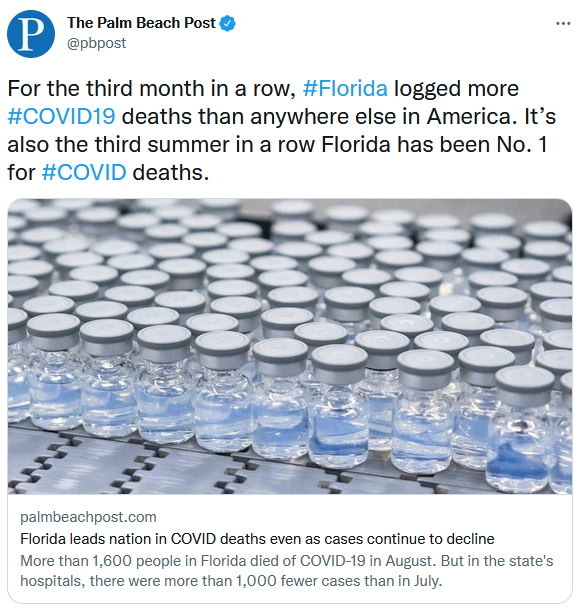
Florida has the highest COVID hospitalization rate in the country. Statewide COVID-19 hospitalizations were 2,536 during the week ending Sept. 2, the most recent date published by the CDC, up from 951 the week ending July 1.

On Wednesday, DeSantis and the surgeon general he appointed, Dr. Joseph Ladapo, responded to the FDA and CDC by recommending people under age 65 not get the new booster. Cohen decried DeSantis and Ladapo’s move. “Public health experts are in broad agreement about these facts, and efforts to undercut vaccine uptake are unfounded and dangerous,” she said in a statement to news organizations.

That leaves Floridians to decide what advice to follow. Among Floridians surveyed last month, 42% said they were very likely to follow vaccine recommendations “by public health officials.” Other findings: somewhat likely, 27%; somewhat unlikely, 17%, and very unlikely, 15%.

There were significant differences based on political affiliation. Among Democrats, 84% said they were or somewhat likely to get the shots, compared to 69% of independents and 53% of Republicans.

The share who don’t plan to get vaccinated is still too high, said Kenneth Goodman, founder and director of the Institute for Bioethics and Health Policy at the University of Miami’s Miller School of Medicine.

“It means more people sick, and it kills more people,” he said. Goodman, who was not involved with the survey, said the views it uncovered showed many people believe false statements about the vaccines would translate into a “higher body count.”

Misinformation

Researchers surveyed Floridians in an attempt to understand the impact of public perceptions of vaccines, given the volume of information floating around “particularly in online/digital spaces.”

Neely’s work in public opinion research has delved into COVID since the early days of the pandemic, including a research about people who have defriended others on Facebook because of their views.

To gauge public beliefs, people were given multiple statements and asked whether they believed the claims. The statements were classified by the CDC as “true” or “false,” but respondents weren’t told what was true or false.

There was widespread agreement with three true statements:

  • COVID-19 vaccines are safe — 71%.
  • Vaccines help prevent the spread of COVID-19 — 69%.
  • Vaccines reduce the risk of dying from COVID-19 — 77%.

Statements classified as “false” by the CDC and percentage of Floridians who believe they are true:

  • Getting sick with COVID-19 builds better immunity than getting a vaccine — 51%.
  • COVID-19 vaccines are causing new variants of the virus to emerge — 42%.
  • COVID-19 vaccines alter your DNA — 26%.
  • COVID-19 vaccines contain a “live strain” of the virus — 49%.
  • Vaccines can cause you to get sick with COVID-19 — 42%.
  • Getting a COVID-19 vaccine will cause you to temporarily test positive for the virus — 42%.

Party affiliation

On almost every question, Republicans are far more skeptical of vaccines than Democrats, significantly more likely to believe in statements that the CDC classifies as false, and less likely to believe statements health authorities say are true.

“Attitudes toward the pandemic remain starkly divided along political lines,” the researchers wrote in a summary of their findings.

For example, Democrats were significantly more willing to receive ongoing vaccine boosters than Republicans (84% to 53%).

And Republicans reported lower levels of trust in COVID guidance from public health officials (47% to 88%) than Democrats.

“Politics shapes perception,” said Charles Zelden, a professor of history and legal studies who specializes in politics and voting at Nova Southeastern University. “And it’s pretty clear in these numbers that Republican perspective on the world leads you down one path and a Democratic perspective leads you down another.”

Zelden wasn’t involved in the survey.

Statements classified as “false” by the CDC and the percentage of Floridians who believe they are true showed the divide:

  • Getting sick with COVID-19 builds better immunity than getting a vaccine — Democrats, 36%; independents, 53%; Republicans, 67%.
  • COVID-19 vaccines are causing new variants of the virus to emerge — Democrats, 31%; independents, 43%; Republicans, 48%.
  • COVID-19 vaccines alter your DNA — Democrats, 16%; independents, 28%; Republicans, 32%.
  • COVID-19 vaccines contain a “live strain” of the virus — Democrats, 36%; independents, 48%; Republicans, 57%.
  • Vaccines can cause you to get sick with COVID-19 — Democrats, 31%; independents, 42%; Republicans, 50%.
  • Getting a COVID-19 vaccine will cause you to temporarily test positive for the virus — Democrats, 36%; independents, 36%; Republicans, 48%.

Development of some vaccines was accelerated by Operation Warp Speed under former President Donald Trump, and political leaders like DeSantis were initially enthusiastic promoters of vaccination.

But as the pandemic was moving into its second year, many Republicans became much more skeptical. DeSantis ultimately emerged as a vaccine skeptic, and he replaced the Florida surgeon general with Ladapo, a vaccine skeptic.

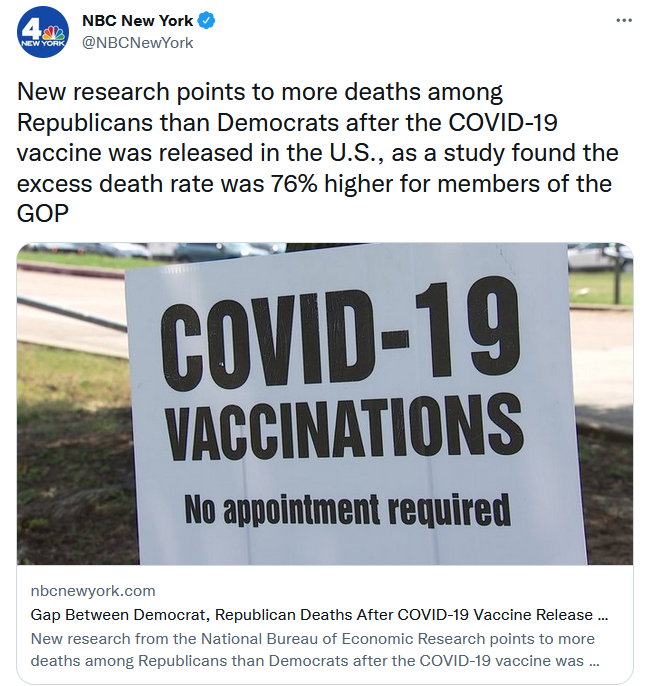
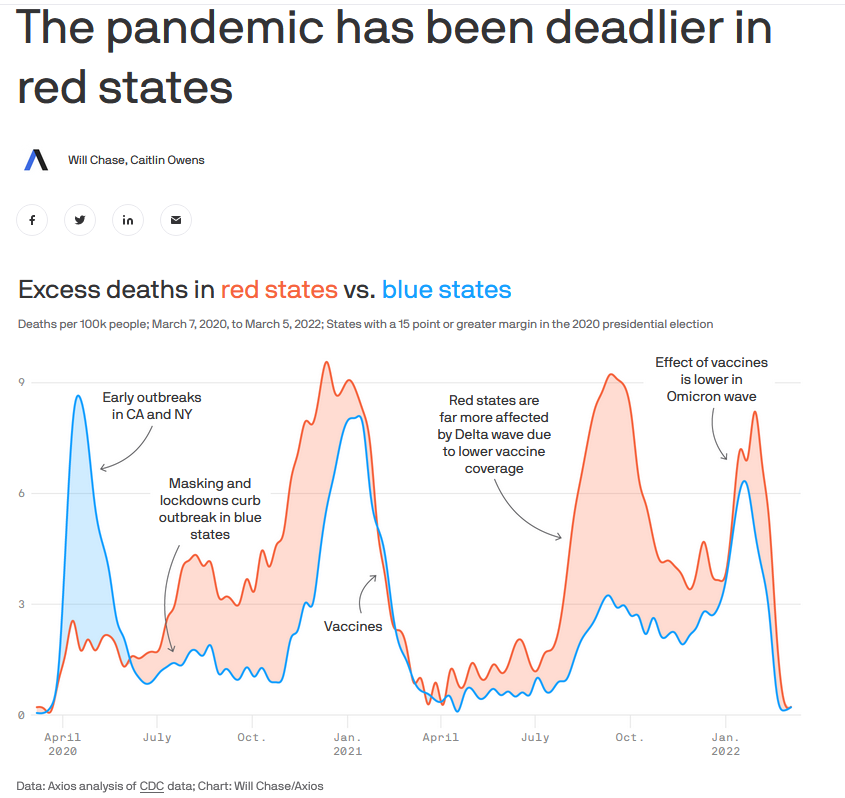
One effect of the partisan divide: Areas in which President Joe Biden performed better than former President Donald Trump in the 2020 election generally had higher vaccination rates. In July, Yale University researchers who studied Florida and Ohio reported in JAMA Internal Medicine that  “excess mortality was significantly higher for Republican voters than Democratic voters after COVID-19 vaccines were available to all adults, but not before.”

In March, Ladapo said that “at this point in the pandemic, I’m not sure anyone should be taking them (vaccines).”

Appearing with DeSantis at a campaign-style event in Sept. 7, Ladapo said there was “no evidence” supporting the new vaccine and asserted there “are a lot of red flags.”

Zelden said the vaccine views reflect an overall shift among many Republicans concerning “attitudes toward government telling you what to do and what not to do, toward expertise. A lot of the culture war positions that the Republicans have challenge existing expertise, because they don’t like what they’re being told. So they question the validity of the underlying science.”

Neely said the survey shows there is no indication that the polarization is easing.

“A lot of us had hoped for a time we could kind of coalesce around a shared scientific understanding,” he said. “Instead, this form of political beliefs around COVID have sort of become a kind of partisan political identity.”


Age, gender

One demographic category stood out: 25- to 44-year-old Floridians.

They had higher beliefs that false information was true — sometimes significantly higher — than other age groups on six of the eight statements considered false by the CDC. In most cases, the belief in the false statements was about 10 percentage points higher among 25- to 44-year-olds than the population as a whole.

Neely said he doesn’t have a good answer for the greater embrace of false information among people aged 25-44. Because it is a large and diverse age group — 25-year-olds are very different from 44-year-olds, Neely said — “it’s a little harder to parse out the meaning.”

He said there may be a lower perceived threat from COVID in that age group “and therefore less urgency to research and talk to your doctor.”

And the oldest group — age 65 and up — had much lower belief in the false claims.

“This is the group that is most at risk for severe COVID illness, the group that is most likely to have spoken to their doctor about a vaccine. They are the least likely to believe in these misinformation themes,” Neel said.

Men and women had almost exactly the same assessments about most of the false statements.

Two exceptions: Men were more likely than women (57% to 45%) to believe getting sick with COVID-19 builds better immunity than getting a vaccine, and women were more likely than men to believe (53% to 45%) that the vaccines contain a “live strain” of the virus.

Microchips

Even before the first vaccines were administered to the public in December 2020, one conspiracy theory was circulating on the internet: that the shots were being used to inject tiny devices allowing people to be tracked.

Many people regarded the notion as a joke and mocked the idea. But it became fairly widespread; a July 2021 YouGov/Economist poll found 20% of Americans said it was definitely or probably true that the U.S. government was using the vaccines to microchip the population. Though 65% said that was definitely or probably false, many public public health organizations and news media outlets debunked the idea.

And it is believed by enough people that it’s refuted by the CDC website: “FACT: COVID-19 vaccines do not contain microchips. Vaccines are developed to fight against disease and are not administered to track your movement.”

Yet the August USF/FAU poll found 14% of Floridians said the claim that the vaccines contain microchips was definitely or possibly true.

“That conspiracy theory has proven more troublesome than we expected at first,” Neely said. “We’re sadly confident that this is the correct number that believe in that particular misinformation theme.”

That’s one area in the survey in which there wasn’t a statistically significant difference between Democrats (12%) and Republicans (13%).

And it was the only false statement included in the survey in which independents had a slightly higher belief (16%) than Republicans. In all other areas, Republicans had a higher percentage of people accepting the misinformation.

There were variations by age, with people aged 25-44 more likely to say the microchip statement was true and people 65 and older far less likely to say it was true.

The microchip belief, broken down by age, was: 18-24 — 17%; 25-44 — 23%; 45-64 — 12%, and 65 and older — 5%.

To Goodman, Neely and Zelden said the overall share of people buying the microchip theory is in line with Americans’ acceptance of all sorts of conspiracy theories.

“This is your basic conspiracy theory,” Zelden said. “That 14% is about the percentage that believe in most conspiracy theories.”

Goodman said “that 14% were out there for other things too: that the moon landing was staged, the world was created 4,000 years ago, and bitcoins are great investment.”

Neely said the result is consistent with previous surveys, and the result is an accurate assessment of Floridians beliefs in the microchip theory — and not a case of people parking the poll by claiming a belief in the microchip theory.

He said it is possible that some people don’t understand what is meant by microchips and so aren’t equating it with the conspiracy theory that microchips are being implanted in people via vaccines so they can be tracked.

Infertility

The survey found 24% of Floridians believe vaccines can cause infertility. The CDC doesn’t state this is false, Neely said, but that there is no evidence in support.

Concerns about fertility have gotten attention since the early days of the vaccine, perhaps most prominently by entertainer Nicki Manaj, who in September 2021 said she wasn’t vaccinated and told her 22.6 million followers on the social media platform then known as Twitter that her cousin’s friend had become impotent after getting the shot.

A wide range of medical experts debunked the assertion. Dr. Ranjith Ramasamy, an associate professor of urology at the University of Miami, wrote at the time that the truth was the opposite of what Minaj said, that the virus that causes COVID — not the vaccine — poses a risk for both erectile dysfunction and male infertility.

Many Floridians believe it does cause infertility.

The survey reported 33% of people aged 25-44 — who are in peak childbearing years — believe the vaccines cause infertility, 9 percentage points higher than the overall population.

Other big believers in the infertility statement: 29% of Republicans and 24% of independents.

Democrats (15%) and people 65 and older (12%) were less likely to believe it.

As with many statements on the survey, there was little difference between men (22%) and women (25%.)

Most say effective

Most Floridians rated the vaccines as effective.

On preventing infection, 71% said they were very or somewhat effective. Among Democrats, 86%; independents, 72%; Republicans, 56%.

On preventing hospitalizations, 79% said they were very or somewhat effective. Among Democrats, 92%; independents, 81%; Republicans, 67%.

On preventing death from COVID-19, 78% said they were effective or somewhat effective. Among Democrats, 91%; independents, 80%; Republicans, 67%.

And most Floridians — 66% — expressed confidence in the COVID guidance provided by the CDC and other public health officials.

Floridians were very confident (31%), somewhat confident (35%), not very confident (18%) and not at all confident (16%).

Very and somewhat confident ranged from 88% among Democrats to 47% among Republicans. As with almost all questions on the survey, independents were in between, at 65%.

Goodman said he’d like to see much more information into people’s COVID and vaccine beliefs, and the behavior it encourages.

“This is no longer politics, this is anthropology. How do you get ordinary people to believe in preposterous things,” Goodman said. “Why are some of the people willing not just to believe, but to embrace the preposterous?”

The fine print

Researchers from the University of South Florida and Florida Atlantic University, sponsored by the Florida Center for Cybersecurity, surveyed 600 Florida adults. The poll was conducted Aug. 10 to 21 using an online survey through market research firm Prodege MR.

The poll has a margin of error of plus or minus 4 percentage points. Because subgroups (such as Democrats and Republicans or men and women) are smaller than in the overall poll, the margins of error are higher for those groups.

Anthony Man can be reached at aman@sunsentinel.com and can be found @browardpolitics on Facebook, Threads.net and Post.news.

Crazy Monsters: Spiders 🕷️ FULL EPISODE | Smithsonian Channel

Anyone who has followed me for a while or seen what I posted on Ark’s blog knows I am terrified of spiders.  Have been from my first memorizes.  But I still like good documentaries, and this goes under know your enemy.  I don’t have a category labeled “scary” but I am thinking I might need one.   Hugs

Meet a family of hairy, scary eight-legged beasts of all shapes and sizes. This bizarre creature showcase is as fascinating as it is frightening, featuring spiders that walk on water, cartwheel across deserts, shoot hairs at predators, and delivery venom 15 times deadlier than a rattlesnake’s.

Fire Ants – Most succesful creature that has ever lived | Full Episode

Horrifying.   I was once working in the yard before I understood what fire ants were when we first moved to Florida.  They swarmed my legs before they started to sting as a group.  That is what they do, the first ant doesn’t sting, they wait until they have a bunch of them when dealing with large prey.    By dogs that love gravy, that is painful.  Ron’s mother had to be hospitalized because of a fire ant attach.  They are nothing to take lightly.  They can kill a fully grown cow because they swarm the prey / threat.  Hugs

Witness one of natures ancient wonders – Fire Ants! It has been adapting, evolving for 150 million years 14 000 species they are nearly everywhere thriving. This is the story of solenopsis Invicta for 80 years it has been on a ceaseless march across the United States racking up six billion dollars every year in crop damage equipment repair and Pest Control conquering 340 million acres in 13 states and it’s still on the Move globally now scientists are cracking their ancient secrets to success and survival we knew that we could speculate all day but to fully understand the ants we decided to bring them into the lab and obtain visual data.

To My Republican Countrymen… | Armageddon Update | Christopher Titus

Jon Stewart GOES OFF On Right Wing Grifter | Hasanabi reacts

Jon Stewart confronts Republican Senator Nathan Dahm on the insane record of dead children due to gun violence and the lack of gun control in America in general.

Man Who Charged BLM Protesters Wearing Glove With Serrated Blades Guilty On 9 Attempted Murder Counts

The goal for these gang thugs is to make everyone afraid to protest the abuses, to make the treat of violence and harm so great people stop putting up supportive signs or speaking out.  And it has worked in a lot of cases, with venues cancelling events.  Horrible way the country is going.  Hugs