Hi Everyone. I woke at 12:22 last night. But I got up at 1 am and started making posts and doing things. So I just finished the asshat yesterday news posts. So now before I answer the comments … and I love comments everyone sends to me, I have to make a red sauce. Ron promised to make me a grand lasagna if I make the sauce. So with ear buds in, off I go to make the sauce. Hugs and loves to everyone. Remember that I really care for everyone. Add any questions or comments in the comments and I will reply there. Hugs.
If you criticize the dear leader of the maga cult then you are forever an enemy. Death to the nonbelievers. This is why the current republicans and maga is very much a cult. Hugs.
This is great. The tRump world crowed about this citizen of Greenland who praised tRump’s plan to take over Greenland. Yet the truth did come out … He was a tRump loving fanboy violent felon drug dealer prison escapee. Hugs.
Please notice the part of the story that talks about Robby Starbuck, if you don’t know of him clicking on his blue highlighted name leads to another story of how he coerced John Deere. McDonald’s claims they are doing this because of the SCOTUS actions on school admissions, but sorry they are not colleges or universities. They are a private business and have the right to set their own no discrimination goals and policies. By blaming the court ruling they are trying to divert attention from the real reason.
Back to Robby Starbuck, This sub human pond scum is winning because he uses threats of hurting the profit of these companies. Now maybe the shareholders are predetermined to be racist bigots. But if we want this coercion to stop, we must be as loud, willing to band together, and use our money even when it hurts. So far only one company has stood against him and Stephen Miller’s white power legal company. We must rise up as we once did, make the haters ashamed again like we did over 1970s to 1990s. We can retire meekly to our self-imposed prisons of our homes and acting straight or cis, but that will only encourage them. This is how it went down in Russia and the Russian controlled influenced nations. The maga cultist and fundamentalist Christian bigots are following the Putin playbook in lockstep. We have to show them the playbook won’t work here. And trust me it is easier to do now than in a future where they have removed all sign of the LGBTQ+ people from society. Hugs
Four years after launching a push for more diversity in its ranks, McDonald’s is ending some of its diversity practices, citing a U.S. Supreme Court decision that outlawed affirmative action in college admissions.
McDonald’s is the latest big company to shift its tactics in the wake of the 2023 ruling and a conservative backlash against diversity, equity and inclusion programs. Walmart, John Deere, Harley-Davidson and others rolled back their DEI initiatives last year.
McDonald’s said Monday it will retire specific goals for achieving diversity at senior leadership levels. It also intends to end a program that encourages its suppliers to develop diversity training and to increase the number of minority group members represented within their own leadership ranks.
McDonald’s said it will also pause “external surveys.” The burger giant didn’t elaborate, but several other companies, including Lowe’s and Ford Motor Co., suspended their participation in an annual survey by the Human Rights Campaign that measures workplace inclusion for LGBTQ+ employees.
McDonald’s, which has its headquarters in Chicago, rolled out a series of diversity initiatives in 2021 after a spate of sexual harassment lawsuits filed by employees and a lawsuit alleging discrimination brought by a group of Black former McDonald’s franchise owners
“As a world-leading brand that considers inclusion one of our core values, we will accept nothing less than real, measurable progress in our efforts to lead with empathy, treat people with dignity and respect, and seek out diverse points of view to drive better decision-making,” McDonald’s Chairman and CEO Chris Kempczinski wrote in a LinkedIn post at the time.
But McDonald’s said Monday that the “shifting legal landscape” after the Supreme Court decision and the actions of other corporations caused it to take a hard look at its own policies.
A shifting political landscape may also have played a role. President-elect Donald Trump is a vocal opponent of diversity, equity and inclusion programs. Trump tapped Stephen Miller, a former adviser who leads a group called America First Legal that has aggressively challenged corporate DEI policies,as his incoming deputy chief of policy.
Vice President-elect JD Vance introduced a bill in the Senate last summer to end such programs in the federal government.
Robby Starbuck, a conservative political commentator who has threatened consumer boycotts of prominent consumer brands that don’t retreat from their diversity programs, said Monday on X that he recently told McDonald’s he would be doing a story on its “woke policies.”
McDonald’s said it had been considering updates to its policies for several months and planned to time the announcement to the start of this year.
In an open letter to employees and franchisees, McDonald’s senior leadership team said it remains committed to inclusion and believes a diverse workforce is a competitive advantage. The company said 30% of its U.S. leaders are members of underrepresented groups, up from 29% in 2021. McDonald’s previously committed to reaching 35% by the end of this year.
McDonald’s said it has achieved one of the goals it announced in 2021: gender pay equity at all levels of the company. It also said it met three years early a goal of having 25% of total supplier spending go to diverse-owned businesses.
McDonald’s said it would continue to support efforts that ensure a diverse base of employees, suppliers and franchisees, but its diversity team will now be referred to as the Global Inclusion Team. The company said it would also continue to report its demographic information.
The McDonald’s Hispanic Owner-Operators Association said it had no comment on the policy change Monday. A message seeking comment was left with the National Black McDonald’s Operators Association.
Durbin is an Associated Press business writer focusing on the food and beverage industry. She has also covered the auto industry and state and national politics in her nearly 30-year career with the AP.
This person was not fired for his religious beliefs. He was fired for pushing his beliefs on others and doing something at work on work property that their employer told them not to do. How many of us get to disregard the orders of our bosses and when fired claim it was because of ours religious beliefs?
But this is entirely about getting the case to the SCOTUS to move the US a little closer to making Christianity the official religion of the country, and cementing into law that Christians do not have to follow the non-discrimination laws due to being Christians, so above such laws. It is about making Christians above any law or rule because of … god, because you can make the bible say anything you desire. It is about making it legal for Christians to push their religious beliefs on coworkers while insulting and refusing to work with those they claim their god dislikes. And forcing the employer to make special concessions to them again based on what they claim their holy book says and it is only their holy book that counts. Hugs.
Eli Lilly & Co. has been hit with a suit claiming it fired a New Jersey drug sales representative for holding a biblically based view on sexual morality. In a case that pits an employee’s right to religious expression against the company’s support of its LGBTQ+ workers, plaintiff Jonathan Samaniego claims he was terminated based on his religious views, in violation of Title VII and New Jersey’s Law Against Discrimination.
In Samaniego v. Eli Lilly & Co., the plaintiff began posting scripture passages during a discussion of Pride Month on the company’s in-house employee communication system, Yammer.
On June 14, 2024, Samaniego’s manager, Jacqueline Porter, posted a lengthy message about Pride Month on Yammer, according to the lawsuit. According to Samaniego’s suit, the plaintiff prayed about how to respond to Porter’s Pride Month posting, then made his own post to Yammer from the book of Leviticus, which said, “You shall not sleep with a male as a with a woman. It is an abomination.”
According to the report, Samaniego was called into HR and told to refrain from such future postings on the company’s system.
However, days later he reportedly posted anti-gay bible verses again, including this from Corinthians: “Do you know that wrongdoers will not inherit the kingdom of God? Do not be deceived: Neither the sexually immoral nor idolaters nor adulterers nor men who have sex with men nor thieves nor the greedy nor drunkards nor slanderers nor swindlers will inherit the kingdom of God.”
After refusing to sign a directive agreeing to stop the postings, he was then terminated, per the report.
Samaniego is being represented by the Pacific Legal Foundation, which appeared here in 2022 when they sued to block LGBTQ-related questions from the US Census.
The group first appeared on JMG in 2010 when they sued then-California Gov. Arnold Schwarzenegger in an attempt to force him to defend Proposition 8 in federal court.
In 2012, they attempted to force a California state referendum that would have banned mentioning LGBTQ figures in history lessons.
Also in 2012, they attempted to sanction DOJ attorneys for opposing the Defense of Marriage Act.
The group has repeatedly sued to overturn state bans on ex-gay torture, claiming that 80% of ex-gay “conversions” are successful.
In 2019 they sued California to end sexual education and HIV prevention instructions in public schools.
The Pacific Justice Institute, their parent organization, was named a hate group by the SPLC in 2014.
Since the advent of the pandemic, the group has also filed multiple lawsuits against COVID protocols and vaccine mandates.
“…fired …for holding a biblically based view on sexual morality…”
No, you have the right to hold any view you choose. You were fired for spreading it around on company media, which you mistakenly thought was a pulpit. Your religious beliefs are YOUR beliefs, just yours.
The company has a right to its policies, seriously, it’s right there in virtually every employee handbook of the majority of companies. You used company property to push your cult bullshit, thus committing acts of discrimination, they warned you and you chose to violate the policy again.
Also, this is in no way a Title VII violation of your rights as you had been told, via the company, that you were violating their employee guidelines and non-discrimination policy that they set. The irony of you suing for doing what you claim they did to you is hilarious. This should be laughed out of court, but in present day USA, anything religious takes priority, even over other human rights.
We in the US need to have the same hope and constant drive as the LGBTQ+ in Poland. See their government is anti-LGBTQ+ and the leader calls them “evil”. But they did not give up and kept working to change the hearts and minds of the people. And it is working. We need to do the same. Hugs.
————————————————————————————————————–
The proposed legislation still has a long way to go, but advocates are optimistic.
June 10, 2018: Warsaw’s LGBTQ pride equality march
Poland made a landmark move for LGBTQ+ rights after it banned hate speech against sexual orientation and gender in a new set of regulations.
Currently, the country’s laws prohibit hate speech on the basis of race, religion, and ethnicity. “These provisions do not provide sufficient protection for all minority groups who are particularly vulnerable to discrimination, prejudice and violence,” the national justice ministry said.
After years of government persecution, the move was unprecedented.
“The new regulations aim to more fully implement the constitutional prohibition of discrimination and to meet international recommendations on standards of protection against hate speech and hate crimes,” the ministry added.
The United Nations Human Rights Council has previously criticized the country’s lack of hate crime protections for LGBTQ+ individuals.
Prime Minister Donald Tusk approved the new legislation. It now moves on to Parliament. If Parliament passes it, President Andrzej Duda will have the option to sign it into law or pass it. He has previously stated that he believes LGBTQ+ individuals are “evil.”
However, Duda’s final presidential term ends next year, and the ruling party hopes they can get someone to replace him in time to sign the legislation into law.
Bart Straszewski, an LGBTQ+ activist in Poland, told PinkNews, “I felt like a second-category citizen, and we were treated like second-category citizens. The government is telling you that you don’t deserve equal rights, that you are not creating families, and that you are an agent of the West trying to fight family values or tradition.
“The atmosphere was hostile. We felt that they didn’t want us here, but we still were here, we still were fighting for our country because we are part of it,” Straszewski added.
Poland previously has not been friendly to LGBTQ+ rights. During the Law and Justice (PiS) party’s time in power, the country became one of the most viciously anti-LGBTQ+ countries in Europe. Cities designated themselves “LGBT-free” zones and government-run media outlets regularly demonized and spread lies about the queer community. Gay reporters were fired from publications as part of the national purge.
However, advocates have been working tirelessly to grant protections for LGBTQ+ individuals. A TV anchor apologized this year for his past anti-LGBTQ+ statements and came out in support of the community. Activists also rejoiced when the Polish Supreme Court ruled that same-sex marriage is not illegal, per Poland’s Constitution.
Subscribe to the LGBTQ Nation newsletter and be the first to know about the latest headlines shaping LGBTQ+ communities worldwide.
Don’t forget to share:
Good News is your section for queer joy! Subscribe to our newsletter to get the most positive and fun stories from the site delivered to your inbox every weekend. Send us your suggestions for uplifiting and inspiring stories.
January 3, 1961 A nuclear reactor exploded at the National Reactor Testing Station in Idaho Falls, Idaho, killing three military technicians, and released radioactivity which, in the words of John A. McCone, Director of the Atomic Energy Commission, was “largely confined” to the reactor building. One technician was blown to the ceiling of the containment dome and impaled on a control rod. His body remained there until it was taken down six days later. The men were so heavily exposed to radiation that their hands and heads had to be buried separately with other radioactive waste. ===================================================== January 3, 1967 Carl Wilson Carl Wilson of the the Beach Boys was indicted for draft evasion. Claiming conscientious objector status, he eventually won his battle against the charges. ===================================================== January 3, 1971 On her first day as a member of Congress, Bella Abzug (D-New York) introduced a resolution calling for the withdrawal of troops from Southeast Asia. Bella Abzug Born in the Bronx in 1920, one month after the passage of the U.S. Constitution’s 19th amendment granting women the right to vote, she was the first Jewish woman elected to Congress. After attending Columbia University Law School, she practiced civil rights and labor law for twenty-three years. Throughout her career, she was known as one of the most vocal proponents of civil rights for women, as well as for gays and lesbians. Background on the indomitable Bella ======================================================= January 3, 1993 The United States of America and the Russian Federation agreed to cut the number of their nuclear warheads to between 3,000 and 3,500 (nearly half).U.S. President George H.W. Bush, just before leaving office, and his Russian counterpart, Boris Yeltsin, signed the second Strategic Arms Reduction Treaty – Start II – in Moscow. Start II marked the biggest reduction in nuclear arms ever agreed, eliminating land-based multiple warhead missiles, and putting limits on submarine-based missiles. Read more ======================================================= January 3, 2003 Brazil’s new leftist president, Luiz Inacio Lula da Silva, suspended purchase of 12 new fighter planes, saying money could be better used to relieve hunger. More about Luiz Inacio
Greater pipefish, Syngnathus acus 54, and Sargassum pipefish, Syngnathus pelagicus 55,56. Handcolored copperplate engraving from Gottlieb Tobias Wilhelm’s Encyclopedia of Natural History: Fish, Augsburg, 1804. Wilhelm (1758-1811) was a Bavarian clergyman and naturalist known as the German Buffon. (Photo by: Florilegius/Universal Images Group via Getty Images)
A new study out of the University of Canterbury in Christchurch, New Zealand has called into question traditional perceptions of mating.
“In most species, males compete to attract females. But with pipefish, the males carry and protect the embryos,” says PhD student Nicole Tosto, who led the research.
“Pipefish are unique because they don’t follow the usual ‘rules’ of evolution.”
The research highlights how biological differences in male and female pipefish influence their survival and mating habits.
While females have genes to support egg production, males activate genes to strengthen their immune system.
This is a key adaptation that allows the males to nurture and care for embryos in their bodies.
The study, published in Molecular Ecology, also uncovered how this switch in activated genes impacts mating selection.
In most species, females prefer larger, dominant males as mates because it often increases their chance of having healthy offspring, as the strong male can provide security and defence from predators.
Instead, the study found that female pipefish swim against this trend and tend to choose smaller males with high fitness levels.
Tosto suggests that this selection is based on efficiency as smaller males may need fewer resources.
Robust Ghost Pipefish, Solenostomus cyanopterus, Bali, Indonesia (Photo by Reinhard Dirscherl\ullstein bild via Getty Images)
She also believes smaller males could be better suited for the synchronised water movements that are a part of the species’ courtship rituals.
In many animals, males and females of the same species can have physical features that are different between the sexes and are often used to attract mates. These visible traits are known as sex-specific ornaments.
However, the pipefish species involved in the study were monomorphic, meaning that male and female pipefish looked almost identical and had no visible differences.
“Nicole’s research has brought up important questions for evolutionary biologists when it comes to current vs past selection,” says her doctoral supervisor, Dr Sarah Flanagan, a senior lecturer in Biological Science at the University of Canterbury.
Natural selection is a process where individuals with traits that help them survive become more likely to reproduce and therefore pass on those traits to their offspring. Overtime these advantageous traits become more commonly inherited among the species.
“For example, whether the existence of sex-specific ornamentation is evidence that selection is currently acting strongly on those sex-specific traits or whether ornaments are evidence of selection having happened in the past.”
Pipefish don’t have sex chromosomes meaning both sexes share the same genetic blueprint, they just use the genes in different ways.
For example, females focus on producing egg-enhancing proteins, whereas males produce immune-boosting proteins for pregnancy.
“Knowing how these pressures shape mating systems helps us better understand how species survive and adapt to their environments,” says Tosto.
While there is no current extinction concern for dusky pipefish (Syngnathus floridae), the species of pipefish investigated in the study, other pipefish species such as the estuarine pipefish are critically endangered.
This is good news and shows why so many are moving into California and out of places like Florida. Students should feel free from fear while learning. They also should feel free to be their authentic self in a supportive atmosphere. School is a time to learn about the world, other people, subjects, and about one’s self. And not all kids have safe supportive homes. Hugs.
———————————————————————————————————–
Miguel Gutierrez Jr.
/
CalMatters
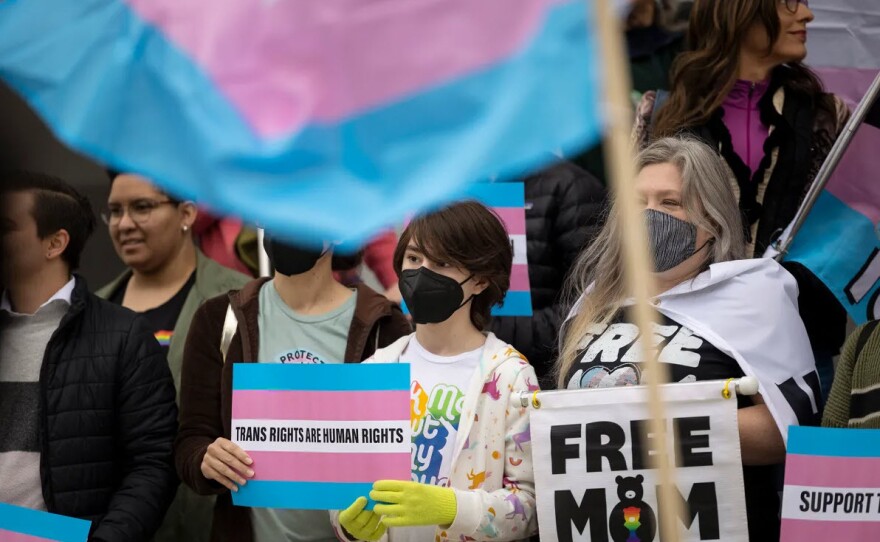
Supporters of transgender rights gathered at the Capitol during a press conference on March 17, 2022.
Amid a flurry of recent school board policies aimed at the rights of transgender students, California passed a new law in July that prevents schools from requiring staff to notify parents if a student identifies as LGBTQ.
“Teachers can still talk to their parents,” Gov. Gavin Newsom said at a press conference on Monday in which he touted a new plan to improve career opportunities for adults. “What they can’t do is fire a teacher for not being a snitch. I don’t think teachers should be gender police.”
LGBTQ advocates said that “forced outing” policies, such as those adopted in Chino, Temecula and a dozen other districts, infringe on students’ privacy and could potentially harm students whose parents disapprove of their identity.
The state sued to stop Chino’s policy, and most districts either scrapped their policies, tweaked the language or put them on hold.
This act “could not be more timely or necessary, and LGBTQ+ students across California can breathe a sigh of relief,” Tony Hoang, executive director of Equality California, which advocates for LGBTQ rights, wrote. “LGBTQ+ youth can now have these important family conversations when they are ready and in ways that strengthen the relationship between parent and child, not as a result of extremist politicians intruding into the parent-child relationship.”
‘The battle continues’
Opponents of the new law said that parental notification policies actually strengthen ties between students and parents, and schools should not withhold information on such important matters. Even though a parental notification measure that would have applied to all schools failed to qualify for the ballot, opponents vowed to keep fighting.
“This (law) doesn’t clarify anything. And nothing prevents individual teachers from bringing the issue up with parents,” said Roseville school board member Jonathan Zachreson, an organizer of the failed ballot measure and whose district was among those that passed parental notification policies. “So the battle continues.”
The new law also requires the state Department of Education to update its LGBTQ resources and encourage school districts to offer counseling, support groups, clubs, anti-bullying policies and other measures to support LGBTQ students and their families. Schools would have to pay for those services with their existing funding.
“I don’t think teachers should be gender police.”
Gov. Gavin Newsom
LGBTQ young people are particularly vulnerable on school campuses. In a recent survey of 18,000 LGBTQ young people nationwide, nearly half said they had been bullied in the past year, and 10% said they had attempted suicide. Those whose schools supported LGBTQ rights were less likely to suffer from mental health challenges.
Even if the new law sparks a backlash in more conservative areas of the state, California was right to move forward with it, especially as some states push ahead with their own parental notification policies, said USC education professor Morgan Polikoff.
“Will everyone like this law? Certainly not. Will it lead to conflict? There is no doubt,” Polikoff said. “But I am hopeful this will be good for the queer kids in California’s schools and will point the way toward similar efforts in other states.”
CalMatters’ Adam Echelman contributed to this story.
Finally a company showing how to stand up to the bigot racist and calling out the real reasons these groups are demanding these changes. I hope the shareholders stand firm on inclusion and diversity. Hugs
The Costco Board pushed back against its anti-diversity, equity and inclusion (DEI) shareholders, who had suggested the wholesale corporation re-evaluate its “illegal discrimination” program.
The Costco board responded to a group of shareholders, unanimously recommending a vote against the proposal to “report on the risks of maintaining DEI efforts.”
The shareholders had suggested Costco employees would potentially become victim to “illegal discrimination because they are white, Asian, male or straight,” which could create “tens of billions of dollars” in legal costs to the company.
In its response to the proposal, Costco called out the group for “inflicting burdens” on companies through “policy bias” and said their proposal did not aim to address financial risks but to strike down DEI efforts.
“The proponent’s broader agenda is not reducing risk for the Company but abolition of diversity initiatives,” the board of directors added.
The annual meeting where shareholders will vote on the matter will take place in late January. Earlier this year, Lowe’s, Harley Davidson and Walmart announced the repeal of DEI practices after facing similar pushback from conservative groups.





 Greater pipefish, Syngnathus acus 54, and Sargassum pipefish, Syngnathus pelagicus 55,56. Handcolored copperplate engraving from Gottlieb Tobias Wilhelm’s Encyclopedia of Natural History: Fish, Augsburg, 1804. Wilhelm (1758-1811) was a Bavarian clergyman and naturalist known as the German Buffon. (Photo by: Florilegius/Universal Images Group via Getty Images)