Gotham FC, Orlando Pride, the National Women’s Soccer League (NWSL), and the NWSL Players’ Association are addressing “hateful language” aimed at Orlando Pride forward Barbra Banda during Sunday’s match between the two teams.
Banda, who is from Zambia, and plays on their national team, joined the Orlando Pride in 2024. This instance of alleged harassment comes months after she became the target of anti-intersex and anti-trans online bullying after she was named BBC’s Women’s Footballer of the Year last November. Shortly after the BBC’s announcement, anti-trans critics in the U.K. — including J.K. Rowling — began spreading a conspiracy that Banda, a cis woman, was secretly a “man” masquerading within the world of women’s sports. Much of this “transvestigation” stemmed from a 2022 incident in which Banda was prohibited from competing in the Women’s Africa Cup of Nations (WAFCON) because a “sex verification” test found that her testosterone levels were allegedly determined to be above what the organization had deemed a “normal” amount.
Sources familiar with the controversy told the AP in 2023 that mismanagement within the Council of African Football (CAF) and FIFA, the international governing body of soccer, was to blame for the situation rather than Banda herself, and WAFCON organizers reportedly don’t have a maximum testosterone level at all. Nevertheless, Banda has faced unfounded anti-trans vitriol over the past several months — including “hateful language” during the Orlando Pride’s March 23 match against Gotham at Gotham’s home field, the Sports Illustrated Stadium.
Reddit user @mitzibitsy claimed to be present at the game and to have witnessed the harassment in a March 24 Reddit post. “One fan got pulled aside by security after he cheered for Banda falling down and yelled, ‘She shouldn’t be on the field anyway!’” they wrote. “I was satisfied to see security speak to him, but all he got was a warning. In the meantime, this really ruined the game for me, and made me feel really unsafe in my season ticket seat going forward.”
Advocates have noted that attacks on athletes’ womanhood put women athletes at risk of violence, particularly women of color such as Banda and Algerian boxer Imane Khelif.
The Orlando Pride, Gotham FC, and the NWSL all spoke out against the incident in a series of March 24 social media statements.
“This behavior is unacceptable and has no place in our league or in our stadiums,” the Orlando Pride’s statement reads. “Barbra is an outstanding role model and an influential advocate for soccer both in Africa and here in the United States. We look forward to continuing to celebrate and support her on and off the pitch.”
The Pride added that “as a club, the Pride will collaborate with the NWSL and with Gotham to ensure that the proper action is taken to hold individuals accountable when violating the league’s standards.”
Gotham FC’s statement noted that “Gotham and the NWSL are working together to further investigate the incident and take additional action where appropriate under the league’s Fan Code of Conduct.”
The league’s Fan Code of Conduct states that “fans are strictly prohibited from using threatening, abusive, or discriminatory words, signs, symbols, or actions based on race, ethnicity, sex, gender, gender identity, sexual orientation, cultural identity, nationality, citizenship status, age, appearance, disability, and/or religion.”
Fans who violate the NWSL Fan Code of Conduct are subject to penalties such as loss of ticket privileges for future games, ejection without refund, and revocation of season tickets. According to the New York Times, Gotham FC is reviewing footage of the March 23 incident using stadium security logs, and the team has spoken to Reddit user @mitzibitsy about what they witnessed.
The NWSL’s statement reaffirmed that “we are committed to ensuring that our venues are safe and respectful environments for all — especially for the athletes who represent the very best of our sport.”
J.K. Rowling delusionally described the win by the cis, Zambian athlete as the BBC attempting to “spit directly in women’s faces.”
“Barba Banda is both an exceptional player and person, and the NWSL is immensely proud to support her as a member of our league,” the league’s statement continued.
In a statement of their own, the NWSL Players’ Association emphasized that “there is no place for harassment or abuse in our sport, and we support efforts to address this incident swiftly and responsibly.”
“Soccer is built on principles of fairness, inclusion, and respect for human dignity,” the statement continued. “Any form of hateful conduct undermines these values and has no place in our fandom. Barbra Banda is a generational talent, and we are fortunate to witness her compete at the highest level.”
During a March 14 appearance on NPR’s All Things Considered, NWSL commissioner Jessica Berman said that the league has been working for the past few months to find a “technology partner who could help us to monitor all of the social media hate that many [players] are targets of.”
“There were a lot of lessons learned, both about things that we could have done better to support [Banda last year], internally and externally,” Berman continued. “[…] Hopefully, we’ll be in a better position to respond quickly if that happens again in the future.”
It’s one of the Tabs on Wonkette this AM. I have a soft spot for Chicago for reasons, and was just interested because it’s not topical, and now I’m sharing it here because maybe we could all pool our money and buy this place for us and our allies! Actually, I’m sharing it because it’s different and interesting to look at. Take a look, and dream a little!
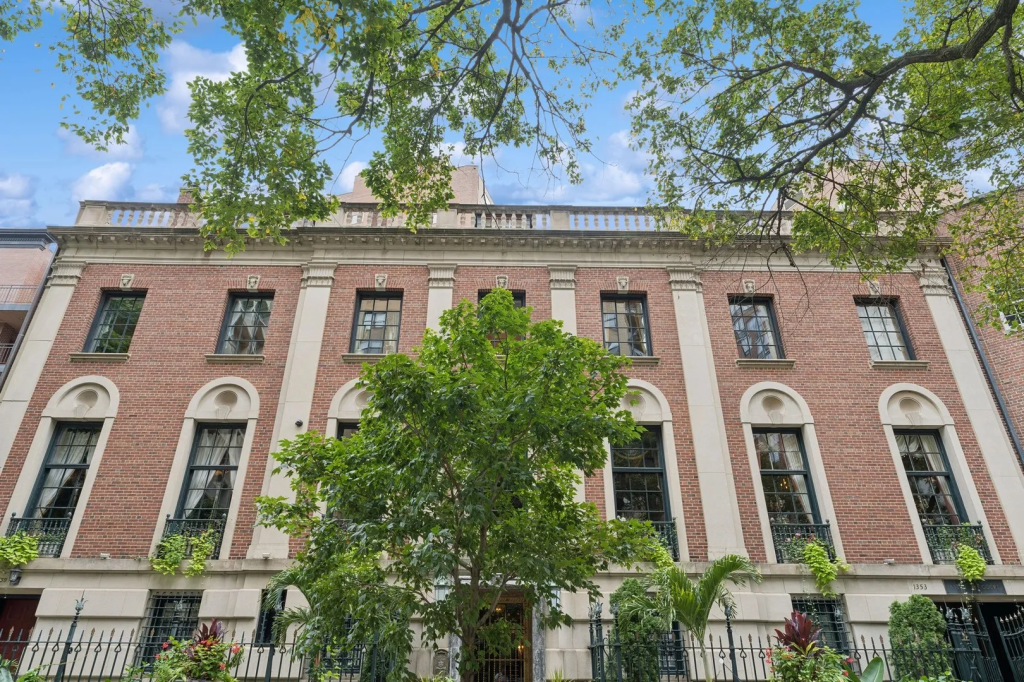
Once-in-a-life time opportunity to own one of Chicago’s iconic estates, showcasing over 25,000 Sq. Ft. of combined living spaces and situated on nearly a third of an acre on Gold Coast’s most coveted Astor street. This palatial architectural masterpiece designed by Howard Van Doren Shaw for the Goodman Family graces the market for the first time in 40 years, promising to leave you speechless. A true hallmark of Chicago’s rich history, Astor Court has long captivated passersby with its magnificent neo-classical/Georgian Revival architecture spanning an impressive 80′ feet across. This distinguished estate is centered around a one-of-a-kind tremendous courtyard, meticulously landscaped with lush gardens and flowing fountains, transporting you to the tranquil Italian countryside, creating a peaceful sanctuary in the vibrant urban setting. The main residence of the estate features over 10,000 sq. ft. of exquisitely renovated grand spaces blending timeless elegance with modern luxury. No expense was spared in creating this treasure, presenting a rare opportunity to own a coveted piece of Chicago’s history. Every inch of the home exudes sophistication and grandeur offering unparalleled living experience featuring 13′ ceilings, venetian plaster walls, incredible intricate millwork and hardwood oak flooring throughout, fireplaces with magnificent original marble mantles, and gold plated fixtures. As you enter the home, you are immediately captivated by the grand sense of space, elegant design and a sweeping curved staircase that ascends to the expansive main living areas. Every room exudes scale and sophistication offering both beauty and functionality. There are five en-suite bedrooms, each with its own style and personality. The luxurious primary suite features beautiful lake views and a grand primary spa bath adorned with exquisite Italian marble. In addition to the main residence, Astor Court showcases six gorgeous unique rental units, each with its own distinct charm and character, generating significant income. The entire estate encompasses 45 rooms, 16 bedrooms, 17 baths and 18 fireplaces offering endless opportunities to expand the main residence or transform it into a sprawling multi-generational family compound. Currently, there are two parking spaces located directly behind the property with the option to convert the coach house into a garage for additional parking. This extraordinary estate is perfectly situated just steps from Michigan Avenue, the lakefront, parks, premier shops, favorite restaurants, and world-class entertainment.
Request a tour as early as Today at 12:30PMSchedule TourRequest Info
Home Highlights
Parking Open Parking Outdoor Patio A/C Heating & Cooling
During the same week as the president’s address to Congress, RepresentWomen held our annual Democracy Solutions Summit (DSS). This solutions-oriented event allowed us to imagine what our democracy could look like with better policies and better representation.
Here, women leaders, elected officials, advocates and experts discussed the problems facing our democracy and uplifted actionable solutions to improve women’s representation and strengthen our democracy overall. This year’s summit addressed the critical need for more women in local, state and federal leadership roles.
The Democracy Solutions Summit clearly contrasts with the uncertainty of Trump’s address to Congress. The DSS is the only democracy summit featuring only women speakers and panelists committed to actionable, data-driven solutions and building coalitions that bolster American democracy at this critical time. Furthermore, our research has found that when multiple structural solutions are combined, we can bolster women’s representation in every level of government.
Complete recordings of the summit are available online, but here is a quick recap of all three days. (snip-More)
Sam and Emma in the fun half. Normally there is only two ways to watch the fun half. You can be a member which they admit that some people can not afford which they have a way to get free membership if you need it. Or you can catch the first half while it is playing live and in the description box will be a link to the free fun half. If you click on that you can watch the entire thing. If you save it like I do for later you can go back and watch it at any time because if you don’t the link will disappear so you can’t see it. They make the second half private. Hugs
Watch the Majority Report live Monday–Friday at 12 p.m. EST on YouTube OR listen via daily podcast at http://www.Majority.FM …OR become a member at JoinTheMajorityReport.com: https://fans.fm/majority/join
BEHOLD! Gay Republicans are finding out they cannot wear the red hat of hatred in LGBTQ+ nightclubs.
1. Gay Bar Bans Bigots
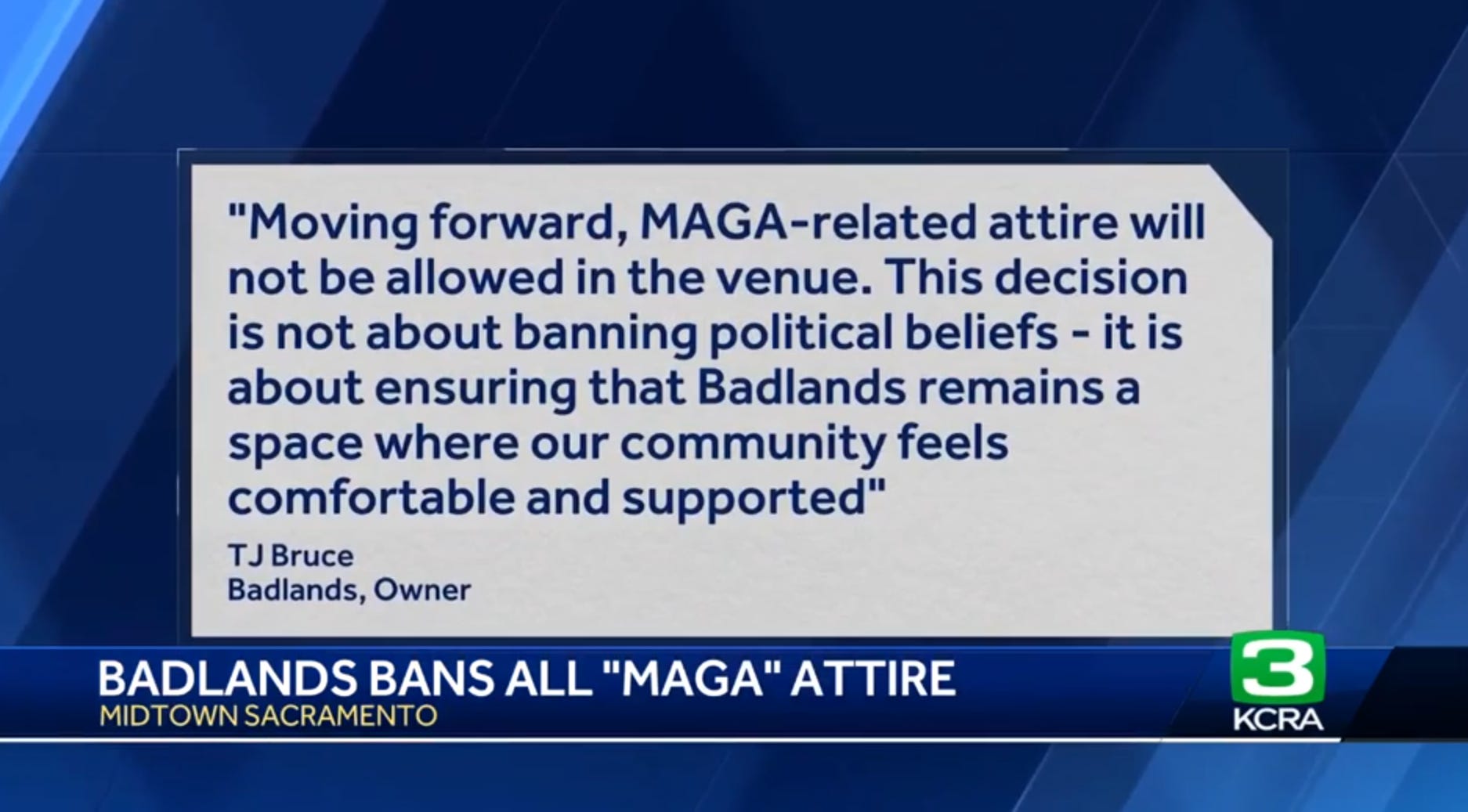
Last week, Badlands, a beloved LGBTQ+ nightclub in Sacramento, posted this heavenly announcement:
“Moving forward, MAGA-related attire will not be allowed in the venue. This decision is not about banning political beliefs — it is about ensuring that Badlands remains a space where our community feels comfortable and supported.”
That’s not censorship. That’s community care. And this is not the first bar to make the news for banning MAGA, either. Last week a bar in Indianapolis went viral for kicking out one of these bigots.
2. “What the Heck? Let’s See What Happens”
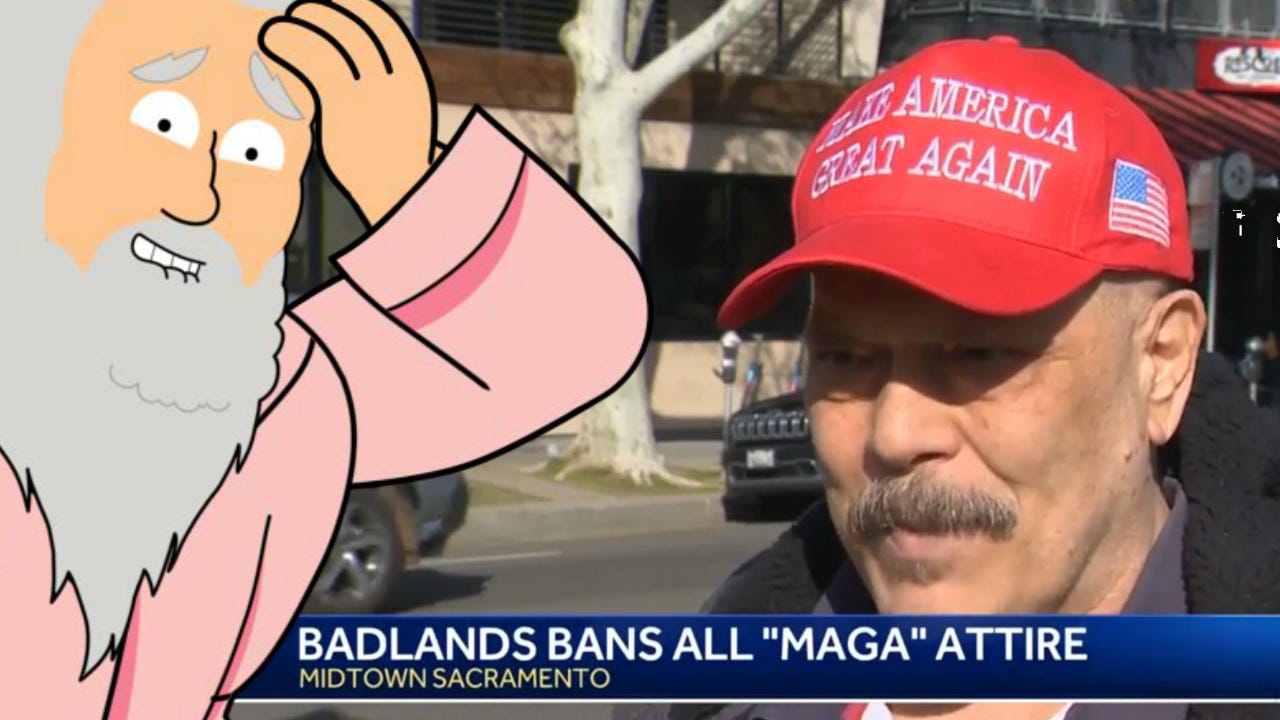
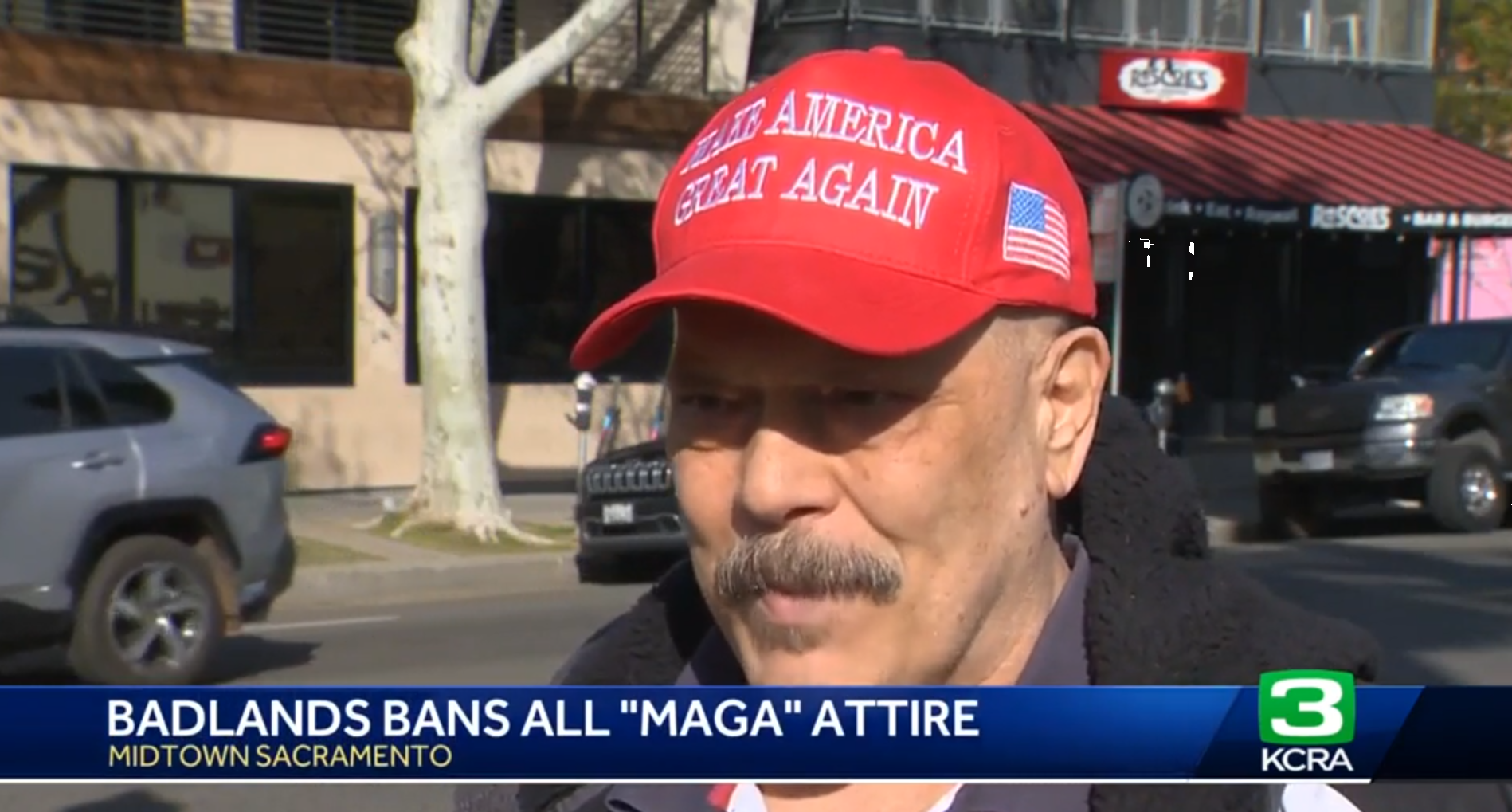
Steven Bourassa, the idiotic Trump supporter whose actions inspired the bar to make the change, told local news station KCRA:
“I’ve never worn a red [Make America Great Again] hat to the gay bars before. I said, ‘What the heck? Let’s see what happens.’ We were having drinks and hanging out, and it was a pleasant time. So I was really impressed. And I complimented security on the good job they did.”
What didst this imbecile think wouldst happen?!?
This is not a prank show. This is real life. And you’re not the main character.
Steven Bourassa.
3. “It’s About Bullying”
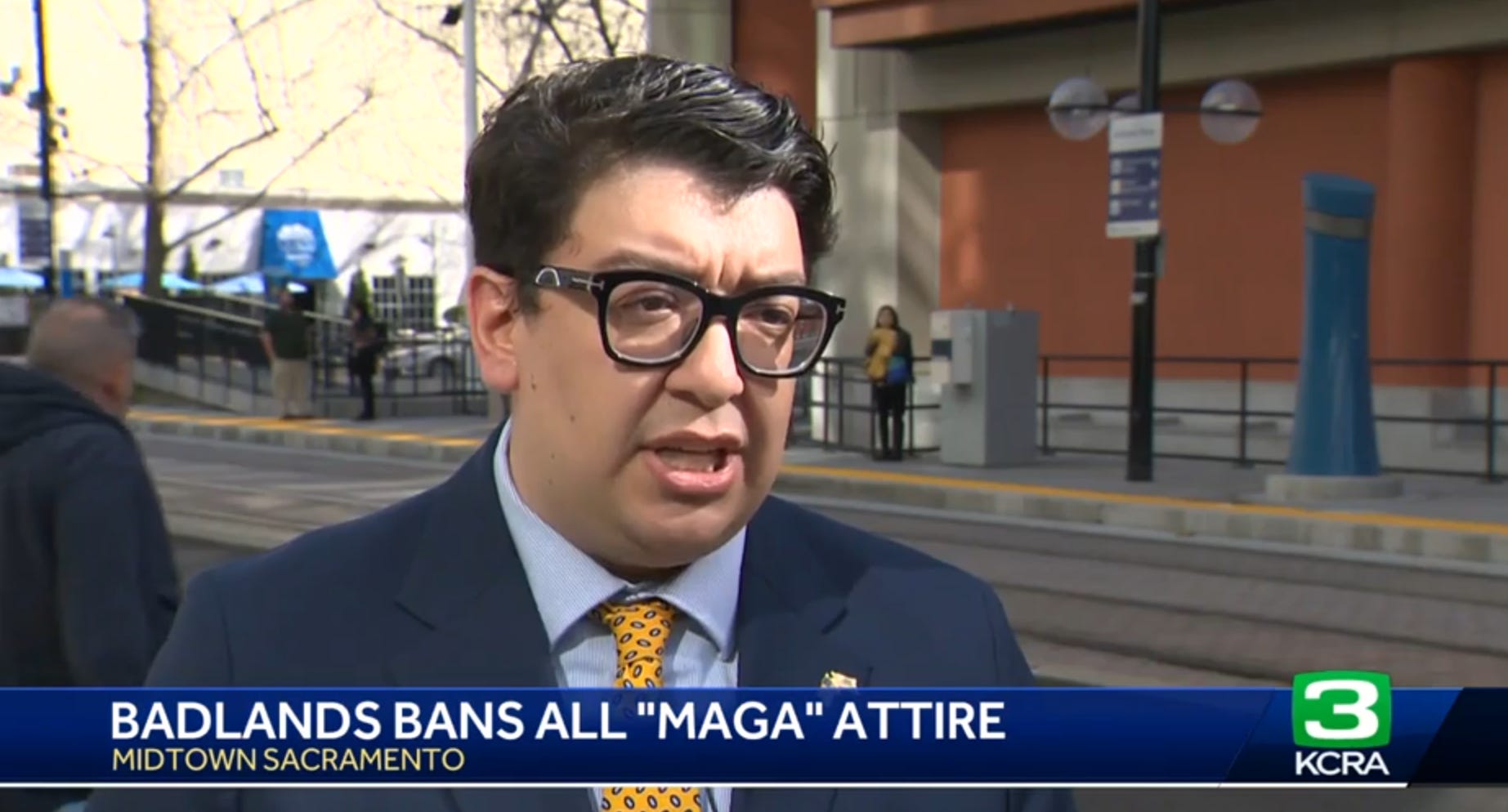
“This decision is not based upon protecting our community,” said Preston Romero, president of the Log Cabin Republicans of Sacramento. “It’s about bullying and singling out one particular political ideology. And we believe that that’s unfair.”
WHAT HEINOUS HYPOCRISY!!! Because when trans kids are banned from sports, queer teachers are forced back into the closet, and drag queens are treated like criminals—they don’t say ONE DAMN WORD.
But when a gay bar sets a boundary to protect its patrons from symbols of literal hatred? Suddenly it’s bullying? Give God a damn break!
Preston Romero, president of the Log Cabin Republicans of Sacramento.
4. God’s Final Word
And after all the hypocritical outrage, Bourassa says he’ll still go to Badlands but he’ll just leave the hat at home.
“I didn’t have any problems,” he said. “I’ll still go back… but I’ll leave the hat at home now.”
This man got banned, agreed with the ban, and is going right back.
REJOICE, everyone! We finally found the thing that can break the MAGA cult…and apparently it’s gay sex.
5. We’re Fighting Back And It’s Working
This isn’t just a moment, it’s momentum.
And it’s building everywhere you look.
People are fighting back everywhere.
Here’s how we fight:
Keep people engaged & informed with truth, hope and laughter.
Rally thousands of voices to push back against fascism.
Build an independent platform where truth can’t be silenced.
And it’s working.
📈 LOOK AT THIS: (snip-go look. The clicks help God [the Substack.])
We’re approaching the third Trans Rights Readathon! It’s an annual call to action that coincides with Trans Day of Visibility on March 31st, and it aims to uplift, amplify, and support trans, nonbinary, gender-nonconforming, and Two-Spirit authors. It takes place from March 21st through the 31st, and this year, there are five core prompts to complete, as well as a list of bonus prompts.
The five core prompts for the 2025 Trans Rights Readathon are Transmasc and Trans Man Rep; Transfemme and Trans Woman Rep; Nonbinary, Agender, Genderqueer, and Other Gender Expansive Rep; Intersectional Trans+ Rep Outside Your Own Experience; and 2Spirit, Indigiqueer and Indigenous Gender Expansive Rep.
If you’d like some recommendations for these prompts, as well as the many bonus prompts, you can find the reading challenge on Storygraph, where users have added suggestions for each. Just be sure to vet these, since anyone can add a title.
The Storygraph description also adds more context to the reading challenge, including making sure not to out authors or interrogate authors about their gender identity: “If information isn’t available in an author’s bio, social media, or on their website, they don’t owe it to you. In an era when people’s identities are being used to target them, please be mindful that we want to CELEBRATE these stories and support authors while keeping each other safe.”
Each prompt also has more information, including that books in the 2Spirit, Indigiqueer, and Indigenous Gender Expansive Rep category may not be trans, so to be mindful about language when discussing these books: “2Spirit, Indigiqueer, and other non-Western Third Genders exist outside of Western concepts of gender and sexuality, and an author who identifies as 2S may not identify as trans.”
Another great resource for the challenge is the Trans Rights Readathon Instagram. They have posts about the readathon itself, including how to participate: by reading trans books, reviewing and discussing them online (using the tags TransRightsReadathon and #TRR2025), and monetarily supporting the trans community (including donating to mutual aid funds).
They also have posts recommending books for each of the prompts. These are vetted by the organizers, so they’re more reliable than the Storygraph suggestions.
Leading up to and during the readathon, I’ll be sharing trans book recommendations. Let me know in the comments if there’s anything in particular you’d like suggestions for!
As a bonus for All Access members, below is a list of 27 new LGBTQ books out this week.
Exclusive content for All Access members continues below. Become a member for $6 a month or $60 a year to get community features and access to exclusive content across all 20+ Book Riot newsletters.
so, obviously, NSFW, for blue language (I tried to put space in, but the preview showed it didn’t work.) Enjoy when you can; resistance is happening everywhere! -A.
let’s all watch some MAGA shithead get bounced from a bar by Jeff Tiedrich
“I’m not fucking around. get out of my bar right now.” Read on Substack
everything sucks right now, so let’s put the focus on our hero of the day. sit back and enjoy the shit out of this bartender eighty-sixing some Trumpist fuckwad.
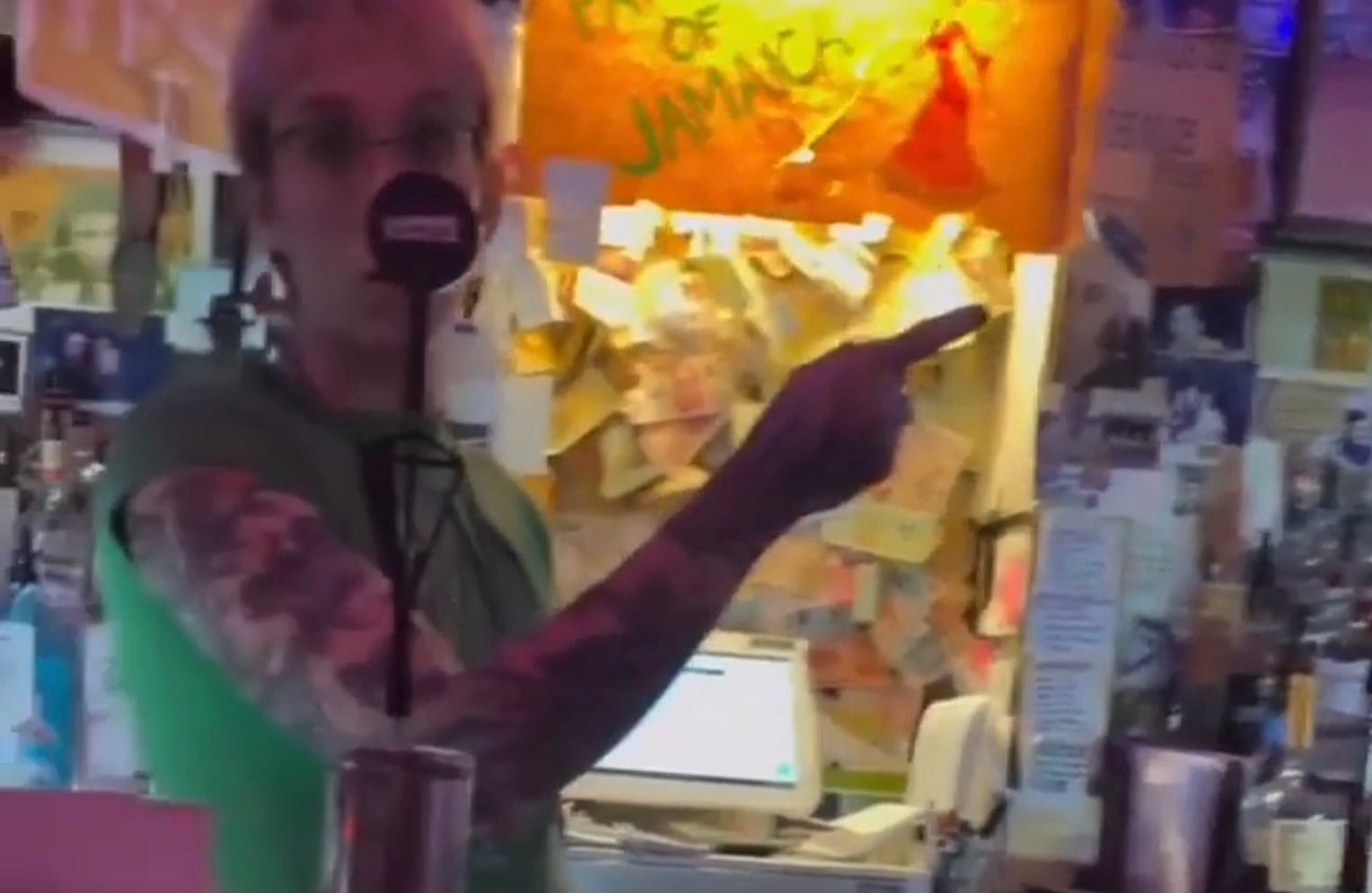
bartender: “get out of the bar.” MAGA: “why?” bartender: “because you’re a Trump supporter.” MAGA: “I know, but don’t you guys want our money?” bartender: “no, actually, we don’t. get out of my bar right now. [picks up baseball bat] I’m not fucking around. get out of my bar right now.” MAGA: “are you serious? bartender: “I’m dead serious. out.” MAGA: “because I’m wearing a Trump hat.” bartender: “yes.” MAGA: “that’s wild.” bartender: “I don’t care. get out.” second bartender: “we can call the police, or you can just leave.” MAGA: “you know this is, like, discrimination, right?” bartender: “boo hoo. boo fucking hoo. get out of my bar.”
fuck yeah. that was satisfying. boo fucking hoo, indeed. here’s your binky, MAGA. now take a hike.
here’s the backstory.
the MAGA asshole who got bounced — and is now whining to the press about it — wants you to believe that she was some innocent victim who wandered into a random bar and met up with some surly bartender.
that’s not the case at all. the cultist — and her friends — showed up to cause trouble, and they got what was coming to them.
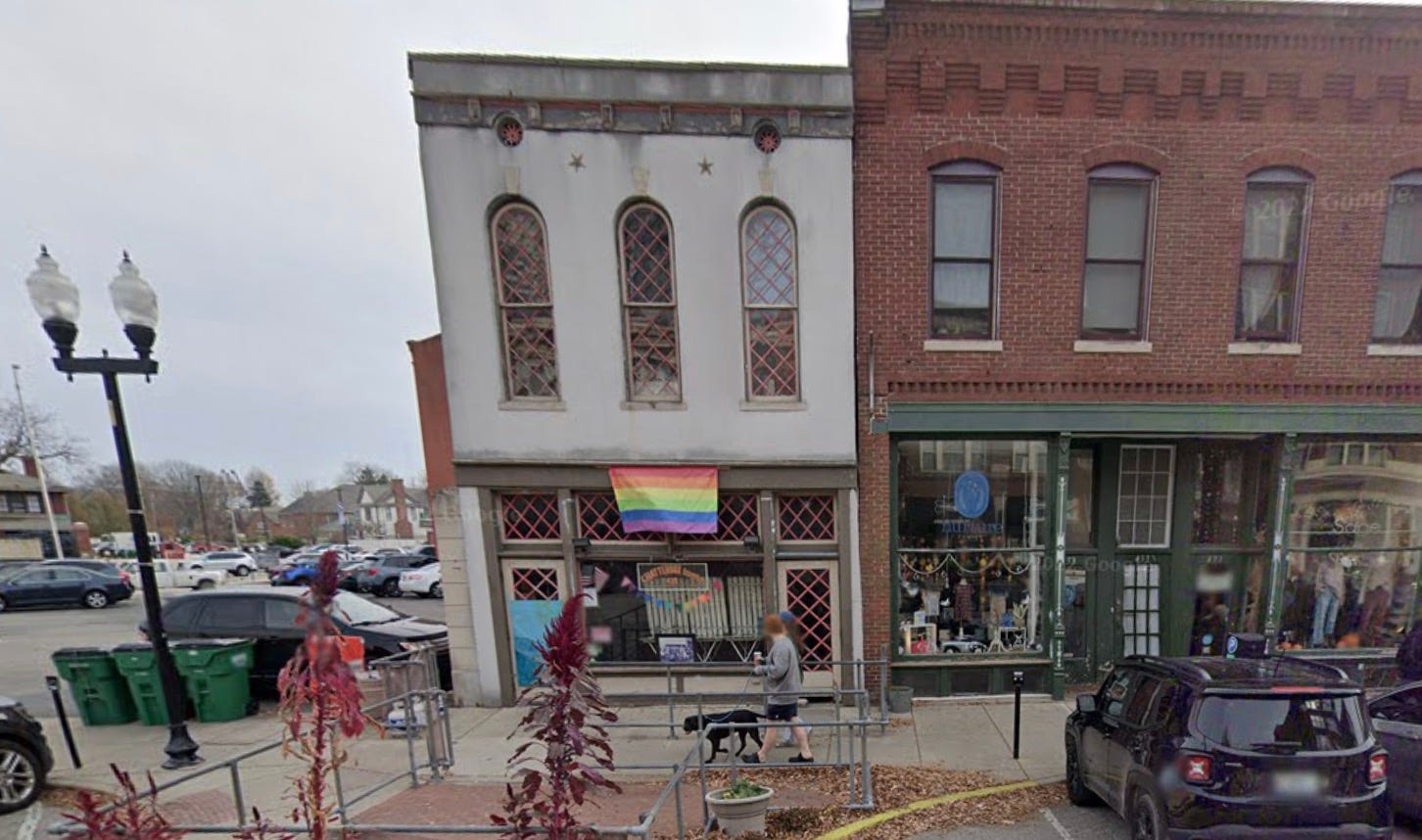
the bar in question is the Chatterbox Jazz Club in Indianapolis. the joint is LGBTQ+ inclusive, and much of the staff is trans.
it’s possible that Fuckface von Maga and her fuckface friends didn’t even know any of that when they showed up to make a scene. maybe they were just offended by the pride flag hanging outside the bar, and decided that it was their divine mission to stir up shit.
here’s David Andrichik, the bar’s owner, to explain.
“We were set up. This was a plan to do something like this. We don’t believe the people that came in to instigate even knew what Chatterbox was, but they came in because of our pride flag,” which is displayed outside the jazz bar.
premeditated or not, these MAGA shitstains stepped inside the Chatterbox and immediately cranked the asshole dial way past eleven. they shouted. they got abusive and confrontational. they deliberately misgendered the bartender. and they got tossed the fuck out.
and then, they came back in and recorded the clip you saw at top of this post — and went whining to the media about it.
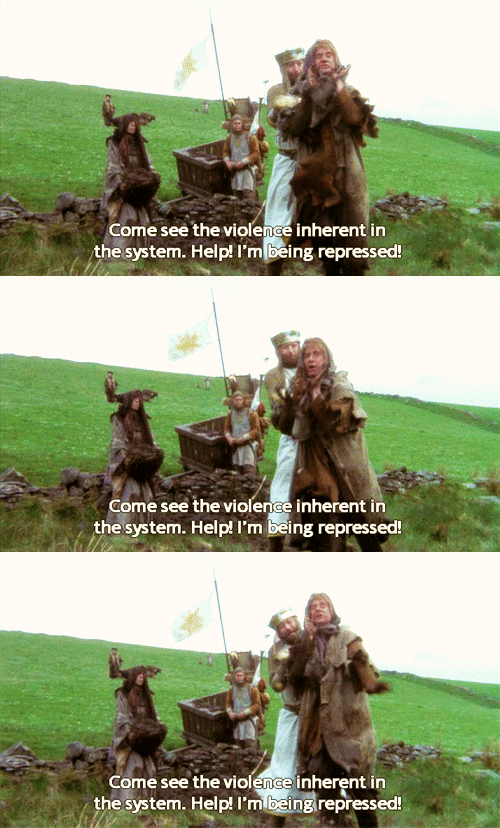
look at us, we’re the real victims here! they hated us for our hats! so unfair! come see the violence inherent in the system!
like their beloved Dear Leader, the cultists always imagine they’re the real victims — everything is unfair, and everything is rigged against them.
all we wanted was to hang out. the bartender was so mean to us.
MAGA, you are cordially invited to fuck straight off with your divisive hate. could you just fucking well leave people alone? they just want to live their lives in peace. next time you see a pride flag, just walk on by. the Earth won’t fall off its axis. I promise.
cultists, can we talk? you’re getting played by the ruling class, and you don’t even realize it. you’re being distracted from the real enemy.
‘keep the people ignorant and fighting each other, and they won’t notice the plutocrats picking their pockets’ is right on page one of the oligarch’s playbook.
and please shut the fuck up already about how unfairly you got treated. you acted like an asshole and you got treated like one.
you fucked around, and you found out. enjoy the tiniest of violins.
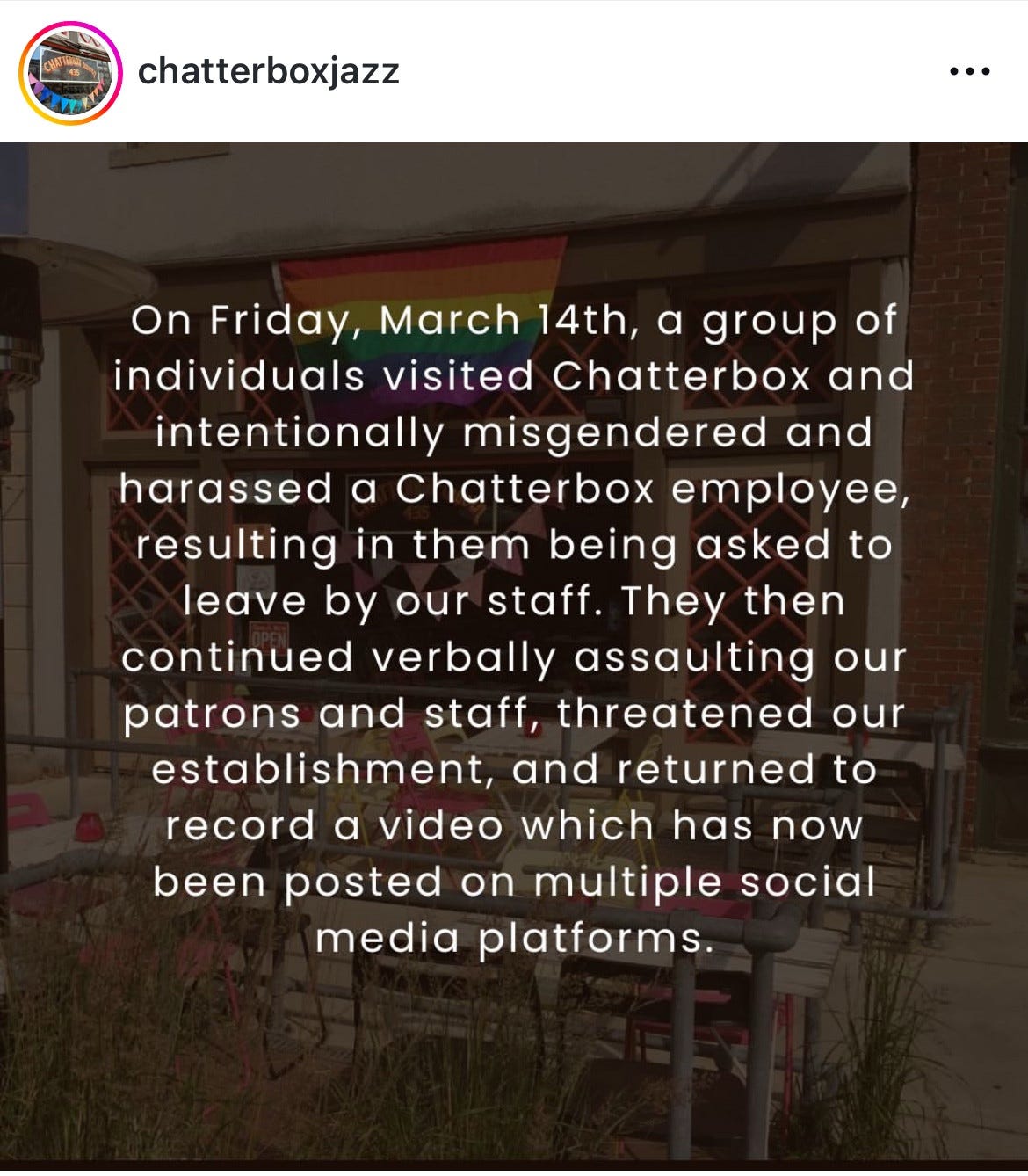
On Friday, March 14th, a group of individuals visited Chatterbox and intentionally misgendered and harassed a Chatterbox employee, resulting in them being asked to leave by our staff. They then continued verbally assaulting our patrons and staff, threatened our establishment, and returned to record a video which has now been posted on multiple social media platforms.
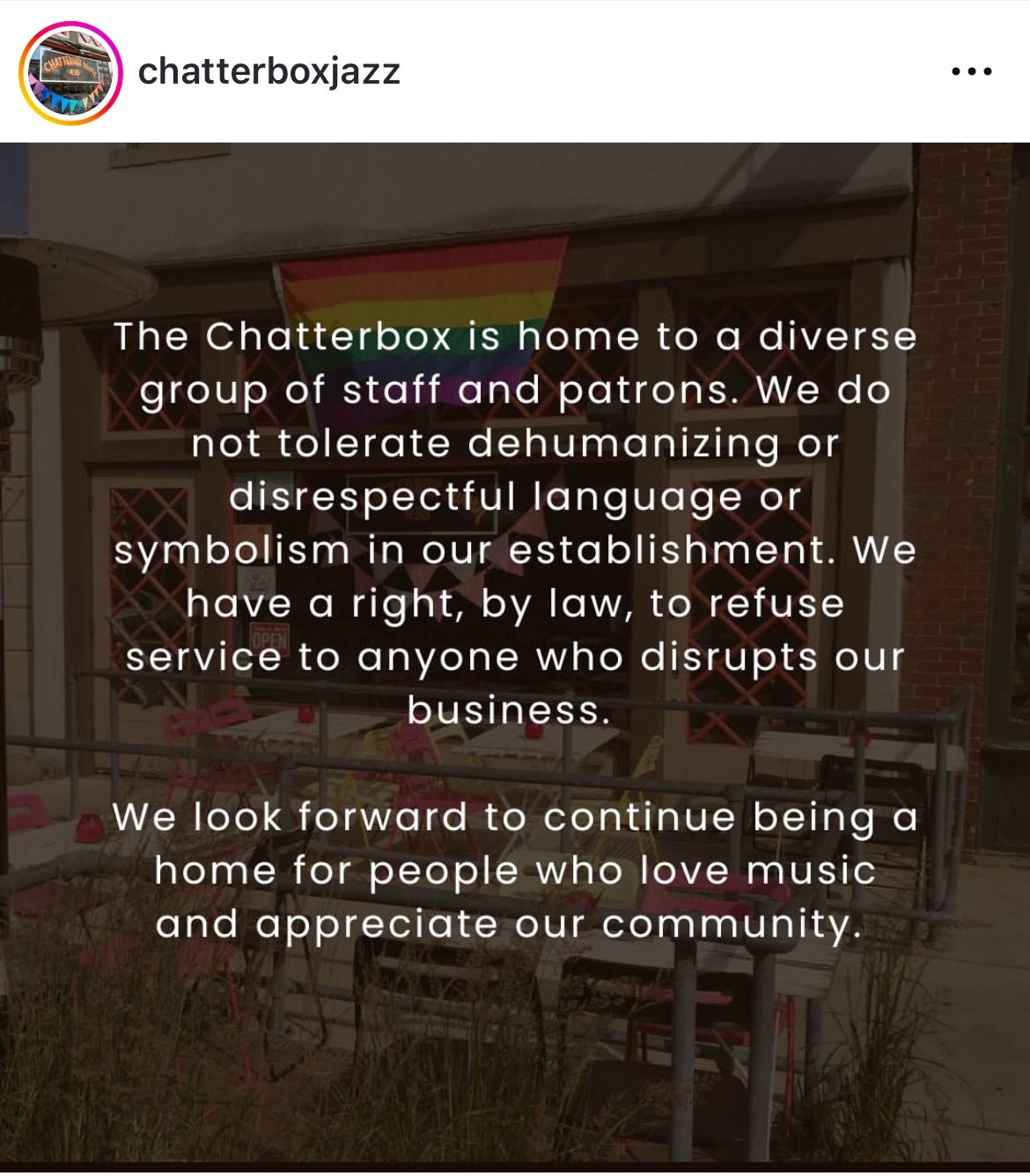
The Chatterbox is home to a diverse group of staff and patrons. We do not tolerate dehumanizing or disrespectful language or symbolism in our establishment. We have a right, by law, to refuse service to anyone who disrupts our business. We look forward to continue being a home for people who love music and appreciate our community.
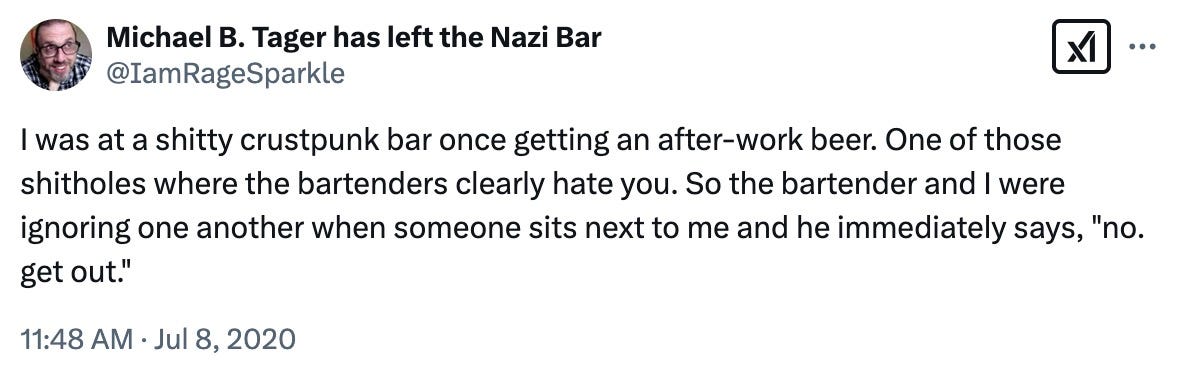
I was at a shitty crustpunk bar once getting an after-work beer. One of those shitholes where the bartenders clearly hate you. So the bartender and I were ignoring one another when someone sits next to me and he immediately says, “no. get out.”
And the dude next to me says, “hey i’m not doing anything, i’m a paying customer.” and the bartender reaches under the counter for a bat or something and says, “out. now.” and the dude leaves, kind of yelling. And he was dressed in a punk uniform, I noticed
Anyway, I asked what that was about and the bartender was like, “you didn’t see his vest but it was all nazi shit. Iron crosses and stuff. You get to recognize them.” And i was like, oh ok and he continues.
“you have to nip it in the bud immediately. These guys come in and it’s always a nice, polite one. And you serve them because you don’t want to cause a scene. And then they become a regular and after awhile they bring a friend. And that dude is cool too.”
“And then THEY bring friends and the friends bring friends and they stop being cool and then you realize, oh shit, this is a Nazi bar now. And it’s too late because they’re entrenched and if you try to kick them out, they cause a PROBLEM. So you have to shut them down.”
of course, what happened at the Chatterbox isn’t totally analogous — Fuckface von MAGA and her friends weren’t polite, and they certainly weren’t there to infiltrate — but the lesson is the same: you have to nip that shit in the bud. zero tolerance for Nazi assholes.
fuck around and find out is in short supply right now. let’s celebrate when it happens.
if you find yourself in Indianapolis, stop by the Chatterbox and show them your support.
here’s your daily reminder that I can be found on Blue Sky at this link.
this is going to be my closing message for the foreseeable future:
practice self-care. do what you need to do to keep sane. if that means you need to disengage with my daily posts for a while, I get it. this community of ours will still be here when you return.
to all the people who have signed on in the days since the election, welcome aboard. settle in as we all try to deal with the shitfuckery that’s ahead of us.
we are all in this together, and we are all here for each other.
I tried to spout off on my view of the things I heard on the Sunday news shows. It took many takes and trying to find my old files as this new program simply wiped out my first video attempt. This is a combination of three videos.
“I stopped breathing and my heart skipped. My pants were down around my ankles, and no one else was within earshot.”
By Rey Katz Mar 11, 2025, 08:25 AM EDT Updated Mar 11, 2025
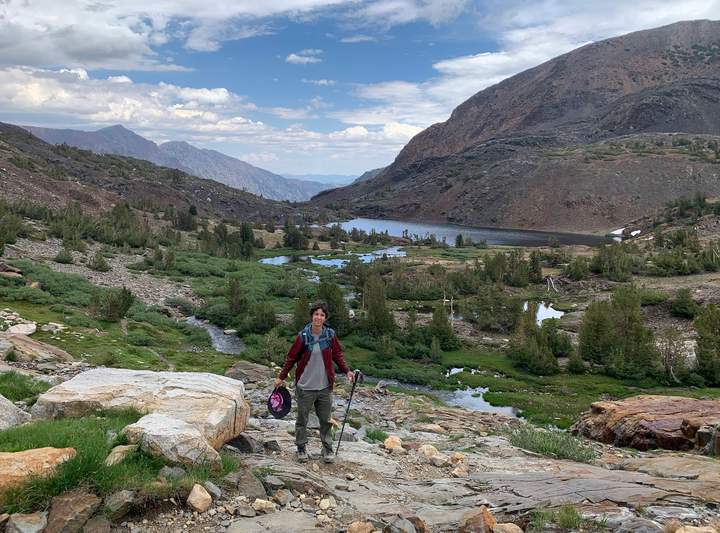
The author hiking just outside Yosemite National Park in July 2024, after cutting their hair short, holding their pink hat.
“Hello? Are you a male or female in there?” a rumbling voice called into the women’s restroom. A man’s boots stepped across the threshold, clunking on the tile floor, as I sat alone in the stall closest to the door.
I stopped breathing and my heart skipped. My pants were down around my ankles, and no one else was within earshot.
My hands went to where my freshly shorn curls used to be — fingers twining into my 2 remaining inches of hair — and I wondered if I had made a mistake. I had been using women’s restrooms my entire life, from when I had long braided pigtails and my mom taught me to lay down two layers of toilet paper on the seat, to my road trip around California as a white, skinny, short, nonbinary person in my early 30s.
***
My partner and I were on an adventure. We had sublet our apartment and were camping in a van for the summer. We slept every night on a memory foam mattress in the van and cooked most of our meals outdoors on a propane stove. Immersed in nature, at a distance from society and community, I could recognize my true self more clearly, and I took the opportunity to explore a more masculine appearance.
I don’t have much experience with people thinking I might be a man. Growing up, people always assumed I was a girl. I still can’t cut my hair without shame, hearing women’s voices in my head: “Oh, but your hair is so lovely, you should keep it long.” It’s as if I hurt my community every time I do it.
Despite the shame, I had cut my hair earlier that week, camped alongside a beautiful, remote river. I trimmed a couple of inches off to give myself the 2-inch-long “men’s” cut I usually give my partner. He is supportive of whatever hair length I want for myself. I squinted into a little travel mirror and lopped off chunks, feeling bits of hair drift down my bare shoulders. Finished with the trim, I dove into the brown river water and scrubbed my scalp with my fingers. I floated in the sun, naked and unjudged by the birds watching me from the trees.
I didn’t feel judged for my haircut until we traveled back into town. While I was washing my face at the sink in a restroom, someone peeked in and then left. I put my glasses back on and walked out. A woman with long hair was standing outside, uncertain, wearing a long skirt. As she turned to face me, I said hello.
“Is this the women’s room?” she asked.
“Yes,” I answered curtly, forced a smile, and walked away quickly, past the word “Women” in 6-inch green painted letters on the wooden wall of the building.
I guess I had been gendered as too-butch-to-be-in-the-women’s-room. Affirming? Slightly. But it was a preview to an unsolvable problem. If I’m not supposed to be in the women’s room, but I also can’t use the men’s, how can I use the bathroom?
***
My partner and I found a lovely city park with a picnic area and gazebo to eat breakfast in after camping on National Forest land nearby. After a mug of coffee, I visited the public restroom. I didn’t expect a stranger to yell at me through the flimsy stall door.
“Hello? Are you a male or female?”
I was the only person using the restroom — the kids who had been in there a minute ago had left. I felt this man’s eyes on my sneakers and blue hiking pants under the stall. I was scared this harassment could escalate if I didn’t say something to diffuse the situation. I gulped and called back, “Hello?”
“Oh, you’re a female. My bad.” He sounded reassured by my quavering voice. I heard his footsteps leaving the room. My heart raced as I fumbled with toilet paper, fingers shaking. I felt nauseated.
My voice had immediately identified me as the “female” I didn’t feel myself to be — and all it took was two syllables. But my “female” voice had also saved me from further harassment. Would that man have dragged me out of the stall if I sounded “like a man” or remained quiet? Would he have looked under the stall? Would he have tried to check what was between my legs while my pants were down? Did he have any idea how much of a violation these real and imagined threats were to me?
And why was a man even in the women’s room, questioning me? Did a kid’s mother report me to her husband for looking too much like a man in the women’s room? Perhaps they were alarmed that I, with my short hair, had been in the restroom with their young kids. I felt physically ill at the troubling thought that someone would assume I would do anything harmful to children. I hadn’t said anything, made eye contact with anyone or done anything other than sit quietly in the stall in the room that matches my assigned sex at birth.
I felt bad for looking masculine to make myself more comfortable, because I didn’t want to make anyone else uncomfortable. Some part of me longed to return to my habit of looking more like a woman, but I also felt sick from not feeling right in my body.
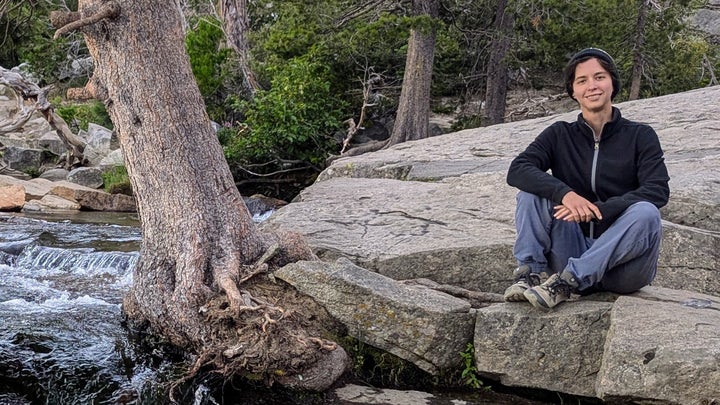
The author sitting beside a mountain stream in August 2024, wearing the same hat, jacket, pants and shoes they had on during the bathroom incident earlier that day.
I can empathize with these strangers viewing me and my body as a threat because I have also viewed my body as a threat. I have been unhappy with the shape of my body, my appearance in the mirror and the tone of my voice. And to have that thrown back in my face in such a vulnerable moment — pants down, defenseless, forced by my body’s very personal needs to be in this gendered room — hit close to home.
It did not occur to me to call the police, because the last thing I needed was to wait around for law enforcement to judge my qualifications to use a bathroom and give a police report about someone I hadn’t actually seen. Instead, I texted a friend — a woman with short hair — to tell her my story of being harassed in the bathroom and share how uncomfortable that made me. She responded that women have screamed after seeing her in the restroom, and she’d had security called on her. My experience seemed mild by comparison. I appreciated her perspective.
For the next several days, I felt intensely conflicted and full of gender dysphoria. I was tense and nervous using public restrooms. I wore my pink hat, forced a big smile and strode in confidently, femininely, trying to look like the kind of woman no one would object to. But I’m not a woman. I came out as a transmasculine, nonbinary person in my late 20s — a person who feels more like a boy than a girl on the inside. A person whose anxiety and depression eased once I no longer had to hide who I am.
I have to choose between a women’s or men’s restroom in most public spaces, as unisex bathrooms are uncommon. Laws restricting bathroom access, which are becoming more prevalent in the United States, attempt to define sex based on whether an individual can produce eggs or sperm. In practice, people look at your body shape, clothes and hair and make an assumption about which restroom you should use. Most people assume I would use the women’s room, so that’s what I continue to use. Trans women often have harder choices. Anyone who pushes back on my use of the women’s room suspects that I am a trans woman. They correctly identify me as trans, but in the incorrect direction.
Trans women are the target of these “bathroom bills” and may encounter harassment and violence in either restroom. Being legally required to use the “wrong” restroom can out people as trans, which can be dangerous for them.
Trans women may need to go more frequently on average. One of the most common testosterone blockers, spironolactone, is a diuretic which means you need to pee often while taking it. The constant stress of navigating public spaces as a trans person with a filling bladder is incredibly — literally — painful.
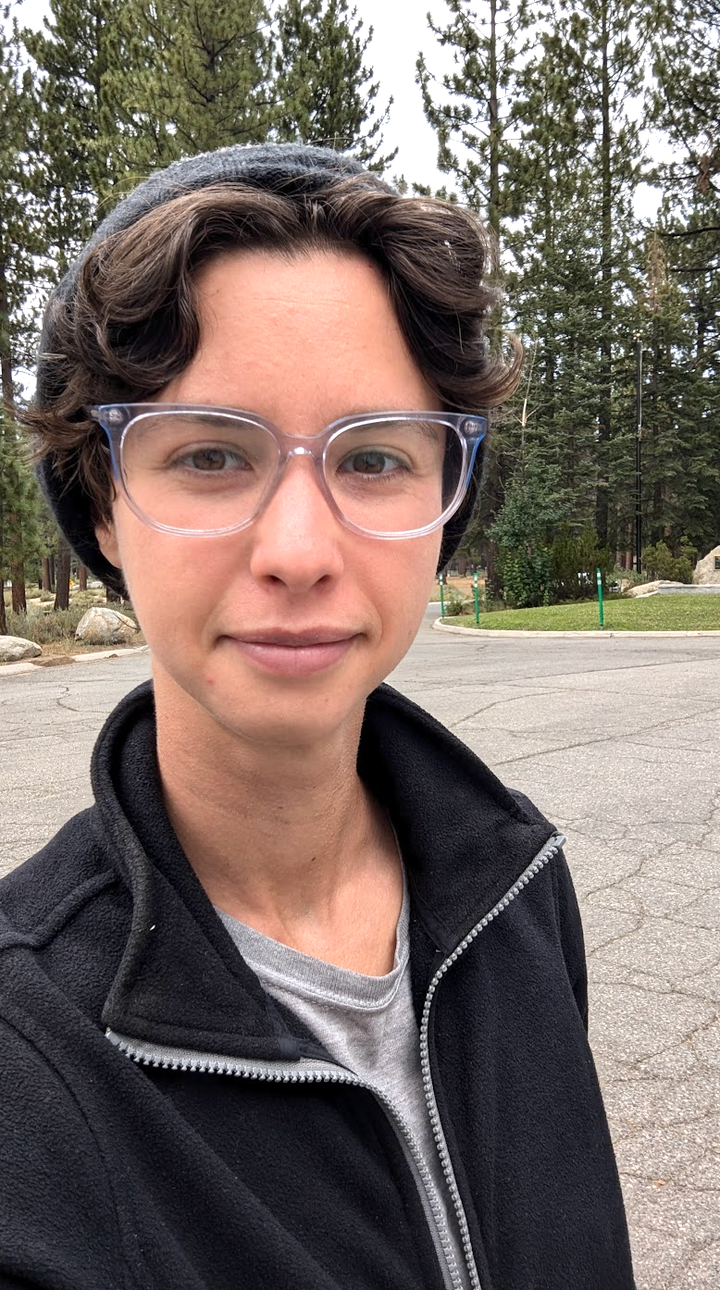
At the park the day of the bathroom incident in August 2024, the author was wearing a hat, glasses and a fleece jacket.
***
A couple of weeks later, my partner and I returned to the same city park. After relaxing at the picnic tables, I walked over to the bathroom. A new porcelain toilet sat whimsically outside the building, prepped for installation. Uh oh, I thought, rounding the corner to see a plumber with a pickup truck. A “closed for cleaning” sign was braced across the door of the women’s restroom.
The plumber, burly, with a beard, glanced at me and asked, “You need to use the restroom?” gesturing to the men’s door. I nodded, but looked back to peer past the closed sign into the women’s room.
“Oh, you want to use that one?” he asked, squinting at me. It was a cold morning. I was bundled up in a knit cap and two layered jackets. Looking at me, the plumber honestly seemed to think I was heading for the men’s. I shrugged and took what I hoped was a few casual steps toward the men’s room.
“Use the toilet in the last stall,” he prompted me. Perhaps the other plumbing hadn’t been hooked up yet.
“All right, thanks,” I said, pitching my voice down, trying to sound like I’d meant to go in the men’s room all along.
I used the toilet in the empty men’s room to pee, washed my hands, walked out, nodded to the plumber and walked off. I felt rattled but also surprisingly comfortable. Someone had told me that I could use that bathroom, that stall, and I felt validated in doing the right thing. It was the opposite of being questioned for being in the women’s room. I hadn’t made anyone else uncomfortable by existing. Was that a success? Is not making anyone uncomfortable except myself a healthy baseline?
***
Although that experience felt validating, using the “wrong” bathroom can have very real consequences. In California, I didn’t face legal consequences for using a men’s bathroom. If I had instead been in Florida and refused to leave the men’s bathroom if asked, I could have been charged with criminal trespass, likely a first-degree misdemeanor, which carries a prison term of up to one year or a $1,000 fine.
Proponents of “bathroom bills” claim they protect children from predators, but assaulting children in restrooms (or anywhere else) is already illegal. A bathroom law doesn’t physically prevent male abusers already willing to break the law from stepping into women’s spaces. However, these laws can prevent trans women from comfortably and legally using any public bathroom, including restrooms in their workplace.
U.S. Rep. Nancy Mace introduced the Protecting Women’s Private Spaces Act in November 2024. If enacted, this law would prohibit transgender individuals from using restrooms that align with their gender identity on federal property, specifically targeting U.S. Rep. Sarah McBride, the first openly transgender member of Congress, who would no longer be allowed to use the women’s bathroom at her workplace in the Capitol.
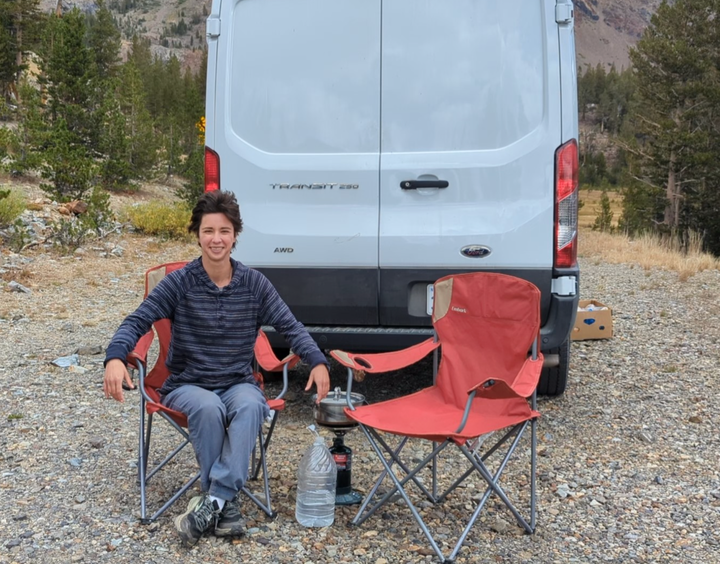
The author relaxing in a camp chair behind the van, with short hair and wearing masculine clothes, in September 2024.
I am lucky I don’t work in a place where I can’t use the bathroom, but navigating my gender identity is still a constant struggle — not solely with myself, but with everyone I interact with. I have to justify my gender expression to strangers and negotiate with them, whether or not our interactions are negative or positive. So why do I subject myself to this frustration? Because it would hurt more to hide myself every moment of every day.
Finding more authentic ways to express myself feels like a weight that I wasn’t aware of has been lifted off my chest, and suddenly, I can breathe deeply, newly grounded in the reality of my body. Swimming in the river after I cut my hair, I felt distantly afraid but excited about what was to come. I felt grateful I took this step toward my true self.
Rey Katz is a nonbinary writer, MIT alum, small-business owner, and black belt in Kokikai Aikido. They are working on a memoir about coming of age as a nonbinary martial artist. Check out their relatable true stories at Amplify Respect and small biz services at reykatz.com.