
Well said / written. It lays bare the hypocrisy of those desperately trying to create some kind of equality and outrage between the very real attempt to overturn a valid election along with other crimes done by trump with a rarely ever charged crime of failure to fully pay taxes which was paid after and a firearms form that is never prosecuted. All to protect Mr. trump while trying to smear President Biden using his son. Hugs
Category: Economics / Economy / Income / Financial
This INSANE PragerU Propaganda Will be Taught to Kids in Florida Schools
RFK Super PAC Largely Funded By GOP Megadonor
Well we knew that. The republicans recruited him to run as a chaos agent to suck votes from Biden. Republicans know their candidates and the ideas they push are unpopular with the people. So they only way they can stay in power is to cheat, suppress votes of the democrats, and gerrymander to create districts that only republicans can win. Rather than change the party to appeal to more people they simply demand no one gets to vote unless they vote for them, so they can rule as a minority over the majority. The problem for the right is RFK is talking more like a republican than a democrat. What republicans are doing should be illegal. Hugs
Politico reports:
A super PAC supporting the presidential ambitions of longshot Democratic presidential candidate Robert F. Kennedy Jr. reported receiving more than half its nearly $10 million in funds from a single GOP donor.
Of the $9.8 million reported, $5 million came from Timothy Mellon, a longtime GOP donor who gave $1.5 million to a Trump-aligned group last fall, according to campaign finance records. In a press release earlier Monday, Mellon touted Kennedy’s bipartisan credentials, calling him “the one Democrat who can win in the general election.”
Most of the rest of the super PAC’s fundraising through the end of June came from Gavin De Becker, an author and consultant who reported giving the group $4.5 million.
The Insider reports:
Mellon also contributed $53 million to an effort led by Republican Gov. Greg Abbott of Texas to build a wall on the US-Mexico border, effectively funding the entire venture himself.
The grandson of famous banking magnate Andrew Mellon and an heir to the family fortune, Mellon once wrote in a self-published autobiography that welfare programs are “slavery redux” and described Black people as becoming “even more belligerent and unwilling to pitch in to improve their own situations” in the 1980s.

Immigration, Texas, and Lazarus
DeSantis appointee to Disney board taught seminar using discredited research claiming White people were slaves in America
Yes because anything to defend white people holding black people as property and what the white people did to them. Don’t mention the bad thing, the rapes, humiliations, the being told what, when, where you were allowed to do anything including pee (sounds like how Amazon treats workers only without them being able to say no or go home) how and when they could eat, basically a white person had complete control over those black people and their bodies. Let’s obscure and fudge that anyway possible, even making up that white Irish people were also chattel slaves. That is a complete lie. But the people that wanted to push it built a whole mythology around the idea. Just like the anti-trans people have done with every mythical idea they can to try to discredit the idea of a person identifying as the gender not assigned at birth by a visual inspection of the genitals. What is it with these type people that they cannot simply accept the truth, the history, the science? Why is it so damn important for the to deny all of the science and history to protect their feelings or their views of the world? Hugs

DeSantis appointee to Disney board taught seminar using discredited research claiming White people were slaves in America


By Andrew Kaczynski, Em Steck and Steve Contorno, CNN
Published 7:00 AM EDT, Fri August 4, 2023

Ron Peri, a member of the Board of Supervisors for the Reedy Creek Improvement District, listens during a monthly meeting on June 21, 2023 in Reedy Creek, Florida.
An appointee by Florida Gov. Ron DeSantis to an oversight board of Disney’s special tax district taught a seminar in 2021 falsely claiming “Whites were also slaves in America,” using discredited research to say there was an “Irish slave trade.”
The comments were made by Ron Peri, one of five people DeSantis appointed earlier this year to oversee the Central Florida Tourism Oversight District to replace the old board after the company spoke out against what critics dubbed the “Don’t Say Gay” law in Florida.
Peri, an Orlando-based pastor and CEO of a Christian ministry group called The Gathering, made the comments in an hourlong class for his group posted on YouTube about critical race theory called “Cunningly Devised Fables.”
In other comments Peri spread false claims that Irish slaves were forcibly bred with enslaved Africans. He also said a “significant” number of free Blacks in the antebellum era owned slaves, claims disputed by reputable historians who say the number was minimal. CNN archived Peri’s comments from 2021, which he deleted from YouTube following his appointment to the Disney oversight board.
The oversight board, previously called the Reedy Creek Improvement District, governed Disney’s sprawling 25,000 acre footprint around Orlando. Created in 1967, its duties include providing services like sewage, fire rescue and road maintenance and issuing debt for infrastructure projects supporting Disney’s theme park empire.
“Slavery is a moral wrong wherever it exists or existed and is one of America’s great historical wrongs,” Peri told CNN in a statement Tuesday. “Similarly, racism is likewise wrong. I countenance neither to any degree, so the criticism of the belief that thousands of people being held in slavery was significant and a terrible wrong is severely misplaced. Even one person in slavery is egregious and morally reprehensible, regardless of race.”
The DeSantis administration but did not respond to CNN’s request for comment.
Peri’s 2021 comments came in the context of him pushing back on claims of “systemic racism” in the United States from past White ownership of slaves.
“Look at old newspapers, as old as you can find, and you’ll find that Whites were also slaves in America,” said Peri. “The Irish slave trade began when James II sold 30,000 Irish prisoners as slaves to the new world. His proclamation of 1625, which you can go back and see, required Irish political prisoners be sent overseas and sold to English settlers in the West Indies.”
“By the mid 1600s, the Irish were the main slaves sold to Antigua and Montserrat,” Peri added. “From 1641 to 1652, over 500,000 Irish were killed by the English, and another 300,000 were sold as slaves.”
“The settlers began to breed Irish women and girls with African men to produce slaves with a distinct complexion,” Peri added.
Peri’s claims are based on fabricated material that has circled the Internet over the last two decades and has been the subject of repeated debunkings from news organizations like the New York Times, Reuters, the Associated Press, Snopes, and frustrated historians – many of whom signed an open letter in 2016 disputing the claims.
Even the article Peri cited as evidence was updated before he used it in the seminar to note it contained a number of factual errors.
Historians who spoke to CNN said that the research Peri cited is ahistorical and based on invented research: Whites were never considered slaves in America, legally or socially; 300,000 Irish were not sent as slaves to the Americas; English King James II – who Peri cited as issuing the proclamation in 1625 – was not born until 1633 and did not take the throne until 1685. Even then, no proclamations by King James II on Irish slaves exist. The Irish did not “breed” with African slaves, as Peri claimed.
Irish immigrants in North America and the Caribbean were never considered slaves but were indentured servants, said Matthew Reilly, a professor of anthropology at City College of New York.
Indentured servitude consisted of a fixed period of time, usually five to seven years, and was not inheritable. Whereas the race-based chattel form of slavery kept enslaved people as property for life and children would inherit their mother’s status.
“The conditions may have been like that of slavery, but socio-legally, it was a very different form of unfreedom,” said Reilly.
In another comment, Peri used data attributed to the 1830 census to say the numbers showed a “significant” and “large number” of free Blacks owned slaves. However, the 1830 census data cited by scholars show that out of 2,009,043 slaves in the United States, 3,776 free Blacks owned 12,907 slaves – 0.006%.
“The justification that they have for it is they claim that systemic racism emanates from White ownership of slaves,” Peri said. “Therefore, all White wealth is based on the hard work and abuse of Black slaves and women. That’s their justification. Well, the reality is all races owned slaves.”
“A significant number of these free Blacks were the owners of slaves,” Peri added.
Historians, like esteemed Harvard professor Henry Louis Gates, Jr., have noted that a large number of those Black slave owners “owned” their own family members to protect them – oftentimes by purchasing a family member. And that pointing to other races owning slaves is a way to minimize the brutal realities of slavery.
“The vast majority, the overwhelming majority – to the tune of millions of people who were brought from West and West Central Africa to the Americas – they were enslaved. Not people who were perpetrating slavery themselves,” Jenny Shaw, a professor of history at the University of Alabama, told CNN. “There’s a small number who did because they rose up in society and did what society was doing, which was enslaving people.” And that some people of African descent enslaved people because they were family members bringing them into their households with the intent of freeing them.
Peri’s unearthed comments come amidst the controversy over the Florida Board of Education’s new standards for teaching Black history.
Disney and DeSantis
Peri’s appointment to the Disney oversight board followed a clash between the company and DeSantis over a state law that would restrict certain classroom instruction about sexual orientation and gender identity. While Disney first declined to weigh in publicly on the legislative fight over what critics called the “Don’t Say Gay” bill, then CEO Bob Chapek, under immense pressure from the company’s employees, later changed directions, and shared his concerns with the legislation. Later, after it became law, the company in a statement said it would work to get it repealed.
However, Peri has also accused Disney in the past of adopting teachings of critical race theory in its company training. The comments touched on another top concern of DeSantis, who sought to ban employers from training workers about privilege and systemic racism when he signed the Stop Woke Act, parts of which were blocked by a federal judge from going into effect.
“We’re seeing companies embracing CRT,” Peri said in his Zoom. “I’m gonna just share two – Walt Disney you’re quite familiar with. You know, down here in Orlando.”
DeSantis has faced backlash in recent days over Florida’s board of education approving controversial new standards for teaching Black history in the state, which includes teaching “how slaves developed skills which, in some instances, could be applied for their personal benefit.” DeSantis has defended the state’s curriculum.
Peri previously faced scrutiny after CNN’s KFile uncovered that the Orlando pastor had suggested tap water turned people gay. Peri disputed that he made the remark during a May 1 Central Florida Tourism Oversight District board meeting, saying from the dais, “I never said that. I don’t believe it, certainly.”
The latest revelations about Peri’s beliefs come as DeSantis’ conflict with Disney is embroiled in dueling legal challenges. Peri is named as a defendant in a lawsuit filed by Disney, which alleges that the Florida governor has punished the company for exercising its First Amendment rights while describing his hand-picked board as a pawn in his “retribution campaign” against the entertainment giant.
In its complaint, filed in the United States Circuit Court for the Northern District of Florida, Disney alleged DeSantis picked board members who would “censor Disney’s speech and discipline the Company” and that DeSantis’ action against the company “threatens Disney’s business operations, jeopardizes its economic future in the region, and violates its constitutional rights.”
Peri, meanwhile, voted with the rest of the Central Florida Tourism Oversight District board to sue Disney in state court. In the past week, a Central Florida judge rejected Disney’s request to dismiss the state lawsuit. In the federal case, lawyers for DeSantis have asked the court to delay a trial until after the presidential election while Disney attorneys suggested a timeline that would put the case before jurors next July.
The board installed by DeSantis has said much of its power was stripped by Disney in an agreement reached before the governor’s appointees took over in February.
Since then, DeSantis and the board have focused on clawing back authority while threatening to develop the land around Disney – including by building a prison or a competing theme park next to Disney World.
An abortion ban made them teen parents.
https://www.washingtonpost.com/politics/interactive/2023/texas-abortion-law-teen-parents/
Two teenagers in a marriage they did not want simply because they had sex and she got pregnant. They are unhappy, her schooling stopped, he was forced to join the military, and they are admitting they are not mature enough to get married or have children. It is a horrifying true tale that the fascist Christian fundamentalist insist must be the only way in an advanced country for kids that have sex. They had sex so it should screw up their entire life. She thought she went to a real clinic, but it was an anti-abortion setup that told her lies to convincer not to get an abortion. They have each talked divorce and I will bet good money in 7 or 8 years they will separate. He talks about how if it were not for the kids, she dropped out of school and she also talks if she had just had an abortion …
Warning when I copied the article it started video audio I couldn’t figure out how to stop. The original site did not have that audio.
Hugs
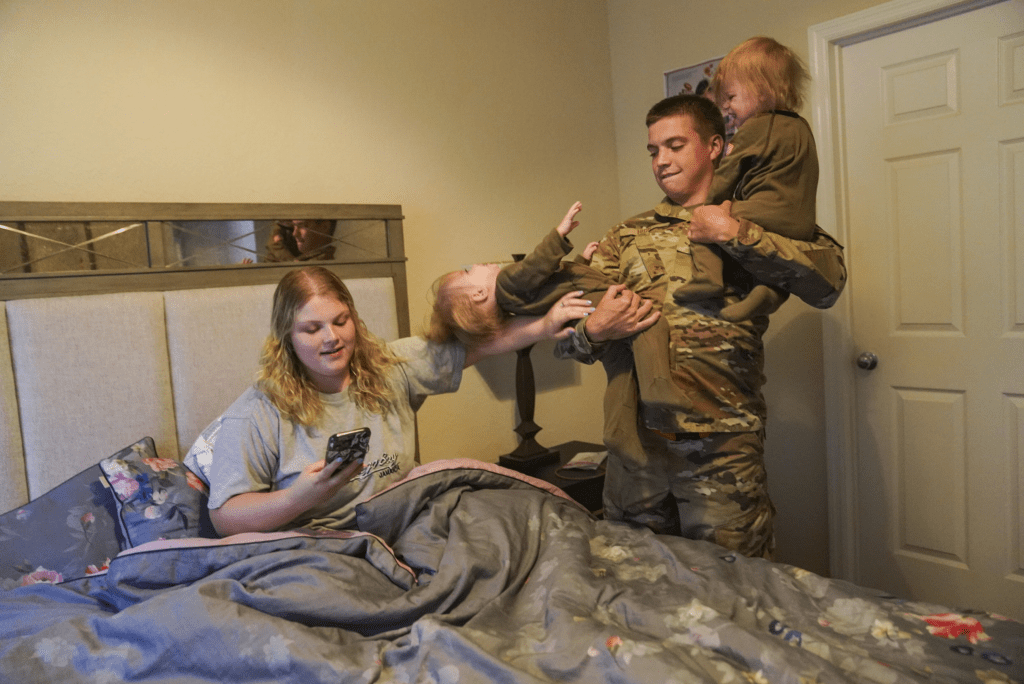
This is life two years later.
Deep Reads features The Washington Post’s best immersive reporting and narrative writing.
TAMPA — Brooke High was not ready to face her family. Sitting on the edge of her bed, hair dripping wet, the 19-year-old listened to her twin daughters cry in their high chairs on the other side of the door. One hurled what sounded like a plate. Then a bottle.
Her husband, Billy High, also 19, was supposed to be watching them. But Brooke could hear one of his TV shows playing on his phone.
She waited a few minutes, reminding herself of everything their marriage counselor had told her. Treat your partner as you would want to be treated. Soften your tone. Don’t yell.
She heard Billy finally take the girls out of their chairs. Then came a loud splash.
Brooke rushed toward the sound of her daughters, stepping over flecks of scrambled eggs and Pop-Tarts from the girls’ breakfast. One of the twins ran out of the bathroom, crying and drenched in toilet water.
“I told you to put the dishes in the dishwasher, and you stood here for 30 minutes,” Brooke said to Billy. “And then while you weren’t watching the girls they got into the damn toilet.”
“Are you going to give them a bath?” she said.

When Brooke met Billy at a skate park in Corpus Christi, Tex., in May 2021, she could not have predicted any piece of the life she was now living. She’d been gearing up for real estate school, enjoying long days at the beach with her new boyfriend. Then she found out she was three months pregnant. And because of a new law, she could no longer get an abortion in Texas. The closest clinic that could see her was in New Mexico, a 13-hour drive away.
She gave birth to Kendall and Olivia six months later.
Brooke, Billy and their baby girls appeared in a story in The Washington Post just days before Roe v. Wade was overturned last summer, thrusting the family into a polarized national debate and turning them into symbols they never imagined they’d become.

This Texas teen wanted an abortion. She now has twins.
For many readers, Brooke and Billy’s story was a Rorschach test, with each side of the abortion debate claiming the teenagers’ experiences as validation of their own views. Sen. Ted Cruz (R-Tex.) called the story “powerfully pro-life.” Abortionrights advocates decried the Texas law that compelled an ambitious young woman to abandon her education and raise two kids on the $9.75 an hour her then-boyfriend made working at a burrito restaurant. People on both sides of the issue donated more than $80,000 to a GoFundMe account that Brooke created, providing a financial cushion the couple says has kept them out of debt.
At the center of the abortion debate is the question of how an unwanted pregnancy, carried to term, reverberates through the lives of those directly involved. The most prominent study on the subject, conducted by a pro-abortion-rights research group at the University of California at San Francisco, included interviews with nearly 1,000 women over the course of eight years. The study, which was published as a book in 2020, found that women who are denied abortions experience worse financial, health and family outcomes than those who are able to end their pregnancies.
Brooke’s future is still uncertain. After her daughters were born, she and Billy got married and moved into a two-bedroom apartment more than 1,000 miles away from South Texas, the only home they’d ever known.
If they didn’t have the babies, Brooke and Billy both concede that they probably wouldn’t still be together. Their teen romance would have flamed and faded, remembered by a few Instagram posts and the pink-wheeled skateboard Billy chose for Brooke at the skate shop by the bay.
Now, with two children, they are permanently linked.


Brooke is proud of the decisions she and Billy have made for their family. Billyis now a mechanic for the Air Force, where he enlisted so he could secure a steady income for his family, while Brooke cares for the girls full time. The twins are healthy and happy, absorbed by weekly swim lessons and the bedtime stories Brooke and Billy read aloud every night. At their one-year checkup, Brooke swelled with pride when the doctor called her daughters “really smart.”
But standing in her kitchen one morning in late May, listening to Billy run the bath for the twins,Brooke also recognized how quickly it could all fall apart. She and Billy fought often — about the messes he left her to clean, the hours he spent playing video games — and she knew they couldn’t manage without his $60,000-a-year military salary. She’d dropped out of real estate school without another career plan in mind.
“It’s a little bit scary,” Brooke said. “Billy and I haven’t been together that long.”
She doesn’t understand why some antiabortion activists see them as the ultimate success story.
“It doesn’t make sense to me that we would be that shining example.” Their lives, she said, were “so imperfect.”
In their Tampa apartment,Brooke could hear Billy blowing kisses to Kendall and Oliviaas they sloshed around in the bathtub, shrieking in delight. It was one of the things she loved most about him: He could always make them laugh.
Brooke gave her husband a half-smile when he reappeared in the doorway — a small reminder, she hoped, that she was still the freckle-faced girl he’d fallen for, not just the angry mother always making demands.
Billy picked up his phone without looking at her.



After Billy graduated from basic training for the Air Force last summer, the family moved across the country in the fall for his new job at a Florida military base.
Brooke and Billy made the long journey from Texas to Tampajust after Thanksgiving last year. They packed everything they owned into a U-Haul and drove 18 hours toward the promise of a new life.
Brooke couldn’t imagine a better military assignment. Florida was blue skies and theme parks, long sandy beaches with turquoise waves — far from her mother’s judgment and the same roads she’d driven down thousands of times.
In the passenger seat, she tried to absorb the changing landscapes speeding past her window. The French spellings in Louisiana. A sign that welcomed her to “Sweet Home Alabama.” The towering pine trees she craned her neck to see as they finally crossed into Florida. In 19 years, Brooke had spent just one week outside Texas.
“We’re moving to Florida!” she or Billy would say out loud every few hours, flashing the other a big smile.
They were really leaving, she kept thinking to herself. Even with two babies, she’d made it out.
Press Enter to skip to end of carousel
Four years reporting on people affected by abortion laws
Washington Post reporter Caroline Kitchener has covered abortion for more than four years. She spends a lot of her time traveling across the South, reporting from the states most affected by the fall of Roe v. Wade. In addition to her coverage of abortion-related laws and court cases, she strives to tell the stories of people at the center of it all.
Caroline has made three trips to see Brooke and Billy High in both Texas and Florida since she first met the couple in Corpus Christi in May 2022, following them as they went about their daily lives. She wrote a story about the couple and their twin daughters in June 2022.
Caroline kept in touch with Brooke over the following year. Readers would frequently ask for updates on the young parents — which prompted Caroline to continue her reporting.
1/3
End of carousel
For a few weeks, Tampa was bliss. Brooke made frequent trips to Target, happily selecting items to furnish their first home together — pots and silverware, a shower curtain covered in pink flowers. She felt that she was doing everything right as she chopped vegetables on her granite countertop, preparing a healthy meal for her family.
In the evenings, after Billy got home from the base, they’d sometimes take a picnic to a nearby soccer field, letting the girls run in circles while they lay on their backs and looked up at the sky.
“I love you,” she’d tell him at least once a day.
Billy would respond as he always had: “Love you more.”
Then, slowly, Brooke felt something shift between them. At first, she blamed a change in Billy’s schedule. He switched to working nights, leaving her alone with the babies from 2 p.m. until after 11.


Every time he walked out the door in his uniform, she felt crushed by the prospect of the next nine hours. The babies were too mobile to take them almost anywhere without help. At the playground, they would shoot off in different directions — Olivia clawing her way up the jungle gym stairs while Kendall teetered on the edge of the platform — and Brooke couldn’t be in two places at once.
Her life quickly started to feel like an endless cycle of tasks, entirely predictable and stretching out into infinity. Cook lunch. Clean up. Play with the girls. Put the girls down for a nap. Change diapers. Cook dinner. Clean up. Repeat.
To get through it, Brooke would play reruns of “Friends” on the TV in the background, comforted by the voices of characters she felt like she knew in a city where she knew almost no one. In her first twomonths in Tampa, she watched all 10 seasons.
Brooke missed her husband desperately, but as the weeks wore on, she worried he wasn’t missing her back. She tried to keep her texts casual — “hey, how’s your day?” — hoping he would respond with the validation she needed: “I miss you, baby” or “Just a few hours until we’re together again.” Instead, he’d dash off a quick “work’s good” or, “it’s fine.”
Once Billy got home, he was often too tired to talk.
Sometimes she would call her dad, Jeremy Alexander, for advice, worried about how Billy seemed to check out other girls. Just like Billy, Alexander had his first child, Brooke’s older brother, as an 18-year-old skater kid in Corpus.
“Look, boys are boys,” he said he would tell her. “Give him time to be a man.”
Brooke was eager to give her life structure — to put concrete plans on the calendar and break up the long days. She’d thought about going back to school, but it didn’t seem possible with the girls at home. She worried about leaving them with strangers — and they couldn’t afford day care anyway. The GoFundMe money, which they’d used in part to furnish their apartment and pay off Brooke’s car, was already running low.
Eventually, she posted a message on a Facebook group for local military wives.
“My name is Brooke and these are my twin daughters,” she wrote, attaching pictures of her and the girls. “We moved here in December and haven’t had any luck finding friends. If anybody would like to get coffee, workout, or have a play date please let me know!”


Until she arrived in Tampa, Brooke hadn’t fully appreciated how much support she had in Corpus Christi. They’d lived with Billy’s dad, and her mom was a 10-minute drive away. Someone was always around to watch Kendall and Olivia.
Brooke thought she and Billy needed time to reconnect — a few softly lit hours away from the babies, laughing with each other, lingering long after dessert.
She was thrilled when a new friend volunteered to babysit.
When Brooke arrived at her friend’shouse on the night of the date, she said, she noticed a few extra cars parked outside. Her friend’s husband opened the door with a bottle of tequila in his hand, a group of people drinking in the room behind him.
Brooke recalled handing over the girls, trying to focus on the night ahead. The deep conversation and the romance. She’d spentover an hour getting ready, pulling her hair back with a ribbon and donning the flowery sundress she’d worn the day they got married.
“I think they’re gonna be fine,” Billy recalled assuring her as they drove away.
But Brooke couldn’t shake the image of her baby girls plopped in an unfamiliar place, reaching for their mother.
“I’m just not okay with it,” she said she told him. “We have to turn around.”

Billy put his hands on his knees and looked down at the concrete quarter-pipe, the hot Florida sun beating down on his back.
He’d tried the same skateboard trick at least 30 times already, his phone perched on a nearby ledge, recording every failure.
“Commit or go home,” he said to himself in an empty skate park at 11 o’clock on a Sunday morning. “Commit, right here.”
But it was hard to commit without his friends around him, as they’d always been in Corpus. Sometimes he’d try to zero in on a stranger passing by. “This one’s for you,” he’d say under his breath, telling himself they were watching, even when he knew they weren’t.
Their marriage counselor had encouraged Billy and Brooke to take time for themselves — for him, a trip to the skate park; for her, an hour working out at the gym.
They’d started seeing the counselor in April, after one of their worst fights. And while Billy appreciated the counselor’s advice, he still felt a little guilty every time he came to the park. Especially in moments like this, struggling to land trickshe’d done before, he wondered whether skating was worth the extra hours away.
Back home, Billy had proudly counted himself among the Corpus Christi “park rats,” often heading to the skate park around noon with a tripod and a Tupperware of watermelon. His friends would scream his name when he pulled up in his car, coming over to talk through the tricks they might try together. When the skating was good, they’d stay for eight hours, leaving well after the sun went down.


Billy and Brooke met at a skate park in Corpus Christi, Tex., where they would spend days hanging out with a big group of friends.
Before he met Brooke two years ago, Billy had planned to live in Corpus forever, skating with his friends whenever they weren’t working. Then Brooke got pregnant.
At first, he wanted her to get an abortion. But he wasn’t going to push.
It was Billy’s idea to join the military. He wasn’t excited about it, but he couldn’t see another way to support a wife and twins. Everyone in his life — his parents, his favorite teacher — told him it was the right thing to do. So Billy committed, marrying Brooke at the courthouse last summer and signing an Air Force enlistment contract that would keep him in uniform for the next six years.
That was something he’d learned from skateboarding: You go for it, or you don’t.
Soon Billy was waking up to a loudspeaker at 5 a.m. at a basic-training camp in San Antonio, hustled out of bed with 43 other guys to do push-ups and run circles around a track. Every day he stood at attention, head shaved, right arm outstretched, for what felt like hours, waiting for an instructorto look him over from head to toe.
At night, Billy would lie in his cot and think of his girls back in Corpus Christi. Kendall and Olivia had just turned four months, old enough to wrap their tiny hands around his index finger. He would imagine Brooke’s blond curls, wishing he could get her advice on whatever he’d struggled with that day. His wife, he said, was one of the smartest people he knew.
“I miss you and our beautiful girls so much to the point that whenever I think of y’all, my eyes water or it feels like I need to cry,” he wrote in a letter after his first week of basic training. “I think about you every day and I wonder what you’re thinking of.”
Before he left to go back to Corpus, Billy got Kendall’s and Olivia’s names tattooed on his chest.


Returning home in his military fatigues, he wasn’t the kid at the skate park anymore. He was the man ready to show his commitment.
“I felt more able to take care of them,” he said. “I felt like I could do anything if I wanted to.”
Six months into his life in Florida, Billy felt proud to flash his credentials at the base gates. As an airman first class, he spent hours every day burrowed deep inside his assigned plane — the KC-135 aerial refueling tanker — inspecting the electrical and hydraulic systems. After two months of technical school, he could help fix most problems and send the plane on its way. (Billy was careful to say that his views do not represent the Department of Defense.)
But as much as Billy appreciated his new job, there were moments when he allowed himself to imagine a different life. If he didn’t have kids, he might be sharing an apartment with a few friends from the skate park, he said, moving on from the burrito place to Walmart, where the pay was better. Skating every day. Partying at night. No worries.
Those thoughts usually surfaced after Brooke yelled at him. Sometimes Billy knew he deserved it — he acknowledged that he probably did play too many video games — but other times he really felt like he didn’t. They would fight about money, especially toward the end of the month when they had to dip into savings for groceries. Most often, he said, they would fight about the babies, with Brooke accusing him of not doing his fair share.
“Once you’re put under all that pressure, you don’t want to be there anymore,” Billy said.


Some nights, he would go sit in his hot car, the lights and the engine turned off so Brooke couldn’t see him. There, he would consider the logistics of leaving, where the girls would go. To keep them with him, he’d have to switch to a day shift and figure out a way to pay for day care.
More likely, Brooke would take the girls back to Corpus. She would be miserable, he thought, probably living with her mom and resenting her lack of freedom, raising two babies alone.
And he would be without them.
Billy said he loved being a dad. He liked to lie on the floor of the girls’ room and feel the weight of his daughters as they climbed on his chest. When he threw them up in the air and caught them in his arms, they looked at him like he was the most important person in the world.
Kendall and Olivia made him feel good about himself and the choices he’d made. Walking through the aisles at the grocery store, tattooed arms holding two baby girls, he knew people were looking at him, impressed. He was proud of all the ways he defied their expectations.
After an hour at the empty skate park, Billy was ready to head home. His daughters met him at the door, holding up their arms for him to lift them up.
“Billy, will you put them to bed?” Brooke asked.
Of all the chores in his new life, this was one of his favorites.
One at a time, he held his daughters to his chest, kissed them on the cheek and laid them down.

When Brooke arrived for the girls’ weekly swim lesson, the other mothers were already in the pool. No matter how much extra time she allotted, somehow she and Billy were always late.
“I’m so sorry,” Brooke said, holding Olivia as she lowered herself into four feet of tepid water.
Brooke nodded vigorously as the swim coach rehashed the first round of instructions, eager to do exactly as she was told. She was acutely aware of the three other moms in black one-pieces, who all looked around 30. Between activities, they would chat among themselves, discussing their favorite jewelry stores and the habits of their doctor husbands.
Brooke wanted to impress them — to prove to them that the 19-year-old in a white bikini was actually a great mom.
While Billy had grown accustomed to approving smiles, Brooke knew to expect judgment everywhere she went. Receptionists whispered to each other when she walked in for medical appointments, wide eyes shifting from her to the twins. She’d always wonder whether they could tell how young she was, if they somehow knew she dropped out of high school.
Even her own mother, who helped convince her to have the babies, still seemed to judge the way Brooke was raising them, Brooke said. When they spoke on FaceTime, her mom would sometimes criticize the clothes Brooke chose for them or the way she did their hair.
Just once, Brooke wished she could be brave enough to say out loud the words she rehearsed when she was alone:
“Regardless of how I look, I’m f—ing doing it. So think whatever the f— you want.”
Brooke’s mother, Terri Thomas, said she is “very proud” of Brooke and Billy.
“They are doing an amazing job as parents and as young adults,” she wrote in a text message.
Brooke was determined to do a better job than her own parents, who she said sometimes left her to care for herself.Her dad gave her a cellphone at age 10, she and her father recalled, allowing her to hole up in her room for hours, staring at a screen. Soon after that, she said, she got a Facebook message from a much older guy who seemed friendly. A few days later, when he asked for a naked picture, Brooke sent him one.
“I’ll never forget about that,” she said. “I saw a lot of things I shouldn’t have seen, things I never want them to see.”
More than almost anything else from her childhood, Brooke said, she remembered the arguments — people throwing things through windows and punching walls. Someone was always yelling.


As she watched the girls sleep, Brooke would think through the promises she’d made to them. Kendall and Olivia would always feel safe in their own home. They would wake up every day and know, without a doubt, how much they were loved.
But there were other things Brooke wanted for her daughters that she could not control or guarantee. At the top of the list: two parents who loved each other — or, at the very least, parents who stayed together.
Brooke still thought about the night, back in March, when Billy suggested they split up.
The fight had started at the beach, when Brooke saw Billy’s eyes lingering on a girl in a bikini. He denied looking at the girl, promising he wasn’t interested in anyone else — which just made Brooke angrier.
“You’re not going to gaslight me when I saw you doing it,” Brooke remembered saying as they drove home, twins in the back seat.
Brooke had worried about other girls ever since they got together. Anxious about losing Billy, she fixated on every pretty girl he knew from work or messaged on Snapchat. Especially now that she and her daughters relied on him completely, her deepest fear was that he might find someone he liked better.
Back at their apartment, Brooke wasn’t interested in hearing Billy’s apologies.
“I don’t want to see you,” she remembered saying. “I don’t want to sleep next to you.”
Then Billy came right out with it: “I think we should get a divorce.”
They both froze as soon as he said it, they each recalled, absorbing the shock of hearing something they’d both privately considered but assumed they’d never say out loud.
“How is that even an option at this point?” Brooke said. “Where am I going to go? What’s going to happen to us?”
Billy got quiet, then left to go sit in his car.

Brooke and Billy rarely think about the new laws that led them to this moment. Even on June 24, the first anniversary of the Supreme Court ruling that overturned Roe v. Wade, the abortion issue was just a passing thought.
“If I see it on the news, I’m like, ‘Yeah, that’s why I have two kids today,’” Billy said. “I think that for like a split second, then I move on.”
“Me too,” Brooke said. “I don’t really dwell on it.”
“If you’re not planning on having a kid,” Billy said, “abortion is much cheaper than raising people.” The new laws, he added, “create not a good situation to be in.”
But then he thought about Kendall and Olivia, and shook his head.
“I don’t know,” he said. “I’m tired.”
In the almost two years since Brooke and Billy ran up against the Texas abortion law — a novel statute that circumvented Roe months before it was overturned — more than a dozenother states have halted all or most abortions. The Texas law, which banned the procedure after about six weeks of pregnancy, has likely resulted in at least 9,000 extra live births, according to a recent study, making Brooke and Billy an early example of a family compelled into existence by an abortion ban. It’s too early to know how many babies were born becauseof the fall of Roe.
Back in August 2021, Brooke called an abortion clinic as soon as she found out she was pregnant. But it had no open slots, overwhelmed with patients racing to end their pregnancies before the new law took effect less than 48 hours later. Instead, Brooke got an ultrasound at a local crisis pregnancy center, not knowing that it was an antiabortion organization. There, employees told her she was 12 weeks along — far enough into her pregnancy, they said, that the babies had“heartbeats.”
She decided not to make the drive to New Mexico.
Now, at home in Tampa, Brooke stared at the wall, clutching a pillow to her chest.
“If I would have had the abortion …”
She stopped.
“I can’t even think of it that way now,” she said. “Those are our babies, and they’re people.”
Still, Brooke said, she felt sick thinking of all the young girls forced to carry pregnancies they didn’t want.
“If you really didn’t want something, and then you’re forced to go through with it … it’s still really very hard,” she said.


Lately, Billy had started to talk about having a son. He wanted a little boy he could teach to change a tire, he said — a sidekick for what he called “boy things.”
When Brooke thought about it, sometimes the idea of another kid didn’t seem so crazy.
After their fight in March, Brooke and Billy had started weekly marriage counseling sessions. With the girls asleep in the next room, they’d sit in bed and FaceTime with the counselor, Brooke’s phone propped up on a plastic bin.
The counselor offered concrete suggestions for how to work through their conflict and move forward. Billy should try to be more communicative; Brooke, more trusting.
The sessions seemed to be helping, Brooke said. She and Billy were talking more, laying plans for their future. They would live in a blue house with a white fence one day, they’d recently decided — with a porch swing and a skate ramp in the backyard. The twins would follow their dad outside with pink skateboards and matching pink helmets.
But it was too early to be sure of any of that. Before Brooke brought another child into their family, she said, she needed to know their foundation was strong.
As soon as the girls were born, she’d gone to her doctor to get an IUD.
She had no plans to remove it.

Brooke sat cross-legged on her bed and stared at her phone. Any second, it would light up with an unknown number. She’d been rehearsing what she would say all day.
“Be confident,” she’d written in her Notes app that morning. “Call within two minutes if they don’t call.”
The call was with a career coach, one of the final steps required to sign up for an online education program for military spouses. If she completed therecommended20 hours of work every week, Brooke learned, she could become a licensed personal trainer and nutritionist in less than five months — and then start earning $25 an hour.
Since she moved to Tampa, she’d seen the same advertisement pop up on her phone again and again: a photo of a man in uniform, lifting up a woman in Keds and skinny jeans. “No cost for education,” the ad said.
For months, Brooke had stopped herself from clicking on it. Why get all excited if she couldn’t make it work?
Butlately she had started to think about school differently: less as a luxury, more as a way to reclaim power over her life.
She attributed at least some of her newfound resolve to Judge Judy, whom she’d watched regularly since she was a kid. Sometimes, after a fight with Billy, she would hear the judge’s voice in her head, as she remembered it: “Always make sure you can support yourself,” Brooke recalled her saying to women who appeared in her courtroom. “Do not put yourself in a vulnerable position.”
As optimistic as Brooke felt after each counseling session with Billy, she knew there were still no guarantees.


When the call came, Brooke picked up on the second ring. She told the coach why she wanted to be a personal trainer, just as she’d practiced.
“I think it would be a good fit for me,” she said. “As for goals, I’d love to complete the program, pass my exam and just learn a whole bunch of new things I didn’t know before.”
The program would help her find a job, the career coach promised. But when he walked her through a preliminary search for personal-trainer positions in Tampa, nothing came up.
“No, I don’t see …” the coach said. “There’s hairstylist, personal assistance provider …”
Brooke tried not to feel discouraged. When she hung up, and Billy asked her how the call went, she smiled.
“It’s really exciting,” she said. “It was a little scary, but I feel like I did good.”
As her husband kissed her goodbye and walked out the door in his uniform, Brooke imagined what it would be like to leave the house on her own every day — to drive to her own job and get her own paycheck.
She opened an email from the career coach and started filling out her forms.
Greg Abbott and Our Call To Hospitality
How cruise ships got so big
Cruise ships are freaking big. They’re the biggest passenger vessels humans have ever built. In size and appearance, they look nothing like almost any other boat. So how did they get that way?
The predecessor of today’s cruise ships was the ocean liner: big, beautiful ships that sailed across the Atlantic. But ocean liners had a totally different purpose from cruise ships: They were for transportation. Everything about them was designed to facilitate an ocean voyage from one continent to another.
But air travel changed that. Planes eliminated the main reason to take a ship somewhere, and ocean liner business plummeted. So the industry pivoted and began selling a ship as the destination itself. The cruise ship was born. But the ocean liners, built for a voyage, weren’t ideal for the purposes of a cruise, and over the next few decades, the cruise ship began its evolution. And it has culminated in the behemoths we see today.

