that according to my email from WordPress on 7/10/24, I was added as an author on Scottie’s Playtime. My mission, as I understood it, is to post some posts often to keep the blog lively while Scottie recuperated from a thing, to keep track of and acknowledge/reply to comments, to thank other bloggers who link to us, and to make sure that readers who feel marginalized know we see them and want to see them here at Playtime. Scottie has the blog mission statement linked up above. I hope I’ve been doing that, and I’m so complimented by Scottie’s continuing support of the stuff I do here. I always want to make sure everyone knows I’m an old woman ally who has plenty of free mom hugs, and I also make some excellent chocolate chip cookies that are not only excellent, but healthful, and I love to share. All are welcome here.
I am up for suggestions on material, too! I’ve been posting the Peace & Justice newsletters here for a year, so they will be becoming redundant. I’m wondering about culling a little something from each one, and maybe posting them weekly, though I’m not adverse to continuing as I am. The one thing about it, some of their links are no longer active, so I’m able to search for newer info and use those links, but otherwise, the newsletters are much the same each year. (I’ve been reading and sharing them since 2002. Not here since then, but other places.😄)
I’ve really been enjoying the Queer History Substacks! I like some lusty language with my facts. However, is there something I can do to make those easier on readers? Let me know!
So, again, I’m humbly pleased that Scottie lets me post here on his blog, and is so supportive of it. I hope to continue for at least the upcoming year, and am always up for suggestions. And comments. And chocolates.
Lisianthus- I think there’s a blue variety ( common name is Texas Bluebells) but I’ve never seen it – I’m familiar with this creamy looking little jewel. Very little fragrance. That’s surprises me- they look like something that would smell good!
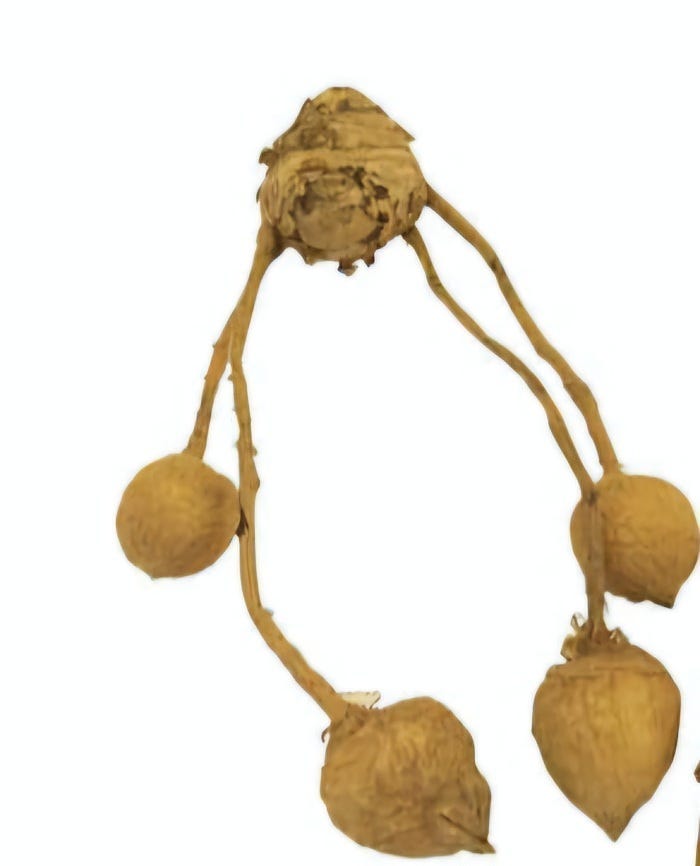
Curcuma alismatifolia – common name Siam Tulip. It’s not a tulip but it is from Laos which I’m guessing used to be Siam. Related to turmeric. The blooms are fetching and persistent.
The best thing about Siam Tulips are the bulbs-
What the hell? How did this happen? They’re just asking for trouble.
This Rudbeckia is astonishing
I grow hosta for the variegated leaves. I’m surprised every year at the beauty and the fragrance of the blooms.
“ Double Dutch” Asiatic Lily – I don’t know if there’s anything more orange.
Gladiolus!
Not a daylily fan, usually, but these are irresistible!
July 7, 1863 The first military draft was instituted in the U.S. to provide troops for the Union army in the American Civil War. Once called, a draftee had the opportunity to either pay a commutation fee of $300 to be exempt from a particular battle, or to hire a replacement that would exempt him from the entire war.
July 7, 1903 The March of the Mill Children watch a video – highly recommended Labor organizer Mary Harris “Mother” Jones led the “March of the Mill Children” over 100 miles from Philadelphia to President Theodore Roosevelt’s Long Island summer home in Oyster Bay, New York, to publicize the harsh conditions of child labor and to demand a 55-hour work week. It is during this march, on about the 24th, she delivered her famed “The Wail of the Children” speech. Roosevelt refused to see them. “Fifty years ago there was a cry against slavery and men gave up their lives to stop the selling of black children on the block. Today the white child is sold for two dollars a week to the manufacturers.” –from Mother Jones’s autobiography Read more about Mother Jones
July 7, 1957 Convened at the onset of the Cold War, a group of scientists held their first peace conference in the village of Pugwash, Nova Scotia, Canada. The mission of the Pugwash Conference was to “. . . bring scientific insight and reason to bear on threats to human security arising from science and technology in general, and above all from the catastrophic threat posed to humanity by nuclear and other weapons of mass destruction . . . .” Bertrand Russell Wealthy industrialist and Pugwash son Cyrus Eaton had invited the world’s greatest minds to his family home in Nova Scotia and address the emerging threat of nuclear war. The Conference became the basis for an ongoing organization that deals with issues of weapons of mass destruction. The 1995 Nobel Peace Prize was awarded to Joseph Rotblat (one of the original signatories of the Pugwash Manifesto) and to the Pugwash Conferences on Science and World Affairs. Albert Einstein Pugwash home
Fifty years later . . . 25 scientists, diplomats and former military officers from 15 countries gathered for a “Revitalizing Nuclear Disarmament” strategy workshop. The meeting was held near the Thinkers’ Lodge, the site of the first meeting in 1957. “Fifty years ago from Pugwash, Nova Scotia, nuclear scientists helped alert the world to the dangers of nuclear weapons, and especially the newly developed hydrogen bomb,” said Paolo Cotta-Ramusino, Secretary General, Pugwash Conferences on Science and World Affairs. “Today, we are working with experts from around the world for global action to revitalize nuclear disarmament and the final elimination of nuclear weapons.” Senator Roméo Dallaire, Honorary Patron of the Pugwash Peace Exchange, said “It is appalling to observe the increasing potential for many regional nuclear arms races, shameless plans to modernize nuclear arsenals and bald-faced threats of pre-emptive nuclear use,” said Senator Dallaire. “Only by revitalizing discussion and implementation of disarmament leading to abolition can we ensure that these genocidal devices will never again be used.”
July 7, 1977 The United States conducted its first test of the neutron bomb. The neutron bomb was a tactical thermonuclear weapon designed to cause very little physical damage through limited blast and heat but was designed to kill troops through localized but intense levels of lethal radiation. A neutron bomb explosion at a test site
July 7, 1979 2,000 American Indian activists and anti-nuclear demonstrators marched through the Black Hills of western South Dakota to protest the development of uranium mines on sacred native lands.
July 6, 1892 In one of the worst cases of violent union-busting, a fierce battle broke out between the striking employees (members of the Amalgamated Association of Iron and Steel Workers) of Andrew Carnegie’s Homestead Steel Company and a Pinkerton Detective Agency private army brought on barges down the Monongahela River in the dead of night. Twelve were killed. Henry C. Frick, general manager of the plant in Homestead, near Pittsburgh, Pennsylvania, had been given free rein by Carnegie to quash the strike. At Frick’s request, Pennsylvania Governor Robert E. Pattison then sent 8,500 troops to intervene on behalf of the company. Read more (2 links)
July 6, 1942 In Nazi-occupied Holland, thirteen-year-old Jewish diarist Anne Frank and her family were forced to take refuge in a secret sealed-off area of an Amsterdam warehouse under threat of arrest and deportation to a concentration camp by the Einsatzgruppen (Task Force), a part of the German Gestapo. The Anne Frank Center for Mutual Respect
July 6, 1944 Irene Morgan, a 28-year-old black woman, was arrested for refusing to move to the back of the bus eleven years before Rosa Parks did so. Her legal appeal, after her conviction for breaking a Virginia law (known as a Jim Crow law) forbidding integrated seating, resulted in a 7-1 Supreme Court decision barring segregation in interstate commerce. Irene Morgan More about Irene Morgan June 3, 1946: Morgan v. Commonwealth of Virginia Zinn Ed Project
July 6, 1965 As many as 500 students in Berkeley, California, attempted to block trains carrying troops destined for Vietnam along the Santa Fe Railroad tracks; there were no casualties. Organized by the Vietnam Day Committee, this was the first civil disobedience at UC-Berkeley against the Vietnam War.
I just ran across this in my SBTB email. It belongs here. Doesn’t look like it embedded (it didn’t on SBTB, either,) so click through on “View this post…” and make sure the sound is on. A very worthy click.
I didn’t get any posts set up last night for today. Ollie got a little overheated yesterday during our walk, and I wanted to watch over and care for him to make sure he’s all right. I just didn’t get to setting up posts. (I feel as if that will be a relief for eyes on the blog! But anyway.) He is fine; he’s not taking the fireworks real well, and for some reason doesn’t want his morning walk today, either, which is different, but I’m letting him lead on that. Fireworks don’t begin until 10AM here, so so far, so good on that. Anyway, that’s what’s up here. I hope all are managing to stay healthily cool enough, and taking good care to hydrate well, and screen the UV rays. And that the fireworks aren’t irritating! 🎆
Losing a pet is a unique kind of heartbreak, one that can feel both profound and invisible. To help bring comfort, we spoke with Patricia Denys, MFA, a compassionate voice in the world of pet grief and healing.
Patricia is an artist, animal activist, creative director of Animal Culture magazine, educator, yogi, vegan, and an interfaith, interspecies animal chaplain ordained by the Compassion Consortium. She’s also a great friend of MUTTS.
In this conversation, Patricia shares her perspective as an animal chaplain on navigating loss, offering support, and finding gentle ways to honor the journey. Whether your pet recently crossed the Rainbow Bridge or you’re reflecting on a loss from long ago, we hope this conversation brings you some clarity, comfort, and connection.
Understanding the Role of an Animal Chaplain
Can you explain what an animal chaplain does?
An animal chaplain helps animals live their fullest lives and helps them transition when it is time. They offer help to animal parents, animal care workers, and animal people in general, navigate stress, grief, and compassion fatigue. Animal chaplains also encourage stronger human-animal (interspecies) bonds, individually and communally. Animal chaplains offer help with end-of-life care, decisions and rituals (interfaith), and bereavement support. An animal chaplain is also there for celebrations and victories for all animals and our planet!
How did you become an animal chaplain, and what drew you to this work?
Our magazine, Animal Culture, interviewed Reverend Sarah Bowen, co-founder of Compassion Consortium and Executive Director of their Animal Chaplaincy Training Program. The program is interfaith, interspiritual, and interspecies, which was important to me. Sarah was a wonderful interviewee, and I became quite interested in the program after connecting with her. It seemed intriguing and intelligent, and an organic next step on my path of a lifetime working with animals. It was quite a commitment of study and well worth it. My fellow students were amazing, compassionate people. It was a very positive experience.
What kinds of support do you offer to people who are grieving the loss of a pet?
The first thing is listening, while being a calming presence for different needs from different people. Using gentle questioning to see what arises for someone. Reminding people that laughter is good and healthy, and part of healing. And, working on realizing that one does not stop loving someone after the transition.
Hospice and Palliative Care for Companion Animals, edited by Amir Shanan, Jessica Pierce, and Tamara Shearer, is an excellent book. In one of the essays, the writer calls mourning, “…a transition from loving in presence to loving in absence.” We work on that as animal chaplains.
Why Saying ‘Goodbye’ to a Pet Is So Painful
Why do we often feel that losing a pet is just as painful — if not more so — than losing a human loved one?
Those of us who have experienced the pain of the loss of a companion animal, or any animal, know this pain all too well. Humans have intense bonds with an animal they love or one that is a part of their lives somehow. Animals’ lives are shorter than humans’. The shock of that short life being over can be very hard to process.
Companion animals also demonstrate stability and routine. A big void is created when these things come to an end. Animals are sentient. They are aware. We see that time and time again. We want to be with them and protect them; they are our family.
How can we respond to people who say, “It was just an animal” or who don’t understand pet grief?
It is very disappointing to hear, “It was just an animal,” from anyone, especially someone you respect or that is close to you. It is the last thing anyone wants to hear since it is so insensitive to one’s feelings and to the memory of the one who has passed. What someone grieving needs is validation that their feelings of loss for such a profound bond with an animal, are understandable and real. You may choose to say that or not.
What are some healthy ways to process and express grief after losing a pet?
Definitely seek support from friends, family, your veterinarian, and/or an animal chaplain. Animal grief is in our mainstream now. There is no shame in asking for help, ever. One needs to talk about the loss. It’s real.
Consider taking a workshop on animal loss or creating a shrine, memorial, art piece, or photo book. Volunteering is also a great, healthy way to heal.
Do you have any advice for someone who feels stuck in their grief or like they should have “moved on” by now?
“Moving on” is a very individual thing. There is no time limit on processing through one’s grief. Accepting the loss and adjusting one’s life accordingly takes time. You need to take your time. If you feel that you are experiencing symptoms of prolonged grief, a therapist can be of help.
Helpful Ways to Honor a Pet’s Memory
How can rituals or memorials help with healing? Do you have any suggestions for meaningful ways to honor a pet’s memory?
Oh, there are so many wonderful things you can do! Humans have always embraced rituals. It is a way to connect to something. A ritual may be something within your religious practices, your own spirituality that you find comforting, or the daily ritual of taking a walk with your dog. That is a ritual for both of you!
A memorial can be a powerful took for healing. It is a coping tool. It is a way to process. Creating an altar on a table for the one you have lost that includes photographs, something that was meaningful for that animal such as a toy, or adding flowers can be a positive expression of your feelings of loss. Re-wilding a small garden that encourages other animals to visit, or creating a small shrine you can carry with you are other ideas. Keeping a journal of your thoughts or sketches can also have a profound effect on healing. The simple act of writing to your loved one — what they meant to you, how much they are missed, what you enjoyed most about them, for example, is often a comfort.
As an artist and a teacher of art, I know creating art can be cathartic and healing, I conduct art workshops on loss and celebration of animals and the planet. They are for non-artists especially. It has been an incredible experience to see what people can create as a way to work out their feelings, and usually, how anxious they are to share with each other. It is a bonding experience about the power of love.
(snip-a bit MORE; click through on the title above)
It happened just a few weeks ago: Jim Obergefell was moving things in his office when he came across the ashes of his late husband, John Arthur, now 12 years gone. Arthur had last wishes for his ashes. Obergefell had yet to fulfill them.
“And it struck me that, oh, I am actually now mentally, emotionally ready to take care of John’s ashes,” Obergefell told The 19th. “It was the first time that I had that feeling so clearly and so strongly.”
Obergefell, 58, is ready to move on. Not exactly from the love of his life or the history-making Supreme Court decision that came after Arthur died. But certainly from the insecurities straight America was grappling with a decade ago about same-sex unions.
Obergefell is that Obergefell: the named plaintiff in the landmark lawsuit that extended marriage equality to every state in the nation in 2015. Ten years later, he celebrates that win and the many ways it rewrote his life. And in a time when LGBTQ+ rights are again under assault, he is looking to the future — of the queer rights movement and also his own.
A journey to the Supreme Court
Obergefell’s journey to the Supreme Court was hardly destined. It began 12 years ago, on June 26, 2013, when the Supreme Court struck down the Defense of Marriage Act, a federal law that prohibited the government from recognizing same-sex marriages.
Obergefell and Arthur had been together for 21 years at the time. The two had discussed getting married before. But they wanted it to be legal, and their home state of Ohio didn’t offer same-sex marriages.
Arthur was gravely ill with ALS, a progressive neurodegenerative disease, and he barely left his home hospice bed.
After the ruling, Obergefell leaned over to Arthur, hugged, then kissed him.
“Let’s get married,” he said.
Arthur agreed.
The logistics were not easy. Arthur was in no shape to travel, and the couple could not wed in Ohio. Obergefell researched and found that Maryland would let him get a marriage license even with only one of them present. But both would need to arrive in the state for the ceremony.
When friends and family learned about their predicament, they pooled together money to charter a medical jet for Arthur. The two flew to Baltimore. Over the course of 45 minutes, they exchanged vows on the tarmac before flying home.
“In the days that followed, we said the word ‘husband’ hundreds of times a day,” Obergefell said on the Decidedly Podcast in 2023.
But just five days later, their joy was muted when civil rights attorney Al Gerhardstein informed them that because of Ohio’s ban on same-sex marriage, Arthur would be listed as single in death.
Arthur and Obergefell were angry. The couple sued the state of Ohio in federal district court and won. Three months later, Arthur died.
The following year, Obergefell, still in mourning, lost on appeal. But he refused to believe he might lose altogether.
“I just kept going,” Obergefell said. “It was the right thing to do.”
On June 26, 2015, he won. For the country, the win was immensely practical. Many told Obergefell it gave them so much hope it saved their lives. For Obergefell, it meant a legacy for the man he loved.
“I made promises to John to love, honor and protect him, and I was going to keep doing that,” he said.
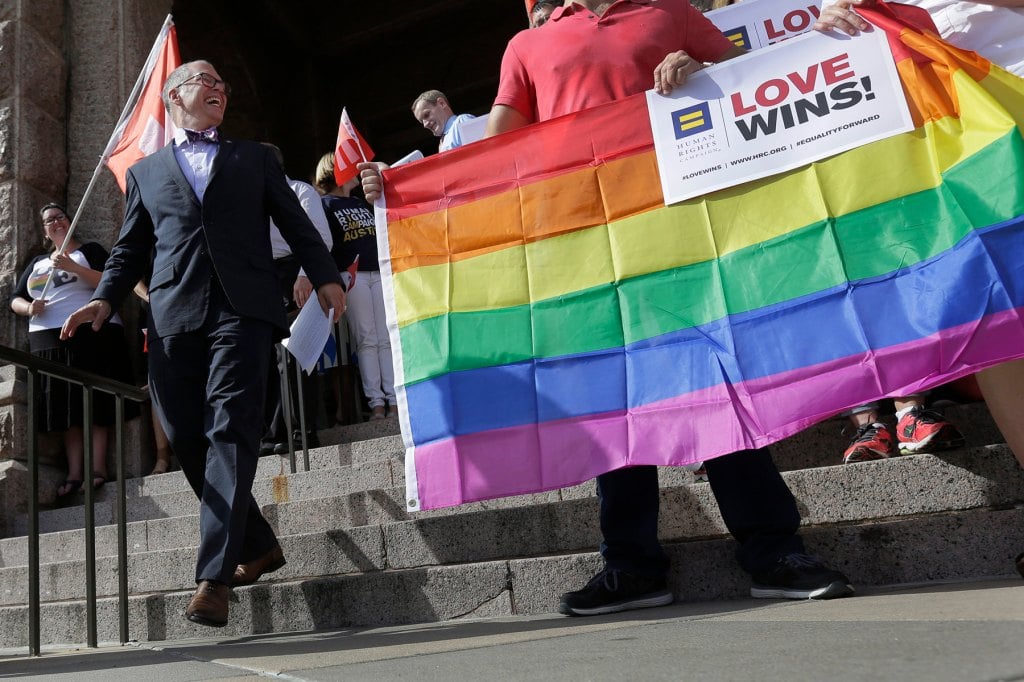
In the decade since Jim Obergefell won his Supreme Court case that made same-sex marriage federally legal, hundreds of thousands of same-sex couples have married in the U.S. (Eric Gay/AP Photo)
Changing history
It’s difficult to overstate the impact of Obergefell’s case on the nation or the world. Since the 2015 ruling, the Williams Institute at the UCLA School of Law estimates, 591,000 queer couples have wed, generating an estimated $5.9 billion in wedding spending for state and local economies.
It has also radically transformed Obergefell’s life. Introverted and unassuming, he has spent the last decade campaigning for LGBTQ+ rights. He helms Equality Vines, a wine company that donates its proceeds to advancing civil rights causes.
It’s a position that makes him deeply proud if not a little fatigued.
“I’m not tired of talking about it,” he said of the 10-year anniversary of the ruling. “I’m just physically tired from all of the interviews and the photographers and the speaking gigs and the events. Yes, I’m exhausted.”
For 12 years, Obergefell has kept Arthur alive through retelling their story countless times in courtrooms and for the media. That exercise, of telling and retelling, helped Obergefell process his profound loss.
But he has never recoupled. It wasn’t that Arthur didn’t want him to. In fact, Arthur told him regularly that he wanted him to find love again. He asked his friends and family to tell Obergefell that he wanted him to find love after he was gone.
“I know it was sincere, because he told me that he had other people tell me that,” Obergefell said.
It isn’t about the pressure he feels as the face of marriage equality, he said, though part of him wonders what it would be like to date after making history.
“I don’t know how to date,” he confessed. “I’m clueless when people flirt with me, and as much as I hate it, and I don’t go into any conversation or anything like this, but you know, there’s that part of me that sometimes wonders, you know, are they interested in me as a person, or are they interested in me as Jim Obergefell, named plaintiff?”
Obergefell’s name has become synonymous with marriage equality in the United States, an issue that has not always united the LGBTQ+ community. Some queer activists have argued that same-sex marriage was a misguided goal for the movement as queer youth continue to face high rates of homelessness and transgender people grapple with police violence and incarceration, among other issues.
More work to do
Obergefell, too, is worried that the needs of the community’s most vulnerable have gone unmet. He has watched horror-struck over the last five years as state legislatures have moved to restrict transgender rights.
“We need to fight for every marginalized community, because the queer community includes every marginalized community, and equality for one is pointless without equality for all,” he said. “I didn’t go to the Supreme Court just so White, cisgender, gay men like me could get married.”
Despite all of the setbacks in LGBTQ+ rights, and even threats to Obergefell’s game-changing victory, he is hopeful — and feels stronger than ever. People assume his case was difficult for him. It was, but the path was also obvious, to him and to Arthur. They loved each other.
“If we weren’t willing to fight for each other and for what was right, then what’s the point?”


















 Scottie's Playtime