
I have only a little to add to Janet’s eloquent observance post. But I want to say, especially to those who believe that people would not die if they kept “their business” to themselves, that these people were doing no more than any person does: they were just trying to get by. Every human bleeds the same color blood as every other human, and all of us humans are the same: human. It is way past time for people to be treating every other human as they themselves want to be treated.
Category: Love
Midweek Poetry
Personal Poem Esther Belin
When I walk around downtown Durango
I sometimes find myself searching for the location
Of shops and restaurants no longer there
With quiet intention, I will walk past familiar places:
Carver’s, Brown’s Shoe, Maria’s Bookshop
When in deep thought, I walk into the Animas
Chocolate Company – and like the numerous times
Before, the rows of truffles within the case
Deeply absorb me – the chocolatier’s artistry of
Small batch truffles, neatly arranged
Multi-colored, diversely shaped, shiny speckled &
smooth surfaced, gold dusted, nut-layered
globes rotate into my thoughts, a lasso spiraling
my focus like a funnel, like a warm caress leading me
by the hand, a lover’s scent lingering in the air
I do not buy a tray of truffles, nor an Americano coffee,
or any discounted chocolate tucked in the bin
by the east wall – rather I deeply absorb into
The something missing from this morning – the lingered
Yearning, the inability to coax last night’s thoughts:
Come forth & sing! Strands of hair beneath my pillow
Lost (or loose among) – inventoried in last month’s
Balance sheet – Did I?
O Asphyxiation – how You applaud My lapses
The lapping of consummating downtown walks
This evening there is a ruckus on Main St.
I lift my head, and see Nancy who just came from
The Pride event at the 11th St. Station
She’s covered with rainbow hearts &
We split one down the middle and pose
Click
Click
Click again
The goofiness, the anointing of laughter, the
Hug in broad daylight on Main St. in this
Mountain desert, tourist-tangled, tousled about
Like miners searching for a Mother-lode-of-
Gold town, the place I call home
Copyright © 2024 by Esther Belin. Originally published in Poem-a-Day on November 19, 2024, by the Academy of American Poets.
More Useful Info and a Couple More Resources
Originally published by The 19th
This story was published in partnership with Them.
Reached by phone in the days following the election, LGBTQ+ movement leaders promised they are more prepared than ever to face off against a second Trump administration.
“We’re ready,” said Heron Greenesmith, deputy director of policy at the Transgender Law Center, a civil rights organization. “We did extensive scenario planning, internal and external. We did safety planning internally. We did scenario planning with partners, cross movement, inter movement, trans specific, LGBT.”
For transgender Americans, the moment feels particularly vulnerable. President-elect Donald Trump has vowed to end what he has termed “transgender insanity” and cut Medicaid and Medicare funding to health providers offering gender-affirming health care on his first day in office.
The result is that many trans Americans are reeling, feeling that the country has elected a man set on wiping them off the face of the earth.
Responding to the election, Sarah Warbelow’s voice broke.
“There’s so much love,” she said. “Love is still out there, and that is not what this election was about.”
Warbelow isn’t transgender. But her daughter is. And as the vice president of legal for the nation’s largest LGBTQ+ rights organization, the Human Rights Campaign, Warbelow will be tasked with shoring up protections for queer Americans as Trump retakes office.
Warbelow’s tone turned from teary to defiant as she talked about a slew of political ads attacking transgender Americans, many of them run by Trump and his surrogates. They don’t represent the feelings of the nation, she said.
“A majority of voters found the anti-trans advertisements were just mean-spirited,” she said.
But Kierra Johnson, president of the National LGBTQ Task Force, one of the community’s largest organizations focused on field organizing and political change, said 2024 is nothing like 2016 when Trump was first elected.
“The strategies are already in motion across movements,” Johnson said.
“Yes, we should be worried,” Johnson said, adding that Project 2025, the blueprint for a second Trump term written by his former advisors, makes extremely concerning suggestions about how to approach LGBTQ+ rights. “They put it in black and white. If we don’t take that as serious, then that’s on us. Whether they execute or not, that’s something else.”
Advocates said there are a number of things trans people can do immediately to protect their rights and safety before January. Here’s how the nation’s LGBTQ+ leaders feel things will go in the top policy areas impacting trans people and how trans folks can prepare ahead of January 2025.
Identification and gender markers
For people who need updated gender markers on their identification or have already obtained them, Greenesmith advised looking at state laws first if there are questions.
“The laws in your state will impact a lot of everything else, including whether or not you can get your name and gender changed to match,” Greenesmith said.
Some have expressed fears that having an “X” gender marker on a driver’s license or passport instead of the formerly standard “M” or “F” will make them a target in the new administration. Advocates advise that deciding on a gender marker is an incredibly personal decision. Some noted that removing the “X” might make one feel safer, but would be unlikely to erase the paper trail of a gender marker change in government records. In other words, if a trans person was trying to change a marker to conceal their gender identity from the federal government, updating gender markers would likely have minimal impact.
Advocates for Transgender Equality has a full ID resources library with a state-by-state drop-down menu, as does Trans Lifeline, to help people navigate local laws. Both are nonprofit civil rights organizations.
The 19th will continue to provide guidance on IDs, documents and other paperwork as organizations release it.
Freedom to be
Perhaps the greatest fear many trans people have is that simply being transgender will be criminalized. While experts acknowledge that it’s reasonable to be scared, they expressed that the federal government doesn’t have the same resources states have to target transgender people individually on the basis of identity alone.
“When you look at the data and the polling, despite what people are pontificating about at this moment, the American public supports the existence of transgender people,” Warbelow said. Because Trump has shown himself to be incredibly fickle, it’s difficult to know at this point exactly what his plans are for carrying out his campaign promises. That said, Warbelow believes that the president-elect does care, on some level, about his popularity with the public.
Warbelow also believes that the administration does not have the levers to target transgender people in the ways that states have aimed to criminalize transgender life.
Greenesmith is quick to add that worst-case scenario fears are already a reality for many of the most marginalized queer people.
“This is why we can’t catastrophize at this moment, because catastrophization is white supremacy,” they said. “All the things that White people fear, Black people, Indigenous folks, migrants have been facing for centuries.”
Andrea Jenkins, a Minneapolis City Council member who made history as the first out Black trans woman elected to public office in the United States, said that for Black trans women, that also means coming together and rising up.
“What I will say to my sisters out there is we got to stand strong,” she said. “We’ve got to organize. We’ve got to build systems of support for each other.”
Moving
As some trans people consider relocating, “it’s not easy for people to just do that,” said Jamison Green, veteran trans organizer and health expert.
Whether people are considering a move out of the country, or out of state, advocates acknowledge that the laws impacting trans lives in real ways differ from place to place. The 19th will be reporting more deeply on these options in the weeks to come, but Green advises that people in states with trans-friendly laws will be far safer than states with anti-trans laws, if they are able to get to affirming states because so many of the policies impacting trans lives are decided at a state level.
No matter what, “get connected to community,” he said.
Organizations on the ground are ready to greet those who do need to move, said Jax Gonzalez, political director at LGBTQ+ statewide equality organization One Colorado.
“We know that we are a sanctuary state, and that there are many families who have been coming here from Oklahoma, Florida, Arkansas, Texas, you name it, Missouri,” Gonzalez said. “We want to ensure that those folks who do come here, that we’re doing everything that we can to ensure that they are protected and can thrive in community.”
Health care
Trump has vowed to cut off federal funding to health providers offering gender-affirming care to transgender people via executive order. Many fear this will mean the end of gender-affirming care like hormones, puberty blockers and surgeries for transgender people on Trump’s first day in office.
Before panicking, experts advise that this will be logistically complicated for the administration to pull off. For one, transgender people are protected by the Supreme Court’s 2020 Bostock v. Clayton County decision, which ruled that gender discrimination and sex discrimination are one in the same, meaning if the government barred gender-affirming care for a trans man, it would have to outlaw that same care (testosterone) for a cisgender man.
Further, Green said the feasibility of the federal government tracking everyone’s prescriptions would get complicated quickly.
“The volume of prescriptions that are written in this country, it would be very difficult and time-consuming and costly to track at a federal level.”
State controls would have more access, he added. Some people have worried that the administration could threaten pharmacists, especially when it comes to prescriptions for testosterone, which is a schedule III class drug. Off-label use would not be allowed. Green, again, thinks this would be challenging for the administration.
“Most drugs are used off label, and that’s a fact,” he added. “Medicine is an extremely complex field. It’s an art as well as a science … this is why we license doctors to use their medical judgment in applying the chemistry of pharmaceuticals to their patients to help them.”
Further, Trump attempted to gut transgender health care protections in the Affordable Care Act during his first term. The fight over those protections wound through the courts, and the repeal was finalized in 2020, only to be reversed by President Joe Biden, another rule-making process and fight that took four years.
In short, advocates said it’s difficult to anticipate how health care policy will play out. But whatever happens is not likely to happen immediately, and all major medical associations back gender-affirming care for transgender people.
Green said there is cause for concern.
“But I think we have to not just roll over and let them do it,” he said. “Whatever, they think they’re going to do, we have to stay fighting for people’s health and rights and social safety.”
Marriage and family planning
Marriage will not immediately be at risk in the new administration because of legal precedent and a 2022 law passed by Congress called the Respect for Marriage Act, which requires states to recognize LGBTQ+ marriages already performed, even those from out of state.
“If something changes in the future, there will still be time to get married,” said Warbelow. “That is not something the Trump administration has the power to undo it any immediate term”
Still, a couple of Supreme Court justices have expressed interest in overturning Obergefell v. Hodges, the landmark 2015 ruling that established nationwide marriage equality.
Advocates advise that for LGBTQ+ people who want to marry, now is not a bad time to do it.
“I think people need to do everything they can to fortify their families and their finances, period,” said Johnson, adding that this can be applied to marriages, adoptions, powers of attorney or wills.
Some Resources
They’re accepting support, and offering support. Snippets here; there is more info about each on the page here:
https://www.them.us/story/trans-mutual-aid-funds-donate-support
This year’s Transgender Awareness Week (the leadup to Trans Day of Remembrance on November 19) has felt particularly macabre, arriving on the heels of a presidential election that will be disastrous for trans rights. Still, there’s never been a better time to help trans communities across the U.S. find shelter, obtain medical care, and protect themselves from state violence — and if you’re reading this, you can help by getting involved in mutual aid.
Although there are plenty of well-known LGBTQ+ nonprofit organizations and advocacy groups throughout the country, mutual aid funds prioritize giving directly to marginalized people in need, in order to survive crises and improve their material conditions. Numerous trans-led mutual aid funds exist on local, state, regional, and national scales, and while many may not be tax-deductible, we think that’s a small price to pay in order to help trans folks find safe shelter, obtain gender-affirming care, change legal identity documents, and more.
The phrase “we keep us safe” may have originated in prison abolition organizing, but it definitely applies to LGBTQ+ folks as well. Below, we’ve highlighted just a few trans mutual aid funds that are open to donations — or applications for assistance, if the trans person in need is you — as of November 2024. For more, check out our state-by-state list of mutual aid funds and advocacy groups. You can also search for #TransCrowdFund on your preferred social media platform to find individual trans people fundraising for their own needs.
Organized by the Louisville, Kentucky-based nonprofit Change Today, Change Tomorrow, the Black Trans Fund offers “unrestricted assistance” for Black trans, nonbinary, and gender-nonconforming people. According to organizers, the fund has distributed over $35,000 for “bills, travel, food, medical needs, and recreational needs” over its four years in existence. Donations are tax-deductible. (snip)
Based in Utah, Genderbands offers individual grants for trans people seeking help with medical costs (including surgeries for those over 18), travel, name and identity document changes, and special grants for trans youth with parental consent. Any trans person in the U.S., Canada, or Mexico may apply, although surgical grants are limited to U.S. residents; the application period for 2025 grants, including one dedicated grant for a masculinizing top surgery procedure in Salt Lake City, ends November 30. Donations of gently used binders are also accepted. (snip)
A project of the Iowa Mutual Aid Network, this fund is dedicated to providing aid for gender-affirming medical care throughout the state, and has distributed over $100,000 since 2021, according to its website. Grant seekers may apply every month, and may receive funding for hormone therapy, surgeries, therapy, and some other medical fees, as well as name change costs, travel expenses for medical care, and gender-affirming clothing. (snip)
One of the largest trans-led mutual aid networks in the U.S., Point of Pride has raised millions for trans mutual aid through its annual TikTok fundraisers. The organization funds gender-affirming surgeries, hormone therapy, hair removal, clothing, and more through its various dedicated funds, and offers free binders and shapewear for those who cannot afford to buy their own. In 2024, Point of Pride reported giving $163,000 to 117 trans people through their HRT Access Fund alone, including 49 Black recipients thanks to funding from the National Black Trans Advocacy Coalition. (snip)
Socialist Trans Initiative (STRIVE)
Based in Pensacola, Florida, STRIVE’s anticapitalist organizers say their mission is to “provide moral and material support to trans people who need it,” in the form of emergency housing, hormone therapy, food support, transportation, and “any other items needed for our survival.” In addition to its aid funds, STRIVE also holds trans community events and weekly political organizing meetings. (snip)
Although most of its organizers are based in Missouri, Transitional Justice seeks to facilitate travel and “temporary, transitional housing” for trans people fleeing harmful legislation throughout the U.S., as well as “people who have been evicted from their homes, fired from their jobs, or denied access to healthcare.” Applicants can request assistance by filling out the organization’s web form. (snip)
Founded in 2013 through the South Carolina nonprofit We Are Family, the Trans Love Fund offers microgrants up to $200 for assorted “medical, legal, and emergency living expenses.” Grants are available to trans South Carolinians ages 16 and older, with applications opening one week out of every month (usually the first week, per the fund’s FAQ). We Are Family also operates the “Closet Case Thrift Store,” which offers free gender-affirming clothing to trans and gender-nonconforming youth. (snip)
Nice Abolitionist Helper Lady From Your ‘Racism Is Over’ 3rd Grade Textbook
[She] F*cked Plantations’ Sh*t Up For Union Army by Rebecca Schoenkopf
Tinker, Tubman, General, Spy. Read on Substack (Also be careful if reading in a workplace -A)

On Monday, Maryland Gov. Wes Moore honored one of his state’s most beloved military veterans, Harriet Tubman, by promoting Tubman posthumously to the rank of brigadier general in the state National Guard. Why yes, that’s General Harriet Tubman, who in addition to being a famous abolitionist and “conductor” on the Underground Railroad was also the first woman to lead a US military operation during wartime.
Tubman’s history of military service doesn’t get the same attention as her activities as an abolitionist and helper of those who freed themselves from enslavement, which was already plenty enough to make her a hero. But after her final expedition to guide escapees from slavery North, she put her skills of disguise, concealment, and familiarity with Southern territory to use for the US Army when the Civil War broke out in 1861, serving as a spy, scout, and eventually, as the joint leader of an 1863 Army raid on plantations in South Carolina, which freed nearly 800 enslaved people and burned several of the plantations.
Here’s a cool thing: A 2022 CIA website article acknowledges that well before she formally became a military operative, her work for the Underground Railroad “applied sophisticated tradecraft including the use of disguises, clandestine communication, and assets and allies, who provided safe houses, transportation, and funding” — genuine praise for an intelligence operative.
Tubman was recruited for the Union cause by Massachusetts Governor John Andrew and sent to Hilton Head, South Carolina, where she was assigned to work under Major General David Hunter, the head of Union operations there and in Georgia and Florida. As the CIA explains, she was trained as a nurse, and worked as one, but that also gave her the documents and funding necessary for her secret work, recruiting a spy ring of Black volunteers in the area, who gathered intelligence on plantations, commerce, Confederate troop positions, and the locations of “torpedoes” — barrels of gunpowder in rivers that could blow up any Union boats. Tubman was unable to read or write, but had an outstanding memory, making her a valuable spy without leaving any notes behind, encrypted or otherwise.
In 1863, Tubman moved from spying and reconnaissance to actually commanding Union troops in a raid on plantations along the Combahee River in South Carolina’s “Lowcountry” region. Although she was not a commissioned officer, she planned and shared leadership duties with Col. James Montgomery, an abolitionist in charge of a Black Army regiment, the Second Carolina Volunteers. The goal of the raid was to rescue enslaved people, recruit the freed men to join the Union Army if they were willing, and to wipe out the rice plantations in the area.
Montgomery commanded about 300 men, and to prepare for the raid, Tubman was in charge of a group of eight scouts who made maps of the area and helped her get news of the coming raid to enslaved people so they could be ready to run for the Union gunboats from which the attack would be launched.
“She was fearless and she was courageous,” said Kate Clifford Larson, historian and author of Bound for the Promised Land: Harriet Tubman, Portrait of an American Hero. “She had a sensibility. She could get Black people to trust her and the Union officers knew that they were not trusted by the local people.”
On the night of June 1, 1863, Tubman, Montgomery, and the troops boarded three Union gunboats to head up the river; on the way, however, one of the steamboats ran aground and the troops had to transfer to the remaining vessels. Tubman’s reconnaissance of the area proved invaluable in avoiding torpedoes in the river, and for guiding the ships close to shore, where they launched smaller boats full of raiders to attack the plantations.
Just before the raid got underway, the gunboats broke formation and headed to different parts of the river, with Montgomery commanding one, the Harriet A. Weed, and Tubman leading the 150 soldiers on the John Adams. Just want to underline this: Tubman wasn’t serving as an adjunct to Montgomery, she was in charge of half the attacking force. In the wee hours of June 2, they attacked their assigned plantations.
Tubman later recalled that when the signal to attack was given, she saw enslaved people running to escape toward the Union boats at the riverside, with women carrying their babies and children and whatever supplies they could take along, including chickens, pigs, and pots of rice. The enslavers tried to chase them down, firing guns on them, reportedly killing one girl. We’ll hand off the narrative here to History.com, and add that we’d watch this movie:
As the escapees ran to the shore, Black troops in rowboats transported them to the ships, but chaos ensued in the process. Tubman, who didn’t speak the region’s Gullah dialect, reportedly went on deck and sang a popular song from the abolitionist movement that calmed the group down.
More than 700 escaped slavery and made it onto the gunboats. Troops also disembarked near Field’s Point, torching plantations, fields, mills, warehouses and mansions, causing a humiliating defeat for the Confederacy, including the loss of a pontoon bridge shot to pieces by the gunboats.
After the raiding gunboats docked in Beaufort, South Carolina, the first press report of the raid didn’t name Tubman, but it did say that the raid was led by a “She-Moses” under the command of Montgomery, and that the raid came off without a single injury to the Union forces. A later report in a Boston newspaper named Tubman as the hero; the editor was a friend of hers. At least 100 men freed during the raid joined the US Army.
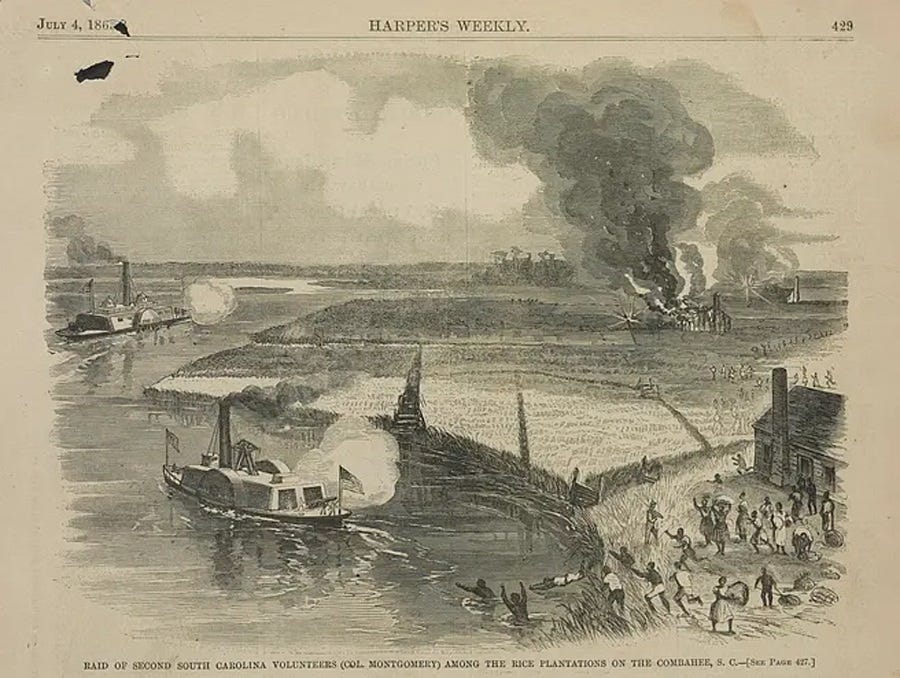
For all the news the story made at the time, Tubman didn’t get paid, and even after the war her petitions to receive a soldier’s pay for the raid were turned down, because women simply weren’t allowed in the Army, you silly goose. She later received a military pension on behalf of her late husband, a Union soldier, but not for herself. But when she died in 1913, she was buried with military honors; the US Army’s Military Intelligence Corps also inducted Tubman into its Hall of Fame in 2021.
Prior to the war, in 1858, abolitionist and eventual insurrectionist John Brown met Tubman and nicknamed her “General” for her courage. That was made official by Gov. Moore’s Veteran’s Day proclamation Monday, naming her a one-star general in the Maryland National Guard.
After Moore read the official order promoting Tubman, he presented the proclamation to Ernestine “Tina” Martin Wyatt, Tubman’s great-great-great-grandniece, as a representative of Tubman’s family.
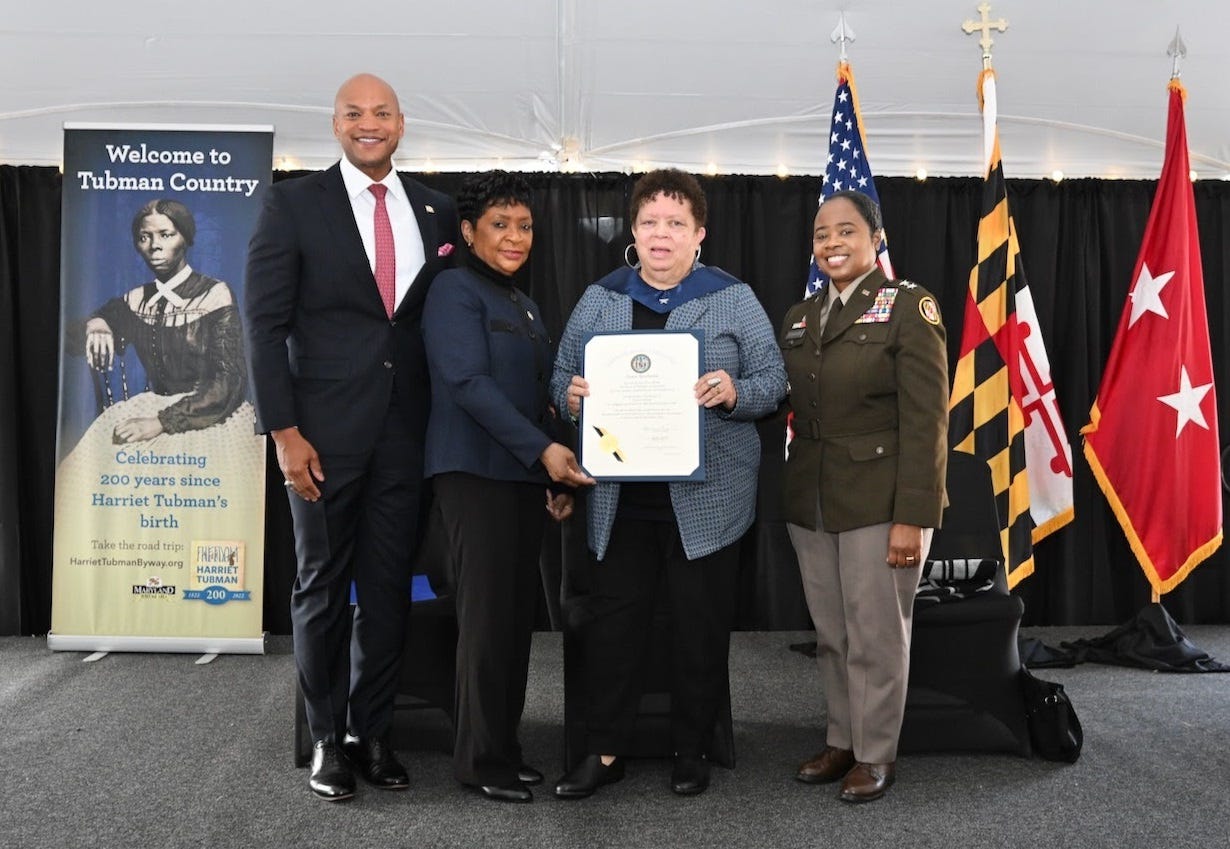
Thank you again for your service, General Tubman. Now if we can just get you on the $20 bill to replace that racist fuck-knuckle Andrew Jackson. (Snip)
Poem-a-Day: Miscarriage
Gauzy film between
evergreens is a web
of loss. Get closer. Reach
to touch the shimmering
gossamer and your finger
pushes through. Remember
filling that space with desire?
Someone else might grieve
the spider who abandoned
this home; others grow anxious
waiting for a deer’s walk
to wreck it. But you—
you grieve the net of thought
spun inside your own womb:
intricate and glossy and strong.
Copyright © 2024 by Christine Stewart-Nuñez. Originally published in Poem-a-Day on November 14, 2024, by the Academy of American Poets.
The Warrior’s Plume
Bertrand N. O. Walker 1870 – 1927
On the plains and in the vales of Oklahoma,
Grew a flower of the Tyrian hue,
The color that is loved by the Redman,
That tells him light and life,
And love are true.
Long ago it flamed in beauty on the prairies,
Lighting reaching vistas with its glow;
Ere advent of the whiteman and his fences,
Told the care-free, roving hunter
He must go.
The throng, the herd, and greed have madly trampled
Prairie, woodland, valley, and the height;
Crushed the feath’ry flower and rudely blighted
Its pride and life and beauty,
And its light.
Today ’tis found in silent glades and meadows
Where by twos and threes it greets the May.
Like the scattered braves who loved its color,
It has passed, been trodden out
Along the way.
As the oriflamme it flaunted through past ages
Went to gladden the fairness of the earth;
So the greatness of the Indian will linger
In the land that loves them both
And gave them birth.
This poem is in the public domain. Published in Poem-a-Day on November 10, 2024, by the Academy of American Poets.
More from and about this poet on the page.
The Week Ahead
by Joyce Vance
November 10, 2024 Read on Substack
This is a tough one to write.
My top-line thought for the week ahead: Don’t give up!
If you want to plan a protest, plan it. If you want to knit in public at a lecture, do it. Don’t let anyone else make the rules for you. You get to set your own vision for what it means to be persistently pro-democracy as we prepare to face what’s ahead.

For me, it means resisting the language of division that brought us here and working to maintain the big tent that helped us win the fight for four more years of democracy in 2020. People are down right now; none of us are at our best. So, give people a lot of space and understanding. But don’t be afraid to act on your own or enlist like-minded friends to come along with your plans. Don’t let anyone tell you that your way of expressing your love for country and Constitution isn’t the right way. There is a lot of that going around, as many people with good intentions are struggling.
If you’re looking for inspiration and have the concentration for a longer piece, read the words of Czech leader Václav Havel, who wrote The Power of the Powerless in 1978, ten years after the Soviet Union crushed Prague Spring. Havel explored the idea that individuals who might normally be seen as powerless can make common cause in dissidence against a repressive political structure. The Czechs did not have the centuries-long history of democracy like we do, nor did they have a Constitution in place that guaranteed rights like our does. Still, Havel pointed the way for them to resist a totalitarian system. Although the story of our coming struggle is likely to be very different from theirs, you may still take heart reading Havel, knowing that his people struggled free from a dictatorial regime and created a republic.
The outcome of this election has been incredibly hard to come to terms with. In my heart, I feared Donald Trump would win—I live in a state where many people support him and their numbers were strong—but I hoped and even dared to believe it wouldn’t happen. And of course, I was wrong.
We are in for tough times, and they will not be times to give up in. Lawyers are already preparing to do important work. They have the experience of 2016 to guide them. Project 2025 and Trump’s Agenda 47 vision are dark. But they are not self-executing; they will have to do the work to put them in place, and we need to be there every step of the way, pushing back. Never underestimate the value of the public voice.
But do take time to refresh your understanding of the policies this administration has rallied around in advance. I have not forgotten that in early July, Heritage Foundation President Kevin Roberts commented that the coming revolution could be “bloodless if the left allows it to be.”
- This interview with States United CEO Joanna Lydgate is an overview of Project 2025
- This piece touches on climate and science
- This piece talks about the impact of mass deportations
- This piece linked Trump to Project 2025 after he disclaimed knowledge of it
- This is an index of the columns I wrote about Project 2025 prior to last July
We have a long history and tradition of democracy in this country. We have local governments and organizations where we can run for office and use our power to make things better, even if Trump is trying to make them worse at the national level. We are still a constitutional democracy, and if we want to keep the Republic, we are going to have to fight to hold onto as many of our norms as we can.
But not all this week.
This week we are going to have to endure the winding down of the criminal cases against Donald Trump. That’s a gut punch for those of us who believed that accountability was possible and that Donald Trump wasn’t above the law.
Tuesday in Manhattan, Judge Juan Merchan is expected to rule on whether the Supreme Court’s presidential immunity decision impacts Trump’s conviction in the New York case. If the convictions survive, and they should, or at least some of them, expect a rocket of an appellate case going off, as Trump tries to avoid being sentenced later this month. He may succeed given the politics of the moment, but legally, there is no reason he can’t be sentenced, although, and I’m sorry to be the bearer of bad news, I expect that even if he receives a custodial sentence, he will not serve it because of the Supremacy Clause of the Constitution. It’s an entirely unsatisfactory conclusion to one of the worst-ever violations of American democratic principles.
I don’t expect normal times ahead. I believe Trump when he tells us who he is. I believe MAGA when they tell us who they are. This wasn’t just a campaign where the winner takes office and we all move on happily together, shoring up our disappointment. We have to be prepared for that reality, and not get sucked into a “business as usual” version of what Trump’s time in office will look like.
We haven’t begun to fight yet, but as we get over the shock of the election, we can begin to get ready. As President Biden says, you can’t love your country only when you win. I’d add to that, you can’t be willing to fight for democracy only when it’s easy.
We’re in this together,
Joyce
Have Some Friday Comics
Also, a question. On Kids Baking Championship, one of the items required is a chocolate-dipped item. One young baker decided to use butterscotch instead of chocolate. They tempered it, they dipped their item, and presented it. When asked about it, since it wasn’t chocolate, they stated that their technique was the same, and the item was dipped; also, that the butterscotch right there among the chocolate in the same area of the pantry.
So. While chocolate is not butterscotch and vice-versa, does this item count as a chocolate-dipped item? Discuss in comments.
Calvin and Hobbes by Bill Watterson for November 08, 2024

https://www.gocomics.com/calvinandhobbes/2024/11/08
Frazz by Jef Mallett for November 08, 2024

https://www.gocomics.com/frazz/2024/11/08
FurBabies by Nancy Beiman for November 08, 2024

https://www.gocomics.com/furbabies/2024/11/08
Jim Benton Cartoons by Jim Benton for November 08, 2024

https://www.gocomics.com/jim-benton-cartoons/2024/11/08
Monty by Jim Meddick for November 08, 2024

https://www.gocomics.com/monty/2024/11/08
Non Sequitur by Wiley Miller for November 08, 2024

More Thursday Poetry+Hope
My friend Mayvella used to say, “If you woke up, put your feet on the floor, the lights turned on, and the toilet flushed, the day will be OK.” I wish more than that for each of us, but seriously, my friend Mayvella was correct. She was a woman of color, very wise when I met her. I’m fortunate to have had her for a friend. She got up, got around, and went and volunteered at the food bank every Monday, Wednesday, and Friday, and brightened lots of days for many people just by being herself. When she passed, it was suggested we close for a day in observance of love and respect. I’m glad we decided she would have taken that as disrespect, and that she would have gone in and worked if one of the rest of us had passed away. So, rest a bit, and hope. (Then, we organize again.)
 Scottie's Playtime