Ron flew to Texas on Saturday. We used Uber to take him. He is driving his sister back here. They should be here tomorrow. I need a few days of rest then I will start replying to comments and bogging again. Hugs
Heather ‘Digby’ Parton joins the program to recap the week’s news. Check out Digby’s work at Salon as well as her blog Hullabaloo. Topics include the American right-wing’s desperation to keep Victor Orban in power in Hungary, Trump firing all the women around him, Iran and more.
Defense Secretary Pete Hegseth has taken steps to block or delay promotions for more than a dozen Black and female senior officers across all four branches of the military, some of whom are seen as having been targeted because of their race, gender or perceived affiliation with Biden administration policies or officials, according to nine U.S. officials familiar with the process.
The process within the Army, the Air Force, the Navy and the Marines is structured to ensure the most qualified officers get promoted. Hegseth’s decision to intervene in the process has raised concerns among some officials within those military branches and the White House, the nine U.S. officials familiar with the situation said.
“There is not a single service that has been immune to this level of involvement by Hegseth,” one of the U.S. officials said. Two of the officials said there are concerns in the military and the White House specifically that Hegseth is blocking or stalling some qualified officers from receiving promotions through the ranks of general and admiral because of their race or gender as he targets diversity, equity and inclusion initiatives at the Pentagon.
Defense Secretary Pete Hegseth has asked the Army’s top officer to step down and retire, defense officials said Thursday, an extraordinary move amid the war with Iran and the latest in a series of clashes between the Pentagon chief and the service’s senior leadership.
Gen. Randy George had been expected to hold the job of Army chief of staff for more than another year, until the fall of 2027, and complete what is typically a four-year assignment as a member of the Joint Chiefs of Staff. But Hegseth decided to go in another direction, representatives for the defense secretary said.
Two other Army generals were removed along with George, said two defense officials, who like some others spoke on the condition of anonymity to discuss the shake-up. They are Gen. David Hodne, who became the head of the service’s Training and Transformation Command in October, and Maj. Gen. William Green Jr., the chief of Army chaplains.
Read the full article. We can guess why the chief of Army chaplains has been removed.
Here’s one egregious example I just read about this morning in The Bulwark, concerning a Black, female major general. Not surprising. Still appalling.
“A few months earlier, Gen. George and [Army Secretary Dan] Driscoll had refused to accede to demands from Hegseth’s office to block the scheduled promotion of Maj. Gen. Antoinette R. Gant to take command of the Military District of Washington. The Washington District commander appears alongside the president at ceremonial functions in the D.C. area, for example at Arlington National Cemetery. Hegseth’s chief of staff reportedly told Driscoll that Trump would not want to stand next to a black female officer at military events.”
The article did not say whether Gant’s promotion ultimately went through.
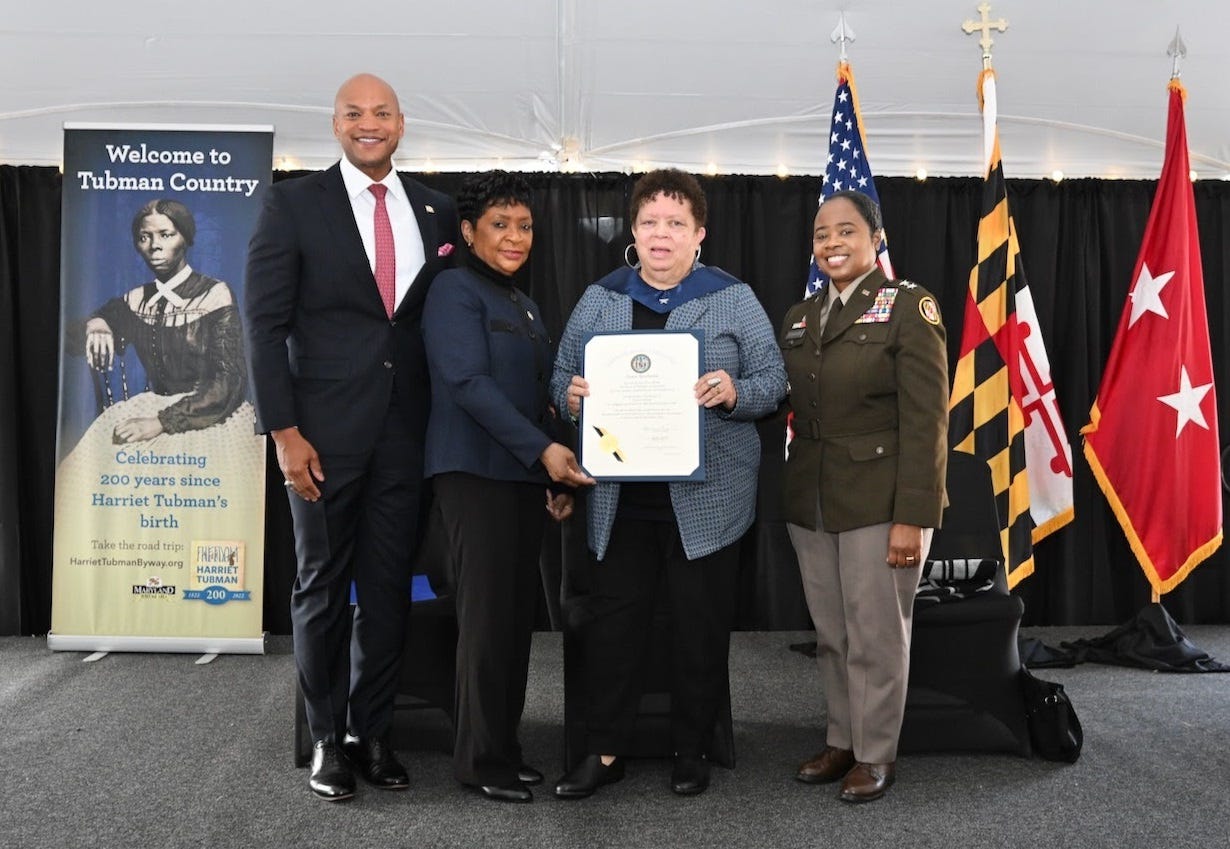
On Monday, Maryland Gov. Wes Moore honored one of his state’s most beloved military veterans, Harriet Tubman, by promoting Tubman posthumously to the rank of brigadier general in the state National Guard. Why yes, that’s General Harriet Tubman, who in addition to being a famous abolitionist and “conductor” on the Underground Railroad was also the first woman to lead a US military operation during wartime.
Tubman’s history of military service doesn’t get the same attention as her activities as an abolitionist and helper of those who freed themselves from enslavement, which was already plenty enough to make her a hero. But after her final expedition to guide escapees from slavery North, she put her skills of disguise, concealment, and familiarity with Southern territory to use for the US Army when the Civil War broke out in 1861, serving as a spy, scout, and eventually, as the joint leader of an 1863 Army raid on plantations in South Carolina, which freed nearly 800 enslaved people and burned several of the plantations.
Here’s a cool thing: A 2022 CIA website article acknowledges that well before she formally became a military operative, her work for the Underground Railroad “applied sophisticated tradecraft including the use of disguises, clandestine communication, and assets and allies, who provided safe houses, transportation, and funding” — genuine praise for an intelligence operative.
Tubman was recruited for the Union cause by Massachusetts Governor John Andrew and sent to Hilton Head, South Carolina, where she was assigned to work under Major General David Hunter, the head of Union operations there and in Georgia and Florida. As the CIA explains, she was trained as a nurse, and worked as one, but that also gave her the documents and funding necessary for her secret work, recruiting a spy ring of Black volunteers in the area, who gathered intelligence on plantations, commerce, Confederate troop positions, and the locations of “torpedoes” — barrels of gunpowder in rivers that could blow up any Union boats. Tubman was unable to read or write, but had an outstanding memory, making her a valuable spy without leaving any notes behind, encrypted or otherwise.
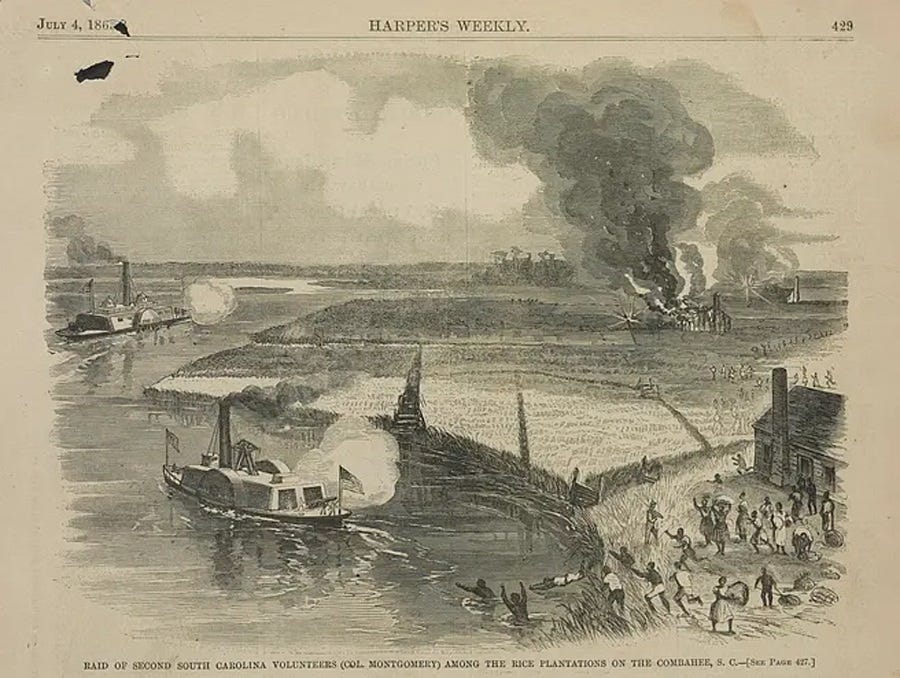
In 1863, Tubman moved from spying and reconnaissance to actually commanding Union troops in a raid on plantations along the Combahee River in South Carolina’s “Lowcountry” region. Although she was not a commissioned officer, she planned and shared leadership duties with Col. James Montgomery, an abolitionist in charge of a Black Army regiment, the Second Carolina Volunteers. The goal of the raid was to rescue enslaved people, recruit the freed men to join the Union Army if they were willing, and to wipe out the rice plantations in the area.
Montgomery commanded about 300 men, and to prepare for the raid, Tubman was in charge of a group of eight scouts who made maps of the area and helped her get news of the coming raid to enslaved people so they could be ready to run for the Union gunboats from which the attack would be launched.
“She was fearless and she was courageous,” said Kate Clifford Larson, historian and author of Bound for the Promised Land: Harriet Tubman, Portrait of an American Hero. “She had a sensibility. She could get Black people to trust her and the Union officers knew that they were not trusted by the local people.”
On the night of June 1, 1863, Tubman, Montgomery, and the troops boarded three Union gunboats to head up the river; on the way, however, one of the steamboats ran aground and the troops had to transfer to the remaining vessels. Tubman’s reconnaissance of the area proved invaluable in avoiding torpedoes in the river, and for guiding the ships close to shore, where they launched smaller boats full of raiders to attack the plantations.
Just before the raid got underway, the gunboats broke formation and headed to different parts of the river, with Montgomery commanding one, the Harriet A. Weed, and Tubman leading the 150 soldiers on the John Adams. Just want to underline this: Tubman wasn’t serving as an adjunct to Montgomery, she was in charge of half the attacking force. In the wee hours of June 2, they attacked their assigned plantations.
Tubman later recalled that when the signal to attack was given, she saw enslaved people running to escape toward the Union boats at the riverside, with women carrying their babies and children and whatever supplies they could take along, including chickens, pigs, and pots of rice. The enslavers tried to chase them down, firing guns on them, reportedly killing one girl. We’ll hand off the narrative here to History.com, and add that we’d watch this movie:
As the escapees ran to the shore, Black troops in rowboats transported them to the ships, but chaos ensued in the process. Tubman, who didn’t speak the region’s Gullah dialect, reportedly went on deck and sang a popular song from the abolitionist movement that calmed the group down.
More than 700 escaped slavery and made it onto the gunboats. Troops also disembarked near Field’s Point, torching plantations, fields, mills, warehouses and mansions, causing a humiliating defeat for the Confederacy, including the loss of a pontoon bridge shot to pieces by the gunboats.
After the raiding gunboats docked in Beaufort, South Carolina, the first press report of the raid didn’t name Tubman, but it did say that the raid was led by a “She-Moses” under the command of Montgomery, and that the raid came off without a single injury to the Union forces. A later report in a Boston newspaper named Tubman as the hero; the editor was a friend of hers. At least 100 men freed during the raid joined the US Army.
Illustration via Library of Congress.
For all the news the story made at the time, Tubman didn’t get paid, and even after the war her petitions to receive a soldier’s pay for the raid were turned down, because women simply weren’t allowed in the Army, you silly goose. She later received a military pension on behalf of her late husband, a Union soldier, but not for herself. But when she died in 1913, she was buried with military honors; the US Army’s Military Intelligence Corps also inducted Tubman into its Hall of Fame in 2021.
Prior to the war, in 1858, abolitionist and eventual insurrectionist John Brown met Tubman and nicknamed her “General” for her courage. That was made official by Gov. Moore’s Veteran’s Day proclamation Monday, naming her a one-star general in the Maryland National Guard.
After Moore read the official order promoting Tubman, he presented the proclamation to Ernestine “Tina” Martin Wyatt, Tubman’s great-great-great-grandniece, as a representative of Tubman’s family.
Thank you again for your service, General Tubman. Now if we can just get you on the $20 bill to replace that racist fuck-knuckle Andrew Jackson. (Snip)


 Scottie's Playtime