
Category: Love
At the Border, a Shelter By — And For — Muslim Women
I think this fits in as information relating to marginalized people. It is from a magazine that is religious, but it’s not pushy; I think everyone can read this article without feeling proselytized. It struck me as important, and overlooked. -A
By Ken Chitwood
Anyone crossing the U.S.-Mexico border faces a journey fraught with violence and danger.
But for women and children, that journey is even more treacherous. Not only are many fleeing violence at home — including gender-based violence — they also experience higher rates of violence en route. Torture, mutilation, sexual violence, femicide,disappearances, and additional health complications are common occurrences for female migrants making their way north.
That danger is amplified for the thousands of girls living in makeshift camps and tent cities along the U.S.-Mexico border without protection or accompanying support. According to the Washington, D.C.-based Kids In Need of Defense, “[u]naccompanied children are especially vulnerable to sexual violence, human trafficking, and exploitation by cartels and other criminal groups.”
Over the last few years, a group of Muslim women has stepped in to meet their needs in unique ways. Albergue Assabil (“the Shelter of the Path”), the first Muslim shelter along the U.S.-Mexico border, has been in operation since June 2022 under the leadership of Sonia Tinoco García, founder and president of the Latina Muslim Foundation. According to staff, the shelter served nearly 3,000 migrants in its first two years of operation. Many of those migrants have been women, attracted to the shelter because of its separate men’s and women’s facilities and the fact that Albergue Assabil is a female-led shelter.
And it’s not only Muslim women finding sanctuary under the shade of the shelter’s blue dome; there have also been other female immigrants looking to García and her team for assistance as they make the perilous journey north.
“A group of Muslim ladies”
When García first headed to the U.S.-Mexico border to help others in 2014, her goal was simple: to help women, especially mothers and unaccompanied children, in their attempts to claim asylum or start a new life in the United States. Having immigrated to the U.S. herself in the 1990s, García knew what it was like.
She also knew the statistics.
Though the share has fluctuated in recent decades, immigrant women and girls make up at least half of all migrants and asylum seekers, according to figures from the Migration Policy Institute. Women and girls made up a total of 53 percent of the immigrant population in 1980, 51 percent in 1990, 50 percent in 2000, and 51 percent in 2010 and 2022.
Given the scale, García gathered what she called “a group of Muslim ladies” from her mosque community in San Diego. Each had a profound understanding of the situation female immigrants were facing.
Angie Gely, who works in the office at Albergue Assabil, said being an immigrant who was deported back to Mexico and is now living in Tijuana, helps her understand what women in the shelter are going through — and what they face once they arrive in the U.S.
“Our families crossed the border to the U.S. too,” Gely said. “We can relate.”
Driven by their own past experiences and a deep desire to help female immigrants, García said she and other Muslim women started volunteering in Tijuana shelters, bringing food and clothing for people regardless of their religious, social, and cultural background.
Along the way, García and her “Muslim ladies” started noticing how many Muslims were mixed in with the larger population of immigrants and deportees. “It got my attention when I saw some women standing at the border with hijab,” García said. “I talked to them and discovered they were from Somalia, trying to go to the U.S. or Canada.”
The more time she spent in Tijuana, the more Muslims she saw arriving. At shelter after shelter, meanwhile, she witnessed staff too overwhelmed to cater to Muslim migrants’ unique needs.
“There were Muslims who didn’t feel safe in the shelters, because they were being discriminated against or questioned because of their faith,” Gely said. As a result, some would avoid the shelters altogether, struggling to find their own way on the streets or seeking help from Muslims at Centro Islámico de Baja — Tijuana’s only mosque at the time.
“The shelters didn’t have the time or money,” García said, “to provide halal food, to provide adequate space for prayer, or even understand their situations are different from those of migrants from Central America or elsewhere.”

García and the others did what they could to serve the immigrants sent their way — covering the cost of hotel rooms, providing home-cooked halal meals, or connecting them to the legal aid they so desperately needed, in a language they could communicate in. Overwhelmed, they turned to their mosque communities in San Diego and Orange counties to raise funds and procure translators who could speak Arabic or Urdu, Farsi or French, and many dialects in between.
But the need continued to increase. More and more Muslim immigrants were making their way to Tijuana, and the “ladies” could only do so much. Shelters were overwhelmed, and García said she was scrambling to field the many calls.
That’s why, in 2017, they decided to do more. Founding a nonprofit organization — the Latina Muslim Foundation — they raised more than $200,000 (USD) to construct a purpose-built Muslim shelter. Situated in the border city’s Zona Norte neighborhood, the shelter features separate men’s and women’s facilities, a prayer area, halal food, Quran classes, and legal services to assist migrants.
The hope, García said, was to provide a humane and helpful place for Muslim migrants to land in Tijuana. They are there to help transform the border from a topography of inhumanity into a place of dignity and opportunity, García said.
A growing number of Mexican Muslim women
García said that as a child, she always dreamed of helping people. “I wanted to become a surgeon, but do surgery for free, because people need it to save their lives,” García said. “Or an attorney who did pro bono work, to help families who don’t have justice.”
García grew up in a large family in a village of 200 people near La Paz, in the very south of the Baja California peninsula. She did not know whether such dreams would — or could — come true. “We had a simple lifestyle. We were not rich people,” she said. “Because we were 11 siblings, not everyone got education.”
García was one of the lucky ones able to finish high school. She moved to Ensenada — an hour and a half south of Tijuana — and started working with a local orthodontist serving medical tourists from the U.S. When she was 21, she met a man named Abu Hamza, a medical tourist from Lebanon living in Los Angeles. Abu Hamza spoke no Spanish at the time, and she did not speak English, but they communicated with books and through other people. Twenty days after meeting, they were married.
García had grown up Catholic and knew little of Islam. But when she saw Abu Hamza, she said, “I saw Islam in him.” After moving to the Los Angeles area with Abu Hamza, she learned English and Islam at the same time.
García joined the growing ranks of Latina converts to Islam. The first Latina and Latino converts can be identified as far back as the 1920s; others converted in the 1960s and ’70s as part of Black Muslim movements such as the Nation of Islam and the Five Percent Nation. In 2011, 6 percent of Muslim Americans identified as Hispanic, according to the Pew Research Center; by 2017, it was 8 percent. The vast majority of this cohort of Hispanic American Muslims are women, many of them from Mexico or having Mexican heritage.
Muslims remain a small minority in Mexico, said Arely Medina, a professor at the University of Guadalajara. There are multiple small groups and communities made up of both migrants and individuals native to Mexico in the country’s interior, all of which have a relatively recent history, Medina said. “Thus, one cannot speak of a ‘Mexican Islam’ per se,” she said, “even though Muslims have a history here stretching back to the conquest of the Americas and continuing with a series of Arab immigrations in the 19th and 20th centuries.”
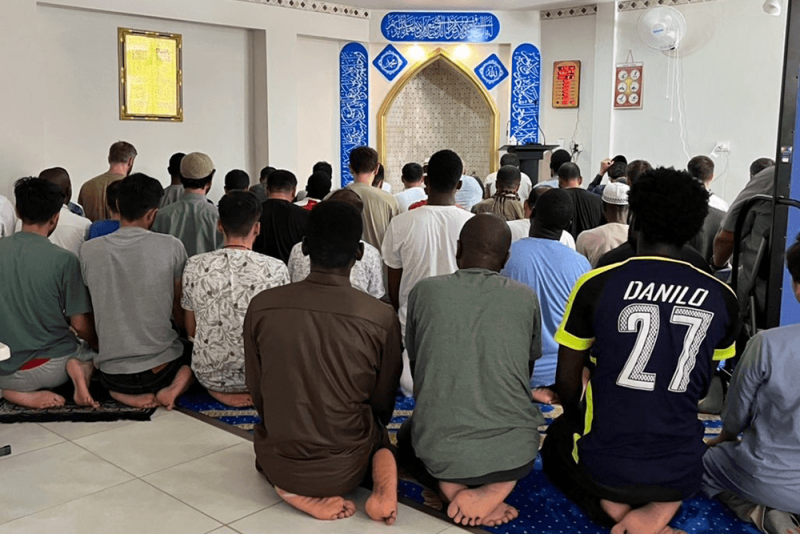
According to Medina and other experts, most Mexican converts to Islam are women. Among them are sizable numbers of female Muslim immigrants from places such as Egypt, Morocco, Syria, Pakistan, Ghana, and Turkey who have made Mexico home. “Some hope to reach the United States and are concentrated along the northern border,” Medina said. “Others concentrate in places like Mexico City, Guadalajara, or Monterrey.”
It is difficult, if not impossible, to generalize these women’s motivations, plans, or situations, Medina said. As is true of those staying at Albergue Assabil, “There is not a single story,” she said. “Each one carries a narrative.”
Because these women face a variety of challenges — such as wearing the veil in a cultural context where Islam is not a prominent reference point or searching for a sense of freedom and security in the face of domestic violence and harassment — Medina said they find in each other a sense of solidarity. “They are in search of a better life,” she said. As Europe, the United Kingdom, and even the U.S. are experienced as less welcoming, Medina said, “Latin America is now seen as a place of possible openness.”
Empowered to help others
Whether local converts or newcomers from elsewhere, Muslim women have carved out their own spaces in Mexico, including the Albergue Assabil shelter and the Nur Ashki Jerrahi Sufi order in Mexico City, which is headed by a woman — Shaykha Amina Teslima.
García often reminds donors, partners, volunteers, journalists, and authorities that Albergue Assabil is a shelter run by women. And not just any women, but Muslim women.
That, she said, makes a difference.
“We found that Islam gives women rights; it gave us empowerment,” she said of her and the other women running the show at Albergue Assabil. “I could do whatever I wanted to do — more than what I could do with my own culture or my own religion before,” she said. “Islam says that women can go study; men cannot tell you no. Men know this. My husband knows he doesn’t own me. He is my support.”
Indeed, her husband, Abu Hamza, is supportive of García’s work. He is often seen around the shelter too, pulling up on a motorcycle with García, bringing in donations, making phone calls, and generally doing whatever needs to be done. When asked about the shelter, he insistently points to his wife. “She knows better than me,” he said.
García said part of the shelter’s work is passing their own empowerment on to women who arrive at their gates. “In the shelter, when women come, we give them tools to be able to continue their education: English, Spanish, computers, cooking,” she said. “We want to give them the basics so that they are not reliant on men. In the time they stay in the shelter, we teach them as much as we can so that they can live for themselves.”
Increasingly, said Gely, that means more and more women are finding their way to Albergue Assabil — Muslim and non-Muslim. “Just yesterday, three ladies from Russia came here looking for shelter,” Gely said. “They’re not Muslim, no. But they hear how nice it is and want to come. Of course we take them in.”
One of them is Amie. Amie has struggled getting an appointment through the U.S. Customs and Border Protection app CBP One. She has spent three months in Mexico so far, arriving at Albergue Assabil six weeks after bouncing from shelter to shelter in Tijuana. Sojourners is withholding Amie’s last name, at her request, to protect her immigration status.
“They’ve been so kind to me,” she said, “out on the street, in other shelters, I feared for my life, worried I would be tortured, abused, or killed. This shelter is the only place I feel I could survive.”
As we talk, two more young Russian women walk through the front doors. They too are looking for shelter. Amie tells them to take a seat. Gely or García will be here soon, she says.
“They’ll take care of you,” Amie said. “They always do.”
https://sojo.net/articles/news/border-shelter-and-muslim-women
It happened again.
I was so excited to do the videos and set tomorrows up along with having such a bad day yesterday that when I got to the comments this afternoon, I realized I lost some. I am so sorry to those who commented and did not get a reply. If that was you, please either put your comment in again on any post or email it to me. My emails are in my profile. I will do better, now I think I will check comments first when I get up and put them in a set of tabs so I don’t lose them. Thank you everyone for understanding. I only have so much time and energy, I am running on fumes right now and so want to go to bed. I woke up at 12:40 last night, have had a lot of my pain medications which are sleep inducing, and I am so tired. I am trying to stay awake. I went to bed last night at 6:30 so when I woke I had only about 6 hours sleep. If that. So I may go to bed soon even though I am trying hard to stay awake. Hugs. Scottie
Peace & Justice History 8/28
| August 28, 1833 The Abolition of Slavery Act was passed by the British Parliament. As early as 1787, members of the Society of Friends (Quakers), particularly Thomas Clarkson and Granville Sharp, organized to end the slave trade.Since Quakers were barred from serving in the House of Commons, the cause was led by a member of the Evangelical Party, William Wilberforce, ending the international trade in slaves in 1807. By 1827 slaving was considered piracy and punishable by death. The complete ban on slavery itself through the British Empire didn’t happen until this day; Wilberforce was informed of the Act’s passage on his death-bed.  William Wilberforce |
| August 28, 1963 Reverend Martin Luther King, Jr. delivered his “I Have a Dream” speech from the steps of the Lincoln Memorial to a crowd of half a million gathered on the Mall in Washington, D.C. They gathered there for jobs and freedom.  The speech: https://www.npr.org/2010/01/18/122701268/i-have-a-dream-speech-in-its-entirety The speech: https://www.npr.org/2010/01/18/122701268/i-have-a-dream-speech-in-its-entirety  organizing to build the march organizing to build the marchFilm of the March and the speech: https://vimeo.com/2158959 1983: Three hundred thousand marched in Washington on the 20th anniversary of MLK’s “I Have A Dream” speech for the second “March on Washington for Jobs, Peace and Freedom.” August 28, 1976 60,000 joined the Community of Peace People demonstrations in Belfast and Dublin, Ireland. Peace People was founded by two women, Betty Williams and Mairead Corrigan to decry the painful violence between Catholics and Protestants, between unionists and republicans, and to move the peace process forward in Northern Ireland.  Betty Williams Betty Williams Mairead Corrigan Mairead CorriganThey jointly won the Nobel Peace Prize for 1976. More about Betty Williams and Mairead Corrigan From the Declaration of the Peace People: “ . . . We want to live and love and build a just and peaceful society. We want for our children, as we want for ourselves, our lives at home, at work and at play, to be lives of joy and peace. We recognize that to build such a life demands of all of us, dedication, hard work and courage . . . We dedicate ourselves to working with our neighbors, near and far, day in and day out, to building that peaceful society in which the tragedies we have known are a bad memory and a continuing warning.” The Peace People’s website: https://www.peacepeople.com/ |
https://www.peacebuttons.info/E-News/peacehistoryaugust.htm#august28
Into The Eyes of Racism (A Sonnet)
In Work Be Restless
Women’s Equality Day!
(Some references, and resources for the day, and every day to come!
Thanks and h/t to Women for Kansas -A)
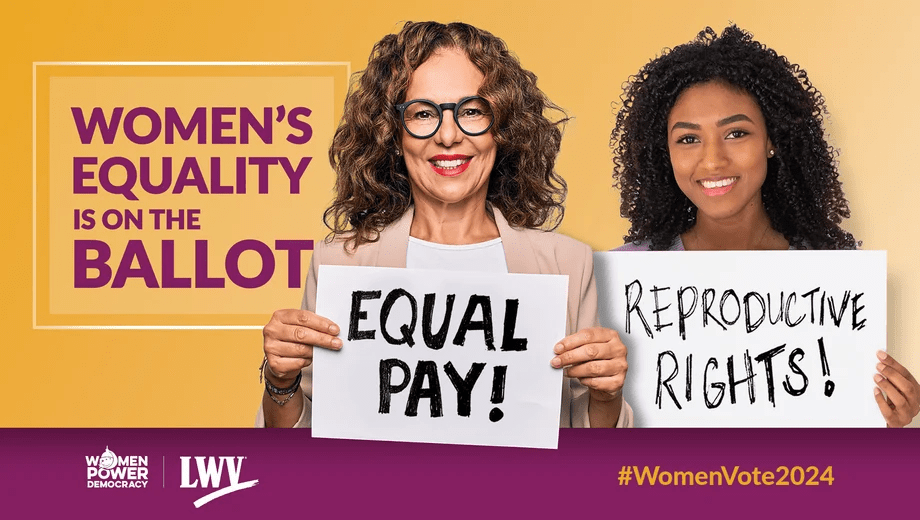
August 26, otherwise known as Women’s Equality Day, marks the anniversary of the certification of the 19th Amendment, which granted some women the right to vote.
Yet today, women have fewer rights than they’d had in decades. To recognize this, we acknowledge Women’s Inequality Day.
Empowering Women Voters in 2024
Women still aren’t equal under the law.
Inequality impacts our health: although women pay $15 million more each year for health care than men, we spend more of our lives in poor health. Those who may experience pregnancy no longer have reproductive freedom; and when we do give birth, we (particularly women of color) face high rates of maternal mortality.
It impacts our work: we’re paid less than our male counterparts and are underrepresented in leadership roles. We also deal with workplace harassment, insufficient maternal leave, and disproportionate caretaking responsibilities that affect our ability to work.
It impacts our representation: women are severely underrepresented in politics, making up only 25% of the Senate, 29% of the House, and 31.9% of statewide elective executives.
How can we make policies that protect and serve women without more women in office? And in an age where our basic freedoms and bodily autonomy are under fire, how can we ensure our rights aren’t degraded further?
The 2024 federal election is a critical moment in the fight for our equality.
The people we elect in November will be in charge of our rights – including the right to reproductive freedom – for the next four years.
So when you cast your vote in 2024, will you vote for someone who defends those rights? Or someone who wants to take them away?
Our 2024 campaign centers around empowering women to make their voices heard at the ballot box by equipping them with essential voter information. We’re highlighting our free, bilingual one-stop-shop for nonpartisan election information, VOTE411.org.
This year’s Women’s Inequality “Day” campaign will take place from August 26-30, with unique calls to action engaging voters every day! Get involved by sharing content via our social toolkit.
=====
International Women’s Day 2024 campaign theme is ‘Inspire Inclusion’
The campaign theme for International Women’s Day 2024 was Inspire Inclusion.
When we inspire others to understand and value women’s inclusion, we forge a better world.
And when women themselves are inspired to be included, there’s a sense of belonging, relevance, and empowerment.
Collectively, let’s forge a more inclusive world for women.
Read more about a definition of what it means to inspire inclusion here.
https://www.internationalwomensday.com/Theme
=====
BAD ROMANCE: WOMEN’S SUFFRAGE
Soomo, youtube.com
“Bad Romance: Women’s Suffrage is a parody music video paying homage to Alice Paul and the generations of brave women who joined together in the fight to pass the 19th Amendment, giving women the right to vote in 1920.” Watch here.
=====
| WOMEN’S PROGRESS THROUGH THE YEARS… |
| Prior to 1918 Doctor’s weren’t allowed to advise married patients about birth control. Prior to 1920 Women couldn’t vote in all elections until 19th Amendment was ratified. Prior to WWII Female teachers couldn’t be married. During 1950’s Domestic abuse was not considered a crime but a’family matter’. Prior to 1963 Equitable wages for the same work, regardless of race, color, religion, national origin, or sex of the workers were not promised until passage of Equal Pay Act. Prior to 1964 Discrimination on the basis of race, color, religion, national origin, or sex was not prohibited until passage ofthe Civil Rights Act. Prior to 1965 State laws could prohibit the prescription or use of contraceptives by married couples. In some states, the woman needed her husband’s permission to purchase contraceptives. Prior to 1969 Yale and Princeton didn’t accept female students. Prior to 1969 Women couldn’t work at jobs that had been for men only. Prior to 1971 Women with a law degree could be denied the right to plead a client’s case in court. Prior to 1971 Private employers could refuse to hire women with pre-school children. Prior to 1972 The Boston Marathon was an all-male event. There was no Women’s Division. Prior to 1972 The right to privacy didn’t encompass an unmarried person’s right to use contraceptives. Prior to 1972 Title IX of the Education Amendment didn’t exist. Schools that received Federal support didn’t need to provide the same programs to women as they did men. | Prior to 1973 Abortions weren’t legal in the entire U.S. until Roe v. Wade decision by Supreme Court declared the U.S. Constitution protected a woman’s right to terminate an early pregnancy. Prior to 1974 Housing discrimination on the basis of sex and credit discrimination against women existed. Prior to 1974 It was legal to force pregnant women to take maternity leave on the assumption they were incapable of working in their physical condition. Prior to 1974 Single, widowed, or divorced women had to bring a man along to open a bank account or to cosign any credit application. Married women couldn’t open a bank account without their husband’s permission. Prior to 1975 Women were excluded from serving on juries. Prior to 1976 West Point Academy didn’t admit female students. Prior to 1977 Harvard didn’t admit female students. Prior to 1978 There was no ban on discrimination against women on the basis of pregnancy, childbirth, or related medical issues. Prior to 1984 Women were not allowed to join all-male organizations (Jaycees, Kiwanis, Rotary, Lions) Prior to 1994 There were no funded services for victims of rape or domestic violence. Prior to 2013 Women in the military were banned from combat positions. Prior to 2022 Since the 1973 Supreme Court decision (Roe v. Wade), a woman’s right to terminate a pregnancy was protected by the U.S. Constitution. This decision was reverse by the current U.S. Supreme Court in 2022. Information provided by Soroptimist site. Learn more about Soroptimist’s by visiting their site here. |
LEARN MORE ABOUT THE HISTORY OF WOMEN’S EQUALITY DAY
National Women’s History Alliance
Read more here.
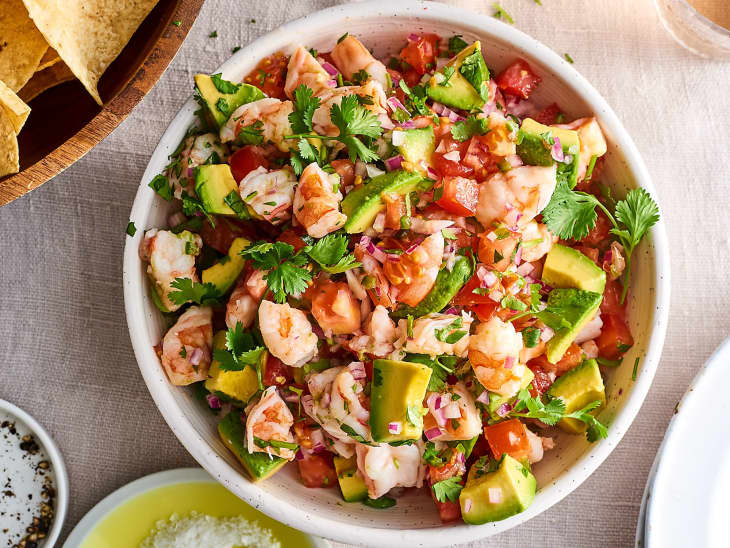
Easy Shrimp Ceviche
Made with poached shrimp marinated in citrus juice, tomato, avocado, and cilantro, this is the perfect thing to make when it’s too hot to cook.
Sheela Prakash Senior Contributing Food Editor
(I had a Substack from Jose’ Andres with a ceviche recipe, but after setting the post up, it turns out it’s a paid article, and I’m a free subscriber. Still, it sounded so perfect, especially for a day when someone might not have much appetite, so here’s a recipe from another place online I like to read. You may do the same thing I do: if I want something today, and don’t have an ingredient or two, or some ingredient doesn’t agree with me, I improvise with what I have/will eat. If I do that, I may not call it, say, ceviche, but just a thing I made. No worries! -A)
When the heat of summer sets in I just want to eat meals that will cool me down. My relationship with soups, stews, and basically anything that comes out of the oven is on hold for these next few months. I prefer easy summer dinners that come together quickly when I don’t feel like cooking.
Needless to say, this shrimp ceviche is on heavy rotation. The shrimp are gently poached first, then marinated in freshly squeezed lime and lemon juice with ripe summer tomatoes, red onion, jalapeño, and fresh cilantro. Add creamy, diced avocado right before serving. It’s tangy and refreshing, perfect for those hot summer days.
Serve the shrimp ceviche with homemade tostadas, crunchy plantain chips, or tortilla chips for scooping. Don’t forget to make pitcher margaritas and invite some friends over! Here’s how to make the best (and easiest) shrimp ceviche.
Why You’ll Love It
- The shrimp are perfectly cooked. Instead of relying on citrus juice to “cook” the shrimp, we’re poaching the shrimp quickly in hot water. Poaching the shrimp gently cooks them for the best texture, then they’re marinated in fresh lime and lemon juice.
- It’s bright and fresh; full of zesty lime, buttery avocado, juicy tomatoes, with a kick of jalapeño. Serve it as a snack, lunch, or light dinner. Whichever way you choose, be sure to have crunchy tostadas or tortilla chips nearby for scooping.
Key Ingredients in Easy Shrimp Ceviche
- Peeled and deveined raw medium shrimp: Unless you’re buying shrimp fresh off the boat, it’s most likely been frozen at some point. Frozen shrimp is the best choice because you can find them already peeled and deveined in the frozen aisle at most grocery stores.
- Citrus juice: Marinate the cooked shrimp in freshly squeezed lemon juice and lime juice.
- Tomatoes: Seed and chop the tomatoes.
- Red onion: Finely chopped red onion gives the shrimp ceviche some bite.
- Jalapeño pepper: Add finely chopped jalapeño for a bit of heat.
- Cilantro: Chop both the leaves and tender stems, which are edible.
- Avocado: Add the diced avocado right before serving.
How to Make Easy Shrimp Ceviche
- Cook the shrimp. Bring a large pot of salted water to a boil over high heat. Turn off the heat, add the shrimp, poach until the shrimp are opaque and just cooked through, drain, and set aside until cool enough to handle.
- Combine the ingredients. Chop the cooked shrimp into 1/2-inch pieces and place in a large bowl. Add the lemon juice, lime juice, tomatoes, red onion, jalapeño, cilantro, and salt, and toss to combine. Cover and refrigerate for at least 1 hour.
- Add the avocado right before serving. Just before serving, dice the avocado, add to the ceviche, and gently toss to combine. Serve with tostadas or tortilla chips.
Helpful Swaps
- Use frozen cooked shrimp. To save time, you can use frozen cooked shrimp instead of frozen raw shrimp. Thaw the frozen cooked shrimp completely and drain well before using.
- Use serrano peppers. Use serrano peppers instead of jalapeño if you like a spicier ceviche.
Is Ceviche Safe to Eat?
We cook the shrimp for this ceviche, which means you don’t have to worry as much about obtaining the freshest raw shrimp possible, which can be a challenge depending on where you live and what’s easily accessible.
Storage Tips
Leftovers can be stored in an airtight container in the refrigerator for up to 1 day.
Easy Shrimp Ceviche Recipe
Prep time 15 minutes to 20 minutes, Cook time 2 minutes to 3 minutes
Serves 4 to 6
Ingredients
- 1 pound peeled and deveined raw medium shrimp, thawed if frozen
- 1/4 cup freshly squeezed lemon juice (from 2 lemons)
- 1/4 cup freshly squeezed lime juice (from 2 to 3 limes)
- 2 medium tomatoes, seeded and chopped
- 1/2 small red onion, finely chopped
- 1 medium jalapeño, seeded and finely chopped (about 3 tablespoons)
- 1/2 cup chopped fresh cilantro leaves and tender stems
- 1/2 teaspoon kosher salt
- 1 medium avocado
- Tostadas or tortilla chips, for serving (optional)
Instructions
- Bring a large pot of salted water to a boil over high heat. Turn off the heat, add 1 pound peeled and deveined raw medium shrimp, and poach until the shrimp are opaque and just cooked through, 2 to 3 minutes. Drain the shrimp and set aside until cool enough to handle, about 10 minutes.
- Chop the shrimp into 1/2-inch pieces and place in a large bowl. Add 1/4 cup freshly squeezed lemon juice, 1/4 cup freshly squeezed lime juice, 2 chopped tomatoes, finely chopped red onion, 1 finely chopped medium jalapeño, 1/2 cup chopped cilantro, and 1/2 teaspoon kosher salt, and toss to combine. Cover and refrigerate for at least 1 hour or up to 4 hours.
- Just before serving, dice 1 medium avocado, add to the ceviche, and gently toss to combine. Serve with tostadas or tortilla chips, if desired.
Recipe Notes
Storage: Leftovers can be stored in an airtight container in the refrigerator for up to 1 day.
Nutritional Info
- alcohol-free
- sulphite-free
- high-fiber
- pork-free
- tree-nut-free
- sugar-conscious
- pescatarian
- red-meat-free
- peanut-free
- egg-free
- soy-free
Per serving, based on 4 servings. (% daily value)
- Calories 275
- Fat 11.5 g (17.7%)
- Saturated 1.6 g (8.2%)
- Carbs 20.3 g (6.8%)
- Fiber 5.2 g (20.9%)
- Sugars 3.3 g
- Protein 25.6 g (51.2%)
- Sodium 425.3 mg (17.7%)
 Scottie's Playtime