So the following paragraphs show just what a person Musk is. His product can not meet the standards so he screams the program that won’t give him money is a waste of taxpayer’s money. Just like tRump, rather than fix the problem he instead attacks the standards demanding they be lowered so his product can qualify. Hugs
After years of negotiation, lawsuits and politicking, the FCC and the NTIA settled on a modern definition for broadband service: 100 megabits per second (Mbps) download speeds, 20Mbps upload speeds, with less than 100 milliseconds of latency.
Right now, Starlink doesn’t meet that standard. It has been getting slightly slower over time even as more people sign up for service, according to internet performance testing service Ookla’s speed tests. In 2022, the FCC rescinded a $900m grant from the Rural Digital Opportunity Fund to Starlink to connect rural communities to the internet, citing its failure to meet the speed and latency standards and declining network performance.
December 4, 1833 The American Anti-Slavery Society was formed by Arthur Tappan in Philadelphia. He and his brother Lewis had been active abolitionists throughout their lives, including providing legal defense for the Africans who mutinied on the slave ship Amistad. Arthur Tappan The Anti-Slavery Society produced The Slave’s Friend, a monthly pamphlet of Christian and abolitionist poems, songs, and stories for children. In its pages, young readers were encouraged to collect money for the anti-slavery cause.
December 4, 1916 Five members of a women’s suffrage group unrolled a banner from the visitor’s gallery during President Wilson’s annual message (state of the union) to Congress, asking, “Mr. President, What will you do for woman suffrage?” There was no mention of the issue in his speech. Wilson and suffrage
December 4, 1969 President Richard Nixon President Richard Nixon, Vice-President Spiro T. Agnew and 40 U.S. governors embarked on a fact-finding mission to discover the causes of the generation gap. They viewed films of “simulated acid trips” and listened to hours of “anti-establishment rock music.” Vice-President Spiro T. Agnew
December 4, 1969 Fred Hampton Black Panther party leaders Fred Hampton and Mark Clark were assassinated by Chicago Police officers with cooperation from the FBI. Hampton had founded the Illinois chapter of the Black Panther Party at the age of 20. He led in establishing the Breakfast for Children program and a free health clinic on the west side of the City. A main purpose of the Panthers was to resist police violence. One of Hampton’s achievements was to persuade Chicago’s most powerful street gangs to agree on a non-aggression pact. FBI Director J. Edgar Hoover, however, considered the Panthers as “the greatest threat to the internal security of the country.” The Panther party headquarters had been raided three times with over 100 members arrested.The Senate Intelligence Committee, led by Frank Church (D-Idaho), revealed in 1976 that William O’Neal, Hampton’s bodyguard, was an FBI informant who had delivered an apartment floor-plan to the Bureau with an “X” marking the bed where Hampton died. About 100 shots were fired by the police, just one from the building. The survivors, including Deborah Johnson, Hampton’s pregnant girlfriend, were arrested and charged with attempting to murder the police. “You can kill a revolutionary, but you can’t kill a revolution!” – Fred Hampton Chicago police remove the body of Fred Hampton, slain by police on Chicago’s west side, Dec 4, 1969 Remembrance by someone who worked with Deputy Chairman Fred Hampton
December 4, 1970 Cesar Chavez was sentenced to 20 days in jail for refusing to call off the United Farm Workers’ consumer boycott of Bud Antle, Inc., the country’s second largest lettuce grower. Antle had signed a contract with Teamsters Local 890 though only 5% of the workers voted to ratify it. Nor had there ever been an election for the workers to choose a union to represent them. The boycott had been called to pressure Antle to negotiate with the Farm Workers. Lettuce & Grape boycott poster UFW chronology About the boycottAbout Cesar Chavezfor students
Sadly a lot of stories about Kennedy never mention the verified deaths his crusade against medical science. Below is a quote from the article which points the cost of his inability to understand or comprehend the science behind vaccines. Hugs
A measles outbreak began a few months after his visit. Eighty-three people died, most of them children, a staggering loss in a nation of about 200,000 people.
The health secretary pick and his organization have worked around the world to undermine longstanding policies on measles, AIDS and more.
Robert F. Kennedy Jr., an environmental lawyer, has spent years working abroad with organizations and associates that undermine longstanding global health policies, records show.Credit…Uli Seit for The New York Times
Robert F. Kennedy Jr., who is in line to lead the Department of Health and Human Services in the next Trump administration, is well-known for promoting conspiracy theories and vaccine skepticism in the United States.
But Mr. Kennedy, an environmental lawyer, has also spent years working abroad to undermine policies that have been pillars of global health policy for a half-century, records show.
He has done this by lending his celebrity, and the name of his nonprofit group, Children’s Health Defense, to a network of overseas chapters that sow distrust in vaccine safety and spread misinformation far and wide.
He, his organizations and their officials have interfered with vaccination efforts, undermined sex education campaigns meant to stem the spread of AIDS in Africa, and railed against global organizations like the World Health Organization that are in charge of health initiatives.
How Robert F. Kennedy Jr. Fights Health Policy Abroad:
Along the way, Mr. Kennedy has partnered with, financed or promoted fringe figures — people who claim that 5G cellphone towers cause cancer, that homosexuality and contraceptive education are part of a global conspiracy to reduce African fertility and that the World Health Organization is trying to steal countries’ sovereignty.
One of his group’s advisers, in Uganda, suggested using “supernatural insight” and a man she calls Prophet Elvis to guide policymaking. “We do well to embrace ethereal means to get ahead as a nation,” she wrote on a Ugandan news site this year.
These people, more than leading scientists and experienced public health professionals, have existed in Mr. Kennedy’s orbit for years. The ideas spread by him and his associates abroad highlight the unorthodox, sometimes conspiratorial nature of the world occupied by a man who stands to lead America’s health department, its 80,000 employees and its $1.8 trillion budget.
Mr. Kennedy did not respond to a list of questions about his organization’s work abroad. His personal email automatically replied with a link to a Google form for people to apply to work with him in government — and name their own job titles. Mary Holland, the chief executive of Children’s Health Defense, said that Mr. Kennedy was the group’s “chairman on leave” and had not been involved in the day-to-day operations in over a year.
As health secretary, Mr. Kennedy would have the opportunity to reshape health policy. The department has a hand in negotiations for an international pandemic-response treaty, is the parent agency of the Centers for Disease Control and Prevention, and finances global projects like vaccine campaigns.
He undermined confidence in the measles vaccine ahead of a deadly outbreak in Samoa.
Mr. Kennedy visited the Pacific island of Samoa in June 2019 in the aftermath of a public health tragedy.
During routine measles immunizations a year earlier, nurses had mistakenly mixed the vaccine with a muscle relaxant, leading to the death of two infants.
Measles, a highly contagious disease, is preventable, thanks to vaccines that have been proven safe since the 1960s.
But vaccine skeptics seized on the death of the two children as evidence that the vaccines should not be trusted. The Samoan government temporarily suspended its immunization program.
Image
Mr. Kennedy visited the Pacific island of Samoa in June 2019 and met with the prime minister.Credit…Misiona Simo/Samoa Observer, via Associated Press
Mr. Kennedy arrived in Samoa, on the invitation of a local anti-vaccine activist, and amplified doubts about the vaccine’s safety. It was a crucial moment. Vaccination rates had plummeted, and the World Health Organization called for Samoa to ramp up immunization as soon as possible.
Mr. Kennedy met with the prime minister and other officials. He told activists that vaccines shipped to Samoa might be of a lower quality than those sent to developed countries.
“With his last name, and the status attached to it, people will believe him,” said Dr. Take Naseri, who met with Mr. Kennedy at the time as Samoa’s director general of health.
A measles outbreak began a few months after his visit. Eighty-three people died, most of them children, a staggering loss in a nation of about 200,000 people.
During the outbreak, Mr. Kennedy falsely suggested that defective vaccines could have caused the deaths. He later dismissed the outbreak as “mild” and denied any connection to it. “I never told anybody not to vaccinate,” he said last year.
When Edwin Tamasese, the anti-vaccine campaigner who arranged Mr. Kennedy’s visit, was arrested and charged with incitement for interfering with vaccinations, Children’s Health Defense helped him obtain legal advice and paid for his lawyers, according to Mr. Tamasese.
The measles outbreak in Samoa ended after 95 percent of the eligible population received vaccinations, according to the W.H.O.
He and his organization promote AIDS falsehoods.
Sex education has been central to the global fight against the spread of AIDS in Africa for decades.
But officials with Children’s Health Defense Africa, one of Mr. Kennedy’s nonprofit groups, see a conspiracy at play.
Wahome Ngare, a Kenyan physician who sits on the group’s advisory board, argued at a conference in Uganda this year that contraception and health education were part of a global plot to reduce Africans’ fertility. He attended the conference alongside the head of the Children’s Health Defense Africa, who presented slides bearing the organization’s logo and web address.
Mr. Kennedy himself has questioned the accepted science behind AIDS. He falsely said that AIDS may have been caused by the recreational use among gay people of the drug amyl nitrite. It is caused by the virus H.I.V.
Last year, Children’s Health Defense posted a video promoting a book that questions the link between H.I.V. and AIDS. Another of the group’s interview subjects this year said that the former U.S. government scientist Anthony Fauci should be imprisoned or “taken off this Earth.”
Dr. Ngare is among the many people in Mr. Kennedy’s orbit whose views conflict sharply with those of the health agency that Mr. Kennedy stands to lead.
In an interview with NPR in 2015 before joining Children’s Health Defense Africa, Dr. Ngare mused about stories that “vaccines have been used for spread of H.I.V.” and called for a boycott of polio vaccines. The U.S. government is a major sponsor of polio vaccine campaigns worldwide. Dr. Ngare did not respond to requests for comment.
Ms. Holland, the chief executive of Children’s Health Defense, said those were Dr. Ngare’s personal views, not those of Mr. Kennedy’s organization.
At the conference in Uganda, Dr. Ngare spoke to far-right lawmakers and activists who support draconian punishments, including life in prison, for people convicted of having gay sex.
He aligned himself with fringe figures, including people who ended up on German security watch lists.
When Mr. Kennedy started his nonprofit group’s European chapter in August 2020, he floated questions about whether the Covid-19 pandemic was part of “a sinister game” played by governments to control people.
“A lot of it feels very planned to me,” he said in Berlin.
The next day, he rallied about 38,000 people at a protest over Covid-19 measures. The protest was organized by a German group called Querdenken. Its leaders have since ended up on a government watch list for fomenting antigovernment sentiment.
Image
Mr. Kennedy speaking during a protest over coronavirus pandemic regulations in Berlin in 2020.Credit…Clemens Bilan/EPA, via Shutterstock
Promoters used Mr. Kennedy’s name to drum up attendance, saying that he personally wanted people to take to the streets and fight back. After the event, hundreds of protesters tried to storm the Reichstag, Germany’s Parliament.
Mr. Kennedy was not in attendance at the Parliament. “That whole Reichstag thing was completely unrelated to the demonstration,” Ms. Holland said.
Mr. Kennedy’s influence in Germany lives on, at least in online forums. Recent data from CeMAS, a research group that monitors conspiracy movements, shows that his name is often invoked on conspiracy-focused German Telegram channels, coming up more than 6,000 times this year alone.
His European chapter paid a British lawmaker to speak at a conference promoting vaccine skepticism.
Children’s Health Defense’s chapter in Europe has cultivated relationships with members of the European Parliament.
In January 2022, the organization held a news conference in Brussels demanding a “moratorium on health restrictions.” An anti-vaccine rally that followed the event turned violent, with protesters smashing windows at the European Union’s diplomatic headquarters.
In April 2023, Children’s Health Defense Europe helped organize a conference on the grounds of the European Parliament in Strasbourg, France. At the conference, lawmakers criticized a proposed pandemic treaty being considered at the World Health Organization.
The chapter has hosted press events with European lawmakers and encouraged Parliament to reject vaccination certificate rules.
In 2023, the European chapter paid a member of Britain’s Parliament, Andrew Bridgen, to speak at a conference it had helped organize. The conference discussed opposition to government pandemic measures and promoted vaccine skepticism. The sum was small, at just under $800, according to Mr. Bridgen’s financial disclosures. Such payments are legal in Britain.
Image
Andrew Bridgen, left, a member of Parliament at the time, in London in 2022. He has compared the Covid-19 vaccine rollout to the Holocaust.Credit…Justin Tallis/Agence France-Presse — Getty Images
Mr. Bridgen has repeatedly compared the Covid-19 vaccine rollout to the Holocaust, including in an interview with the Children’s Health Defense online television station.
Children’s Health Defense spent $315,000 in Europe last year, including in Iceland and Greenland, its U.S. tax filings show. Ms. Holland said that as of this year, the European chapter was run by volunteers and no longer funded by the U.S. operation.
His Africa chapter pushes measles misinformation and risky remedies.
In 2021, a South African herbalist named Toren Wing reached out to Mr. Kennedy about his effort to ban 5G cellphone towers over health concerns.
In an email, Mr. Wing recalled in an interview, he invoked a rousing speech about liberty that Mr. Kennedy’s father had delivered as a senator visiting apartheid South Africa in 1966.
“This is so cool,” Mr. Kennedy responded, according to a copy of the email. He looped in a Children’s Health Defense lawyer. The anti-5G effort fizzled, Mr. Wing said, but it laid the groundwork for a Children’s Health Defense chapter in Africa.
At the chapter’s launch, Mr. Kennedy said the continent was “a testing and clinical trial laboratory for multinational pharmaceutical companies that see African people as commodities.” His group sent just over $15,000 for “setup expenses” in 2022, U.S. tax filings show.
Shabnam Palesa Mohamed, who leads the chapter, is a frequent host of the nonprofit’s online show. She interviews doctors promoting unproven Covid-19 remedies and rails against vaccines.
After a measles outbreak started in Cape Town, Ms. Mohamed appeared in a video discussing supposed negative effects of “alleged measles injections” in South Africa.
In 2023, Unicef reported a 30 percent decline in confidence in childhood vaccines in South Africa after the Covid-19 pandemic, coming amid the world’s “largest sustained backslide in childhood immunization in 30 years.” The group cited factors including “growing access to misleading information.”
Ms. Mohamed and others affiliated with Children’s Health Defense Africa pushed the discredited theory that the drug ivermectin will treat Covid-19. They also sued the South African government, unsuccessfully, to stop Covid-19 vaccinations. Ms. Mohamed thanked Children’s Health Defense for supporting the case.
Ms. Mohamed has promoted conspiracy theories against the World Health Organization, Bill Gates and two of the world’s biggest money managers, BlackRock and Vanguard. Ms. Mohamed declined to answer questions about her work.
“I don’t think she was speaking on behalf of C.H.D.,” said Ms. Holland, who said the Africa chapter was a volunteer organization. “She’s an individual. She has her own views.”
Kimon de Greef contributed reporting.
Selam Gebrekidan is an investigative reporter for The Times whose work focuses on accountability — of governments, companies and people who wield power.More about Selam Gebrekidan
A version of this article appears in print on Dec. 1, 2024, Section A, Page 13 of the New York edition with the headline: Kennedy Has Worked Abroad to Undermine Global Health Policies. Order Reprints | Today’s Paper | Subscribe
The paragraph below shows that what happened then is happening again now. It was scary for me as a teen back then. Gay people in deep country settings in the backwoods, especially gay teens desperately trying to keep people from finding out. Especially abused gay kids who felt that abuse was written all over them for people to see. I was so happy to see that time gone for most of the school kids by the 2010s. Kids accepted in their class by their peers, the fellow students. That very acceptance terrified the conservative religious, but I have never understood why? Why is terrifying and hurting kids so pleasing to them? But the quote from the article below says it all. Hugs
The late 1970s was a somber, frightening time in queer history. The rise of a Christian right – branding themselves the “moral majority” – in conjunction with an energized Republican party began a culture war against women, people of color and queer people. The combination of religious rhetoric, nationalism and economic conservatism – Reaganomics, in other words – created a groundswell of contemporary far-right politicking that became the template for our contemporary political world.
December 3, 1833 Oberlin College was founded in Ohio. It was the first college to enroll men and women on equal terms, and to accept African-American men and women on equal terms with white students.
December 3, 1965 An all-white jury in Alabama convicted three Ku Klux Klansmen for the murder of white civil rights activist Viola Liuzzo. Viola Liuzzo The mother of five from Detroit was shot and killed while driving a young black activist, Leroy Moton, back to the town of Selma following a protest march to the state capital in Montgomery. It was later learned that another Klansmen in the car, Gary Thomas Rowe, was an FBI informant. Klansmen Collie Wilkins, Eugene Thomas and William Eaton at their trial
December 3, 1969 Files were destroyed at eight New York City draft boards in protest of the Vietnam War.
December 3, 1984 In the early morning hours, one of the worst industrial disasters in history began when American-owned Union Carbide’s pesticide plant located near the densely populated city of Bhopal in central India leaked a highly toxic cloud of methyl isocyanate into the air. Estimates of the fatalities vary widely, but of the approximately one million people living in Bhopal at the time, 2,000 were killed immediately, at least another 8,000 within a short time, and hundreds of thousands were injured, many still suffering today. The U.S. blocked extradition of Union Carbide officials facing criminal prosecution in India. Union Carbide has since been purchased by Dow Chemical which continues to refuse responsibility for the incident or its victims, and has yet to clean up the site. Contemporary news report on the incident bhopal.org
December 3, since 1992 The International Day of Disabled Persons was declared by the United Nations. “The annual observance of the International Day of Disabled Persons … aims to promote an understanding of disability issues and mobilize support for the dignity, rights and well-being of persons with disabilities . . . .” 2020 Theme: Building Back Better: toward a disability-inclusive, accessible and sustainable post COVID-19 World. more info
December 3, 1997 An international treaty banning land mines was signed by 122 countries. It comprehensively prohibits the use, production, trade or stockpiling of antipersonnel mines. Buried landmines kill about 15,000 people every year worldwide. The dangerous and time-consuming process of removal would take centuries at the current rate of landmine clearance.The United States and approximately forty other countries have yet to sign the treaty, and fifteen countries continue to produce land mines. The Pentagon requested $1.3 billion for research on and production of two new landmine systems—Spider and Intelligent Munitions System—between fiscal years 2005 and 2011, but Congress has resisted funding the programs under pressure from nearly 500 U.S.-based organizations opposing the weapons. Comprehensive information from the International Campaign to Ban Landmines Recent U.S. policy on land mines:
It’s Monday. There are 700 days until the midterm elections. The FBI is about to get way scarier, a warning from a monster’s mommy and Dark Brandon goes Dark Daddy.
Be advised: This newsletter uses profanity. And it’s been saving that shit up for like a week.
Note: Sexy Patriots! Holy shit we sure missed your hot asses. How the hell are you?! How was your Thanksgiving? Does Uncle Trump Trash have third-degree burns on his crotch thanks to an “accidental” gravy boat spill? Oh that’s a shame. Well we sure are glad to be back with you, and we’re damn grateful to you for letting us take some time off to recharge. Lots of scary fucked up shit happened while we were away. But right now we need to talk about this…
Um… We don’t really know what to say here. There’s weird, there’s fuck-a-couch weird and then there’s whatever the hell that is. We kinda like that Jello Diddler (JD) Vance has gone missing, but when he pops up just to do shit like this it really freaks us the eff out. It’s like there’s a roomful of horrifying serial killers but the one you really gotta worry about is the guy who keeps disappearing. We like to think Trump traded him out for Elon Leon or he’s just off defiling a sofa, but we all know he’s probably up to something stupid and evil. Whatever it is, dude, it ain’t worth it if you’re posting shit like that on Thanksgiving. Yikes. Y’all have a blessed day.
Note two: We’d just like to take a second to congratulate all the dumbshit mainstream media reporters who bought Trump’s bullshit denials about Project 2025. More: AP News
Note three: Jamie Raskin is making a move to replace Nadler on the House Judiciary Committee. Nadler is a nice man, but this needs to happen. We need warriors in key places, and few people fight like Raskin does. More: Axios
Note four: Ex-convict Charles Kushner, who was pardoned by his son’s father-in-law, will be our next ambassador to France because the only thing Trump loves more than criminals is nepotism. More: AP News
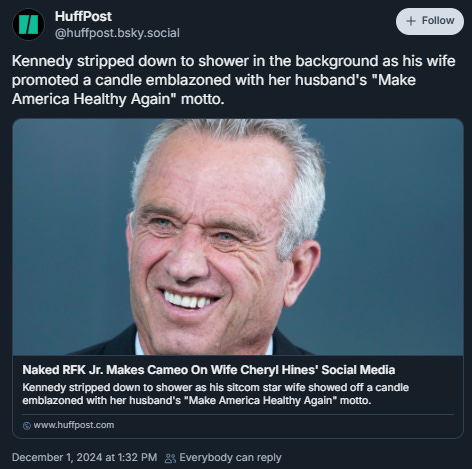
Note five: We like y’all too much to show you the clip of RFK Jr. in the shower while Cheryl Hines sells her crap. So here’s the story without the video. You’re welcome.
Note six: We understand there are people who wish Biden hadn’t done what he did for Hunter (more in the news section), but watching Colorado Gov. Jared Polis try to cozy up to the right every chance he gets is really pissing us off. Go ahead and run for president, asshole. More: The Hill
Note seven: You’re not gonna believe this but pardoned criminal Dinesh D’Souza is totally full of shit. Ok so you will believe it. This weekend Dinesh apologized for the lies in his movie, 2,000 Mules, which was about voter fraud in the 2020 election. He should have kept lying. He might have gotten elected president. More: Independent
Note eight: Did y’all watch “A Man on the Inside” over the break? Isn’t it wonderful?
Note nine: Elon Leon Musk has like 50 kids of his own, but he spent Thanksgiving with Baron Trump. How fucking weird is that? More: CNN
Note 10: Politico and other kiss-asses just don’t understand why normal decent people are leaving Elon Leon’s nazi playground Twitter for Bluesky. (snip-MORE)
==================
OK. Now for the message from Ali. Can you tell I watched a lot of PBS this weekend, with the interruption of a perfectly good and funny bit of work to remind people that democracy and freedom are not free? I feel like I’m doing that.
The thing is better and more succinctly explained here, but very briefly, tomorrow the US legislature opens a session, and we want to meet them with the message that “LGBTQ+ People Are Not Going Back.” And neither are your allies-we aren’t going back, but we are going with you wherever you need us to, and many of us have free mom hugs to go along with that. After you wash your hands. Anyway, my bit, which I’m working on and is saved in drafts, will be to encourage all of us to write to our Congress critters, and any other Congress critters to whom we’re moved to write. I’m likely to do the Congress critters writing tonight, so they see it in the morning first thing. As the draft post here will be.
We can fight like Jamie Raskin! (See above; Parkhomenko has that bit of great news up there. It could be a great idea to write to him, and encourage him to make the move.)
(As is said on my other favorite blog, Our Failed Political Press at work again. sigh The money graf here: A foreign national under federal fraud prosecution making a purchase that results in $18 million cash payment to the president-elect has all the makings of a major scandal. But it has been virtually ignored by several major media outlets.
The banana is not Sun’s most notable recent purchase.
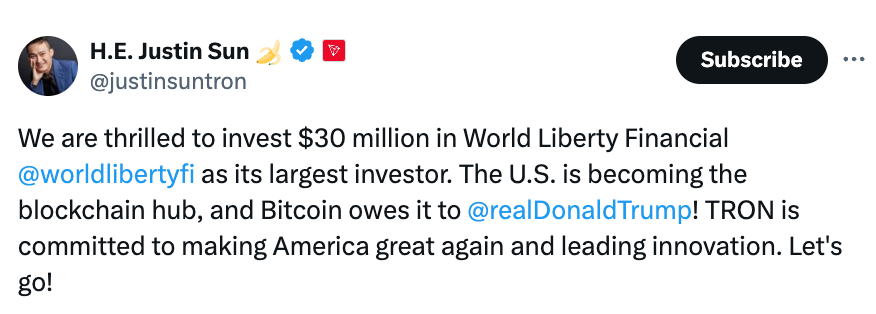
On November 25, Sun purchased $30 million in crypto tokens from World Liberty Financial, a new crypto venture backed by President-elect Donald Trump. Sun said his company, TRON, was committed to “making America great again.”
World Liberty Financial planned to sell $300 million worth of crypto tokens, known as WLF, which would value the new company at $1.5 billion. But, before Sun’s $30 million purchase, it appeared to be a bust, with only $22 million in tokens sold. Sun now owns more than 55% of purchased tokens.
Sun’s decision to buy $30 million in WLF tokens has direct and immediate financial benefits for Trump. A filing by the company in October revealed that “$30 million of initial net protocol revenues” will be “held in a reserve… to cover operating expenses, indemnities, and obligations.” After the reserve is met, a company owned by Donald Trump, DT Marks DEFI LLC, will receive “75% of the net protocol revenues.”
So before Sun’s purchase, Trump was entitled to nothing because the reserve had not been met. But Sun’s purchase covered the entire reserve, so now Trump is entitled to 75% of the revenues from all other tokens purchased. As of December 1, there have been $24 million WLF tokens sold, netting Trump $18 million.
Sun is also joining World Liberty Financial as an advisor, making Sun and the incoming president business partners.
While Trump has the cash, Sun’s tokens are effectively worthless. To comply with U.S. securities law, WLF tokens are “non-transferable and locked indefinitely in a wallet or smart contract until such time, if ever, [WLF tokens] are unlocked through protocol governance procedures in a fashion that does not contravene applicable law.” The only thing that Sun can do with his tokens is participate in the “governance” of World Liberty Financial. Right now, the only thing World Liberty Financial does is sell tokens.
Any foreign national paying an incoming president $18 million weeks before entering the White House should raise red flags. Sun’s purchase is even more alarming because the Securities and Exchange Commission (SEC) is currently prosecuting him for fraud.
The SEC’s ongoing prosecution of Sun
On March 22, 2023, the SEC charged Sun and three companies he owns. The SEC accused Sun of marketing unregistered securities and “fraudulently manipulating the secondary market” for a crypto token “through extensive wash trading.” Wash trading involves “the simultaneous or near-simultaneous purchase and sale of a security to make it appear actively traded without an actual change in beneficial ownership.” In other words, according to the SEC, Sun made it seem like there was a lot of interest in crypto tokens he issued when much of the trading was fraudulent and manufactured by Sun.
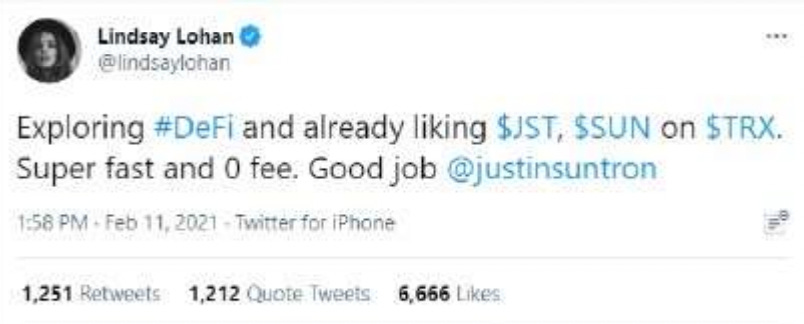
The SEC also charged Sun with “orchestrating a scheme to pay celebrities to tout” his crypto tokens “without disclosing their compensation.” Federal law requires people who endorse securities to “disclose whether they received compensation for the promotion, and to specify the amount.” The celebrities involved included Lindsay Lohan, Jake Paul, and Soulja Boy.
Lohan paid $40,000, and Paul paid about $100,000 to settle the charges against them without admitting liability. Soulja Boy did not respond to the lawsuit, and a default judgment was issued against him.
Sun posted on X that he believes the SEC “complaint lacks merit” and complained that “the SEC’s regulatory framework for digital assets is still in its infancy and is in need of further development.”
The litigation against Sun is ongoing, with a federal judge considering a motion by Sun’s attorneys to dismiss the charges. The current SEC Chairman, Gary Gensler, who announced the charges against Sun, will step down when Trump takes office in January. A new SEC commissioner appointed by Trump could settle or dismiss the charges against Sun.
How Trump can use the power of the presidency to unlock hundreds of millions in profits for himself
Through World Liberty Financial, Trump can reap massive personal profits from creating a more permissive regulatory environment for crypto ventures.
In addition to his 75% share of revenues over $30 million, Trump’s company was also awarded 22.5 billion WLF tokens. At the current sale price, these tokens are worth more than $300 million. That is more than 20 billion tokens being offered for sale publicly. (This makes the “governance” value of WLF tokens, which was already questionable, effectively worthless. No matter how many tokens you own, Trump will always be able to outvote other token holders.)
Right now, Trump’s tokens — like those purchased by Sun — are worthless because they cannot be transferred. But Trump could appoint a new SEC chairman who is friendly to the crypto industry and who would create new rules allowing the WLF tokens and similar crypto assets to be legally traded. If the price of the tokens increases when they hit the open market, which is a possibility for a crypto token backed by the President of the United States, the value of Trump’s tokens could be in the billions.
That appears to be exactly the path Trump is taking. WIRED reports that Trump is “asking the crypto industry to weigh in on potential picks.” Among the leading contenders is Paul Atkins, a former SEC Commissioner, who, since leaving the agency in 2008, has run a consulting firm that works with crypto companies. Atkins is also co-chair of the Token Alliance, an initiative of the Chamber of Digital Commerce, the lobbying group for the crypto industry. He is also a member of the Chamber of Digital Commerce’s Board of Directors.
Another top contender, former SEC General Counsel Robert Stebbins, has said that the SEC should “pause most of its crypto lawsuits while clearing a path for the firms to do business without the overhang of litigation.” But Stebbins’ candidacy underscores the need for Sun to forge a favorable relationship with Trump. Stebbins acknowledged that, even if it takes a more permissive view toward the crypto industry, it may want to consider continuing to pursue litigation involving fraud.
Major media outlets obsessed with banana, ignore Sun’s payment to Trump
A foreign national under federal fraud prosecution making a purchase that results in $18 million cash payment to the president-elect has all the makings of a major scandal. But it has been virtually ignored by several major media outlets.
The New York Times, for example, has published five articles about Sun’s purchase of the banana but none about Sun’s $30 million purchase of WLF tokens and his business partnership with Trump. The Washington Post has published three articles about the banana, but its coverage of Sun’s purchase of WLF tokens was limited to one short paragraph in a larger editorial about the crypto industry. (The paragraph does not explain how Trump personally profits from Sun’s token purchase.) The Wall Street Journal did publish a short piece about Sun’s token purchase on its “Live Update” blog, but the piece was not viewed as significant enough to be included in the print edition. The paper published two articles, plus a video, focused on the banana. One of the Wall Street Journal articles about the banana was published on the front page of the paper.
His funeral had been attended by more than 15,000 mourners, not including the thousands who were turned away by the police. He had been arrested for writing inflammatory pamphlets and “inciting unrest” among the black community. Steve Biko
The news story ————————————- December 2, 1980 Maryknoll Sisters Ita Ford and Maura Clarke, Ursuline Sr. Dorothy Kazel, and lay missionary Jean Marie Donovan were raped, murdered, buried outside San Salvador, and unearthed shortly thereafter.
American Nuns Maura Clarke, Ita Ford, Dorothy Kazel and Jean Marie Donovan- killed in El Salvador in 1980.
U.S.-trained and -supported Salvadoran national guardsmen, widely known to act as death squads, were suspected.The Reagan administration, taking office seven weeks later, and relying in part on the Salvadoran military to rid Central America of communism, denied the National Guard’s involvement. General Alexander Haig, the president’s secretary of state, explained the churchwomen’s deaths to Congress as an accident caused by nervous soldiers who “misread the mere traveling down the road (of the nuns’ van) as an effort to run a roadblock.” The FBI and CIA later reported this as a total fabrication, and five national guardsmen were later convicted of murder. More about the Maryknoll Sisters





 Biko’s funeral
 Steve Biko


