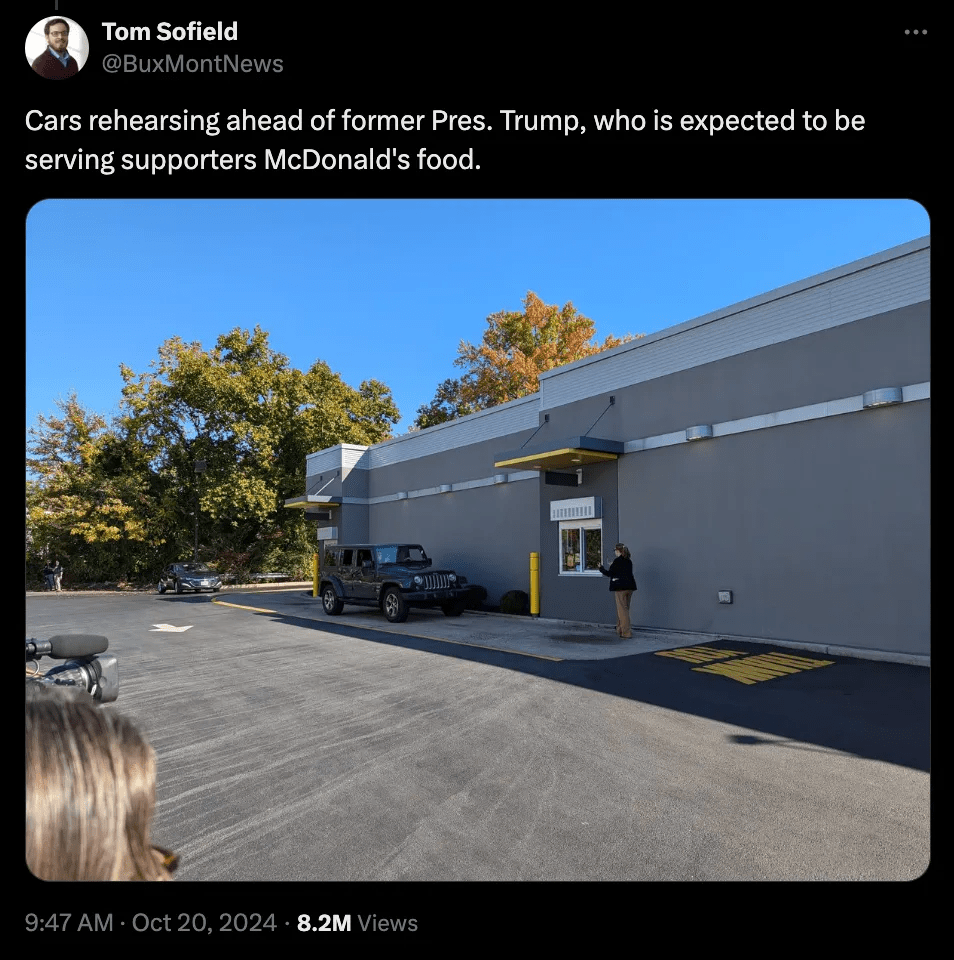
Get ready for Donald Trump’s blue state extravaganza.
With less than four weeks until Election Day, Trump is scheduled to hold rallies in staunchly Democratic states he has virtually no chance of winning. It’s an unorthodox strategy campaign advisers say is designed to focus on areas where Democratic policies have failed, but it will also keep him away from the small handful of swing states almost certain to determine the election.
Over the next month, the former president has events scheduled in Colorado, California, Illinois and New York. President Joe Biden won those states by an average of 20 points in 2020, with his 13-point Colorado win the closest margin. Colorado is the only one of those states to vote for a Republican nominee for president this millennium, backing George W. Bush in 2004.
While each event will be held in slightly different venues, the most notable will be later this month in Madison Square Garden, a place where Trump has long said he wanted to hold political rally.
“Choosing high-impact settings makes it so the media can’t look away and refuse to cover the issues and the solutions President Trump is offering,” said a senior Trump campaign adviser of the strategy behind late-election cycle events in Democratic states. “We live in a nationalized media environment and the national media’s attention on these large-scale, outside-the-norm settings increases the reach of his message across the country and penetrates in every battle ground state.”
“President Trump is closing the campaign highlighting the problems the country faces as a result of Harris and Biden’s failed leadership and articulating his solutions to solve the problems they created,” the adviser added.
The decision to deviate from a traditional campaign playbook comes at a time when the race is almost certain to be decided in places like Georgia, Pennsylvania, Nevada, North Carolina, Wisconsin and Michigan, places that are within the margin of error in most public polling and considered winnable for both Trump and Vice President Kamala Harris.
“This does not seem like a campaign putting their candidate in critical vote rich or swing vote locations — it seems more like a candidate who wants his campaign to put on rallies for optics and vibes,” longtime Republican operative Matthew Bartlett said.
He called Trump the “most unorthodox candidate in modern history,” which means the off-script strategy could have some value.
“In 2016, Trump realigned the party to be much more rural and working class, now in 2024 he is trying to expand his voting base along certain cultural lines that may eat away at traditional Democratic voting blocs,” Bartlett said.
A second Trump adviser said that no matter where Trump holds rallies, he gets huge online viewership, including in swing states, and there is a confidence within the campaign about their chances, which in their estimation allows for some risk.
“Certainly we are bullish on our prospects writ large,” the adviser said.
Some Trump supporters argued that going into areas of the country traditionally not visited by Republican presidential candidates could have a sort-of coattail effect, helping boost down-ballot Republicans in tough races. None of the states where Trump is visiting has a competitive Senate race, but there are a handful of competitive House races in a year where the majority of that chamber will likely be decided on a razor-thin margin.
In California, House District 40 is represented by Republican Young Kim, and House District 41 is represented by Republican Ken Calvert, both of whom are in contested races in the Los Angeles media market along with Coachella, which is where Trump will be holding his rally.
In New York, Rep. Mike D’Esposito won Nassau County’s 4th district in 2022, but it is a seat that leans Democratic and was won by Joe Biden by 15 points in 2020. Flipping the seat played a big role in helping Republicans take the House majority in 2022.
“The fact that we can pickup down ballot seats with President Trump’s aggressive travel plan is a testament to the well orchestrated and effective campaign plan that focuses on unifying all Americans,” said Ed McMullen, a Trump donor who served as ambassador to Switzerland during the Trump administration.
“It is a well-planned effort to reach out and win key seats,” he added.
October 10, 1699 The Spanish issued a royal decree which stated that every African-American who came to St. Augustine, Florida, and adopted Catholicism would be free and protected from the English.
October 10, 1963 The Limited Test Ban Treaty—banning nuclear tests in the oceans, in the atmosphere, and in outer space—went into effect. The nuclear powers of the time—the United States, Great Britain, and the Soviet Union—had signed the treaty earlier in the year. In 1957, Nobel Prize-winner (Chemistry) Linus Pauling drafted the Scientists’ Bomb-Test Appeal with two colleagues, Barry Commoner and Ted Condon, eventually gaining the support of 11,000 scientists from 49 countries for an end to the testing of nuclear weapons. These included Bertrand Russell, Albert Einstein, and Albert Schweitzer. Linus Pauling Pauling then took the resolution to Dag Hammarskjöld, then Secretary-General of the United Nations, and sent copies to both President John F. Kennedy and Soviet Premier Nikita Kruschev. The final treaty had many similarities to Pauling’s draft. It went into effect the same day as the announcement of Pauling’s second Nobel Prize, this time for Peace.
October 10, 1967 The Outer Space Treaty (Treaty on Principles Governing the Activities of States in the Exploration and Use of Outer Space, Including the Moon and Other Celestial Bodies) demilitarizing outer space went into force.It sought to avoid “a new form of colonial competition” as in the Antarctic Treaty, and the possible damage that self-seeking exploitation might cause. Discussions on banning weapons of mass destruction in orbit had begun among the major powers ten years earlier. 1949 painting by Frank Tinsley of the infamous “Military Space Platform” proposed by then Secretary of Defense James Forrestal in the December 1948 military budget.
October 10, 1986 Elliott Abrams, then assistant secretary of state for inter-American affairs, testified before the Senate Foreign Relations Committee (in closed executive session) that he did not know that Marine Lt. Col. Oliver North, a White House employee in the Reagan administration, was directing illegal arms sales to Iran and diverting the proceeds to assist the Nicaraguan contras. Abrams pled guilty in 1991 to withholding information on the Iran-contra affair during that congressional testimony, but was pardoned by President George H.W. Bush. Elliott Abrams Presidents George W. Bush & George H.W. Bush Oliver North Read more about the pardons
October 10, 1987 Thirty thousand Germans demonstrated against construction of a large-scale nuclear reprocessing installation at Wackersdorf in mostly rural northern Bavaria.
October 10, 2002 The House voted 296-133 to pass the “Joint Resolution to Authorize the Use of United States Armed Forces Against Iraq,” giving President George W. Bush broad authority to use military force against Iraqi leader Saddam Hussein, with or without U.N. support.
This one is a bit creepy. Maybe for Halloween? But if you don’t want to learn about insects that scarf our blood and leave us with diseases this video is not for you. Hugs. Scottie
Sometimes, it seems to me that Robert Reich has lost his fire. Not in this story, though; this is the Robert Reich I remember!! Organize, speak out, make our government do our work!
One issue not being talked about enough during this election, although both parties are courting working-class voters, is the chilling extent to which corporations are maiming and killing their employees.
According to data Amazon reported to OSHA, for example, Amazon had 6.6 serious injuries for every 100 workers in 2022. More than half of all warehouse injuries in the U.S. happened at Amazon, though they employed only 36 percent of all factory workers.
What’s behind the injuries? Corporate demands for faster speed and higher productivity.
Last week, The Wall Street Journal featured a story about corporations not allowing workers to lock down machinery when the machinery has to be maintained or cleaned.
I wish this were new news, but I vividly recall one morning in 1994 when Joe Dear, who then ran OSHA, the Occupational Safety and Health Administration, stormed into my office at the labor department.
Joe was short and wiry, with the energy of a coiled spring. He had come to OSHA after serving as director of Washington state’s department of labor and industries. He was dedicated to worker safety.
Breathlessly, he told me that workers at Bridgestone’s tire plant in Oklahoma City were getting mangled, even killed, in assembly machines that suddenly restarted when the workers were unjamming or cleaning them. The company’s other plants had similar horrors.
OSHA investigators had repeatedly told Bridgestone executives to install a simple $6 device that would automatically cut off power to the machines whenever a worker wanted to lock them down to clean or repair them, but the company wouldn’t budge.
Joe thought it was because the company was afraid its workers would use the device to stop the assembly line in order to gain bargaining leverage in upcoming union negotiations.
“We’re hitting them with a $7.5 million fine, the maximum under the law,” Joe said.
Joe hadn’t sought a fight with the second-largest tire maker in the world. We both knew it would unleash a giant team of lawyers and might drag the case through the courts for years unless we settled for a fraction of the fine.
We also knew that the final settlement wouldn’t be enough to get Bridgestone to mend its ways anyway if the company figured it was cheaper to pay up and continue risking workers’ lives and limbs. Not for the first time had a company made this sort of calculation.
But something had to be done. Workers were getting maimed and killed.
I was indignant. I felt righteousness coursing through my veins. “We’ve got to stop this, Joe. Maybe they could get away with this shit under the Republicans, but I’ll be damned if they do it under our watch.”
Joe looked worried. “We can’t go any higher with the fine. We might be able to go to court in Oklahoma City and get an emergency order forcing them to comply there. It’s dicey.”
“Why not use all our ammo?” I felt like I was putting on my holster. “Let’s also mobilize public opinion.”
“Public opinion?” Joe’s worry deepened.
I explained my theory. “Big corporations like Bridgestone spend millions on advertising and marketing to boost their public image. If we get this story on television, we’ll embarrass the hell out of them and strike fear in the hearts of every other corporation that’s screwing its workers.”
Joe hadn’t planned on my fury.
“I want to go out there,” I said, now simmering. “I’ll deliver the legal papers in person. We’ll fly out Sunday night and do it Monday morning. Alert the media so they can be on hand. Hold a press conference, maybe with some of the injured workers, including the widows of workers who were killed.”
Press conference? Injured workers? Widows? Joe was warming to the idea. A smile spread across his face. This was no longer a legal matter. It had become an issue of public morality — and public relations.
“Will the employees be with us on this?” I asked.
“No question. You’ll be a hero.”
“Okay then. We go to Oklahoma City.”
It was like I was galloping into town on a large white stallion, a sheriff’s badge pinned to my vest. Few feelings in public office are more exhilarating than self-righteous indignation — or as dangerous.
Late Sunday night we met at the Murrah Federal Building in downtown Oklahoma City to plan the final details of our operation.
We planned it so the press could set up cameras outside the gate and film us as we entered and the time and place of the press conference afterward. Several of the injured workers along with the widow of one who died were ready to appear.
Joe and I and the rest of our team rode in silence to the Bridgestone plant. A half-dozen TV cameras were waiting at the gate to record the spectacle. A guard allowed us through. We parked.
“We’ve hit the beach, captain,” Joe said.
“Walk slowly and keep your ammo dry.”
We walked across the lot to the plant entrance. I imagined the scene on the evening news: barely visible through the mist, the silhouettes of America’s runty but courageous secretary of labor leading his small battalion of gallant men to their fates, as they took on Industrial Evil. We were taking on the bullies.
Once we were inside, a nervous receptionist asked us to follow her. We walked down a narrow corridor and into a linoleum-floored room with a Formica table in the center, encircled by several chrome-and-plastic chairs. She said two gentlemen would be with us shortly, then rushed off.
A few minutes later, two grim-faced men entered and asked us to sit. One was a top executive from the company’s U.S. headquarters, the other the plant manager.
I introduced myself and the others, trying not to let my voice betray my nervousness. “We have come here to present you with court papers alleging that this plant presents an imminent hazard to the safety of its employees,” I said gravely. Joe removed an inch-thick pile of legal papers from his briefcase and placed them in the center of the table. The two men stared at the pile, expressionless.
I continued to speak, more forcefully now. “We have urged you to correct these hazards, but they have not been corrected. We have no choice but to seek an emergency order that will require you to equip employees on the assembly line with a simple device to turn off the power when they must clean or unjam the machines. We’re also imposing a $7.5 million fine.”
I looked intently at the two men. They stared back. They said nothing.
We marched back out of the building and across the parking lot. I tried to look determined, like someone who has just summoned the full force of the United States government against a common enemy.
A half an hour later, the press gathered for the news conference at a downtown hotel to hear of our great battle. One of the widows, a frail woman in her late fifties, stood beside me. Around us were several of the workers who had been injured or maimed in the plant. In front of me, sitting in two rows of chairs, were other workers from the plant.
I explained why I had come to Oklahoma City, describing the mayhem that the company had caused and what actions the department would take, doing a weak imitation of William Jennings Bryan: “We will not allow workers to risk death and dismemberment simply because a company refuses to buy a $6 piece of safety equipment. American workers are not going to be sacrificed on the altar of profits. We are not going to allow a competitive race to the bottom when it comes to the lives and limbs of American workers.”
The workers applauded. The widow’s eyes filled with tears. Reporters asked a few questions. Then, having cleaned up Oklahoma City, we rode off into the sunset on the next commercial flight back to Washington, feeling triumphant.
The triumph was short-lived.
Soon after we left, Bridgestone’s vice president for public affairs held a news conference to announce that Bridgestone had decided to close its Oklahoma City tire factory. All 1,100 workers would be out of jobs in weeks. He blamed the federal government, asserting that its safety standards had made the plant uneconomical.
The next morning’s Daily Oklahoman used my expedition as an illustration of the worst sort of meddling from Washington. In a bitter editorial, it accused me of grandstanding for political purposes. Its front-page story quoted angry tire workers, soon to be unemployed, saying I never should have come to Oklahoma City. One even asserted that safety was never a problem at the plant and that machines must be kept running to be serviced properly.
If it’s a choice between a dangerous job and no job, people will choose the dangerous job. I can’t blame them. America’s safety nets were — still are — in tatters, and we repeatedly force workers to make this terrible choice.
In the end, I asked our legal staff to drop the emergency order if the company would keep its plant open, which they agreed to do.
The bullies won.
I was haunted by our failure. I hadn’t imagined Bridgestone would take hostage the livelihoods of more than a thousand people. I hadn’t understood that the mounting economic stresses across America would fuel anger at every major institution in society, including a federal government that sought to protect people from some of those stresses.
We must protect workers from corporate greed. That means fines must be high enough to make it truly costly for a corporation to ignore worker safety laws when it’s profitable to do so. And it means safety nets must be strong enough to enable workers to refuse to take on illegally dangerous work.
Sometimes knowledge helps us cope with less stress. Plus, this is available on any device, as long as there is wifi or mobile data available. Which, tomorrow, may not be a thing for Scottie, Ron, and the kitties tomorrow and after, as well as any other readers in the vast path of Milton. But up till then, there is current info. It’s better on the page; I put a bit here so we can see what’s available. The time zone will be that of the person accessing the info; I’m in Central, so this shows Central. I learned Zulu time researching tornado formation! NWS uses Zulu, as well, but this page does show regular time.
Hurricane Milton Satellite | Buoys | Grids | Storm Archive… TODAY IS THE LAST FULL DAY FOR FLORIDA RESIDENTS TO GET THEIR FAMILIES AND HOMES READY AND EVACUATE IF TOLD TO DO SO BY LOCAL OFFICIALS…
10:00 AM CDT Tue Oct 8 Location: 22.7°N 88.4°W Moving: ENE at 9 mph Min pressure: 929 mb Max sustained: 150 mph
One of the most disturbing things about billionaire tech leader Elon Musk’s insistence on backing Donald Trump’s presidential campaign is that he’s the CEO of X, the massive social media platform which reported more than 170 million daily active users worldwide on its mobile app in February 2024.
Considering many of X’s Black users — who have made Black Twitter a thing of legend over the years — don’t believe that Trump has our best interests at heart, some have attempted to create other digital spaces for us to shed that X business, and they’re being helped by the likes of Kerry Washington.
Washington is throwing a major investment into SPILL, a Black-owned Twitter alternative created by Alphonzo Terrell, one of the nearly 4,000 employees laid off from the social media platform formerly known as Twitter when Musk acquired the company in November 2022 for $44 billion.
Rather than sulking over his job loss, Terrell linked with friend and former co-worker DeVaris Brown to formulate a plan to make something for us, by us.
“I called [Brown] and I said, ‘I think it’s time to build and if we do this together, I think this can be really successful,’” Terrell told CNN in a September 2022 interview.
Since its 2022 launch, SPILL has grown its customer base to more than 200,000 users. One of the most unique features of the app is SPILL Spades, a live, multiplayer Spades game the company says keeps users engaged for an average of 30 minutes.
In addition to her financial contribution, Washington has hosted live conversations on the platform known as “Tea Parties.” The actress says she’s proud to support a platform in which underrepresented groups are top of mind.
“In a digital world where marginalized groups, especially Black, Brown, and LGBTQIA folks, rarely feel prioritized, SPILL stands out,” Washington said in a statement. “I’m proud to be part of this community as both a user and an investor.”
Terrell says as the company keeps looking for ways to stand out, he is confident SPILL will make a big splash in the social media space.
October 7, 1989 Tens of thousands (estimates ranged from 40,000 to 150,000) from all over the country marched on Washington, lobbied Congress and Housing Secretary Jack Kemp to provide affordable housing for the homeless. Some of the signs read, “Build Houses, Not Bombs.” Kemp signed a letter committing the George H.W. Bush administration to several steps to help the homeless, including setting aside about 5000 government-owned single-family houses for them.
=============== October 7, 1998 Matthew Shepard Matthew Shepard, a gay student at the University of Wyoming, was beaten, robbed and left tied to a wooden fence post outside Laramie, Wyoming; he died five days later. His death helped awaken the nation to the persecution of homosexuals and their victimization as objects of hate crimes. A play about the incident, and later an HBO movie, “The Laramie Project,” has been performed all over the country. Watch a preview MatthewShepard.org Matthew’s Place
In a world increasingly illuminated by artificial light, the beautiful night skies of a small coastal town in South Australia have attracted international recognition. Carrickalinga on the Fleurieu Peninsula is Australia’s first official Dark Sky Community. The title rewards a dedicated community effort to combat light pollution and preserve the natural environment at night.
The journey began three years ago when I was a PhD candidate at the Australian National University, working on the value of night skies. I was a regular visitor to Carrickalinga, but this time conversations at a picnic one evening turned to the clarity and brilliance of the stars. I was inspired to work with the locals to nominate Carrickalinga as a “Dark Sky Place”.
My recent research suggests restoring dark skies would be worth US$3.4 trillion (A$5.16 trillion) to the world, annually. That’s largely because light pollution is disrupting nocturnal pollinators, altering predator-prey interactions, and changing the behaviours of nocturnal species.
Light pollution has detrimental effects on wildlife, human health, and ecosystem functions and services. But there are simple solutions. By embracing responsible lighting practices, everyone can contribute to a healthier future in which the wonders of the night sky are accessible to all.
Understanding light pollution
Light pollution refers to human alteration of outdoor light levels. Excessive or misdirected artificial light brightens the night sky, diminishing our ability to see stars.
Research shows the problem is getting worse. Light pollution increased by 7–10% a year from 2011 to 2022. More than a third of people on Earth cannot see the Milky Way.
Light pollution not only affects our view of the cosmos, but also wastes energy and money, contributes to climate change and has significant repercussions for both ecological and human health.
Nocturnal animals such as bats and certain birds rely on darkness to navigate and find food. Insects, crucial for pollination and as a food source for other wildlife, are also affected. Artificial light at night is contributing to their decline.
In humans, studies have shown artificial light interferes with circadian rhythms, leading to sleep disorders and other health issues.
The global Dark Sky movement
DarkSky International, formerly known as the International Dark Sky Association, is a global network of volunteers combating light pollution. The non-profit organisation established in 1988 is based in Tuscon, Arizona in the United States. But more than 193,000 people across more than 70 countries are involved, including astronomers, environmental scientists and the public.
The International Dark Sky Places Program was born in 2001 when Flagstaff, Arizona was named the first International Dark Sky City. Now the program certifies five types of Dark Sky Places: sanctuaries, reserves, parks, communities, and urban night sky.
DarkSky says the aim is to “preserve and protect the nighttime environment and our heritage of dark skies through environmentally responsible outdoor lighting”. It recognises places that demonstrate a commitment to reducing light pollution through public education, policy, and promoting responsible lighting practices.
There are now well over 200 Dark Sky Places across the globe. This covers more than 160,000 square kilometres in 22 countries on six continents.
Australia’s Dark Sky Places
Australia is home to several Dark Sky Places, each recognised for their exceptional night skies and dedication to reducing light pollution. These include:
Since 2021, the Carrickalinga community has worked tirelessly towards achieving International Dark Sky Community certification. The journey involved several key initiatives:
Sky Quality Metering Program: regular measurements of sky brightness to monitor light pollution levels
Community engagement: presentations to community groups and the district council to raise awareness about light pollution, information stalls at local markets, community consultation process (led by the District Council of Yankalilla)
Educational materials: printed flyers, video, and a “Star Party” including a presentation on First Nations cosmology
Policy development: collaboration with the district council to create a lighting policy including public lighting design that complies with both Australian standards and DarkSky requirements.
Carrickalinga is currently upgrading existing public lighting to reduce light pollution. This will involve a new lighting design plan that reduces correlated colour temperature, ensuring shielded downward-facing lights minimise skyglow, glare and light trespass.
Reducing light pollution by upgrading lighting fixtures does not compromise safety. Dark sky does not mean dark ground.
Light pollution has become such a problem because our lights are unnecessarily bright and poorly designed. Fixing the problem simply involves changing the colour from white to amber, shielding and targeting lights so they do not shine upwards and outwards, and reducing wattage where it is surplus to requirements for people’s safety.
Carrickalinga became Australia’s first International Dark Sky Community in May, 2024. Credit: The Backyard Universe
How you can help
Achieving and maintaining dark sky status is not difficult but it does require ongoing community effort. Here are the five principles for responsible outdoor lighting, which apply equally to domestic as well as public lighting:
Useful – use light only if it is needed and has a clear purpose
Targeted – direct light so it falls only where it is needed
Low light levels – light should be no brighter than necessary
Controlled – use light only when it is needed
Warm colours – use warm coloured lights wherever possible and avoid short-wavelength (blue–violet) light.
An inspirational journey
Achieving International Dark Sky Community status was a significant achievement in preserving the natural night environment and educating the local community about light pollution. This accomplishment demonstrates the power of community action and serves as a model for others.
By protecting our night skies, we safeguard a vital part of our natural and cultural heritage and also promote healthier ecosystems and communities. Carrickalinga’s journey serves as an inspiring example of what can be achieved through collective effort and dedication to preserving our planet’s natural beauty.
I would like to acknowledge the enormous contribution of Carrickalinga Dark Sky Community volunteer Sheryn Pitman, who works for Green Adelaide in the South Australian Department for Environment and Water, and helped write this article.
The Smithsonian National Museum of American History houses thousands upon thousands of artifacts. Here are some of the more unusual items from their collection.
Soap babies of Republican William McKinley and Democrat William Jennings Bryan from the 1896 election (The Smithsonian National Museum of American History)
The Smithsonian Institution in Washington, D.C. was formally established on August 10, 1845, and over the years has amassed more than 157 million items across 21 museums and galleries. The Smithsonian National Museum of American History houses artifacts related to national elections and the presidency. We offer a look at some of the most unusual.
All images courtesy of The Smithsonian Institution unless otherwise noted
1. Bandana Featuring Excerpts from George Washington’s Farewell Address
In which Washington encouraged all Americans to put aside regional and party divisions in support of the newly formed republic. Observed Washington, “Your Union ought to be considered as a main prop of your liberty, the love of the one ought to endear you to the preservation of the other.”
2. Presidential Hair Cabinet
John Varden, keeper of collections for the National Institute for the Promotion of Science at the U.S. Patent Office, began collecting locks of hair from prominent individuals in 1850 and quickly amassed a collection that included presidents, senators, artists, and other luminaries. Varden’s presidential hair collection includes strands from George Washington and Franklin Pierce.
Brain drain could undermine the country’s hi-tech economy as liberal families conclude social contract has been broken
This summer, the Nobel laureate Prof Aaron Ciechanover joined a group of prominent Israelis gathered in the ruins of the Nir Oz kibbutz to demand a hostage release and ceasefire deal.
Nir Oz was the worst hit of all the communities targeted by Hamas on 7 October, with a quarter of its residents kidnapped or killed. Twenty-nine are still in Gaza.
If the hostages were not brought back, the basic social contract that underpinned Israeli society would unravel, the 77-year-old professor of medicine warned – with catastrophic consequences for the entire country.
He cited an accelerating “brain drain” of doctors and other professionals as a worrying sign that some of Israel’s elite already feel they no longer have a future in the country. And without them, Israel itself might struggle to have a future.
Ciechanover is a long-term critic of Benjamin Netanyahu and joined protests against his government before the war. But concern about this trend is not limited to political opponents of the Israeli leader. Earlier this year, Netanyahu’s former chair of the National Economic Council, Eugene Kandel, joined forces with the administrative expert Ron Tzur to warn that Israel faces an existential threat.
In a paper calling for a new political settlement, they warned that under a business-as-usual scenario “there is a considerable likelihood that Israel will not be able to exist as a sovereign Jewish state in the coming decades”. (snip)
The problem precedes the 7 Octoberattacks and the war that followed, as demographic and political shifts have prompted some secular, liberal Israelis to question their future in a state increasingly dominated by religious traditionalists.
Noam is a father of three with businesses that include a PR consultancy and a cannabis pharmacy. He expected that his 40s would be a time of “less doing, more enjoying”, after decades of hard work.
Instead, he and his wife spend evenings poring over school options in European countries as they weigh up where to start a new life. The war increased the urgency of the search, but it has been a decision born out of longstanding concerns.
“The main reason we are leaving is that we are seeking a better future for our children. Even if peace can be brokered tomorrow, we still can’t see a future we want to be a part of,” Noam said. “The demographics speak for themselves.”