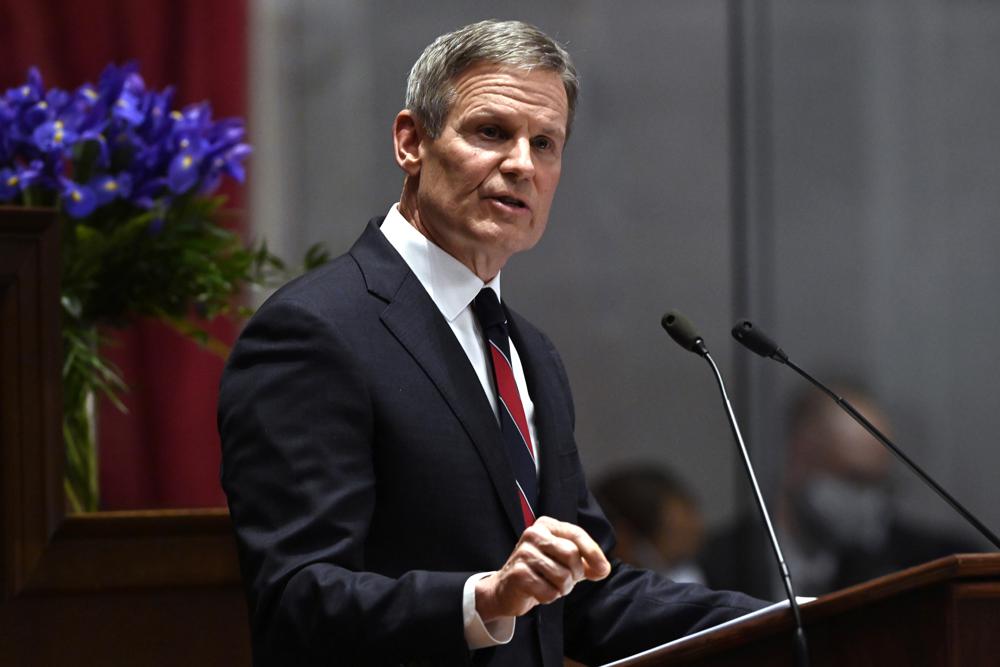
FILE – Tennessee Gov. Bill Lee delivers his State of the State address in the House Chamber of the Capitol building, Monday, Jan. 31, 2022, in Nashville, Tenn. Lee has signed legislation that will strictly regulate the dispensing of abortion pills, including imposing harsh penalties on doctors who violate them. The measure will go into effect Jan. 1, 2023. (AP Photo/Mark Zaleski, File)
NASHVILLE, Tenn. (AP) — Tennessee will soon strictly regulate the dispensing of abortion pills, including imposing harsh penalties on doctors who violate them, under legislation recently signed into law by Republican Gov. Bill Lee.
The measure, which Lee signed on Thursday, will go into effect Jan. 1, 2023. Once enacted, a medical clinician will be required to be physically present when abortion pills are administered to a patient even though federal regulations now allow mail delivery nationwide.
The issue has become even more important as the U.S. Supreme Court seems poised to overturn the landmark 1973 Roe v. Wade decision as suggested through a recently leaked draft opinion. Notably, Tennessee is among the 13 states with a so-called trigger law that would make abortion illegal should Roe be overturned.
To date, 19 states have placed strict restrictions on accessing medication abortion. Under the Tennessee version, delivery of abortion pills by mail would be outlawed and anyone who wanted to use abortion pills would be required to visit a doctor in advance and then return to pick up the pills.
The drugs may be dispensed only by qualified physicians — which would include barring pharmacists from doing so. Violators would face a Class E felony and up to a $50,000 fine.
However, according to abortion law experts, it’s an unsettled question whether states can restrict access to abortion pills in the wake of the the Food and Drug Administration’s decision earlier this year to no longer require women to pick up the abortion medication in person. The move allowed millions of American women to get a prescription via an online consultation and receive the pills through the mail.
“The general rule is that federal law preempts conflicting state law,” Laura Hermer, a professor at the Mitchell Hamline School of Law in St. Paul, Minnesota, recently told The Associated Press.
No lawsuit has been filed challenging Tennessee’s newly enacted restrictions.
Meanwhile, the in-person requirement had long been opposed by medical societies, including the American Medical Association, which said the restriction offers no clear benefit to patients
Use of abortion pills has been rising in the U.S. since 2000 when the FDA approved mifepristone — the main drug used in medication abortions. More than half of U.S. abortions are now done with pills, rather than surgery, according to the Guttmacher Institute, a research group that supports abortion rights.
Two drugs are required. The first, mifepristone, blocks a hormone needed to maintain a pregnancy. A second drug, misoprostol, taken one to two days later, empties the uterus. Both drugs are available as generics and are also used to treat other conditions.
Tennessee is the latest red state to make it a felony to mail abortion pills.
The law makes it punishable by 20 years in prison and a $50,000 fine. https://t.co/xdMbhujz13
Extremist Republican Matt Gaetz sent out a tweet railing against women pro-choice protestors, saying that they’re just “over-educated, under-loved millennials”. Gaetz’s comments perfectly epitomize the Republican Party’s social views as he is just rehashing old anti-feminist talking points.
“Matt Gaetz is a model avatar for the Republican Party’s manic culture war. As a far-right reactionary currently under investigation for sex crimes, he checks several boxes of hypocrisy so often seen among the GOP’s moral crusaders. It makes sense, then, that he delivered the best encapsulation of the socially conservative right’s response to pro-choice protests now sweeping the country. “How many of the women rallying against overturning Roe are over-educated, under-loved millennials who sadly return from protests to a lonely microwave dinner with their cats, and no bumble matches?” Gaetz asked on Twitter on Wednesday morning. The core of the argument is familiar: feminists are unhappy shrews, and only conservative women are happy and have families. Conservatives looking for quick clout have been adopting this mantra for years in an effort to virtue-signal their support for “traditional” values and demean their political opponents. Early resistance to Donald Trump’s presidency, like the 2017 Women’s March, inspired a similar rash of boorish or sexist posts by GOP officials, likely inspired by the former president’s long history of misogynistic remarks. Sexism in the Republican Party isn’t new or particularly revelatory; the GOP made limiting the rights of women a de facto policy for years before Trump took power. But as the modern culture war intensifies, it’s clear that unvarnished sexism will be a common bedrock conservatives like Gaetz fall back on.”
Protesters were heard shouting “shame on you” right before DeLemus was seen pointing at protesters screaming “Shame on you, shame on all of you. Shame on you, killing babies.” It then escalated to her pointing at the crowd, repeatedly screaming “You’re a murderer!”
DeLemus also shouted, “I murdered my own baby!” referring to an abortion she had decades ago and has publicly declared her regret about in the past. In 2012, DeLemus recounted an abortion she had when a bill was up for discussion on instating a 24-hour waiting period, AP reported.
In an interview hours after Thursday’s incident, DeLemus said she heard a large group of people yelling. When she came outside and said, “Abortion is murder,” they started yelling “Shame on you” at her.
“My feeling is shame on you and shame on me because I murdered my own baby by aborting it,” DeLemus said Thursday. “I stole that baby’s life from my family and from the community. I stole that person’s life, I took it for my own convenience, which I think that happens a lot with people who get abortions. Anyone who’s had an abortion, or anyone who supports abortion in my eyes, is a murderer or is pro abortion, pro death, pro ending the life of a baby.”
DeLemus said while it’s their right to be pro-abortion, everyone is entitled to their own opinions, and she is very passionate about the issue.
“Just because it’s legal, abortion doesn’t mean that I did not kill another human being, and that’s my stance,” DeLemus said. “That was what the yelling was about. I raised my voice and tried to be loud to be heard by the chanting crowd.”
DeLemus was criticized for her actions Thursday. State Rep. Chuck Grassie, D-Rochester, said her behavior doesn’t reflect well on the city he and DeLemus represent.
“It’s an embarrassment to Rochester,” Grassie said. “She has no concern about the decorum and how a state representative should act. No matter how you feel you should respect people’s free speech rights. If this goes viral nationally, all people will see is she’s a representative from Rochester. If we want to grow our community and image, that isn’t the kind of news or image we want to project.”
Kayla Montgomery, spokesperson for Planned Parenthood of Northern New England and Planned Parenthood New Hampshire Action Fund, said people advocating or seeking reproductive health care should not be harassed or threatened.
“This incident demonstrates why it is so critical for reproductive health centers to have all options available to ensure patient and public privacy and safety,” Montgomery said. “No one should face threats, intimidation, or shame when accessing health care, including safe, legal abortion.”
Palana Hunt-Hawkins, a former Rochester city councilor and board member of 603 Forward and Women’s Foundation, said this kind of behavior cannot be condoned.
“Representative DeLemus is playing a dangerous game with bodily autonomy, choosing to ignore the majority of Granite Staters who oppose abortion restrictions and the 95% of people who do not regret their abortions,” Hunt-Hawkins said. “While I have sympathy for her regret, I have zero sympathy for an elected official who chooses to engage in yelling matches and accuse her constituents who support reproductive freedom of being ‘murderers’.”
New Hampshire Republican House Speaker Sherman Packard could not be immediately reached for comment.
“Just because it's legal, abortion doesn't mean that I did not kill another human being, and that's my stance,” state Rep. @SusanDeLemus said. “That was what the yelling was about. I raised my voice and tried to be loud to be heard by the chanting crowd.” https://t.co/NNgzm8xCof
— Seacoastonline.com (@seacoastonline) May 5, 2022
One police instructor who has taught 560 officers in recent years has joined one extremist group and supported other far-right movements. Others have echoed QAnon and other fringe conspiracy theories on social media, a Reuters examination found.
On social media, Richard Whitehead is a warrior for the American right. He has praised extremist groups. He has called for public executions of government officials he sees as disloyal to former President Donald Trump. In a post in 2020, he urged law enforcement officers to disobey COVID-19 public-health orders from “tyrannical governors,” adding: “We are on the brink of civil war.”
Whitehead also has a day job. He trains police officers around the United States.
The Idaho-based law enforcement consultant has taught at least 560 police officers and other public safety workers in 85 sessions in 12 states over the past four years, according to a Reuters analysis of public records from the departments that hired him. A Washington state training commission in 2015 temporarily banned Whitehead from advertising courses on its website because of instructional materials that referred to a turban-wearing police officer as a “towel head” and contained cartoons of women in bikinis, according to emails from the commission to Whitehead that were reviewed by Reuters. Other marketing literature touted Whitehead’s “deception detection” technique that, among other things, teaches officers not to trust sexual-assault claimants if they use the word “we” in referring to themselves and their assailant.
The commission was responding to a student complaint citing “offensive slurs” and “blatant misogyny.” Whitehead said in an interview that the commission had given too much credence to one student’s opinion and caused him to lose business. Since then, he said, he has expanded the section of his course that caused that controversy, adding more “pot-stirring” material, including a slide that ridicules transgender people: “Suspect is a gender-fluid assigned-male-at-birth wearing non-gender-specific clothing born Caucasian but identifies as a mountain panda.” Whitehead said such barbs are intended to push back against pressures on law enforcement to espouse left-wing views on gender or race.
Law enforcement trainer Richard Whitehead has publicly espoused far-right extremist views and, in the classroom, has drawn complaints of using offensive language and content targeting women, Muslims and transgender people. REUTERS/Jim Urquhart
Whitehead is part of a trend in pushing a radical-right political agenda to American police forces. He’s one of five police trainers identified by Reuters whose political commentary on social media has echoed extremist opinions or who have public ties to far-right figures. They work for one or more of 35 training firms that advertised at least 10 police or public-safety training sessions in 2021, according to a Reuters analysis of scheduling data from policetraining.net, the main site where local departments connect with trainers. The news organization also reviewed materials describing classes by specific training companies.
The five trainers have aired views including the belief in a vote-rigging conspiracy to unseat Trump in the 2020 election. One trainer attended Trump’s January 6, 2021, rally at the U.S. Capitol that devolved into a riot, injuring more than 100 police officers. Two of the trainers have falsely asserted that prominent Democrats including President Joe Biden are pedophiles, a core tenet of the QAnon conspiracy theory. Four have endorsed or posted records of their past interactions with far-right extremist figures, including prominent “constitutional sheriff” leader David Clarke Jr. and Proud Boys leader Joe Biggs, who is being prosecuted for his involvement in the Capitol riots.
Whitehead adheres to the constitutional sheriff philosophy, which holds that county sheriffs should ignore any law they find unconstitutional. The growing movement claims sheriffs are the supreme law enforcement authority in their jurisdictions – more powerful even than the U.S. president. A spokesperson for the Constitutional Sheriffs and Peace Officers Association disputed the characterization of its views as extreme and said it was neither right- nor left-wing.
In interviews, Whitehead and the other four trainers also said their beliefs are neither extreme nor far-right. Some said posts that appeared to urge the overthrow of the U.S. government were intended as humorous or figurative. They said they keep their politics separate from their training, which they said focused on officer safety.
Whitehead was listed in a database of members of the Oath Keepers, a far-right anti-government group, that was leaked in September by the nonprofit Distributed Denial of Secrets, which says it aims to publish data in the public interest. The members list included some 15 other people who identified themselves as law enforcement trainers and dozens more who said they were retired officers or trainers, or firearms instructors, according to a Reuters review of the data. The anti-government militia group focuses on recruiting police and military personnel, according to some experts who track extremism, and claims to have thousands of members. Oath Keepers founder Stewart Rhodes was charged with seditious conspiracy for his role in the Jan. 6 Capitol riots. He has pleaded not guilty.
Kellye SoRelle – an attorney for the Oath Keepers who has called herself the group’s acting president during Rhodes’ pretrial detention – did not respond to a request for comment on the law enforcement officers listed in the database.
Whitehead told Reuters he was an Oath Keeper for about a year, in 2016 and 2017, and continues to support its ideology of “defending the constitution.” He said he filmed a promotional video at an event of a far-right militia, the Real Three Percenters, when Whitehead ran for sheriff of Kootenai County, Idaho in 2020. He praised the Three Percenters, who train for armed resistance of what they call a tyrannical U.S. government, as being “all about community” and also defending the constitution.
Private trainers work in an unregulated industry that largely has evaded the heightened scrutiny of U.S. policing in recent years in the wake of high-profile police killings of civilians. Trainers like those identified by Reuters, a half dozen police-training specialists say, highlight a lack of standards and oversight that allows instruction that can often exaggerate the threats that officers face, making them more likely to respond with excessive force in stressful situations.
U.S. law enforcement officers receive far less initial training at police academies than their counterparts in comparable countries, said Arjun Sethi, a Georgetown University adjunct law professor and policing specialist. That opens “immense commercial opportunities” for private trainers to fill the void with ongoing training of active-duty officers, often “in a politicized manner” that normalizes biased policing against Black people and other communities, he said.
“Suspect is a gender-fluid assigned-male-at-birth wearing non-gender-specific clothing born Caucasian but identifies as a mountain panda.”
Private trainers typically advertise their courses to police and sheriffs’ departments, who often pay for their officers to take them. But individuals can also seek out and pay for courses on their own to satisfy government or department requirements for ongoing training. The courses vary widely in content and in price, from hundreds to thousands of dollars per attendee.
State-based oversight institutions, often called Peace Officer Standards and Training agencies, set requirements for police training, such as the types of classes and minimum teaching hours that officers must complete. But the institutions have little power in most states to influence course content or set standards for private police trainers, in part due to budget constraints, said Randy Shrewsberry, a former police officer. He saw unregulated police training as such a problem that in 2017 he founded the California-based Institute for Criminal Justice Training Reform.
Some officers will subscribe to the extremist ideology of their trainers, Shrewsberry said, because they perceive instructors as having authority and credibility. “Bad training is instilling bad behavior,” he added.
Whitehead disputed the assertion that police trainers need more oversight, noting that many states review course material. “That seems regulated to me,” he said.
Support for QAnon, election conspiracies
On social media, some trainers have echoed core tenets of the QAnon conspiracy theory, which holds that some prominent Democrats and Hollywood celebrities are part of a cabal of Satanist pedophiles and cannibals.
Kansas-based trainer Darrel Schenck teaches firearms classes through his own company as well as through the law enforcement division of the National Rifle Association (NRA), the leading U.S. gun-rights lobby. Schenck has voiced the belief that Democrats are pedophiles, called reports of violence during the U.S. Capitol riots “fake news,” and declared the 2020 election illegitimate, commenting: “election fraud is the real pandemic.”
”
Social media post from police trainer Darrel Schenck, including baseless conspiracy theories about alleged criminal ties between Joe and Hunter Biden, the Chinese Communist Party, sex trafficking rings and the Federal Bureau of Investigation.
In an interview, Schenck stressed he was a professional whose personal views do not affect his training. The NRA did not respond to a request for comment.
Police instructor Adam Davis characterized Biden as a “puppet and a pedophile” on Facebook. In other posts, he slammed people who protest racial bias in policing as “pawns” in the “scheme to destroy this nation.”
Davis has worked as a contractor for Street Cop Training, one of the biggest private providers of law enforcement instruction. He spoke at an industry trade conference hosted by the company in October, and he gives lectures to police agencies nationwide. Street Cop Training did not respond to requests for comment.
Davis said in an interview that he “did not know for a fact” whether Biden was a pedophile. He said his criticism of anti-racism protesters was based on the property destruction that occurred during protests in various cities in 202o. He characterized his political views as “middle of the road.”
Texts with a Proud Boys leader
The lack of regulation gives individual trainers wide latitude to teach America’s police officers whatever they see fit. For trainer Tim Kennedy, that means training in martial arts, sharpshooting and strength-building.
In 2020, Kennedy posted on Instagram a video of himself taking out trash in combat gear, captioned: “When you want to boogaloo but you still have a bunch of honey-dos to do,” referring to household chores. That was an apparent reference to the anti-government “boogaloo” movement, whose adherents anticipate – and sometimes call for, or train for – a revolution toppling the federal government or a second U.S. civil war.
Two months later, Kennedy posted a photo of himself wearing a Hawaiian shirt and aiming a rifle. Hawaiian shirts are a trademark of the boogaloo movement. The picture was captioned: “If you choose to be an a‑‑hole… I picked out a special shirt for the occasion.”
Kennedy said in an interview that he does not support the boogaloo movement. He said he loves Hawaiian shirts and owned many before they became a boogaloo symbol.
Kennedy’s Twitter account shows that he has been an associate of Joe Biggs, a leading organizer of the right-wing Proud Boys group who is being prosecuted for his role in the U.S. Capitol riots. Their online interactions were as recent as May 2018, several months before Biggs’ Twitter account was suspended.
In Twitter posts, Kennedy discussed going on motorcycle rides with Biggs; named Biggs as his Interior Secretary in an imaginary presidential cabinet; and posted screenshots of their text-message conversation about an anticipated rally by antifa, the loosely organized left-wing anti-fascism movement.
President Joe Biden is a “puppet and a pedophile.” Protestors decrying racial bias in policing are “pawns” in a “scheme to destroy this nation.”
“Going down town to cause havoc,” wrote Biggs.
“Same. Sounds like a date!” Kennedy replied.
Biggs is currently detained pending trial. He was charged for his role in the Capitol riots with six counts including obstruction of an official proceeding, obstruction of law enforcement, destruction of government property, and conspiracy. Reached through a lawyer, Biggs declined to comment.
Kennedy told Reuters he believed Biggs had taken a “radical” turn and said he had not had any recent contact with him. He denied ever being friends with Biggs. “I’m pretty anti-antifa, and I’m pretty anti-far right radical,” Kennedy said. “I like the middle, where logic and rational people exist.”
Kennedy said he held about 200 training sessions across the United States in 2021. He offers individual officers a discount on his courses, which cost between $400 and $900 per student, because most police agencies refuse to pay for Kennedy’s training out of what he described as “political” reasons and “ignorance.” Kennedy said his courses focus on cultural understanding and de-escalation techniques as well as physical training.
One teaching method he cited, however, was a chart of different mental states – each assigned its own color – describing levels of preparedness, or the lack of it, to respond to threatening situations. The chart was developed by former U.S. Marine Col. Jeff Cooper, now deceased, “as a means of setting one’s mind into the proper condition when exercising lethal violence,” according to a 2004 written commentary attributed to Cooper.
Kennedy features a fighting practice in an instructional video, showing him and students wrestling and trying to tackle one another. He described the practice as a form of “stress inoculation” that aims to improve officers’ performance under pressure.
“The point of that is to induce stress onto a person, and then we make them try to solve a problem,” such as intervening in a simulated mugging, he said. Such training is needed, Kennedy said, because officers are at “unprecedented” risk of death and assault. Police reform measures taken in the wake of the 2020 racial-justice protests across the United States have left them even less protected, he said.
Long-term data on police officer deaths shows a different trend. Officer deaths caused by felonies last year increased to 73, compared to an average of 49 in the previous four years. But 2021 was an anomaly, as crime surged amid the coronavirus pandemic and related economic turmoil.
Students of police trainer Richard Whitehead watch a video showing officers’ funerals. One former police chief called instruction emphasizing violent threats “the worst kind of training to give officers today.” REUTERS/Jim Urquhart
Over the long term, police deaths per 100,000 officers, from both felonies and accidents, plunged from 81 to 20 between 1970 and 2016, a decline of 75%, according to a 2019 analysis of historical Federal Bureau of Investigation (FBI) data in the journal Criminology & Public Policy. Deaths from crimes fell even faster than accidental deaths over the period.
“The number of line-of-duty deaths has declined dramatically over the last five decades,” the study concluded. “The ‘war on cops’ thesis is not supported by any evidence.”
Kennedy disputed the FBI data and said he would send figures contradicting it. He never did. The FBI declined to comment on the study of officer deaths and on the police trainers identified by Reuters.
In light of such data showing declining dangers to officers, many training agencies long ago abandoned training that emphasized putting officers through simulations of threatening situations, said Gil Kerlikowske, who led the police departments of Seattle and Buffalo, New York, before serving as commissioner of the U.S. Customs and Border Patrol from 2014 until 2017.
“That’s the worst kind of training to give officers today, to make them feel more vulnerable,” Kerlikowske said. “You want people to have an awareness” of violent threats, “but you don’t want them to be so hypersensitive that it impacts everything they do.”
The mindset that trainers impart, such as a feeling of constant vulnerability, can be more influential than the technical knowledge they share, said Seth Stoughton, a law professor at the University of South Carolina and former police officer with expertise in law enforcement training. Stoughton said studies show that training which overemphasizes life-threatening situations can impart a “warrior mentality,” convincing the officers that they face constant deadly threats.
In a promotional video that Kennedy released in 2020, Chris Jackson, an officer who works for a California police agency operated by a Native American tribe, said Kennedy’s course had “opened his eyes to the world” and changed the way he would respond to threats. “You never want to be a victim of anything,” he said in the video.
Jackson told Reuters in an interview that the training, which his agency paid for, made him more aware of potential threats and prepared to respond with less hesitation. “Sometimes you gotta do what you gotta do to eliminate the threat,” he said.
Asked whether Kennedy’s social media posts referring to the boogaloo movement and his association with Joe Biggs affected his perception of the training, Jackson said it did not. “What he does on his own time is his own deal,” he said.
Moonlighting on Jan. 6
Ryan Morris, founder of Pennsylvania-based training firm Tripwire Operations Group, said in an interview that he posts political content on social media to attract customers. “It’s all marketing,” he said. “We put it out there to all different realms, hoping to spark some kind of conversation … and then we generate classes out of that.”
In social posts reviewed by Reuters, Morris and other Tripwire trainers have cast the 2020 election as a socialist plot to seize the U.S. government, echoing Trump’s false stolen-election claims. “You have just witnessed a coup, the overthrow of the US free election system, the end of our constitutional republic, and the merge of capitalism into the slide toward socialism,” read a Facebook post that Morris shared about a month after the 2020 election.
Police training company Tripwire Operations Group posts a photo from the Jan. 6, 2021 protests at the U.S. Capitol that devolved into a deadly riot.
Tripwire trains first responders and military personnel in explosives handling, shooting and de-escalation. Morris told Reuters that he and several other Tripwire trainers were “employed” at the Jan. 6, 2021, rally at the U.S. Capitol that devolved into a riot. He declined to say who hired them or how specifically Tripwire staffers were employed. He said Tripwire is sometimes hired to help law enforcement agencies or to “protect high-level executives,” because its staff consists of bomb technicians and active law enforcement officers.
Morris retired from his part-time position as a police officer in Washington Township, Pennsylvania, in early March. The township declined to comment beyond saying Morris no longer works there.
“You have just witnessed a coup, the overthrow of the US free election system.”
On the day of the rally, the official Tripwire Twitter account posted a link to a since-deleted Instagram photo. The post indicated the image was taken at the U.S. Capitol in Washington, D.C., midway into the three-hour breach of the building. Morris said he could not recall what was pictured in the deleted post, and that neither he nor any other Tripwire employees entered the Capitol building on Jan. 6.
Tripwire held about 50 classes in 2021, of which roughly half were attended by law enforcement officers, according to Morris. Law enforcement agencies, non-profit organizations, or officers themselves typically cover tuition, which ranges from $250 for a basic shooting class to $2,000 for more specialized training in how to handle explosives.
Tripwire instructors are politically neutral when it comes to training, Morris said. But political views are sometimes expressed in class, he said, because “law enforcement, military have certain mindsets. I’ll just leave it at that.”
Social media post from police trainer Richard Whitehead echoing the extremist “constitutional sheriff” philosophy.
‘Political correctness’
Richard Whitehead, the Idaho consultant, started his training firm in 1995 during his 25-year career in the sheriff’s department of Travis County, Texas. He moved to Idaho and, in 2020, ran for sheriff of Kootenai County. During his campaign, he handed out cards identifying himself as an Oath Keeper. He ran on a “constitutional sheriff” platform, he said in an interview. Whitehead lost in the primary, placing third of four candidates.
Adherents to the constitutional-sheriff movement consider the federal government a grave threat to U.S. citizens. They argue that local law enforcement is a higher authority, with the power to countermand the decisions of legislatures, courts and presidents. They have advocated that sheriffs refuse to uphold certain laws, involving, for instance, background checks of gun buyers. Whitehead said he campaigned for sheriff because he wanted to block the government from imposing “unconstitutional” limits on citizens, including pandemic-safety regulations such as mask mandates or business restrictions.
Whitehead primarily trains police officers. He also advises a range of other public safety workers, including dispatchers, jailers and paramedics. At a paramedic training in Sandpoint, Idaho, in April 2020, he put on an “appalling show,” according to Lieutenant David Ramsey, who described the event in an email to his supervisor two days after the class. Reuters obtained the email in a public-records request.
Ramsey wrote that Whitehead dismissed the COVID-19 pandemic as a joke, called infection-control measures unconstitutional and showed a video mocking women for not saying what they mean. After showing students an image of a police car with an LGBTQ flag on the side, according to Ramsey’s email, Whitehead asked the class: “What’s next? We have to have a Muslim flag to satisfy the goat f‑‑‑ers?”
Contacted by Reuters, Ramsey acknowledged writing the email but did not comment further.
Whitehead said he was not aware of Ramsey’s complaint. He said he stood by his view that putting an LGBTQ flag on a police car could create a “slippery slope” that drags law enforcement officers away from their mission of fighting crime. He denied making the comment about a “Muslim flag.”
“What’s next? We have to have a Muslim flag to satisfy the goat f‑‑‑ers?”
Ozzie Knezovich is the sheriff in Spokane County, Washington, just across the state line from the Idaho county where Whitehead ran for sheriff. He slammed Whitehead’s ties to militias and the constitutional sheriffs movement during his campaign. But Knezovich never realized until he was contacted by Reuters that Whitehead had been hired by the Spokane sheriff’s office to run 15 deputy trainings since 2015.
Knezovich, shocked that an instructor from “the lunatic fringe” had trained his own deputies, said he would ensure it didn’t happen again. The sheriff said a now-retired training coordinator had selected Whitehead.
“I’ll be having a conversation with my training unit to take somebody off the list,” the sheriff said.
Whitehead gave a Reuters reporter permission to attend a training he gave last June for police officers in Killeen, Texas. In that class, Whitehead referred to COVID-19 as the “China flu” and mocked transgender people. He also blasted some states’ efforts to end the “qualified immunity” legal doctrine that gives officers broad protection from civil lawsuits when they injure or kill suspects. “If qualified immunity goes away, that takes away your ability to make a mistake,” he said.
In an interview after the session, Whitehead said his class was about teaching officers “bulletproof” methods of documenting incidents on the job, and “not becoming susceptible to the winds of political correctness and appeasement.”
Louisiana’s Republican state legislators are advancing a bill that would categorize abortions as homicides, charging the pregnant person and anyone who assists with the abortion with murder. The bill will move to the state House for a full vote and if passed, by law, the state could charge a woman who got an abortion with the death penalty.
“A state legislative committee in Louisiana has advanced a bill that would criminalize abortion as homicide, in which the pregnant person or people who assist with their abortion could be charged. The bill, proposed by Republican state Rep Danny McCormick, advanced from the state’s House Criminal Justice Committee by a vote of 7-2 on 4 May, despite at least one legislator who supported the bill stressing that it is likely unconstitutional. House Bill 813 now heads to the state House of Representatives for a full vote. The bill’s introduction follows a leaked opinion from the US Supreme Court’s conservative majority that appears willing to revoke constitutional protections for abortion care affirmed by the rulings in Roe v Wade and Planned Parenthood v Casey, ending healthcare protections for millions of Americans. Abortion remains legal in all states, though Republican legislators across the US have introduced dozens of anti-abortion measures in 2022 to restrict access or eliminate it entirely, with several states targeting abortion providers with felonies, though such legislation has exempted people seeking abortions.”
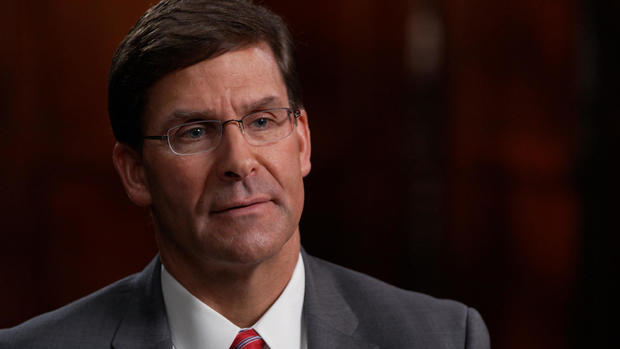
Former Defense Secretary Mark Esper says he personally killed a “ridiculous” plan from White House adviser Stephen Miller to deploy 250,000 troops to the southern border as a migrant caravan approached. Esper, who writes about the moment in his upcoming book, “A Sacred Oath,” says he initially thought Miller was joking when he asked for the troops while waiting in the Oval Office.
“We’re in a meeting, waiting for the president to come out,” Esper tells Norah O’Donnell for an interview airing this Sunday on “60 Minutes,” “We’re standing around the Resolute Desk. And he’s behind me. And this voice just starts talking about caravans are coming. And, ‘We need to get troops to the border.’ And, ‘We need a quarter-million troops.’ And I think he’s joking. And then I turn around and I look at him and these– and these deadpan eyes. Clearly, he is not joking.”
Mark Esper
Esper, who served as President Trump’s second secretary of defense, says he told Miller the Department of Homeland Security could handle any caravans, as they had done in the past.
“He repeats, ‘No, we need a quarter-million troops,'” Esper says. “And I just turn squarely around to him, face him, and say, ‘I don’t have a quarter million troops to send on some ridiculous mission to the border.'”
But Esper says the plan that Miller had been pushing was already in motion.
“I told this story to General Milley and my chief of staff,” Esper says. “I said, ‘Let’s be safe. Let’s just check and make sure that this isn’t being worked somewhere in the building.’ And Milley comes back days later and the door opens up and he’s waving a document that’s in hand.”
“And he says something like, ‘secretary, you’re not gonna believe this.’ And that’s when he explains to me that, yes, they were working. That we had developed a plan, initial concept of how this might happen,” Esper tells O’Donnell. “And I was just flabbergasted that, not only was the idea proposed, but that people– people in my department were working on it.”
Esper still laughs at the idea.
“It’s just so absurd,” Esper says. “I can’t even consider it. I mean, again, we don’t have 250,000 troops to send to the border. And to do what? It’s just ridiculous.”
Miller declined to comment when reached by CBS News.
“Whatever happened to that plan to deploy a quarter million troops to the border with Mexico?” O’Donnell asks Esper.
“Well, it died,” Esper says. “I gave General Milley specific instruction to tell NORTHCOM, Northern Command, to stop working on it, to cease and desist. And that if anybody had any questions, you tell them they should call me direct. I never got a phone call.”
“It was dead and it died, as it should,” Esper says.
O’Donnell’s interview with Esper will air Sunday night on “60 Minutes.”
Former Defense Secretary Mark Esper says he personally killed a "ridiculous" plan from White House adviser Stephen Miller to deploy 250,000 troops to the southern border as a migrant caravan approached. https://t.co/aJOCstSjhx
"We had developed a plan, initial concept of how [sending 250,000 troops to the U.S.-Mexico border] might happen. And I was just flabbergasted," former Secretary of Defense Mark Esper tells @NorahODonnell.
President Donald J. Trump in 2020 asked Mark T. Esper, his defense secretary, about the possibility of launching missiles into Mexico to “destroy the drug labs” and wipe out the cartels, maintaining that the United States’ involvement in a strike against its southern neighbor could be kept secret, Mr. Esper recounts in his upcoming memoir.
Those remarkable discussions were among several moments that Mr. Esper described in the book, “A Sacred Oath,” as leaving him all but speechless when he served the 45th president.
Mr. Esper, the last Senate-confirmed defense secretary under Mr. Trump, also had concerns about speculation that the president might misuse the military around Election Day by, for instance, having soldiers seize ballot boxes. He warned subordinates to be on alert for unusual calls from the White House in the lead-up to the election.
Donald Trump asked his then-defense secretary, Mark Esper, about the possibility of launching missiles into Mexico to “destroy the drug labs” and wipe out the cartels, Esper said in his upcoming memoir. https://t.co/HsaD7M1GQX
And Trump’s not at all good at keeping secrets. Y’all know he would repeatedly hint at being responsible, especially if the operation was deemed a success via public opinion. Eventually, he would strut and take credit for it.
On the other hand, if it was a disaster and innocents were killed, the orange POS would still hint that these were still “very bad people.”
How we managed to survive this dim maniac is astounding. But thx for saving this for your book Esper. Dammed you too. https://t.co/MFuqnBoYsd
The fact that TFG even asked the question (among other equally insane suggestions) is proof of his utter incompetence. The fact that Esper kept this to himself until he could drop it for a pre-publish tease to sell a book is contemptible.
A Lebanon man accused of killing his wife in March and dumping her body in a creek is among the candidates to advance in a local election after Indiana’s primaries Tuesday.
Andrew Wilhoite, who’s suspected of fatally striking his wife with a gallon-sized concrete flower pot, secured a spot Tuesday as one of three Republican candidates in the race for a seat on the Clinton Township Board.
The 40-year-old has been incarcerated in the Boone County Jail since March after police said he told investigators he threw a concrete flower pot at his wife, Nikki Wilhoite, the night before and dropped her body over the side of a bridge.
Prosecutors charged Andrew Wilhoite with murder in his wife’s killing. His next court hearing is scheduled for May 27.
How can a candidate run for office while facing felony charges?
State election officials said it’s legal for people facing felony charges, such as Andrew Wilhoite, to run for local office. A person is only ineligible if they are convicted.
“Under our legal system, every person is innocent until proven guilty,” said Brad King, co-director of the Indiana Election Division. “If a candidate is ultimately convicted, then depending upon the timing of that conviction, the person can be replaced on the ballot by the political party that has a vacancy.”
Township boards consist of three members, state officials said. The local Republican primary race has only drawn the three candidates. No one filed on the Democratic primary ticket.
Boone County election results show Andrew Wilhoite earned 60 votes, just over 21%, to his competitors’ 110 and 106 votes. Clinton Township has a population of 906, according to data from STATS Indiana.
If a person facing felony charges is elected in a township race and they are convicted after being sworn in, King said the vacancy will be filled by someone affiliated with the political party of the last person to have the seat.
King further noted that there’s no law prohibiting a person who’s incarcerated before trial from “exercising the duties of their office,” should they get elected.
“How that practically gets executed will depend on the facts,” King said.
Wife’s death investigation
The Boone County Clerk’s office said election filings occurred at the beginning of January through the first week of February, before Andrew Wilhoite was taken into custody on his murder charge.
IndyStar has reached out to Andrew Wilhoite’s attorney for comment.
Nikki Wilhoite was reported missing March 25 after her friend noticed she didn’t show up for work that day.
Investigators in a probable cause affidavit said Andrew Wilhoite initially told police he last saw his wife sleeping on the couch after the couple had an argument. When police spoke further with him, he asked for an attorney.
Police said Andrew Wilhoite called again shortly after and said he’d take them to his wife’s body.
Andrew Wilhoite was charged in March after a detective said he threw a cement flower pot at his wife and dumped her body in a nearby creek in Boone County. https://t.co/UPKfhfYUGm
Anti-LGBTQ extremist Ethan Schmidt (left) and Michael Meritt Graham (right) use bullhorns to shout at abortion rights protesters at a rally at the state Capitol on May 3, 2022. Graham was arrested after punching abortion rights protesters; Schmidt was detained by state troopers but was later released without being charged Photo by Jerod MacDonald-Evoy | Arizona Mirror
A group of far-right extremists with ties to white nationalists tried to counter-protest an abortion rights rally held at the Arizona Capitol Tuesday night, where they were vastly outnumbered and one was arrested for violently attacking a demonstrator.
Michael Merritt Graham, 34, was arrested by the Arizona Department of Public Safety and booked for suspicion of assault and disorderly conduct after state troopers witnessed him punch another person at the rally.
Graham, who was wearing a shirt with the slogan “Baby Lives Matter” from the disinformation website InfoWars, was carrying a .45 caliber Glock 36 pistol when he was arrested, according to a police report obtained by the Arizona Mirror. Graham was not the only counter-protester who was armed: The Mirror observed other counter-protesters openly carrying firearms. Graham had his handgun tucked into his waistband out of view, according to the police report.
Graham was among roughly 20 counter-protesters who showed up to the event where over one thousand protesters marched in support of abortion rights in the wake of a leaked U.S. Supreme Court opinion that would overturn the landmark court decision of Roe v. Wade and strip the right of women to seek an abortion that was established nearly 50 years ago.
Graham was joined by Ethan Schmidt, an anti-LGBTQ extremist and provocateur, known mostly for stunts challenging mask mandates and for “hunting” what he deems “LGBT pedophiles.” Hours before Graham was arrested, Schmidt walked straight into the crowd of protesters as he was recording video in an apparent attempt to spark a confrontation.
Near the end of the evening, Schmidt and Graham confronted protesters with bullhorns.
According to the police report, Graham got into a physical altercation with a protester. The incident began when Graham ripped the protester’s sign out of his hands and threw it to the ground. The victim then stepped in front of his girlfriend and grabbed Graham’s bullhorn before leaning down to pick up the sign.
Graham responded by hitting the man in his face, bloodying him.
Graham then started to leave the crowd and encountered Jace Robert Denis, 20, another protester. Troopers wrote that they saw Graham hit Denis, who described it as a “sucker punch.”
Denis began running after Graham “in an aggressive manner” and DPS arrested him, booking him for suspicion of disorderly conduct.
Denis told troopers that Graham had punched “another male” twice and “started walking towards a black female.” Denis ran towards Graham to get in between him and the woman yelling “don’t” before Graham threw the punch, Denis told troopers.
But DPS didn’t just put Graham and Denis in cuffs that night.
Schmidt was also detained by state troopers; he was later released without being charged.
Schmidt, who is currently awaiting sentencing on an extreme DUI in Chandler, was far from the only far-right extremist present among the counter-protesters.
In attendance were also members of the group American Populist Union, which is closely aligned with groypers, a group of white nationalists who strive for their ideas to become a part of the Republican mainstream and are largely followers of 23-year-old white nationalist Nick Fuentes.
And Kyle Clifton, a Fuentes acolyte with ties to APU, was also among the counter-protesters.
Clifton was behind an account on Instagram called “afu.arizona” which posted white nationalist messaging, touted the “great replacement” theory and antisemitic images.
Antisemitism was present among the counter protesters with some spewing rants about “freemasonry” when debating with abortion rights activists. Many of the Freemason conspiracy theories are rooted in antisemitism and can be traced back to an antisemitic hoax from more than a century ago.
“The Lake campaign did not organize the counter-protest,” Sam Stone, the policy director for Lake’s campaign, told the Mirror. “Everyone was kind of showing up at the same time.”
Stone said that no one associated with the campaign was aware of who Clifton was. He added that the counter-protest falls within the realm of “field activity,” and that many conservatives consider Lake to be the “candidate for them” when asked about the signs at the event.
DPS may also be getting a call from the Lake campaign, Stone said: One of the Lake staffers allegedly was spit on by an abortion rights activist.
“I tend to believe that you settle these things at the ballot box, but I tend to believe that fits the description of assault,” Stone said, adding that they may send the video they have to DPS.
Oh cry me a river, a politician who is a well known Christian nationalist, has staff that are involved with a group that assaults and threatens pro-choice demonstrators and wants the police instead to arrest someone who spit on one of the staff members. The white Christian nationalist racists who assaulted, threatened, punched, and bloodied the protestors is not a problem, she but wants the feelings of her staff defended. Give me a break.
One extremist bloodied a protester, before running away and "sucker-punching" another man.
Neo-Nazi/anti-LGBTQ+ extremist Ethan Schmidt-Crockett posted a video calling for Ukrainian president Zelenskyy to be assassinated. He praises Putin's oppression of LGBTQ+ people and says the U.S. should follow Putin's example. He finishes with a Nazi salute and says "Heil Putin!" https://t.co/5sm1jARbkopic.twitter.com/oQEdvQl1uL
— Vishal P. Singh 🏳️⚧️ (they/he) (@VPS_Reports) April 28, 2022