From gay polyamorous flamingos to a “half-male, half-female bird” sighting, Mother Nature has proven that she’s pretty damn queer. But sometimes, scientists like to get in on the fun, too. It turns out that some are even using their talents to engineer “trans” mosquitoes (yes, really).
On October 5, the X account @Rainmaker1973 shared a video of a female mosquito attempting to bite a human hand. However, its blood-sucking attempts are thwarted because its proboscis — aka its needle-like mouth — could not break through the skin.
“Using the CRISPR technique, it’s possible to genetically modify mosquitoes by disabling a gene in females, so that their proboscis turns male, making them unable to pierce human skin,” @Rainmaker1973 explained.
Before we go further, a quick science lesson: According to the National Human Genome Research Institute, Clustered Regularly Interspaced Short Palindromic Repeats, or CRISPR, is a technology that allows scientists to selectively modify DNA.
So why use this technology on mosquitoes? Well, malaria, which kills more than 600,000 people per year, is transmitted to humans by female mosquitoes belonging to the genus Anopheles, which, per the National Institute of Allergy and Infectious Diseases, encompasses between 30 and 40 mosquito species. According to a 2018 study in the journal Nature Biotechnology, using CRISPR technology on female mosquitoes resulted in egg production reaching the point of “total population collapse” within 7 to 11 generations. In other words, this technique allows scientists to not only ensure that female mosquitoes carrying malaria can’t spread the disease to humans, but that they can’t reproduce in general. This CRISPR-enabled gene editing is just one of several techniques that researchers have used to fight the spread of malaria in humans.
So, sure, in a manner of speaking, scientists are doing their best to curb the spread of malaria by making some mosquitoes “trans.” In addition to being a genetic achievement, @Rainmaker1973’s viral video sharing the news also unsurprisingly inspired some excellent tweets. (see on the page)
She strokin tryna wake it up OMG… hrt no joke,” one X user tweeted.
“Mosquitoes pissing me off so I took out my crispr and gave them gender dysphoria,” another joked.
The past few years have introduced no shortage of queer bugs, from fruit flies who were potentially turned gay by air pollution to cicadas who became hypersexual zombies after being infected with a sexually transmitted fungus. What’s a few more trans mosquitoes?
October 10, 1699 The Spanish issued a royal decree which stated that every African-American who came to St. Augustine, Florida, and adopted Catholicism would be free and protected from the English.
October 10, 1963 The Limited Test Ban Treaty—banning nuclear tests in the oceans, in the atmosphere, and in outer space—went into effect. The nuclear powers of the time—the United States, Great Britain, and the Soviet Union—had signed the treaty earlier in the year. In 1957, Nobel Prize-winner (Chemistry) Linus Pauling drafted the Scientists’ Bomb-Test Appeal with two colleagues, Barry Commoner and Ted Condon, eventually gaining the support of 11,000 scientists from 49 countries for an end to the testing of nuclear weapons. These included Bertrand Russell, Albert Einstein, and Albert Schweitzer. Linus Pauling Pauling then took the resolution to Dag Hammarskjöld, then Secretary-General of the United Nations, and sent copies to both President John F. Kennedy and Soviet Premier Nikita Kruschev. The final treaty had many similarities to Pauling’s draft. It went into effect the same day as the announcement of Pauling’s second Nobel Prize, this time for Peace.
October 10, 1967 The Outer Space Treaty (Treaty on Principles Governing the Activities of States in the Exploration and Use of Outer Space, Including the Moon and Other Celestial Bodies) demilitarizing outer space went into force.It sought to avoid “a new form of colonial competition” as in the Antarctic Treaty, and the possible damage that self-seeking exploitation might cause. Discussions on banning weapons of mass destruction in orbit had begun among the major powers ten years earlier. 1949 painting by Frank Tinsley of the infamous “Military Space Platform” proposed by then Secretary of Defense James Forrestal in the December 1948 military budget.
October 10, 1986 Elliott Abrams, then assistant secretary of state for inter-American affairs, testified before the Senate Foreign Relations Committee (in closed executive session) that he did not know that Marine Lt. Col. Oliver North, a White House employee in the Reagan administration, was directing illegal arms sales to Iran and diverting the proceeds to assist the Nicaraguan contras. Abrams pled guilty in 1991 to withholding information on the Iran-contra affair during that congressional testimony, but was pardoned by President George H.W. Bush. Elliott Abrams Presidents George W. Bush & George H.W. Bush Oliver North Read more about the pardons
October 10, 1987 Thirty thousand Germans demonstrated against construction of a large-scale nuclear reprocessing installation at Wackersdorf in mostly rural northern Bavaria.
October 10, 2002 The House voted 296-133 to pass the “Joint Resolution to Authorize the Use of United States Armed Forces Against Iraq,” giving President George W. Bush broad authority to use military force against Iraqi leader Saddam Hussein, with or without U.N. support.
Hurricane Milton Tropical Cyclone Update
NWS National Hurricane Center Miami FL       AL142024
1000 PM EDT Wed Oct 09 2024

...FLASH FLOOD EMERGENCY IN EFFECT FOR THE TAMPA BAY AREA AS
MILTON CONTINUES MOVING INLAND...
...1000 PM EDT POSITION UPDATE...

A sustained wind of 69 mph (111 km/h) and a gust of 102 mph (165
km/h) was recently reported at the Sarasota-Bradenton International
Airport. A sustained wind of 86 mph (139 km/h) and a gust of 105 mph
(169 km/h) was recently reported at a WeatherFlow station at Egmont
Channel. A sustained wind of 74 mph (119 km/h) and a gust of 98 mph
(157 km/h) was recently reported at a NOS station at Middle Tampa
Bay. A gust of 91 mph (146 km/h) was recently reported at a Citizen
Weather Observer Program station in Bartow.

A Flash Flood Emergency is in effect for the Tampa Bay area,
including the cities of Tampa, St. Petersburg, and Clearwater.
Albert Whitted Airport in St. Petersburg has received 16.61 inches
of rain so far today.

The next update will be the full advisory at 1100 PM EDT (0300
UTC).

SUMMARY OF 1000 PM EDT...0200 UTC...INFORMATION
-----------------------------------------------
LOCATION...27.5N 82.3W
ABOUT 20 MI...30 KM NE OF SARASOTA FLORIDA
ABOUT 90 MI...145 KM SW OF ORLANDO FLORIDA
MAXIMUM SUSTAINED WINDS...110 MPH...175 KM/H
PRESENT MOVEMENT...ENE OR 60 DEGREES AT 16 MPH...26 KM/H
MINIMUM CENTRAL PRESSURE...958 MB...28.29 INCHES
BULLETIN Hurricane Milton Intermediate Advisory Number 19A NWS National Hurricane Center Miami FL AL142024 800 PM EDT Wed Oct 09 2024
...MILTON CLOSE TO MAKING LANDFALL ALONG THE COAST OF WEST-CENTRAL FLORIDA... ...LIFE-THREATENING STORM SURGE, DAMAGING WINDS, AND FLOODING RAINS OCCURRING ACROSS PORTIONS OF CENTRAL AND SOUTHWESTERN FLORIDA...
SUMMARY OF 800 PM EDT...0000 UTC...INFORMATION ---------------------------------------------- LOCATION...27.2N 82.8W ABOUT 20 MI...30 KM WSW OF SARASOTA FLORIDA ABOUT 130 MI...205 KM SW OF ORLANDO FLORIDA MAXIMUM SUSTAINED WINDS...120 MPH...195 KM/H PRESENT MOVEMENT...ENE OR 60 DEGREES AT 15 MPH...24 KM/H MINIMUM CENTRAL PRESSURE...954 MB...28.17 INCHES
WATCHES AND WARNINGS -------------------- CHANGES WITH THIS ADVISORY:
None.
SUMMARY OF WATCHES AND WARNINGS IN EFFECT:
A Storm Surge Warning is in effect for... * Florida west coast from Flamingo northward to Yankeetown, including Charlotte Harbor and Tampa Bay * Sebastian Inlet Florida to Altamaha Sound Georgia, including the St. Johns River
A Hurricane Warning is in effect for... * Florida west coast from Bonita Beach northward to Suwannee River, including Tampa Bay * Florida east coast from the St. Lucie/Martin County Line northward to Ponte Vedra Beach
A Hurricane Watch is in effect for... * Lake Okeechobee * Florida east coast from the St. Lucie/Martin County Line to the Palm Beach/Martin County Line
A Tropical Storm Warning is in effect for... * Florida Keys, including Dry Tortugas and Florida Bay * Lake Okeechobee * Florida west coast from Flamingo to south of Bonita Beach * Florida west coast from north of Suwanee River to Indian Pass * Florida east coast south of the St. Lucie/Martin County Line to Flamingo * North of Ponte Vedra Beach Florida to Edisto Beach South Carolina * Extreme northwestern Bahamas, including Grand Bahama Island, the Abacos, and Bimini
A Storm Surge Warning means there is a danger of life-threatening inundation, from rising water moving inland from the coastline in the indicated locations. For a depiction of areas at risk, please see the National Weather Service Storm Surge Watch/Warning Graphic, available at hurricanes.gov. This is a life-threatening situation. Persons located within these areas should take all necessary actions to protect life and property from rising water and the potential for other dangerous conditions. Promptly follow evacuation and other instructions from local officials.
A Hurricane Warning means that hurricane conditions are expected somewhere within the warning area.
A Tropical Storm Warning means that tropical storm conditions are expected somewhere within the warning area within 36 hours.
A Hurricane Watch means that hurricane conditions are possible within the watch area.
For storm information specific to your area in the United States, including possible inland watches and warnings, please monitor products issued by your local National Weather Service forecast office. For storm information specific to your area outside of the United States, please monitor products issued by your national meteorological service.
DISCUSSION AND OUTLOOK ---------------------- At 800 PM EDT (0000 UTC), the center of Hurricane Milton was located near latitude 27.2 North, longitude 82.8 West. Milton is moving toward the east-northeast near 15 mph (24 km/h), and this general motion is expected to continue through Thursday, followed by a turn toward the east on Friday. On the forecast track, the center of Milton will make landfall just south of the Tampa Bay region within the next hour or two, and then move across the central part of the Florida peninsula overnight, and emerge off the east coast of Florida on Thursday.
Maximum sustained winds are near 120 mph (195 km/h) with higher gusts. Milton is a category 3 hurricane on the Saffir-Simpson Hurricane Wind Scale. Little change in strength is likely until landfall, and Milton is expected to remain a hurricane while it moves across central Florida through Thursday. The system is forecast to weaken over the western Atlantic and become extratropical by Thursday night.
Hurricane-force winds extend outward up to 35 miles (55 km) from the center and tropical-storm-force winds extend outward up to 255 miles (405 km). A sustained wind of 54 mph (87 km/h) and a gust of 96 mph (154 km/h) was recently reported at the Sarasota-Bradenton International Airport. A C-MAN Station in Venice, Florida recently reported a sustained wind of 71 mph (115 km/h) with a gust to 90 mph (145 km/h).
The minimum central pressure estimated from Hurricane Hunter aircraft observations is 954 mb (28.17 inches).
HAZARDS AFFECTING LAND ---------------------- Key Messages for Milton can be found in the Tropical Cyclone Discussion under AWIPS header MIATCDAT4 and WMO header WTNT44 KNHC and on the web at hurricanes.gov/text/MIATCDAT4.shtml
STORM SURGE: The combination of a dangerous storm surge and the tide will cause normally dry areas near the coast to be flooded by rising waters moving inland from the shoreline. The water could reach the following heights above ground somewhere in the indicated areas if the peak surge occurs at the time of high tide...
Anna Maria Island, FL to Boca Grande, FL...9-13 ft Anclote River, FL to Anna Maria Island, FL...6-9 ft Tampa Bay...6-9 ft Boca Grande, FL to Bonita Beach, FL...8-12 ft Charlotte Harbor...8-12 ft Bonita Beach, FL to Chokoloskee, FL...5-8 ft Chokoloskee, FL to Flamingo, FL...3-5 ft Sebastian Inlet, FL to Altamaha Sound, GA...3-5 ft Yankeetown, FL to Anclote River, FL...2-4 ft Dry Tortugas...2-4 ft St. Johns River...2-4 ft
The deepest water will occur along the immediate coast near and to the south of the landfall location, where the surge will be accompanied by large and dangerous waves. Surge-related flooding depends on the relative timing of the surge and the tidal cycle, and can vary greatly over short distances. For information specific to your area, please see products issued by your local National Weather Service forecast office.
For a complete depiction of areas at risk of storm surge inundation, please see the National Weather Service Peak Storm Surge Graphic, available at hurricanes.gov/graphics_at4.shtml?peakSurge.
RAINFALL: Rainfall amounts of 6 to 12 inches, with localized totals up to 18 inches, are expected across central to northern portions of the Florida Peninsula through Thursday. This rainfall brings the risk of catastrophic and life-threatening flash and urban flooding, along with moderate to major river flooding.
For a complete depiction of forecast rainfall associated with Hurricane Milton, please see the National Weather Service Storm Total Rainfall Graphic, available at hurricanes.gov/graphics_at4.shtml?rainqpf and the Flash Flood Risk graphic at hurricanes.gov/graphics_at4.shtml?ero.
WIND: Hurricane conditions are occurring within the hurricane warning area and will spread east-northeastward across the Florida peninsula overnight. Hurricane conditions are possible in the hurricane watch area tonight and on Thursday. Tropical storm conditions are occurring along the west coast of Florida and are forecast to spread across the peninsula and reach the east coast tonight. Tropical storm conditions are expected to begin in the warning area along the Georgia and South Carolina coast on Thursday.
Tropical storm conditions are expected in portions of the northwestern Bahamas on Thursday.
TORNADOES: Several tornadoes, possibly including a few strong tornadoes, are likely this evening and tonight across parts of central Florida.
SURF: Swells generated by Milton are expected to continue to affect much of the Gulf Coast and will increase along the southeastern U.S. coast during the next day or two. These swells are likely to cause life-threatening surf and rip current conditions. Please consult products from your local weather office.
NEXT ADVISORY ------------- Next complete advisory at 1100 PM EDT.
Next-generation optical fibre manufactured in microgravity aboard the International Space Station has been returned safely to Earth.
Scientists at Adelaide University in South Australia are now comparing the fibres to otherwise identical Earth-made counterparts to confirm whether the space-made product is superior.
It’s thought likely that it is, but the results won’t be known for a couple of months.
The research has already delivered some interesting results: “Seven of the draws went beyond 700 meters, showcasing that it is possible to produce commercial lengths of fibre in space,” says Rob Loughan, CEO of the company that designed the fibre drawing device, Flawless Photonics.
“The longest draw went above 1,141 meters, setting a record for the longest fibre manufactured in space.”
ZBLAN glass fibre. Credit: Imma Perfetto
The fibres were made of ZBLAN glass, a substance which has the potential to transmit light 20 times further than traditional silica-based fibre-optic cables.
In an optical fibre, light becomes dimmer and dimmer as it travels along the fibre. Therefore, for example, submarine fibre optics cables require amplifiers about every 100km to boost the light signal to allow it to be transmitted over long distances.
A ZBLAN optical fibre could increase distances between amplifiers, from every 100 km for silica fibres to every 2,000 km.
But this isn’t feasible yet. In practice, ZBLAN fibres perform about 10 times worse than the best silica fibres because the fabrication process introduces defects and impurities, which lower its efficiency at transmitting light.
Professor Heike Ebendorff-Heidepriem, and her team at the University of Adelaide’s Australian National Fabrication Facility’s (ANFF) are trying to solve the problem of enhanced impurities and defects in current ZBLAN glass fibres.
Dr Yunle Wei, Alson Ng, Professor Heike Ebendorff-Heidepriem, and Dr Ka Wu with the team’s 4m draw tower. Credit: Imma Perfetto
“The purity of the glass depends on the purity of the raw material, and it is challenging to make highly pure solid raw materials,” says Ebendorff-Heidepriem. The team is trying to completely remove one of the main reasons the defects form: gravity.
“Gravity here on Earth causes convection … If you heat up something on a hot plate, the liquid is hot at the bottom. That makes the density of the liquid at the bottom become lower, which moves this portion of the liquid up, at the top the liquid becomes cooler, making the density higher, therefore gravity pulls it down, and so on” she explains.
Ebendorff-Heidepriem partnered with Flawless Photonics which designed and operates a fibre drawing device that squeezed all the necessary technology into a 0.8m-long box for the ISS.
In June, the more than 11km of fibre returned to Earth, intact. Now, work is underway at the University of Adelaide and at 5 other organisations around the world to determine how much of an impact gravity has on ZBLAN’s ability to transmit light. They are hoping to complete their analysis by December this year.
“We will see: is it better? Is it worse? Is it the same? And no matter what result we get, I think the biggest outcome is already achieved – we can make commercial lengths of optical fibres in space.”
Sometimes knowledge helps us cope with less stress. Plus, this is available on any device, as long as there is wifi or mobile data available. Which, tomorrow, may not be a thing for Scottie, Ron, and the kitties tomorrow and after, as well as any other readers in the vast path of Milton. But up till then, there is current info. It’s better on the page; I put a bit here so we can see what’s available. The time zone will be that of the person accessing the info; I’m in Central, so this shows Central. I learned Zulu time researching tornado formation! NWS uses Zulu, as well, but this page does show regular time.
Hurricane Milton Satellite | Buoys | Grids | Storm Archive… TODAY IS THE LAST FULL DAY FOR FLORIDA RESIDENTS TO GET THEIR FAMILIES AND HOMES READY AND EVACUATE IF TOLD TO DO SO BY LOCAL OFFICIALS…
10:00 AM CDT Tue Oct 8 Location: 22.7°N 88.4°W Moving: ENE at 9 mph Min pressure: 929 mb Max sustained: 150 mph
October 8, 1945 President Harry S. Truman announced that the secret of the atomic bomb would be shared only with Great Britain and Canada.
October 8, 1982 The Polish Parliament overwhelmingly approved a law banning Solidarnos´c´ (Solidarity), the independent trade union that had captured the imagination and allegiance of nearly 10 million Poles. Solidarnosc leader Lech Walesa, 1982 The law abolished all existing labor organizations, including Solidarity, whose 15 months of existence brought hope to people in Poland and around the world but drew the anger of the Soviet and other Eastern-bloc (Warsaw Pact) governments. The parliament created a new set of unions with severely restricted rights.
The UK’s last coal-fired power plant, Ratcliffe-on-Soar in Nottinghamshire, will close this month, ending a 142-year era of burning coal to generate electricity.
The UK’s coal-power phaseout is internationally significant.
It is the first major economy – and first G7 member – to achieve this milestone. It also opened the world’s first coal-fired power station in 1882, on London’s Holborn Viaduct.
From 1882 until Ratcliffe’s closure, the UK’s coal plants will have burned through 4.6bn tonnes of coal and emitted 10.4bn tonnes of carbon dioxide (CO2) – more than most countries have ever produced from all sources, Carbon Brief analysis shows.
The UK’s coal-power phaseout will help push overall coal demand to levels not seen since the 1600s.
The phaseout was built on four key elements.
First, the availability of alternative electricity sources, sufficient to meet and exceed rising demand.
Second, bringing the construction of new coal capacity to an end.
Third, pricing externalities, such as air pollution and carbon dioxide (CO2), thus tipping the economic scales in favour of alternatives.
Fourth, the government setting a clear phaseout timeline a decade in advance, giving the power sector time to react and plan ahead.
The UK’s experience, set out and explored in depth in this article, demonstrates that rapid coal phaseouts are possible – and could be replicated internationally.
As the UK aims to fully decarbonise its power sector by 2030, it has the challenge – and opportunity – of trying to build another case study for successful climate action.
In a world increasingly illuminated by artificial light, the beautiful night skies of a small coastal town in South Australia have attracted international recognition. Carrickalinga on the Fleurieu Peninsula is Australia’s first official Dark Sky Community. The title rewards a dedicated community effort to combat light pollution and preserve the natural environment at night.
The journey began three years ago when I was a PhD candidate at the Australian National University, working on the value of night skies. I was a regular visitor to Carrickalinga, but this time conversations at a picnic one evening turned to the clarity and brilliance of the stars. I was inspired to work with the locals to nominate Carrickalinga as a “Dark Sky Place”.
My recent research suggests restoring dark skies would be worth US$3.4 trillion (A$5.16 trillion) to the world, annually. That’s largely because light pollution is disrupting nocturnal pollinators, altering predator-prey interactions, and changing the behaviours of nocturnal species.
Light pollution has detrimental effects on wildlife, human health, and ecosystem functions and services. But there are simple solutions. By embracing responsible lighting practices, everyone can contribute to a healthier future in which the wonders of the night sky are accessible to all.
Understanding light pollution
Light pollution refers to human alteration of outdoor light levels. Excessive or misdirected artificial light brightens the night sky, diminishing our ability to see stars.
Research shows the problem is getting worse. Light pollution increased by 7–10% a year from 2011 to 2022. More than a third of people on Earth cannot see the Milky Way.
Light pollution not only affects our view of the cosmos, but also wastes energy and money, contributes to climate change and has significant repercussions for both ecological and human health.
Nocturnal animals such as bats and certain birds rely on darkness to navigate and find food. Insects, crucial for pollination and as a food source for other wildlife, are also affected. Artificial light at night is contributing to their decline.
In humans, studies have shown artificial light interferes with circadian rhythms, leading to sleep disorders and other health issues.
The global Dark Sky movement
DarkSky International, formerly known as the International Dark Sky Association, is a global network of volunteers combating light pollution. The non-profit organisation established in 1988 is based in Tuscon, Arizona in the United States. But more than 193,000 people across more than 70 countries are involved, including astronomers, environmental scientists and the public.
The International Dark Sky Places Program was born in 2001 when Flagstaff, Arizona was named the first International Dark Sky City. Now the program certifies five types of Dark Sky Places: sanctuaries, reserves, parks, communities, and urban night sky.
DarkSky says the aim is to “preserve and protect the nighttime environment and our heritage of dark skies through environmentally responsible outdoor lighting”. It recognises places that demonstrate a commitment to reducing light pollution through public education, policy, and promoting responsible lighting practices.
There are now well over 200 Dark Sky Places across the globe. This covers more than 160,000 square kilometres in 22 countries on six continents.
Australia’s Dark Sky Places
Australia is home to several Dark Sky Places, each recognised for their exceptional night skies and dedication to reducing light pollution. These include:
Since 2021, the Carrickalinga community has worked tirelessly towards achieving International Dark Sky Community certification. The journey involved several key initiatives:
Sky Quality Metering Program: regular measurements of sky brightness to monitor light pollution levels
Community engagement: presentations to community groups and the district council to raise awareness about light pollution, information stalls at local markets, community consultation process (led by the District Council of Yankalilla)
Educational materials: printed flyers, video, and a “Star Party” including a presentation on First Nations cosmology
Policy development: collaboration with the district council to create a lighting policy including public lighting design that complies with both Australian standards and DarkSky requirements.
Carrickalinga is currently upgrading existing public lighting to reduce light pollution. This will involve a new lighting design plan that reduces correlated colour temperature, ensuring shielded downward-facing lights minimise skyglow, glare and light trespass.
Reducing light pollution by upgrading lighting fixtures does not compromise safety. Dark sky does not mean dark ground.
Light pollution has become such a problem because our lights are unnecessarily bright and poorly designed. Fixing the problem simply involves changing the colour from white to amber, shielding and targeting lights so they do not shine upwards and outwards, and reducing wattage where it is surplus to requirements for people’s safety.
Carrickalinga became Australia’s first International Dark Sky Community in May, 2024. Credit: The Backyard Universe
How you can help
Achieving and maintaining dark sky status is not difficult but it does require ongoing community effort. Here are the five principles for responsible outdoor lighting, which apply equally to domestic as well as public lighting:
Useful – use light only if it is needed and has a clear purpose
Targeted – direct light so it falls only where it is needed
Low light levels – light should be no brighter than necessary
Controlled – use light only when it is needed
Warm colours – use warm coloured lights wherever possible and avoid short-wavelength (blue–violet) light.
An inspirational journey
Achieving International Dark Sky Community status was a significant achievement in preserving the natural night environment and educating the local community about light pollution. This accomplishment demonstrates the power of community action and serves as a model for others.
By protecting our night skies, we safeguard a vital part of our natural and cultural heritage and also promote healthier ecosystems and communities. Carrickalinga’s journey serves as an inspiring example of what can be achieved through collective effort and dedication to preserving our planet’s natural beauty.
I would like to acknowledge the enormous contribution of Carrickalinga Dark Sky Community volunteer Sheryn Pitman, who works for Green Adelaide in the South Australian Department for Environment and Water, and helped write this article.
The Smithsonian National Museum of American History houses thousands upon thousands of artifacts. Here are some of the more unusual items from their collection.
Soap babies of Republican William McKinley and Democrat William Jennings Bryan from the 1896 election (The Smithsonian National Museum of American History)
The Smithsonian Institution in Washington, D.C. was formally established on August 10, 1845, and over the years has amassed more than 157 million items across 21 museums and galleries. The Smithsonian National Museum of American History houses artifacts related to national elections and the presidency. We offer a look at some of the most unusual.
All images courtesy of The Smithsonian Institution unless otherwise noted
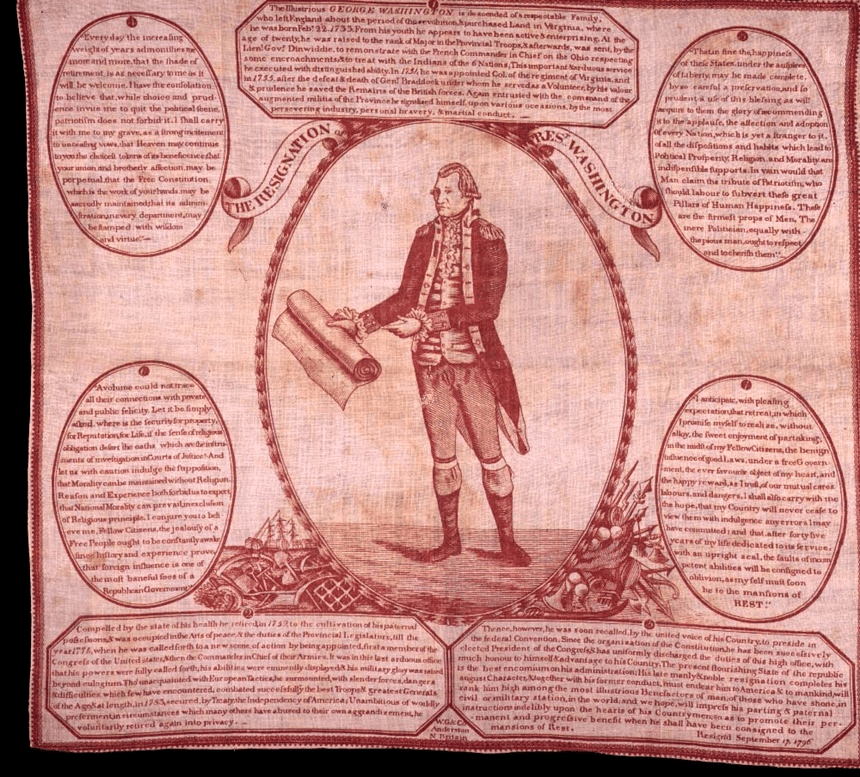
1. Bandana Featuring Excerpts from George Washington’s Farewell Address
In which Washington encouraged all Americans to put aside regional and party divisions in support of the newly formed republic. Observed Washington, “Your Union ought to be considered as a main prop of your liberty, the love of the one ought to endear you to the preservation of the other.”
2. Presidential Hair Cabinet
John Varden, keeper of collections for the National Institute for the Promotion of Science at the U.S. Patent Office, began collecting locks of hair from prominent individuals in 1850 and quickly amassed a collection that included presidents, senators, artists, and other luminaries. Varden’s presidential hair collection includes strands from George Washington and Franklin Pierce.


 Hurricane Milton
 Solidarnosc leader Lech Walesa, 1982


 Scottie's Playtime