So after about two hours a different person than who checked him in came into the waiting room and told Ron they did the diagnostic and it showed this spark plug dome clearance problem so Ron needed to buy a new engine. Ron told them him drove it in and he was driving it out. The guy said that it could cause more damage to the engine and he shouldn’t drive it. Ron told him he was leaving with the car!
That seemed to cause them some problems because it took them almost another hour to bring Ron the car. It was the person who checked him in who came into clear the paper work with Ron over what was done. When Ron questioned them on what spark plugs they put in she said none they did not even do anything like that. She showed him the paperwork and it said that they put it on the diagnostic machine and it gave an error code meaning that the spark plug was seized with an intrusion of coolant fluid. The suggested thing was to try to remove the spark plug.
Instead they did the oil change, checked the fluids, and rotated the tires. The standard stuff for an oil change. They discounted the $360 dollar diagnostic tests $100 because Ron told them to not do it but they had already started it, they don’t say if they completed it. When he signed in the woman tried to tell him he needed the 60,000 mile fluid flush and it would cost $650.00. Yet she did not tell him and the paperwork did not say how much each fluid was or cost.
When he got home Ron told me the other part of this. Our car is the top of the line with all option. It has had all maintenance done at the dealership along with us having bought the “butler service” keeping the paint job as grand as possible by redoing the clear coat after doing touch up work. It has a very high resale price. The dealership has been sending us offers to buy the car back or give us a great trade in for it. Seems they have wanted it back so badly someone thought if they went in and told this senior citizen that their car that would be paid off next month and was 7 years old needed a 10 grand engine replacement they might get him to deal the car away to them.
The thing that I stick on is after they told Ron that and he said no he was taking the car home it took them an hour to bring it out from the garage to the waiting room area. Why. Did they just not do anything for a couple of hours and then tell him that thinking he would be too scared to try to drive it home? So then they had to do the service he had an appointment for? Or did they do it and had something else going on that they had to do to get the car ready to come back to the front? It took three hours to run the diagnostic machine, do the oil change and fluid check, and rotate the tires. Seems a long time to me. I would love to hear the thoughts you all have. Hugs.
Ron took our 2018 Ford Escape to the dealership this morning for an oil change and that the car ran rough when first started. On the way there the check engine light came on. No blinking but steady. So the dealership told Ron that to even do the tests would be $360 plus the cost of the oil change along with any needed repairs. They came back to Ron nearly 2 hours later and told him we needed a new engine for $10,000 because of a dome spark plug clearance problem. Ron told them he drove it there with no issues and he was driving it home. I called Randy who has some knowledge and works with mechanics who say that it is possible but not likely and that the engine should go for $3,500 not $10,000. I found online that normally it is the plug that is the problem, using the wrong plug or the plug specs have changed a small amount. But like anything online I couldn’t find a real clear answer. I could use some help if anyone out there understands engines and this stuff. Thanks and hugs
“This is a once-in-a-century brain gain opportunity.”–Australian Strategic Policy Institute, urging its government to woo U.S.-based scientists and researchers caught in the Trump II attack on research and development
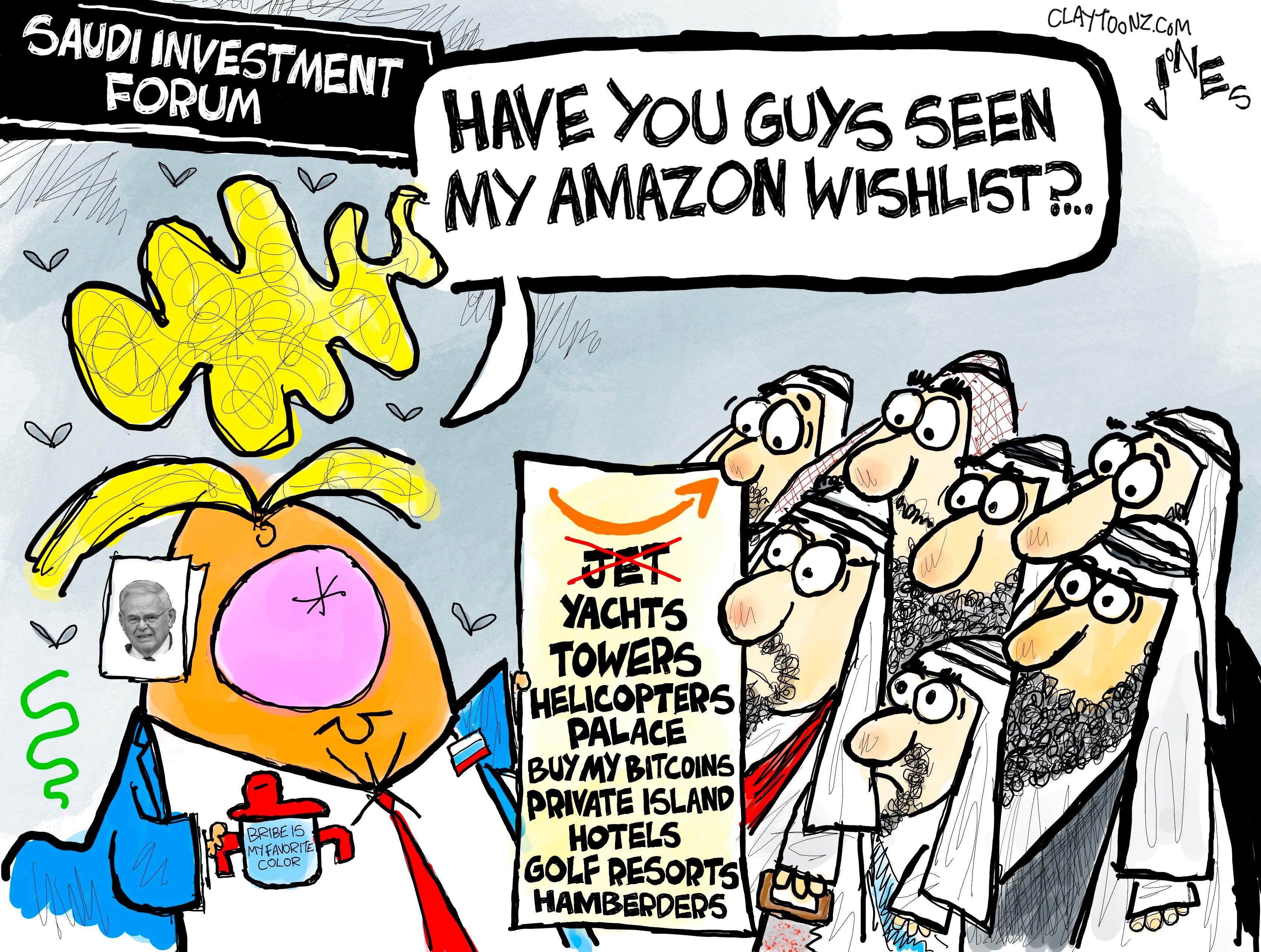
I was watching Trump talk about the “gift” from Qatar, the 747 jet that’s going to be our newest Air Force One. He said, “I could be a stupid person and say we don’t want a free plane, but this helps us out.” That sounds a lot like an excuse from a guy who just took a bribe.
This plane doesn’t help us out, it helps him out. If Qatar were trying to help us out, they would have given the gift without any stipulations, except they didn’t give us the gift. They gave it to Trump, and only to Trump.
Yeah, sure. It technically belongs to the Air Force, but the stipulation is that when Trump leaves office, which is supposed to be in January 2029, the plane is transferred to his presidential library. Three odd things about this is, why does Qatar get to tell us how to use its gift, why can’t the plane remain in service, and why does an illiterate fuckface get a library?
Don’t believe me on the illiterate part? Check this out from 2017. I noticed three things in that video.
One, he can’t read. Two, he’s calling out his new friend in Qatar and accusing them of financing terrorism, which includes groups like Hama, ISIS, al Qaida, and the Taliban (who are also his friends now). Three, the wind is having a very difficult time budging that bleached, dead aardvark on his head. What the hell does he put in that shit, concrete?
Maybe Qatar bribed Trump to stop accusing them of financing terror while encouraging him to learn how to read. There’s no help with the bleached, dead aadvark shit.
So what does Qatar get from this bribe? Maybe we’ll find out from his personal business deals in Qatar, the United Arab Emirates, and Saudi Arabia. Trump is visiting all three nations during this trip. By the way, the Trump Crime Family’s net worth increased by $3 billion since January. I’m sure that happening after Trump becoming president (sic) is just a coincidence.
It was announced last week that a brand new Trump Tower and hotel resort will be built in Qatar. It’s even being developed by one of the government’s companies. The Trump Organization announced an ethics (haha) pledge for Trump 2.0, and that it would permit foreign business deals, but explicitly bar partnerships with foreign governments. HAHAHA. Ethics from the Trump Organization.
On my GoComics page, there’s an idiot still screaming about Joe Biden’s “foreign” business deals.
There’s also going to be a $5.5 billion Trump beachside golf course in Dubai in the UAE, which was canceled years ago but re-approved in 2025. What explicit timing.
Saudi Arabia, the nation that butchered an American-protected journalist, recently announced new deals for Trump properties in several of its cities, which I’m sure had nothing to do with Trump giving them huge arms packages today.
Also, I should have scratched out the hamberders on the list, because the Saudis rolled out a full-size, mobile McDonald’s truck ahead of Trump’s arrival, knowing that a corrupt toddler with power was coming.
Trump is announcing investments in America from these three nations worth billions and perhaps even trillions, but the thing with these promises is that they’re just promises. Sure, they’ll invest, but in what and for how much? You can’t trust Trump’s numbers. It’s like all those factories he promised would be built by companies that exported jobs. They didn’t arrive.
The Trump Organization also announced deals for new golf resorts in Vietnam, which are with the Communist Party.
One last point for the day: If President Joe Biden were corrupt, some foreign country would have bought him a plane.
Speaking of Gocomics: The streak of posting a brand new cartoon every day on GoComics is now at eight years. I passed it on May 6, but I was too busy drawing a cartoon to notice.
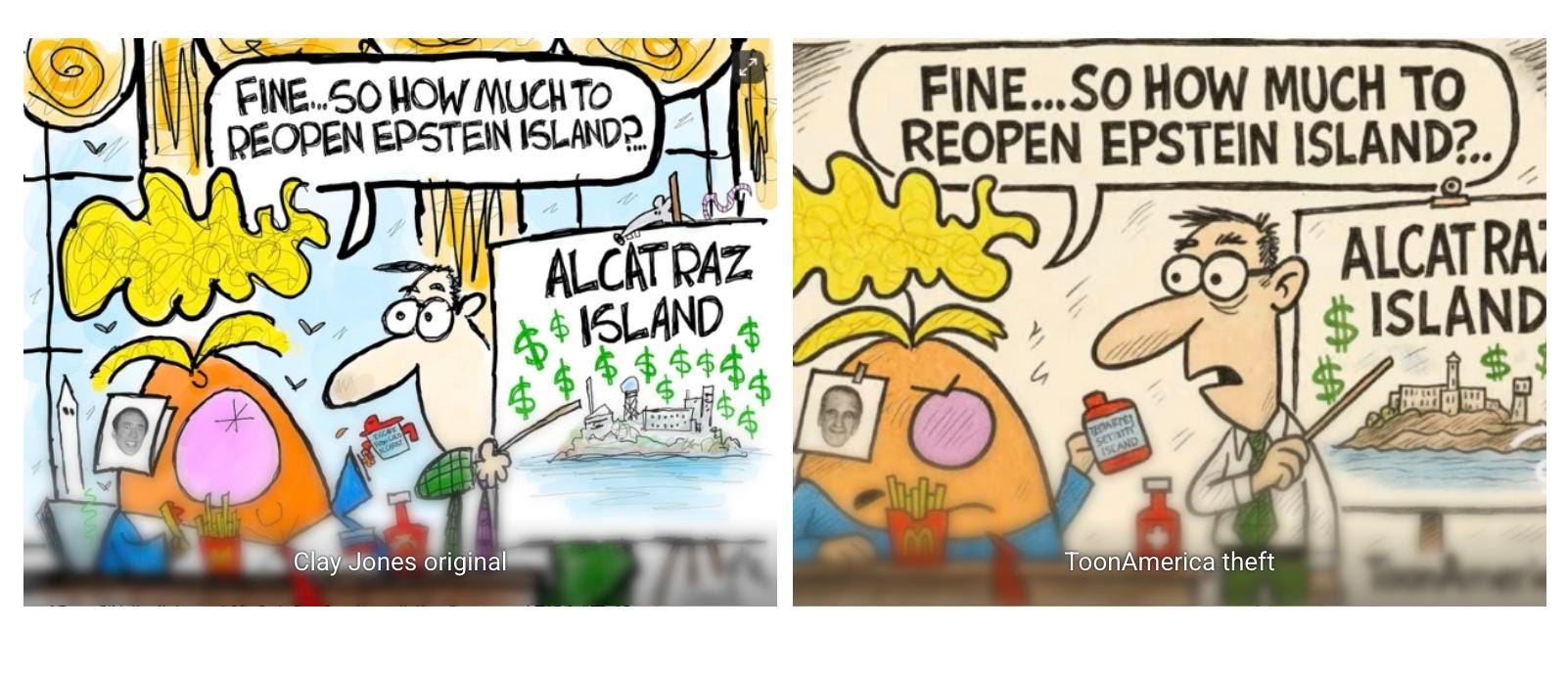
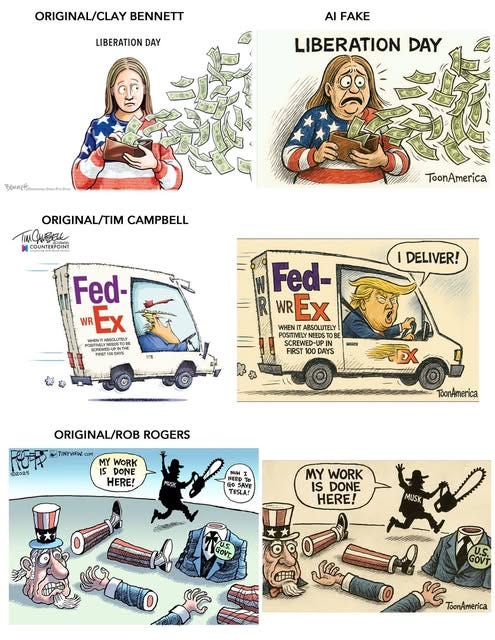
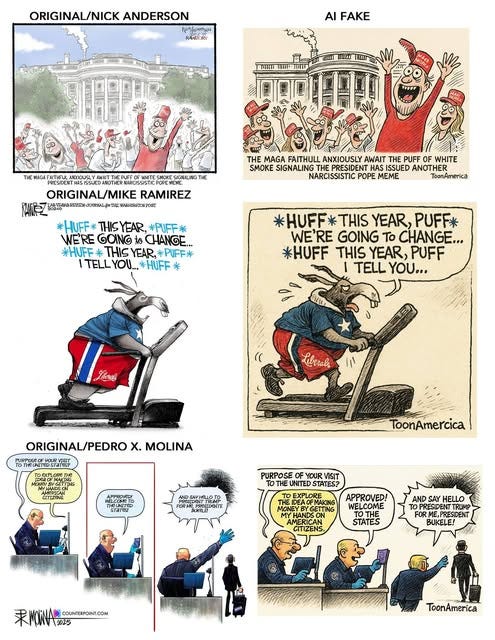
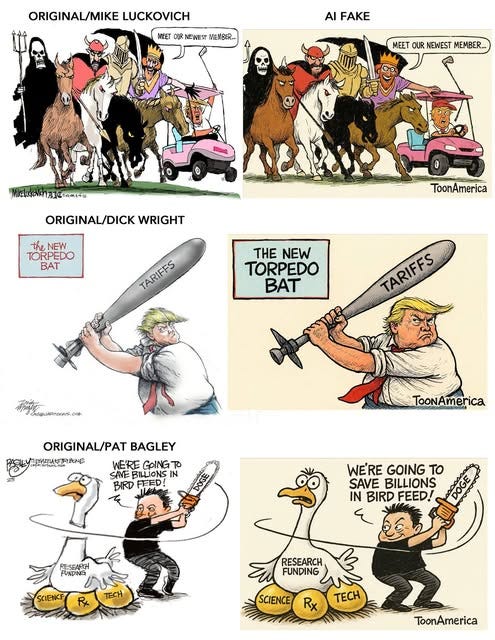
AI thieves: So this is new. A couple of YouTube channels are using AI to copy cartoons, or as ToonAmerica says, reported by the Daily Cartoonist, finish “manually sketch[ed] unique, raw cartoon concepts”
First off, when my cartoon is published, it’s “finished.” I get annoyed simply by a reader telling me how the cartoon could be better or how I should have drawn it, but this shit?
I don’t like to give these guys publicity, but I do need to post the links so you know where to go to report them.
I’m very protective of my work. I don’t like it when Facebook pages steal my cartoons to build their audience, don’t even give me a tag or credit, and then argue that they had the right to steal it. But this theft of copying my work, and doing it with AI, really pisses me off.
Someone defending AI posted to Facebook a few days ago, “What’s the problem?” This. This is the problem, asshole. Another user of AI “art” told me today not to take it personally. I hope he doesn’t take it personally after I block him.
So, when people steal my work, I go after them. Fortunately, I’m not alone this time, because he/it/they hit a bunch of cartoonists.
Most of the time, my colleagues support me in these fights and say, “Go get ‘em, Tiger,” but they don’t get off the bench. They were too afraid to go after Ted Rall when he was working for a Russian propaganda outlet, they remained silent about the anonymous cartoonist (Rivers) or outright supported him, and most refuse to call out all the tracers out there (there’s a bunch). But now, they want to form a posse. Welcome to the game, fuckers.
I’ve been trying to fight for this industry, and not just for myself. Other cartoonists don’t want to ruffle feathers or get in trouble with colleagues. Maybe I’m the stupid one for doing so. But now, other cartoonists are ready to fight because someone stuck their fingers in their pies.
I told a couple of colleagues on Facebook, who are victims of this AI theft, that I would help them, and that was before I found out I was a victim too. They should take note of that. So far, the only ones I’ve noticed who have spoken out about this are the ones who’ve been affected.
Comic Strip of the Day: Mike Peterson does a great service for political cartoonists with his daily feature, Comic Strip of the Day, which can be found at the Daily Cartoonist. But there are times when I think he’s full of himself.
Today, he included two cartoons about the pope being an American. The cartoons were the same cartoon, and he wrote, “I’m ignoring cartoons about Leo XIV being a White Sox fan or refusing to put ketchup on hot dogs, and even the mildly sacrilegious jokes about deep-dish communion hosts. While I don’t think they’re insightful or funny, I’m not particularly offended.”
Peterson uses my work quite often, and I appreciate it. A lot of the White Sox and Hot Dog jokes did get old (but I was the first with the hot dog thing). But, Mike, with all due respect, I would never rely on you for what’s insightful or funny.
Creative note: I chose this over Trump pausing tariffs on China. I may go back to that tomorrow.
In April, Coca-Cola proudly launched a new ad campaign it called “Classic,” celebrating famous authors and the sugary drink’s omnipresence in culture by highlighting classic literary works that mention the brand. The firm that produced the ad campaign said it used AI to scan books for mentions of Coca-Cola, and then put viewers in the point of view of the author, typing that portion of the text on a typewriter. The only issue is that the AI got some very basic facts about the authors and their work entirely wrong.
One of the ads highlights the work of J.G. Ballard, the British author perhaps best known for his controversial masterpiece, Crash, and David Cronenberg’s film adaptation of the novel. In the ad, we get a first person perspective of someone typing a sentence from “Extreme Metaphors by J.G Ballard,” which according to the ad was written in 1967. When the sentence gets to the mention of “Coca-Cola,” the typeface changes from the generic typewriter font to Coca-Cola’s iconic red logo.
The scarcity of the President’s Daily Briefings comes as he pursues high-stakes diplomacy with America’s friends and foes.
The low number of briefings this time around is troubling to many in and around the intelligence community, who were already concerned about Trump’s act-first-evaluate-after approach to governing. | Andrew Harnik/Getty Images
Since President Donald Trump was sworn into office in January, he has sat for just 12 presentations from intelligence officials of the President’s Daily Brief.
That’s a significant drop compared with Trump’s first term in office, according to a POLITICO analysis of his public schedule.
In much of his first term, Trump met with intel officials twice a week for the briefing, which provides the intelligence community’s summary of the most pressing national security challenges facing the nation.
The low number of briefings this time around is troubling to many in and around the intelligence community, who were already concerned about Trump’s act-first-evaluate-after approach to governing.
“It’s sadly clear that President Trump doesn’t value the expertise of and dangerous work performed by our intelligence professionals each and every day, and unfortunately, it leaves the American people increasingly vulnerable to threats we ought to see coming,” Sen. Mark Warner (D-Va.), the top Democrat on the Senate Intelligence Committee, said in a statement to POLITICO.
The sporadic pace of briefings comes as Trump has been working to broker an end to the wars in Gaza and Ukraine and to jump-start nuclear talks with Iran — all while navigating increasing potential threats from adversaries such as Russia and China.
Each president is different in the manner and pace at which they receive their briefings, and Trump is not entirely out of step with some of his predecessors.
But with Trump, there is added concern as he is known not to read the accompanying briefing document, referred to as “the book,” that is put together by intelligence analysts in a highly labor-intensive process. This document is delivered in hard copy or on a tablet device to the president and his key advisers five days a week.
The briefings from senior intelligence officials are often a chance for the president to hear detailed assessments on global crises and to receive updates on highly classified covert operations overseas — along with blunt facts about the state of the world, regardless of policy implications or the president’s own views.
Trump received just two in-person PDB briefings per month in January, February and March, before settling into a more regular rhythm of once per week in April and May, according to the president’s daily schedule maintained by Faceba.se, a website that collates the president’s statements as well as his public calendar.
PDB presentations are typically tailored toward informing the president as he conducts high-stakes diplomacy, detailing what a foreign government may be thinking and what its intentions are, former intelligence officials said.
“The point of having an $80 billion intelligence service is to inform the president to avert a strategic surprise,” said a former CIA analyst who, like others in this story, was granted anonymity to discuss sensitive intelligence matters.
Trump’s top national security aides and Cabinet officials receive similar intelligence briefings and can ensure that critical information reaches the president’s ears.
Senior administration officials said Trump gets the information he needs through frequent communication with his intelligence chiefs.
“The president is constantly apprised of classified briefings and is regularly in touch with his national security team,” said Davis Ingle, a White House spokesperson. “The entire intelligence community actively informs President Trump in real time about critical national security developments.”
Ingle declined to comment on why Trump has received fewer daily PDB presentations compared to his first term..
Former intelligence officials argued that the PDB sessions are an opportunity for the president to hear from career intelligence officials who are skilled in imparting information regardless of whether it complements or contradicts the president’s foreign policy strategies.
They questioned whether other top advisers or Cabinet officials would be able — or willing — to relay these stark realities to the president.
And the circle of officials receiving the PDB may also be smaller than in Trump’s first term. CNN reported last month that the Trump administration has tightly restricted the number of people who have access to the intelligence report.
Trump’s first term in office was marked by a high turnover in his national security team, a trend that looks set to continue. Last week, Trump ousted his national security adviser Mike Waltz, who had long been on thin ice with other administration officials.
“The advantage of an IC briefer is its somebody who is trained to tell the hard truths to the president,” said Larry Pfeiffer, who served as chief of staff to CIA Director Michael Hayden.
“They are going to be more inclined to provide him with more nuanced information — information that’s not been parsed through a policy perspective,” Pfeiffer said.
Presidents vary in how often they have received in-person briefings. George W. Bush saw briefers from the intelligence community almost every day and preferred hearing directly from analysts, while Obama was a studious reader of the PDB book itself.
Obama received in-person briefings 44 percent of the days he was in office during his first term, according to a 2012 analysis by the conservative research group the Government Accountability Institute, which would equate to multiple briefings a week. He was attacked by the conservative media and former Vice President Dick Cheney for not attending more.
Biden received one to two briefings a week, according to a former U.S. intelligence official familiar with the matter and a former Biden White House official.
But Biden was known to regularly read the PDB briefing book, the former intelligence official said. A former official who served in Biden’s National Security Council said that the president would use the delivery of the book as an opportunity to gather his top national security aides and Cabinet officials to discuss its contents and foreign policy implications.
At the time, intelligence officials found Trump to be more responsive to graphics, maps and a more storified approach to recounting the intelligence, according to interviews with his briefers published in “Getting To Know The President,” a history of intelligence briefings of candidates and presidents-elect, authored by John Helgerson, a former senior CIA official.
Trump had a fraught relationship with the intelligence community during his first term. But the cadence of briefings almost three months into his second term represents a stark drop when compared to his first four years in office, and offers insight into how Trump might prioritize these briefings throughout the next four years.
In the first five weeks following his inauguration in 2017, Trump received an average of 2.5 briefings a week before settling into an average of two briefings a week in the latter half of his presidency, according to a detailed historical account published by the CIA’s own in-house academic research center.
Trump’s briefings during his first term were substantive, the former U.S. intelligence official said, noting that the president listened and was interactive during the presentations.
And during Trump’s first term, Vice President Mike Pence was an “assiduous, six-day-a-week reader,” of the PDB, Helgerson noted in his book.
A second former senior U.S intelligence official stressed that there are other avenues for Trump’s spy chiefs to get information to him, beyond his daily briefing, including standalone memos and articles based on the latest intelligence findings.
“It’s not the be all and end all,” they said, speaking of the PDB. The person also noted, as the White House did, that the president’s top advisers can also serve as a conduit for relaying information to the president.
A person familiar with how Trump takes his PDB briefings said that the president has received standalone briefings on global flashpoints on an ongoing basis separate from the PDB and that it would be incorrect to imply he wasn’t fully briefed. They were granted anonymity to discuss how Trump receives his intelligence.
“He’s calling people all day. If he wants an update on some of these things, he’ll call Ratcliffe, Rubio, Witkoff, Waltz, kind of in an ad-hoc fashion throughout the day, receiving this stuff,” said the person, who spoke before Waltz was removed from his position as national security adviser last week.
Asked for comment about the president’s briefing schedule, National Security Council spokesperson Brian Hughes said “President Trump has multiple high-level, national security briefings every day. While the scope can range from a comprehensive presentation of global intelligence, to meeting with senior national security officials on an issue of immediate importance, the daily engagement of President Trump is prolific.”
Former intelligence officials argue that the in-person presentations from experienced briefers offer a further opportunity for the president to receive important context on the intelligence delivered, ask questions and relay any requests for additional information back to the intelligence agencies.
That feedback gives the country’s spy agencies an opportunity to learn more about the president’s needs and interests. “We learn too,” said a third former senior U.S. intelligence official.



 Scottie's Playtime