In April, Coca-Cola proudly launched a new ad campaign it called “Classic,” celebrating famous authors and the sugary drink’s omnipresence in culture by highlighting classic literary works that mention the brand. The firm that produced the ad campaign said it used AI to scan books for mentions of Coca-Cola, and then put viewers in the point of view of the author, typing that portion of the text on a typewriter. The only issue is that the AI got some very basic facts about the authors and their work entirely wrong.
One of the ads highlights the work of J.G. Ballard, the British author perhaps best known for his controversial masterpiece, Crash, and David Cronenberg’s film adaptation of the novel. In the ad, we get a first person perspective of someone typing a sentence from “Extreme Metaphors by J.G Ballard,” which according to the ad was written in 1967. When the sentence gets to the mention of “Coca-Cola,” the typeface changes from the generic typewriter font to Coca-Cola’s iconic red logo.
The scarcity of the President’s Daily Briefings comes as he pursues high-stakes diplomacy with America’s friends and foes.
The low number of briefings this time around is troubling to many in and around the intelligence community, who were already concerned about Trump’s act-first-evaluate-after approach to governing. | Andrew Harnik/Getty Images
Since President Donald Trump was sworn into office in January, he has sat for just 12 presentations from intelligence officials of the President’s Daily Brief.
That’s a significant drop compared with Trump’s first term in office, according to a POLITICO analysis of his public schedule.
In much of his first term, Trump met with intel officials twice a week for the briefing, which provides the intelligence community’s summary of the most pressing national security challenges facing the nation.
The low number of briefings this time around is troubling to many in and around the intelligence community, who were already concerned about Trump’s act-first-evaluate-after approach to governing.
“It’s sadly clear that President Trump doesn’t value the expertise of and dangerous work performed by our intelligence professionals each and every day, and unfortunately, it leaves the American people increasingly vulnerable to threats we ought to see coming,” Sen. Mark Warner (D-Va.), the top Democrat on the Senate Intelligence Committee, said in a statement to POLITICO.
The sporadic pace of briefings comes as Trump has been working to broker an end to the wars in Gaza and Ukraine and to jump-start nuclear talks with Iran — all while navigating increasing potential threats from adversaries such as Russia and China.
Each president is different in the manner and pace at which they receive their briefings, and Trump is not entirely out of step with some of his predecessors.
But with Trump, there is added concern as he is known not to read the accompanying briefing document, referred to as “the book,” that is put together by intelligence analysts in a highly labor-intensive process. This document is delivered in hard copy or on a tablet device to the president and his key advisers five days a week.
The briefings from senior intelligence officials are often a chance for the president to hear detailed assessments on global crises and to receive updates on highly classified covert operations overseas — along with blunt facts about the state of the world, regardless of policy implications or the president’s own views.
Trump received just two in-person PDB briefings per month in January, February and March, before settling into a more regular rhythm of once per week in April and May, according to the president’s daily schedule maintained by Faceba.se, a website that collates the president’s statements as well as his public calendar.
PDB presentations are typically tailored toward informing the president as he conducts high-stakes diplomacy, detailing what a foreign government may be thinking and what its intentions are, former intelligence officials said.
“The point of having an $80 billion intelligence service is to inform the president to avert a strategic surprise,” said a former CIA analyst who, like others in this story, was granted anonymity to discuss sensitive intelligence matters.
Trump’s top national security aides and Cabinet officials receive similar intelligence briefings and can ensure that critical information reaches the president’s ears.
Senior administration officials said Trump gets the information he needs through frequent communication with his intelligence chiefs.
“The president is constantly apprised of classified briefings and is regularly in touch with his national security team,” said Davis Ingle, a White House spokesperson. “The entire intelligence community actively informs President Trump in real time about critical national security developments.”
Ingle declined to comment on why Trump has received fewer daily PDB presentations compared to his first term..
Former intelligence officials argued that the PDB sessions are an opportunity for the president to hear from career intelligence officials who are skilled in imparting information regardless of whether it complements or contradicts the president’s foreign policy strategies.
They questioned whether other top advisers or Cabinet officials would be able — or willing — to relay these stark realities to the president.
And the circle of officials receiving the PDB may also be smaller than in Trump’s first term. CNN reported last month that the Trump administration has tightly restricted the number of people who have access to the intelligence report.
Trump’s first term in office was marked by a high turnover in his national security team, a trend that looks set to continue. Last week, Trump ousted his national security adviser Mike Waltz, who had long been on thin ice with other administration officials.
“The advantage of an IC briefer is its somebody who is trained to tell the hard truths to the president,” said Larry Pfeiffer, who served as chief of staff to CIA Director Michael Hayden.
“They are going to be more inclined to provide him with more nuanced information — information that’s not been parsed through a policy perspective,” Pfeiffer said.
Presidents vary in how often they have received in-person briefings. George W. Bush saw briefers from the intelligence community almost every day and preferred hearing directly from analysts, while Obama was a studious reader of the PDB book itself.
Obama received in-person briefings 44 percent of the days he was in office during his first term, according to a 2012 analysis by the conservative research group the Government Accountability Institute, which would equate to multiple briefings a week. He was attacked by the conservative media and former Vice President Dick Cheney for not attending more.
Biden received one to two briefings a week, according to a former U.S. intelligence official familiar with the matter and a former Biden White House official.
But Biden was known to regularly read the PDB briefing book, the former intelligence official said. A former official who served in Biden’s National Security Council said that the president would use the delivery of the book as an opportunity to gather his top national security aides and Cabinet officials to discuss its contents and foreign policy implications.
At the time, intelligence officials found Trump to be more responsive to graphics, maps and a more storified approach to recounting the intelligence, according to interviews with his briefers published in “Getting To Know The President,” a history of intelligence briefings of candidates and presidents-elect, authored by John Helgerson, a former senior CIA official.
Trump had a fraught relationship with the intelligence community during his first term. But the cadence of briefings almost three months into his second term represents a stark drop when compared to his first four years in office, and offers insight into how Trump might prioritize these briefings throughout the next four years.
In the first five weeks following his inauguration in 2017, Trump received an average of 2.5 briefings a week before settling into an average of two briefings a week in the latter half of his presidency, according to a detailed historical account published by the CIA’s own in-house academic research center.
Trump’s briefings during his first term were substantive, the former U.S. intelligence official said, noting that the president listened and was interactive during the presentations.
And during Trump’s first term, Vice President Mike Pence was an “assiduous, six-day-a-week reader,” of the PDB, Helgerson noted in his book.
A second former senior U.S intelligence official stressed that there are other avenues for Trump’s spy chiefs to get information to him, beyond his daily briefing, including standalone memos and articles based on the latest intelligence findings.
“It’s not the be all and end all,” they said, speaking of the PDB. The person also noted, as the White House did, that the president’s top advisers can also serve as a conduit for relaying information to the president.
A person familiar with how Trump takes his PDB briefings said that the president has received standalone briefings on global flashpoints on an ongoing basis separate from the PDB and that it would be incorrect to imply he wasn’t fully briefed. They were granted anonymity to discuss how Trump receives his intelligence.
“He’s calling people all day. If he wants an update on some of these things, he’ll call Ratcliffe, Rubio, Witkoff, Waltz, kind of in an ad-hoc fashion throughout the day, receiving this stuff,” said the person, who spoke before Waltz was removed from his position as national security adviser last week.
Asked for comment about the president’s briefing schedule, National Security Council spokesperson Brian Hughes said “President Trump has multiple high-level, national security briefings every day. While the scope can range from a comprehensive presentation of global intelligence, to meeting with senior national security officials on an issue of immediate importance, the daily engagement of President Trump is prolific.”
Former intelligence officials argue that the in-person presentations from experienced briefers offer a further opportunity for the president to receive important context on the intelligence delivered, ask questions and relay any requests for additional information back to the intelligence agencies.
That feedback gives the country’s spy agencies an opportunity to learn more about the president’s needs and interests. “We learn too,” said a third former senior U.S. intelligence official.
In what may be the most valuable gift ever extended to the United States from a foreign government, the Trump administration is preparing to accept a super luxury Boeing 747-8 jumbo jet from the royal family of Qatar — a gift that is to be available for use by President Donald Trump as the new Air Force One until shortly before he leaves office, at which time ownership of the plane will be transferred to the Trump presidential library foundation, sources familiar with the proposed arrangement told ABC News.
The gift is expected to be announced next week, when Trump visits Qatar on the first foreign trip of his second term, according to sources familiar with the plans.
Trump toured the plane, which is so opulently configured it is known as “a flying palace,” while it was parked at the West Palm Beach International Airport in February.
A 13-year-old private Boeing aircraft that President Donald Trump toured on Saturday to check out new hardware and technology features and highlight the aircraft maker’s delay in delivering updated versions of the Air Force One presidential aircraft, takes off from Palm Beach International Airport, Sunday, Feb. 16, 2025, in West Palm Beach, Fla. (A…Show more
Ben Curtis/AP
The highly unusual — unprecedented — arrangement is sure to raise questions about whether it is legal for the Trump administration, and ultimately, the Trump presidential library foundation, to accept such a valuable gift from a foreign power.
Anticipating those questions, sources told ABC News that lawyers for the White House counsel’s office and the Department of Justice drafted an analysis for Defense Secretary Pete Hegseth concluding that is legal for the Department of Defense to accept the aircraft as a gift and later turn it over to the Trump library, and that it does not violate laws against bribery or the Constitution’s prohibition (the emoluments clause) of any U.S. government official accepting gifts “from any King, Prince or foreign State.”
Sources told ABC News that Attorney General Pam Bondi and Trump’s top White House lawyer David Warrington concluded it would be “legally permissible” for the donation of the aircraft to be conditioned on transferring its ownership to Trump’s presidential library before the end of his term, according to sources familiar with their determination.
The sources said Bondi provided a legal memorandum addressed to the White House counsel’s office last week after Warrington asked her for advice on the legality of the Pentagon accepting such a donation.
The White House and DOJ didn’t immediately respond to request for comment. A spokesperson for the Qatari embassy did not respond to ABC’s inquiries.
President Donald Trump speaks with reporters after disembarking Marine One upon arrival on the South Lawn of the White House in Washington, Sunday, May 4, 2025.
Rod Lamkey/AP
The plane will initially be transferred to the United States Air Force, which will modify the 13-year-old aircraft to meet the U.S. military specifications required for any aircraft used to transport the president of the United States, multiple sources familiar with the proposed arrangement said.
The plane will then be transferred to the Trump Presidential Library Foundation no later than Jan. 1, 2029, and any costs relating to its transfer will be paid for by the U.S. Air Force, the sources told ABC News.
According to aviation industry experts, the estimated value of the aircraft Trump will inherit is about $400 million, and that’s without the additional communications security equipment the Air Force will need to add to properly secure and outfit the plane in order to safely transport the commander in chief.
As the Wall Street Journal first reported, the aviation company L3Harris has already been commissioned to overhaul the plane to meet the requirements of a presidential jet.
President Donald Trump walks to board Marine One to depart for Alabama, on the South Lawn of the White House in Washington, D.C., U.S., May 1, 2025.
Nathan Howard/Reuters
Both the White House and DOJ concluded that because the gift is not conditioned on any official act, it does not constitute bribery, the sources said. Bondi’s legal analysis also says it does not run afoul of the Constitution’s prohibition on foreign gifts because the plane is not being given to an individual, but rather to the United States Air Force and, eventually, to the presidential library foundation, the sources said.
The primary aircraft used in the current Air Force One fleet includes two aging Boeing 747-200 jumbo jets that have been operational since 1990. The Air Force contract with Boeing to replace those aircraft has been riddled with delays and cost overruns.
The original contract was signed in 2018, but as of last year, Boeing anticipated the aircraft would not be ready until 2029, after Trump leaves office.
The president has expressed deep frustration with the delays, tasking Elon Musk to work with Boeing and the Air Force to speed up the process. Those efforts have been modestly successful. Boeing’s most recent estimated delivery date is now 2027, but Trump has made it clear he wants a new plane this year.
Hackers say they have obtained what they say are passenger lists for GlobalX flights from January to this month. The data appear to include people who have been deported.
Hackers have targeted GlobalX Air, one of the main airlines the Trump administration is using as part of its deportation efforts, and stolen what they say are flight records and passenger manifests of all of its flights, including those for deportation, 404 Media has learned.
The data, which the hackers contacted 404 Media and other journalists about unprompted, could provide granular insight into who exactly has been deported on GlobalX flights, when, and to where, with GlobalX being the charter company that facilitated the deportation of hundreds of Venezuelans to El Salvador.
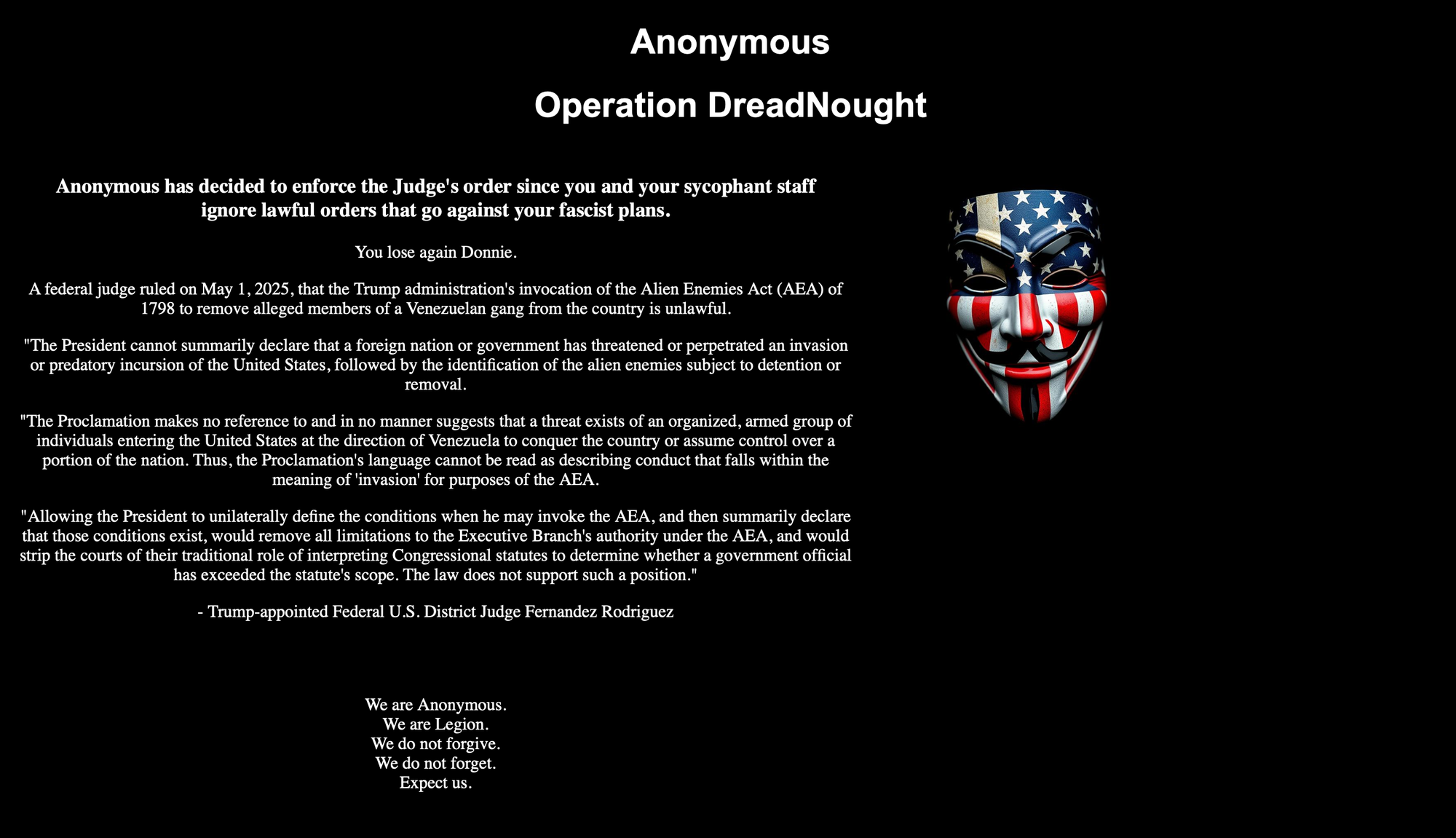
“Anonymous has decided to enforce the Judge’s order since you and your sycophant staff ignore lawful orders that go against your fascist plans,” a defacement message posted to GlobalX’s website reads. Anonymous, well-known for its use of the Guy Fawkes mask, is an umbrella some hackers operate under when performing what they see as hacktivism.
The hacker says the data includes flight records and passenger lists. The hacker sent 404 Media a copy of the data, which is sorted into folders dated everyday from January 19 through May 1.
404 Media cross-checked known information about ICE deportation flights that come from official and confirmable sources with information contained on the flight manifests and flight details obtained by the hacker. Information about Kilmar Abrego Garcia’s flight is in the hacked data.
For example, the hackers obtained what appears to be detailed flight information about GlobalX flights 6143, 6145, and 6122 that left from Harlingen, Texas’s Valley International Airport on March 15. These flights are at the center of a class-action lawsuit filed by five pseudonymous Venezuelan men against the Trump administration (which eventually went to the Supreme Court) and which took off during and immediately following a court proceeding in which their lawyers were trying to get a restraining order to prevent the flights from taking off.
During a District Court proceeding in Washington D.C., the federal government argued that it had no flight information to share with the court: “the Government surprisingly represented that it still had no flight details to share,” during the hearing, the judge’s opinion in that case reads. “When pressed, Government counsel stated that the ‘operational details’ he had learned during the recess ‘raised potential national security issues,’ so they could not be shared while the public and press listened.”
Image: A screenshot of the defacement.
“Although the Government has refused to provide the particular details, all evidence suggests that during the short window that the Court was adjourned, two removal flights took off from Harlingen—one around 5:25 pm and the other at about 5:45 pm,” court records say, noting that these were GlobalX flights 6143 and 6145; a third referenced flight left immediately following the hearing. These details closely match the timing of the flights and other details in the hacked data.
Also included in the data is a record mentioning the name Heymar Padilla Moyetones, a 24-year-old woman who was flown from Texas to Honduras, then from Honduras to El Salvador by mistake, and then was returned to Texas. The data obtained by the hackers says that GlobalX flew her from Valley International Airport in Texas to Honduras on March 15 on Flight 6143, then was flown from Comayagua International Airport in Honduras to El Salvador International on flight 6144 later that day. She then was flown directly from El Salvador International back to Valley International Airport in Texas on March 15. The information in the hacked data lines up with what Moyetones told NBC.
404 Media was also able to cross-check the names on larger published lists of people who have previously been reported to be deported, finding their names in the hacked data with the specific flights that they were purportedly on.
404 Media is not publishing the full list of passengers at this time as we work to verify which passengers were specifically on deportation flights and to protect peoples’ privacy because the manifests contain personally sensitive information like passport details. We will continue to analyze the data for information in the public interest and explore what we’re able to publish.
Neither GlobalX nor ICE responded to requests for comment.
The Trump administration contracts with a company called CSI Aviation as part of its deportation flights. On February 28, ICE posted a notice saying it would award $128 million to the company for its work. In turn, CSI Aviation subcontracts some of its work to GlobalX, which said it expects to make $65 million per year from the deal. In 2024, 74 percent of ICE’s more than 1,500 removal flights were on GlobalX plans, the Project on Government Oversight reported in March.
ProPublica previously reported on what it is like for flight attendants working on GlobalX, also known as Global Crossing Airlines. Sources in that piece said they were worried what would happen in an emergency, in part because the passengers were shackled.
“They never taught us anything regarding the immigration flights,” ProPublica quoted one flight attendant as saying. “They didn’t tell us these people were going to be shackled, wrists to fucking ankles.”
The hacker told 404 Media they managed to find a token belonging to a GlobalX developer. They then used that to find access and secret keys for GlobalX’s AWS instances which contained the data. They said they also sent a copy of the defacement message to GlobalX’s employees, and then deleted company data. 404 Media does not know the identity of the hacker, and the hacker said they sent the data to other journalists
The hacker said they also sent the message to GlobalX pilots and crew members through the company’s NAVBLUE account. NAVBLUE is a flight operations platform made by Airbus which pilots use for flight planning, among other things.
404 Media was unable to verify whether pilots or crew members received this message. But the hacker provided screenshots which appear to show them logged into the platform. They also provided a screenshot purporting to show access to GlobalX’s GitHub.
The website defacement quotes a May 1 ruling from US District Judge Fernando Rodriguez which said that the president unlawfully invoked the Alien Enemies Act and blocked the administration from deporting more alleged Venezuelan gang members without due process.
The defacement adds: “You lose again Donnie.” (snip)
Musk gave Trump $290 million. The quid pro quo? Deregulation.
– The NLRB dropped union-busting charges against SpaceX – The EPA backed off fines for environmental violations – The FAA continues approving launches despite rocket explosions – The FCC is giving Starlink favorable… pic.twitter.com/jH64dF6m1c
Detailed Army plans for a potential military parade on President Donald Trump’s birthday in June call for more than 6,600 soldiers, at least 150 vehicles, 50 helicopters, seven bands and possibly a couple thousand civilians, The Associated Press has learned.
The planning documents, obtained by the AP, are dated April 29 and 30 and have not been publicly released. They represent the Army’s most recent blueprint for its long-planned 250th anniversary festival on the National Mall and the newly added element — a large military parade that Trump has long wanted but is still being discussed.
The Army anniversary just happens to coincide with Trump’s 79th birthday on June 14.
While the slides do not include any price estimates, it would likely cost tens of millions of dollars to put on a parade of that size. Costs would include the movement of military vehicles, equipment, aircraft and troops from across the country to Washington and the need to feed and house thousands of service members.
High costs halted Trump’s push for a parade in his first term, and the tanks and other heavy vehicles that are part of the Army’s latest plans have raised concerns from city officials about damage to roads.
Asked about plans for a parade, Army spokesman Steve Warren said Thursday that no final decisions have been made.
Col. Dave Butler, another Army spokesman, added that the Army is excited about the plans for its anniversary.
“We want to make it into an event that the entire nation can celebrate with us,” said Butler. “We want Americans to know their Army and their soldiers. A parade might become part of that, and we think that will be an excellent addition to what we already have planned.”
Others familiar with the documents, who spoke on condition of anonymity because the plans have not been finalized, said they represent the Army’s plans as it prepares for any White House approval of the parade. The White House did not immediately respond to a request for comment.
There has been no formal approval yet. Changes to the plans have been made in recent weeks and more are likely.
In a Truth Social post Thursday night that did not mention the June 14 plans, Trump wrote, “We are going to start celebrating our victories again!” He vowed to rename May 8, now known as Victory in Europe Day, as “Victory Day for World War II,” and to change November 11, Veterans Day, to “Victory Day for World War I.”
What would go into the potential Army parade
Much of the equipment would have to be brought in by train or flown in.
Some equipment and troops were already going to be included in the Army’s birthday celebration, which has been in the works for more than a year. The festival was set to involve an array of activities and displays on the National Mall, including a fitness competition, climbing wall, armored vehicles, Humvees, helicopters and other equipment.
A parade, however, would increase the equipment and troops involved. According to the plans, as many as 6,300 of the service members would be marching in the parade, while the remainder would be responsible for other tasks and support.
The Army’s early festival plans did not include a parade, but officials confirmed last month that the Army had started discussions about adding one.
The plans say the parade would showcase the Army’s 250 years of service and foresee bringing in soldiers from at least 11 corps and divisions nationwide. Those could include a Stryker battalion with two companies of Stryker vehicles, a tank battalion and two companies of tanks, an infantry battalion with Bradley vehicles, Paladin artillery vehicles, Howitzers and infantry vehicles.
There would be seven Army bands and a parachute jump by the Golden Knights. And documents suggest that civilian participants would include historical vehicles and aircraft and two bands, along with people from veterans groups, military colleges and reenactor organizations.
According to the plan, the parade would be classified as a national special security event, and that request has been submitted by the National Park Service and is under review.
And it is expected that the evening parade would be followed by a concert and fireworks.
One of the documents raises concerns about some limitations, which include where troops would be housed and “significant concerns regarding security requirements” as equipment flows into the city. It says the biggest unknown so far is which units would be participating.
Trump has long wanted a big military parade
In his first term, Trump proposed having a parade after seeing one in France on Bastille Day in 2017. Trump said that after watching the two-hour procession along the famed Champs-Elysees that he wanted an even grander one on Pennsylvania Avenue.
That plan was ultimately dumped due to the huge costs — with one estimate of a $92 million price tag — and other logistical issues. Among those were objections from city officials who said including tanks and other heavy armored vehicles would tear up the roads.
Trump said in a social media post in 2018 that he was canceling the event over the costs and accused local politicians of price gouging.
This year, as plans progressed for the Army to host its birthday festival in Washington, talk about a parade began anew.
D.C. Mayor Muriel Bowser acknowledged in April that the administration reached out to the city about holding a parade on June 14 that would stretch from Arlington, Virginia, where the Pentagon and Arlington National Cemetery are located, across the Potomac River and into Washington.
Bowser at the time said she didn’t know if the event was being “characterized as a military parade” but added that tanks rolling through the city’s streets “would not be good.”
“If military tanks were used, they should be accompanied with many millions of dollars to repair the roads,” she said.
In 2018, the Pentagon appeared to agree. A memo from the defense secretary’s staff said plans for the parade — at that time — would include only wheeled vehicles and no tanks to minimize damage to local infrastructure.
Baldor has covered the Pentagon and national security issues for The Associated Press since 2005. She has reported from all over the world including warzones in Iraq, Afghanistan and Syria.
Trump’s D.C. U.S. attorney pick appeared on Russian state media over 150 times
Nominee Ed Martin did not initially disclose his RT and Sputnik appearances from 2016 to 2024 to the Senate. The State Department has said the networks act like arms of Russian intelligence.
Starmer told UK must repeal hate speech laws to protect LGBT+ people or lose Trump trade deal
‘Good chance’ of agreement, says JD Vance – but a source close to the administration says his concerns over Britain’s hate speech laws ‘are still a red line’
Australian with working visa detained and deported on returning to US from sister’s memorial
Man who says he had previously left and re-entered the country multiple times alleges border officials called him ‘retarded’ and boasted ‘Trump is back in town’
I enjoy this man’s commentary. He’s always seemed to know whereof he speaks. Every weekend I intend to post this newsletter, and every weekend gets by me without me getting it done. This is a copy-paste of my newsletter; I receive it in email from “The Nation” magazine. All links within are live.
A retirement for the ages Illinois Senator Dick Durbin, who has been in Congress or the Senate for nearly my entire life, has announced that he will not seek reelection in 2026. The 80-year-old’s retirement will touch off a firestorm of a Democratic primary in Illinois, and I’m already dreading the prospect of a heap of progressives jumping into the race, cannibalizing each other, and clearing the path for the wealthiest available moderate white man to buy the nomination. If progressives could just coalesce around one candidate and stick together, they’d win this thing. Then again, if I had wheels, I’d be a wagon. In any event, Durbin’s long overdue retirement is more important to what I cover than the primary, because Durbin is the ranking member of the Senate Judiciary Committee, which controls the judicial nomination process. He was the head of the committee during Joe Biden’s presidency—a job he got by literally pulling rank over the guy who was best suited for the post (according to me), Senator Sheldon Whitehouse. The last four Democratic leaders on Judiciary have been, pretty much, a disaster. Durbin was preceded by Diane Feinstein, who was preceded by Patrick Leahy, who was preceded by Joe Biden. All four of these people were establishment moderates who were more concerned with formalities and courtesies than fighting for control of the courts. It was during their watch that the Federalist Society was able to overrun the judiciary with Republican judges who have literally taken away constitutional rights and redefined the law as a tool of the Republican political agenda. The Judiciary Committee desperately needs new, energetic leadership, to say nothing of a fighting spirit. I can only hope that Durbin’s retirement marks the end of the era of Democrats’ getting punked on judicial nominations.
The Bad and The Ugly SCOTUSblog, a popular website that reports on the Supreme Court, has been acquired by the right-wing media outlet The Dispatch. The acquisition likely marks the end of one of the few nonpartisan sources of information about the Supreme Court and plunges yet another independent outlet into the dark morass of the white-wing media ecosystem. I have a ton of respect for the website’s senior editor, Amy Howe, and I know she will fight like hell to retain the site’s nonpartisan independence. But this ain’t no fairy tale. When you lie down with dogs, you wake up with fleas.The number of young people who are incarcerated is going down, but the racial disparities among the children we put behind bars are “the highest in decades.” Black and Native American children are getting the worst of it, according to NPR. Pope Francis died. Francis was from Argentina. He was the first pope from Latin America, the first pope from the Southern Hemisphere, the first Jesuit pope, and the first pope born and raised outside of Europe since the 8th century. He was also one of the most progressive popes in the history of that office, though admittedly that’s a bit like saying he was the least fungal fungus. For my lapsed-Catholic part, I liked him. I hope the next pope is the second pope who can claim to be most of these things. Secretary of Defense Pete Hegseth has been caught up in yet more Signal-inspired controversy. I know I’m supposed to care, but I don’t. They put a Fox News host in charge of the American military; what the hell did people think was going to happen? Decency? Competence? A group of bigoted parents went before the Supreme Court this week and asked the justices to allow them to object to books in school that mention gay people. The Republican justices on the court fell all over themselves to agree with the parents. I am once again asking bigoted religious wing nuts to homeschool their children and leave the rest of us who want to live in a society alone.
Inspired Takes In The Nation, my colleague Joan Walsh took on the Trump administration’s ridiculous and sexist obsession with white birth rates. For my part, I am willing to help the administration accomplish its goals: If it really wants white birth rates to go up, all it has to do is make most white people poor again. The lesson from literally all today’s high-income societies is that birth rates go down as economic prosperity goes up, so the solution is actually pretty simple. Maybe that’s the real reason behind Trump’s tariffs? Contraband Camp has put out a “Trump Administration Discrimination Database.” So now, whenever your MAGA uncle says, “Point to one thing Trump has done that is racist,” you have a reference source. I used to feed my dog a “raw food” diet. It made sense to me, in an unthinking way (dog = wolf = murderous carnivore = “Aww… who’s the good girl who wants to feast on the raw viscera of your slain enemies?”). The fru-fru suburban veterinarian I go to didn’t immediately tell me it was a bad idea. But then, I happened to run into my old, hardscrabble city veterinarian and she basically said, “What the fuck? Don’t do that. I thought you were a smart person?” She then gave me some research. Now, we’re back to kibble. For people who don’t have the benefit of knowing a frank-talking vet, Emmet Frazier explains in The Nation why your fully domesticated dog doesn’t need to be eating rabbit liver.
Worst Argument of the Week This isn’t really an argument, but I read a story in Gothamist that almost made me cry. The Trump administration has largely cut off funding for legal aid programs that would provide lawyers to immigrant children sent here without their parents or legal guardians. That has forced thousands of children in New York City to go through the court process—which can lead to their deportation (among other things)—with no legal representation. We’re talking about children as young as 4 being hauled into a courtroom without a lawyer. I do not know what kind of sick fucks think this is OK. I cannot fathom the base, racist, cruelty and inhumanity you have to be comfortable with to think that Trump is right to cut this funding. I cannot conceive of the argument one might make to support this. All I know is that whatever argument one has for making this OK is wrong.
What I Wrote I was not prepared to engage with a Supreme Court decision at 1 o’clock on Saturday morning, but I’m very glad the court was still working. It issued a ruling that prevented Trump from deporting another group of immigrants, and in so doing, probably saved some of their lives. The Harvard lawsuit against the Trump administration over his illegal and unconstitutional freeze of the university’s research funding is very strong. Harvard should win, if winning in court still matters.
In News Unrelated to the Ongoing Chaos You should watch Andor. The first episode of its second season just came out and, trust me, you should just watch it. Forget that it’s part of the Star Wars franchise. Forget that it’s another Disney-owned media property looking to milk that franchise for all its worth. This show is about fighting fascism. It is the most relevant piece of dramatic fiction of this era.