Musk spent the money to buy a president and he wants his payoff. Hugs.
Exclusive: Trump transition wants to scrap crash reporting requirement opposed by Tesla
The Trump transition team wants the incoming administration to drop a car-crash reporting requirement opposed by Elon Musk’s Tesla (TSLA.O), according to a document seen by Reuters, a move that could cripple the government’s ability to investigate and regulate the safety of vehicles with automated-driving systems.
Ocasio-Cortez Has A Blunt Message For Those ‘Confused Or Shocked’ By CEO Shooting
“Health care in this country has gotten to such a depraved state that people are living with things they should never have to live with,” the congresswoman said.
NASA Mars Rover Delivers Triumphant First Photos From Crater Rim
NASA’s Perseverance rover celebrated the end of a tough climb out of the Jezero Crater on Mars with new images and a new science campaign.
December 13, 1917 Denmark, which was not involved in World War I, recognized the right of conscientious objection (CO) to military service. Norway had done so in 1900, Sweden in 1920. The Netherlands went so far as to write it into their constitution in 1922, and Finland enacted it in 1931. European Bureau for Conscientious Objection Their history ———————————————————————- December 13, 1942 Nazi propaganda minister Joseph Goebbels recorded in his journal his contempt for the Italians’ treatment of Jews in Italian-occupied territories. “The Italians are extremely lax in their treatment of Jews. They protect Italian Jews both in Tunis and in occupied France and won’t permit their being drafted for work or compelled to wear the Star of David.” ———————————————————————– December 13, 1981 Poland’s new military leaders issued a decree of martial law, drastically restricting civil rights and suspending the operations of the Solidarinosc (Solidarity) trade union. The union’s activists reacted with an appeal for an immediate general strike to protest. In-depth history of U.S. and the Solidarity movement ————————————————————————- December 13, 1982 At the United Nations Second Special Session on Disarmament, the two resolutions for a nuclear freeze (a verifiable end to all testing, production and deployment of nuclear weapons by the Soviet Union and the United States) passed 119-17 and 122-16. The socialist and developing countries voted solidly for a freeze, while the U.S. and member countries of the NATO alliance voted against it. ————————————————————————— December 13, 2001 In Belgium, 80,000 labor and anti-globalization activists began several days of protests at a European Union summit conference in Brussels. Despite a massive police presence, unlike other similar meetings, events remained peaceful. —————————————————————————– December 13, 2001 President George W. Bush served formal notice that the United States was withdrawing from the 1972 Anti-Ballistic Missile Treaty with Russia (then the Soviet Union). “I have concluded the ABM treaty hinders our government’s ability to develop ways to protect our people from future terrorist or rogue state missile attacks.” The anti-ballistic missile system, known during the Reagan administration as the Strategic Defense Initiative (SDI) or, commonly, Star Wars, are referred to as National Missile Defense (NMD). To date, research, testing and limited deployment have cost approximately 500 billion dollars.
Mysterious Sightings of ‘Massive’ Drones Over New Jersey Spark Call for ‘Limited State of Emergency’
Reports of the nighttime drones started in November, and the FBI is asking the public for information
Investigators found 11 children working ‘dangerous’ overnight shift in meat processing plant
The children used “corrosive cleaners to clean head splitters, jaw pullers, bandsaws, neck clippers and other equipment” the Labor Department said.
Do not lose all hope yet. The case is not decided, just argued. Hugs
Supreme Court skeptical of challenge to Tennessee ban on transgender youth treatments
The court is considering a challenge to a Tennessee law that bars the use of puberty blockers and hormone therapy.
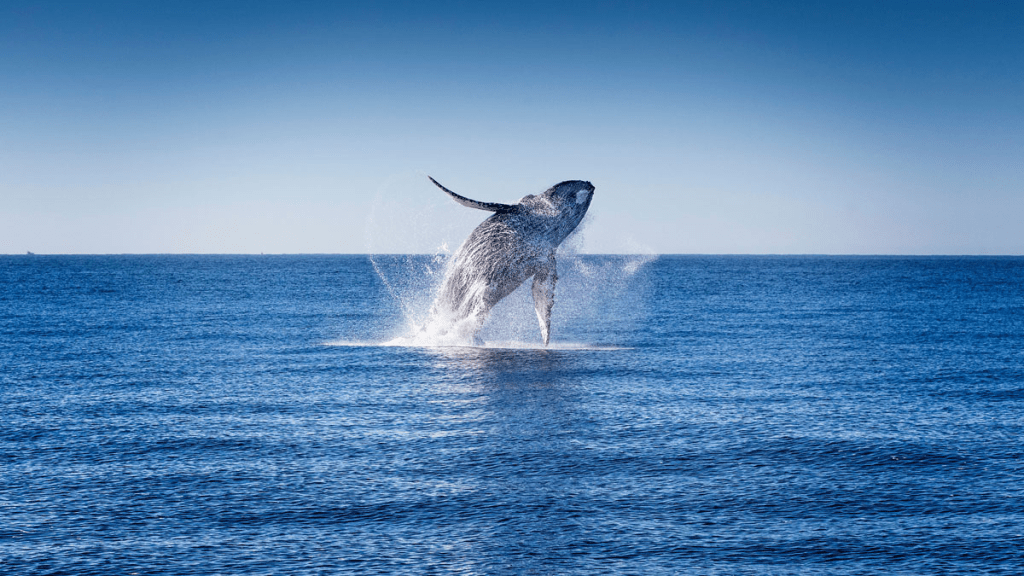
This year’s humpback whale (Megaptera novaeangliae) season in Australia has almost come to an end. The beloved mammals are on their way to Antarctica for a summer of feeding. Next year from April onwards, millions of people will again witness their movements and acrobatic displays – either from the coast or by joining one of the hundreds of whale-watch boat operators.
But as much as we like to watch humpback whales, we still know very little about them. They are notoriously difficult to study in the field. While they are known for their surface activities, they spend most of their time underwater and outside the range of direct observations.
One of the biggest mysteries of all is how these animals make decisions to determine what they do and where they go.
This is where our new research, published in Marine Mammal Science, comes in. We developed a model which effectively captures key humpback whale behaviours and their resulting southward migratory movements in east Australia. It can help anticipate challenges whales may face in the future. In turn, it may aid efforts to better conserve these majestic animals.
A humpback whale comeback
Following the end of commercial whaling, the worldwide recovery of humpback whale populations has been very successful. In Australia, the species was removed from the threatened species list in 2022.
However, scientists fear the effects of climate change may now be the biggest threat to their survival.
Our previous research examined which environmental factors matter in humpback whale ecology. For instance, while water temperature may have little impact in the cold Antarctic waters, breeding grounds further north that are too warm could drive humpback whales to seek better conditions elsewhere.
Currently we rely on satellite tags to inform us of their large-scale whereabouts. But unfortunately, this provides little information on humpback whale activities on a smaller scale, such as how they socialise, hunt, or react to specific conditions.
Humpback whales migrate throughout the year between Antarctica and northern Australia. NPWS/DPIE
Movements through space and time
To address this, we turned to computer models, as these can deal with scarce or inconsistently collected data. In particular, “agent-based” models are designed to capture the behavioural response of an agent (in this case, a pod consisting of a humpback whale mother and one calf) to the environmental conditions they encounter. Based on this information, the models then project movements through space and time.
We developed the first such model to simulate migratory movements of humpback whale mother and calf pods between the Great Barrier Reef and the Gold Coast bay. Along this route is Hervey Bay, an important resting area due to its calm and sheltered waters, where the pairs may stay for up to a few weeks before continuing migration.
As humpback whales are almost always sighted in waters between 15 and 200 metres deep and below 28°C, we took a simple yet reasonable approach where we assumed they avoided waters too shallow, deep, or warm as they swam southwards.
This “avoidance” response would be similar to us going indoors when it is too hot outside or raining heavily: a simple decision to move away from somewhere we are not comfortable.
A combo of current and swimming speed
To estimate how fast whales were moving, we combined the speed of the current with an estimate of real-world swimming speeds by migrating mother and calf pairs along the Gold Coast.
Our simulations accurately predict the routes taken by migrating mother and calf pairs but point to a change in direction after Hervey Bay so whales remain close to the coastline.
Other research has shown that this “distance to shore” is an important variable to consider when studying humpback whales.
Results also highlight the importance of water depth when entering Hervey Bay and ensuring the whales avoid getting too close to shore or into the deep ocean.
A tool for conservation
What the model does less well is accurately predict travel time between the Great Barrier Reef and the Gold Coast bay.
There are a few reasons why this may be the case. For example, the aforementioned underwater movements and associated behaviours are difficult to capture and convert into meaningful components of our model. Research has started to reveal detailed dive profiles but is time consuming and expensive.
We also assume that swimming speed remains more or less constant over time regardless of whether it is day or night. However, research into daily activity patterns has, so far, focused primarily on feeding and mating behaviours rather than variations in swimming speed.
Nevertheless, the current version of our model provides a suitable framework for simulating humpback whale migration and can be expanded to investigate a response of this species to future changes in ocean conditions. In theory, it can be applied to other marine species too, as long as relevant behavioural response data is available.
The development of such predictive models is increasingly important to aid conservation efforts and guide effective strategies for protecting vulnerable species affected by climate change.
This morning I woke up to read that President Joe Biden pardoned his son, Hunter Biden, for any crimes, etc., he committed. And the republican right lost their shit.
You, who sought to humiliate and hound the only living son of a sitting president, are offended? You who put naked pictures of the his son up in open congress are aghast at his temerity? You who have excused attempted extortions, sexual assaults, tax evasions, theft from children’s charity, stated intentions of pardoning the people who assaulted the Capital, stated intentions of pardoning himself!, theft of State secrets… do I need to go on?… by your cult leader – you now beat your chest because the sitting president finally had enough? Wow. Yeah, cry me a damn river.




 Scottie's Playtime