
Peace & Justice History for 2/15

| February 15, 1898 The man-of-war (battleship) USS Maine was sunk in Cuba’s Havana Harbor as the result of an explosion, 260 American naval personnel dying as a result, another 58 wounded. An insurrection against Spanish colonial rule in Cuba had persisted for years, and brutal Spanish tactics had engendered strong American reaction. That is why Consul General Fitzhugh Lee had asked President William McKinley to send the Maine “for the moral effect it might have.” Spain’s Governor-General Weyler had forced 300,000 Cubans into towns and cities to insulate them from the insurgents but had made no preparations for their food, housing or health care. Half of the reconcentrados, as they were called, died as a result. Pres. McKinley had tried since coming into office to reach a settlement through negotiation but Spain rejected his efforts. Following the sinking of the Maine, popular opinion in the U.S. moved toward war with Spain, partially in response to inflammatory press coverage. Congress then voted McKinley $50,000,000 to be used for the national defense at his discretion, and provided for a contingent increase of the army to 100,000 men. The cause of the explosion ??? |
| February 15, 1998 About 2,000 people – including a tractor convoy consisting of over 100 farmers – staged a demonstration in the north German town of Ahaus in protest against the planned shipment of nuclear waste to a storage facility in the town. A consignment of full CASTOR (Casks for Storage and Transport of Radioactive Material) containers was expected at the Ahaus interim nuclear storage site within the next two weeks. |
| February 15, 2002 President George W. Bush approved Nevada’s Yucca Mountain as the site for long-term disposal of 70,000 metric tons (77,000 tons) of highly radioactive nuclear power plant waste. 12 years and $6.8 billion worth of study and construction had gone into the site 90 miles from Las Vegas.  It is officially estimated that, by the time it is completed in 2017, the total construction cost will be $23 billion. 2000 additional metric tons of such waste are generated by U.S. nuclear power plants each year, leading to concerns that the facility would be full shortly after its opening. All such waste is currently stored onsite at individual nuclear power plants.  Problems with the Yucca Mountain site What are the alternatives FAQs on Yucca Mountain |
| February 15, 2003 The world said NO to war… In the single largest day of protest in world history, millions on 6 continents demonstrated against the U.S./U.K. plans to invade Iraq. Reported totals included 1 to 2 million in London and Rome; 1.3 million in Barcelona, Spain (a city of 1.5 million); 500,000 each in Berlin, Paris, Madrid, and New York. Smaller demonstrations were held in over 600 cities and towns across the U.S., including tens of thousands in several cities, and 150,000 the following day in San Francisco. Total participation is estimated at 25 million in more than 100 countries.  |
https://www.peacebuttons.info/E-News/peacehistoryfebruary.htm#february15
MSNBC: Trump warns consumers: Prices ‘could go up’ because of White House plans
Trump warns consumers: Prices ‘could go up’ because of White House plans
The Republican president is moving forward with an agenda that, by his own assessment, is going to make the cost of living worse.
Read in MSNBC: https://apple.news/AQW6uxW6uTQG9e_-C4y1Kvw
Shared from Apple News
Best Wishes and Hugs,Scottie
MSNBC: Opinion | The grim reason Trump is trying to distort the meaning of ‘lawfare’
Opinion | The grim reason Trump is trying to distort the meaning of ‘lawfare’
The president and his allies don’t like that he’s being held to account by judges.
Read in MSNBC: https://apple.news/AWhvbdxrUR6OaGXKif2V70g
Shared from Apple News
Best Wishes and Hugs,Scottie
THE GUARDIAN: Stars pull out of shows and positions at Kennedy Center after Trump takeover
Stars pull out of shows and positions at Kennedy Center after Trump takeover
Issa Rae, Ben Folds and Shonda Rhimes among those who chose not to associate with the institution and president
Read in The Guardian: https://apple.news/A_HkeZ7CZSlmJ34IcN6P9pg
Shared from Apple News
Best Wishes and Hugs,Scottie
Happy Valentine’s Day!
This story has nothing to do with Valentine’s Day, or even Friday except I just saw it over on Oliver Willis’s Breaking News USA.
Federal Judge Temporarily Blocks Trump’s Order Targeting Medical Care For Trans Youth
This is your TPM evening briefing. By Nicole Lafond | February 13, 2025 6:27 p.m.
A federal district court judge issued a temporary restraining order Thursday afternoon blocking the enforcement of Donald Trump’s sweeping Jan. 28 executive order that sought to shut down medical care for trans youth under the age of 19 nationwide.
Judge Brendan Hurson of the U.S. District Court for the District of Maryland, a Biden nominee, issued the decision from the bench earlier this afternoon and a written order is due out soon.
The ruling puts Trump’s executive order on hold while the case moves forward.
During Trump’s second week in office, he signed an executive order that declared the U.S. will not “fund, sponsor, promote, assist, or support” gender transition for people under the age of 19. The executive order specifically sought to block trans youth from accessing gender-affirming medical care, such as blocking medical professionals from prescribing hormones or puberty blockers to patients under the age of 19. This executive order was separate from the one Trump signed on his first day back in the White House, which sought to enable discrimination against trans people across multiple agencies and departments within the federal government through a very specific and somewhat bizarre assertion that there are only two genders “at conception.”
Quickly after Trump signed the executive order seeking to ban gender affirming care for trans youth on Jan. 28, hospitals in Massachusetts, Maryland, Washington, Illinois, Colorado, Virginia, Pennsylvania, New York City, Los Angeles and Washington, D.C., among other places, announced their intentions to either suspend or review their care; many “abruptly halted medical care for transgender people under age 19, canceling appointments and turning away patients, including some who had been receiving this care for most of their life,” according to the ACLU, a plaintiff in the case that Hurson’s court is presiding over.
The ACLU, along with Lambda Legal and the ACLU of Maryland filed a federal lawsuit on Feb. 4, on behalf of trans youth and their families whose health care had been blocked in the immediate aftermath of Trump’s order.
In Thursday’s hearing, Hurson heard arguments from plaintiffs, who requested a temporary restraining order. Plaintiffs argued the EO was “unlawful and unconstitutional” because it violates anti-discrimination laws and attempts to block funds that have already been allocated by Congress.
The government argued that the executive order was not a ban on gender affirming care, but a “general policy directive,” claiming that the plaintiffs did not yet have grounds to sue, NBC News reported.
Hurson disagreed, per NBC News:
“In this situation, it is clear that these plaintiffs have received phone calls stopping their care, stopping their appointments, stopping their everything,” Hurson said during the hearing Thursday, adding that hospitals stopped care because of the order, which also seeks to prohibit federal funding of transition-related care for minors.
“I don’t know how you can credibly argue that this is not demanding the cessation of funding for gender affirming care,” he said.
Additionally, the executive order “seems to deny that this population even exists, or deserves to exist,” Hurson continued, according to the AP.
Lambda Legal told NBC News that they intend to request a preliminary injunction before the 14 days are up.
More Fighters:
EFF sues Elon Musk and DOGE to block their access to federal employee data
The foundation wants the court to cut their access to the Office of Personnel Management systems.
mariella moon Contributing Reporter Tue, Feb 11, 2025, 10:22 PM CST·2 min read
The Electronic Frontier Foundation, along with multiple federal employee unions, have filed a lawsuit against Elon Musk and his Department of Government Efficiency (DOGE) team to block their access to sensitive and identifying information on millions of Americans. Specifically, the plaintiffs are looking to block them from being able to access data stored by the Office of Personnel Management (OPM) and to delete any information they’ve collected so far. The lawsuit also names OPM and Acting Director Charles Ezell as defendants.
In early February, Reuters reported that Musk’s aides locked OPM employees out of the agency’s systems. “We have no visibility into what they are doing with the computer and data systems,” one of its sources said back then. The OPM has the largest collection of employee data in the US and contains sensitive information on both past and current federal employees, as well as on job applicants for federal positions who applied through USAJobs.gov. As the EFF notes, the agency’s records contain federal employees’ names, birthdates, home addresses, social security numbers, work experience, union activities, salaries, performance reviews, demotions, life insurance, death benefits as well as classified information NDAs. The list even includes the first names and last name initials of CIA employees in highly sensitive roles.
In its announcement, the EFF explained that the mishandling of information in OPM’s systems could lead to “significant and varied abuses,” and that DOGE’s “unchecked access” on its own puts federal employees at risk of privacy violations and even political pressure and blackmail. The foundation also emphasized the risk federal employees are facing with DOGE’s access to unrestricted information and Musk’s ownership of X. It cited Musk’s old tweets naming specific government personnels whose jobs he would cut even before he had access to OPM’s database. (snip-MORE)
Happy Valentine’s Day, to all who observe! 💜 💖 🍫
https://www.poetryfoundation.org/poetrymagazine/poems/49493/i-carry-your-heart-with-mei-carry-it-in
[i carry your heart with me(i carry it in]
i carry your heart with me(i carry it in
my heart)i am never without it(anywhere
i go you go,my dear;and whatever is done
by only me is your doing,my darling)
i fear
no fate(for you are my fate,my sweet)i want
no world(for beautiful you are my world,my true)
and it’s you are whatever a moon has always meant
and whatever a sun will always sing is you
here is the deepest secret nobody knows
(here is the root of the root and the bud of the bud
and the sky of the sky of a tree called life;which grows
higher than soul can hope or mind can hide)
and this is the wonder that’s keeping the stars apart
i carry your heart(i carry it in my heart)
Copyright Credit: “[i carry your heart with me(i carry it in]” Copyright 1952, © 1980, 1991 by the Trustees for the E. E. Cummings Trust, from Complete Poems: 1904-1962 by E. E. Cummings, edited by George J. Firmage. Used by permission of Liveright Publishing Corporation.
Source: Complete Poems: 1904-1962 (Liveright Publishing Corporation, 1991)
======================
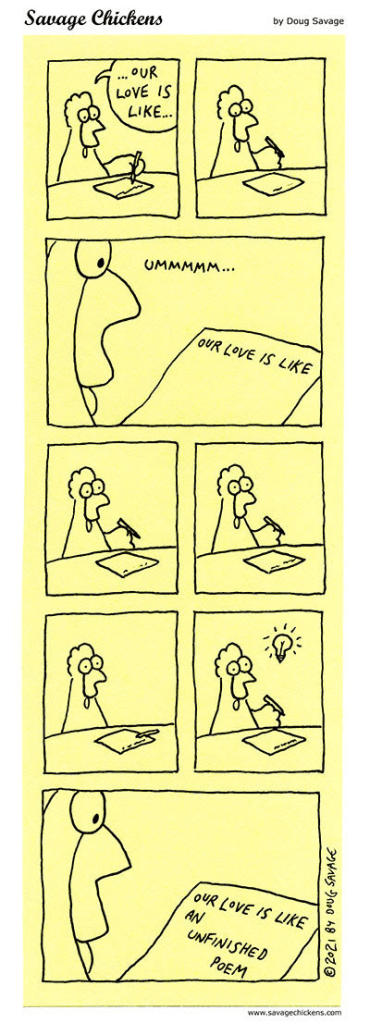
https://www.gocomics.com/savage-chickens/2025/02/10

==========

==============
https://www.gocomics.com/wumo/2025/02/13
WuMo by Wulff & Morgenthaler for February 13, 2025

================
And for all the huggers here:
https://www.gocomics.com/9chickweedlane/2025/02/13
9 Chickweed Lane by Brooke McEldowney for February 13, 2025

===============

I hope today is everything you all, and each of you, hopes it will be! 💖

We Try, But We Don’t Get Out Our Vote in Red States
Peace & Justice History for 2/14
| February 14, 1957 The organization that would shortly be called the Southern Christian Leadership Conference (SCLC) chose its leadership at a meeting in New Orleans. Reverend Martin Luther King, Jr. and Reverend Ralph David Abernathy led the group which sought to coordinate civil rights protests throughout the South. Organizers of bus boycotts, inspired by the one in Montgomery, Alabama, had met in Atlanta a month earlier. During that meeting, Dr. Abernathy’s home and church were bombed.  Reverend Ralph David Abernathy and Rev. Martin Luther King, Jr. Southern Christian Leadership Conference history |
February 14, 1971 President Richard Nixon ordered a secret taping system to be installed for his offices in the White House. Listen in on the presidents |
| February 14, 1989 At a meeting of the presidents of Nicaragua, Honduras, Guatemala, Costa Rica, and El Salvador, the Sandinista government of Nicaragua agreed to release a number of political prisoners and hold free elections within a year. In return, Honduras promised to close bases established by the U.S. for and used by the anti-Sandinista Contra rebels. Just over one year later, elections were held (with international observers including former President Jimmy Carter) though the nation was threatened with a continuing U.S. economic boycott, and was experiencing ongoing Contra violence. The Sandanista Front candidate was defeated 55% to 41%. |

