I talk about tRump’s new Sec Of Defense being a Christian nationalist fundamentalist fanatic, a white supremacist, and a hater of the LGBTQ+. I talk about how he wants to purge the ones he doesn’t like from the military and how tRump hopes to use him to purge the military of anyone not cis straight white Christian and totally loyalist to tRump, the Dear Leader.
Republican presidential nominee former President Donald Trump walks from the podium after speaking at a campaign rally at Lee’s Family Forum, Thursday, Oct. 31, 2024, in Henderson, Nev. (AP Photo/Julia Demaree Nikhinson)
2 of 3 |
FILE – Protesters advocating for transgender rights and healthcare stand outside of the Ohio Statehouse, Jan. 24, 2024, in Columbus, Ohio. (AP Photo/Patrick Orsagost, File)
3 of 3 |
FILE – Jude Armstrong and fellow Benjamin Franklin High playwriting class students perform their play, “The Capitol Project,” on the steps of the Louisiana Capitol in Baton Rouge, La., March 27, 2024. (AP Photo/Gerald Herbert, File)
We knew he was going to go to this, but remember the only one talking about trans people was the republicans. Harris never mentioned them. This is totally a manufactured outrage. No one cared before a few religious republicans got talking constantly about it. I think you all need to ask yourself how trans people affect your lives? There are what 1,400 trans people in the country? There are 5 trans kids in sports? There has never been a trans woman sweep the awards at any event yet that was the constant talking point. Trans women who they mistakenly call men / boys are going to steal your daughter’s trophy. But it never happened and they couldn’t show it. How was this something people voted to switch the election on? Think on it right wing voters on how you were played. So silly and stupid. Plus the religious people now in charge of the military intend to remove trans people and gay people. That will not only harm readiness because the military keeps saying it doesn’t affect the readiness at all. I know from experience that if you remove the LGBTQ+ from the military, it will gut the military entirely and that will harm readiness. Hugs
Transgender youth in the United States have been flooding crisis hotlines since the election of Donald Trump, who made anti-transgender themes central to his campaign. Many teens worry about how their lives could change once he takes office.
During his presidential bid, Trump pledged to impose wide-ranging restrictions and roll back civil rights protections for transgender students. And his administration can swiftly start work on one major change: It can exclude transgender students from Title IX protections, which affect school policies on students’ use of pronouns, bathrooms and locker rooms.
One ad that aired over 15,000 times crystallized Trump’s stance on rights for transgender and nonbinary Americans: “Kamala is for they/them. President Trump is for you.”
For one Alabama teen, the ad seemed to paint transgender and nonbinary people as a threat to society. The weekend before Election Day, the 16-year-old teen, who identifies as nonbinary and uses the pronouns “he” and “they,” called a crisis hotline at the Rainbow Youth Project. The group that serves LGBTQ+ young people has received more than 5,500 calls to its crisis hotline in the past 10 days, up from the 3,700 calls it typically gets every month.
The teen was in despair and struggling with suicidal thoughts, according to his mother, Carolyn Fisher. She said she hadn’t realized the depth of her child’s depression and how painful it was for him to see political ads that felt like a personal attack.
With the help of crisis counselors, Fisher said her teen has begun feeling better. But bullying at school has gotten worse, with some students telling her child Trump is going to make him “go back in the closet,” Fisher said.
”The kids who have taunted him are now proud of themselves, and they rub it in,” she said.
Opposition to transgender rights was a focal point of Trump’s campaign: Republican ads attacking political opponents over transgender or LGBTQ+ issues have aired over 290,000 times on network TV since March 2023, according to data from the media tracking firm AdImpact.
The messaging may have resonated with many Americans. More than half of voters overall — and the vast majority of Trump supporters — said support for transgender rights in government and society has gone too far, according to AP VoteCast, a survey of more than 120,000 voters nationwide.
President Joe Biden’s administration expanded recognition of transgender rights just this year. Interpretation of Title IX, a landmark sex discrimination law, is largely up to the executive branch, although court rulings can affect enforcement.
Originally passed in 1972, Title IX was first used as a women’s rights law. This year, Biden’s administration said the law forbids discrimination based on gender identity and sexual orientation, but Trump can undo that. Biden’s new guidance had limited implementation in any case: After a spate of lawsuits, courts had issued injunctions pausing the rule in 26 states.
“Title IX will be a top priority. It is emblematic of all the culture war issues that have been created over the past few years surrounding gender identity versus sex,” said Candice Jackson, a lawyer who led the Education Department’s Office for Civil Rights in the first Trump administration.
Trump also has said he would ask Congress to pass a bill stating there are “only two genders” and to ban hormonal or surgical intervention for transgender youth in all 50 states. Most Republican-controlled states already have banned gender-affirming health care for transgender youth under age 18 or 19, and several have adopted policies limiting which school bathrooms trans people can use.
While Biden’s election-year guidance did not extend to transgender students in sports, Trump has promised to end “boys in girls’ sports.” The administration likely would “approach these issues from a traditional understanding” of what Title IX has meant, “with a biological, binary understanding of sex,” said Bob Eitel, who served during the first Trump administration as a senior counselor to the education secretary.
In the U.S., 3.3% of high school students identify as transgender and another 2.2% question their gender, according to a U.S. Centers for Disease Control and Prevention survey released last month.
The survey found 72% of transgender and gender-questioning teens experienced persistent feelings of sadness and hopelessness in the past year. These teens also reported higher rates of bullying at school compared with peers. About 1 in 4 transgender students said they had attempted suicide in the past year, the CDC said.
LGBTQ+ advocates are mobilizing to address the despair they see rising among transgender and nonbinary youth. The Rainbow Youth Project, for one, has increased virtual peer groups and town halls so LGBTQ+ youth can connect. Another organization, It Gets Better, has focused on reaching young people online through social media platforms like Twitch and YouTube to create supportive environments even if legal protections are rolled back, said Brian Wenke, the group’s executive director.
Across the country, particularly in conservative areas, LGBTQ+ youth are discussing whether it would be safer to live somewhere else.
Jude Armstrong, a transgender high school senior in New Orleans, has led protests against Louisiana laws that regulated pronoun usage and discussions of gender and sexuality in the classroom. With the potential for federal changes on the horizon, Armstrong, 17, said he has thought of going to school in the United Kingdom, but worries about leaving behind the queer culture and history he loves at home.
“How do you feel like you’re protecting your own community when you’re leaving that community and going to another country?” he asked.
FILE – Jude Armstrong and fellow Benjamin Franklin High playwriting class students perform their play, “The Capitol Project,” on the steps of the Louisiana Capitol in Baton Rouge, La., March 27, 2024. (AP Photo/Gerald Herbert, File)
Alejandro Jimenez, a sophomore at Texas State University, dreams of being a theater teacher in Texas. He knows how important it is for trans kids to see someone like them in the classroom. Now, he’s not sure if he’ll stay in his home state.
Already, tensions have risen on his campus in a way that makes him feel unsafe. The day after the election, two protestors held up signs that said, “Homo sex is sin” and “Women are property.”
“I feel it’s my duty to stay here, but I’m scared of being pushed out,” said Jimenez, who is transgender.
Under the new Trump administration, advocates worry efforts anywhere to accommodate transgender and nonbinary students could face scrutiny. Trump’s platform called for pulling federal funding for any school pushing “gender ideology, or other inappropriate racial, sexual, or political content on our children.”
“It sounds really dystopian to say that trying to be more inclusive could actually result in punishment from the federal government. But that is a risk,” said Elana Redfield, federal policy director for the Williams Institute at the UCLA School of Law.
With so much uncertainty, Eli, an 18-year-old trans college student in New York, stressed the importance of community, especially online for youth who feel concerned right now.
“You are not alone,” said Eli, an ambassador for It Gets Better, who asked to be identified only by his first name for safety reasons. “We will come out the other side. There are queer adults who have lived long and happy lives, and you will get there too.”
A broken window on an LGBTQ fashion boutique storefront in Manhattan, New York on June 12, 2023.Photo: Shutterstock
There has been a 112% increase in documented attacks on LGBTQ+ people nationwide, according to a newly unveiled Anti-LGBTQ Extremism Reporting Tracker (ALERT) from the queer media watchdog organization GLAAD. GLAAD hopes to use the tracker to provide comprehensive reporting and analysis detailing anti-LGBTQ+ hate in the U.S. and the specific communities and targets affected by it.
ALERT recorded 524 such incidents between June 2022 and 2023 and 1,109 incidents from June 2023 to 2024. These attacks have included over 450 protests, 330 propaganda drops, 320 acts of vandalism, 200 bomb & mass shooting threats, 130 assaults, and 45 cases of arson that have resulted in at least 161 injuries and 21 deaths, GLAAD’s ALERT Desk reported.
While the cases focus on drag bans and trans protections, they address larger issues of free speech and civil rights.
The attacks have also included over 567 attacks on transgender and gender non-conforming people, 360 incidents targeting educational institutions and libraries, 325 incidents targeting Pride flags and other LGBTQ+ community symbols, 160 protests and violent threats against drag performers, and 140 incidents targeting health care providers of gender-affirming care and their patients.
The tracker, which will be updated quarterly, includes data on criminal and non-criminal acts of hate from sources like news media, partner organizations (like the Human Rights Campaign or Anti-Defamtion League’s Center on Extremism), right-wing forums on social media sites like Gab or chat apps like Telegram as well as incident reports submitted via GLAAD’s website. All documented incidents must occur against groups or individuals within the U.S. and must include harassment, threats, or actual violence specifically targeting LGBTQ+ people.
GLAAD’s ALERT team will verify the validity of each incident to maintain credibility, remove duplicates, and exclude spam and trolling, the organization said.
“The ALERT Desk tells a story not entirely captured by the FBI’s hate crime statistics because many of these incidents, like protests at Pride events, don’t meet the criteria necessary to bring legal charges [and] aren’t included in most official hate crime counts,” GLAAD wrote in its recently released report on ALERT’s findings. “However, we must recognize that the impact of these acts on local LGBTQ communities is felt regardless of whether or not the incident is prosecuted.”
“We must recognize that the impact of these acts on local LGBTQ communities is felt regardless of whether or not the incident is prosecuted.”
GLAAD’s 2024 report on ALERT’s findings
During a press call, Barbara Simon, senior director of news and campaigns at GLAAD, noted that ALERT seeks to contextualize anti-LGBTQ+ incidents to help media and other experts understand larger systems of violence.
“[Recently], there was a bomb threat against a library in Massachusetts,” Simon said, a threat against a Drag Queen Story Hour at the public library in Somerville. “But it’s not just about that library. It’s not just about the inclusive materials and programs they had, about how the bomb squad had to come in and sweep the library, how children and families and patrons had to evacuate the library.”
“Our data shows how that incident is connected to the bigger picture, which is more of a broad-based, systemic attack against LGBTQ people, our visibility, our equality and our allies,” Simon added. “It is one of 365 attacks nationwide against drag artisan events. It’s one of 63 anti-LGBTQ attacks in Massachusetts alone, one of 15 attacks specifically against drag in Massachusetts.”
The quarterly reports will also include stories from those affected by the incidents.
GLAADA bar graph showing anti-LGBTQ+ hate incidents from GLAAD’s ALERT Desk. | GLAAD
For example, Dr. Jack Turban, pediatric psychiatrist and director of the gender psychiatry program at the University of California in San Francisco, said during the press call that bans on gender-affirming care for youth in 26 states have worsened the mental health of his young trans patients even though they live in a state where such health care is protected. Their mental health has been worsened, Turban said, because of an increase in anti-trans rhetoric nationwide whose indirect effects cross state lines.
“Kids are hearing things like being trans is a mental illness, or being trans is bad, or you shouldn’t be allowed to use the bathroom that aligns with your gender identity because trans people are sexual assaulters, or you shouldn’t be allowed to play on sports teams with your friends because you’re going to physically hurt them,” Turban said. “My patients know that none of those things are true, right? They can know that, but if you’re hearing it every single day, all over social media and all over the news and now right in their communities, even it’s impossible to not be impacted by that.”
GLAAD pointed out that media coverage tends to falsely frame medical care for transgender people as a “debate” despite every major medical association supporting the care. This coverage compounds the effect of hateful rhetoric from anti-trans politicians, protestors, and pundits.
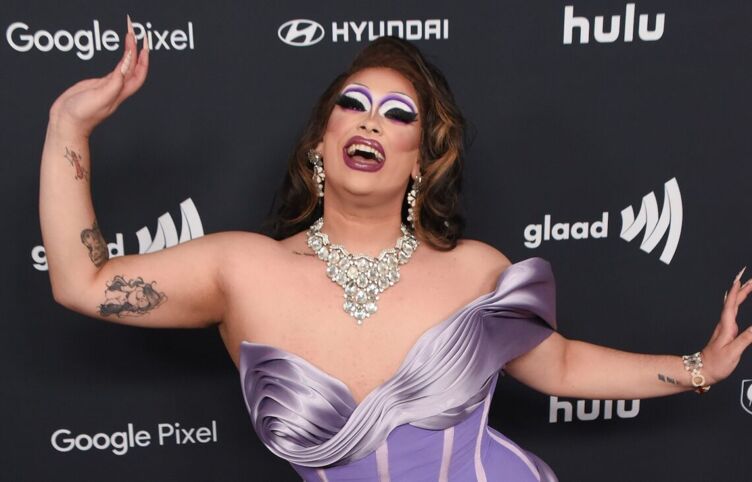
ShutterstockSalina EsTitties attends the 35th Annual GLAAD Awards on March 14, 2024 in Beverly Hills, California. | Shutterstock
The hateful rhetoric affects even LGBTQ+ celebrities and their fans, like Salina EsTitties, a competitor who appeared in Season 15 of RuPaul’s Drag Race. EsTitties told the press call that she’s generally insulated from hatred against gender non-conforming people since she lives in the very gay city of West Hollywood, California. However, she sees its impact whenever she travels to other states or posts social media videos about LGBTQ+ issues.
“There’s comments every single day of people being like, ‘This is not what God created. God created two genders. Oh, they keep adding alphabets. Oh, just shoot it between the eyes and get rid of it,’” EsTitties said. “The online hate is insane and there’s so much of it, and people are so willing to just let it all out, but it’s a clear representation of how people actually feel in America and across, you know, the U.S. here.”
“Not only are our LGBT community dealing with having to be their authentic selves,” she continued. “Being their authentic selves with just who they are outside of their queer identity is a lot to navigate, and it’s not easy, especially when people are telling you, ‘You’re the Devil, you’re a demon,’ or ‘It’s not acceptable to be that.’”
Hate crimes typically increase during presidential election years. Marie Cottrell, executive director for the New Jersey-based LGBTQ+ advocacy center Out Montclair, said she hopes that increased awareness of anti-LGBTQ+ hate incidents will empower communities to build intersectional coalitions between other demographic groups whose members are targeted by similar hate.
“I think that it’s really important that you be the person that the community needs,” Cottrell told the press call. “They need to see you stand for and with them. Find folks who in your community who will stand with you in the face of intolerance, build a community of support within your township — whether that’s forging a relationship with your LGBTQ liaison within the local police department … working with the township, the mayor, the town council, and really having open conversations … having conversations that address really hard questions and topics and that starts the process of understanding and healing in your community.”
“It’s a small step, but it’s a step forward and a step forward in helping others understand the community,” she said.
Subscribe to the LGBTQ Nation newsletter and be the first to know about the latest headlines shaping LGBTQ+ communities worldwide.
I bet the next election will be well attended and these people will lose their seats and new progressive inclusive people will win. That is what has happened all over when the right bigots and haters snuck into school board seats, they go too far trying to erase the LGBTQ+ kids / people from existence, then they get kicked out. Sadly by then the damage is done. What they hell do they want people perving on kids in the bathrooms for? To make the kids scared to use them and to make sure the weird kids are not doing weird gay stuff in them, right? Hugs. Scottie.
By the way. We have a hurricane headed right at us. It will be here Wednesday at around noon, but we have three days of wind and rain beforehand. It will hit at a class three. It is projected to hit just above us but could hit us directly. We will be spending the next few days getting as much done as possible, stocking in cat food Ron forgot and getting more gas and propane for the generator. It is unlikely that pole of ours will survive another storm as it is already leaning hard. Repair crews are already stretched thin in other areas so won’t be able to come rescue us in our time of need. Going to be a very long few months. Hugs. Scottie
YORK DISPATCH EDITORIAL BOARD
York Dispatch
At the risk of stating the obvious, South Western’s elected school board is making some strange decisions.
For the last two years, they’ve fixated on which bathrooms LGBTQ+ kids use. In 2023, officials in this Hanover-area district played musical chairs with school bathrooms in a misguided attempt to appease the loudest bigots among them — ending up with five different types of bathrooms.
After a low-turnout school board election in which several far-right members joined their ranks, they hired a Christian law firm, decided to begin banning books and reopened the bathroom issue. Board President Matthew Gelazela, who was elevated to his post after previously serving as the board’s most vocal bomb-thrower, pointed to Red Lion’s discriminatory policiesas something to aspire to.
These adults want to make it easier for other people to watch your children while they’re in the bathroom. It’s absolutely mind-boggling.
Gelazela, who’s steadfastly refused to explain the logic here, said in a public meeting that the windows help “[add] privacy in the toilet facility” and that they “increase oversight of the wash area.”
There’s a reason public restrooms tend not to have windows — or, if they do, they have frosted glass.
No one wants to be spied on when they’re relieving themselves.
The parents who spoke to The York Dispatch about the latest bathroom renovations said their children no longer feel comfortable using these bathrooms. One of the parents went to the principal and asked for an exemption to allow her son to use a different bathroom further away from class.
Her 13-year-old doesn’t want to be spied on while he’s in the bathroom.
And we don’t blame him.
It’s creepy and weird.
And let’s not ignore the bigger picture: This is happening at a time when this and other York County school boards are pushing policies that would restrict what books students read, what sports teams they compete on and even which pronouns they use.
All of this is part of an attempt to erase LGBTQ+ people.
Cutting a window into these bathrooms is an intimidation tactic designed to make sure students who use the so-called “gender-identity” facilities — and, let’s be honest, any student who doesn’t fit neatly into the worldview of the school board’s far-right majority — know they’re being watched, controlled and judged.
In their quest to punish LGBTQ+ kids, however, the misguided “adults” on this South Western School Board are doing the things they accuse others of doing.
This is an invasion of privacy and a waste of taxpayer dollars.
This man understands, this person gets it! Those of us not center, those of us not maga, those of us paying attention to what is happening and see what red states are doing to the LGBTQ+ and how hard they are trying to keep anyone not fully supporting them from voting … Yes we are scared. We feel all the movement to the future acceptance of people who are different from the main stream, all the rights for black people, all the rights for minorities, all the rights for the disabled, all the rights for the poor, and all the rights that have been gained for the LGBTQ+ are being wiped away with the goal being removing us from public society so that we have no voice in the very country we live. Welcome to the 1950s white cis straight men in charge society. Hugs. Scottie
Here is why the right / republicans are panicking. It is an attack on trans boys. This who line of they are putting them in the boy’s bathroom is really a way to say Walz supports trans kids. The truth is the bill doesn’t require the products be in any bathroom, just they be available to menstruating students and that includes trans boys. Ron and I off the top of our head thought of dozens of places in a school that they could be put instead of the bathrooms. Just a few, nurses stations, main offices, teachers could keep them in their rooms, a storage closet open to students, dispensers on doors or in hallways, student activity rooms, the rooms used for the gay straight clubs, so on. But even if they were in the boy’s bathrooms, what is the problem with that, other than the made up issue the right has with trans boys? That boys will see tampons and pads. Do these boys not have mothers or sisters? Have they never been in a store? Do they help unpack grocery bags? If boys do not know what these items are for, then they should be taught. It need not be a deep mystery and a shame for girls and women. It won’t turn them gay or trans, it won’t cause their spines to break. Below I post the important quote then the article. Hugs. Scottie
That might mean making these products available for free in various locations for all who need them, such as unisex bathrooms, girls’ bathrooms, the school nurse or the front office, but not necessarily in boys’ bathrooms. Henton, in an interview, lauded the “local control” the law provides for implementation, and said she’s fielded no concerns about its rollout.
At Anoka-Hennepin, the state’s largest school district, the free products are not found in traditional male-only bathrooms, a spokesman said. But they are provided for free to all in “nongendered bathrooms,” girls’ bathrooms or from health staffers.
A smart, compassionate new state law is spurring misinformed attacks on Minnesota’s latest vice presidential contender: Gov. Tim Walz.
Kristy Wesson and Margie Solomon of the National Council of Jewish Women Minnesota and student Elif Ozturk delivered menstrual products to Hopkins High School in 2022. Ozturk and community advocates were pushing for a bill, subsequently made law, to require public schools to provide such products.
Opinion editor’s note:Editorials represent the opinions of the Star Tribune Editorial Board, which operates independently from the newsroom.
•••
On Tuesday, Democratic presidential nominee Kamala Harris tapped Minnesota Gov. Tim Walz as her running mate. By Wednesday, the opposition had mobilized with lightning speed for its one of its first political attacks, dubbing Walz “Tampon Tim” in reference to a new state law providing free menstrual products to school students.
The nickname was trending nationally this week on Twitter, an indicator of its political currency. Chaya Raichik, whose scurrilous “Libs of TikTok” account on X (formerly Twitter) has more than 3 million followers, was one of the first to amplify it. Former Fox News host Megyn Kelly added to the momentum, endorsing the nickname via tweet. Former First Lady Hillary Clinton weighed in from a different angle, with a tweet supporting the Minnesota measure.
Social-media users swiftly took sides as well, and as usual, facts and context were missing, especially from those who see the new law as evidence of a radical Minnesota under Walz’s leadership. But a closer, more informed look at the issue should yield a different conclusion. This is good and necessary policy. Providing free menstrual products is a practical, compassionate remedy to address an under-the-radar reason for student absenteeism. Some families can’t afford menstrual products, and when that happens students stay home instead of going to class, falling behind as they do.
There’s a lot of talk about closing educational achievement gaps in Minnesota and elsewhere, particularly for low-income students. The new state law, which has a price tag of about $2 million a year, is an actual solution to help address this, one that’s relatively low-cost. And there’s real-world data to back it up. New York City schools reported a 2.4% increase in attendance after a state law went into effect requiring free period products for students, according to the advocacy group Alliance for Period Supplies.
Minnesota is far from alone in providing this type of assistance. More than half of the nation’s 50 states have taken steps to help students who struggle to afford tampons and pads. Ohio, led by Republican Gov. Mike DeWine, now requires period products in schools and has provided $5 million in funding for this, the Alliance for Period Supplies reports. Alabama and Georgia provide grants for schools to make free products available.
Other states, such as Washington, Nevada, Illinois and Utah, require schools to provide these products, though they didn’t fund them. To Minnesota’s legislators’ credit, the new law provides dollars to schools and is not an unfunded mandate.
Other background information is also useful as the dubious online debate continues.
The new law went into effect in January and applies to students in grades four through 12. The legislation itself was passed during the 2023 session as part of a broader educational bill, which Walz then signed. Rep. Sandra Feist, DFL-New Brighton, was the bill’s chief author in the Minnesota House. Sen. Steve Cwodzinski, a retired teacher and DFLer from Eden Prairie, championed the measure in Minnesota Senate.
But the most powerful advocates for it came from outside the State Capitol. Young Minnesotans reached out to Feist about this issue. After Feist introduced it, these students testified on its behalf as the legislation made its way through various committees. Among them was Elif Ozturk of Golden Valley, who is now 18 and will attend Columbia University this fall.
In an interview, Ozturk told an editorial writer she got involved after seeing other students struggle to afford these products in junior high. She spoke to counselors and was told that some students had to leave class or couldn’t attend because they lacked pads or tampons. Ozturk dug into the issue and discovered that other states had taken steps to help students’ access these products. She thought Minnesota should do the same.
“If we don’t talk about it, it’ll never be fixed. These people who are in power, predominantly old men, have no clue what young girls go through every single day,“ Ozturk said.
Other advocates for the law’s passage: school nurses, who testified movingly about how students struggle to afford these products and the educational and emotional consequences when they can’t.
A specific but ill-informed attack on the new Minnesota law is in dire need of a reality check. Critics contend, wrongly, that it mandates menstrual products in boys’ bathrooms. This has unfortunately been used to stoke ongoing culture wars over transgender individuals.
That might mean making these products available for free in various locations for all who need them, such as unisex bathrooms, girls’ bathrooms, the school nurse or the front office, but not necessarily in boys’ bathrooms. Henton, in an interview, lauded the “local control” the law provides for implementation, and said she’s fielded no concerns about its rollout.
At Anoka-Hennepin, the state’s largest school district, the free products are not found in traditional male-only bathrooms, a spokesman said. But they are provided for free to all in “nongendered bathrooms,” girls’ bathrooms or from health staffers.
There’s nothing radical about Minnesota’s new law. Instead it’s a smart, low-cost measure to address educational achievement gaps, one that many states are embracing. Weaponizing this measure is laughably out of touch and likely to backfire not only with women, but all who care about them.

 A broken window on an LGBTQ fashion boutique storefront in Manhattan, New York on June 12, 2023.Photo: Shutterstock




 Scottie's Playtime