(I have AdBlock on my puter. If there’s an orange box on this post for you, just tell the box you’ll fix it next time. It’s the first option. This is a wonderful thing to read on its own, but it seems a good recommendation, as well. Enjoy! -A.)
This guest review is from Crystal Anne! Crystal Anne with An E comes to us from a sunny clime, but prefers to remain a pale indoor cat. She enjoys reading, cross-stitching something nerdy, going to see live music, and playing video games.
She works as an autism consultant by day, got a degree in information science for fun, and currently serves on her local library advisory board.
CW/TW
“I believe the children are our future….” Sometimes this is not just a line in a song.
My daughter learned much of her geekery from me. Fortunately for us both, that means we have noticeably similar taste in things we enjoy. I got her into Buffy the Vampire Slayer and Hamilton. I procured her every single Percy Jackson book available when she decided she wanted to read them. She recently returned the favor, by introducing me to Epic: The Musical.
I am rather confident that I would not have discovered it without her. I am terminally online the way a 46 year old person is. She is terminally online the way that an 18 year old is, and these ways are pretty different. She also is deeply interested in art and animation in a way that I am not (I enjoy these things, but she’s interested in making a career of it), and much of her discovery of this musical came about as she watched animatics of it. I am a deeply lucky parent in that when my daughter loves something, she wants me to love it, too, so she insisted that I was going to listen to the entirety of Epic with her. Yes, all 2 and a half hours of it. (snip-MORE. Go read it! It’s delightful! -A.)
Ocean acidification now looms as a direct challenge to oysters. Experts warn that more acidic conditions can alter the sex balance in these shellfish. Some oysters start life as male, then switch to female later. Shifts in pH threaten to speed that switch.
These shifts could upend aquaculture and coastal ecosystems everywhere.
Researchers note that an oyster population with too many females might see future reproduction problems, since a balanced sex ratio helps keep populations stable.
Photo: Pexels
Oysters rely on environmental cues to decide their sex. (snip-MORE)
Proposal calls on company to prepare reports on ‘macroeconomic costs’ of health insurer’s practices
UnitedHealth Group is attempting to swat down a non-binding shareholder proposal that asked the company to prepare reports on the costs of delayed and denied healthcare.
The proposal, filed by members of the Interfaith Center on Corporate Responsibility (ICCR), represents a new frontier in seeking to hold insurance companies accountable for the “macroeconomic costs” of denied care – arguing they eventually hurt the bottom line of large investors.
The proposal asks UnitedHealth Group to prepare reports on the “public health-related costs and macroeconomic risks created by the company’s practices that limit or delay access to healthcare”.
“The investors we work with are interested in long-term value creation,” said Meg Jones-Monteiro, senior director of health equity at ICCR. The coalition represents primarily institutional investors, such as pensions and foundations.
“When you think about the investment portfolios our members have, they are very diverse,” Jones-Monteiro. “What happens in one sector impacts another.”
The proposal is non-binding, but UnitedHealth Group is nevertheless fighting to stop it. In a filing with the Securities and Exchange Commission in January, UnitedHealth Group attempted to exclude the proposal from proxy statements on technical grounds, arguing in part that the terms “public-health related costs” and “macroeconomic risks” are vague and subject to interpretation. (snip-MORE)
Last month I asked to hear from trans-friendly employers who sponsor visas, and provided a simple form for interested employers to reach out. In the process, I heard from many individuals: people who were hoping to find new employment in another country, and people who worked for companies that were aligned, who were encouraging their bosses to fill in the form.
A quick reminder before we dive in: I’m not providing formal legal or financial advice. I’m just trying to point people in the right direction and provide some ideas for relocation for people who want it.
The bad news
Here’s the bad news: today, that form sits empty. While the post was shared far and wide, not a single person has filled it in.
I think there are a few reasons for this. First and foremost, in the current environment, being listed in such a database presents a significant risk, particularly if you’re doing business with US entities. In an environment where the administration is firing employees and cutting contracts for even the barest mention of support for trans people, there’s every reason to believe that the current administration will penalize people and organizations who work with trans people.
So, that’s not great. I’m very sorry to everyone who got their hopes up that I would be able to make direct connections.
The good news
The good news: some countries actively sponsor visas, welcome trans people, and are hiring.
In my personal conversations with people, what jumped out again and again was that emigrating to the Netherlands was a viable route for many people — and particularly those with tech skills (engineering, IT, product management, design, research, and so on).
Reasons include:
Dutch tech companies tend to sponsor visas. (Look for job vacancies written in English and/or on boards like Tech Me Abroad and Relocate.me.)
You can relocate with a self-employment visa if you have a skilled background, can demonstrate at least one Dutch-based contract or that you’ll start a tech-based business, and can show that you’ll independently make €1,613 (~$1,700) per month.
The DAFT visa lowers the barrier to entry for US entrepreneurs who can commit to invest €4,500 (~$4,700).
The Netherlands is also kind of just a neat country: excellent social safety net, great support for culture and the arts, good connectivity to other European countries, and a strong grant support network for mission-driven tech. Amsterdam is a first-class cosmopolitan city, but other centers in the Netherlands are not to be sniffed at, and the country is so small that you can easily take public transit from one to another in less time than it might take you to commute to work by car in the US.
It is not, however, perfect. Much like the US, the Netherlands has had its own racial reckoning; unlike the US, the discourse has often centered on the idea that racism doesn’t happen there. That’s a rich claim from a society where racist tropes like Zwarte Piet are still commonplace, and where women of color are often marginalized. There’s work to be done — although it’s worth asking if this is truly any worse than the US.
Not everybody can relocate, and not everybody has these skills. I’m aware that this is a privileged route that not everybody can take advantage of. It would be better if there was a defined route for everybody who needed to find a safer place to live; it would be better still if a safe place to live was the place they already call home. This situation is sick and sad, and I truly wish that everything was different.
It also comes with an attendant cost. It’s estimated that moving to the Netherlands will set you back between $6-10K. That’s a lot less than one might expect, but it’s obviously a significant barrier for many people. Unfortunately, very little financial support exists for these moves. If you know of grants, mutual aid funds, or community resources that help trans people relocate, please share them. Funding and guidance from those who’ve navigated the process could make all the difference.
Please reach out
In the meantime, I’ll keep looking. If you are a company in a country that is safe for trans people, and you’re looking to hire people from the US who need visa sponsorship, please fill out this form or reach out to me via email. I’m not giving up.
==========
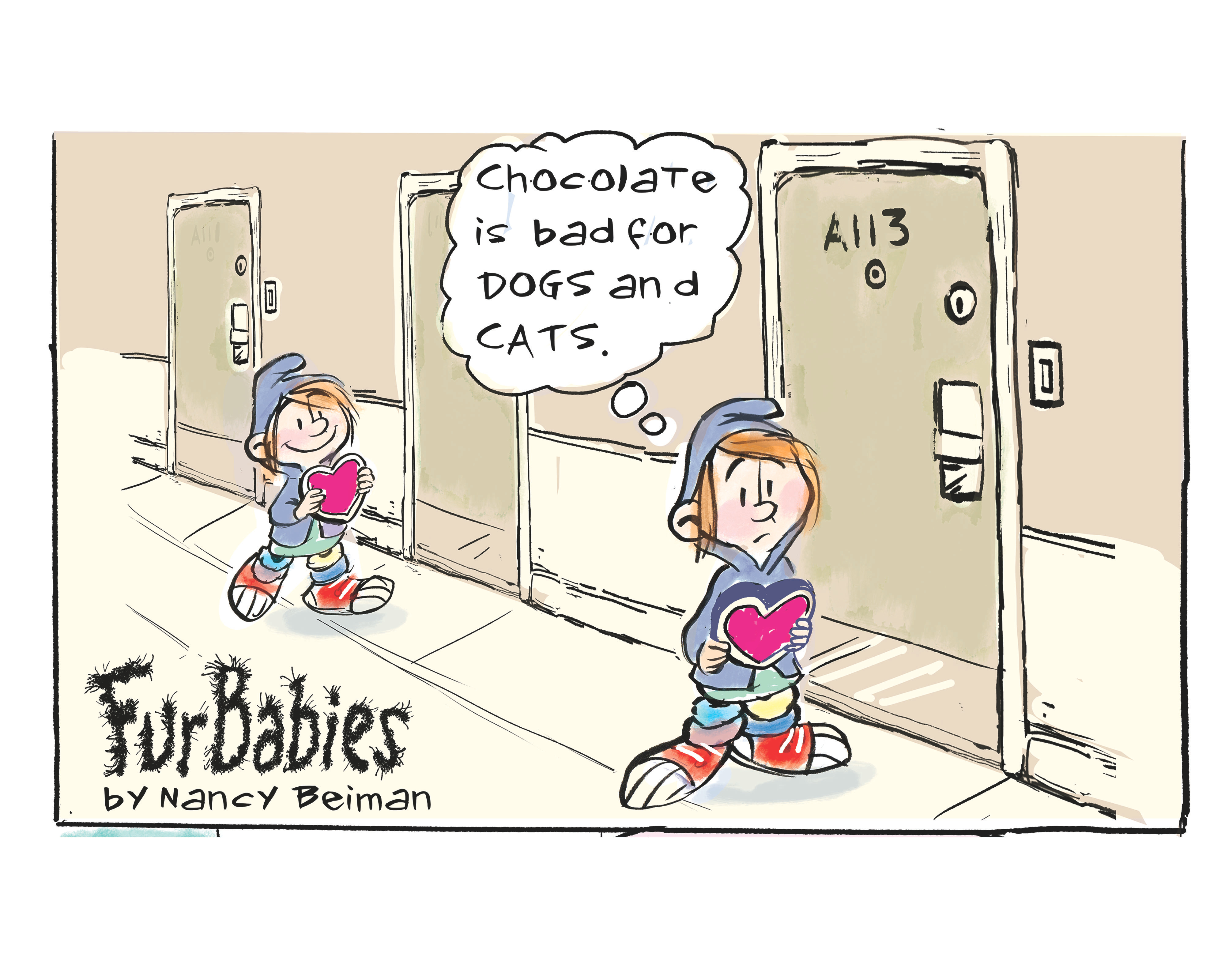
I once had a wonderful experience with tens of thousands of pansies. by Worriedman
Plant the green side up and give it a good drink of water a couple of times a week…
Pansies are Viola hybrids, Viola x wittrockiana. (“wittrockiana” sounds like a mountainous region in the south of the Duchy of Grand Fenwick) The common names, pansy, viola and violet are used interchangeably. “Pansies” are usually larger and taller than true violas, with large showy blooms. Violas are usually smaller plants, with smaller blooms, more plentiful than find on pansies. If you want to be a real nerd you can look at the petals. Both kinds of blooms have five petals . On the pansy, four petals point up, one points down. On the viola, two petals point up and three point down.
Leslie Margolin, the other girl in the first class, was not interviewed. A group photo was taken of other graduates for Vanity Fair. I am not in it. Tim Burton was Photoshopped in, but no one would do that for me even though I offered to go to New York for the photo shoot.
The so called Cal Arts Mafia only worked for the male students.
Thanks for reading FurBabies (formerly Animation Anarchy)! Subscribe for free to receive new posts and support my work.
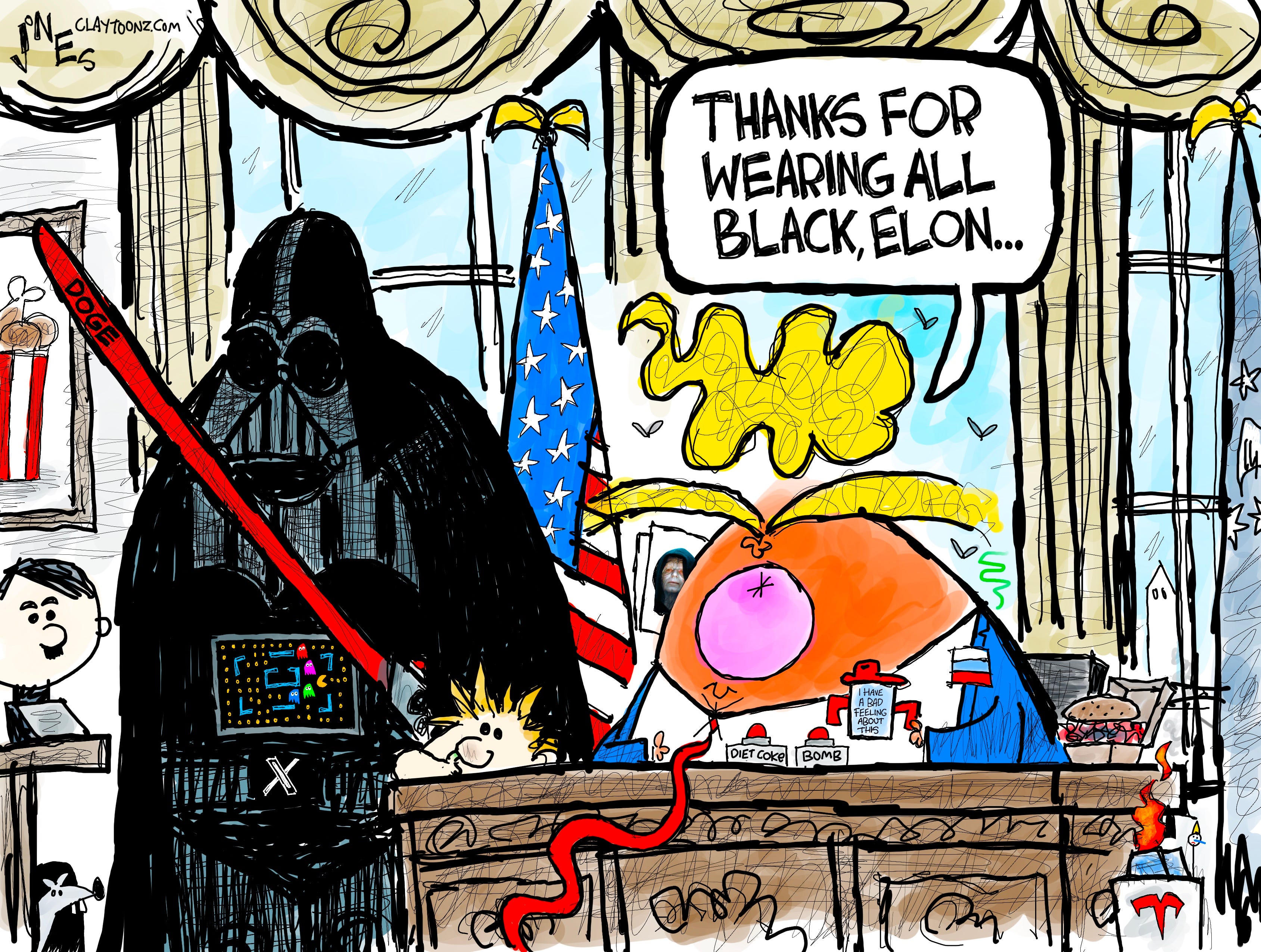
Elon Musk visited Donald Trump in the Oval Office yesterday and was a total disgrace.
Elon, who was in all black, wearing a black T-shirt and a black MAGA hat, said he was “open” and “honest” in his work finding waste and fraud in federal spending.
When asked about his lie that $50 million was spent on condoms for Gaza, Elon said, “Some of the things that I say will be incorrect and should be corrected. Nobody’s going to bat 1.000.” A good example of “some” of the things he says that are incorrect is his statement that DOGE was “open” and “honest.”
Before you tell a lie, like Elon’s condom bullshit, you can easily look up the facts, like when Elon lied about the last budget and claimed it included $300 billion for a football stadium in Washington DC, Congress would get a 40 percent pay increase, or that it funded bioweapons labs. Elon could have looked all this shit up before posting about it on his platform X/Twitter…over 100 times within 24 hours.
Unfortunately, we can’t fact-check Elon’s claims that the federal bureaucracy had been corrupted by cheats and officials who had approved money for “fraudsters.”
We can’t fact-check his claim that officials at USAID were taking “kickbacks.”
We can’t fact-check his claim that some officials “managed to accrue tens of millions of dollars in net worth while they are in that position.”
We can’t fact-check his claim that some people were receiving Social Security benefits at the age of 150.
We can’t fact-check his statement, “There are quite a few people in the bureaucracy who have ostensibly a salary of a few hundred thousand dollars but somehow managed to accrue tens of millions of dollars in net worth while they are in that position.”
The reason we can’t fact-check any of that is because Elon didn’t provide any proof of his claims and DOGE is operating in secret. There is no transparency with DOGE. None, nada, zip, zip, zippity-doo-dah, none.
Here’s a case of irony: The employee Musk claims made millions off the government had to file a financial disclosure form. Elon does not because Trump designated him a “special employee.” So just as we can’t see Trump’s tax returns, we can’t see Elon’s either.
When asked about the conflict of interest of him scouring billion-dollar contracts while his company Space X has billion-dollar contracts with the government, he said, “First of all, I’m not the one filing the contract. It’s the people at SpaceX or something.” As Sarah Marshall said in the great film Forgetting Sarah Marshall, “bullshit, bullshit, bullshit, bullshit.” It’s still a conflict of interest, even if he’s not lying.
Elon said, “I don’t know of a case where an organization has been more transparent than the DOGE organization. He also said, “We are actually trying to be as transparent as possible,” and then some more crap came out of his mouth when he said, “So all of our actions are maximally transparent.”
Bullshit, bullshit, bullshit, bullshit.
Without exhibiting any self-awareness, Elon said the bureaucracy is an “unelected, fourth, unconstitutional branch of government, which has, in a lot of ways, currently, more power than any elected representative. That might be the only thing Elon said that is true other than when he said, “There are boogers in my ears.” We’ll get to that.
Elon also lacked self-awareness when he said this bureaucracy “does not match the will of the people.” That’s true because nobody voted for Elon.
A lot of Elon/Trump defenders say we did vote for Elon because Trump said Elon was going to find government waste if he won the election. What Trump did NOT say was that Elon would fire people himself, cut government spending himself, gain access to all our financial information, or hire Nazis to help (which he has rehired after momentarily firing him).
Elon also really really really really really lacked all fucking self-awareness when he said, “The goal is to “restore democracy. If the bureaucracy’s in charge, then what meaning does democracy actually have?”
People like Musk and Trump don’t know the meaning of words like “democracy.” When they say “democracy,” they mean fascism. When they say “patriot,” they mean traitor beholden to Vladimir Putin, whom Trump surprised with a phone call today because it’s two days before Valentine’s. And when Trump says “vegetable,” he means ketchup.
Every MAGAt who defends Elon’s claims is too stupid to realize they don’t see any evidence of his claims. A few days ago, an Elon-defending MAGAt asked me, “What do you have against transparency?”. Again, total lack of awareness. People who defend Elon and Trump take them at their word, which is bizarre because they’re both huge sack-of-shit liars.
Trump and Elon talk about fraud and theft in the federal government while taxpayers are paying millions for Trump to sleep in his own bed at his bedbug-ridden golf resorts. Remember when Trump tried to host an international summit at one of his golf clubs? If you believe that was the best venue in the nation for a G7 summit, then let me sell you some golf club memberships and some bridges.
The only person who didn’t lie to the press in the Oval Office yesterday was Elon’s booger-mining kid, named X. At one point, X, who is Elon’s 11th child, stuck his fingers in his father’s ears…the same fingers he was picking his nose with. Trump seemed very uncomfortable with the kid in the room, probably because he’s jealous that X has at least outgrown his diapers. X can probably also hold a water bottle with one hand.
Elon wants to cut funding to feed children living in poverty, but his little trust-fund baby has so much White privilege that he gets to pick his nose in the Oval Office because his dad has so much White Privilege that he’s not required to wear a suit and tie in the Oval and instead can come dressed as a Bond villain.
Now there will have to be DNA experts to figure out which boogers under the Resolute Desk belong to Little X…and which belong to Trump.
February 10, 1961 Pirate radio ship The Voice of Nuclear Disarmament, a pirate radio station, began operation offshore of Great Britain. It was run by John Hasted, a physicist, a musician, and a radio expert in World War II. He was active with mathematician and philosopher Bertrand Russell in the Committee for Nuclear Disarmament, a group that practiced Gandhian an nonviolent civil disobedience.
February 10, 1964 Bob Dylan’s ”The Times They Are A-Changin’” was released. The album’s title song captured the emerging, principally generational gap in American culture concerning war and racism. Come mothers and fathers Throughout the land And don’t criticize What you can’t understand Your sons and your daughters Are beyond your command Your old road is Rapidly agin’ watch video (1964) the lyrics
February 10, 2003 Iraq acceded to U-2 surveillance flights over its territory, meeting a key demand by U.N. inspectors searching for banned weapons of mass destruction (WMD) there.The 60 weapons inspectors in Baghdad and Mosul were under the U.N. Monitoring, Verification and Inspection Commission (UNMOVIC), led by Hans Blix, and the International Atomic Energy Agency under Mohamed El Baradei. The U.N. had destroyed all of Iraq’s banned weapons by 1994, as well as production and development facilities later, though Saddam Hussein expelled the U.N. representatives in 1998. U-2 spy plane. Hans Blix gives his report at the UN as Mohamed El Baradei listens. The economic and trade embargo during the inter-war period prevented resumption of the weapons programs. CIA and other intelligence estimates, however, insisted upon the existence of WMDs in Iraq. None have ever been found.
We ask for peace. We, at the bound O life, are weary of the round In search of Truth. We know the quest Is not for us, the vision blest Is meant for other eyes. Uncrowned, We go, with heads bowed to the ground, And old hands, gnarled and hard and browned. Let us forget the past unrest,— We ask for peace.
Our strainéd ears are deaf,—no sound May reach them more; no sight may wound Our worn-out eyes. We gave our best, And, while we totter down the West, Unto that last, that open mound,— We ask for peace.
This poem is in the public domain. Published in Poem-a-Day on February 8, 2025, by the Academy of American Poets.
I do not care for sleep, I’ll wait awhile For Love to come out of the darkness, wait For laughter, gifted with the frequent fate Of dusk-lit hope, to touch me with the smile Of moon and star and joy of that last mile Before I reach the sea. The ships are late And mayhap laden with the precious freight Dawn brings from Life’s eternal summer isle.
And should I find the sweeter fruits of dream— The oranges of love and mating song— I’ll laugh so true the morn will gayly seem Endless and ships full laden with a throng Of beauty, dreams and loves will come to me Out of the surge of yonder silver sea.
This poem is in the public domain. Published in Poem-a-Day on February 9, 2025, by the Academy of American Poets.
(From A: I got a big laugh, thinking about how dumb the Republicans are being about such things, especially due to actual human biology at conception.)