I stay at an underwater hotel My room cost $40,000 per night But I used my hotel points I earned From all the traveling I have done over the years My room’s floor-to-ceiling windows look out into the royal purple waters A Convict Surgeonfish swims by Its electric blue body tilts as it veers to my left Two snorkelers dive below me Paying close attention to the rapidly changing current
And watching out for the camouflaged stone fish Whose spine releases a poison that can cause paralysis There is no antidote for its venom Glad that I’m far from the crowds And in my room relaxing
I dine at the underwater hotel My table placed against the glass windows The deep waters below me And shallow waters above me I look through the glass ceiling And see a white light at the top, Which is a reflection of the sunlight
I visit the underwater hotel’s spa Tucked underneath white sheets With hot stones placed on my upper back, neck and shoulders I close my eyes Hearing the sounds of rainfall, breaking waves, wind, Landslides and earthquakes from the depths below As I get massaged by candlelight
I depart the underwater hotel The boat taking me back to shore Where I meet a taxi that takes me to the airport We glide over turquoise, shallow waters I look behind me I see the hotel becoming smaller and smaller And the deep waters becoming a darker and darker blue A storm is approaching The sky reflects how I feel Now that my solo vacation has come to an end
(One of the teachers with whom I worked had a beautiful tattoo of this painting on her inner wrist. She said it gave her strength. I need to send this to her, as she tutors STEAM aside from classroom work, and this is her top favorite painting.)
Starry Night, by Vincent van Gogh. The painting is currently held in the Museum of Modern Art in New York, USA.
Scientists have peered at Vincent van Gogh’s The Starry Night painting and discovered it displays a startling resemblance to real atmospheric turbulence.
To see stars, one needs clear skies. But just because we can’t see it, doesn’t mean there aren’t intricate patterns of air movement above us on a clear night.
A paper published in Physics of Fluids, suggests that van Gogh had an “intuitive” understanding of this while making his famous painting in 1889.
A Chinese and French team analysed the brush strokes in The Starry Night, aiming to see how similar they were to real atmospheric movements.
The masterpiece has been the subject of several atmospheric studies before, with contradictory conclusions, but the researchers say they’re the first to look at all of the painting’s whirls and eddies.
They looked at the 14 main swirls in the painting, and compared these with theories on energy and turbulent flows in the atmosphere.
“The scale of the paint strokes played a crucial role,” says author Associate Professor Yongxiang Huang, a researcher in fluid dynamics at Xiamen University, China.
“With a high-resolution digital picture, we were able to measure precisely the typical size of the brushstrokes and compare these to the scales expected from turbulence theories.”
The authors measured the whirling brush strokes in van Gogh’s “The Starry Night,” along with variances in brightness of the paint colours, to see how closely they reflected real atmospheric physics. There were several matches between the painting and fluid dynamics, suggesting van Gogh had an “intuitive” understanding of these concepts. Credit: Yinxiang Ma
As well as brush stroke size, the researchers also examined the “relative luminance” of paint colours used in the painting’s swirls.
They found that the picture aligned with a theory of turbulence called Kolmogorov’s Law, which predicts atmospheric movement based on measured inertia.
The changes in brightness reflect a process called Batchelor’s scaling, which describes how fluids diffuse at smaller scales.
“It reveals a deep and intuitive understanding of natural phenomena,” says Huang.
“Van Gogh’s precise representation of turbulence might be from studying the movement of clouds and the atmosphere or an innate sense of how to capture the dynamism of the sky.”
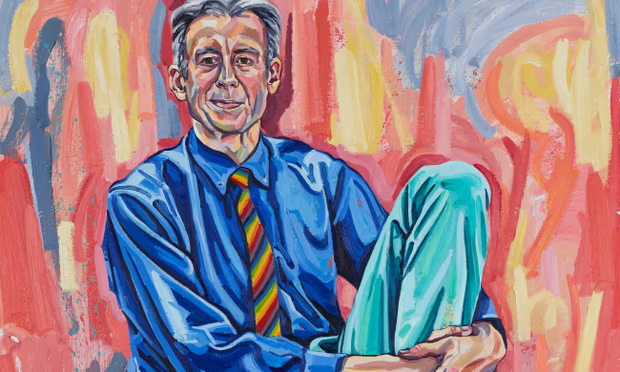
Peter Tatchell’s portrait is in the History Makers gallery alongside other prominent public figures. Photograph: National Portrait Gallery
A vibrant portrait of the LGBTQ+ and human rights campaigner Peter Tatchell has been hung in the National Portrait Gallery’s History Makers gallery as part of a drive to better reflect the diversity of the UK.
The painting by Sarah Jane Moon shows Tatchell in a casual pose, seated with his hands clasping his left calf. The 72-year-old activist is sporting a rainbow tie to celebrate almost six decades of fighting for LGBTQ+ rights.
Tatchell, who has experienced more than 300 violent assaults and has been arrested or detained by police more than 100 times, said he was “delighted and honoured” to have his portrait in the gallery “alongside so many esteemed public figures”.
“I love the bold, expressive, joyful style [of the painting], which reflects the spirit of my campaigns,” he added. He consciously chose brightly coloured clothes for sittings in order to avoid “the sombre, dark tones” of many portraits.
Although few men routinely wear ties these days, it is not unusual for Tatchell. He realised many years ago that people had “preconceptions about campaigners in T-shirts. I put on a tie and people started treating me much more seriously, so I’ve stuck with ties ever since.” (snip-More)



 Scottie's Playtime