Things That Matter

‘Like walking through time’: as glaciers retreat, new worlds are being created in their wake

As Swiss glaciers melt at an ever-faster rate, new species move in and flourish, but entire ecosystems and an alpine culture can be lost

 Photographs by Nicholas JR White By Katherine Hill

From the slopes behind the village of Ernen, it is possible to see the gouge where the Fiesch glacier once tumbled towards the valley in the Bernese Alps. The curved finger of ice, rumpled like tissue, cuts between high buttresses of granite and gneiss. Now it has melted out of sight.

People here once feared the monstrous ice streams, describing them as devils, but now they dread their disappearance. Like other glaciers in the Alps and globally, the Fiesch is melting at ever-increasing rates. More than ice is lost when the giants disappear: cultures, societies and entire ecosystems are braided around the glaciers.

The neighbouring Great Aletsch, like the Fiesch, flows from the high plateau between the peaks of the Jungfrau-Aletsch, a Unesco region in the Swiss canton of Valais and Europe’s longest glacier. It is receding at a rate of more than 50 metres a year, but from the cable car above it remains a mighty sight.
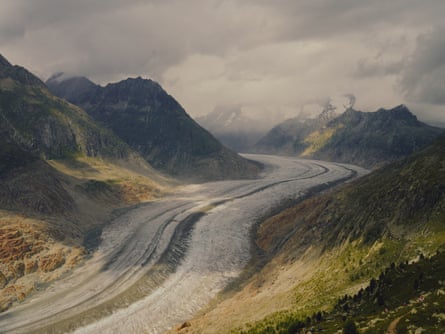
View of a glacier running through a valley with snow-clad peaks in the distance
The Aletsch glacier viewed from Moosfluh, looking towards the Olmenhorn and Eggishorn peaks

Clouds scud across the sky and shafts of light marble the ice. On the rocky slopes leading down to the glacier from the ridge, there are pools of aquamarine brilliance, the ground speckled with startling alpine flowers. The ice feels alive, with waterfalls plunging into deep crevasses and rocks shimmering in the sun.

“It’s just so diverse, these harsh mountains and ice, and up the ridge, a totally different habitat,” says Maurus Bamert, director of the environmental education centre Pro Natura Aletsch. “This is really special.”

Participants now pray for the glacier not to vanish, but they once prayed for it to retreat and stop swallowing their meadows

Many of the living worlds in the ice and snow are not visible to the human eye. “You don’t expect a living organism on the ice,” Bamert says. But there is a rich ice-loving biotic community and surprising biodiversity that thrives in this frozen landscape.

Springtails or “glacier fleas” survive on the snow’s crust – this year alone, five new species were identified in the European Alps. But there are also algae, bacteria, fungi and ice worms, as well as spiders and beetles, which feed on springtails.
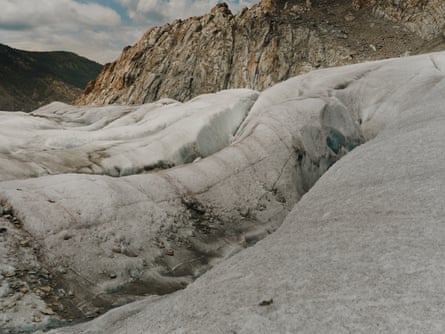
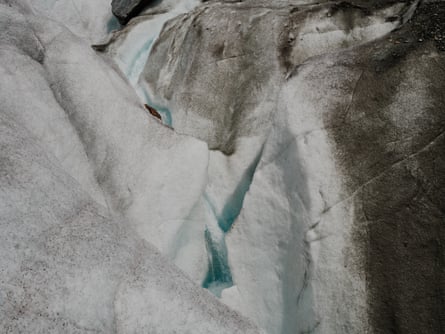
Folds of ice with a sooty crust on a glacier
A fissure in the glacier where water has cut a channel
Folds on the glacier showing the sooty crust left on the ice from fossil fuels, wildfires, mineral dust and organic matter. The bare rock shows the retreat of the ice, leaving meltwater pools and rivulets cutting through the ice

As ice melts, this landscape and its inhabitants, human and non-human, are all affected. Along the glacier’s path, ice turns to water and the rushing sound of the river becomes audible. In 1859, at the greatest extent of its thickness, the glacier reached 200 metres higher than it does now.

The landscape revealed by the melt is mostly bare rock, riven with fissures that spill across the hillside. Jasmine Noti from Aletsch Arena, the regional tourism organisation, says these widen each year, new cracks appear and routes are redesigned. The ice acts like a massive buttress, gluing the hillside together, and as it melts, slippage and instability increase.

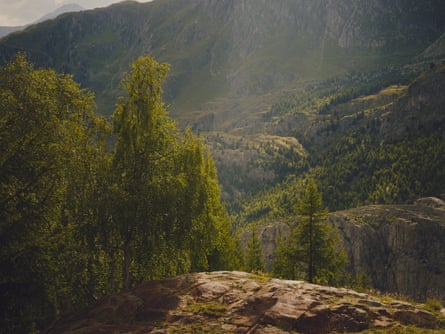
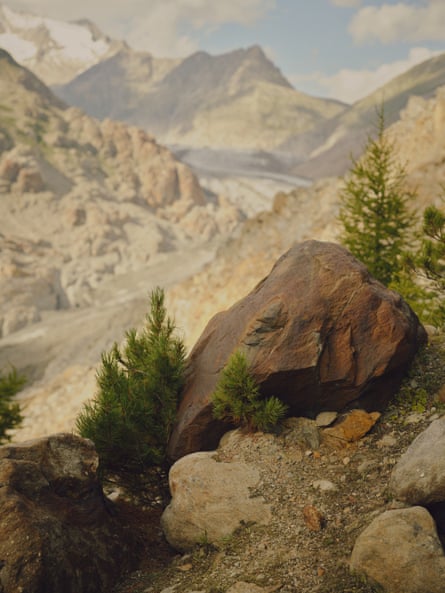
As the edges of the glacial valley descend into the cool cover of the Aletschwald forest, “it’s like walking through time”, says Bamert. On the higher slopes, older pines dominate, but lower down the trees thin, and the pioneer species of larch and birch cover the hillside: early signs of newer postglacial reforestation.

It only takes about five to 10 years for plants to colonise the land. Further down yellow saxifrage and mountain sorrel cling to the rocks. All this was once under ice sheets, but the succession of growth tells a story of glacial retreat, historic and recent.
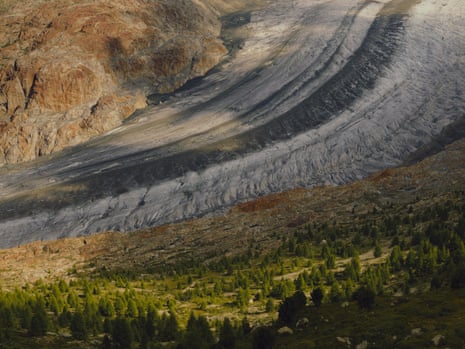
View from a peak of a glacier running through a valley with trees covering the slope
Larch and birch are beginning to cover hillsides laid bare by the retreating glacier, with pines higher up the slopes

Tom Battin, professor of environmental sciences at Lausanne’s Swiss Federal Institute of Technology, says glacial margins are a transitional landscape where ecosystems are vanishing and appearing. An expert on the microbiology of stream ecosystems, Battin led a multiyear project on vanishing glaciers and what is lost with them.

As he walks down to the Märjelensee, one of the Aletsch’s glacial lakes, this transition is readily apparent. In this mountain hollow, there was once an expansive lake with ice cliffs around its rim. Today, the pools of water are lit by patchy sun and rain, fish jumping and bog cotton dancing in summer light.

Battin points to aquatic mosses. These, he says, could never live in glacial streams which are fast flowing and extreme. Wading into the water, he searches for the golden-brown blooms of a particular alga, Hydrurus foetidus, which is a keystone species that thrives in glacier-fed rivers, fixing carbon dioxide into organic matter.
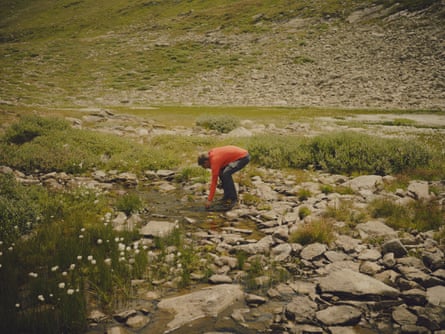
A man stoops to pick something out of a mountain stream
Prof Tom Battin inspects a stream near the Märjelensee. He studies the biodiversity that will be lost with glaciers

Lee Brown, professor of aquatic sciences at Leeds University, has studied invertebrate communities in glacier-fed rivers around the world, and says we do not yet know the full importance of those that are likely to disappear.

“It’s a challenge to communicate,” he says, pointing out the crucial roles that tiny organisms have in the “trophic networks” – the nutrients flowing between organisms within an ecosystem – that connect ice, rivers, land and oceans. Biofilms, or communities of micro-organisms that stick to the surface of ice and rivers, filter the water. Glaciers wash down vital nutrients from the mountain, but their rivers may run dry when the ice melts.

Without this biodiversity which you can’t see, all that other biodiversity that people care about might disappear

Tom Battin

There are whole worlds in and around the ice, poorly known and understood until recently. Mountains are like high islands, Battin says, with unique ecosystems and endemic species.

“Without this biodiversity which you can’t see,” he says, “all that other biodiversity that people care about might disappear.”
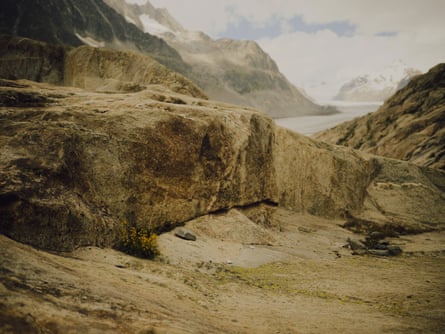
A small yellow plant seen growing under a ledge with an alpine lake and snowy peaks in the background
Small saplings growing on a rocky slope with an glacier and snowy peaks in the background
Birch trees in the foreground with a larch in the background
Pioneering plants and trees such as birch and larch colonising the slopes above the Aletschwald

Francesco Ficetola is a professor of environmental science at Milan University who leads the PrioritIce project examining emerging ecosystems in glacial forelands, or land exposed by the retreating ice. As it melts, he says, “there’s a powerful combined effort of organisms” to create new and increasingly complex habitats.

As something is gained, however, much is lost. Cold-climate specialists such as ptarmigan and Alpine ibex are retreating up mountains, their habitats becoming ever smaller. The Swiss pines, on whose seeds nutcracker birds feed, are also moving upwards. Specialist alpine flowers and other pioneer plants at glacier edges are threatened, pushed out by the succession of forests and meadows.
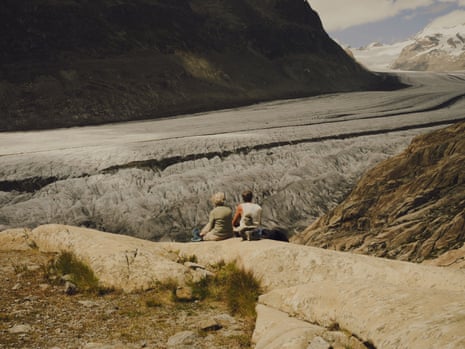
Two people sit on a rocky ledge above the glacier with snowy peaks in the background
Admiring the Aletsch glacier. A timeless landscape, but for how much longer?
Portrait of an older man and a younger one with their arms around each other and the glacier behind them
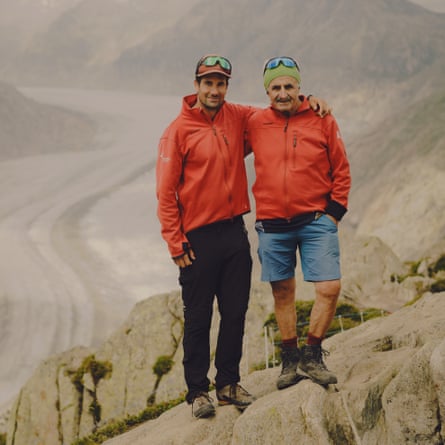
Local guides, father and son Martin and Dominik Nellen

For the people of this region, too, life alongside the glacier is changing. The guides Martin Nellen and his son, Dominik, have lived with the Aletsch glacier all their life. Martin jokes that the older he gets, the farther he must climb from the ridge to the glacial valley as the ice melts. “It’s rubbish,” he says.
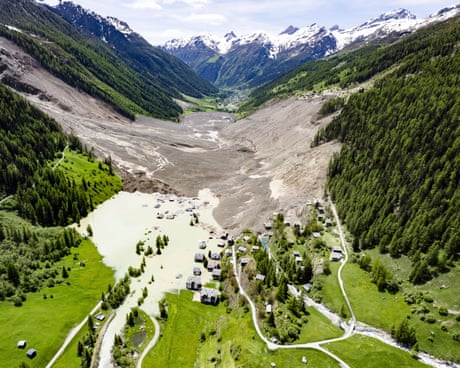
An aerial view of the destruction of Blatten

Martin was instrumental in raising funds for information boards, which he also helped design, that explain the life story of the Aletsch. Dominik says they feel “sad, of course” about the glacier’s retreat, but they are also proud to educate people about glaciers and the distinctive landscape of snow-covered peaks and lush pastures.

Every year at 6am on 31 July people gather for a procession that winds from the church in Fiesch to the Mariahilf chapel in the forest above. Participants now pray for the glacier not to vanish, but they once prayed for it to retreat and stop swallowing their meadows and grazing land.
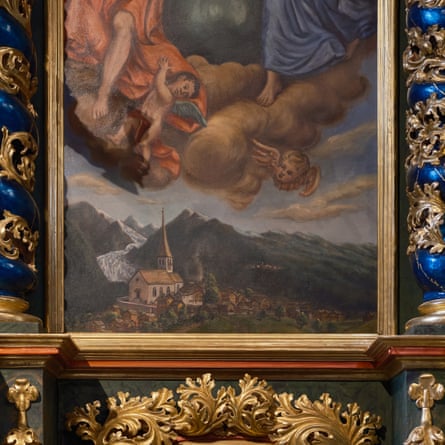
A baroque-style painting of Jesus and angels above a white church with a glacier in a valley and snow-clad peaks in the background
An altarpiece in the chapel in Ernen, showing the Fiesch glacier

Divine assistance was first requested in 1652. Rosa, one of those gathered for the pilgrimage, remembers the deep snow and cold of past years. “I have been going since I was five,” she says. “There used to be more people.”

This procession is special for the reversal of its request, but similar stories exist across the Alps. They are a reminder that something intangible is lost as glaciers disappear. The great rivers of ice have shaped the imaginations of inhabitants and visitors. Not everyone sees the glacier through the lens of faith, but many visitors – whether praying, guiding or educating – worry what the future holds.

At a place called Baseflie, a cross still stands, erected in 1818 to banish the Aletsch glacier when it threatened pastures. Today, the wooden silhouette against a blue sky seems like a memorial to all that may be lost as glaciers vanish.
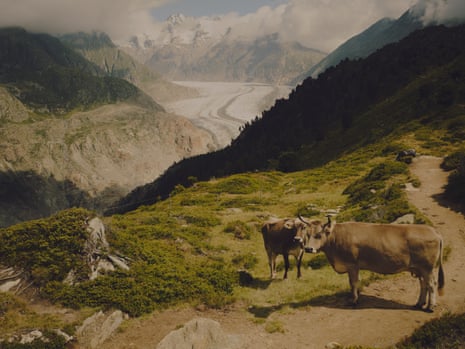
Two cattle on a mountain path with a valley with snow-clad peaks in the distance
Cattle above the Aletsch glacier

Find more age of extinction coverage here, and follow the biodiversity reporters Phoebe Weston and Patrick Greenfield in the Guardian app for more nature coverage
I Read This Substack Every Chance I Get; About Louisiana Culture, History, & Food, & Now Survival

This one’s about trouble for all coastal states, coming from Louisianans.

Louisiana Fights Against Becoming Another Not There No More Statistic by Jerileewei

Terrebonne Parish: Where the Rivers Meets the Sea Read on Substack

CCJC Audio Podcast Episode 00086, Season 2

“It’s not just the land we’re losing. It’s the stories. The way we talk. The smell of the air before a big storm.” — Emile Navarre

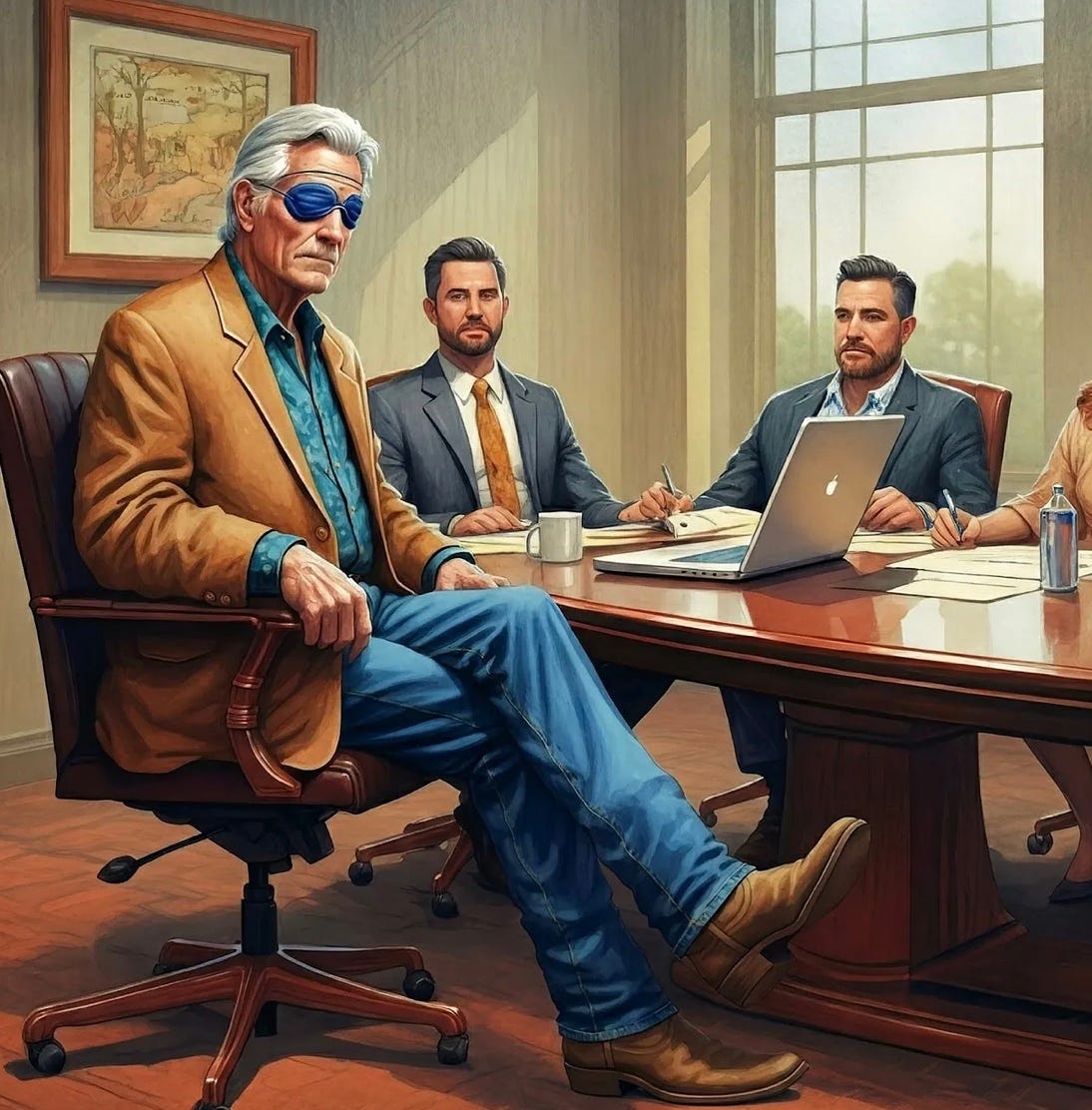
Staff meeting at Cajun Chronicles Podcast Corp in New Orleans, with Blind Writer/Editor Emile Navarre and others.
Cajun Chronicles Audio Podcast – Bringing you the heart of Louisiana. Artwork generated with Google Docs Image Maker.

Back from his month long vacation in Chacahoula, Louisiana, Cajun Chronicle Podcast, Writer/Editor, Emile Navarre arrived for our first staff meeting armed with fresh material for a future episode, as soon as Marie Lirette, our Outreach Coordinator can reach out to potential experts on the topic of “Ain’t There No More” – a nation wide trending group talk everywhere these days, as our world changes in ways none of us could have imagined.

Here is his recount of his lifelong story telling to his family’s youngest children:

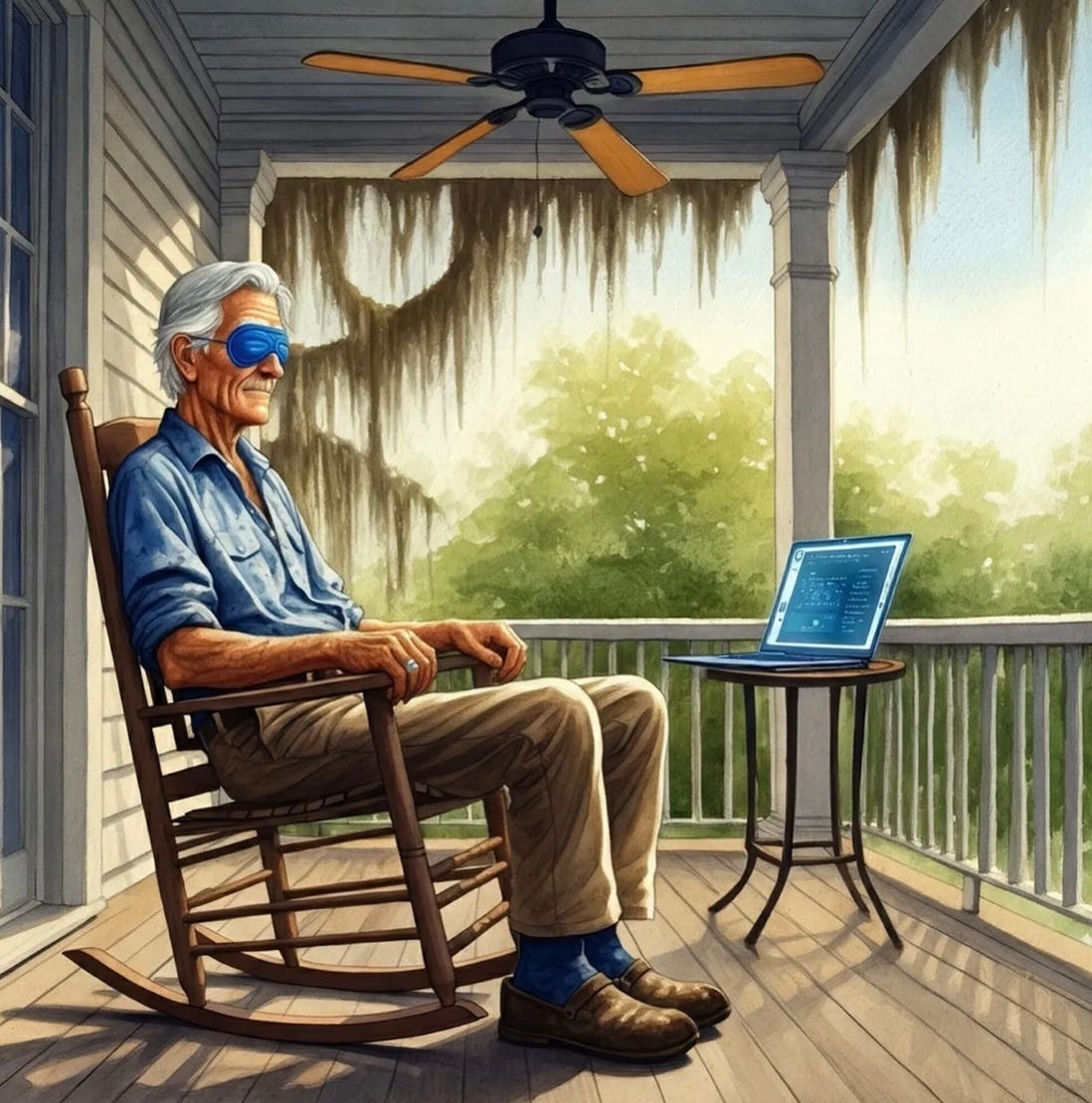
Emile Navarre in his rocking chair on front porch in Louisiana.
Cajun Chronicles Audio Podcast – Bringing you the heart of Louisiana. Artwork generated with Google Docs Image Maker

Come closer, chérs,” he said, his voice a low rumble like the last Lafitte skiff shrimping boat of the day heading down the Bayou Lafourche over Galliano or Golden Meadow way. His cane bottom rocking chair seat creaked a steady rhythm against the worn Cedar floorboards as he said that.

The sun, a too warm blanket he could feel, but not see, was sinking somewhere behind the great oak in the yard he will always remember. He ran a hand over the cane of his chair, then rested it on the knee of a boy sitting on the steps below him. He lifted his walking stick and pointed off to the right side. “You see that big fence, hein?

Or that levee your mamans and pépère have to climb to get home from work at the Bollinger Shipyard, just to get up to the house? We didn’t have such a thing when I was a boy. Back then, my feet knew every dip and bump in this land”.

“From our porch right down that oyster shell road to the bayou where the shrimp jumped so high, you’d swear you could catch them in your mouth, if you were quick.” A ripple of giggles ran through the children.

Ah, oui,” he chuckled, “I lost a good tooth catching shrimp that way. But the land, it was different. We were like a river familyShe’d bring us a big muddy hug every spring, and we’d be happy for it.”

The floods, they were always a part of life. We’d move our things up high, sing songs, and wait for the water to go down. When it did, Mother Nature would leave behind a gift, a rich, dark mud that made our gardens burst with life. You could feel it in your toes, a soft, giving sponge of sandy soil that told you everything was going to be alright.”

He paused, and the laughter faded, replaced by the chirping of crickets.

My pépère, he’d sit right here on the back porch with a fishing line tied to his toe, but in his mind, Gaia was always busy with the water. He’d talk about how the Lafourche river was a living thing, always moving, always changing. ‘She builds, and she takes away,‘ he’d say.”

We knew that. A little bit here, a little bit there. It was a fair trade. But then came the men with the big ideas. They came from places where the land didn’t move so much. They told us we could stop the river’s big hugs. They said we could make a straight line and build high walls, so the water would stay in its place.”

Emile’s voice dropped to a conspiratorial whisper. “The young people, they thought it was wonderful. No more floods! No more moving furniture to the attic! But my pépère, he just shook his head. ‘You can’t trap a wild woman, not for long,’ he said. ‘She will find her way, and she will be angry for it.'”

And she was,” he said, his hand now clutching his walking stick. “For years, the river was quiet, but our land, she was not. I can’t see it anymore with my eyes, but I felt it with my feet. The soil grew tired, no longer receiving her yearly gift.”

The ground began to sag, and the bad marsh saltwater, it came closer in to say hello, not from a storm, but like a thief in the night, creeping up through the channels les Américains dug for the oil. They were for the big machines, the big money, but they were also a wound. A wound in the land that never healed.”

He turned his head toward the silent children, his milky blind blue eyes fixed on something only he could see. “Now, this levee you have, it protects you from the river, oui? But it holds the land in a box. It cannot breathe. The land is sick, and the ocean is hungry, taking a football field from our home every hour, the experts say.”

I hear it in the wind now, not just the storms, but also in the sad whispers of the marsh, of the birds that have no place to land anymore. The land is leaving us, and we are left behind. We traded our river’s muddy hugs for a straight line and some high walls, and now we pay for it. Now, it’s not just the water that takes. It’s the land that gives itself away.”

The porch was silent, a stillness that was heavier than the humid air. The children looked at each other, not understanding all the words, but feeling the weight of them. One of the little girls, her braids tied with pink ribbons, quietly moved her hand to rest on the Emile’s knee as she headed inside for bed.

Emile smiled, his face creasing with a thousand invisible memories. Talking to the breeze, he raised his fist and threatened, “But you know what else my pépère said? He said, ‘As long as we tell the stories, the land is not truly gone.’ So listen, chérs, listen closely to my bedtime stories. Because now, it is your turn to remember.”

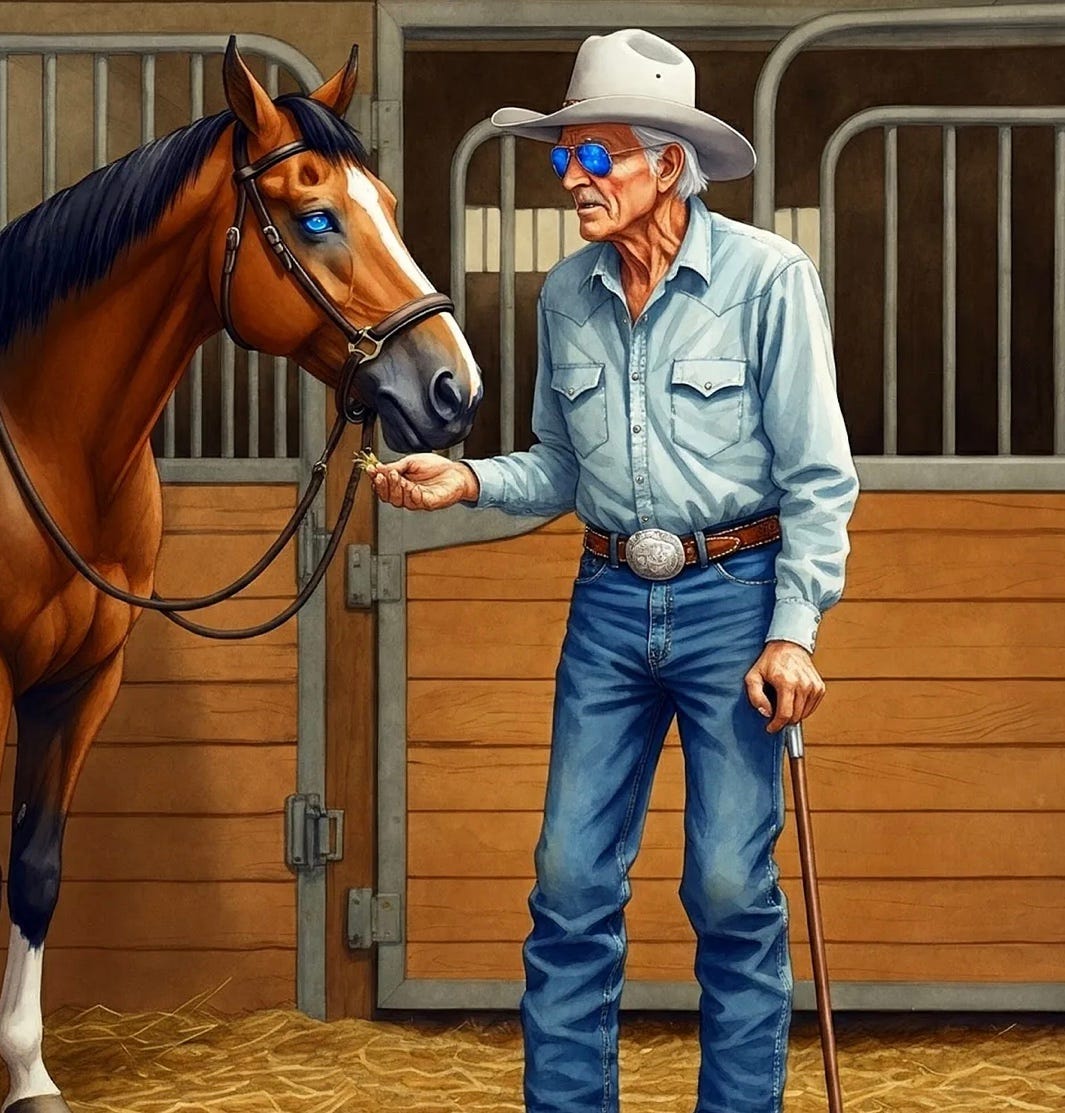
Emile Navarre with his horse, once a cattleman always a cattleman.
Cajun Chronicles Audio Podcast – Bringing you the heart of Louisiana. Artwork generated with Google Docs Image Maker

He had felt the last of the children’s light footsteps fade into the dusk, and the porch was still again except for his rocking chair. His head turned to the quiet rustling of the adults lingering on the porch. “You hear my stories, oui?” he said, his voice now lower, rougher.

You too remember what I said about the river’s gift of mud? We didn’t know it, but we were like a family that had a big, generous table. Rivers brought food, and our land ate it. Every year, she’d get fat and happy. We thought we were so smart, so clever, when we built those high walls.”

We told Gaia to stop eating for a while, believing for a while that she didn’t need the mud. ‘Don’t worry,’ we said, ‘We’ll protect you from the floods.’ But what we really did was put the food in a box and send it out to sea. Now, the land is starving. You cannot see it in a day, or a year. But that’s happening rapidly.”

But I feel it in every part of my mind and body. Every year, she gets thinner, weaker. And like a sick old person who can’t stand anymore, Mother Earth’s starting to melt away. The medicine to save her is that very food we cut her off from. But the walls of levees and the canals the Corps of Engineers built? They are so high.”

How will we get the food back to Louisiana’s coast before she’s gone entirely? That is the story my heart tells me now. And that is the story for you all to worry about. Time’s running out. I’m 75 years young this month. In another 75 years I won’t be here to see that my beloved Louisiane will be added to that dreaded list, “Ain’t Here No More.


Cajun Chronicles Note: Sediment Starvation: The settlers’ levees and later government agencies built, while protecting their land from floods, also had an unintended consequence that would become a major factor in today’s coastal crisis. By containing the rivers, they prevented the natural flooding that would have deposited sediment into the wetlands.

This sediment was the building block of the delta. Without it, the land began to sink (subsidence) and slowly disappear. The settlers since the 1800s and later colonists were unaware of this long-term process and the vital role of the Mississippi’s and other rivers’ sediment in sustaining the land.

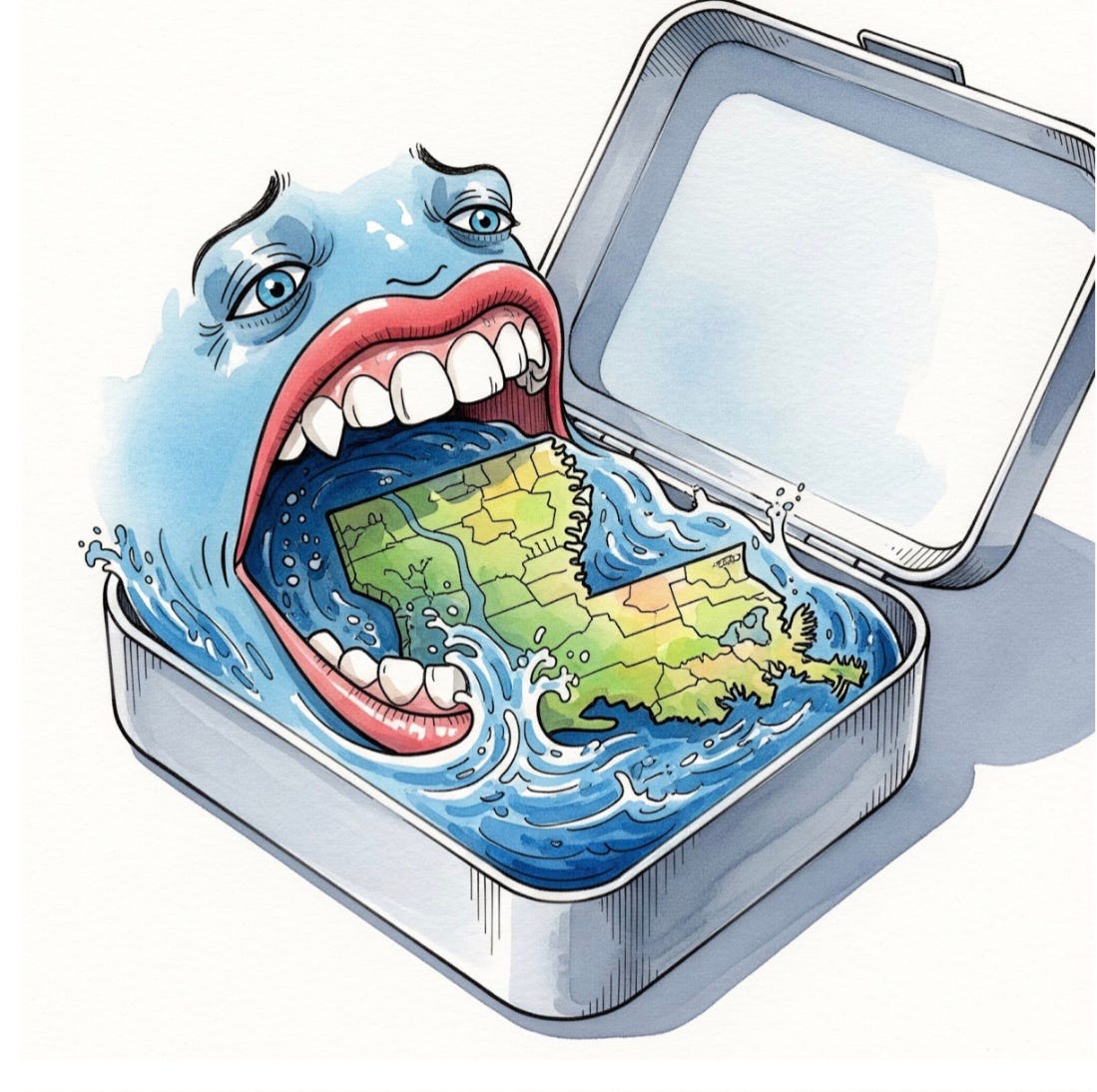
Water’s Takin’ Our Land, Gulf’s Hungry & She Ain’t Slowin’ Down

Cartoon image of Gulf ocean swallowing coastal Louisiana in a lunch box.
Cajun Chronicles Audio Podcast – Bringing you the heart of Louisiana. Artwork generated with Google Docs Image Maker

Louisiana has the highest coastal land loss rate in the United States. Since the 1930s, the state has lost about 2,000 square miles of land. This is a significant amount, roughly the size of the state of Delaware.

Without major intervention, the state of Louisiana is projected to lose an additional 700 to 1,000 square miles of land by the year 2050. This is an area roughly the size of the greater Washington D.C.-Baltimore area.

By the year 2100, the projections are even more dire, with some worst-case scenarios suggesting that up to 3,000 square miles of land could be lost. Some scientists have even warned that the entire remaining 5,800 square miles of Louisiana’s coastal wetlands in the Mississippi River delta could eventually disappear.


A Word of Wisdom:

Our fictional and non-fictional tales are inspired by real Louisiana and New Orleans history, but some details may have been spiced up for a good story. While we’ve respected the truth, a bit of creative license could have been used. Please note that all characters may be based on real people, but their identities in some cases have been Avatar masked for privacy. Others are fictional characters with connections to Louisiana.

As you read, remember history and real life is a complex mix of joy, sorrow, triumph, and tragedy. While we may have (or not) added a bit of fiction, the core message remains, the human spirit’s power to endure, adapt, and overcome.

© Jerilee Wei 2025 All Rights Reserved.

Two For Science On Sunday

Fully recyclable solar cells – just add water

February 14, 2025 Richard Musgrove

Swedish researchers have invented a fully-recyclable perovskite solar cell that may provide a solution to the growing problem of solar panel waste.

 All renewable technologies have a life span — with solar panels it’s 25 to 30 years — which means our solar waste pile is rapidly becoming mountainous. Just 17 % of solar panel components were recycled in Australia in 2023, specifically the aluminium frames and junction boxes. The remaining 83% (glass, silicon and polymer back sheeting) was shuttled out to landfill. Other countries do better; France’s ROSI was an early starter in what could be a $2b market by 2050.

Linköping University researchersmay have a solution — fully recyclable perovskite solar cells.

These cells are also flexible, transparent and inexpensive — who needs aluminium frames when your PVs are stuck to your windows?

Low res
Professor Feng Gao with postdocs Xun Xiao and Niansheng Xu at Linköping University (Image Thor Balkhed)

“There is currently no efficient technology to deal with the waste of silicon panels. That’s why old solar panels end up in the landfill,” says coauthor, Xun Xiao, at the Department of Physics, Chemistry and Biology (IFM) at Linköping University (LiU).

“Huge mountains of electronic waste that you can’t do anything with.”

Perovskites used in photovoltaic solar cells are ‘metal-halide perovskites’ — made from organic ions, metals and halogens.  Such cells’ active layers are much thinner and cheaper than those of conventional silicon PV and show efficiencies of more than 26%, comparable with silicon PVs (20% – 22%).

But perovskite PVs are not yet produced at scale.   

Recyclability is the key.

“We need to take recycling into consideration when developing emerging solar cell technologies,” says Professor Feng Gao, also at IFM at LiU and a co-author. “If we don’t know how to recycle them, maybe we shouldn’t put them on the market at all.” 

(Snip-MORE, and they can recycle them!)

Pressing pause: how a unique insect survives Antarctica

February 14, 2025 Ariel Marcy

The inhospitable Antarctic Peninsula hosts only one native insect, and scientists from Japan have just identified an unprecedented combination of adaptations that allow it to thrive in the extreme cold.

The Antarctic midge is a tiny, flightless insect that lives most of its two-year life as a larva, the grub-like stage that follows the egg stage. (Complete metamorphosis in insects includes egg, larva, pupa, and adult stages).

Two insects, adult flightless antarctic midges on ice.
Adult Antarctic midges. Credit: Yuta Shimizu / Osaka Metropolitan University.

How these larvae overwinter in Antarctica could have implications for cryopreservation technology but, perhaps more pressingly, better understanding of the species’ response to climate change. Previous researchers have suggested that the Antarctic midge be developed as a model organism for survival in extreme and fluctuating temperatures.

The Japanese research team led by Shin Goto of Osaka Metropolitan University studied the unique midge after developing a specialised rearing method, which took them six years to establish.  

The team then tracked the growth and physiology of the midge larvae through their natural lifecycle. In a first for science, they documented two distinct forms of dormancy used as seasonal survival adaptations.

In general, dormancy is a state of inactivity, suspended development and reduced metabolism, but insect scientists distinguish between two types: quiescence and diapause.

In the first winter, the Antarctic midge larvae adapted via quiescence, a form of dormancy triggered by external conditions, such as cold temperatures. This means all the midge larvae go dormant at the same time. Quiescence ends when the temperature rises.

(Snip-MORE; it’s fascinating and worth the click. Also not long.)

“Fearsome Forest Hawk”

Click through to see and hear.

Meep, Meep!

American Bird Conservancy

Peace & Justice History for 10/30:

October 30, 1967
Martin Luther King, Jr. and seven other clergymen were jailed for four days in Birmingham, Alabama. They were serving sentences on contempt-of-court charges stemming from Easter 1963 demonstrations they had led against discrimination.
The U.S. Supreme Court had upheld their convictions for violating a court order enjoining them from marching [
Walker v. Birmingham]. Public Safety Commissioner Eugene “Bull” Connor had twice denied them a parade permit. The law Connor used was declared unconstitutional two years later [Shuttlesworth v. City of Birmingham].
The constitutional issues
October 30, 1995

Over 80 people were arrested at Sugarloaf Mountain in southern Oregon during a massive direct action to prevent clear-cutting of old-growth forests on public land by private timber companies.
Sugarloaf protest 
October 30, 2000
George Mizo of the United States, Rosi Hohn-Mizo of Germany (his wife) and Georges Doussin of France were awarded Vietnam’s first-ever State Medal of Friendship by the President of the Socialist Republic of Vietnam for their work in building the Vietnam Friendship Village.

The Vietnam Friendship Village after five years; the medical clinic is in the foreground, other buildings are residences.

Mizo and the Vietnam Veterans Association built a residential facility for orphan children and elderly or disabled adults. George Mizo was a veteran of both the Vietnam War and the struggle to end U.S. support of the contra insurgency in Nicaragua, and repressive regimes elsewhere in Central America [see September 15, 1986].
General Vo Nguyen Giap, Vietnam’s senior military commander during both the French and American wars advised the Mizo’s 12-year-old son, Michael, “Never go to war.”

About the Vietnam Friendship Village Project 

https://www.peacebuttons.info/E-News/peacehistoryoctober.htm#october30

American Bird Conservancy: “The Sleeping One”