Many people seem to expect me to draw this comic forever. You’ve seen the amount of hate that I get for it. Anyone who googles my name will be terrified to even speak to me. Every bit of the person I am is being shred and crushed and mocked. It’s practically destroying my life and any hope that I do anything else in the future, as well as affecting me on physical and mental levels.
Now why am I still doing it? Part of it because making comics is everything I wanted in my life. I guess I could make comics that would make the majority feel good or that aren’t political, but that would feel like betraying my readers. Another part is because those readers are amazing and give me life. People have been sharing their stories with me in a way that would make any creator jealous.
The fact is that I am doing all of this by myself. I never got any help or support from publishers, editors, media, government or visible person of any kind. I’m putting everything in your hands. I trust my readers to keep this project alive. It might make my anxiety peak, as I know that as soon as you grow disinterested in my silly stories, I won’t have any other choice to survive than change my name and return to school.
So please, keep reblogging those stories, like them, comment on them. That’s the reasons why they’re out there. ❤
I know I already posted the one below but I love it and wanted to post it again. I wish shy abused gay me had a protector. The predators seemed everywhere. Hugs
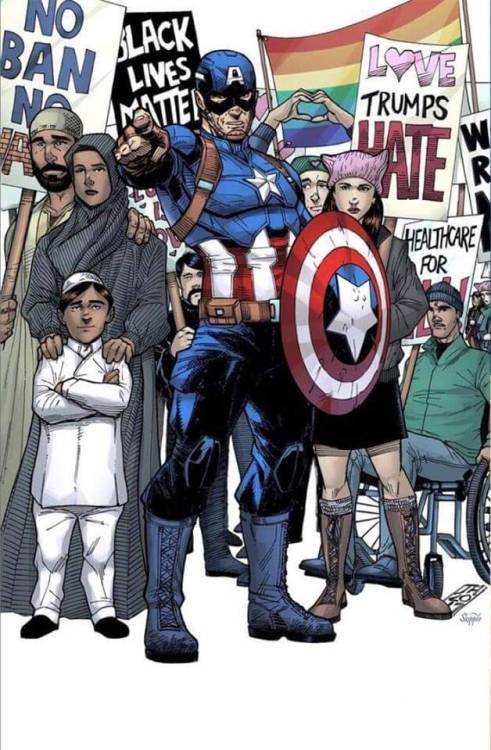
I will never tone down or stop fighting for everyone’s equality. I wonder how many politicans said hey tone down this civil rights for black people stuff back in the late 1950s and early 1960s. Where would they have been if they had been listened to? Same with marriage equality—far too many democrats said don’t push for it. Either we all have equality of civil rights or no one does. I will not agree to disagree on someone’s basic rights.
What is with the desperate need to murder people, even criminals? It doesn’t deter crime and can’t be reversed if it is found out to be a wrong conviction. Hugs
This is horrific that a young person has had to live with racism all his life and now has to protect his family and others from a racist gang of thugs who only want to hurt brown people like him. He is doing a great thing but he shouldn’t need to do this in the land of the free. Hugs.
Cesar Vasquez, who has supported families of undocumented immigrants since age 14, has become a community lifeline – and a known ICE target
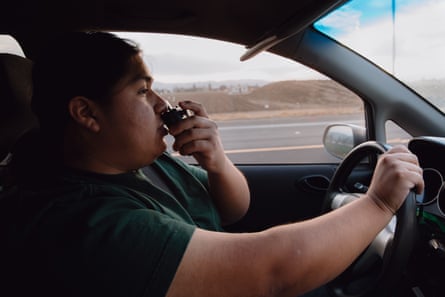
While most 18-year-olds worry about college papers and spring break plans, Cesar Vasquez drives through coastal California farm towns scanning for unmarked SUVs before dawn. He flips down his driver’s seat visor to look at a taped list of license plates he has already identified as Immigration and Customs Enforcement (ICE) vehicles, and jots down a few new ones he suspects could be. His phone buzzes constantly – tips from neighbors, text chains from volunteers alerting to ICE activity – all in an attempt to keep his community safe from being swept up in federal agents’ widening dragnet.
This is what organizing looks like for this son of undocumented immigrants. In his home town of Santa Maria, a small farming town on California’s central coast where over 80% of farm workers are undocumented, Vasquez has become both a crucial community lifeline and a known target of federal immigration enforcement.
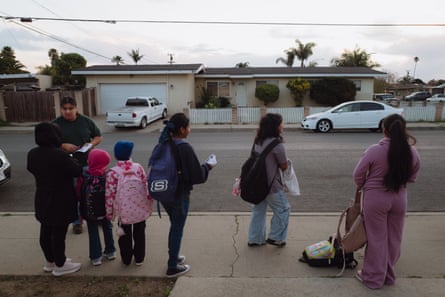
Outside the ICE office in Santa Maria, California, Cesar Vasquez and a group of activists gather to decide who will patrol each neighborhood.
Vasquez began volunteering with the 805 Immigrant Rapid Response Network as a high school senior. Last August, he was hired full-time as a rapid response organizer, covering North Santa Barbara and San Luis Obispo counties, overseeing volunteers, supporting families and tracking ICE activity.
Routinely, he visits the families of detained immigrants. “There have been so many occasions where I walked through the door, and a kid was expecting their father or mother,” Vasquez said wistfully. “And it was just me, and I had to explain what happened to their parents.”
Other times, for Vasquez, the reality is personal. He recalled in December, speaking with families waiting for news about their detained relatives outside the immigration enforcement office in Santa Maria, when an ICE vehicle slowed down in front of them. The agent’s voice crackled from the car’s speaker, loud enough to carry through the open window: “How’s your mother, Cesar? We’ll go visit her soon.”
Vasquez drove straight home and found his mother washing clothes.
“I took her car keys and told her to stop everything she’s doing. My hands were shaking,” Vasquez said. “I then moved her to a secret location that I have precisely for this moment.”
As the sun rises in Santa Maria, Vasquez continues monitoring ICE activity in his neighborhood. The 18-year-old says he spends more time in his car than anywhere else these days.
Growing up as a birthright citizen of undocumented parents
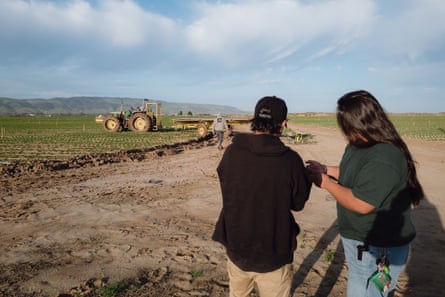
Vasquez’s mother is one of the thousands of undocumented farm workers in Santa Maria whom he is trying to protect. She left her home in a tiny town in Mexico to cross the US-Mexico border at age 13 in search of a better life. Vasquez’s biological father was one of the first people she encountered – a Guatemalan American whose family was settled in California and who held US citizenship. He was also abusive and never legally married her, keeping her from accessing US citizenship, Vasquez said. When Vasquez was an infant, his mother ran away with her three children to Santa Maria, a town about 150 miles (240km) north of Los Angeles, where she found work in the strawberry fields. She has been trying to secure documentation for more than a dozen years now.
Vasquez distributes flyers on immigration rights to farmworkers in Santa Maria on 6 February.
Strawberry picking is physically demanding work, and the pay is minimal. Pickers spend hours bent over in the fields under the California sun, with no benefits, no sick days and no guaranteed work once the season slows between October and March. Climate change has made the labor even more precarious, disrupting growing cycles and shrinking paychecks. Rising costs of living – rent, food, transportation – have squeezed families further. In Santa Maria, where a two-bedroom apartment can cost $3,000 a month, many families crowd into single rooms or garages.
Built on an economy of strawberries, lettuce and wine grapes, Santa Maria has long depended on undocumented labor while rendering those workers largely invisible. Many arrived during waves of Mexican migration in the 1980s and 90s, settling into a community where immigration enforcement and workplace exploitation became routine. Before Donald Trump’s recent immigration priorities, ICE enforcement in the region tended to be more targeted – focusing on people with criminal convictions or referrals from local jails, rather than broad community sweeps. ICE didn’t even have a holding facility in Santa Maria until 2015.
But since 2025, enforcement has intensified dramatically with rapid‑response trackers documenting more than 620 immigration arrests across Santa Barbara, Ventura and San Luis Obispo counties, with Santa Maria often at the center of daily apprehensions. These high‑profile raids – often carried out with unmarked vehicles and tactical gear, drawing protests and criticism from community leaders – reflect a broader national surge in immigration enforcement under Trump.
Vasquez holds his mother along the river in Santa Maria. He keeps a feather with him, which he says brings spiritual cleansing when he burns sage.
When Trump was first elected, Vasquez was only nine years old. He was already well-acquainted with the repercussions of growing up in a mixed-status household.
“I mean, it’s common for most children of immigrants to be doing things for their parents like filling out their legal forms, right?” Vasquez said. “But in fourth grade, I had to learn what a warrant looked like and what rights I had.”
He was in a Halloween costume shop, age 14, when it clicked that his fears and concerns weren’t just his own. He overheard a woman at the register, saying she had saved all year to buy her son a costume, but it didn’t fit. The store wouldn’t take it back. Her shirt was stained with strawberries, her exhaustion visible. He’d seen his own mother do the same thing countless times, so he offered to buy the woman’s son the costume.
Building a network at 14
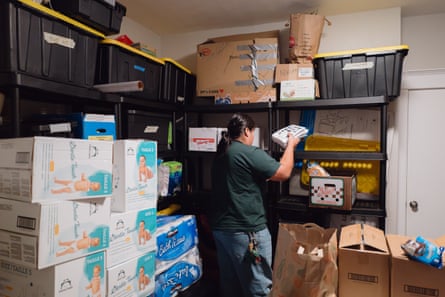
At age 14, Vasquez founded La Cultura Del Mundo, an entirely youth-led organization that eliminates what he calls the “red tape” associated with traditional aid. They prioritize direct, unrestricted support to families in need, asking, “How much do you need?” rather than requiring forms. The group then rapidly mobilizes whatever the family requests, whether that’s cash assistance, groceries, rent help or other essential support.
In August, La Cultura Del Mundo drew national attention when Vasquez organized La Marcha De La Puebla, a national protest against ICE raids that involved nearly 30 cities across 17 states, drawing about 10,000 participants.
Seventeen-year-old Claudia Santos is one of the many young people Vasquez has inspired. “My sister and I heard about a school walkout and just decided to go. After that, Cesar told us about a meeting at city hall, and that’s how I got involved,” Santos said. “I did it because I feel like the kids coming here from Mexico deserve a good future too.”
Vasquez packs up flyers to hand out to the immigrant community as they head to work in Santa Maria.
While Vasquez was organizing in high school, he was simultaneously struggling with his own mental health. He commuted by bus an hour each way to a school in a predominantly white neighborhood with good academic prospects.
When he told his counselor that he had anxiety, “she couldn’t understand that I was uncomfortable because I was brown in a white school, where the principal was racist and the students were racist. It led me to become really suicidal.”
Being misunderstood drove him closer to his community. He transferred to his local school and graduated early. Despite being accepted into San Diego State University, he deferred enrollment.
Most kids who grow up in Santa Maria look forward to leaving. One of Vasquez’s older sisters became a teacher in Los Angeles, the other a graduate student in the UK. But Vasquez likes that the impact of his work is immediate.
Tina van den Heever, one of his teachers from Santa Maria high school, said it was clear Vasquez was a leader with great potential: “To be honest, I worry about his safety, because as we’re seeing, the United States tends to silence people who stand up in the way that he does.”
‘I think about the kids being left behind’
During a four-day raid in late December, Vasquez’s uncle was among the 118 people detained.
“I think about the kids being left behind,” Vasquez said. “The children home for winter break whose parents never returned because of the December raids. And there was no way to know what happened to them because school didn’t reopen until days later.”
Vasquez distributes flyers on immigration rights to parents.
During the raids, flower vendors disappeared from the streets. When Vasquez later visited the area, the children of a family he had gotten close to told him they had gone inside after hearing his warning. They were safe.
The work – the constant alertness, the phone calls at all hours, the weight of knowing families depend on his network – has taken a toll. But he sees no alternative.
“I’m continuously preparing for the worst,” Vasquez said. He keeps a “to-go bag”, extra clothes and cash in his car.
Every time ICE picks up someone in the Central Coast valley, Vasquez plays the same song in his car: Hasta La Piel (Down to My Skin) by the Mexican American artist Carla Morrison. The lyrics speak to having and losing, wanting and not being able to say, intense love and desperate fear of loss – an homage to those who have been detained.
“They want us to be afraid,” he said. “But fear is what keeps people isolated.”
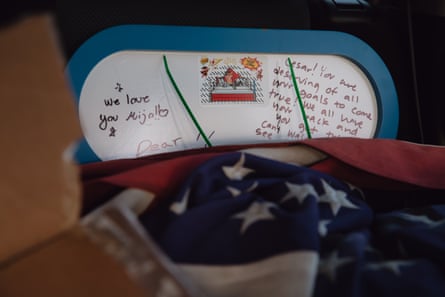
In the back seat of his car, a whiteboard filled with encouraging messages for Vasquez sits alongside an American flag.
Jennifer Chowdhury reported this story while participating in the USC Annenberg Center for Health Journalism’s Kristy Hammam Fund for Health Journalism
I was an abused boy trying to deal with his budding sexuality being gay. I did not think I gave off signs but the bullies sensed my vulnerability because I did not form friends and stayed to myself. So they attacked me. What shocked me was not that the bullies attacked me but that the teachers in the 1970s joined in, giving the bullies full permission to do so while restricting my grades. Remember, I was not an out gay kid, I was an abused boy trying to keep his head down and get by each day. But the future maga sinced my vunerablebiltey and attacked me. Once it went around the school my entire teen school years became agony. That is what the republican Christian nationalists are trying to drive us back to. It changed in the 2000s with anti bulling and anti-discrimination programs. tRump’s amdin has desperately attempted to remove all those programs and protections. Hugs
Plenty of gay men took their husbands name or they both hyphenated both their names. So these gay couples would not have a matching birth certificate. I am one of those. I took Ron’s last name deperatly wanting to leave my abusive adoptive parents last name very far behind. Hugs
About these letters. Allison Gill on the Daily Beans news podcast gave sourced reports that ICE detention agents raided the children’s rooms at this detention concentration camp for children / families and took all their letters with the intent to destroy their reports of what was happening to them. Allison Gill has sued the government in court to save them and get them published. I fear it will be too late. Hugs.
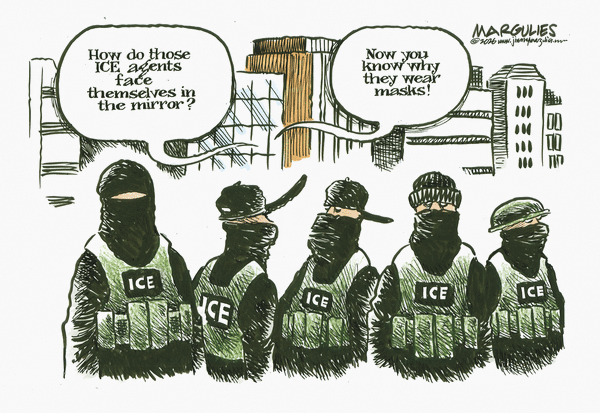
ICE nearly kills another child by mistreatment and ignoring their worsening health and healthcare needs. This is so familiar if you remember history. Lack of food, no healthcare, no humanity. Hugs
Children cry, thinking their parents will be taken if ICE follows them home. All because they are brown skinned. Is this the USA? Hugs
I just cannot understand why they hate so. They refuse to understand or accept that some kids are born LGBTQ+ just as some kids are born cis and straight. They seem to think that children see LGBTQ+ people in society, in public, and in books / TV / movies then become LGBTQ+. It doesn’t work that way. They reallyhope all LGBTQ+ stay hidden either in fake loveless opposite gender marriages or stay single and celibate for life. They are not happy or content to live their lives as they wish, they demand the right to force everyone else must live as they do or by their church doctrines. Hugs
The video below shows a tRump administration nominee spews white supremacy crap, claiming the white people suffer the most discrimination in the US. Claims the white culture is being erased. But he can’t explain what white culture is except to claim that white Christians worship differently than black christians. Food and music are different and white churches and white food are being erased. Hugs
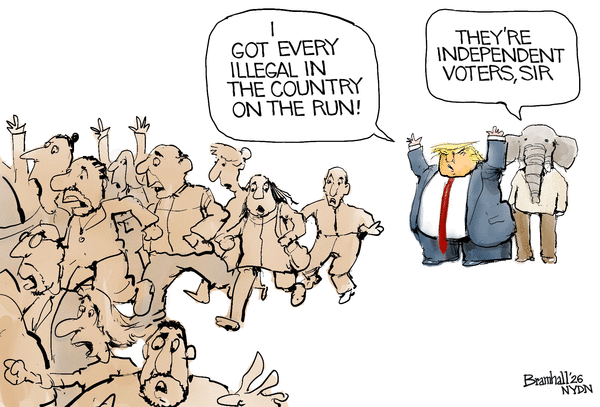
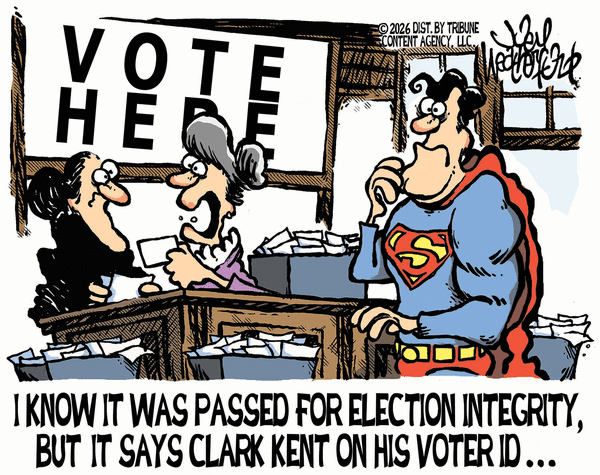
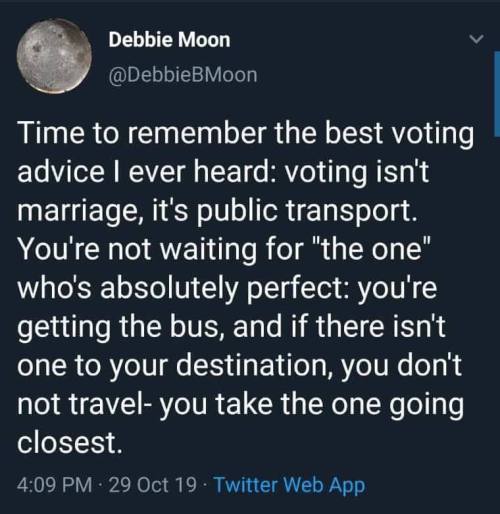
I have to ask why the republicans are against counting every vote of people entitled to vote by law. Why do they work so hard to restrict voter options and confine voting to a time and place where only their majority supporters tend to vote? Because they are not interested in representing the will of the people, they demand the right to rule over the public. The country better wake up because think of the right wing head explosions if the left was trying to restrict right wing voting areas. The right wants a single party rule like in China onely with them in charge. Hugs
If this goes through I will not be able to vote. I was adopted and my birth certificate has my adoptive parents names on it. In 2015 when the state of Florida allowed same sex marriages to become law Ron and I were the first ones in our county to get married. It was a wonderful event. But then I went to the Social Security office and had my last name legally changed to Ron’s, I am proudly Scottie Miller. I think everyone here can understand why I hated the last name I had which was the name of my abusers. So I was so happy to be able to change that and the forms that I was handed showing that came with a handwritten note of support and a heart emoji. Hugs
Understand none of these kids in that car did anything wrong… Other than being black. This is blatant racism being allowed to terrorize the nonwhite communities / people in the hopes of racially purifying and cementing the white people as the dominitate race while everyone else is a less than. This is an attempt by white supremacists in the US government / employed by the US government to create and inforce an US Apartide system. Horrific. Hugs



















































































 Cesar Vasquez, who has supported families of undocumented immigrants since age 14, has become a community lifeline – and a known ICE target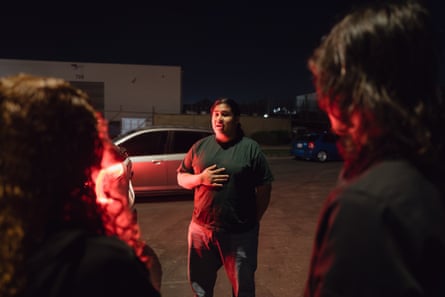










































 Scottie's Playtime