Well It happened again.

Hi all.  For two days I have worked on a couple posts.  Never seeming able to get to the end of them.  I get up at 2 or early and work on the Male Survivor site, then I have an hour or more long audio call with a fellow survivor, then I go to Joe My God to collect memes and see if there are stories I should post.  In between there is the morning walk with Ron, feeding and cleaning up after cats, and doing home stuff.  After showering I notice most of the morning is gone.  During The Majority Report which comes on at noon and runs for 2 or 3 hours, I turn the monitor around and put on headphones and do the dishes, a job that takes me about two hours.  Then another check in with the person I had the audio call with.  Then supper.  I realize the day went by without me being able to check my blog, without reading what Ali and Randy posted, not even time to reply to comments before I am struggling to stay awake and end up going to bed. That doesn’t include the days my pain or exhaustion doesn’t require me to go lay down.   Get up far too early only to do it all again.  

So last night before going to bed I put all the comments I could find in open tabs.  I am going to work on them now.  But I know some passed the last few days I did not see.  If you had something you wanted to say to me and I did not reply, please send it again even on a different thing I post.   Remember I do not see comments on Ali’s or Randy’s posts unless I go to the post page.  I do care about the blog, I do love the comments.  I am simply severely trying to do too much and deal with personal issues also.  I have to cut something and concentrate on what is important, which is Ron, the blog, and you all.  As I have taken to saying lately, far more than I ever thought I would, I care about you, I care for you.  Ron wants me to watch more movies and TV shows like Piccard, wants us to go out to eat, wants us to spend more time together.  All of these will eat into my online time.  I have some thinking to do, and right now thinking is sometimes hard for me.   Best wishes.  Hugs. Scottie

A reality check on the ‘Tampon Tim’ meme

https://www.startribune.com/a-reality-check-on-the-tampon-tim-meme/600965646

Here is why the right / republicans are panicking.   It is an attack on trans boys.  This who line of they are putting them in the boy’s bathroom is really a way to say Walz supports trans kids.  The truth is the bill doesn’t require the products be in any bathroom, just they be available to menstruating students and that includes trans boys.  Ron and I off the top of our head thought of dozens of places in a school that they could be put instead of the bathrooms.  Just a few, nurses stations, main offices, teachers could keep them in their rooms, a storage closet open to students, dispensers on doors or in hallways, student activity rooms, the rooms used for the gay straight clubs, so on.  But even if they were in the boy’s bathrooms, what is the problem with that, other than the made up issue the right has with trans boys?  That boys will see tampons and pads.  Do these boys not have mothers or sisters?  Have they never been in a store?  Do they help unpack grocery bags?   If boys do not know what these items are for, then they should be taught. It need not be a deep mystery and a shame for girls and women.   It won’t turn them gay or trans, it won’t cause their spines to break. Below I post the important quote then the article.  Hugs.  Scottie

But the law’s actual language provides considerable flexibility for school districts to implement it, according to Deb Henton, the executive director of the Minnesota Association of School Administrators.

That might mean making these products available for free in various locations for all who need them, such as unisex bathrooms, girls’ bathrooms, the school nurse or the front office, but not necessarily in boys’ bathrooms. Henton, in an interview, lauded the “local control” the law provides for implementation, and said she’s fielded no concerns about its rollout.

At Anoka-Hennepin, the state’s largest school district, the free products are not found in traditional male-only bathrooms, a spokesman said. But they are provided for free to all in “nongendered bathrooms,” girls’ bathrooms or from health staffers.

A smart, compassionate new state law is spurring misinformed attacks on Minnesota’s latest vice presidential contender: Gov. Tim Walz.

By Editorial Board

Star Tribune

AUGUST 8, 2024 AT 8:14PM
Kristy Wesson and Margie Solomon of the National Council of Jewish Women Minnesota and student Elif Ozturk delivered menstrual products to Hopkins High School in 2022. Ozturk and community advocates were pushing for a bill, subsequently made law, to require public schools to provide such products.
 

Opinion editor’s note: Editorials represent the opinions of the Star Tribune Editorial Board, which operates independently from the newsroom.

•••

On Tuesday, Democratic presidential nominee Kamala Harris tapped Minnesota Gov. Tim Walz as her running mate. By Wednesday, the opposition had mobilized with lightning speed for its one of its first political attacks, dubbing Walz “Tampon Tim” in reference to a new state law providing free menstrual products to school students.

The nickname was trending nationally this week on Twitter, an indicator of its political currency. Chaya Raichik, whose scurrilous “Libs of TikTok” account on X (formerly Twitter) has more than 3 million followers, was one of the first to amplify it. Former Fox News host Megyn Kelly added to the momentum, endorsing the nickname via tweet. Former First Lady Hillary Clinton weighed in from a different angle, with a tweet supporting the Minnesota measure.

Social-media users swiftly took sides as well, and as usual, facts and context were missing, especially from those who see the new law as evidence of a radical Minnesota under Walz’s leadership. But a closer, more informed look at the issue should yield a different conclusion. This is good and necessary policy. Providing free menstrual products is a practical, compassionate remedy to address an under-the-radar reason for student absenteeism. Some families can’t afford menstrual products, and when that happens students stay home instead of going to class, falling behind as they do.

There’s a lot of talk about closing educational achievement gaps in Minnesota and elsewhere, particularly for low-income students. The new state law, which has a price tag of about $2 million a year, is an actual solution to help address this, one that’s relatively low-cost. And there’s real-world data to back it up. New York City schools reported a 2.4% increase in attendance after a state law went into effect requiring free period products for students, according to the advocacy group Alliance for Period Supplies.

Minnesota is far from alone in providing this type of assistance. More than half of the nation’s 50 states have taken steps to help students who struggle to afford tampons and pads. Ohio, led by Republican Gov. Mike DeWine, now requires period products in schools and has provided $5 million in funding for this, the Alliance for Period Supplies reports. Alabama and Georgia provide grants for schools to make free products available.

Other states, such as Washington, Nevada, Illinois and Utah, require schools to provide these products, though they didn’t fund them. To Minnesota’s legislators’ credit, the new law provides dollars to schools and is not an unfunded mandate.


Other background information is also useful as the dubious online debate continues.

The new law went into effect in January and applies to students in grades four through 12. The legislation itself was passed during the 2023 session as part of a broader educational bill, which Walz then signed. Rep. Sandra Feist, DFL-New Brighton, was the bill’s chief author in the Minnesota House. Sen. Steve Cwodzinski, a retired teacher and DFLer from Eden Prairie, championed the measure in Minnesota Senate.

But the most powerful advocates for it came from outside the State Capitol. Young Minnesotans reached out to Feist about this issue. After Feist introduced it, these students testified on its behalf as the legislation made its way through various committees. Among them was Elif Ozturk of Golden Valley, who is now 18 and will attend Columbia University this fall.


In an interview, Ozturk told an editorial writer she got involved after seeing other students struggle to afford these products in junior high. She spoke to counselors and was told that some students had to leave class or couldn’t attend because they lacked pads or tampons. Ozturk dug into the issue and discovered that other states had taken steps to help students’ access these products. She thought Minnesota should do the same.

“If we don’t talk about it, it’ll never be fixed. These people who are in power, predominantly old men, have no clue what young girls go through every single day,“ Ozturk said.

Other advocates for the law’s passage: school nurses, who testified movingly about how students struggle to afford these products and the educational and emotional consequences when they can’t.


specific but ill-informed attack on the new Minnesota law is in dire need of a reality check. Critics contend, wrongly, that it mandates menstrual products in boys’ bathrooms. This has unfortunately been used to stoke ongoing culture wars over transgender individuals.

But the law’s actual language provides considerable flexibility for school districts to implement it, according to Deb Henton, the executive director of the Minnesota Association of School Administrators.

That might mean making these products available for free in various locations for all who need them, such as unisex bathrooms, girls’ bathrooms, the school nurse or the front office, but not necessarily in boys’ bathrooms. Henton, in an interview, lauded the “local control” the law provides for implementation, and said she’s fielded no concerns about its rollout.

At Anoka-Hennepin, the state’s largest school district, the free products are not found in traditional male-only bathrooms, a spokesman said. But they are provided for free to all in “nongendered bathrooms,” girls’ bathrooms or from health staffers.

There’s nothing radical about Minnesota’s new law. Instead it’s a smart, low-cost measure to address educational achievement gaps, one that many states are embracing. Weaponizing this measure is laughably out of touch and likely to backfire not only with women, but all who care about them.

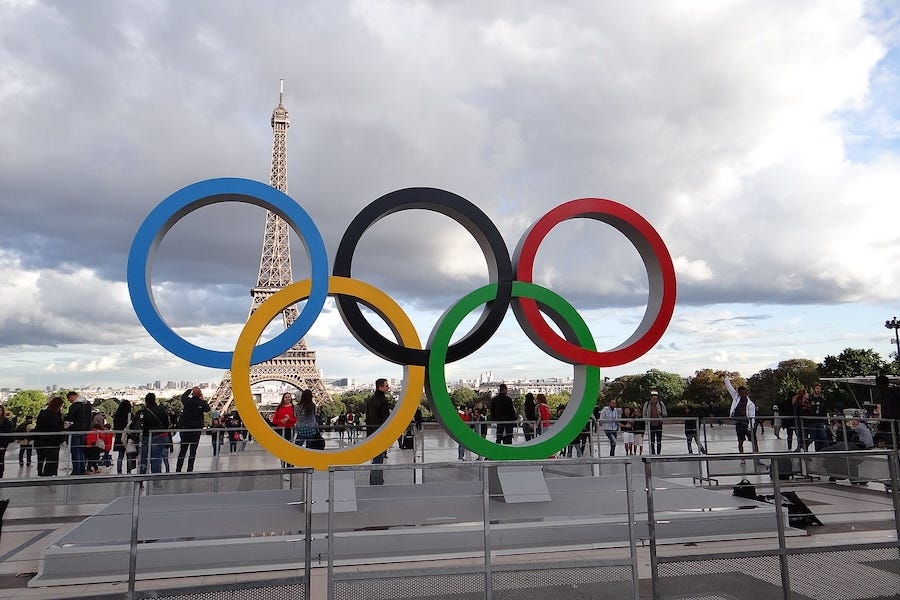
US Athletes Discover Joys Of Universal Healthcare In Olympic Village by Rebecca Schoenkopf

This is one of those feel-good stories that is actually very depressing when you think about it! Read on Substack

Snippets:

Wikimedia Commons

There’s a lot of money to be made on the Olympics — though not necessarily by the people participating in them (or most people who live in the host cities). Those athletes who participate don’t get paid (unless they get sponsorship deals) and, as a result, many of them go into poverty while trying to go for the gold. Training costs are huge and so, often, are the medical bills.

But not when they’re at the Olympic Village!

Ariana Ramsey, who won a bronze medal as part of the US female rugby team has been going viral on TikTok, talking about how amazing it’s been getting free healthcare at the Olympic Village — and in the days following her victory, she was able to celebrate by going to the gynecologist, dentist and an ophthalmologist, where she was able to get free glasses as well.

Via Sports Illustrated:

Ramsey came to Paris as a rugby player. She is leaving as a healthcare influencer. More than 135,000 people have watched her initial TikTok, and another of the half-dozen follow-up videos she has made has pulled in more than 570 views. That is fine with her. The more she thinks about it, the more frustrated she is that she’s so astonished by the concept. 

“That’s just America and their privatized healthcare system,” she laments in an interview, adding, “I’ll fight for universal healthcare.”

The idea has gone viral in France: American discovers healthcare. “A lot of people are kind of making a joke about it,” she says. “Like, welcome to France.” (snip)

Every other country has figured out that it makes far, far more sense (and is far, far more economically sane) for health care to be seen as a public good, but we’re still out here making insurance company CEOs obscenely rich for who knows what reason.

Many American athletes do have access to the United States Olympic and Paralympic Committee’s health insurance policy. But their eligibility for the program is up to their sport’s governing body, and an independent commission appointed by Congress found that “some of the most talented competitors under our flag go to sleep at night under the roof of a car or without sufficient food or adequate health insurance.” More than a quarter of U.S. athletes report earning less than $15,000 per year, and more than 40% said they paid out of pocket for healthcare, with an average cost of $9,200 per person. Only 16% said they’d been reimbursed.

Meanwhile, in 2022, the US Olympic and Paralympic Committee had a net revenue of 61 million dollars and paid their CEO a salary of $1.1 million.

Also meanwhile, NBCUniversal sold $1.2 billion in advertising ahead of the last Olympic Summer Games in Tokyo and say that they have surpassed that number this year (though an exact figure has not been given). (snip)

On the bright-ish side, because of Ramsey’s videos, hundreds of other Olympic athletes have taken advantage of the free healthcare at Olympic Village that they might not otherwise get at home. So that’s nice for them!

A couple of bits from Cosmos

for science!

Lithium-ion batteries made from wastewater phosphorus

Good news for some sustainability. Here’s a snippet:

“Engineers have found a way to turn phosphorus from city wastewater into parts for lithium-ion batteries.

“The Chinese researchers say that their method could be used to supply 35% of the phosphorus demand for their national lithium-ion battery industry.

“They’ve published their findings in Engineering.

“Phosphorus is a common component in the cathodes of lithium-ion batteries – specifically, lithium iron phosphate batteries, which represent about 60% of the lithium-ion market according to the researchers.

“As an important ingredient in fertilisers and industrial chemicals, mineral phosphorus is in high demand. Mining stocks of phosphorus are expected to be depleted in the next 50-100 years.

“But, point out the researchers, more than 250,000 tonnes of phosphorus pollutes Chinese wastewater every year, coming from food consumption and chemical waste. This is more phosphorus than the amount consumed each year to make batteries.” (snip)

“The researchers used their wastewater-derived mixture to build small lithium-ion batteries in the lab. These batteries could charge and discharge at the rates needed for electric vehicles and large-scale storage systems, and they kept 99.2% of their capacity after being charged and discharged 100 times.

“Batteries made with higher doses of the wastewater material performed better than batteries made with lower doses. The researchers believe that impurities from the sludge helped to stabilise the batteries, allowing them to perform better.

“’The amount of phosphorus recovered from municipal wastewater is projected to be sufficient to meet up to 35% of the phosphorus demand by the lithium-ion battery industry in China, enhancing the cost-effectiveness of phosphorus recovery and alleviating the global shortage of phosphorus resources to achieve both clean energy and sustainable development,’ conclude the researchers in their paper.”

=====

When it rains, it pours! This old idea looks set to be Australia’s future

“In the last few years, Australia has faced both flooding rains and some of the lowest rainfall on record. Now, researchers from the Chinese Academy of Sciences have the data that explains why rain in Australia has seemed so unpredictable.

“The researchers have shown that human-induced climate warming is driving increases in rainfall variability over 75% of the Earth’s land, and they say the effects are especially prominent in Australia.

“The study looked at increases in rainfall variability, which can mean wetter wet periods and drier dry periods. They found that daily variability has increased by 1.2% per decade globally, and that humans are largely to blame.

“’The increase in rainfall variability is mainly due to anthropogenic greenhouse gas emissions, which have led to a warmer and more humid atmosphere,’ said Dr Zhang Wenxia, lead author of the study. 

“’This means that even if the atmospheric circulation remains the same, the additional moisture in the air leads to more intense rain events and more drastic fluctuations between them.’

“Professor Steven Sherwood at the UNSW Climate Change Research Centre, who was not involved in the study, told the AusSMC that this means rainier rainy periods and drier dry periods. 

“’This is going to increase as global warming continues, enhancing the chances of droughts and/or floods.’

“The paper identified Australia as being a particular hotspot for rainfall variability. Dr Milton Speer from the University of Technology Sydney said the paper’s findings are significant, and that other recent studies have had similar conclusions.” (snip-More)

Rafah’s health crisis

rawgod brought this up, also, and I’m running with it here, because the Don is dominating the news (it’s all he can dominate) and there’s no reason to cover him these days. Anyway, here is some info from 2 sources regarding the spiralling health catastrophe in Rafah.

Rafah water facility demolition raises health risks in Gaza, UN says

July 30, 2024 1:10 PM By Lisa Schlein

GENEVA — 

U.N. agencies warn that the demolition of a critical water facility in Rafah in the southern Gaza Strip increases the risk of infectious diseases as people are forced to drink unsafe water while sanitary conditions continue to deteriorate.

“Until recently, that reservoir served thousands and thousands of internally displaced people who had sought refuge in Rafah in the area,” James Elder, UNICEF spokesperson, told journalists at a briefing in Geneva on Tuesday.

“Now without it, vulnerable children and families are likely to be forced again increasingly to resort to unsafe water, so putting them again at all those risks that we see time after time, day after day in Gaza — dehydration, malnutrition, diseases,” he said.

The Israeli daily Haaretz reported Monday that the troops blew up the central reservoir “on the orders of the brigade commanders” but without receiving permission from the senior level of the Southern Command. It added that the incident was being investigated by Israel’s Military Police as “a suspected violation of international law.”

Infections spreading

Elder said the destruction of the Canada Well reservoir “is yet another grim reminder of the assaults on families who already are in desperate need of water.”

“We have seen spikes in diarrhea, in skin infections — all due to a lack of access to hygiene and a lack of access to water,” he said, noting that people in emergencies require a minimum of 15 liters (almost 4 gallons) of water per person per day.

Now, the range of water availability in Gaza has been reduced to between 2 and 9 liters per person, per day, and some people are getting just a fraction of that, Elder said.

“Somehow, people are holding on, but of course, we are now in that deathly cycle whereby children are very malnourished. There is immense heat. There is [a] lack of water. There is a horrendous lack of sanitation, and that is the cycle,” he said.

The World Health Organization reports a surge in infectious diseases in the Gaza Strip. As of July 7, it has recorded nearly 1 million cases of acute respiratory infections, 577,000 cases of acute watery diarrhea, 107,000 of acute jaundice syndrome and 12,000 of bloody diarrhea. It also has recorded nearly 200,000 cases of scabies, lice, skin rashes, chicken pox and other illnesses.

Polio threat

The recent identification of circulating vaccine-derived poliovirus type 2 in Gaza’s sewage system is of particular concern. Under prevailing conditions in Gaza, there is a high risk of spread of this paralytic, deadly disease within the Palestinian enclave and across borders.

“Having a vaccine-derived polio virus in the sewage very likely means that it is out there somewhere in people,” WHO spokesperson Christian Lindmeier said. “It most likely is in the population, but that does not necessarily mean that we see an outbreak of cases.

“But of course, we need to be prepared. We need to be utterly prepared. And we need vaccinations, and we need vaccination campaigns,” he said. (snip-More)

Inside Rafah’s Deteriorating Health Crisis

Health conditions are rapidly deteriorating in Rafah as a possible ground offensive nears. Project HOPE reports that 1 in 5 children under age two showed signs of malnutrition in an underserved displacement camp in Rafah.

This week, the Israeli Government announced plans to move forward with a ground offensive in Rafah despite concerns from the international community about the severe impact it would have on civilian lives. As the threat of forced evacuation or an escalation of violence looms, the health of people living in Rafah is rapidly deteriorating. Inhumane and crowded living conditions, limited access to clean water and food, and inadequate hygiene facilities have led to an increase in cases of hepatitis A, upper respiratory tract infections, tonsillitis, and urinary tract infections.

Malnutrition rates are on the rise due to limited availability, loss of income, and soaring food prices linked to the destruction of Gaza’s food system. At Project HOPE’s clinic in Jaafar Al-Tayyar, an underserved displacement camp in Rafah, 1 in 5 children under the age of two exhibited signs of malnutrition over the last month. The camp has turned into a breeding ground for disease and illness. Over 100,000 people are crammed into one area. Project HOPE’s team reports that it is common for 20-30 people to live in just one tent and hundreds share access to one toilet and shower, which not only creates serious hygiene and disease concerns but poses protection risks for women, children, and others.

Rafah was home to 280,000 people before the war. Today, over one million people seek refuge in the small city. Families live in overcrowded tents, homes, and makeshift shelters with limited access to the necessities to survive. Project HOPE calls upon all parties involved to implement an immediate and sustained ceasefire to prevent the loss of more innocent lives.

Dr. Nour Al-Din Khaled Alamassi, Physician for Project HOPE, said:
“Everywhere around me, people are hungry. It is inevitable here, especially for children, pregnant women, and people with chronic illnesses. In our clinic, we constantly see people who are sick, uncomfortable, and hungry. Children’s bodies are deteriorating. Food is way too expensive and fresh foods like chicken or vegetables are impossible to find. We cannot rely on aid shipments for regular meals.

I recently met Nafisa Al-Dakakheneh, a 67-year-old, who moved from Gaza City to Rafah. She told me, ‘We had no food, no water, nothing – we’re tired. We were starving so we had no choice but to leave our home and come to Rafah.’ Nafisha has no home in Rafah. She sleeps on the hard ground under blankets hanging in the air as cover because she can’t afford a tent. Her grandchild tragically died in the hands of his mother due to lack of food and severe dehydration. Nafisa is terrified of dying. I resonated with her words, ‘We really need to feel like we’re human again.’

Naifsa’s story is not unique. If we do not die from violence, we could die from disease or hunger. More violence in Rafah would be devastating. The last safe haven in Gaza would be destroyed. Every day, I fear what might happen. I worry about having to be displaced constantly. We are living in a nightmare.” (snip-More)

Staying Cool: Helpful Hints From History

Take a look back at how others have survived—and thought about—the high heat of summer.

By: Matthew Wills  July 28, 2024

In an episode of The Twilight Zone called “The Midnight Sun,” first broadcast in November 1961, the apocalyptic temperature of an Earth getting ever closer to the Sun is represented by a thermometer bursting at…130°F. On July 5, 2024, Palm Springs, California, reached 124°F, while the next day, Death Valley hit 128°F, amidst a shattering of triple-digit temperature records across the American West.

Benchmarks have shifted. In 1961, the amount of carbon dioxide (CO2) in the atmosphere was 318 parts per million by volume (ppmv). CO2 is a greenhouse gas, acting as atmospheric insulation, preventing heat radiation from dissipating into space. Last year, 2023, the amount of CO2 in the atmosphere was 421 ppmv. It continues to increase, not least as we battle the resulting heat by burning fossil fuels to stay cool. We’re in a global greenhouse, and the doors seem to be locked as we paradoxically produce more CO2 to stay cool in the face of heating caused by the production of more CO2.

Humans have long worked to beat the heat, especially in the tropics and in deserts. Their perfectly rational strategies—stay out of the midday sun, live underground, cover up completely—may once have been criticized by those from temperate zones, sometimes in racist terms, but more and more parts of the world are having to learn the lesson of those strategies.

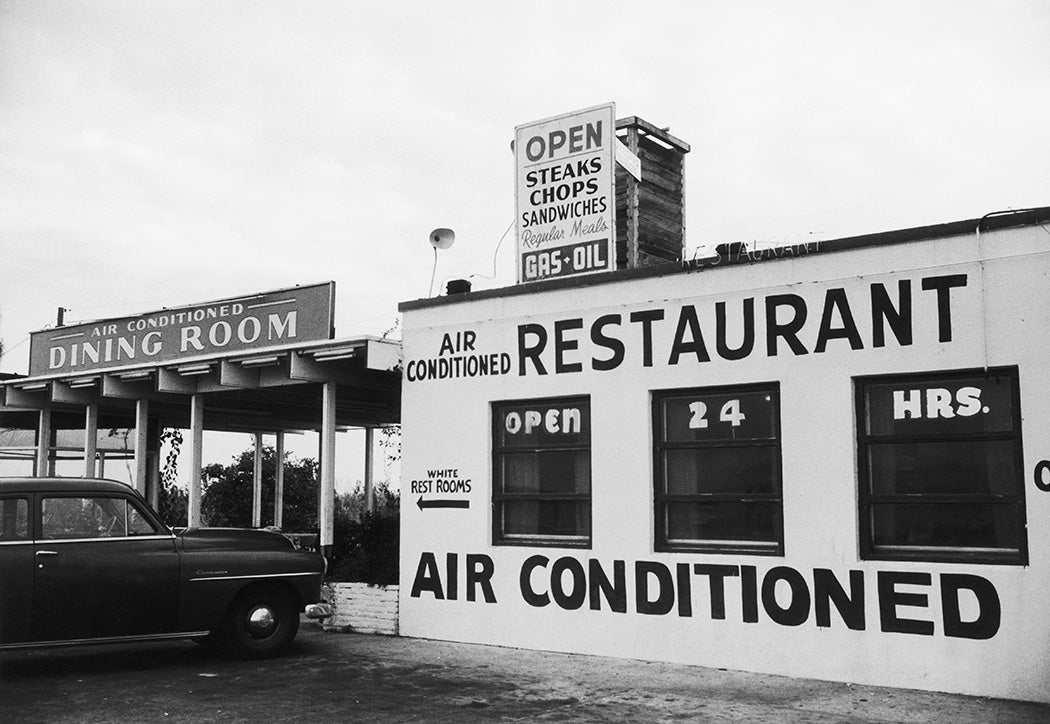
A sign outside an air conditioned American restaurant points to the 'White Rest Rooms', in a clear indication of racial segregation, circa 1960.
A sign outside an air-conditioned American restaurant points to the “White Rest Rooms,” in a clear indication of racial segregation, circa 1960. Getty

What, after all, would it be like without air conditioning? Take a look at this Before Air-Conditioning piece in Scientific American’s “Hints for Keeping Cool.” Published in July 1858, the piece begins with a dietary suggestion: eat “fruits, vegetables, and farinaceous food, and the lighter kinds of meat.” In 1858, the amount of CO2 in the atmosphere was 286 ppmv. Seven years earlier, Dr. John Gorrie, striving to cool down his malaria and yellow fever patients in Florida, patented the first ice-making machine (1851, 285 ppmv).

The first modern, electrical air condition system dates to 1902 (297 ppmv), when inventor Willis Carrier cooled and dehumidified the Sackett-Wilhelms Lithographic & Publishing Company in Brooklyn, New York. The publishing company was most concerned about humidity warping their paper supplies. Carrier is still a going concern.

A little over a century after Scientific American’s helpful hints, The Science News-Letter’s “Keeping Cool in Summer Heat” (1961: 318 ppmv) wasn’t so very different.

“If you suffer from heat frustration when the mercury hits the 90’s, a little scientific knowledge of summer heat can help your body temperature and state of mind remain well within the comfort zone,” the editors claim.

These hints were essential for those without air conditioning, that wonder of the twentieth century. Try to imagine cars, theaters, restaurants, the suburbs, office towers, apartment blocks, malls, et cetera, without A/C. The post-World War II population growth across the Sun Belt, stretching from Southern California to North Carolina, would most likely not have been possible without it.

In his exploration of how A/C transformed the South, Raymond Arsenault quotes a Floridian circa 1982 (341 ppmv).

“I hate air conditioning,” the woman confirmed. “It’s a damnfool invention of the Yankees. If they don’t like it hot, they can move back up North where they belong.”

But most people—in the South and elsewhere—welcomed A/C with a passion. Arsenault notes that historians tended to shy away from writing about the transformative power of air-conditioning on the South because they were leery of falling into an old climate-is-destiny paradigm. In the first three decades of the twentieth century, the South’s climate was held responsible for everything from the Southern drawl to plantation slavery. Climate determinism faded by mid-century (1950: 311 ppmv), as the “long hot summers” of the Civil Rights years transitioned into the “New South,” supposedly post-racial but definitely all indoor-cooled.

Why We Investigated Matthew Trewhella, the Far-Right Wisconsin Pastor Influencing Republican Politics

Some people said militant anti-abortion activist Matthew Trewhella was a ’90s figure who’s no longer relevant, but our reporting shows he’s influencing policies, bills and movements today.

by Phoebe PetrovicWisconsin Watch Aug. 2, 5 a.m. EDT

This article was produced for ProPublica’s Local Reporting Network in partnership with Wisconsin WatchSign up for Dispatches to get stories like this one as soon as they are published.

In the fall of 2022, Phoebe Petrovic, an investigative reporter at Wisconsin Watch and a member of ProPublica’s Local Reporting Network, noticed a pastor and his church appearing in local news coverage for their anti-LGBTQ+ protests. Looking closer revealed Pastor Matthew Trewhella’s startling history. And digging even deeper, she noticed an untold story: his broader influence on modern Republican politics. His rise helps illustrate the growing power of the Christian right in the Republican party. Here, Petrovic describes how she reported the story and what she learned.

What were the key takeaways from your reporting?

  • A few decades ago, Trewhella was known as a militant anti-abortion activist. Today, he’s got a different reputation: thought leader on the far right, increasingly welcomed by Republicans.
  • Trewhella helped to rehabilitate his reputation through his 2013 self-published book, “The Doctrine of the Lesser Magistrates,” which uses a 16th-century Protestant doctrine to argue that government officials have a God-given right and duty to defy laws, policies or court opinions deemed “unjust or immoral” under “the law of God.”
  • He’s preached this doctrine to county Republican parties and local groups across the country, even to the National Sheriffs’ Association, a preeminent law enforcement organization.
  • His book has influenced Second Amendment sanctuary resolutions. At least 10 measures across the country refer to lesser magistrates. One of the earliest, issued in 2019, was authored by a county commissioner who has described reading Trewhella’s book as a “turning point” for him.
  • A prominent booster of debunked election conspiracy claims is using Trewhella’s book to disrupt future elections.

How does Trewhella fit into the election? What does he say about his work?

  • In the cast of characters who might influence the upcoming election, Trewhella is not rallying crowds the same way as Steve Bannon, the former Donald Trump strategist, or Charlie Kirk, the founder of the conservative student group Turning Point USA. Trewhella is more behind the scenes, providing a religious justification for some far-right policies and causes.
  • Trewhella says that he promotes nonviolence. But after an activist killed an abortion provider in 1993, he signed a document describing the murder of these doctors as “justifiable.”
  • In a brief interview, I asked Trewhella about his reputational shift over the decades. He responded: “Most people will always only care about three things in life: me, myself and I. … It’s only because of their mundane, self-absorbed lives that they would think someone like me is an extremist. That’s my answer.”
  • Trewhella did not respond to over a dozen attempts to set up a second interview. He did not answer written questions by email and refused a certified letter containing them.

What did experts tell you about Trewhella?

  • Frederick Clarkson, a senior research analyst at Political Research Associates, which studies threats to democracy and human rights, has tracked Trewhella for decades. Clarkson said, “All of those county commissioners and mayors and whatnot who are entertaining this stuff, they’re putting people’s lives and the entirety of civil order at risk by playing footsie with Matt Trewhella.”
  • Another extremism researcher, Devin Burghart, said, “I think that the public needs to know that he’s a dangerous theocrat, who would fundamentally alter the United States in irreparable ways that would harm many, including women, people of color and the LGBTQ community.” Burghart is president of the Institute for Research and Education on Human Rights, which tracks the far right. (snip-More)

https://www.propublica.org/article/investigating-matthew-trewhella-wisconsin-pastor

A Prayer for Resistance. Please join, if you will.

Followup article on Vivian Wilson

I was gonna snip it, but I couldn’t find a good place to stop, and then I was at the end. Here it is:

By David Ingram

Vivian Jenna Wilson, the transgender daughter of Elon Musk, said Thursday in her first interview that he was an absent father who was cruel to her as a child for being queer and feminine.

Wilson, 20, in an exclusive interview with NBC News, responded to comments Musk made Monday about her and her transgender identity. On social media and in an interview posted online, Musk said she was “not a girl” and was figuratively “dead,” and he alleged that he had been “tricked” into authorizing trans-related medical treatment for her when she was 16. 

Wilson said that Musk hadn’t been tricked and that, after initially having hesitated, he knew what he was doing when he agreed to her treatment, which required consent from her parents.

Musk’s recent statements crossed a line, she said. 

“I think he was under the assumption that I wasn’t going to say anything and I would just let this go unchallenged,” Wilson said in a phone interview. “Which I’m not going to do, because if you’re going to lie about me, like, blatantly to an audience of millions, I’m not just gonna let that slide.” 

Wilson said that, for as long as she could remember, Musk hasn’t been a supportive father. She said he was rarely present in her life, leaving her and her siblings to be cared for by their mother or by nannies even though Musk had joint custody, and she said Musk berated her when he was present. 

“He was cold,” she said. “He’s very quick to anger. He is uncaring and narcissistic.” 

Wilson said that, when she was a child, Musk would harass her for exhibiting feminine traits and pressure her to appear more masculine, including by pushing her to deepen her voice as early as elementary school. 

“I was in fourth grade. We went on this road trip that I didn’t know was actually just an advertisement for one of the cars — I don’t remember which one — and he was constantly yelling at me viciously because my voice was too high,” she said. “It was cruel.” 

Musk didn’t respond to a request for comment.

Wilson and her twin brother were born to Musk’s first wife, author Justine Musk. The couple divorced in 2008, and Wilson said her parents shared custody between their homes in the Los Angeles area. 

Musk, 53, is among the wealthiest people in the world through his stakes in Tesla, where he’s CEO, and in SpaceX, which he founded. He has also become a significant political figure, having endorsed former President Donald Trump this month for another term in the White House. Musk has 12 children, including Wilson. 

Now a college student studying languages, Wilson has never granted an interview before and has largely stayed out of public view. She did, however, attract attention in 2022 when she sought court approval in California to change her name and, in the process, denounced her father. 

“I no longer live with or wish to be related to my biological father in any way, shape or form,” she said in the court filing. 

She told NBC News that at the time, she was surprised by the media attention to the court filing, which she submitted when she was 18. She said in the interview that she stands by what she wrote, though she said she might have tried to be more eloquent had she known the coverage it would get. 

Wilson said that she hadn’t spoken to Musk in about four years and that she refused to be defined by him. 

“I would like to emphasize one thing: I am an adult. I am 20 years old. I am not a child,” she said. “My life should be defined by my own choices.” 

Musk threw a spotlight on Wilson on Monday by speaking about their relationship in a video interview with psychologist and conservative commentator Jordan Peterson streamed live on X, saying he didn’t support Wilson’s gender identity. 

“I lost my son, essentially,” Musk said. He used Wilson’s birth name, also known as a deadname for transgender people, and said she was “dead, killed by the woke mind virus.” 

And in a post on X, Musk said Monday that Wilson was “born gay and slightly autistic” and that, at age 4, she fit certain gay stereotypes, such as loving musicals and using the exclamation “fabulous!” to describe certain clothing. Wilson told NBC News that the anecdotes aren’t true, though she said she did act stereotypically feminine in other ways as a child. 

Wilson also addressed Musk’s recent comments in a series of posts Thursday on the social media app Threads. 

“He doesn’t know what I was like as a child because he quite simply wasn’t there,” she wrote. “And in the little time that he was I was relentlessly harassed for my femininity and queerness.”

“I’ve been reduced to a happy little stereotype,” she continued. “I think that says alot about how he views queer people and children in general.” 

In recent years, Musk has taken a hardright turn into conservative politics and has been waging a campaign against transgender people and policies designed to support them. This month, he said he was pulling his businesses out of California to protest a new state law that bars schools from requiring that trans kids be outed to their parents.

On X, Musk has for years criticized transgender rights, including medical treatments for trans-identifying minors, and the use of pronouns if they are different from what would be used at birth. He has promoted anti-trans content and called for arresting people who provide trans care to minors. 

After Musk bought X, then known as Twitter, in 2022, he rolled back the app’s protections for trans people, including a ban on using deadnames

Musk told Peterson that Wilson’s gender transition has been the motivation for his push into conservative politics. 

“I vowed to destroy the woke mind virus after that, and we’re making some progress,” he said. 

Wilson was also mentioned in a biography of Musk by author Walter Isaacson — a book that she told NBC News was inaccurate and unfair to her. The book refers to her politics as “radical Marxism,” quoting Musk’s sister-in-law Christiana Musk, but Wilson said she’s not a Marxist, though she said she does oppose wealth inequality. The book also calls her by her middle name, Jenna. 

Wilson said Isaacson never reached out to her directly ahead of publication. In a phone interview Thursday, Isaacson said he had reached out to Wilson through family members. 

Christiana Musk didn’t immediately respond to requests for comment Thursday.

Wilson told NBC News that for years she had considered speaking out about Musk’s behavior as a parent and as a person but that she could no longer remain silent after his comments Monday. 

She said she had never received an explanation for why her father spent so little time with her and her siblings — behavior that she now views as strange. 

“He was there, I want to say, maybe 10% of the time. That’s generous,” she said. “He had half custody, and he fully was not there.” 

“It was just a fact of life at the time, so I don’t think I realized just how abnormal of an experience it was,” she added.

Wilson said she came out twice in life: once as gay in eighth grade and a second time as transgender when she was 16. She said that she doesn’t recall Musk’s response the first time and that she wasn’t present when Musk heard from others that she was transgender, because by then the pandemic had started and she was living full-time with her mother. 

“She’s very supportive. I love her a lot,” Wilson said of her mom.

The pandemic was a chance to escape Musk’s cruelty, she said. 

“When Covid hit, I was like, ‘I’m not going over there,’” she said. “It was basically very lucky timing.” 

Musk told Peterson in the interview that he had been “tricked” into signing documents authorizing transgender-related medical treatment for Wilson — an allegation Wilson said isn’t true. 

“I was essentially tricked into signing documents for one of my older boys,” Musk said, using her birth name.

“This was before I had really any understanding of what was going on, and we had Covid going on,” he said, adding that he was told she might commit suicide.

Wilson said that, in 2020, when she was still a minor at 16, she wanted to start treatment for severe gender dysphoria but needed the consent of both parents under California law. She said that her mother was supportive but that Musk initially wasn’t. She said she texted him about it for a while. 

“I was trying to do this for months, but he said I had to go meet with him in person,” she said. “At that point, it was very clear that we both had a very distinct disdain for each other.” 

When she eventually went and gave him the medical forms, she said, he read them at least twice, once with her and then again on his own, before he signed them. 

“He was not by any means tricked. He knew the full side effects,” she said. 

She said she took puberty blockers before she switched to hormone-replacement therapy — treatments that she said were lifesaving for her and other transgender people. 

“They save lives. Let’s not get that twisted,” she said. “They definitely allowed me to thrive.” 

She said she believed the requirements to obtain such treatments remain onerous, with teenagers pressured to say they’re at extreme risk of self-harm before they’ll be approved. She said she felt judged by Musk and Peterson, in the Monday interview, for not being at a high enough risk in their eyes. 

“I have been basically put into a point where, to a group of people, I have to basically prove whether or not I was suicidal or not to warrant medically transitioning,” she said. “It’s absolutely mind-boggling.” 

David Ingram

https://www.nbcnews.com/tech/tech-news/elon-musk-transgender-daughter-vivian-wilson-interview-rcna163665

Ron has an infected tooth

I spent the last two hours in bed hugging, rubbing, cuddling, pressed tight to, and comforting Ron as he slept.  He recently had two infected upper teeth, one was a wisdom tooth that was in sideways.  Now he has a lower wisdom tooth that is infected.  It has been really painful for him and he has not been sleeping at night.  He has an appointment at 8 am to have it pulled.  When he told me he needed to go to bed and how tired he was, then asked me to come down and hold him, how could I refuse?  It has put me behind on everything, but he feels so much better.  We just got up and I made him a cup of coffee.  Randy bought us a coffee machine that lets us do one cup at a time with regular coffee grounds.  As I am not drinking coffee any more Ron loves the machine.   Hugs.  Scottie