So, as I do most evenings, Saturday evening I opened the NewsCow to see what I’d missed about town since Friday evening. Turns out, the Recycling Center had reopened, effective Saturday morning! There is very little info, so I’m including it all underneath, but you can click through to nose about and maybe vote in a poll, or something, if you like. This is follow-up to So Reading the News Yesterday, from July 11th.
…..Sumner Newscow report — Effective Saturday, July 19, 2025, the Wellington Recycling Center will reopen and begin collecting materials again. At this time, the materials will remain the same as before: cardboard, paper products, magazines, tin cans, and aluminum cans. Hours of operation will also remain the same:
Monday, 11 a.m. to 1 p.m. and Saturday, 9 a.m. to noon.
City staff is in discussions with multiple buyers and evaluating the environmental, operational and financial impacts of all of the options available at this time. Information will be provided in the future if any changes at the Center are required. (End; now you know what I know. Oh, except the City’s Recycling Center Page is not yet updated as of Sunday evening. Interesting!)
If you or a loved one are in crisis, please call the National Suicide Prevention Lifeline at 1-800-273-TALK (8255), or contact the Crisis Text Line by texting TALK to 74174.
When Arden was 16, they called a suicide crisis hotline “thinking their life was over.”
They were in an abusive relationship, regularly self-harming, and felt that nothing was helping. “It was terrifying,” they told Uncloseted Media.
“If it weren’t for the hotline, I would have killed myself.”
Since that day, Arden, now 24 years old and living in Brooklyn, has used various crisis helplines. When the 988 national suicide prevention hotline launched a “Press 3” option in 2022 for LGBTQ+ youth, they immediately started using the resource.
Arden, who identifies as nonbinary, says the LGBTQ+ hotline workers “respected their identity” and were understanding that they are not a woman. “It was really affirming for a very troubling time in my life.”
Since then, Arden has “Pressed 3” more times than they can remember, seeking help for everything from dealing with the loss of their friend, who died by suicide, to “stupid cliquey gay people stuff.”
“I remember when my friend had killed himself and I was dealing with a lot. I called them and they talked to me for over an hour because I was really upset,” they say. “When I called the hotline, it was a last resort. I was really at my wits’ end.”
Arden — whose last call to the lifeline was two weeks ago — is one of 1.3 million callers and chatters the LGBTQ+ youth hotline has served since it launched, according to federal data. The legislation that greenlit the national program, signed by Trump in 2020 during his first term, explicitly recognized that LGBTQ+ youth are more than “4 times more likely to contemplate suicide than their peers, with 1 in 5 LGBTQ+ youth and more than 1 in 3 transgender youth reporting attempting suicide.”
Kaoly Gutierrez/Uncloseted Media
This new option to “Press 3” allowed queer youth in crisis the ability to directly connect with counselors from a set of specialized LGBTQ+ crisis centers. These counselors are trained in cultural competency and often bring lived experience, providing identity‑affirming, empathetic support for challenges like coming out, discrimination or mental health crises.
Despite the hotline’s success, the Trump administration announced last month that they would be shutting it down on July 17, claiming that the service had run out of congressionally directed funding. The Substance Abuse and Mental Health Services Administration said in an email to Uncloseted Media that “continued funding of the Press 3 option threatened to put the entire 988 Suicide & Crisis Lifeline in danger of massive reductions in service.”
“This is absolutely a mistake,” a suicide prevention call center director told Uncloseted Media. “We are concerned that this will result in increased suicide rates for LGBTQ+ youth.”
Why we need option 3
The director’s concern is supported by a 2022 research brief that found that queer college students with access to LGBTQ-specific services were 44% less likely to attempt suicide than those without it. Research also shows that a hotline specific to LGBTQ+ services increases the likelihood of queer youth calling.
“It’s true for any direct service,” Harmony Rhoades, associate research professor of sociology at Washington University, told Uncloseted Media. “People who are in substance use recovery want to work with people who’ve gone through recovery themselves because they understand what that experience is. Culturally, there is not a lot of understanding of the specific experiences of someone who is LGBTQ+ and without specific training, a crisis counselor isn’t going to be able to know the language that’s going to feel affirming.”
Kaoly Gutierrez/Uncloseted Media
“Connecting with someone who gets it was really helpful. … Because at home, I was so isolated and I didn’t really interact with other queer people,” says Genna Brown, who used the Trevor Project’s chat function at 10 years old.
“I was an extremely self-loathing, suicidal kid who was under the impression that God hated me and I was gonna burn in hell for eternity,” Brown, now 15 and living in High Point, North Carolina, told Uncloseted Media.
“I only used the chat feature because I was scared my parents would hear me. We shared a wall,” she says. “I was spiraling really bad. I’d just realized I was crushing on girls, and I thought I was going to burn in hell for all eternity because that is what we are taught.”
Raised in a Southern Baptist church, Brown never felt safe at home, where her father would regularly spit slurs like “faggots” and “queers.” At church, every sermon was about Sodom and Gomorrah or about how “real love” only existed between a man and a woman.
“I grew up knowing the number one thing not to be was one of the ‘dirty queers,’” she says. “I kept thinking, I can kill myself now and go to hell, or live longer and still go to hell. I used to have panic attacks at 9, 10 years old, just thinking about burning in hell perpetually.”
Brown remembers Caitlin, the chat counselor who helped her, being the first ever to tell her that queer love was valid.
“She told me she’d been with her girlfriend for seven years. I didn’t even believe queer people could be happy. … It broke my brain in the best possible way,” says Brown, who is now out and proud to her parents, who have come around, and to most of her friends on social media.
Genna and her Mom, Melanie. Kaoly Gutierrez/Uncloseted Media
Arden had a similar experience. “The queer line is better than the regular line,” they say. “I feel like it’s less like going through a checklist on the queer line.”
As a survivor of sexual assault, Arden says knowing that the counselors on the other line were trained in LGBTQ-specific trauma made it easier to reach out for help. “My voice doesn’t pass per se but they still respected my identity,” they say.
LGBTQ-specific resources for youth are critical, with 41 percent seriously considering suicide in 2024. In addition, queer youth are disproportionately affected by a litany of mental health issues and trauma, including physical and sexual assault, anxiety, depression, eating disorders, bullying and addiction.
“It’s not like we’re cherry-picking some random group,” says Rhoades. “If we are going to fund [suicide prevention], there is no reason we should do it inefficiently by not effectively targeting the people who need it most. So yes, they need specific suicide prevention services.”
While the hotline focuses on LGBTQ+ youth, they don’t turn away adults who need help. Joshua Dial, 36, says that when he called 988, he was often connected to the LGBTQ+ youth hotline after mentioning that he’s gay.
“I always walked away feeling better after I called,” he says. “There have been times when I spoke to the regular 988 crisis people, and they helped too. But they didn’t understand quite as much.”
Dial, a Lutheran who lives in Stillwater, Oklahoma, says he wasn’t always comfortable being open about his sexual orientation to his religious community and that the only way to meet other gay people was on hook-up and dating apps, which he notes are “not for emotional support.”
“I wouldn’t be talking to my pastor about getting on Grindr. I can’t go to my pastor and tell them what I did last weekend,” he says.
Dial, who was raised to believe that homosexuality is a sin, has experienced depression since the age of 16 and has also struggled with bipolar disorder, addiction and PTSD. “My addiction was getting worse, and the only constant was that the line was always available,” he says. “I didn’t have any other options, but I knew that if I called the hotline, I would get help.”
Dial says the emotional support he received through these phone calls kept him from self-harm and suicide. “There are times when I called that number and was this close to taking a handful of pills, this close to slitting my wrist, this close to buying a gun to shoot myself. And I talked to those people, and they not only understood, but they gave me the empowerment of knowing that someone had my back.”
How cutting option 3 affects the whole system
While the cuts are only meant to affect the hotline’s support for LGBTQ+ youth, crisis center employees say they’ll impact the entire 988 network.
“This being rifted does very much mean less capacity for 988 as a whole,” says the suicide prevention call center director. “Everyone will be affected.”
“When the LGBTQ+ hotline opened up, it really lowered the volume on the mainstream counselors,” a 988 hotline counselor in Washington state told Uncloseted Media. “It seemed really helpful, and I didn’t get a lot of LGBTQ+ chats after that point.”
The counselor at the Washington state center says they are about to lay off 42 counselors from their LGBTQ+ hotline. They say these roles won’t be replaced on the main 988 line due to a hiring freeze. Because of this, counselors expect the number of calls they receive to double, which could dramatically increase wait times. The Washington state center did not respond to a request for comment.
Even without the cuts, wait times are an issue. A 17-year-old caller from Virginia says that even the 10 minutes they had to wait for their call to be answered were painful. “I was worried that nobody would want to talk to me. I was just feeling hopeless,” they say. “There’s this one resource that I’m supposed to be able to have access to 24/7, but it just isn’t as accessible as it should be. For some people, those 10 minutes are crucial.”
In a 2009 study of 82 patients referred to a psychiatric university hospital after a suicide attempt, nearly half reported that the period between their first thought of suicide and their actual attempt had lasted 10 minutes or less, underscoring how shorter wait times can be a matter of life and death.
“If we are not able to catch someone during the time that suicidal thoughts have appeared and intervene as quickly as possible, they could start figuring out how they’re going to kill themselves and make it happen,” says the suicide prevention call center director. “And a lot of folks have access to means that can result in instant death like firearms.”
What can be done?
With the “Press 3” option gone, Rhoades worries that the current spate of anti-LGBTQ+ legislation and hateful rhetoric toward the community will affect how counselors without queer-specific training will provide care.
“We’re living in an unprecedented time where anti-LGBTQ+ hatred is being normalized,” she says. “It absolutely affects how young people are treated. And it filters down to crisis counselors.”
As Congress and the Trump administration prepare to shut down “Press 3” on July 17 in an effort to save money, many believe that it will have the reverse effect.
“They just want these people to die. … That’s the message I got,” says a hotline operator in Washington state, adding that the administration is “not looking at the bigger picture.”
Arden says they wouldn’t be here today without the line’s support. “I’ve been struggling for a long time in my life [with] self-harm and I’ve been clean almost two years now,” they say. “I would definitely not be clean if it weren’t for the hotline and I would probably hurt myself again.”
Queer History 491: Barbara Gittings – The Librarian Who Told the Shrinks to Go Fuck Themselves by Wendy🏳️⚧️🏳️🌈🌈 Read on Substack
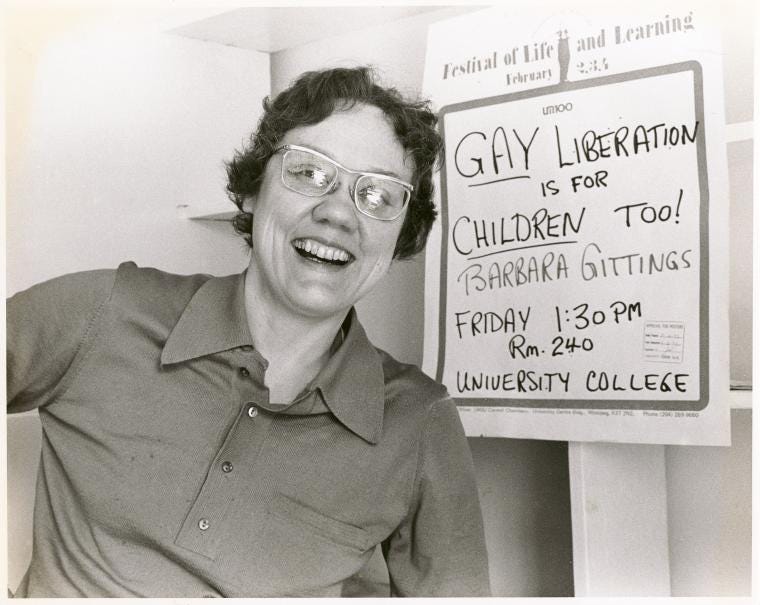
In the dark fucking ages of American psychiatry, when homosexuality was classified as a mental illness and queer people were subjected to electroshock therapy, chemical castration, and lobotomies in the name of “treatment,” Barbara Gittings stood up and said what needed to be said: “We’re not sick, you assholes.” Born in 1932 in Vienna, Austria, to American parents, Gittings didn’t just challenge the psychiatric establishment’s classification of homosexuality as pathology—she dismantled it piece by piece with the methodical precision of the librarian she was and the righteous fury of a woman who had spent her entire adult life watching her community be tortured by medical professionals who should have been helping them.
Gittings wasn’t content to politely ask for acceptance or quietly hope that attitudes would change. She organized, she protested, she confronted the American Psychiatric Association directly, and she refused to let them continue pathologizing her existence without a fight. When the APA finally removed homosexuality from their Diagnostic and Statistical Manual in 1973, it wasn’t because they suddenly developed enlightened attitudes—it was because activists like Gittings had made their position scientifically and politically untenable. She didn’t just change a classification; she helped save thousands of lives by ending the medical justification for torturing gay people into compliance.
The Making of a Revolutionary: From Confusion to Clarity
Barbara Gittings’s journey to activism began in the most American way possible—in a college library, researching her own fucking existence because nobody else would give her straight answers about what it meant to be attracted to women. Born into a middle-class family that moved frequently due to her father’s work, she grew up feeling different but having no language or framework to understand why.
When she enrolled at Northwestern University in 1950, she was a typical college student in every way except one: she was desperately trying to figure out why she was attracted to women instead of men. In an era when homosexuality was literally unspeakable in polite society, when the very word “lesbian” was considered so shocking that newspapers wouldn’t print it, Gittings did what any good researcher would do—she went to the library.
What she found there was a psychological horror show disguised as medical literature. Book after book described homosexuality as a mental illness, a developmental disorder, a psychological pathology that could and should be cured. The “experts” had a whole arsenal of explanations for why people like her existed—overbearing mothers, absent fathers, childhood trauma, arrested development—and an even more horrifying arsenal of “treatments” designed to fix them.
The psychological impact of reading this shit cannot be overstated. Imagine being a young woman trying to understand herself and discovering that every medical authority in your society considers your very existence to be evidence of mental illness. The internalized shame, self-doubt, and fear that this “research” created in LGBTQIA+ people was devastating and intentional—designed to make them compliant with attempts to “cure” them.
But Gittings had something that many of her peers lacked: a librarian’s skepticism about sources and a growing suspicion that the experts might be full of shit. The more she read, the more she began to question whether the problem was with homosexuality or with the people studying it.
The Mattachine Society: Where Polite Activism Met Reality
In 1958, Gittings discovered the Mattachine Society, one of the earliest gay rights organizations in America, and it changed her life forever. But it also pissed her off. The organization, founded in the early 1950s, was committed to what they called “accommodation”—basically, trying to prove to straight society that gay people were just like everyone else, except for that one little detail about whom they fucked.
The Mattachine approach was understandable given the political climate of the 1950s—this was the era of McCarthyism, when being gay could cost you your job, your security clearance, and your freedom. The organization’s founders believed that the best strategy was to keep their heads down, be respectable, and hope that straight society would eventually accept them as harmless.
Gittings thought this approach was bullshit, and she wasn’t afraid to say so. She joined the New York chapter of Mattachine in 1958 and immediately began pushing for more visible, more confrontational activism. She understood something that the old guard didn’t: that respectability politics wouldn’t work because the problem wasn’t that gay people were too visible—it was that they weren’t visible enough.
Her psychological insight was profound: as long as gay people remained hidden, straight society could continue to believe whatever stereotypes and prejudices they wanted about homosexuality. The only way to change attitudes was to force people to confront the reality of gay existence—to see actual gay people living actual lives rather than the pathological caricatures promoted by the medical establishment.
The Daughters of Bilitis: Creating Community Through Visibility
In 1958, Gittings also became involved with the Daughters of Bilitis, the first lesbian organization in the United States. Founded in San Francisco in 1955, DOB was even more conservative than Mattachine, focused primarily on providing social opportunities for lesbian women in a safe, private environment.
But Gittings wasn’t interested in hiding. She became the editor of The Ladder, DOB’s newsletter, and immediately began transforming it from a timid publication that avoided anything controversial into a bold voice for lesbian rights and visibility. Under her editorship, The Ladder began featuring photographs of lesbians (with their permission), publishing articles that challenged the medical pathologizing of homosexuality, and providing positive representations of lesbian relationships.
This shift toward visibility was revolutionary in ways that are hard to understand today. In the 1960s, most gay publications featured either no photographs of gay people or images that were so heavily shadowed or cropped that the subjects were unrecognizable. The idea that lesbians would allow their faces to be published in a gay magazine was considered so dangerous that many DOB members were horrified by Gittings’s approach.
But Gittings understood the psychological importance of representation. She knew that isolated lesbians across the country were reading The Ladder as their only connection to lesbian community, and she wanted them to see that lesbians were real people with real lives, not the pathological specimens described in medical literature.
The psychological impact of this visibility cannot be overstated. For many readers, The Ladder was the first place they had ever seen positive representations of lesbian existence. It provided both validation and hope—proof that they weren’t alone and that other women like them were not only surviving but thriving.
The Confrontation Strategy: Making Homosexuality Impossible to Ignore
By the early 1960s, Gittings was convinced that the gay rights movement’s strategy of respectability and accommodation was not only ineffective but counterproductive. She began advocating for what she called “confrontation”—direct, visible challenges to discrimination and prejudice that would force society to deal with gay people as real human beings rather than abstract concepts.
In 1965, she organized the first gay rights picket in front of the White House, protesting the federal government’s ban on employing gay people. The images of well-dressed gay men and lesbians carrying signs demanding equal rights were shocking to a society that had never been forced to confront organized homosexual political action.
The psychological courage required for these early demonstrations cannot be overstated. The participants were risking their jobs, their families, their safety, and their freedom by identifying themselves publicly as homosexuals. Many wore sunglasses or otherwise tried to disguise their faces, but they showed up anyway because they understood that visibility was the price of liberation.
Gittings’s strategic insight was brilliant: by presenting gay people as ordinary Americans demanding basic civil rights rather than patients seeking treatment for mental illness, she was reframing the entire discourse around homosexuality. She was moving the conversation from the medical model—where gay people were sick individuals who needed to be cured—to the civil rights model—where gay people were a minority group facing discrimination.
The War Against Psychiatric Oppression
But Gittings’s most important battle was against the psychiatric establishment itself. She understood that as long as homosexuality was classified as a mental illness, gay people would continue to be subjected to “treatments” that were actually torture, and society would continue to view them as fundamentally defective.
The psychiatric profession’s approach to homosexuality in the 1960s was a fucking nightmare. Therapists were using electroshock therapy, aversion therapy (including showing gay men pictures of naked men while administering electric shocks or nausea-inducing drugs), hormone treatments, and even lobotomies to try to “cure” homosexuality. These treatments didn’t work—they couldn’t work, because there was nothing to cure—but they destroyed thousands of lives and caused immeasurable psychological trauma.
Gittings began a systematic campaign to challenge the psychiatric establishment’s classification of homosexuality as mental illness. She studied the research, attended psychiatric conferences, and began confronting psychiatrists directly about their unscientific and harmful approaches to treating gay people.
Her psychological insight was devastating to the psychiatric establishment: she pointed out that their research was fundamentally flawed because it was based entirely on gay people who were seeking treatment or who had been forced into treatment. It’s like studying cancer by only looking at people who are dying from it and then concluding that cancer is always fatal.
The vast majority of gay people, Gittings argued, were living perfectly healthy, productive lives without any need for psychiatric intervention. The only reason they might seek therapy was to deal with the psychological damage caused by living in a society that told them they were sick.
The APA Infiltration: Activism from Within
Gittings’s most brilliant tactical move was her decision to infiltrate the American Psychiatric Association’s own conferences and meetings. Starting in the late 1960s, she began attending APA meetings not as a patient or a researcher, but as an activist demanding that gay voices be heard in discussions about homosexuality.
This was psychological warfare at its finest. Psychiatrists were used to talking about gay people, not to gay people. They were comfortable theorizing about homosexuality in the abstract but deeply uncomfortable being confronted by actual homosexuals who refused to accept their pathological classifications.
In 1972, Gittings organized a panel at the APA’s annual meeting titled “Psychiatry: Friend or Foe to Homosexuals?” The panel included both hostile and sympathetic psychiatrists, but the real bombshell was the appearance of “Dr. H. Anonymous”—a gay psychiatrist who spoke from behind a mask and with a voice modulator to protect his identity while describing the discrimination and fear that gay medical professionals faced within their own profession.
The psychological impact of this presentation on the psychiatric establishment was enormous. For the first time, many psychiatrists were forced to confront the possibility that their colleagues—people they respected and worked with—might be gay themselves. It shattered the comfortable distance between the treaters and the treated.
The Victory: When Science Finally Caught Up with Reality
The combination of Gittings’s activism, changing social attitudes, and pressure from within the psychiatric profession itself finally led to the APA’s decision in 1973 to remove homosexuality from the Diagnostic and Statistical Manual of Mental Disorders. This wasn’t just a bureaucratic change—it was a fundamental shift in how American society understood homosexuality.
The psychological impact of this victory on the LGBTQIA+ community cannot be overstated. Overnight, millions of gay people were no longer officially mentally ill. Parents could no longer force their gay children into psychiatric treatment. Insurance companies could no longer pay for “conversion therapy.” The medical justification for discrimination and violence against gay people had been removed.
But Gittings understood that the victory was fragile. She continued her activism, working to ensure that the APA’s decision stuck and that other medical and psychological organizations followed suit. She also worked to educate mental health professionals about how to provide genuinely helpful therapy to LGBTQIA+ people—therapy that affirmed their identities rather than trying to change them.
The philosophical implications of this victory were profound. For the first time in modern American history, a minority group had successfully challenged the medical establishment’s classification of their identity as pathological. It established an important precedent for other groups facing medical discrimination and provided a model for how activism could challenge supposedly scientific authority.
The Personal Cost of Public Activism
Gittings’s decades of activism came with significant personal costs. She faced job discrimination, social ostracism, and constant stress from being a public target for anti-gay hostility. Her relationship with her partner, Kay Tobin (later Kay Tobin Lahusen), was subjected to scrutiny and criticism from both hostile straight society and conservative elements within the gay community who thought she was too visible, too confrontational, too unwilling to compromise.
The psychological toll of being a full-time activist for an unpopular cause was enormous. Gittings dealt with depression, anxiety, and the constant stress of knowing that her public visibility made her a target for violence and harassment. She also faced criticism from within the gay community—from people who thought her tactics were too aggressive and from younger activists who thought she wasn’t radical enough.
But she persisted because she understood that the stakes were too high for compromise. Every day that homosexuality remained classified as mental illness, gay people were being subjected to harmful “treatments.” Every day that gay people remained invisible, young LGBTQIA+ people were growing up believing they were fundamentally broken.
Her commitment to the cause required sacrificing many of the normal pleasures and securities of life. She couldn’t have a completely private relationship, couldn’t avoid political controversy, couldn’t retreat into the kind of respectability that might have made her life easier but would have betrayed the people counting on her activism.
The Intersection of Library Science and Liberation
Gittings’s background as a librarian profoundly shaped her approach to activism. She understood the power of information, the importance of documentation, and the need to preserve the historical record of LGBTQIA+ resistance. Her work wasn’t just about changing laws or policies—it was about changing the fundamental narratives that society told about gay people.
She applied librarian principles to activism: careful research, systematic organization, preservation of documents, and broad dissemination of information. She understood that lasting social change required changing not just attitudes but the underlying information systems that shaped those attitudes.
Her work with The Ladder exemplified this approach. She transformed it from a social newsletter into a comprehensive archive of lesbian thought, experience, and resistance. She published articles by and about lesbians from all walks of life, creating a literary and intellectual tradition that had previously been almost completely suppressed.
The psychological importance of this work cannot be overstated. For isolated LGBTQIA+ people across the country, publications like The Ladder were lifelines—proof that they weren’t alone, that other people shared their experiences, and that their lives had value and meaning beyond what mainstream society acknowledged.
The Legacy of Confrontational Activism
Gittings’s approach to activism—direct, confrontational, unwilling to compromise on fundamental questions of dignity and rights—provided a model for later LGBTQIA+ activists and for other social justice movements. She demonstrated that marginalized groups didn’t have to wait for permission to demand equality, didn’t have to prove their worthiness for basic human rights, and didn’t have to accept expert opinion that contradicted their lived experience.
Her victory over the psychiatric establishment proved that supposedly scientific authority could be challenged and changed when it was based on prejudice rather than evidence. This lesson has been crucial for other communities facing medical discrimination, from transgender people challenging pathological classifications of gender identity to fat activists challenging medical assumptions about weight and health.
The psychological liberation that her work provided to LGBTQIA+ people continues to reverberate today. Every time someone refuses to accept a mental health professional’s attempt to pathologize their sexual orientation or gender identity, every time an LGBTQIA+ person demands affirmative therapy rather than conversion therapy, every time someone challenges medical authority that contradicts their lived experience, they’re building on the foundation that Gittings laid.
The Continuing Relevance of Information Warfare
In an era when LGBTQIA+ rights are again under attack, when conversion therapy is being repackaged and promoted by religious and political conservatives, when young LGBTQIA+ people are being told that their identities are phases or mental illnesses, Gittings’s example remains urgently relevant.
Her understanding that information is power, that representation matters, and that marginalized communities must control their own narratives provides a roadmap for contemporary activism. She showed that it’s possible to challenge expert authority when that authority is being used to harm rather than help, and that sustained, organized resistance can change even the most entrenched institutional prejudices.
The psychological principles she identified—that visibility reduces stigma, that community reduces isolation, that accurate information reduces fear—remain as relevant today as they were in the 1960s. Her work reminds us that the fight for LGBTQIA+ rights isn’t just about laws and policies—it’s about the fundamental right to exist without being pathologized, criminalized, or erased.
The Sacred Act of Refusing to Be Sick
Perhaps Gittings’s greatest contribution to LGBTQIA+ liberation was her simple, revolutionary insistence that being gay was not a sickness. This wasn’t just a political position—it was a spiritual and psychological stance that transformed how millions of people understood themselves.
By refusing to accept the psychiatric establishment’s pathological classification of homosexuality, she was asserting something profoundly important: that LGBTQIA+ people were the ultimate authorities on their own experience, that scientific-sounding prejudice was still prejudice, and that no one had the right to define another person’s identity as inherently disordered.
This principle—that marginalized people are experts on their own lives—has become central to contemporary social justice movements. From disability rights activists challenging medical models that pathologize difference to racial justice activists challenging psychological theories that blame victims for systemic oppression, Gittings’s example continues to inspire people who refuse to let experts define their experiences for them.
The Revolutionary Power of Saying “Fuck That”
Barbara Gittings’s legacy can be summed up in her fundamental refusal to accept bullshit, even when that bullshit came with medical degrees and official stamps of approval. She looked at a psychiatric establishment that was torturing gay people in the name of treatment and said, essentially, “Fuck that. We’re not sick, you’re the ones with the problem.”
This kind of clarity—the ability to see through official rhetoric to underlying prejudice—is what made her such an effective activist. She wasn’t intimidated by credentials or authority when those credentials were being used to justify harm. She trusted her own experience and the experiences of her community over the theories of people who had never lived what they were trying to explain.
Her victory over the APA wasn’t just a policy change—it was proof that marginalized communities have the power to challenge and change even the most entrenched systems of oppression when they organize, persist, and refuse to accept definitions of themselves created by their oppressors.
The revolution she started continues today, carried forward by every LGBTQIA+ person who refuses to be pathologized, every activist who challenges expert authority that contradicts lived experience, and every individual who understands that the most radical act is sometimes simply insisting on your right to define yourself.
Holy shit, what a legacy: she helped save an entire community from medical torture by having the courage to tell the experts they were wrong. That’s the kind of revolutionary clarity the world needs more of—the willingness to trust your own experience, challenge authority that causes harm, and never stop fighting until justice is achieved.
July 17, 1927 In a significant early use of close air support, a U.S. Marine squadron of seven airplanes dive-bombed rebels and peasants surrounding Marines and Nicaraguan military (then under direct U.S. control) in Ocotal, Nicaragua, killing more than 100. The rebels were opposed the presence of U.S. forces, essentially continuously in their country since 1909. Why was the U.S. in Nicaragua?
July 17, 1970 The Young Lords Party entered the Lincoln Hospital in the South Bronx, NYC. The hospital, located in a condemned and dilapidated building, was filled with pain, degradation, neglect, flies, and humiliation. The YLP set up care units in the Hospital, and drew attention to the abysmal conditions. The direct-action takeover prompted a response by the government, and the building of a new Lincoln Hospital. The Lincoln Hospital Offensive
=July 17, 1976 The opening ceremony of the 21st Olympic Games in Montreal was marked by the withdrawal of more than twenty African countries, Iraq and Guyana, and their 300 athletes. They had demanded that New Zealand be banned from participation because its national rugby team had toured South Africa, itself banned from the Olympics since 1964 for its refusal to end the racially separatist policy of apartheid. The Soweto Massacre, in which 150 children were killed by South African troops, had occurred just one month earlier. The apartheid government had been using international sport as a means to build respectability. The following year, however, in reaction to the Olympic boycott, the nations of the British Commonwealth (which includes New Zealand) adopted the Gleneagles Agreement, discouraging all sporting contacts with South Africa. African countries boycott Olympics Gleneagles Agreement (It’s a .pdf)
July 17, 1979 Fighters of the Sandinista National Liberation Front overthrew the U.S.-supported dictatorial regime of Anastasio Somoza in the Central American republic of Nicaragua and forced him to flee the country. The notorious and feared U.S.-trained National Guard crumbled and its surviving commanders negotiated a surrender, despite their superiority in armaments. The Sandanista Revolution Anastasio Somoza Girls born after the historic Sandinista victory. Legal voting age in Nicaragua is 16 years. The overthrow: Sandinista rebels take Nicaraguan capital
We may have seen this here before, I don’t recall. We’ve each probably seen it somewhere before. It’s still funny! Laughter releases endorphins; those endorphins make us stronger. Enjoy!
If you head to the Louvre, make sure you visit the Mona Lisa, Venus de Milo, and Liberty Leading the People. But then swing by the Department of Greek, Etruscan, and Roman Antiquities. There you might find (no guarantee!) a Roman mosaic featuring a rabbit riding a chariot pulled by geese. Discovered at Hadrian’s villa in Tivoli, Italy, the mosaic dates back to the 2nd century. About the mosaic, the History Cool Kidswrites:
This kind of humorous scene is an example of asária, a type of ancient visual joke where animals behave like humans (anthropomorphism). Such mosaics were popular in Roman domestic decoration, often as floor or wall panels in villas and bathhouses.
This particular mosaic is part of the Louvre’s extensive collection of Greek, Etruscan, and Roman Antiquities. It illustrates how Roman artists loved playful or satirical imagery alongside more serious mythological and realistic scenes. The rabbit, a symbol often associated with fertility and speed, paired with the absurdity of it driving a chariot of geese, reflects both Roman wit and their fondness for decorative exuberance.
Some scholars believe the mosaic plays on a line in Ovid’s Metamorphoses: “Cytherea [Aphrodite] was riding in her dainty chariot, winged by her swans, across the middle air making for Cyprus, when she heard afar Adonis’ dying groans, and thither turned her snowy birds.” But it’s hard to know for sure.







 Scottie's Playtime