Springfield, Ohio's city hall was evacuated this morning due to a bomb threat.
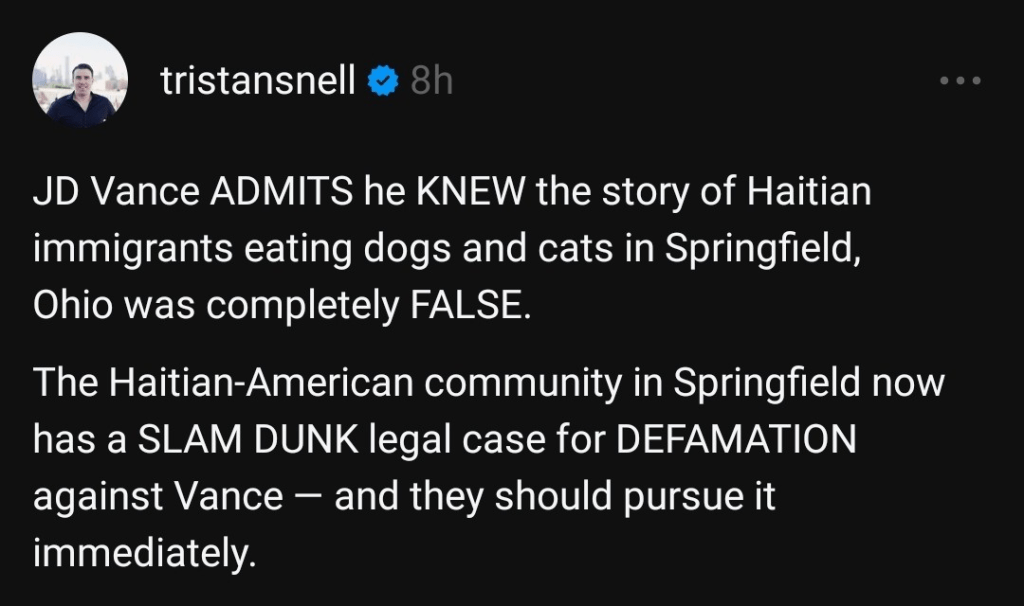
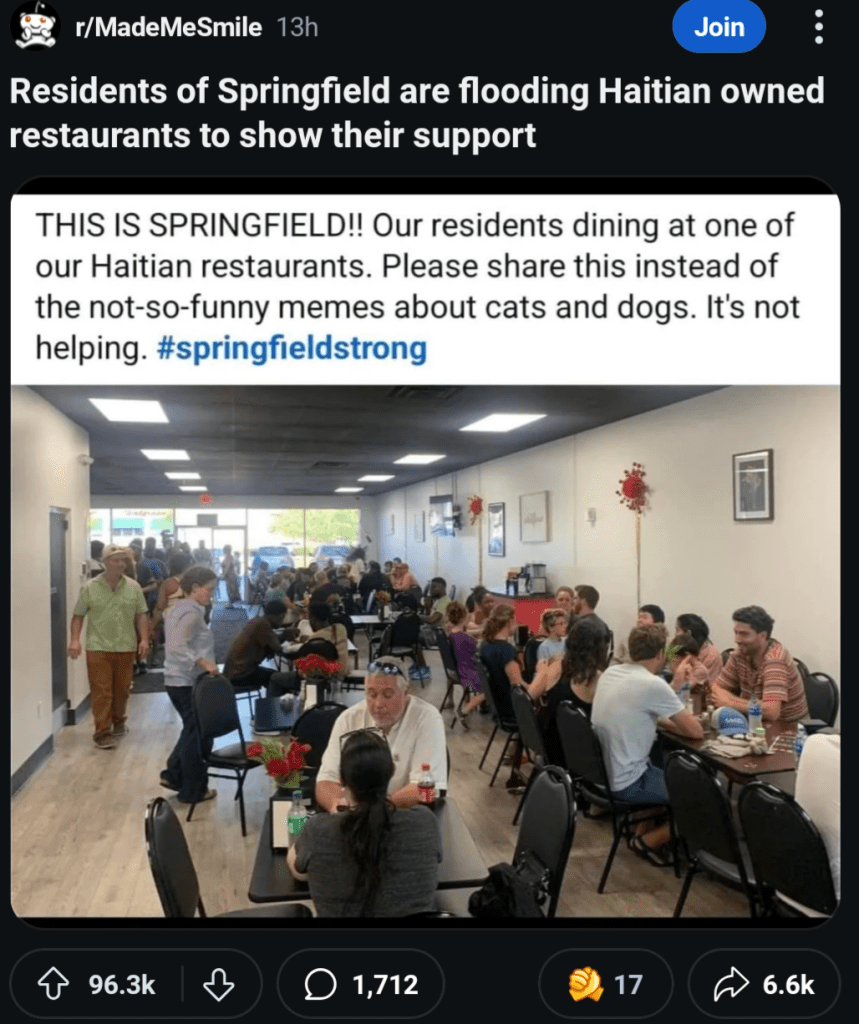
This comes two days after former President Donald Trump boosted the baseless rumor that Haitian immigrants there were “eating the pets of the people that live there.” pic.twitter.com/VnCwYE5Zpy
Springfield Police confirmed to me that "multiple facilities" including at least city hall and Fulton Elementary have been evacuated due to a bomb threat received around 8:20 this morning https://t.co/MyOVu2bgze
Wittenberg University is currently taking precautions following a possible threat to campus tomorrow, Sunday, Sept. 15, 2024. All events and activities tomorrow are canceled. See alert website at https://t.co/q8SBqL88p1 for more information, safety tips, and resources. pic.twitter.com/w7GcwjIlWC
Ohio Gov. Mike DeWine defends Haitian immigrants, telling @MarthaRaddatz that while there are “legitimate” problems at the border, “What’s going on in Springfield is just fundamentally different.”
A day after a Springfield school and other public buildings were evacuated and closed due to bomb threats, and the same day that two other Springfield elementary schools were evacuated and one middle school closed due to a new, separate bomb threat, Husted posted a photo of two geese on X Friday morning with the comment, “Most Americans agree that these migrants should be deported.”Husted’s spox has refused to comment. He first appeared here in 2012 when as Ohio secretary of state he eliminated extended hours for early voting.
NEW: Fraudulent petition signatures cited by the DeSantis administration to justify its probe of Amendment 4 had already been rejected by a local supervisor of elections.
They were never counted toward the total that got the initiative on the ballot. https://t.co/f0sXetVwUW
Ron DeSantis has mobilized the Florida state government to spend taxpayer resources on the political process. He's now waging a multi-front war against Amendment 4, which would restore abortion rights pic.twitter.com/QreyQAi7Kn
This kind of propaganda issued by the state, using taxpayer money and operating outside of the political process sets a dangerous precedent.https://t.co/dJbVj8A6kK
After sending police to knock on doors of voters who signed petitions to get the FL abortion rights amendment on the ballot, now Ron Desantis is using taxpayer funds to illegally have a state agency & website campaign against the amendment. Story.https://t.co/2ywnO6kALR
BREAKING: In a 2022 tirade against reproductive health care, Mark Robinson repeatedly waves his hand by his groin, says young women just need to “get this under control." #NCGovpic.twitter.com/QXuUtZuBAL
“When people ask me…What’s gonna happen if the Flip – Flopping, Laughing Hyena Wins?? I say…write down all the addresses of the people who had her signs in their yards! Sooo…when the Illegal human ‘Locust’ (which she supports!) Need places to live…We’ll already have the addresses of the their New families…who supported their arrival!” Zuchowski wrote.
Read the full article. Replies to his post are turned off. Zuchowski made news several years ago for a rant about the name change for the Cleveland Indians, which he claimed was “erasing our heritage.”
Ryan Routh voted for Trump in 16’, then supported Gabbard, and then moved on to Hailey. He’s no liberal. He’s a Republican who is disillusioned with Trump’s foreign policy and Putin-phelia. pic.twitter.com/PaEkWoPcqX
Suspect Ryan Wesley Routh is a Democrat. He was allegedly hiding in the bushes with an AK-47 with a scope, two backpacks, and a GoPro and was spotted by the Secret Service before he could take action on President Trump #shootingpic.twitter.com/3xkbB7EU19
Elon/X has allowed someone to create a fake account under the alleged shooter’s name (Ryan Wesley Routh), and it’s now being used to spread vile anti-Semitic content including quotes from a Hitler account that X is also allowing on the platform. pic.twitter.com/reqGUcmynS
“I’ve seen the guns myself and all, and, yeah, they had a lot of guns and stuff over there, and, yeah, a lot of people were afraid of him back in the day,” she said.
The State Attorney for Palm Beach County is an elected Democrat, so Desantis is doing what Desantis does.
Maybe Desantis should investigate himself for making it so easy to acquire and walk around with an assault rifle in FL even with an extensive criminal history. pic.twitter.com/DwAWAE928L
“These are people that want to destroy our country. It is called the enemy from within. They are the real threat. They do it with a combination of rhetoric and lawsuits they wrap me up in.
September 15, 1915 In a letter, Turkish Minister of the Interior Mehmet Talaat Pasha explained that the real intention of sending the Armenians to the Der-el-Zor (Deir el-Zor) Desert (now in Syria) was to annihilate them. Talaat had primary responsibility for planning and implementing the Armenian Genocide. The day before, The New York Times reported that the murder of 350,000 Armenians in Turkey had already occurred. 1915, orphaned Armenian children in the open, many covering their heads from the desert sun. Location: Ottoman empire, region Syria. The Turkish Adolf Eichmann
September 15, 1935 The “Law for the Protection of German Blood and German Honor” and the “Reich Citizenship Law” were adopted by the Nazi (National Socialist German Workers’) Party Rally in Nuremberg, depriving German Jews of their citizenship.
September 15, 1963 During Sunday School, 15 sticks of dynamite blew apart the Sixteenth Street Baptist Church in Birmingham, Alabama, killing four children in the basement changing room, and injuring 23 others. Prime suspects were the Ku Klux Klan (KKK) and Nacirema (both white supremacist organizations; Nacirema is “American” spelled backwards). A week before the bombing Governor George C. Wallace had told The New York Times that to stop integration, Alabama needed a “few first-class funerals.” The four girls lost in the Sixteenth Street Baptist Church bombing, the ruins of the church and grieving parents This event set off racial rioting and other violence in which two African-American boys were shot to death, and became a turning point in generating broad American sympathy for the civil rights movement. A member of the church, studying on a scholarship in Paris at the time, was Birmingham High School student Angela Davis. Lives cut short… Addie Mae Collins (14), Cynthia Wesley (14), Caole Robertson (14), Denise McNair (11) Read more
September 15, 1981 A blockade started at a nuclear power plant construction site in Diablo Canyon near San Luis Obispo, California. Nearly 10,000 people tried to prevent fuel rods from being loaded into the two reactor cores. Over two weeks, 1,901 are arrested in the largest occupation of a nuclear power site in U.S. history. Their immediate major concern was over the region being seismically active and the plant’s location near the Hosgri fault. In 2004 a 6.5 (on the Richter Scale) earthquake was centered less than 40 miles from the plant. Four other faults nearby have since been identified. Additionally, 9.5 billion liters (2.5 billion gallons) of water needed to cool the reactors each day are discharged directly into the Pacific 11°C (20°F) warmer than the surrounding ocean water, affecting marine plant and animal life there.Diablo canyon As with all nuclear plants, the problem remains with storage of spent nuclear fuel that remains dangerously radioactive for more than 10,000 years. Diablo Canyon generates 110 spent fuel rod assemblies each year. There is still no satisfactory solution to this long-term storage problem. Diablo Canyon timeline
September 15, 1986 Veterans Duncan Murphy (World War II) and Brian Willson (Vietnam) joined Charles Liteky & George Mizo in the Fast For Life, opposing U.S. support for the terrorist contra war against Nicaragua. The contras were insurgent guerillas using violence against civilians in the countryside to bring down the newly formed Sandanista government. The contras were supported in contravention of the Boland Amendment which prohibited U.S. agencies from providing military equipment, training or support to anyone “for the purpose of overthrowing the Government of Nicaragua.” Duncan Murphy, Brian Willson, Charles Liteky, George Mizo The Fast for Life from Brian Willson’s perspective
September 15, 1996 6,000 rallied and 1,033 were arrested near the Headwaters Grove in rural Carlotta, California, in protest against cutting one of the last large unlogged stands of redwood trees in the world. Redwoods are coniferous trees (sequoia sempervivens: the genus is named for Sequoya, or George Guess, an American Indian scholar; sempervivens is ever alive in Latin) that can reach over 90m (300 ft.) over a life as long as 2000 years.
September 15, 1997 Sinn Fein, the political party closely allied with the goals of the Irish Republican Army (IRA), entered Northern Ireland’s peace talks for the first time.
September 15, 2001 Four days after 9/11, Representative Barbara Lee (D-California) cast the only congressional vote against authorizing President Bush to use “all necessary and appropriate force” against anyone associated with the terrorist attacks of September 11. “I am convinced that military action will not prevent further acts of international terrorism against the United States.” Barbara Lee – Alone on the Hill
The presidential election has turned into a contest between a capable, smart woman who emphasizes what Americans can achieve when they work together for the common good, and a sundowning old racist creep who would be pathetic if he weren’t so dangerously close to returning to power.
In case you’re wondering what the difference looks like, compare the hate and division the old racist creep is spreading with some recent announcements from President Joe Biden’s administration, nearly all of them about programs funded by one or another of Biden’s big legislative packages. Just a little reminder of why elections matter, and of the legacy that Kamala Harris is committed to building on. For, y’know, the people.
taking the Covid vac with other shots; I did flu and Covid yesterday, got tired and achey around 6 hours later, and chilled and sweated through the night. I did sleep some, but not as usual, and I’m exhausted today. Corky’s not even nagging me about a walk, she can tell, with her doggy ESP, that I really don’t feel good. Anyway, I thought I’d pass that along. I admire people who take both or more of the vacs, then live through this each year, but I’m going back to getting one one week, the other the next week. I sailed through, comparatively, last year doing that. But now I know! And it is true I do not have to go back next week for another shot. 👨⚕️
(Back in the 80s I heard a story of Norman Cousins putting his apple juice in a specimen cup, then later taking a sip while listening to a visitor. I think of Norman Cousins when I see headlines like this one. I don’t believe he was a clown, but others’s mileage may vary, as to humor in the hospital, also Norman Cousins, not to mention clowns.)
Credit: FatCamera / Getty Images
Medical clowns are known to have a positive therapeutic impact on kids in hospitals for a range of health issues, and now it’s been shown they can reduce the length of stay and antibiotic use for children with pneumonia.
A study, done on 51 children, found that those visited by medical clowns on average left hospital more than a day earlier than those who weren’t.
“Medical clowns undergo specific training to work in hospitals,” says Dr Karin Yaacoby-Bianu, a researcher at the Carmel Medical Centre and Israel Institute of Technology, Israel.
“They have been shown to reduce pain and alleviate stress and anxiety in children and their families during medical treatment, and have been gradually integrated into many aspects of hospital care.
“But their impact on children being treated for pneumonia has not been investigated.”
“Community acquired pneumonia is one of the leading causes of hospitalisation in children, globally,” she says.
The team split 51 children, aged between 2 and 18, who had been hospitalised with pneumonia, into 2 groups.
They all received standard care, but one group also had four 15-minute visits from a medical clown from the Dream Doctors Project during their stays.
Medical clown ‘tres jolie’. Credit: Dream Doctors/European Respiratory Society
The clowns did a variety of activities including music, singing, and guided imagination.
The group visited by clowns stayed in hospital for 43.5 hours on average, while the control group stayed in hospital for 70 hours on average.
Children visited by clowns needed an average of 2 days of IV antibiotic treatment, while the control group required 3. Other medical markers, like heart rate and inflammation, were lower in the clown group.
“While the practice of medical clowning is not a standardised interaction, we believe that it helps to alleviate stress and anxiety, improves psychological adjustment to the hospital environment and allows patients to better participate in treatment plans like adherence to oral antibiotics and fluids,” explains Yaacoby-Bianu.
“Laughter and humour may also have direct physiological benefits by lowering respiratory and heart rates, reducing air trapping, modulating hormones, and enhancing the immune function.”
Dr Stefan Unger, a paediatrician at the Royal Hospital for Children and Young People Edinburgh, UK, who wasn’t involved in the research, says the study shows the positive effect humour can have in healthcare. (snip-MORE)
Barbara Gittings was a lover of books. She realized, from a young age, that she also loved girls. So when, in 1949, she left Wilmington, Delaware to attend Northwestern University, she did what any bookish young lesbian would do: research homosexuality in the school’s library. What Gittings found was not comforting. The vast majority of sources were written by medical professionals and described homosexuality as an illness or a perversion. She became so consumed with spending time in various Chicago libraries that she neglected her coursework and flunked out of school. But as a result of the discouraging information she found, an activist was born. With passion, determination, and what she would come to refer to as “gay gumption,” Gittings would spend the rest of her life working, in various ways, to correct those lies she found in the pages of books and scientific journals on the library shelves.
Gittings moved to Philadelphia in 1950 and supported herself with part-time clerical work. She continued to read everything she could find on homosexuality and, as part of her search, discovered Donald Webster Cory’s The Homosexual in America: A Subjective Approach, originally published in 1951. Gittings was particularly impressed with Cory’s arguments that gays and lesbians constituted a large unrecognized minority who deserved civil rights and his attempts to cultivate empathy in his readers by outlining the difficulties faced by American homosexuals. She wrote to Cory’s publisher and discovered he lived in New York City. The two met on several occasions, and Cory informed Gittings of a newly-formed gay organization in Los Angeles: the Mattachine Society, founded in 1950 by Harry Hay.
In the summer of 1956, when she was on vacation from her office job, Gittings boarded a plane to Los Angeles and visited the office of ONE, Inc., a homophile organization who had amicably split from the Mattachine Society in 1952. The members of ONE, Inc. informed her of the existence of a San Francisco-based organization for lesbians, the Daughters of Bilitis (DOB), founded in 1955 by lesbian partners Del Martin and Phyllis Lyon.
Gittings once again boarded a plane, this time bound for San Francisco. The DOB were, fatefully, having a meeting that very evening in a member’s apartment. The meeting was the first time in her life Gittings would interact with a group of lesbians outside of a bar setting. Two years later, in 1958, Gittings officially joined the DOB and was tapped by Martin and Lyon to start an East Coast chapter of the organization based in New York City. With her co-founder, Marion Glass, Gittings built the chapter into the largest in the country.
In 1963, Gittings, whose enthusiasm and knowledge of literature left an impression on Martin and Lyon, was tapped to be the editor of The Ladder, the DOB’s national magazine for gay women. Gittings transformed The Ladder from what was essentially a newsletter to a national magazine respected within gay circles. With the help of her partner, Kay “Tobin” Lahusen, whom she met in 1961 at a DOB picnic in Rhode Island, Gittings replaced the amateurish illustrations that typically adorned the cover of The Ladder with photographs taken by Lahusen of actual lesbians who appeared confident and happy.
Gittings began to take The Ladder in an increasingly militant direction, reporting on protests, questioning the merits of various activist strategies such as picketing, and engaging in debates with so-called “experts,” arguing that homosexuality was a social and cultural problem, not a psychological problem. The activist bent of The Ladder under Gittings’ editorship alarmed the West Coast leadership of the DOB. When Gittings, amidst her many activities on behalf of gay rights, was late with the August 1966 issue, Martin and Lyon used her tardiness as an excuse to oust her as editor.
Gittings would also find a kindred spirit in Frank Kameny, who she credited as the first person to articulate a fully coherent philosophy of gay rights. She and Lahusen partnered with Mattachine Washington, of which Kameny was a co-founder, working alongside other lesbians and gay men to directly challenge the federal government. Gittings participated in the first picket of the White House for homosexual rights on April 17th of 1965.
Gittings worked with Kameny and other activists to lobby the American Psychiatric Association (APA) to remove homosexuality as a diagnostic category from the Diagnostic and Statistical Manual (DSM). At the APA’s 1972 conference, held in Dallas, Texas, Gittings, Kameny, and Lahusen created a display entitled “Gay, Proud, and Healthy: The Homosexual Community Speaks.” The exhibit, which featured photographs of gay couples taken by Lahusen, was adorned with the word “LOVE” in bold letters and portrayed gay people as healthy and happy, not as patients who were tormented and in need of a cure. In December of 1973, the APA board of trustees voted to pass a resolution to remove homosexuality from the DSM, effectively declassifying it as a mental illness.
Gittings was a lifelong bibliophile, and though she recognized the importance of taking on the federal government and institutions such as the APA, she never lost sight of the “lies in the libraries” she discovered as a college freshman and the importance of gay representation. In 1970, she joined the American Library Association’s (ALA) newly-formed Task Force on Gay Liberation (TFGL). The TFGL, whose mission was to provide support for gay librarians within the profession and increase gay representation in libraries, was glad to have a veteran activist like Gittings join their ranks.
With the help of Israel Fishman, the first coordinator of the TFGL, Gittings organized a gay kissing booth — titled “Hug-a-Homosexual: Free Kisses” — for the 1971 ALA conference in Dallas, Texas. While the group could have created a nice display featuring gay books, periodicals, and their bibliography, they instead decided to make their presence known by showing gay love live. The publicity was better than Gittings and the TFGL could have imagined, and continued to spark discussions within the ALA over the next year.
In 1999, in honor of her contributions to create more visibility for gays and lesbians in libraries and in the profession, Gittings was awarded a lifetime membership at the annual ALA conference, held that year in New Orleans, Louisiana. The ALA also named an award after Gittings as part of their Stonewall Book Awards, sponsored by the Gay, Lesbian, Bisexual, and Transgender Round Table (GLBTRT), the contemporary iteration of the TFGL. The Stonewall Book Award-Barbara Gittings Literature Award is given annually for works of fiction that exhibit “exceptional merit relating to the LGBT experience.”
Barbara Gittings died on February 18th, 2007 at the age of 74 after a long battle with breast cancer. In a 1999 interview with American Libraries magazine, she summarized her career as a gay activist with the wit and wisdom she was known for:
“As a teenager, I had to struggle alone to learn about myself and what it meant to be gay. Now for 48 years I’ve had the satisfaction of working with other gay people all across the country to get the bigots off our backs, to oil the closet door hinges, to change prejudiced hearts and minds, and to show that gay love is good for us and for the rest of the world too. It’s hard work — but it’s vital, and it’s gratifying, and it’s often fun!”
Telling tourists on the Great Barrier Reef about climate change doesn’t negatively affect their trip, according to a new study.
Instead, finds the research, it could be a good avenue to promote climate action for people who wouldn’t otherwise be engaged.
The study, done by a team of Queensland researchers, is published in People and Nature.
“Tourism operators are getting more engaged in learning how they can spread more awareness, given the state of the Reef and how urgent it’s getting,” says lead author Dr Yolanda Waters, an environmental social scientist at the University of Queensland.
“But they still have these concerns – what if it ruins people’s day? People pay a lot of money to go to the Reef.”
The team tested this concern by surveying 656 visitors on a variety of Reef tours that either did or didn’t mention climate change.
Waters tells Cosmos that her background working in Great Barrier Reef tourism provided the stimulus for the research.
“I used to work on the boats out of Cairns, and I went through these experiences of tourists asking questions and not really feeling equipped to answer them,” she says.
“There is this real feeling: how do we talk about this in a way that doesn’t negatively affect the industry?”
Dr Yolanda Waters (right) on the Great Barrier Reef. Credit: Yolanda Waters
The researchers joined forces with 5 Reef tour operators in north Queensland to set up the experiment.
“We tried to get a range of different operators out of Cairns and Townsville, because we were also testing if it depends on the type of experience, the type of boat, if it’s 300 people or a smaller trip,” says Waters.
The researchers and tour staff developed control and experimental climate trips for each tour.
“It really depended on the boat and the type of trip,” says Waters.
“The operators let us work with their staff and design one trip that had no information about climate change specifically – they still had their regular information about marine life and regular day-to-day operations.
“And on other trips, they let us work with the staff to make sure climate change was very clearly incorporated throughout the day.”
This might include marine biologists’ presentations addressing climate change, videos, and posters.
“On the trip back, I went around and surveyed as many tourists as I could,” says Waters.
Visitors were asked to complete a 5-minute paper survey asking about their experience of the trip, and their engagement with climate change.
The researchers found that trips mentioning climate didn’t have a significant effect on visitors’ experiences.
“There was no overall effect on satisfaction,” says Waters.
Credit: Yolanda Waters
People on both trips were interested in learning more about climate change.
“A lot of them wanted to have a chat about it, especially on days where there was no climate information on the boat – people noticed,” says Waters.
But people on trips with climate information weren’t any more likely to be spurred to action on climate change.
“We found that the climate information did increase people’s awareness about the threat, that information did get across to people, but we found that didn’t really translate to people’s willingness to do something when they went home,” says Waters.
This means that the information about climate change could be tweaked to be more solutions-focussed, according to the researchers.
“Our conclusion out of this, which aligns with some of the other research we’ve been doing, is that if tourism is to be this beacon of engaging people with climate change, it can’t just be talking about threats – people really want to know about solutions,” says Waters.
“Most people have no idea how they can help stop the ocean boiling. So that was the opportunity we identified.”
Credit: Yolanda Waters
The research comes shortly after the release of the 2024 Great Barrier Reef Outlook report by the Great Barrier Reef Marine Park Authority, which is compiled every 5 years.
The report found that, while parts of the Reef had declined and parts had improved, the overall state of the Reef remained “poor” and climate change was rapidly closing the window to preserve its health.
The researchers say in their paper that the tourism industry has an opportunity to promote action on climate change, provided it uses the right strategies.
“Two million people visit the Reef every year,” points out Waters. She adds that tourists often place a high amount of trust in the information given to them by guides.
“This is the right place and time to do it, but if tourism wants to really embrace the role, they need to start tailoring those talks and those education materials around solutions and actions that people can take home with them.”
Waters says the tourism operators the team worked with were “very receptive” to the study.
“I think tourism really does want to be on board,” she says.
“Tourism has to change, no matter what happens. And I think they’re starting to really recognise that.”
This guy used to write a Substack that I’d read as I had time, but usually always got to his Links writeup. You can see this week’s here; all the bits are choice, but I’m snipping one into this post. It’s a varied lot, but there’s at least something for everyone. When you need something to read, take a look!
Breakfast from the supermarket and bakery, for three people, costs a shade over 7 euros. Two fancy-pants coffees to-go costs a shade over 8 euros.
That seems like the right kind of gearing? Essentials are easily within reach; luxury items you have to think about.
Essentials are like: basic groceries, broadband/phone, roads, education, healthcare, energy, water, rent up to a certain amount etc. “Normal” coffee, house wine, that kind of thing.
It’s very hard to justify, in my head, why these should be the province of profit-seeking companies. Given we all have to have them, why should some people get to leach on that? Yes the profits are taxed but that’s an inefficient way to collect extra money from citizens.
We all form a government which is a kind of enlarged co-operative really. Why don’t we make a basket of essentials, democratically argued about and iterated over time, then nationalise not-for-profits to run supply chains and shops for them?
Just… take essentials out of the for-profit bit of the economy.
Our priorities have lost their way somewhere along the line.
And good for for-profit companies too, right? People without broadband can’t buy from Shein; can’t receive deliveries from Amazon. People without their health, without education can’t staff them. Remove the friction by making essentials work. (snip)
Come to Europe and get low-key radicalised haha
The EU may (or may not) be making technology policy missteps, but they are gently and patiently promoting a certain way of life which feels globally very, very special, and fundamentally counter to the hypercapitalism found elsewhere. (emph. mine-Ali)
Honestly I’d like to see serious economic papers that compare the two approaches. Why not do it this way? Why not go further and, as I suggested, choose radical nationalised businesses for essentials? Genuinely what is the problem with that? Why isn’t it simply obvious that we should live our lives in comfort, with room to participate and be kind to each other, and knock off early to go to the beach early on sunny days? And that’s not compatible with profit-extracting water suppliers etc, and shops run by people not just on minimum wage but without any kind of employment protection?
Why can’t politicians propose these kind of ideas, even as a generational directional plan rather than an election promise, without getting yelled at? (snip)



 Diablo canyon


 Scottie's Playtime