If you see this post, can you please help spread this information?#ASafeChoice is a referral network of physicians who provide medication abortion services ACROSS THE US.People everywhere need to know about this option. These doctors have capacity to help more women! Let’s spread word! ❤️✊
This is the hyper Fundamentalist Christian who is radically against trans people and the entire LGBTQ+. He has made it his mission in political life to push bigotry and hate to anything he thinks the Christian god hates while trying to promote Christianity as a state religion at every turn. So here he is trying to shut down a homeless shelter. Really what Jesus would ask his followers to do, right? No this is not based on religion or faith, this is about profit and who gives him money. He pushes religious stuff because his main benefactor and political protector is a billionaire fundamentalist Christian preacher who thinks the government should force every person to be a Christian with his views. And what about the homeless shelter … Well local business don’t like the look or the congestion so more donations to remove them … Get the point. The point is the wealthy people who support this … Ultra Christian simply don’t like the poor around. They want them to go away and never be seen. Hugs.
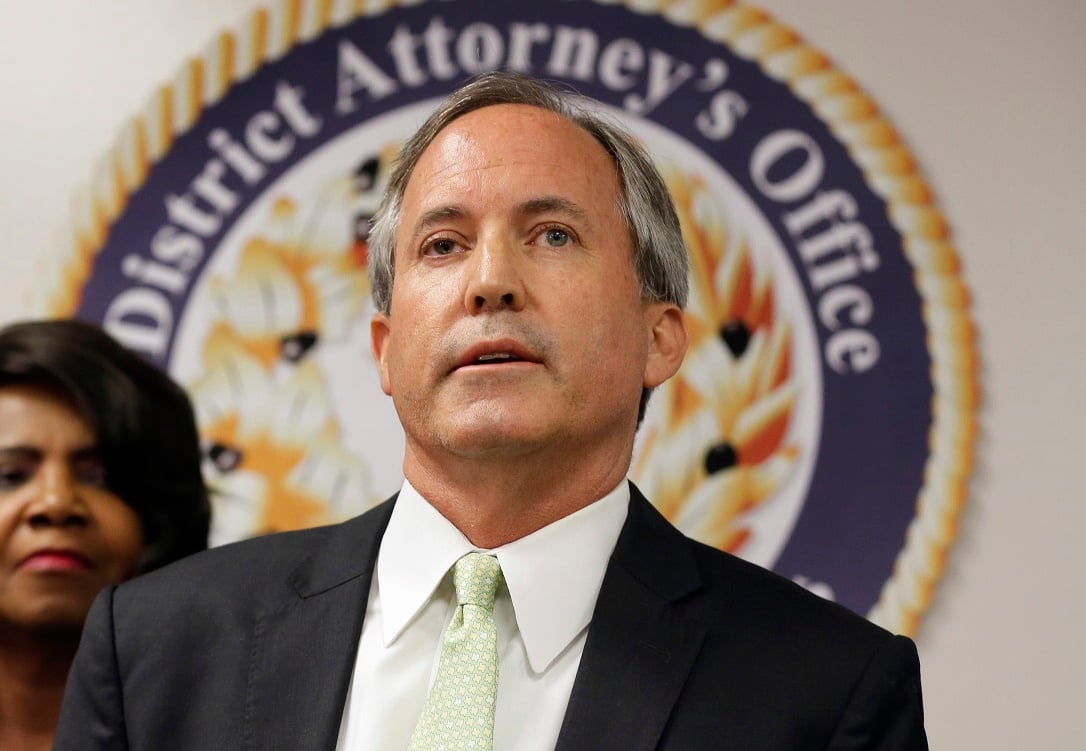
In this June 22, 2017, file photo, Texas Attorney General Ken Paxton speaks at a news conference in Dallas. (AP Photo/Tony Gutierrez, File)
Texas Attorney General Ken Paxton filed a lawsuit Tuesday seeking to shut down an Austin, Texas, homeless center, calling the charity a public nuisance.
The Sunrise Homeless Navigation Center says it’s the largest provider of homeless services in Travis County. According to its website, the center provides a number of services, including physical and mental health care, substance abuse care, harm reduction, housing interventions and benefits enrollment. The center has received over a $1 million from the city of Austin, according to Paxton’s complaint.
“In South Austin, a once peaceful neighborhood has been transformed by homeless drug addicts, convicted criminals, and registered sex offenders,” Paxton says in the complaint, filed in Travis County District Court. “These people do drugs in sight of children, publicly fornicate next to an elementary school, menace residents with machetes, urinate and defecate on public grounds, and generally terrorize the surrounding community.”
In his complaint, Paxton notes the center’s location across the street from an elementary school. The Texas Attorney General’s Office said in a statement on the lawsuit that the school has been forced into lockdown repeatedly due to violent behavior from people receiving services at the center.
Paxton also takes issue with the center allowing a clean syringe distribution program on its property, which he says amounts to facilitating drug use. Part of a “harm reduction” philosophy, clean syringe programs aim to help people who are already using intravenous drugs do so more safely. In Texas, such programs operate in a legal grey area, as they are not authorized by the state and Texas law criminalizes the possession of drug paraphernalia.
“Drug activity and criminal behavior facilitated by this organization have hijacked an entire neighborhood,” Paxton said in a statement. “By operating a taxpayer-funded drug paraphernalia giveaway next to an elementary school, this organization is threatening students’ health and safety and unjustly worsening daily life for every single resident of the neighborhood. We will shut this unlawful nuisance behavior down.”
Paxton seeks an injunction requiring the center to close for a year and prohibiting it from conducting operations within 1,000 feet of a school, playground or youth center. But in a statement, the center’s executive director Mark Hilbelink said the services will continue.
“It is regrettable that Attorney General Paxton took this route, especially during the week of Thanksgiving, but Sunrise intends to keep offering services to people in our community who need them,” Hilbelink said in a statement. “We are committed to being a good neighbor. We will continue to work, every day, to support Joslin Elementary School, our neighborhood, and our entire community.”
He also noted the center is a ministry of Sunrise Community Church and is therefore protected by the First Amendment, the U.S. Religious Land Use and Institutionalized Persons Act and the Texas Religious Freedom Restoration Act.
“These laws have been tested in court on multiple occasions, always with the same result: churches are protected to do work that is an expression of their religious practice,” Hilbelink said.
The Texas committee that examines all pregnancy-related deaths in the state will not review cases from 2022 and 2023, the first two years after Texas’s near-total abortion ban took effect, leaving any potential deaths related to abortion bans during those years uninvestigated by the 23 doctors, medical professionals and other specialists who make up the group.
Leaders of the Texas Maternal Mortality and Morbidity Review Committee said the change was made to “be more contemporary” — allowing them to skip over a backlog of older cases and review deaths closer to the date when they occurred, and therefore offer more relevant recommendations to policymakers. At least three women have died in Texas because of delays in care related to the abortion bans, according to reporting from ProPublica.
Boxes of mifepristone, the first pill given in a medical abortion, are prepared for patients at a clinic in New Mexico on Jan. 13, 2023. Credit: REUTERS/Evelyn Hockstein
A Louisiana law that reclassified abortion-inducing drugs as controlled substances has made it more difficult for doctors to treat a wide range of gynecological conditions, doctors say.
Now, a similar proposal has been filed in Texas.
Texas Rep. Pat Curry, a freshman Republican from Waco, said the intent of House Bill 1339 is to make it harder for people, especially teenagers, to order mifepristone and misoprostol online to terminate their pregnancies. Doctors in Louisiana say the measure has done little to strengthen the state’s near-total abortion ban, but has increased fear and confusion among doctors, pharmacists and patients.
“There’s no sense in it,” said Dr. Nicole Freehill, an OB/GYN in New Orleans. “Even though we kept trying to tell them how often [these medications] are used for other things and how safe they are, it didn’t matter. It’s just a backdoor way of restricting abortion more.”
These medications are often used to empty the uterus after a patient has a miscarriage, and are commonly prescribed ahead of inserting an intrauterine device. Misoprostol is also often the best treatment for obstetric hemorrhages, a potentially life-threatening condition in which women can bleed to death in minutes. Since the Louisiana law went into effect, hospitals have taken the medication off their obstetrics carts and put them in locked, password-protected central storage.
One hospital has been running drills to practice getting the medications to patients in time, and reported, on average, a two minute delay from before the law went into effect, the Louisiana Illuminator reported.
“In obstetrics and gynecology, minutes or even seconds can be the difference between life and death,” Dr. Stella Dantas, president of the American College of Obstetrics and Gynecologists, said in a statement after the Louisiana law passed. “Forcing a clinician to jump through administrative hurdles in order to access a safe, effective medicine is not medically justified and is, quite simply, dangerous.”
Curry said these restrictions won’t stop doctors from prescribing these medications when necessary, but will stop the “wide misuse” of the drugs to circumvent the state’s near-total abortion ban.
Curry said he consulted with the author of the Louisiana law, as well as OB/GYNs in Texas to draft the bill. He said the doctors who have criticized the legislation are raising these concerns as a “smokescreen” because they don’t want more restrictions.
“I understand that. We don’t need or want all kinds of regulations,” he said. “Especially as Republicans, regulations should not be high on our list, but in this case it’s a necessary evil given the situation.”
Texas roots for a Louisiana law
In March 2022, Mason Herring, a Houston attorney, spiked his wife’s water with misoprostol to force her to have an abortion. Catherine Herring was pregnant with the couple’s third child, a daughter who was born 10 weeks premature. She survived, but has significant developmental delays, according to the Associated Press.
Mason Herring was charged with felony assault to induce abortion, and pled guilty to injury to a child and assault to a pregnant person. He was sentenced to 180 days in jail and 10 years of probation.
Catherine Herring’s experience led her brother, Louisiana state Rep. Thomas Pressly, to file a bill that would have made it a crime to coerce someone into having an abortion.
But at the last minute, the bill was amended to also reclassify abortion-inducing drugs as controlled substances, according to the Louisiana Illuminator, leaving hospitals and doctors scrambling to comply with the new restrictions. The state health department advised storing the medication in a locked area on the crash cart, which at least some hospitals have said is not feasible.
“We had to rework how we utilize misoprostol across our hospital systems,” Freehill said. “Labor and delivery, pharmacy, nursing staff, you name it, they were all involved with figuring out how to stay within the law but still use these medications that we need access to.”
It’s rare for a state to decide on its own to classify a drug as a controlled substance. Most commonly, the federal government decides which medications should be “scheduled,” based on their medical usefulness and the potential for abuse. Schedule I drugs, like heroin, have no medical use and are often used recreationally; Schedule IV and V are medications that are useful but have a potential for abuse, like Xanax or Valium.
There are enhanced penalties for having a controlled substance without a prescription, and increased restrictions on how doctors can dispense them. Pharmacists must report any prescriptions for controlled substances to the state Prescription Monitoring Program, and doctors are required to check the database before prescribing certain controlled substances. Law enforcement also has access to that database.
Prescription monitoring has been key to combating the opioid epidemic by identifying doctors who were overprescribing and patients who were getting prescriptions from multiple providers. But with so much political attention on mifepristone and misoprostol as abortion-inducing drugs, doctors are worried about scrutiny for frequently prescribing these common medications.
“We had to fix a problem that wasn’t broken,” said Freehill. “There’s no reason for it to be Schedule IV. It’s not something people abuse. It’s not something people can become addicted to. It’s extremely safe.”
A group of Louisiana health care providers recently filed a lawsuit arguing the law discriminates against people who need mifepristone and misoprostol for other conditions, and challenging whether the last minute amendments to the bill were proper. Louisiana Attorney General Liz Murrill has said the new restrictions are clear and should not delay care. Those who “have attempted to sow confusion and doubt,” she said in a statement, “profit from misinformation.”
When the law first went into effect, Anna Legreid Dopp, senior director of government relations for the American Society of Health-System Pharmacists, told CNN that the group expected other states to consider similar measures.
“Almost immediately, our members raised concern that if this is being done in one state, it can easily be a template for other states to use it,” Dopp said.
Restrictions on medication
Curry, who recently won a special election to fill the seat long held by Republican Rep. Doc Anderson, said Pressly and Herring have offered to come testify in support of his bill this session. He anticipates it getting wide support from his fellow lawmakers.
Since the overturn of Roe v. Wade, conservative groups have turned their attention to restricting access to abortion-inducing medications. A group of anti-abortion doctors filed a lawsuit to revoke the Food and Drug Administration’s approval of mifepristone, which the U.S. Supreme Court ultimately rejected.
Curry said there are reasons to keep these medications on the market beyond abortion, but they need tighter restrictions.
“You can lie about your age, you can lie about your name, you can lie about your address, there’s no verification whatsoever,” he said, referring to online prescribers. “And it gets shipped to a 15-year-old girl, a 13-year-old girl.”
It is already a crime to mail abortion-inducing medications in Texas, and many of the online pharmacies operate in a legal gray area outside U.S jurisdiction. Others are working in states that have “shield laws” that protect doctors’ ability to prescribe and mail pills into states that have banned abortion. None of these interstate and international legal questions have been tested in court with regards to abortion.
Freehill said she would encourage Texas doctors to learn from what has happened in Louisiana as they prepare to advocate against this bill this session.
“There’s a lot of education that needs to be done surrounding what this means and what these drugs are really used for,” she said. “I don’t know that we would have been able to sway people, even with more time, but we can at least educate on why this is completely inappropriate and really governmental overreach.”
Donald Trump has been outspoken against the LGBTQ+ community. (Getty)
At the time of writing, it seems almost inevitable that Donald Trump will become the 47th President of the United States, meaning LGBTQ+ rights are under serious threat.
The election was one of the closest in history according to voting polls over the past few weeks, with polling group FiveThirtyEight reporting that Harris just barely reached a 1.2 per cent lead on Trump a day before the results were counted.
The last Trump presidency led to a roll-back of protections and anti-discrimination laws for LGBTQ+ people, and it doesn’t look as if a second term would be any different if he is re-elected, based on campaign promises and the detailed policy proposals outlined in Project 2025 – although Trump has tried to distance himself from the right-wing proposals.
In anticipation of a Trump win, the American Civil Liberties Union (ACLU) suggested a new Trump administration would “reinstate and significantly escalate the removal of anti-discrimination policies… proactively require discrimination by the federal government [and] weaponize federal law against transgender people across the country”.
So, what are Trump’s views about LGBTQ+ rights, and what exactly might he do?
Erase federal non-discrimination protections for LGBTQ+ people
Trump’s first term was extremely detrimental to the rights and protections of LGBTQ+ people, and a second term could roll back protections once again.
LGBTQ+ people might no longer be guaranteed to be free of discrimination across several federal government programs, such as Social Security, Medicare, housing and employment.
Exclude openly transgender people from the military
The first Trump administration reversed policies allowing trans people to serve in the military, and it is not difficult to foresee the president doing so again.
Another ban on trans people in the military would force out active-duty transgender service personnel as well as prevent trans people enlisting in the future.
This is despite a report in 2016 revealing that trans-inclusive policies have “little or no impact on unit cohesion, operational effectiveness, or readiness”.
In fact, trans-inclusive military policies could benefit all active service members by “creating a more inclusive and diverse force.”
Trans people could once again be banned from serving. (Getty)
Withhold federal funding if school officials affirm transgender students
Trump has said he would act to stop any school district introducing or maintaining trans-inclusive policies and practices.
This would include withholding federal funding that allow trans students to use toilets and changing rooms that align with their gender identity, or even acknowledging that they are trans, as well as arguing that trans-inclusive policies violate the rights of cisgender pupils.
Discrimination against trans students, causing significant harm to the community as a whole, would be the likely result of such a move.
During a recent campaign rally, Trump said he was not going to “let” trans women compete in sporting events at all if he becomes president again.
He said invoking the ban would “not [be] a big deal”, citing recent sporting events in which trans women competed against cisgender women, claiming that the trans athlete had a competitive edge over their opponent.
“Physically, from a muscular standpoint… look at what’s happened in swimming. Look at the records that are being broken,” he said.
Prohibit gender-affirming care in federal healthcare programmes
His website also promises that on his first day in the Oval Office, he would issue an executive order “instructing every federal agency to cease all programs that promote the concept of sex and gender transition, at any age”.
The administration would also probably deny Medicaid funding for hospitals that provide gender-affirming care, forcing medics to deny trans people the care they require.
Access to healthcare for more than 100,000 transgender youngsters in 24 states has already been halted in the past three years.
Allow employers to discriminate against LGBTQ+ staff
A second Trump administration could bring in provisions to allow employers to discriminate against LGBTQ+ members of staff based on the boss’ stated religious beliefs, a reversal of existing non-discrimination laws.
This would not require congress or bipartisan support, and could be pushed through using an executive order from the president.
The administration could go one step further to prevent state and local governments enforcing non-discrimination laws if the defendant says the discrimination was based on religious belief.
Laws protecting LGBTQ+ people and other minorities from discrimination based on protected characteristics might also disappear.
Donald Trump has continued to target the LGBTQ+ community. (Getty)
Criminalize gender-non-conformity in public life
Project 2025 – a hard-line right-wing blueprint for a future Republican president – suggests the use of criminal laws to punish gender-non-conformity in public life, with pornography being the crux of the issue.
The authors of the plan, the Heritage Foundation, inexplicably link pornography with “transgender ideology” and argue that neither has a “claim to First Amendment protection” and therefore should be outlawed.
“The people who produce and distribute it should be imprisoned,” they demand. “Educators and public librarians who purvey it should be classed as registered sex offenders, and telecommunications and technology firms that facilitate its spread should be [closed down].”
That means any discussion of transgender people in schools and libraries could be criminalized, and trans people might face jail time for being themselves.
Trump would only be able to put this into practice with congress’ approval and there is unlikely to be bipartisan support for such a law, but even the slim possibility is terrifying.
Finally – could gay marriage be reversed?
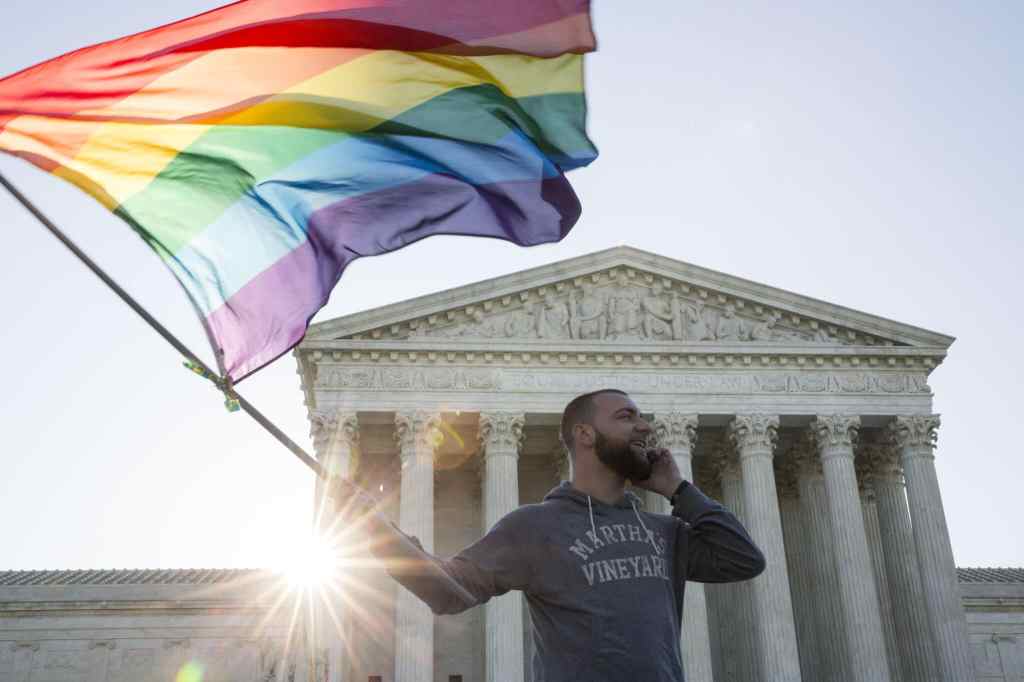
Same-sex marriage supporter Vin Testa, of Washington DC, waves a rainbow pride flag near the Supreme Court. (Drew Angerer/Getty Images)
Unfortunately, yes, it could.
After crucial abortion legislation Roe v. Wade was overturned by the Supreme Court, many people said that next, they would be coming for Windsor and Obergefell and Lawrence – three rulings that unlocked a national right to same-sex marriage.
Whether a same-sex couple could marry varied by state before 2015. With its 5-4 decision in Obergefell v. Hodges, the Supreme Court extended the full federal right to marry to all same-sex couples.
So would – or could it be taken away? Many people think that the Supreme Court wouldn’t dare. Same-sex marriage is now too accepted in American society, they argue. It would cause “legal chaos.”
However, it remains the case that some justices, particularly Samuel Alito and Clarence Thomas, appear to be itching to overturn Obergefell. In 2022, Justice Thomas said the Supreme Court “should reconsider” its past rulings codifying rights to contraception access, same-sex relationships and same-sex marriage.
It’s important to remember in all of this Pride is a protest, and it continues to be. We can fight any and all of these attacks by standing up, speaking out and refusing to stay silent.
FILE – Texas Gov. Greg Abbott speaks at a news conference in Austin, Texas on June 8, 2021. (AP Photo/Eric Gay, File)
By THE ASSOCIATED PRESS
Updated 7:10 AM EST, November 1, 2024
Texas hospitals must ask patients starting Friday whether they are in the U.S. legally and track the cost of treating people without legal status following an order by Republican Gov. Greg Abbott that expands the state’s clash with the Biden administration over immigration.
Critics fear the change could scare people away from hospitals in Texas, even though patients are not required to answer the questions to receive medical care. The mandate is similar to a policy that debuted last year in Florida, where Republican Gov. Ron DeSantis is also a frequent critic of the federal government’s handling of illegal crossings along the U.S.-Mexico border.
Texas hospitals have spent months preparing for the change and have sought to reassure patients that it won’t affect their level of care.
Here’s what to know:
Required to ask, not required to answer
Under the executive order announced by Abbott in August, hospitals must ask patients if they are citizens in the U.S. and whether they are lawfully present in the country.
Patients have the right to withhold the information and hospital workers must tell them their responses will not affect their care, as required by federal law.
Tracking hospital costs and patient data
Hospitals are not required to begin submitting reports to the state until March. An early draft of a spreadsheet made by state health officials to track data does not include fields to submit patient names or personal information.
Providers will fill out a breakdown of visits by inpatient and emergency care patients and document whether they are lawfully present in the country, citizens or not lawfully present in the U.S.
The reports will also add up costs for those covered by Medicaid or the Children’s Health Insurance Program, known as CHIP; and the cost for patients without it.
“Texans should not have to shoulder the burden of financially supporting medical care for illegal immigrants,” Abbott said when he announced the policy.
Texas is following Florida’s lead
Florida enacted a similar law last year. Health care advocates contend the law has made immigrants who need of emergency medical care fearful and led to fewer people seeking help, even from facilities not subject to the law.
Florida’s early data is — by the state’s own admission — limited. The data is self-reported. Anyone can decline to answer, an option chosen by nearly 8% of people admitted to the hospital and about 7% of people who went to the emergency room from June to December 2023, according to Florida’s state report. Fewer than 1% of people who went to the emergency room or were admitted to the hospital reported being in the U.S. “illegally.”
Texas hospitals have been preparing
Immigrant and health care advocates have sought to educate the Texas public about their rights. In Florida, groups used text messages, posters and emails to get the word out. But advocates there have said they didn’t see fears subside for about a year.
Health care providers received directives from the state and guidance from the Texas Hospital Association.
“The bottom line for patients is that this doesn’t change hospital care. Texas hospitals continue to be a safe place for needed care,” said Carrie Williams, spokesperson for the hospital association.



/https://static.texastribune.org/media/files/fb7ca36d07ff3d7950072cb9fcc7dbe2/Mifeprex%20REUTERS.jpg)