Republicans being assholes and the damaging effects on people it has

The bible lessons were pushed by Jonathan Covey [photo], head of the anti-LGBTQ hate group Texas Values, which has appeared here multiple times in the past. In February 2015, on the tenth anniversary of the Texas state ban on same-sex marriage, Texas Values held a “banniversary” celebration complete with a cake-cutting ceremony. The actual tenth “banniversary” wasn’t until November 2015, but Texas Values held their little party months early because they rightly feared what the Supreme Court would ultimately rule in June of that year.


I had a classmate tell me that Dems would do better if we dropped the “whole bathroom thing.” I educated him that this was not a fight we chose and that trans people have been around for decades using the bathrooms they fit in best. It was Republicans that made it a “thing.”

All of the “hot button social issues” are issues created and kept alive by Republicans.
People are just trying to live their lives, and the GQP decides they’re doing it wrong.

Exactly, because Rethugs always know what triggers their fragile, fearful, deeply insecure base the most.

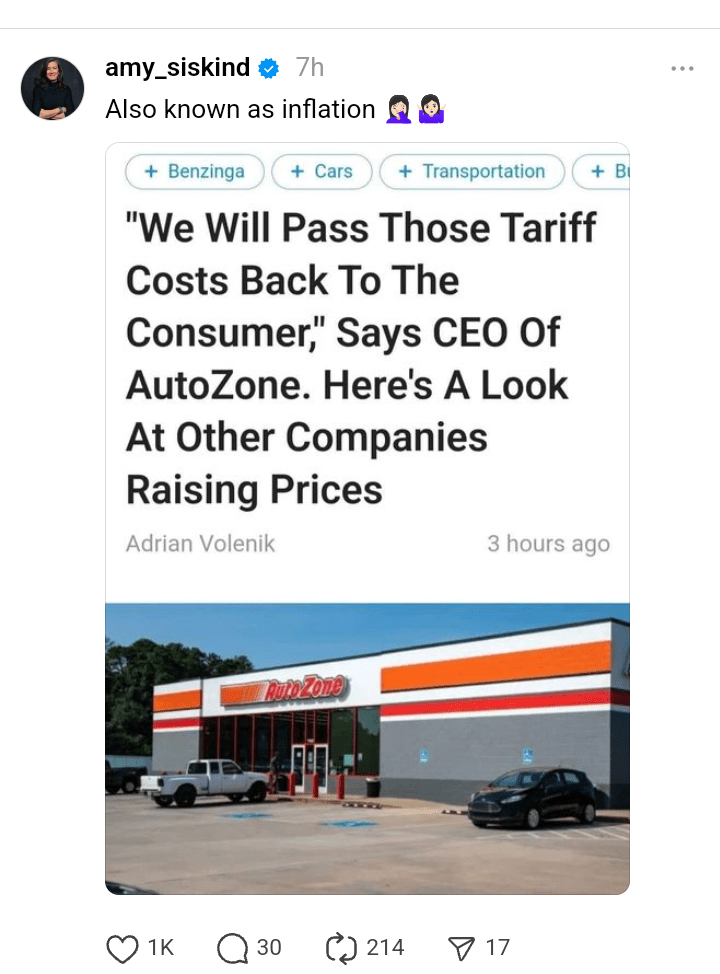
American People: We don’t have enough money to buy gas, groceries, healthcare or pay rent. We need help!

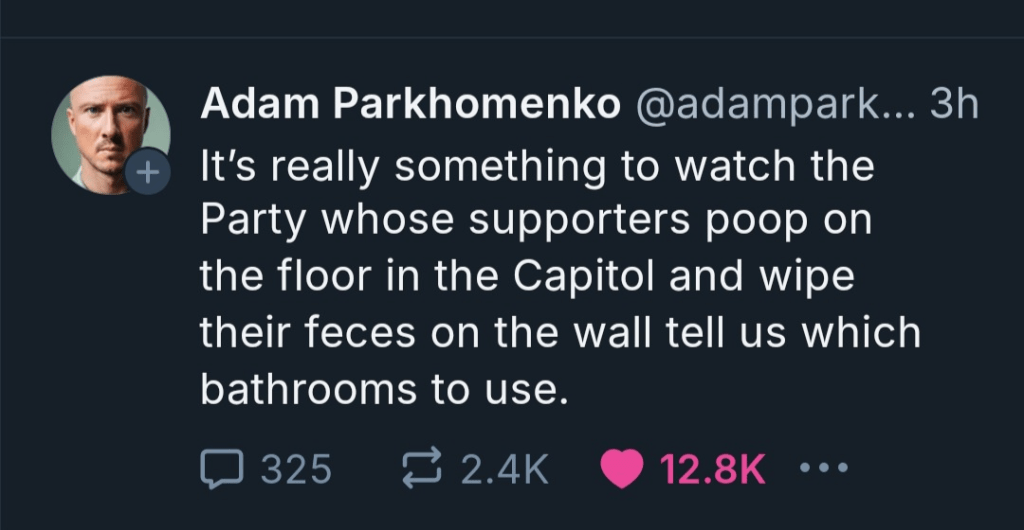
Republicans: We’re banning trans women from Capitol restrooms.

A Trump supporting, anti-trans, anti-gay Republican was elected commissioner of the county where I grew up. He won despite being in jail on election night for a sexual assault in Vegas. It’s now come out that the woman he assaulted was his daughter. fox59.com/news/indycri…

Radley Balko (@radleybalko.bsky.social) 2024-11-20T01:22:20.078Z

Three wives, adultery with an employee, and an alleged sexual assault is what Jesus would want.

Letters From An American for 11/17:

This is pretty cool to read!

November 17, 2024 by Heather Cox Richardson Read on Substack

Tonight is a break from the craziness of the news. 

I often say that 1883 is my favorite year in history because of all that happened in that pivotal year, and one of those things is the way modernity swept across the United States of America in a way that was shocking at the time but that is now so much a part of our world we rarely even think of it….

Until November 18, 1883, railroads across the United States operated under 53 different time schedules, differentiated on railroad maps by a complicated system of colors. For travelers, time shifts meant constant confusion and, frequently, missed trains. And then, at noon on Sunday, November 18, 1883, railroads across the North American continent shifted their schedules to conform to a new standard time. Under the new system, North America would have just five time zones. 

Fifteen minutes before the time of the shift, the telegraph company Western Union shut down all telegraph lines for anything but the declaration of the new time. It identified the moment the new time went into effect in telegraph messages to local railroad offices and to the jewelers known in cities for keeping time. In offices that got the message, men had their timepieces in their hands and ready to reset when the chief operator shouted “twelve o’clock!” 

In Boston the change meant that the clocks would move forward about 16 minutes; in New York City, clocks were set back about four minutes. For Baltimore the time would move forward six minutes and twenty-eight seconds; in Atlanta it went back 22 minutes. 

The system was a dramatic wrench for the rural United States, bringing it into the modern world. Uniform time zones had been proposed by pioneering meteorologist Cleveland Abbe, who developed the U.S. system of weather forecasting. Having joined the United States Weather Bureau as chief meteorologist in 1871, he recognized that predicting the weather required a nationally coordinated team and worked with Western Union to collect information about temperature, wind direction, precipitation, and sunset times from across the country. 

Coordinating that information required keeping time across all the stations he had set up. To do so, Abbe divided the United States into four time zones, each one hour apart, and in 1879 he suggested those zones might smooth out the chaos of the railroad systems, each trying to coordinate schedules across a patchwork of local times. Railroad executives, who were concerned that if they didn’t do something, the government would, listened to Abbe, and by 1883 they had concluded to put his new system in place.

Members of the new professional class who traveled by train from city to city were on board because they thought the need to regularize train schedules was imperative. But standard time was controversial. In the United States, people had operated entirely by the rhythms of the sun until the establishment of factories in New England in the 1830s, and most people still lived by those rhythms, their local time adjusting to solar time according to their geographical location. 

Telling the time by sundial and history not only was custom, but also was understood as following God’s time. The idea of overriding traditional timekeeping because of the needs of the modern world seemed positively sacrilegious. “People…must eat, sleep and work…by railroad time,” wrote a contributor to the Indianapolis Daily Sentinel. “People will have to marry by railroad time…. Ministers will be required to preach by railroad time…. Banks will open and close by railroad time; notes will be paid or protested by railroad time.” 

The mayor of Bangor, Maine, vetoed an ordinance in favor of standard time, saying it was unconstitutional, that it changed the immutable law of God, that the people didn’t want it, and that it was hard on the working men because it changed day into night. Those planning for a switch to standard time tried to ease fears by providing that Americans would operate on both local time and standard time, with both times represented on clocks.

On November 18, no one quite knew what the dramatic wrench into the future might mean. 

What did it mean to gain or lose time? Many people expected “a sensation, a stoppage of business, and some sort of a disaster, the nature of which could not be exactly ascertained,” a New York Times reporter recorded. As the great moment approached, people crowded the streets in front of jewelers to see the “great transformation.” 

They were disappointed when, after all the buildup, the future arrived quietly.

The New York Times explained: “When the reader of THE TIMES consults his paper at 8 o’clock this morning at his breakfast table it will be 9 o’clock in St. John, New Brunswick, 7 o’clock in Chicago, or rather in St. Louis—for Chicago authorities have refused to adopt the standard time, perhaps because the Chicago meridian was not selected as the one on which all time must be based—6 o’clock in Denver, Col. and 5 o’clock in San Francisco. That is the whole story in a nut-shell.”

Notes:

Chicago Daily Tribune, “At Noon today Most of the Railroads Will Discard the Old and Adopt the New,” November 18, 1883, p. 12. 

Boston Daily Globe, “Modern Joshuas: They Make Clocks, If Not the Sun, Stand Still,” November 19, 1883, p. 5.

Boston Daily Globe, “At the Railroad Stations, At the Churches,” November 19, 1883, p. 5.

Washington Post, “New Time in Other Cities,” November 18, 1883, p. 1.

Chicago Daily Tribune, “Standard Time,” November 19, 1883, p. 1.

Indianapolis Daily Sentinel, November 21, 1883, p. 4, Quoted in Ian R. Bartky, Selling the True Time: Nineteenth-Century Timekeeping in America (Stanford: Stanford University Press, 2000), p. 144.

New York Times, “Time’s Backward Flight,” November 18, 1883, p. 3. https://historymatters.gmu.edu/d/5748

Robert E. Riegel, “Standard Time in the United States,” American Historical Review 33 (October 1927): 84–89.

Let’s talk about China wanting peaceful coexistence with Trump….

Belle talks about how tRump and his supporters build his fake image of being a superpower in the world.  They take stuff that tRump had nothing to do with and claim it only happened because of him.   They depend on people not knowing the subject they are talking about.    Hugs

Let’s talk about Trump’s Social Security plans….

We can only hope the divisions and internal infighting will delay the worst of the things the most maga want to do including tRump.  Remember the republicans in congress and in the states still have to be voted in.  Call your local offices even if they are republicans, tell them you are a voter, be polite and to the point.  You disagree and why.   They are worried about their job and even in deep red districts republicans won’t be happy if their incomes and funds are cut or shit interferes with their families.  Sadly a lot of people who voted for tRump thinking he did not mean them or their families will find out he did, just as the people deported last time whose family members voted for tRump.   Hugs.

Let’s talk about Trump vs Democratic Governors….

Important info for fighting back.  As I said the other day, tie everything up in the courts until we can win the Senate back.   And we will.  As crazy as tRump is / will try to be, we will win in 2026.  Hugs

Great song, better meaning

Thanks to Ten Bears for the reminder that others faced a harder struggle and stood their ground in order to create a more perfect union.  I will give myself today to absorb it, to be stunned at how we were so misled.  How with all the support, money, and him being him, how did Harris lose.  Misogyny comes to mind.  But we fought for our rights before.   We started at the ground, the grassroots and changed minds along with changing who was in charge.  The other side learned our lessons and turned them against us.  So tomorrow we go back to doing what we must to change the direction the country is going in, to make sure school boards are filled with people who want kids to learn science, learn to treat those different from them with respect and dynasty.  We were on the way to a better world, those that did not want that fought back.  Now the shoe is back on our feet.  We have to make sure it starts at every level and every state.  Make sure we are in the community and seen.  Make sure we let people know we will not return to the 1850s or even the 1950s.  We remember, let’s make sure everyone else does also.  Hugs

Let’s talk about checking Trump’s Man of the Year claims….

Peace & Justice History for 10/6

(Peace History’s links were misdirected for a few days, but the links are back now.)

October 6, 1683
Thirteen Mennonite families from the German town of Krefeld arrived in Philadelphia on the ship Concord. Having endured religious warfare in Europe, the Mennonites were pacifists, similar to the Society of Friends (often known as Quakers) who opposed all forms of violence. The first Germans in North America, they established Germantown which still exists as part of Philadelphia.
Modern Mennonite peace activism: 
October 6, 1955
Poet Allen Ginsberg read his poem “Howl” for the first time at Six Gallery in San Francisco. The poem was an immediate success that rocked the Beat literary world and set the tone for confessional poetry of the 1960s and later.
“Howl and Other Poems” was printed in England, but its second edition was seized by customs officials as it entered the U.S. City Lights, a San Francisco bookstore, published the book itself to avoid customs problems, and storeowner (and poet) Lawrence Ferlinghetti was arrested and tried for obscenity, but defended by the American Civil Liberties Union (ACLU).


Working on Howl in San Francisco,
circa June, 1956
Following testimony from nine literary experts on the merits of the book, Ferlinghetti was found not guilty.

Lawrence Ferlinghetti outside City Lights 
More about City Lights 
Read Howl 
Read more about Allen Ginsberg 
 
October 6, 1976
An airliner, Cubana Airlines Flight 455, exploded in midair, killing 73 mostly young passengers including the entire Cuban youth fencing team. The plot was engineered by Orlando Bosch and Luis Posada Carriles, a Cuban former CIA agent, who was based in Venezuela at the time.

The Posada Carriles file from the National Security Archive 
October 6, 1978
346 protestors were arrested at the site of the proposed Black Fox Nuclear Power Plant in Inola, Oklahoma.
In 1973 Public Service of Oklahoma announced plans to build the Black Fox plant about 15 miles from Tulsa.
It was also near Carrie Barefoot Dickerson’s family farm. She became concerned as a nurse and a citizen about the potential health hazards.
Carrie Barefoot Dickerson
Through her group, Citizens’ Action for Safe Energy (CASE), and the consistent opposition of informed and persistent allies, the project was canceled in 1982. There are no nuclear plants in the state of Oklahoma, and no nuclear plant has been built in the U.S. since then.
Carrie Dickerson Foundation 
October 6, 1979

Seabrook Nuclear Power Plant protest – late 1970s
Over 1400 were arrested at Seabrook, New Hampshire, the construction site of two new nuclear power plants. The occupation was organized by the Clamshell Alliance.
Clamshell history 

https://www.peacebuttons.info/E-News/peacehistoryoctober.htm#october6

Something To Read On A Lazy Weekend Day

https://lithub.com/tag/fonts/

(I did not find this bit in there, so here it is from my email. It’s a start! There are a few more, all interesting and totally off topic.)

The Times introduces your favorite (?) typeface, Times New Roman.
What font do you write in? People may argue all day on the internet about their favorite typefaces, but it’s a fair wager that the most ubiquitous font of all, whether it’s your personal go-to or not, is Times New Roman.  

Whence this towering behemoth, you may wonder? It was invented in the 1930s by type designer Stanley Morison, who, after criticizing the London Times for their dated font, was asked to make them a new one. “Morison enlisted the help of draftsman Victor Lardent and began conceptualizing a new typeface with two goals in mind: efficiency—maximizing the amount of type that would fit on a line and thus on a page—and readability,” writes Meredith Mann, Assistant Curator of Manuscripts at the New York Public Library. Morison’s new font was taller and narrower, but the letterforms were weighted in a new way that made them easier to read, despite the cramped spacing. (The weighting meant that the font also required more ink, which meant more money—a main reason that the font wasn’t immediately picked up by other papers.) 

Once the new font was approved, The Times published a pamphlet explaining the switch. “It is evident that there must be changes in typography as long as our social habits are open to variation,” the editors explained. “When it was founded, The Times was largely read in coffee-houses; in the nineteenth century it came to be read in trains; today it is largely read in cars and airliners. Reading habits, dependent on social habits, will not remain constant. Neither must newspaper typography remain constant.” 

Indeed not, especially when you’ve got such a splashy new font to brag about. “The new [font] will be employed on and after October 3, 1932,” the notice declares. “The Times, for generations the best printed paper, will, by present-day optical standards, be the most comfortably readable journal in the world.” 

The paper held onto the exclusive rights to Times New Roman for a year, and after that, other publications—once they’d decided it was worth shelling out for—began to follow suit. By now, it’s trickled down into just about everybody’s personal computers and for many, simply become the default. 

“Times New Roman is a workhorse font that’s been successful for a reason,” writes Matthew Butterick, author of the impressively niche Typography for Lawyers. “Yet it’s an open question whether its longevity is attributable to its quality or merely its ubiquity. Helvetica still inspires enough affection to have been the subject of a 2007 documentary feature. Times New Roman, meanwhile, has not attracted similar acts of homage.”

 Why not? “Fame has a dark side,” Butterick writes. “When Times New Roman appears in a book, document, or advertisement, it connotes apathy. It says, ‘I submitted to the font of least resistance.’ Times New Roman is not a font choice so much as the absence of a font choice, like the blackness of deep space is not a color. To look at Times New Roman is to gaze into the void.” 

(Or perhaps you are merely a novelist, who knows that if your paragraph looks good in Times New Roman, it will look good in anything. Too often have we been fooled by the slender affections of Garamond!)

By the way, Butterick points out, lawyers should beware: though it’s as much the standard font for them as everyone, the highest court in the land (such as it is) forbids its use. Something to remember for when you get there.

Didn’t Have To Be This Way …

I want to thank Ten Bears for this video.  I really enjoy history and how it still affects us today.  I almost lost the link of his to reblog it as I switch videos to the secondary computer and keep reading and responding on the primary as I watch.    I am glad I found the original post as it saved me a lot of work.  All I can say is if you are interested in history, electric cars, and why we went to using gas when it was much cheaper and not totally profit driven, please watch this video.  Hugs.  Scottie.