
We can only hope the divisions and internal infighting will delay the worst of the things the most maga want to do including tRump. Remember the republicans in congress and in the states still have to be voted in. Call your local offices even if they are republicans, tell them you are a voter, be polite and to the point. You disagree and why. They are worried about their job and even in deep red districts republicans won’t be happy if their incomes and funds are cut or shit interferes with their families. Sadly a lot of people who voted for tRump thinking he did not mean them or their families will find out he did, just as the people deported last time whose family members voted for tRump. Hugs.
Tag: History
Let’s talk about Trump vs Democratic Governors….
Important info for fighting back. As I said the other day, tie everything up in the courts until we can win the Senate back. And we will. As crazy as tRump is / will try to be, we will win in 2026. Hugs
Great song, better meaning
Thanks to Ten Bears for the reminder that others faced a harder struggle and stood their ground in order to create a more perfect union. I will give myself today to absorb it, to be stunned at how we were so misled. How with all the support, money, and him being him, how did Harris lose. Misogyny comes to mind. But we fought for our rights before. We started at the ground, the grassroots and changed minds along with changing who was in charge. The other side learned our lessons and turned them against us. So tomorrow we go back to doing what we must to change the direction the country is going in, to make sure school boards are filled with people who want kids to learn science, learn to treat those different from them with respect and dynasty. We were on the way to a better world, those that did not want that fought back. Now the shoe is back on our feet. We have to make sure it starts at every level and every state. Make sure we are in the community and seen. Make sure we let people know we will not return to the 1850s or even the 1950s. We remember, let’s make sure everyone else does also. Hugs
Let’s talk about checking Trump’s Man of the Year claims….
Peace & Justice History for 10/6
(Peace History’s links were misdirected for a few days, but the links are back now.)
| October 6, 1683 Thirteen Mennonite families from the German town of Krefeld arrived in Philadelphia on the ship Concord. Having endured religious warfare in Europe, the Mennonites were pacifists, similar to the Society of Friends (often known as Quakers) who opposed all forms of violence. The first Germans in North America, they established Germantown which still exists as part of Philadelphia. Modern Mennonite peace activism: |
| October 6, 1955 Poet Allen Ginsberg read his poem “Howl” for the first time at Six Gallery in San Francisco. The poem was an immediate success that rocked the Beat literary world and set the tone for confessional poetry of the 1960s and later. “Howl and Other Poems” was printed in England, but its second edition was seized by customs officials as it entered the U.S. City Lights, a San Francisco bookstore, published the book itself to avoid customs problems, and storeowner (and poet) Lawrence Ferlinghetti was arrested and tried for obscenity, but defended by the American Civil Liberties Union (ACLU).  Working on Howl in San Francisco, circa June, 1956 Following testimony from nine literary experts on the merits of the book, Ferlinghetti was found not guilty.  Lawrence Ferlinghetti outside City Lights More about City Lights Read Howl Read more about Allen Ginsberg |
| October 6, 1976 An airliner, Cubana Airlines Flight 455, exploded in midair, killing 73 mostly young passengers including the entire Cuban youth fencing team. The plot was engineered by Orlando Bosch and Luis Posada Carriles, a Cuban former CIA agent, who was based in Venezuela at the time. The Posada Carriles file from the National Security Archive |
| October 6, 1978 346 protestors were arrested at the site of the proposed Black Fox Nuclear Power Plant in Inola, Oklahoma. In 1973 Public Service of Oklahoma announced plans to build the Black Fox plant about 15 miles from Tulsa. It was also near Carrie Barefoot Dickerson’s family farm. She became concerned as a nurse and a citizen about the potential health hazards.  Carrie Barefoot Dickerson Carrie Barefoot DickersonThrough her group, Citizens’ Action for Safe Energy (CASE), and the consistent opposition of informed and persistent allies, the project was canceled in 1982. There are no nuclear plants in the state of Oklahoma, and no nuclear plant has been built in the U.S. since then. Carrie Dickerson Foundation |
October 6, 1979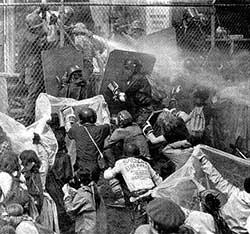 Seabrook Nuclear Power Plant protest – late 1970s Over 1400 were arrested at Seabrook, New Hampshire, the construction site of two new nuclear power plants. The occupation was organized by the Clamshell Alliance. Clamshell history |
https://www.peacebuttons.info/E-News/peacehistoryoctober.htm#october6
Something To Read On A Lazy Weekend Day
(I did not find this bit in there, so here it is from my email. It’s a start! There are a few more, all interesting and totally off topic.)
| The Times introduces your favorite (?) typeface, Times New Roman. |
| What font do you write in? People may argue all day on the internet about their favorite typefaces, but it’s a fair wager that the most ubiquitous font of all, whether it’s your personal go-to or not, is Times New Roman. Whence this towering behemoth, you may wonder? It was invented in the 1930s by type designer Stanley Morison, who, after criticizing the London Times for their dated font, was asked to make them a new one. “Morison enlisted the help of draftsman Victor Lardent and began conceptualizing a new typeface with two goals in mind: efficiency—maximizing the amount of type that would fit on a line and thus on a page—and readability,” writes Meredith Mann, Assistant Curator of Manuscripts at the New York Public Library. Morison’s new font was taller and narrower, but the letterforms were weighted in a new way that made them easier to read, despite the cramped spacing. (The weighting meant that the font also required more ink, which meant more money—a main reason that the font wasn’t immediately picked up by other papers.) Once the new font was approved, The Times published a pamphlet explaining the switch. “It is evident that there must be changes in typography as long as our social habits are open to variation,” the editors explained. “When it was founded, The Times was largely read in coffee-houses; in the nineteenth century it came to be read in trains; today it is largely read in cars and airliners. Reading habits, dependent on social habits, will not remain constant. Neither must newspaper typography remain constant.” Indeed not, especially when you’ve got such a splashy new font to brag about. “The new [font] will be employed on and after October 3, 1932,” the notice declares. “The Times, for generations the best printed paper, will, by present-day optical standards, be the most comfortably readable journal in the world.” The paper held onto the exclusive rights to Times New Roman for a year, and after that, other publications—once they’d decided it was worth shelling out for—began to follow suit. By now, it’s trickled down into just about everybody’s personal computers and for many, simply become the default. “Times New Roman is a workhorse font that’s been successful for a reason,” writes Matthew Butterick, author of the impressively niche Typography for Lawyers. “Yet it’s an open question whether its longevity is attributable to its quality or merely its ubiquity. Helvetica still inspires enough affection to have been the subject of a 2007 documentary feature. Times New Roman, meanwhile, has not attracted similar acts of homage.” Why not? “Fame has a dark side,” Butterick writes. “When Times New Roman appears in a book, document, or advertisement, it connotes apathy. It says, ‘I submitted to the font of least resistance.’ Times New Roman is not a font choice so much as the absence of a font choice, like the blackness of deep space is not a color. To look at Times New Roman is to gaze into the void.” (Or perhaps you are merely a novelist, who knows that if your paragraph looks good in Times New Roman, it will look good in anything. Too often have we been fooled by the slender affections of Garamond!) By the way, Butterick points out, lawyers should beware: though it’s as much the standard font for them as everyone, the highest court in the land (such as it is) forbids its use. Something to remember for when you get there. |
Didn’t Have To Be This Way …
I want to thank Ten Bears for this video. I really enjoy history and how it still affects us today. I almost lost the link of his to reblog it as I switch videos to the secondary computer and keep reading and responding on the primary as I watch. I am glad I found the original post as it saved me a lot of work. All I can say is if you are interested in history, electric cars, and why we went to using gas when it was much cheaper and not totally profit driven, please watch this video. Hugs. Scottie.
Peace & Justice History for 9/11:
| September 11, 1906 Mohandas Gandhi, a young Indian lawyer, began a nonviolent resistance campaign in Johannesburg, South Africa, demanding rights and respect for those of Asian descent. It was the birth of his concept of political progress through nonviolent resistance known as Satyagraha, or truth-force. He led a meeting of 3000 of the town’s Indians, protesting the Transvaal Asiatic Law Amendment Ordinance. That law required all Asians to obey three rules: those of eight years or older had to carry passes for which they had to give their fingerprints; they would be segregated as to where they could live and work; new Asian immigration into the Transvaal would be disallowed, even for those who had left the town when the South African War broke out in 1899, and were returning.  Gandhi, London, 1906 The meeting produced the Fourth Resolution, in which all Indians resolved to go to prison rather than submit to the ordinance. In Gandhi’s own words: |
| September 11, 1973 Chile’s armed forces staged a coup d’etat against the government of President Salvador Allende, the first democratically elected socialist head of state in Latin America. Some three thousand were held in Santiago’s national stadium where guards singled out folksinger Victor Jara as he continued to sing protest songs. Jara was viciously beaten, and his mutilated body machine-gunned in front of the other prisoners.   dissidents held in the stadium dissidents held in the stadiumRead more on Victor Jara  Victor Jara plays to young supporters Victor Jara plays to young supporters Victor Jara Victor JaraThe U.S. government, through the Central Intelligence Agency (CIA), had worked for three years to foment the coup against Allende. Striking Chilean labor unions, instrumental in destabilizing the Allende government, were secretly bankrolled by the CIA. During the brutal and repressive 17-year rule of General Augusto Pinochet that followed, more than 3,000 political opponents were assassinated or “disappeared.” The U.S.-backed military dictatorship banned Jara’s music, image, name and, for a time, even outlawed the public performance of the folk-guitar. More about the coup |
September 11, 2001 Suicidal Islamist terrorists, members of Al Qaeda and most of them Saudis, hijacked four commercial airliners in the eastern U.S., and managed successfully to turn three of the jet-fuel-loaded planes into missiles: two flew into New York City’s World Trade Center towers, destroying them, and a third into the west side of the Pentagon. On the fourth, passengers heroically seized back control but crashed it into an empty field in western Pennsylvania. The hijackers killed nearly 3000 that day: passengers and crew, workers in the twin towers and the Pentagon. A 911 chronology |
| September 11, 2002 Women In Black (WIB) Baltimore started the first Peace Path as a response to 9/11 World Trade Center attacks. The nonviolent action presented images of peace rather than war and militarism as a response to problems. Now in its seventh year, the path will extend for 12 miles through Baltimore. Others are beginning to create 9/11 peace paths in their own communities.  Women in Black along the peace path in Baltimore, 2007 Women in Black along the peace path in Baltimore, 2007   Participants in WIB vigils wear black as a sign of mourning for all that is lost through war and violence. The group seeks to bring together people of all races, faiths, nationalities, and genders who support positions of nonviolence and who seek peace through mutual understanding and constructive dialogue.  |
https://www.peacebuttons.info/E-News/peacehistoryseptember.htm#september101996
Peace & Justice History for 9/9:
| September 9, 1862 Minnesota Governor Alexander Ramsey declared that “The Sioux Indians of Minnesota must be exterminated or driven forever beyond the borders of the state.” The previous month the Dakota, or Santee, Sioux, long burdened by treaty violations and late or unfair payments from Indian agents, killed four settlers and decided to attack settlers throughout the Minnesota River valley. The number killed was estimated between 300 and 800, until 9/11 the largest civilian death toll in the U.S. The number of Indian deaths was not recorded. |
| September 9, 1944 Religious conscientious objector Corbett Bishop was arrested after walking out of a Civilian Public Service Camp. During subsequent trials and imprisonments, he refused any type of cooperation with the government until he was released 193 days later.  “I’m not going to cooperate in any way, shape or form. I was carried in here.If you hold me, you’ll have to carry me out.War is wrong. I don’t want any part of it.” – Corbett Bishop, 1906-1961 |
| September 9, 1963 Students at Chu Van An boys’ high school in Saigon tore down the government flag and raised a Buddhist flag to protest the corrupt Diem regime in South Vietnam; 1,000 were arrested. |
| September 9, 1971 The Attica (New York) State Penitentiary revolt began. The interracial revolt was led by blacks but featured cooperation between prisoners of different racial and ethnic backgrounds.  It was finally brutally suppressed by the state five days later, upon orders from Governor Nelson Rockefeller who refused to become directly involved. 29 prisoners and 10 guards were shot and killed by attacking state troopers in the bloodiest prison confrontation in U.S. history.  The prisoners had been demanding improvements in their living and working conditions at the increasingly overcrowded facility. |
| September 9, 1980 Eight activists from the Atlantic Life Community were arrested after hammering the nose cones of two missiles at the General Electric plant in King of Prussia, Pennsylvania. Read about Plowshares 8  The Plowshares 8 (in alphabetical order): Daniel Berrigan, Philip Berrigan, Dean Hammer, Carl Kabat, Elmer Maas, Anne Montgomery, Molly Rush, and John Schuchardt.  This action would become the first of an international movement of dozens of “Plowshares” anti-nuclear direct actions. A chronology of Plowshares actions |
| September 9, 1997 Sinn Fein (pronounced shin fayn), the Irish Republican Army’s allied political party, formally renounced violence by accepting the principles put forward by former U.S. Senator George Mitchell (D-Maine) who was mediating the talks between the Irish Republicans and the British Unionists on Northern Ireland’s future.  Senator George Mitchell Senator George MitchellThe Mitchell Principles: • To democratic and exclusively peaceful means of resolving political issues; • To the total disarmament of all paramilitary organisations; • To agree that such disarmament must be verifiable to the satisfaction of an independent commission; • To renounce for themselves, and to oppose any effort by others, to use force, or threaten to use force, to influence the course or the outcome of all-party negotiations; • To agree to abide by the terms of any agreement reached in all-party negotiations and to resort to democratic and exclusively peaceful methods in trying to alter any aspect of that outcome with which they may disagree; and, • To urge that “punishment” killings and beatings stop and to take effective steps to prevent such actions. |
https://www.peacebuttons.info/E-News/peacehistoryseptember.htm#september9
Peace & Justice History for 9/7:
(Really!)
| September 7, 1948 3,000 attended a rally to publicly launch the Peace Council in Melbourne, Australia. |
September 7, 1957 Barbara Gittings leading a picket in the ’60s Barbara Gittings leading a picket in the ’60sBarbara Gittings organized the first New York meeting held for the Daughters of Bilitis, a pioneer lesbian organization. The group was founded two years earlier in San Francisco. Barbara Gittings: Mother of the Gay Rights Movement (This link requires a sign-in on Medium, so I’m going to post it in another entry on its own.) Cover from their magazine “The Ladder”, October,1968  |
| September 7, 1990 Two British peace activists, Stephen Hancock and Mike Hutchinson known as the Upper Heyford Plowshares were sentenced to 15 months in prison for disabling an F-111 bomber in Oxford, England. A brief History of Direct Disarmament Actions |
| September 7, 1992 South African troops killed at least 24 people and injured 150 more at an African National Congress (ANC) rally on the border of Ciskei, in South Africa. 50,000 ANC supporters had turned out to demand Ciskei’s re-absorption into South Africa. Ciskei was one of ten black “homelands,” so designated to keep blacks from claiming citizenship in South Africa itself. They were a legal fiction, not recognized by any other country, that was part of the racially separatist apartheid regime.  News at the time BBC |
| September 7, 1996 Two women were arrested for trespass at the Norfolk (Virginia) Naval Base after walking into the base with a banner reading, “Love Your Enemies.” |
https://www.peacebuttons.info/E-News/peacehistoryseptember.htm#september7

