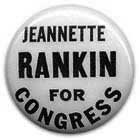
March 4, 1917 Montana elected Republican Jeannette Rankin as the first woman to sit in the U.S. House of Representatives three years before American women nationwide could legally vote. Rep. Jeannette Rankin with her colleagues in the 61st Congress. A persistent advocate for women’s rights, particularly suffrage, Rankin voted in Congress against American entry into both world wars, and late in life led marches against the Vietnam war. More about Jeanette Rankin Visit the Jeanette Rankin Peace Center
March 4, 1933 Franklin Delano Roosevelt was sworn in as president in the midst of the Great Depression. From his inaugural address: “This is preeminently the time to speak the truth, the whole truth, frankly and boldly. Nor need we shrink from honestly facing conditions in our country today. This great Nation will endure, as it has endured, will revive and will prosper. So, first of all, let me assert my firm belief that the only thing we have to fear is fear itself — nameless, unreasoning, unjustified terror which paralyzes needed efforts to convert retreat into advance. In every dark hour of our national life, a leadership of frankness and of vigor has met with that understanding and support of the people themselves which is essential to victory.” President Franklin Delano Roosevelt delivering his first inaugural address Audio and video of the speech
March 4, 1965 Moved to action by President Lyndon Johnson’s sustained bombing of North Vietnam beginning two months before, Vietnam Day was declared by the Universities Committee, led by Wayne State University Professor Otto Feinstein. At about 100 college campuses nationwide, faculty, students and others gathered for lectures and meetings about the war. This occurred just three weeks before the first “teach-in” at the University of Michigan.
March 4, 1969
The Union of Concerned Scientists (UCS) was founded. From its founding document: “Misuse of scientific and technical knowledge presents a major threat to the existence of mankind. Through its actions in Vietnam our government has shaken our confidence in its ability to make wise and humane decisions. There is also disquieting evidence of an intention to enlarge further our immense destructive capability…”. . . continued here
March 4, 1978 40,000 demonstrated against the enlargement of the uranium enrichment plants in Almelo, Holland. Enrichment is the processing of uranium with gas cetrifuges to the level required for use as fuel in nuclear reactors.
March 4, 2011 A new Egyptian prime minister called on thousands of cheering protesters in Cairo’s Tahrir Square to rebuild their country. Essam Sharaf, appointed by the military, told the crowd: Egypt’s new prime minister, Essam Sharaf, is greeted by supporters at Tahrir Square in Cairo. Photo: Amr Nabil/AP “I salute the martyrs. Glory and respect to the families of the victims and a special salute to everyone who took part and gave for this white revolution. I am here to draw my legitimacy from you. You are the ones to whom legitimacy belongs.”
He ws appointed to replace deposed President Hosni Mubarak who had forced out of office by the widespread unrest that had spread from Tunisia, Egypt’s neighbor to the west. Sharaf was cheered and carried to and from the podium on the shoulders of protesters, escorted by military police.
March 4, 2011 In cities across Iraq demonstrators gathered for the second consecutive Friday to demand jobs, effective government services and an end to corruption. Inspired by movements elsewhere in the Arab world, 500 convereged in Liberation Square in the capital Baghdad, 1000 in Basra. Those in Baghdad were surrounded by at least as many security forces and overcame official resistance to the gathering including a citywide ban on vehicles. One protester had walked from Sadr City and had to pass through eight checkpoints.
Snippet (We can read or watch, on the page linked above.):
Chair Walberg, Ranking Member Scott, and members of the committee, thank you for the opportunity to testify today.
My name is Heidi Shierholz, and I am an economist and the president of the Economic Policy Institute (EPI) in Washington, D.C. EPI is a nonprofit, nonpartisan think tank created in 1986 to include the needs of low- and middle-wage workers in economic policy discussions. EPI conducts research and analysis on the economic status of working America, proposes public policies that protect and improve the economic conditions of low- and middle-wage workers, and assesses policies with respect to how well they further those goals. I previously served as Chief Economist at the U.S. Department of Labor.
In considering the topic of “unleashing” America’s workforce and strengthening the economy, I make three main points in this testimony: (1) the Trump-Vance administration has inherited unquestionably the strongest economy for an incoming administration in a quarter-century;1 (2) that strength was driven in large part by economic policy choices by the prior administration and Congress; and (3) the Trump-Vance administration agenda will be profoundly destructive to the incomes and economic security for both the most vulnerable families and the broad middle class. The administration is aiming to gut key income support and safety net programs that provide direct support to tens of millions of working families, and the chaos and uncertainty they are intentionally sowing with reckless power grabs over key economic institutions will likely cause an economic crisis unless it is stopped.
The basic facts about the economy that the Trump-Vance administration inherited
The availability of jobs and the growth in real wages (i.e., growth in the purchasing power of wages after accounting for inflation) are where the rubber meets the road as far as “the economy” goes for working people. On both of these fronts, the economy that the Trump-Vance administration inherited is extremely strong.
In January 2025, when the Trump-Vance administration took office, the unemployment rate was 4.0%, and had been at or below 4.2% since November 2021. The last time the United States saw unemployment that low, for that long, was more than a half century ago. Further, the share of prime-age adults (25–54 years old) with a job was higher during January 2025 than at any time during the business cycle from 2007 to 2019, and near its highest rate in a quarter-century. The labor force participation rate of prime-age adults was also higher than at any time during the business cycle from 2007–2019, and the labor force participation of prime-age women was near its all-time high. Finally, job growth averaged 168,000 per month over the 12 months ending January 2025—a very healthy pace of growth, particularly considering how close the economy is to full employment (when job growth would be expected to slow since there is no longer a large employment gap to be filled).
The purchasing power of workers’ wages, after taking inflation into account, was higher in 2024 than it was at the most recent business cycle peak in 2019 or any point before that. (In other words, real wages were higher in 2024 than they were in 2019 or any point before that.) Further, this was true all across the wage distribution—for low-wage workers, middle-wage workers, and high-wage workers. In fact, bucking the trend of the business cycles of the prior 40 years, wage growth since 2019 has been stronger among low-wage workers than at any other point in the wage distribution. Real wage growth for workers at the 10th percentile, for example, rose by 3.4% annually between 2019 and 2024, for a total increase of 18.2%—the fastest five-year stretch of real wage growth for this group since data started being collected in the 1970s. (snip-MORE)
March 3, 1863 In the midst of the Civil War, President Abraham Lincoln signed a conscription act that created the first draft lottery of American citizens. The act called for registration of all males between the ages of 20 and 35, and unmarried men up to 45, including aliens with the intention of becoming citizens, by April 1. Exemptions from the draft could be bought for $300 or by finding a substitute draftee. Many objected to this provision describing the war as a “rich man’s war, but poor man’s fight.” Black Americans were also not eligible for the draft because they weren’t considered citizens. Bounties for New York military “volunteers” during the Civil War
March 3, 1913 The day before Woodrow Wilson’s inauguration as president, 8000 from the National American Woman Suffrage Association (NAWSA), representing every state, marched in Washington, D.C. to call for a constitutional amendment granting women the right to vote. Organized by Alice Paul and Lucy Burns, who had been inspired by the parades, pickets and speeches of the British suffragists, the march drew hundreds of thousands of spectators. Though some of the marchers were attacked by onlookers, the march focused attention on the suffrage issue. [see March 4, 1917 ] More about Alice Paul
March 3, 1961 The village council in the Inupiat Eskimo town of Point Hope, Alaska, formally protested, in a letter to President Kennedy, the proposed chain explosion of three atomic bombs in the nearby above-ground “Project Chariot” tests. The project entailed using atomic explosions to create a harbor near Point Hope, above the Arctic Circle in northwest Alaska. The excavation never happened due to public opposition and inspired native peoples in Alaska to assert their rights and legitimate land claims. Edward Teller “Father of the hydrogen bomb” arrives to promote plans for Project Chariot. Read more about Project Chariot
March 3, 2003 In the first-ever worldwide theatrical act of dissent, there were at least 1029 stagings of Lysistrata, the 2400-year-old anti-war comedy by Greek playwright Aristophanes. Conceived and organized in just two months by Kathryn Blume and Sharron Bower, the performances all occurred on the same day to express opposition to the U.S. invasion of Iraq. Staged in 59 countries (including Iraq), the bawdy play tells of Athenian and Spartan women who unite to deny their lovers sex in order to stop the 22-year-long Peloponnesian War between the two city-states. Desperate for intimacy, the men finally agree to lay down their swords and see their way to achieving peace through diplomacy. More about how it happened
I have strong feelings about women’s restrooms, too, as we all know; so many thoughts about so many women’s bathroom issues. I’m in agreement with this essay. Stick with it, you’ll see. You might want a tissue.
A Trans Girl Approached Me in the Ladies’ Bathroom and It Bothered Me. Here’s Why. by Natalie S. Ohio
Why the girls’ bathroom is a sacred space for women and how we must seek to keep it that way.Read on Substack
Ugh, no hand soap. Again.
If there’s one thing living in Spain will teach you, it’s that hand washing isn’t priority número uno in public spaces.
Luckily, as someone who grew up here, this is no surprise to me. As Gang Starr once said, “I’m not new to this, I’m true to this.”
In other words, I carry soap sheets wherever I go.
As I was washing my hands in the shopping mall bathroom last week, the door cracked open and a head peeked around.
Big brown eyes appeared from under a blunt-cut fringe. A smattering of adolescent acne decorated soft, rounded cheeks and a set of metallic braces twinkled between glossy pink lips.
Either retro makeup is back in style or rubbing my hands together had sent me ricocheting back to the mid-80s…
We regarded each other for a moment.
“¿Puedo pasar?” May I come in?
Her delicate, childlike voice softly penetrated the silence of the empty bathroom.
“Sí, claro.” Of course.
I smiled and gestured to the vacant stalls and the rows of mirrored sinks behind me.
I wondered if she mistakenly believed from the outside that this was a single-person bathroom. Or maybe she thought I was a cleaner. It wouldn’t be the first time a Spaniard had seen my complexion and automatically assumed I was the help.
I was otherwise a little perplexed as to why she would ask.
She hesitated slightly as she stepped around the door.
“Bueno, es que… soy trans.”
Well, it’s just that… I’m trans.
What I’m about to say may sound strange to some, but here goes:
The ladies’ bathroom plays a surprisingly significant role in girlhood.
I’m not talking about the one at Grandma’s house with its peach-coloured wall tiles, nor the ones in fancy restaurants where you go to check your appearance on a date.
I’m talking about the public toilets that double as makeshift community hubs for women — grubby little social sinkholes you find in nightclubs, bars, and airports that offer a brief moment of tranquillity as the commotion fades behind the closing door.
Restrooms with precarious toilet seats, broken flushes, and “love urself babe ur perfect” scribbled in eyeliner on the inside of the stall.
I’m willing to bet that anybody who has used a public ladies’ room has had at least one memorably positive encounter with someone they’ve met inside.
What’s so special about it? I hear you cry. Men have bathrooms too and nobody bats an eyelid. If anything, the less said about those, the better.
On a functional level, nothing at all.
In fact, the ladies’ very often sucks in comparison to the men’s. A victim of long queues, scarce toilet paper, and the most unflattering lighting known to man.
However, we’re not talking about serviceability. If we were, we wouldn’t have a leg to stand on.
What I’m referencing is much deeper than that. Much more visceral.
I once undid a drunken stranger’s bodysuit in a nightclub bathroom so she could relieve herself before going back out to tear up the dancefloor. If you’ve any idea what a bodysuit is and where its fastening is located, you’ll understand why that’s a tall order.
I’ve witnessed countless girls take their drinks inside and leave them unattended by the sink without any concerns over getting roofied.
There’s nearly always someone giving an empowering pep talk to a broken-hearted friend who needs a boost of confidence.
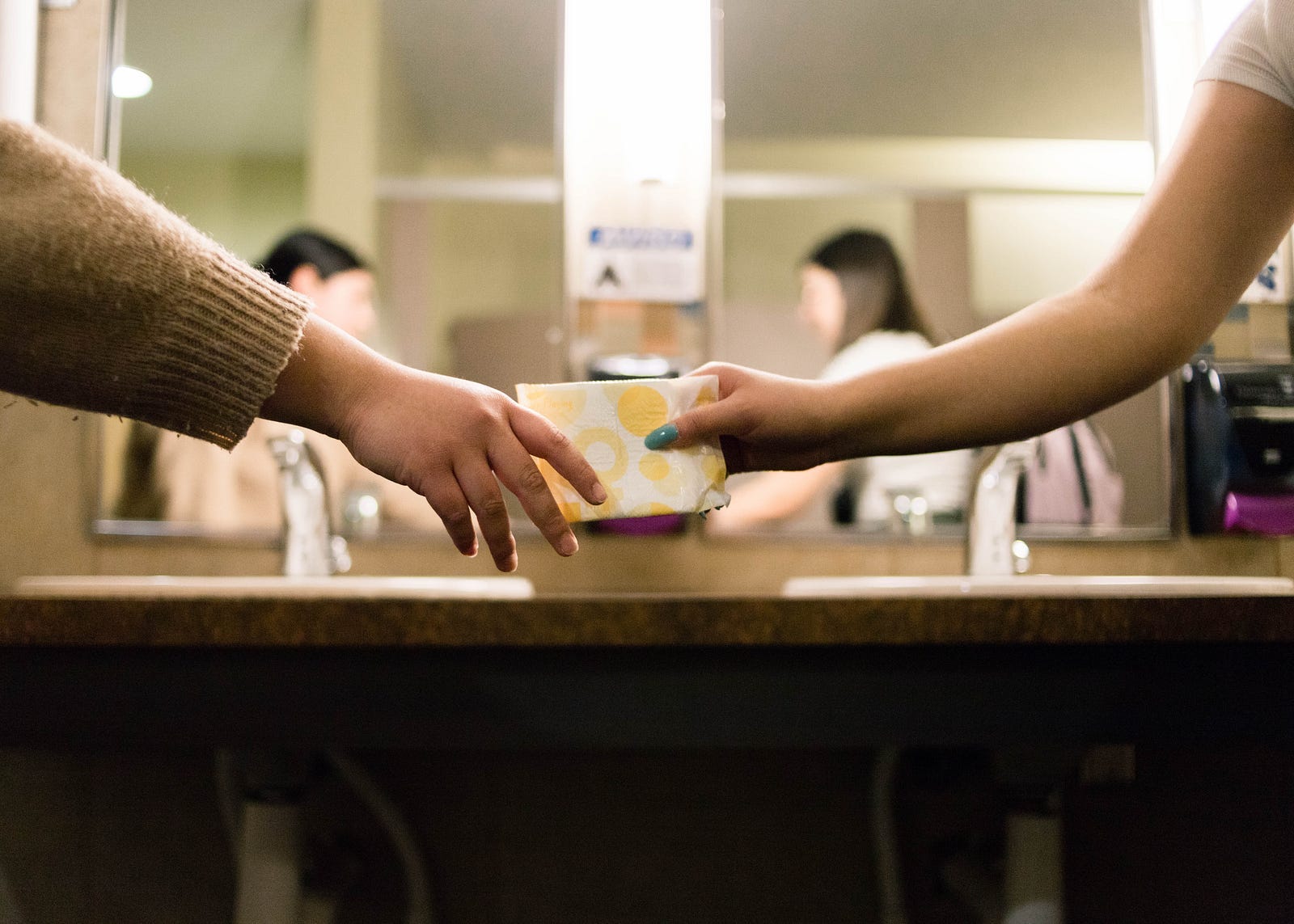
Blister plasters, boob tape, and tampons are handed out like Werther’s Originals at a Women’s Institute meeting. Pleasant conversation dapples the air. Strangers become new best friends.
Outfits are readjusted, hair is coiffed, perfume is shared, and doors with faulty locks are guarded to prevent accidental walk-ins. Those who are desperate are permitted to jump the line.
It’s where the power of sorority is comfortably displayed.
The girls’ bathroom is one of the few places where female vulnerability isn’t preyed upon.
Conversely, it’s often bolstered and allowed to exist without any need for justification.
Sure, it’s where you go when nature calls. But it also acts as a cocoon-like environment — somewhere you can retreat to when you want to feel… safe.
Nat, why are you waxing lyrical about the loo?
Well, because this recent encounter brought about a bracing realisation for me — a conventional woman with an uncomplicated identity who fits comfortably within the margins of the archetype.
I realised that the person peeking her head around the door wasn’t merely asking for permission to enter the room.
She was asking for permission to belong.
She was giving me the power to accept or reject her appeal to exist freely in a space that—for people like me—is a place of comfort, and for people like her, is commonly associated with hostility and consternation.
The alignment of my biological sex and gender identity affords me the confidence to take up space in social settings where others, with less streamlined identities, may feel reluctant.
Of course, uncertainty is a perfectly natural phenomenon in adolescence — kids are constantly trying to make sense of themselves and explore how and where they best fit in a world governed by grown-ups. And this kid, who looked to be some 14 or 15 years old, is no different.
However, this situation was unique because it didn’t focus on the implicit social hierarchy that comes with a significant age gap.
Instead, our respective positions on the spectrum of womanhood forced us to weigh up the other’s existence.
It was as though she believed that within a shared space her identity would encroach on mine; so announcing that she was trans and verbally acknowledging our differences would help me to legitimise her humanity some.
She asked me if she could come in because there may have been a chance that I wouldn’t have wanted her to.
And that is devastating to me.
“Bueno, hija, ¿qué más da? Pasa, pasa.” So what, kiddo? Come on in.
I headed over to the hand dryer.
“Ay, muchas gracias!”
She smiled sweetly and walked past me in her fishnet tights and patent Dr. Martens.
Transphobia is not an alien concept in countries that operate under organised religion or have a traditional set of social values, such as Spain.
Vox—a prominent far-right political party—has been consistently vocal about its disdain towards transgender people and its desire to prevent their access to base-level human rights. Transgender people are persecuted by conservative political parties and their followers all across the nation.
Adults berating other adults is one thing, but what happens when this toxic, nefarious behaviour falls upon the shoulders of children?
Children are sacred
“Los niños son sagrados” (children are sacred) is a phrase you see and hear typically in response to the mistreatment of children in any form.
Children are revered in Hispanic culture, so why was this particular child so acutely aware of the controversy surrounding her identity? Shouldn’t the innocence we try so hard to preserve in children include transgender children too?
Shouldn’t she be able to exist as comfortably as her peers do?
Had I voiced an issue with her coming into the bathroom, there is no doubt in my mind that she would’ve turned away and left. And that’s what bothered the hell out of me. It upset me that she felt the need to even mention it.
Because who am I? I’m not important. I have no authority over public spaces or gender identity whatsoever.
I don’t care what people do in the privacy of a bathroom stall. I don’t stop to intimidate them or pass judgement.
I’m just a stranger washing her hands at the sink. But luckily for this girl, I’m a kind stranger. Someone whose cup of compassion and understanding runneth over.
The fact that she felt the need to ask stirred up feelings of pity and rage in equal measure.
It disgusts me that this harmless individual possibly has and probably will suffer at the hands of narrow-minded losers who mind other people’s business more than their own.
As if growing up isn’t already fraught with insecurity and a heightened awareness of your differences from others. Being a teenager in today’s world is like wandering into the seventh circle of hell with gasoline shorts on.
Sure, the world is a big, scary place. But the girls’ bathroom is something else entirely, and it should stay that way.
I felt a wave of protectiveness wash over me as I thought about how she must feel on a regular basis. Physically, she was long-limbed and lofty, yet she seemed so small and defenceless.
A kid.
Just figuring herself out, one day at a time.
When she came into the sink area, she told me she liked my outfit — I told her that I have my own clothing line and was wearing one of my newest designs. I offered her a soap sheet and asked her about her makeup — her parents had bought her an eyeshadow palette for her birthday recently. I’ve never been any good with eyeshadow. She doesn’t go a day without it.
So there we were.
Just two gals chopping it up in the girls’ bathroom, enjoying pleasant conversation with someone we’ll probably recall warmly once or twice before returning to the monotony of our everyday affairs.
I suppose that these are the situations we need more of. Just witnessing humans being humans and doing human things.
So often bigots behave as though those they’re prejudiced towards are a subhuman entity that needs to be exterminated to restore a sense of harmony and order to the world.
In reality, we’re all just people. Trying to get by and get on with things before we shuffle off this mortal coil once our number is up.
Coexisting peacefully really isn’t as complicated as it’s made out to be. Being kind to others is far from difficult.
We’re all different, and that’s fine — it doesn’t need to be fire and brimstone and bloodbaths and battalions.
So when you meet someone different from you, just share the soap.
(I put a new theme on the phone for March; it’s called “Four Leaf Spring.” I thought it would be seasonable. I noticed on the thumbnail that the four leaved clover had 5 leaves, so kept looking, then decided to go back and just take it because other than the extra leaf, I like it, and it’s free. It did strike me that that theme artist used AI. Or is AI? dun dun DuN…)
March 2, 1807 The U.S. Congress sought to end international slave trade by passing an act to make it unlawful “to import or bring into the United States or the territories thereof from any foreign kingdom, place, or country, any negro, mulatto, or person of colour, with intent to hold, sell, or dispose of such negro, mulatto, or person of colour, as a slave, or to be held to service or labour.” Domestic traffic in slaves, however, was still legal and unregulated. Article I, Sec. 9 of the Constitution had set 1808 as the end to the individual states’ control of immigration..
The first shipload of African captives to North America had arrived at Jamestown, Virginia, in August 1619, and the first American slave ship, named Desire, sailed from Marblehead, Massachusetts, in 1637. In total, nearly 15 million Africans were transported as slaves to the Americas. The African continent, meanwhile, lost approximately 50 million human beings to slavery and related deaths. Despite the federal prohibition and because the slave trade was so profitable, an additional 250,000 slaves would be “imported” illegally by the time the Civil War began in 1861. African slave trade timeline
March 2, 1955 Nine months before Rosa Parks made headlines, teenager Claudette Colvin was arrested in Montgomery, Alabama, for refusing to give up her bus seat to a white person. She was active in the Youth Council of the local NAACP (National Association for the Advancement of Colored People). Though the Montgomery Bus Boycott was begun after Ms. Parks’s arrest, Clovin’s legal case became part of the basis for a federal court challenge to Alabama’s segregation laws. Colvin became one of four plaintiffs in Browder v. Gayle, in which the Supreme Court ultimately struck down the law under which she was arrested for merely taking her seat on a bus. Claudette Colvin More about Claudette Colvin
March 2, 2011 British, French and Tunisian planes began airlifting to Cairo some 85,000 mostly Egyptians who had been guest workers in Libya. Made refugees by the civil war being raged against the four-decade-long dictatorship of Muammar Qadaffi, they had fled to Djerba on the Libya-Tunisia border. Tunisia, just recently convulsed by the first stirrings of the so-called Arab Spring, was unable to deal with the potential humanitarian crisis at their border. Iraqi security forces close a bridge leading to the heavily guarded Green Zone in Baghdad. Photo: Khalid Mohammed/AP
Dria James is a former DEI executive, with over a decade of experience driving diversity, equity, inclusion, and belonging across financial services, management consulting, higher education, and non-profit sectors. Now, she’s the CEO and founder of Black In Diversity, dedicated to empowering Black leaders and allies to thrive while driving systemic change. Here, shetakes us inside what it’s like to work in America’s most contested industry.
The emptiness of not-quite belonging followed me like a shadow from a young age. Born in the late ’80s in Paterson, New Jersey, to two young parents, private school education was seen as one of the few lifelines available for Black folks looking to transcend the social, economic, and political firestorm that engulfed Paterson in the 1990s. At the time, the city was marred by rising crime rates, declining businesses, and severe budget cuts to public schools, leaving many families searching for alternatives. In fact, my mother’s high school, Eastside, is featured in Lean On Me, the Black film classic that details the true story of Paterson’s own Principal Joe Clark, an educator who went to extreme lengths to help improve the test scores and livelihoods of Black students at the inner city school.
My parents, both educators, witnessed firsthand the crumbling state of local public school education: overcrowded classrooms, underfunded programs, and a growing sense of despair among students and teachers. So, they made immense sacrifices, often forgoing their own comforts, to ensure I had access to a quality education in a private school life. But that choice carried an unseen cost—a nagging fractured sense of identity that lingered long after I left the classroom.
Courtesy of Dria James, The author, Dria James
In college, I penned a personal statement titled The Struggle of Adaptation, detailing the weight of double-consciousness I carried as a child while wading alone in a sea of white for most of my formal education. On the one hand, I knew I was privileged to attend the schools I did, gaining access to extracurricular opportunities, like playing the violin and traveling, rare opportunities that few Black kids from Paterson could even dream of at the time. But inside those classrooms, as one of the only Black girls in a space where no one looked like me, I often felt small, like my experiences and perspectives were invisible or undervalued. My educational experience was a tightrope walk between two worlds, never quite falling safely into either.
Looking back, my own awkward dance with cultural isolation set the stage for my future career as a corporate human resources executive in diversity, equity, and inclusion (DEI). Perhaps subconsciously, I was driven to resolve my internal conflict by helping other underrepresented communities navigate the challenges of educational and workplace integration with less angst. But DEI work extends far beyond my personal story, it is deeply woven into this country’s history. The earliest forms of this work trace back to the Civil Rights Act of 1964, which guaranteed equal employment rights to Americans regardless of race, age, sex, religion, or national origin. With that storied history on my shoulders, I enrolled at Cornell University, determined to make a tangible impact. My first step? A DEI internship at a major financial institution, where I arrived with the enthusiasm of a true changemaker, eager to reshape the narrative.
As an intern, I was involved in diversity recruiting efforts on college campuses. As a bright-eyed, bushy-tailed college junior, I put together a list of schools to visit, including Historically Black Colleges and Universities (HBCUs), determined to bring diverse, qualified Black talent into the Wall Street pipeline. But I was quickly hit with my first strip of DEI yellow caution tape — I was told those schools were too small to justify a campus visit from a budget perspective and was instead directed to focus on institutions with larger enrollment numbers.
That early career disappointment was a wake-up call. As much as I wanted my work to be heart-centered and passion-driven, I realized that passion alone wasn’t enough in the corporate world. Everything had to have a clear return on investment (ROI). That’s why the current narrative that DEI is a shell-tactic to simply give a handout to undeserving folks is so wildly misleading. Companies wouldn’t invest in these policies if they weren’t economically advantageous to their bottom line. (snip-there is MORE; not tl,dr.)
“Nothing that you are seeing right now is normal,” says Gabrielle Perry, a political commentator, nonprofit founder, and organizer. “We are seeing the Latino community buying groceries in bulk so that they do not have to leave their homes frequently. We are seeing Native American people’s citizenship being called into question. We are seeing Black people in mass being laid off from their jobs at the federal level.” In each of these situations, the law is being weaponized as a tool of fear and anxiety, but it’s the latter threat — the legal war against diversity, equity, and inclusions in workplaces — that hits home for Perry. “DEI has now become synonymous with Black people and that’s not an accident,” says Perry, who is the founder and executive director of The Thurman Perry Foundation, a nonprofit organization that lost a $35,000 grant that they normally receive annually. “White people, particularly white men, are suing nonprofits and universities for awarding any aid to anyone on the basis of race or gender,” she tweeted out afterwards. Though Perry’s organization wasn’t sued, her funders are responding to this moment with an abundance of caution which means pulling “risky” investments. And after Trump’s executive order urging the roll back of DEI at the federal level, everyone else seems to be falling in line and investing in anything Black is deemed a “risk”.
Fear is a powerful motivator and the threat of having the full force of the American legal system against you is enough to make anyone cower. For example, even when Latine Americans do have citizenship, there is a fear of being rounded up anyway with no clear path to resistance. And even when there is no legal grounds to strip employees of their right to equity and inclusion, Trump’s grandstanding has stoked enough uncertainty that his rhetoric is working. Multiple brands have announced they are either ending or curtailing their DEI efforts in what seems to be a pre-emptive show of compliance to the Trump administration. That’s exactly what makes these shifts so dangerous; conservatives don’t even need to have constitutional cover for their onslaught. Republicans only need to make the average American fear their proposed policies enough to shift their behavior proactively.
These attacks are not new. Over the past few years, Republicans have come after “woke culture,” critical race theory,affirmative action, and now DEI. Trump has positioned DEI as standing in the way of others’ freedoms, a falsehood that his base has run with in recent years. “The distortion of our words and work is right out of the playbook for opponents of freedom for all people,” says Susan Taylor Batten, President and CEO of ABFE. She encourages people to refocus the conversation around the true history of this country and Black organizations’ consistent investment in fighting for all people regardless of race, ethnicity, gender, ability, and more. Similarly, Dr. Alvin Tillery believes we need to shift our strategy for how we communicate what is happening. Tillery is a tenured professor at Northwestern University and founder of The Alliance for Black Equality. “I see so many beautiful Black kids on social media posting things like, ‘Donald Trump is a DEI hire.’ No, he’s not,” Tillery corrected. “DEI hires are qualified and legitimate. Donald Trump is a white supremacy hire.” When conservatives co-opt progressive messaging, the answer isn’t to fall in line with their revisionism. “We don’t need to respond to racism by saying we’re excellent,” Tillery warns. “Rebranding our work won’t protect us or these programs because this fight isn’t rational. We have to fight back.”
Perry also expanded on this moment and how these attacks are bleeding into all facets of American life — not just Black communities. “People began to see this coming to a head on a national lens last February when the Fearless Fund venture capital lawsuit hit national headlines,” Perry expounded. The Fearless Fund previously extended grants to small businesses led by women of color and was sued by Edward Blum and his conservative organization, the American Alliance for Equal Rights. The claim was essentially one of reverse-racism; that by only opening their grant program to Black women, Fearless Fund was discriminating against others in violation of the Civil Rights Act of 1866. “At the time,” Perry said, “I knew it was horrible what was happening to her but I had no idea that was going to trickle down to my little organization in Louisiana. [Arian Simone] made the absolutely selfless decision to settle and to close her doors because she knew that if she took it to the Supreme Court, so much would be stacked against her, and that it would affect all of us.” Blum and the AAER claimed victory, labeling the Fearless Fund’s work as “divisive and illegal” and painted the founders — working to resource the most marginalized among us — as exclusionary (Unbothered has reached out to Blum and the AAER and they have yet to respond). Unfortunately, the decision has hurt Black founders anyway as funders pull resources in fear of litigation and as the federal government remains on the attack. Litigation is expensive and sets precedence which can completely shift the landscape facing Black-led organizations. It takes deep coffers to go up against a high-powered law team and, if you lose, a single legal decision can hurt thousands of organizations. For many, it’s easier to avoid lawsuits altogether.
“The cruelty is the point,” Gabrielle Perry reiterated. “Trump is testing what will hold and what won’t. Who’s going to push back and who won’t.” Perry urges that there needs to be a strong and unrelenting response to these attacks, something Democrats haven’t been doing with nearly enough force. Tillery agrees and brought up some important historical context to emphasize how much more could be done right now. “We have more power in 2025 than Dr. King and Fannie Lou Hamer and Rosa Parks and Ralph Abernathy had in 1964 when the Civil Rights Act passed,” Tillery called out. “There were three Black members of Congress, then, and it was a segregated institution. Today there are over 60 Black members of Congress including five Black senators who have the ability to filibuster. Why aren’t we putting pressure on them right now to step up?” (snip-MORE; again, not tl,dr.)
(Posted in full for full effect. I pulled it from Ten Bears’s post because I haven’t opened my email yet and was reading “Homeless On The High Desert.”)
By Reuters March 1, 2025 4:44 AM CST Updated 8 hours ago
March 1 (Reuters) – Ukrainian President Volodymyr Zelenskiy and U.S. President Donald Trumpclashed at a White House meeting that ended in disaster on Friday, prompting an outpouring of reaction from across the globe.
ZELENSKIY ON X
“Thank you America, thank you for your support, thank you for this visit. Thank you @POTUS, Congress, and the American people. Ukraine needs just and lasting peace, and we are working exactly for that.”
In a social media post on Saturday:
“It is very important for us that Ukraine is heard and that no one forgets about it, neither during the war nor after. It is important for people in Ukraine to know that they are not alone, that their interests are represented in every country, in every corner of the world.”
CANADIAN PRIME MINISTER JUSTIN TRUDEAU ON X
“Russia illegally and unjustifiably invaded Ukraine. For three years now, Ukrainians have fought with courage and resilience. Their fight for democracy, freedom, and sovereignty is a fight that matters to us all. Canada will continue to stand with Ukraine and Ukrainians in achieving a just and lasting peace.”
GERMAN CHANCELLOR OLAF SCHOLZ
“No one wants peace more than the citizens of Ukraine! That is why we are jointly seeking the path to a lasting and just peace. Ukraine can rely on Germany – and on Europe.”
FRENCH PRESIDENT EMMANUEL MACRON TO REPORTERS IN PORTUGAL:
“Russia is the aggressor, and Ukraine is the aggressed people. I think we were all right to help Ukraine and sanction Russia three years ago, and to continue to do so. We, that is the United States of America, the Europeans, the Canadians, the Japanese and many others. And we must thank all those who have helped and respect those who have been fighting since the beginning. Because they are fighting for their dignity, their independence, their children and the security of Europe. These are simple things, but they’re good to remember at times like these, that’s all.
ITALIAN PRIME MINISTER GIORGIA MELONI
“Every division of the West makes us all weaker and favours those who would like to see the decline of our civilisation. Not of its power or influence, but of the principles that founded it, first and foremost freedom. A division would not benefit anyone. What is needed is an immediate summit between the United States, European states and allies to talk frankly about how we intend to deal with the great challenges of today, starting with Ukraine, which we have defended together in recent years, and those that we will be called upon to face in the future. This is the proposal that Italy intends to make to its partners in the coming hours.”
SPOKESPERSON FOR BRITISH PRIME MINISTER KEIR STARMER
“He retains his unwavering support for Ukraine and is playing his part to find a path forward to a lasting peace, based on sovereignty and security for Ukraine.”
AUSTRALIAN PRIME MINISTER ANTHONY ALBANESE
“We will continue to stand with Ukraine for as long as it takes, because this is the struggle of a democratic nation versus an authoritarian regime led by Vladimir Putin, who clearly has imperialistic designs, not just on Ukraine, but throughout that region.”
CANADIAN FOREIGN MINISTER MELANIE JOLY ON X
“Canada remains committed to providing the necessary assistance to ensure Ukraine’s security, sovereignty, and resilience.”
DENMARK’S FOREIGN MINISTER LARS LOKKE RASMUSSEN ON FACEBOOK
“It’s a punch in the gut for Ukraine. … There must be room for robust conversations – even between friends. But when it happens in front of rolling cameras like that, there is only one winner. And he sits in the Kremlin.”
FORMER RUSSIAN PRESIDENT DMITRY MEDVEDEV, DEPUTY CHAIRMAN OF RUSSIA’S SECURITY COUNCIL, ON TELEGRAM
“A brutal dressing down in the Oval Office.”
EUROPEAN COMMISSION PRESIDENT URSULA VON DER LEYEN ON X
“Your dignity honors the bravery of the Ukrainian people. Be strong, be brave, be fearless. You are never alone, dear President.
“We will continue working with you for a just and lasting peace.”
MOLDOVAN PRESIDENT MAIA SANDU ON X
“The truth is simple. Russia invaded Ukraine. Russia is the aggressor. Ukraine defends its freedom – and ours. We stand with Ukraine.”
SPANISH PRIME MINISTER PEDRO SANCHEZ ON X
“Ukraine, Spain stands with you.”
HUNGARIAN PRIME MINISTER VIKTOR ORBAN ON X
“Strong men make peace, weak men make war. Today President @realDonaldTrump stood bravely for peace. Even if it was difficult for many to digest. Thank you, Mr. President!”
NORWEGIAN PRIME MINISTER JONAS GAHR STOERE IN STATEMENT TO TV2
“What we saw from the White House today is serious and disheartening. Ukraine still needs the US’s support, and Ukraine’s security and future are also important to the US and to Europe. President Volodymyr Zelenskiy has strong support in Ukraine, broad support in Europe, and he has led his people through a very demanding and brutal time, under attack from Russia. That Trump accuses Zelenskiy of gambling with World War III is deeply unreasonable and a statement I distance myself from. Norway stands with Ukraine in their struggle for freedom. We hope that the Trump administration also understands the importance of a just and lasting peace in Ukraine.”
CZECH PRESIDENT PETR PAVEL ON X
“We stand with Ukraine more than ever. Time for Europe to step up its efforts.”
DUTCH PRIME MINISTER DICK SCHOOF
“The Netherlands continues to support Ukraine. Especially now. We want lasting peace and an end to the war of aggression that Russia has started. For Ukraine, for all its inhabitants and for Europe.”
ESTONIAN FOREIGN MINISTER MARGUS TSAHKNA ON X
“The only obstacle to peace is (Russian President Vladimir) Putin’s decision to continue his war of aggression. If Russia stops fighting, there will be no war. If Ukraine stops fighting, there will be no Ukraine. Estonia’s support to Ukraine remains unwavering. Time for Europe to step up.”
POLISH PRIME MINISTER DONALD TUSK ON X
“Dear @ZelenskyyUa, dear Ukrainian friends, you are not alone.”
GEORGIAN PRIME MINISTER IRAKLI KOBAKHIDZE
“Yesterday, once again, a clear line was drawn between the war party and the peace party. I am referring not so much to the debate between Trump and Zelenskiy, but to the subsequent reactions to this debate. President Trump and his peace efforts were condemned one after another by people responsible for allowing a bloody war and callously sacrificing Ukraine and the lives of thousands of Ukrainians.”
GREEK FOREIGN MINISTER GEORGE GERAPETRITIS
U.S. support in the conflict in Ukraine is necessary, although Europe still needs to upgrade its own defence infrastructure, the minister said.
SWISS PRESIDENT KARIN KELLER-SUTTER ON X
“Switzerland remains firmly committed to supporting a just and lasting peace, while condemning Russia’s aggression against a sovereign state.”
JOHANN WADEPHUL, DEPUTY OF CONSERVATIVE PARTY-GROUP IN GERMAN PARLIAMENT, THE PARTY OF INCOMING CHANCELLOR FRIEDRICH MERZ, ON X
“The scenes from the White House are shocking. How can you stab the president of an invaded country in the back like this? Free Europe will not betray Ukraine!”
ITALIAN DEPUTY PRIME MINISTER MATTEO SALVINI, LEADER OF THE FAR-RIGHT LEAGUE PARTY ON X
“Aim for PEACE, stop this war! Come on @realDonaldTrump”.
The Reuters Daily Briefing newsletter provides all the news you need to start your day. Sign up here.
Reporting by Kate Entringer, Jason Hovet, Andreas Rinke, Anna Wlodarczak-Semczuk, Nerijus Adomaitis, Ron Popeski, Krisztina Than, Ana Cantero Rios; Editing by Howard Goller and Richard Chang
Jenny Blake Isabella is proof that it is never too late to embrace being your true authentic self.
A former writer for both Marvel and DC comics Isabella is most well-known for creating the characters Black Lightning, Misty Knight and Tigra.
Over the weekend Isabella came out as transgender with a post on her social media with the meme “Keep Calm and Yes I’m Transgender”. She elaborated further in the caption writing, “This is real. I’ll have more to say soon. In the meantime, I ask you respect my privacy and especially that of my wife and our children. Thank you.”
Isabella is married to Barbara Isabella and the two share two children. While Isabella is now personally using the name Jenny Blacke, she shares that she will continue to write under both that name and her professional name Tony Isabella, and will be presenting as Tony Isabella at upcoming conventions this year. (snipn-MORE)
March 1, 1943 A huge rally in New York City’s Madison Square called on the U.S. government to reconsider its refusal to offer sanctuary to Jewish refugees of Nazi Germany.
March 1, 1954 Nuclear Free and Independent Pacific Day, or Bikini Day, marks the anniversary of the explosion of the largest-ever U.S. nuclear weapon which contaminated major parts of the Marshall Islands [see February 28, 1954]. The land and people of the south Pacific have been exposed to numerous nuclear bomb tests and their radioactive aftermath. In addition to the 67 atmospheric U.S. tests at Bikini and Eniwetok Atolls, France tested 193 weapons in French Polynesia, 46 in theatmosphere. The U.K. exploded 34 devices on Malden and Christmas Islands.The day is also intended to call attention to the potential danger of the increasing trans-oceanic shipment of hazardous nuclear materials, and the need of nuclear and shipping nations to consider the rights and health of the indigenous peoples of the region. The proposed South Pacific Nuclear-Free Zone Treaty
March 1, 1956 The University of Alabama permanently expelled Autherine Lucy, the first African-American person ever admitted to the University (following a federal court’s ordering her admission).She was met with rioting by thousands of students (none of whom were disciplined) and others. She charged in court that University officials had been complicit in allowing the disorder, as a means of avoiding compliance with the court order. The trustees expelled her for making such “ baseless, outrageous and unfounded charges of misconduct on the part of the university officials.” Burning desegregation litgerature at the University of Alabama. Students, adults and even groups from outside of Alabama shouted racial epithets, threw eggs, sticks and rocks, and generally attempted to block her way. Autherine Lucy Foster receives her master’s degree from University of Alabama in 1992. Autherine Lucy Foster ultimately received her master’s degree from the University of Alabama in library science in 1991, the same year her daughter, Grazia, earned her undergraduate degree. The University now grants an endowed scholarship annually in Lucy Foster’s name.
March 1, 1961 President John F. Kennedy issued Executive Order 10924 establishing the Peace Corps as a new agency within the Department of State. The same day, he sent a message to Congress asking for permanent funding for the agency, which would send trained American men and women to foreign nations to assist in development efforts. The Peace Corps captured the imagination of the U.S. public, and during the week following its creation, thousands of letters poured into Washington from young Americans hoping to volunteer. What is the Peace Corps today?(A happy surprise; the website is still up and functioning at 7:54 PM 2/28/25. -A)
March 1, 1974 Former top Nixon White House aides H.R. Haldeman and John D. Ehrlichman, and former Attorney General John Mitchell, were indicted on obstruction of justice charges related to the Watergate break-in.








 Scottie's Playtime