From The Smart Ones:

Kickass Women in History: Carlota and Fermina

by Carrie S · Jun 6, 2026 at 6:00 am

TW/CW:  slavery, shackles, torture, violence

The stories of rebellion by enslaved peoples has been largely erased or occluded from history, and when these stories are told, they usually center men. In Cuba, however, two women became legends because of the leadership roles they took in rebellion. Carlota and Fermina were decisive, brave, and brutal. Both women were kidnapped from the Yoruba Nation and given the last name ‘Lucumí’, a word which refers to Afro-Cubans of Yoruba descent.

The Triunvirato sugar plantation was a fucking hellscape. By the 1840s, one third of Cuba’s population consisted of enslaved persons, almost all of whom worked in the sugar trade in some capacity. The 1840s saw Cuba utilizing steam-powered mails and railroads and engaging in massive deforestation as the economy became reliant on sugar. The Triunvirato Plantation was one of many that subjected enslaved people to a starvation diet and horrific working and living conditions.

We know very little about Carlota and Fermina. We do know, however, that on November 6, 1843, Carlota and others launched the Triunvirato Rebellion, the last in a series of uprisings across Cuba. Carlota used talking drums to communicate with other plantations, bringing the neighboring Acaná plantation, where Fermina was enslaved, as well as several others into the plan.
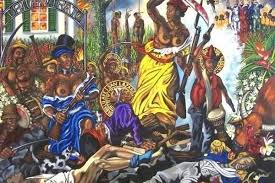
brightly colored painting shows a Black woman in a yellow dress, breasts exposed, wielding a machete
Carlota Leading the People (after Eugene Delacroix’s Liberty Leading the People by Lili Bernard, 2011

Fermina had recently escaped from Acaná and may have planned a June rebellion, but it didn’t happen. She was recaptured and shackled for months. Her tormentors released her from the shackles just a few days before the Triunvirato Rebellion, which she helped lead on the Acaná Plantation. In all, the enslaved people on five plantations rose up against their oppressors on or near November 6.

Here is a good overview of what we know about Carlota:

The series of rebellions that took place in 1843 (including uprisings in March and May, as well as a thwarted uprising in December) were collectively referred to as La Escalera. In response, slavers tortured and murdered so many people that 1844 became known as “The Year of the Lash”. Fermina was tortured and then killed by a firing squad. Carlota died at some point during the Trinuvirato Rebellion. Slavery in Cuba wasn’t abolished until 1886.

However, Carlota’s memory was preserved in oral legend. She became a famous symbol of resistance in Cuba. In 1975, when Cuba sent troops to support the People’s Movement for the Liberation of Angola (MPLA), they called the operation ‘Operation Carlota.’
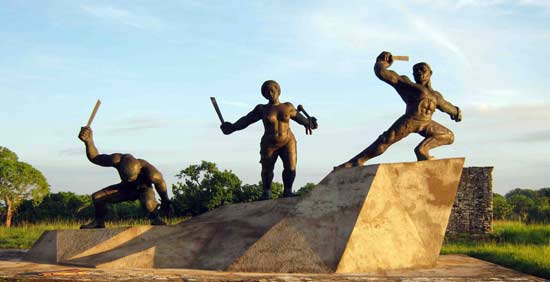
a monument showing three figures, two men with a woman in the center, brandishing weapons
Monument to Carlota’s Rebellion, located at Triumvirato, erected in 1991

Writing about history is a messy business. For one thing, many historical figures, especially women, and most especially women of color, have been so systematically erased that the stories we still have of them are murky. This is certainly true of Carlota and Fermina. We don’t even know their real names – only the names their slavers forced them to bear. We know for sure that they existed, and everything else is a matter of sifting various stories together and trying to figure out where they overlap.

In this column, there is also the matter of who to choose as ‘Kickass.’ Carlota and Fermina were both said to have done terrible, violent things.

CW/TW

Their story can be seen as one in which brutality begets brutality, and it can also be seen as a human being refusing to break or to become passive with despair in the face of massive crushing forces. Carlota and Fermina were clever, resourceful, determined leaders. I only wish I knew their real names.

Sources:

Many Items in Peace & Justice History for 6/1

Also, I want to mention that I’ve been publishing here at Scottie’s Playtime since 7/10 or 11, and normally, have posted one of these each day. There hasn’t been much change or updating for a while; the newsletter and history website is Carl Bunin’s labor of love, depending upon the sales of buttons, pencils, and other merch. I’ve been reading these since 2001, and have noted it feels as if we here may have seen some of these before, and definitely will have by next month. So: should I continue after July 10th, or has everyone seen these, and enough is enough for a while? I don’t mind either way, but I don’t want to use up space and give people repeats. Just let me know in comments over the next few days, OK? And thanks for visiting Scottie’s Playtime!

June 1, 1845

Sojourner Truth (born Isabella Baumfree, but went by the name she believed God had given her as a symbolic representation of her mission in life) set out from New York City on a journey across America, preaching about the evils of slavery and promoting women’s rights. She had been a slave with several owners but was legally free when slavery was abolished in New York state.
Read more about Sojourner Truth (There’s a very cool yet somewhat incendiary comment there on this page; go see it.)
June 1, 1921
America’s worst race massacre, begun the day before over the threat of a lynching, culminated in the complete destruction of the African-American neighborhood of Greenwood in Tulsa leaving nearly 10,000 homeless.
The ruins of Tulsa Oklahoma’s Greenwood District following the assault by the white community.
Death in a Promised Land: The Tulsa Race Massacre of 1921  
read more 
Meet The Last Surviving Witness To The Tulsa Race Riot Of 1921 
June 1, 1932
Gay rights organizer Henry Gerber published an article in Modern Thinker magazine attacking the view that homosexuality is a neurosis.
In 1924, Henry Gerber, a postal worker in Chicago, started the Society for Human Rights, America’s first known gay rights organization.

“The Society for Human Rights is formed to promote and protect the interests of people who are abused and hindered in the legal pursuit of happiness which is guaranteed them by the Declaration of Independence, and to combat the public prejudices against them.”

After having created and distributed a newsletter called “Friendship and Freedom,” Gerber was arrested and held for 3 days without a warrant or being charged with any infractions. Upon release he lost his job for “conduct unbecoming a postal worker.”
Following the last of his three trials, in which the charges were ultimately dismissed, Gerber moved to new York City and re-enlisted in the U.S. Army, serving another 17 years. He lived until 1972, passing away at the the U.S. Soldiers’ and Airmen’s Home in Washington, D.C., living long enough to see the Stonewall Rebellion [see June 28, 1969], the beginning of the modern gay rights movement.
 
More on Henry Gerber 
June 1, 1942

On the advice of Nazi propaganda minister Joseph Goebbels, German Chancellor Adolf Hitler ordered all Jews in occupied Paris to wear an identifying yellow star on the left side of their coats.
The following month 13,000 French Jews were deported to the Auschwitz-Birkenau concentration camps.

June 1, 1950
Senator Margaret Chase Smith (R-Maine), then the only woman in the Senate, and just the second in U.S. history, denounced Senator Joseph McCarthy (R-Wisconsin) and his “red-baiting” tactics on the floor of the U.S. Senate, in a speech called “A Declaration of Conscience.”

“Those of us who shout the loudest about Americanism in making character assassinations are all too frequently those who, by our own words and acts, ignore some of the basic principles of Americanism—the right to criticize;
the right to hold unpopular beliefs;
the right to protest;
the right of independent thought.”

Text of the Senator Smith’s Declaration 
June 1, 1963
The U.S. Supreme Court ruled that recitation of the Lord’s Prayer and readings from the Bible in public schools violated the establishment clause of the first amendment to the U.S. Constitution in School Dist. Of Abington Township v. Schempp. The Court reasoned that the daily practice was unconstitutional because a public institution was conducting a religious exercise and “that public funds, though small in amount, are being used to promote” a particular religion. “It is not the amount of public funds expended; as this case illustrates, it is the use to which public funds are put . . . .”
The decision 
June 1, 1967
The Vietnam Veterans Against War (VVAW) was founded in New York City after six Vietnam vets marched together in a peace demonstration. The group was organized to give voice to the growing opposition to the escalating war in Indochina among returning servicemen and women.


VVAW, through open discussion of soldiers’ first-hand experiences, revealed the truth about the nature of U.S. involvement in Southeast Asia.
VVAW demonstrating against Iraq war 2004
The VVAW today 

https://www.peacebuttons.info/E-News/peacehistoryjune.htm#june1

The Sedition Act of 1918, and More, in Peace & Justice History for 5/16

May 16, 1792
Denmark became the first country to outlaw the slave trade.
CHRONOLOGY-Who banned slavery when? 
May 16, 1918
The U.S. Congress passed the Sedition Act, legislation designed to protect America’s participation in World War I. Along with the Espionage Act of the previous year, the Sedition Act was orchestrated largely by A. Mitchell Palmer, the United States attorney general under President Woodrow Wilson. The Espionage Act, passed shortly after the U.S. entrance into the war in early April 1917, made it a crime for any person to convey information intended to interfere with the U.S. armed forces’ prosecution of the war effort or to promote the success of the country’s enemies.
Aimed at socialists, pacifists and other anti-war activists, the Sedition Act imposed harsh penalties on anyone found guilty of making false statements; insulting or abusing the U.S. government, conscription, the flag, the Constitution or the military; agitating against the production of necessary war materials; or advocating, teaching or defending any of these acts.

The Sedition Act of 1918 
May 16, 1943
The Nazis crushed the Jewish uprising in the Warsaw ghetto after a month of bloody fighting.
56,000 died in the struggle.


Read more 
May 16, 1967
Nhat Chi Mai immolated herself in Saigon, the capital of South Vietnam, to protest the war.
“I offer my body as a torch / to dissipate the dark / to waken love among men / to give peace to Vietnam.”

The flower known as Nhat Chi Mai.
Read more 
May 16, 1998
Tens of thousands of Britons supporting Jubilee 2000 formed a human chain around the meeting place of the G7 Summit (an annual meeting of the leaders of the largest industrial countries) in Birmingham, England. Jubilee 2000 urged the major international lending countries to relieve terms of and forgive the massive indebtedness of poor countries around the world.
Jubilee 2000 by Noam Chomsky 

https://www.peacebuttons.info/E-News/peacehistorymay.htm#may16

Peace & Justice History for 3/2

March 2, 1807
The U.S. Congress sought to end international slave trade by passing an act to make it unlawful “to import or bring into the United States or the territories thereof from any foreign kingdom, place, or country, any negro, mulatto, or person of colour, with intent to hold, sell, or dispose of such negro, mulatto, or person of colour, as a slave, or to be held to service or labour.”

Domestic traffic in slaves, however, was still legal and unregulated. Article I, Sec. 9 of the Constitution had set 1808 as the end to the individual states’ control of immigration..

The first shipload of African captives to North America had arrived at Jamestown, Virginia, in August 1619, and the first American slave ship, named Desire, sailed from Marblehead, Massachusetts, in 1637. In total, nearly 15 million Africans were transported as slaves to the Americas. The African continent, meanwhile, lost approximately 50 million human beings to slavery and related deaths. Despite the federal prohibition and because the slave trade was so profitable, an additional 250,000 slaves would be “imported” illegally by the time the Civil War began in 1861.

African slave trade timeline  
March 2, 1955
Nine months before Rosa Parks made headlines, teenager Claudette Colvin was arrested in Montgomery, Alabama, for refusing to give up her bus seat to a white person. She was active in the Youth Council of the local NAACP (National Association for the Advancement of Colored People).
Though the Montgomery Bus Boycott was begun after Ms. Parks’s arrest, Clovin’s legal case became part of the basis for a federal court challenge to Alabama’s segregation laws. Colvin became one of four plaintiffs in Browder v. Gayle, in which the Supreme Court ultimately struck down the law under which she was arrested for merely taking her seat on a bus.

Claudette Colvin 
More about Claudette Colvin 
March 2, 2011
British, French and Tunisian planes began airlifting to Cairo some 85,000 mostly Egyptians who had been guest workers in Libya. Made refugees by the civil war being raged against the four-decade-long dictatorship of Muammar Qadaffi, they had fled to Djerba on the Libya-Tunisia border. Tunisia, just recently convulsed by the first stirrings of the so-called Arab Spring, was unable to deal with the potential humanitarian crisis at their border.

Iraqi security forces close a bridge leading to the heavily guarded Green Zone in Baghdad. Photo: Khalid Mohammed/AP

https://www.peacebuttons.info/E-News/peacehistorymarch.htm#march1 (Note: if you click through from here, scroll down a bit for 3/2. P&J’s 3/2 link goes to 3/30.)

Peace & Justice History for 9/18:

September 18, 1850

Congress passed the Fugitive Slave Act, allowing slave owners to reclaim slaves who escaped into another state, and levying harsh penalties on those who would interfere with the apprehension of runaway slaves.

As part of the Compromise of 1850, it offered federal officers a fee for each captured slave and denied the slaves the right to a jury trial.
about the Fugitive Slave Act 
The Compromise of 1850 
September 18, 1895
African-American educator (founder of the Tuskegee Institute) and leader (born a slave) Booker T. Washington spoke before a predominantly white audience at the Cotton States and International Exposition in Atlanta. Although the organizers of the exposition worried that “public sentiment was not prepared for such an advanced step,” they decided that inviting a black speaker would impress Northern visitors with the evidence of racial progress in the South. Washington, in his “Atlanta Compromise” address, soothed his listeners’ concerns about “uppity” blacks by claiming that his race would content itself with living “by the productions of our hands.”
Text of the speech 
September 18, 1961
Earl Bertrand Russell and Lady Edith Russell were released from prison after serving one week of their two-month sentences.
They had been part of a Hiroshima Day vigil in Hyde Park, and were accused of inciting civil disobedience.

Bertrand and Edith Russell after being released from prison.

https://www.peacebuttons.info/E-News/peacehistoryseptember.htm#september18