March 23, 1918 The trial of 101 Wobblies (members of the Industrial Workers of the World or IWW) began in Chicago, for opposition to World War I. In September 1917, 165 IWW members were arrested for conspiring to hinder the draft, encourage desertion, and intimidate others in connection with labor disputes. The trial lasted five months, the longest criminal trial in American history at the time.The jury found them all guilty. The judge sentenced IWW leader “Big Bill” Haywood and 14 others to 20 years in prison; 33 were given 10 years, the rest shorter sentences. They were fined a total of $2,500,000 and the IWW was shattered as a result. Haywood jumped bail and fled to the Soviet Union, where he remained until his death 10 years later. “Big Bill” Haywood Read more
March 23, 1942 The U.S. government began moving all those of Japanese ancestry, including some native-born U.S. citizens (known as nisei), from their west coast homes to indefinite imprisonment in detention centers, beginning with Manzanar in California which eventually held more than 10,000 Americans. Located on 60,000 acres west of Los Angeles, it is now a national historic site; only 3 of the original 800 buildings remain. Gallery of photos and other materials about Manzanar
March 23, 1961 Army Major Lawrence Robert Bailey was the first recorded American to be held as a prisoner of war in Southeast Asia. One of eight crew members of a C-47 surveillance aircraft shot down over Laos, Bailey was held by the Pathet Lao for 17 months, losing one-third of his body weight (down to 53 kg, or 117 lbs) during that time. The other occupants of the plane are presumed to have died in the crash; Bailey always wore a parachute.
March 23, 1984 USS Queenfish nuclear submarine student die-in outside the U.S. Consulate. One thousand boats, known informally as the Auckland Harbour Peace Squadron, demonstrated against arrival of the nuclear submarine, U.S.S. Queenfish in New Zealand.
March 22, 1933 The Nazi German concentration camp at Dachau was opened, the first of many such camps built for the incarceration and extermination of those considered unfit: Jews, Polish Catholics, Communists, the Roma (frequently referred to as Gypsies), the “work-shy,” homosexuals, the “hereditary asocial,” and those with mental and/or physical handicaps. The gate to Dachau “Work will make you free” Over 200,000 prisoners were registered at Dachau, nearly all of whom died there. The early days of Dachau
March 22, 1956 Civil rights leader Reverend Martin Luther King, Jr., was convicted of organizing an allegedly illegal boycott by black passengers of buses in Montgomery, Alabama. He was fined $500 but when his lawyers indicated his intent to appeal, the sentence was changed to 386 days of imprisonment. Story of the Montgomery Bus Boycott
March 22, 1965 3,200 civil rights demonstrators, led by the Reverend Martin Luther King, Jr., and under protection of a federalized National Guard, began a third attempt at a week-long march from Selma, Alabama, to the state capitol at Montgomery in support of voting rights for black Americans. Marchers on their way to Montgomery A week before, the march had been violently stopped before leaving Selma. People from all over the country arrived to support the effort for enfranchisement of African Americans in the South whose right to vote had been systematically denied. From Selma to Montgomery: An Introduction to the 1965 Marches – Lesson Plan
March 22, 1974 The Equal Rights Amendment to the U.S. Constitution (ERA) was passed by both houses of Congress with two-thirds majorities. The amendment, to give women full equality under law, was ratified by the legislatures of only 35 states, short of the required three-quarters of the 50 states, and thus never became law. Detailed history of the Equal Rights Amendment
March 22, 1980 30,000 marched in Washington, DC against re-introduction of draft registration. Denise Levertov’s lines from her poem, “A Speech for Antidraft Rally, D.C., March 22, 1980″”…Let our different dream, and more than dream, our acts of constructive refusal generate struggle. And love. We must dare to win not wars, but a future in which to live.” The entire poem(pdf)
Lee Moran Thu, March 20, 2025 at 2:02 AM CDT 1 min read
White House press secretary Karoline Leavitt faced mockery on Wednesday after another apparent slipup during a press briefing.
Leavitt stated that President Donald Trump is “committed to passing a big reconciliation package later this year,” which includes “ending no taxes on tips.”
Leavitt says Trump is committed to "ending no taxes on tips"
Critics quickly seized on the phrase, interpreting it as an accidental double negative that contradicted Trump’s 2024 election campaign promise to nix taxes on tips. Trump has yet to implement the policy.
Leavitt on Monday drew similar mockery after she accidentally claimed the Department of Justice will focus on “fighting law and order” when “fighting for law and order” was likely what she meant.
We’re approaching the third Trans Rights Readathon! It’s an annual call to action that coincides with Trans Day of Visibility on March 31st, and it aims to uplift, amplify, and support trans, nonbinary, gender-nonconforming, and Two-Spirit authors. It takes place from March 21st through the 31st, and this year, there are five core prompts to complete, as well as a list of bonus prompts.
The five core prompts for the 2025 Trans Rights Readathon are Transmasc and Trans Man Rep; Transfemme and Trans Woman Rep; Nonbinary, Agender, Genderqueer, and Other Gender Expansive Rep; Intersectional Trans+ Rep Outside Your Own Experience; and 2Spirit, Indigiqueer and Indigenous Gender Expansive Rep.
If you’d like some recommendations for these prompts, as well as the many bonus prompts, you can find the reading challenge on Storygraph, where users have added suggestions for each. Just be sure to vet these, since anyone can add a title.
The Storygraph description also adds more context to the reading challenge, including making sure not to out authors or interrogate authors about their gender identity: “If information isn’t available in an author’s bio, social media, or on their website, they don’t owe it to you. In an era when people’s identities are being used to target them, please be mindful that we want to CELEBRATE these stories and support authors while keeping each other safe.”
Each prompt also has more information, including that books in the 2Spirit, Indigiqueer, and Indigenous Gender Expansive Rep category may not be trans, so to be mindful about language when discussing these books: “2Spirit, Indigiqueer, and other non-Western Third Genders exist outside of Western concepts of gender and sexuality, and an author who identifies as 2S may not identify as trans.”
Another great resource for the challenge is the Trans Rights Readathon Instagram. They have posts about the readathon itself, including how to participate: by reading trans books, reviewing and discussing them online (using the tags TransRightsReadathon and #TRR2025), and monetarily supporting the trans community (including donating to mutual aid funds).
They also have posts recommending books for each of the prompts. These are vetted by the organizers, so they’re more reliable than the Storygraph suggestions.
Leading up to and during the readathon, I’ll be sharing trans book recommendations. Let me know in the comments if there’s anything in particular you’d like suggestions for!
As a bonus for All Access members, below is a list of 27 new LGBTQ books out this week.
Exclusive content for All Access members continues below. Become a member for $6 a month or $60 a year to get community features and access to exclusive content across all 20+ Book Riot newsletters.
March 21, 1937 On Palm Sunday (the Sunday before Easter), the Nationalist Party of Puerto Rico was to march in Ponce (city on the southern coast of the island) in support of Puerto Rican independence. They were also protesting the imprisonment of Albizu Campos, leader of the Party and the lawyer for the sugarcane workers who had led a general strike.The colonial military governor, Blanton Winship (a Georgian who had been Judge Advocate General of the U.S. Army), revoked the parade permit at the last minute. Nationalists insisted on marching regardless and, surrounded by the well armed police, were fired upon as they began. Whoever fired the first shot, 18 Nationalists and 2 policemen died. 200 others, Nationalists and bystanders, were injured, 150 arrested. This incident is known as Masacre de Ponce, or “The Ponce Massacre.” Families of those who died in the Ponce Massacre A history of Puerto Rico The Ponce massacre remembered
March 21, 1960 South African police opened fire on unarmed demonstrators in the black township of Sharpeville near Johannesburg. The demonstrators were protesting the establishment of apartheid pass laws which restricted movement of non-whites. In Sharpeville itself, 69 were killed and 176 wounded when police fired on the crowd, 63 of them shot in the back. In the aftermath of the Sharpeville massacre, protests broke out in Cape Town and elsewhere, and there were further casualties. Overall, 13,000 were jailed. The organizer, Robert Mangaliso Sobukwe, head of the Pan-Africanist Congress, had written to the police commissioner, notifying him of the plans, and had said at a press conference, “I have appealed to the African people to make sure that this campaign is conducted in a spirit of absolute nonviolence, and I am quite certain they will heed my call.” The Sharpeville Massacre and its significance in South African history
March 21, 2003 The report of the Truth and Reconciliation Commission of South Africa was released. The commission was led by the Reverend Desmond Tutu, a bishop in the Anglican Church, the first black General Secretary of the South African Council of Churches, and Nobel Peace Prize winner for his efforts to bring peace and justice to all South Africans. .Archbishop Desmond Mpilo Tutu The Commission was charged with investigating and providing “as complete a picture as possible of the nature, causes and extent of gross violations of human rights” under the racial separatist apartheid regime from 1960 until the inauguration of Nelson Mandela in 1994, South Africa’s first black president. But the Commission sought to go beyond truth-finding to promote national unity and reconciliation, to facilitate the granting of amnesty to those who made full factual disclosure, to restore the human and civil dignity of victims by providing them an opportunity to tell their own stories, and to make recommendations to the president on measures to prevent future human rights violations. Reverand Tutu concluded in his foreword to the report, “Quite improbably, we as South Africans have become a beacon of hope to others locked in deadly conflict that peace, that a just resolution, is possible. If it could happen in South Africa, then it can certainly happen anywhere else. Such is the exquisite divine sense of humour.” The complete report of the Commission
March 21, 2008 More than 300 people participated in an annual Good Friday peace action at the Lawrence Livermore National Laboratory, organized by Tri-Valley Communities Against a Radioactive Environment (CARES). The lab is a key participant in the design of all weapons in the U.S. nuclear arsenal. The Alameda County Sheriff arrested 91 of the protesters. CARES Executive Director Marylia Kelley said, “The emphasis is on nonviolence and rejecting violence.” The organization behind the action
March 21, 2011 An estimated 14 million Egyptians voted in an essentially problem-free election. 77% voted to endorse a process that would bring elections for parliament within six months and a presidential election later.
March 20, 1815 Switzerland was declared neutral by the great powers of Europe at the Vienna Congress following the defeat of Napoleon Bonaparte. The confederation of 22 cantons (member states) had its current borders established with its neighbors France, Germany, Austria and Italy. Switzerland’s history
March 20, 1852 Harriet Beecher Stowe’s influential novel about slavery, Uncle Tom’s Cabin, or Life Among the Lowly, was first published in book form by J.P. Jewett of Boston. The text had previously been serialized in the anti-slavery newspaper, the National Era. 10,000 copies were sold in the first week, 300,000 within the first year. The many different editions published in Europe sold an aggregate of one million copies in the first year. It was the second best-selling book of the 19th century after the Bible. Uncle Tom’s Cabin was soon published in dozens of languages.
March 20, 1998 Despite the efforts of thousands of anti-nuclear demonstrators, a train hauling 60 tons of nuclear waste arrived in the north German town of Ahaus from Walheim in the south. Twice the train was stopped by protestors chained to the tracks; 300 were arrested with police using water cannon in response to rocks and sticks being thrown at them. The size of the security deployment, outnumbering the protestors ten to one, necessitated the postponing of ten days of football (soccer) matches. A similar shipment the previous year provoked several days of rioting.
March 20, 2010 5:32 PM GMT The first day of spring (the vernal equinox) is the day for celebrating NoRuz [no-rooz], the Persian New Year. More on NoRuz and other Persian celebrations
March 20, 2011 The nuclear reactor crisis created in the wake of the earthquake and tsunami on the northeast coast of Japan began to spread health risks to the surrounding area. Elevated levels of radiation were found in spinach and milk in the nearby prefectures (counties). As a result of pumping seawater to keep the reactors cool after loss of electricity and damage wiped out all the cooling systems, radiation was found in the ocean waters. Fukushima today
March 19, 1911 The first International Women’s Day was held in Germany, Austria, Denmark, and some other European countries. This date was chosen by German women because, on that date in 1848 the Prussian king, faced with an armed uprising, had promised many reforms, including an unfulfilled one of votes for women. A million leaflets calling for action on the right to vote were distributed throughout Germany.
March 19, 1963 The blacklisting of Pete Seeger (and other members of The Weavers) from the folk music television show “Hootenanny” prompted a boycott by 50 folk artists (The Kingston Trio, Bob Dylan, Joan Baez and Peter, Paul & Mary, among others). Seeger had become a cultural hero through his outspoken and joyful commitment to the anti-war and civil rights movements, and helped popularize the anthemic “We Shall Overcome.” Pete Seeger bio from Encyclopedia of the American Left Pete singing and talking about the music with Hugh Hefner on TV in the early ‘60s
March 19, 1978 50,000 marched in Amsterdam to protest U.S. deployment of the neutron bomb in Europe. The neutron bomb was a tactical (artillery shell) enhanced-radiation weapon. It killed people with a neutron flux that penetrated armor but was effective only over a limited area, leaving little fallout or residual radiation. It did minimal damage, however, to physical structures. More about the Neutron Bomb
March 19, 2003 U.S. and coalition forces launched missiles and bombs at targets in Iraq including a “decapitation attack” aimed at Iraqi President Saddam Hussein and other top members of the country’s leadership.
Baghdad, Iraq under attack There were nearly 300,000 American, British and other troops at the border. President George W. Bush warned Americans that the conflict “could be longer and more difficult than some predict.” He assured the nation that “this will not be a campaign of half-measures, and we will accept no outcome except victory.” Read about the cost of this war
March 19, 2011 In response to widespread peaceful demonstrations for political change in Syria, the government sealed off the city of Deraa. Syrian President Bashar Al-Assad claimed his country would not be affected by the movement for more democracy across the Arab world that had already toppled governments in Tunisia and Egypt. His regime was composed almost entirely of ethnic Allawites in a country more than 80% Sunni. Mourners at the funerals for five shot dead by security forces in Deraa chanted, “God, Syria and freedom only.” Demonstrations had been held in at least five cities, including the capital of Damascus.
so, obviously, NSFW, for blue language (I tried to put space in, but the preview showed it didn’t work.) Enjoy when you can; resistance is happening everywhere! -A.
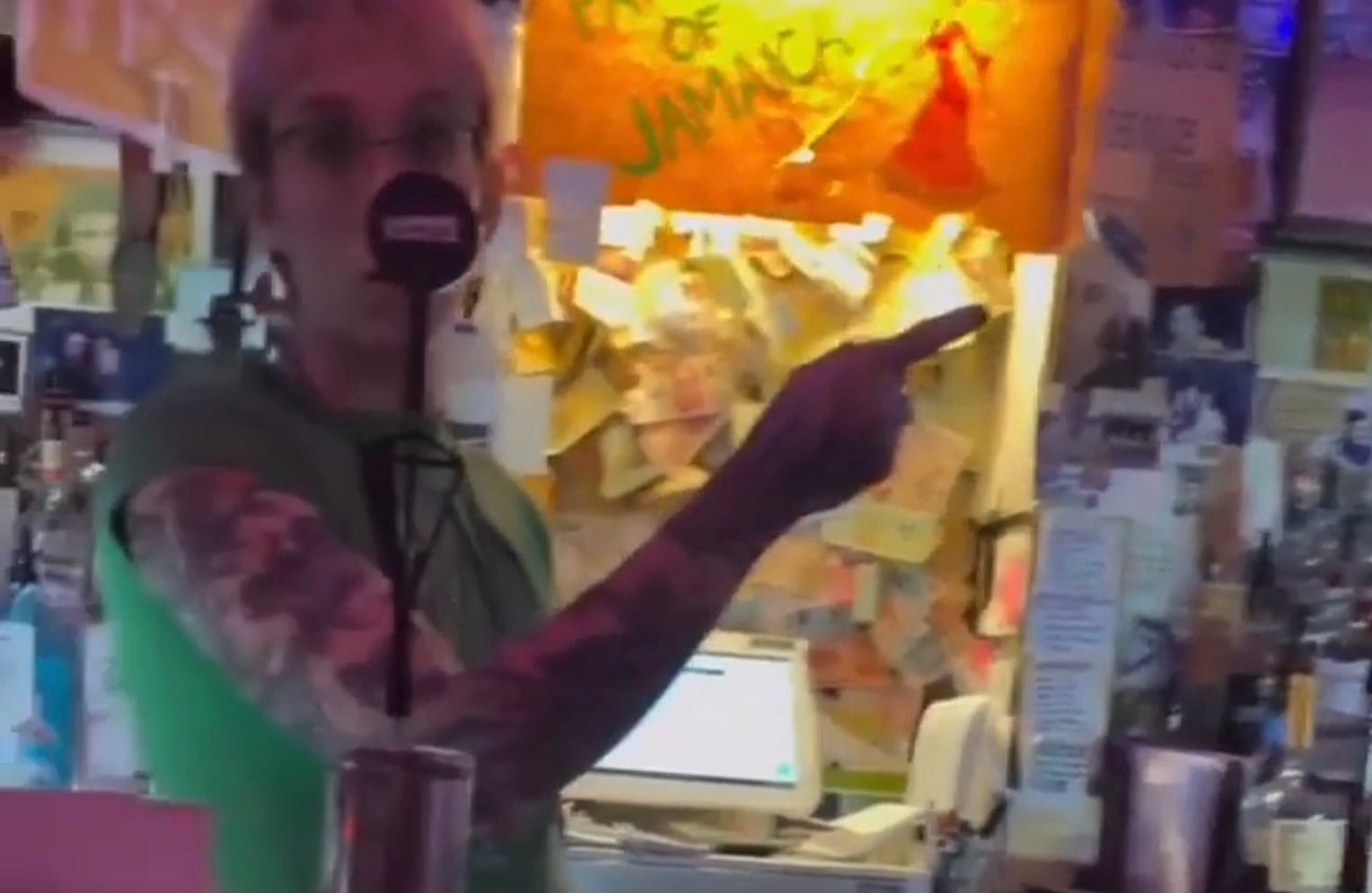
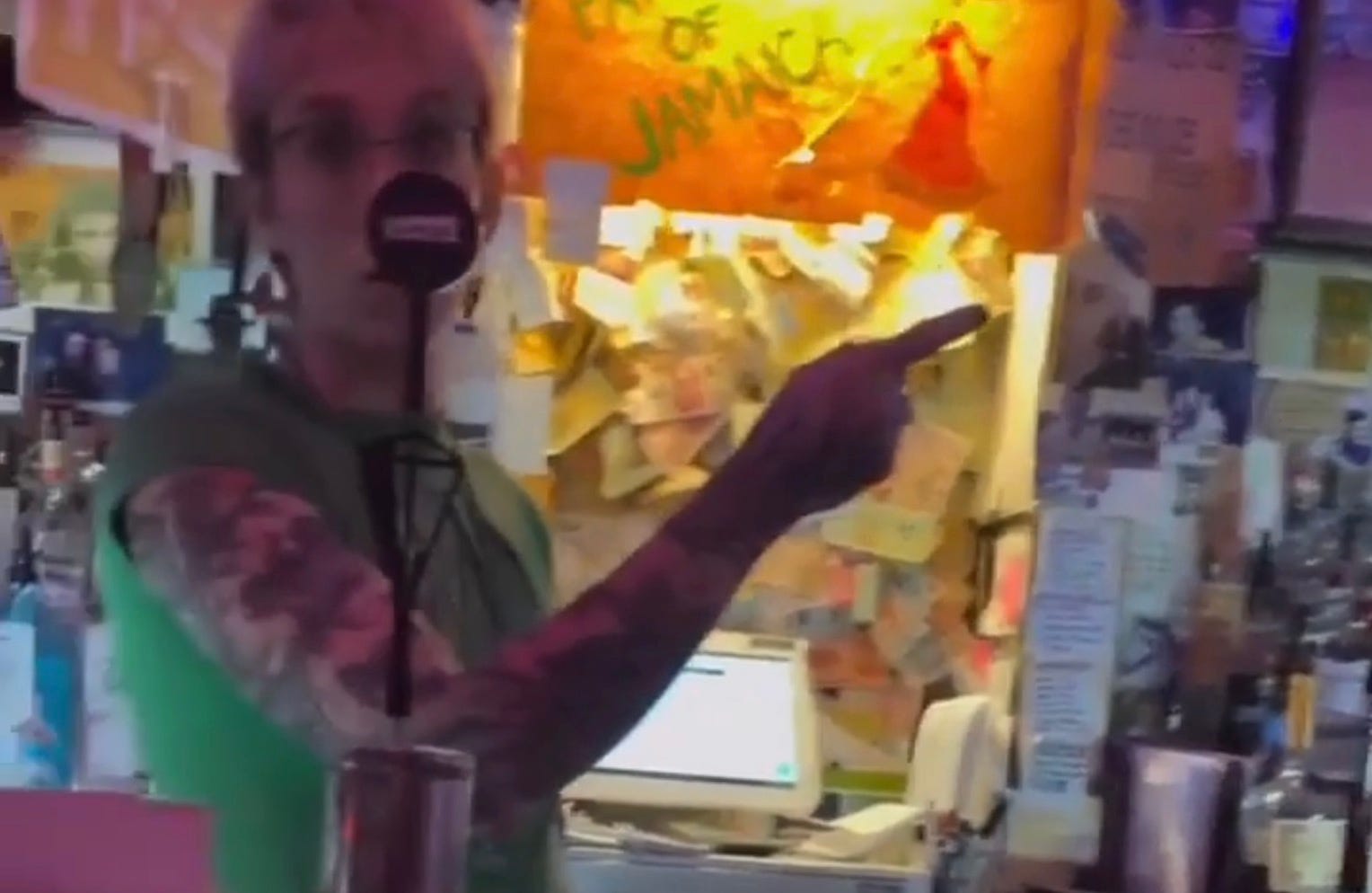
let’s all watch some MAGA shithead get bounced from a bar by Jeff Tiedrich
“I’m not fucking around. get out of my bar right now.” Read on Substack
everything sucks right now, so let’s put the focus on our hero of the day. sit back and enjoy the shit out of this bartender eighty-sixing some Trumpist fuckwad.
bartender: “get out of the bar.” MAGA: “why?” bartender: “because you’re a Trump supporter.” MAGA: “I know, but don’t you guys want our money?” bartender: “no, actually, we don’t. get out of my bar right now. [picks up baseball bat] I’m not fucking around. get out of my bar right now.” MAGA: “are you serious? bartender: “I’m dead serious. out.” MAGA: “because I’m wearing a Trump hat.” bartender: “yes.” MAGA: “that’s wild.” bartender: “I don’t care. get out.” second bartender: “we can call the police, or you can just leave.” MAGA: “you know this is, like, discrimination, right?” bartender: “boo hoo. boo fucking hoo. get out of my bar.”
fuck yeah. that was satisfying. boo fucking hoo, indeed. here’s your binky, MAGA. now take a hike.
here’s the backstory.
the MAGA asshole who got bounced — and is now whining to the press about it — wants you to believe that she was some innocent victim who wandered into a random bar and met up with some surly bartender.
that’s not the case at all. the cultist — and her friends — showed up to cause trouble, and they got what was coming to them.
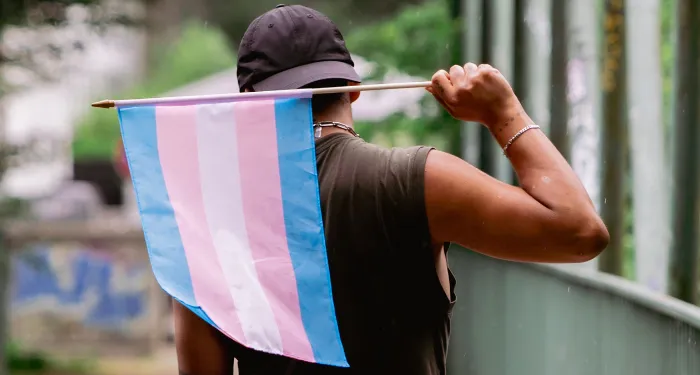
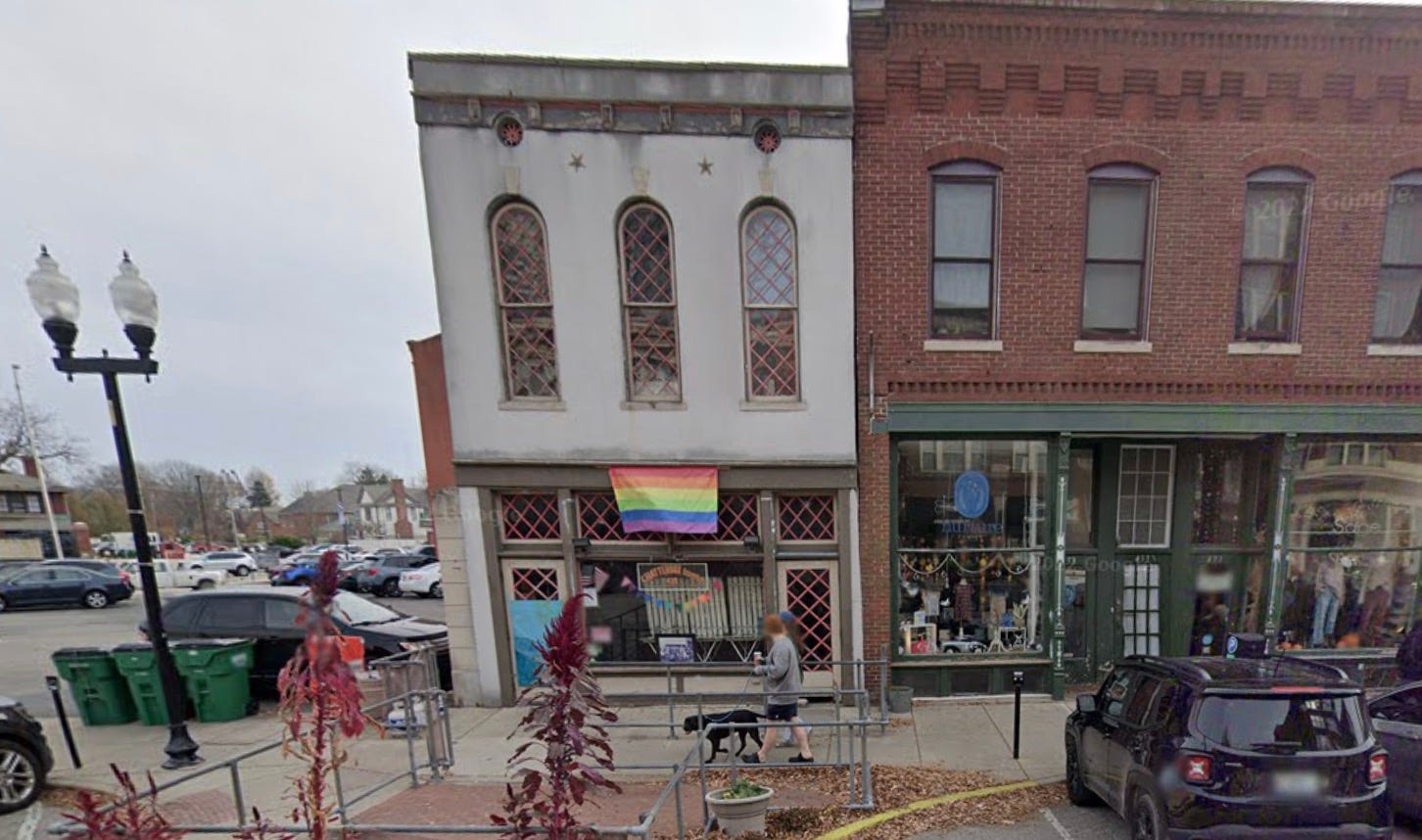
the bar in question is the Chatterbox Jazz Club in Indianapolis. the joint is LGBTQ+ inclusive, and much of the staff is trans.
it’s possible that Fuckface von Maga and her fuckface friends didn’t even know any of that when they showed up to make a scene. maybe they were just offended by the pride flag hanging outside the bar, and decided that it was their divine mission to stir up shit.
here’s David Andrichik, the bar’s owner, to explain.
“We were set up. This was a plan to do something like this. We don’t believe the people that came in to instigate even knew what Chatterbox was, but they came in because of our pride flag,” which is displayed outside the jazz bar.
premeditated or not, these MAGA shitstains stepped inside the Chatterbox and immediately cranked the asshole dial way past eleven. they shouted. they got abusive and confrontational. they deliberately misgendered the bartender. and they got tossed the fuck out.
and then, they came back in and recorded the clip you saw at top of this post — and went whining to the media about it.
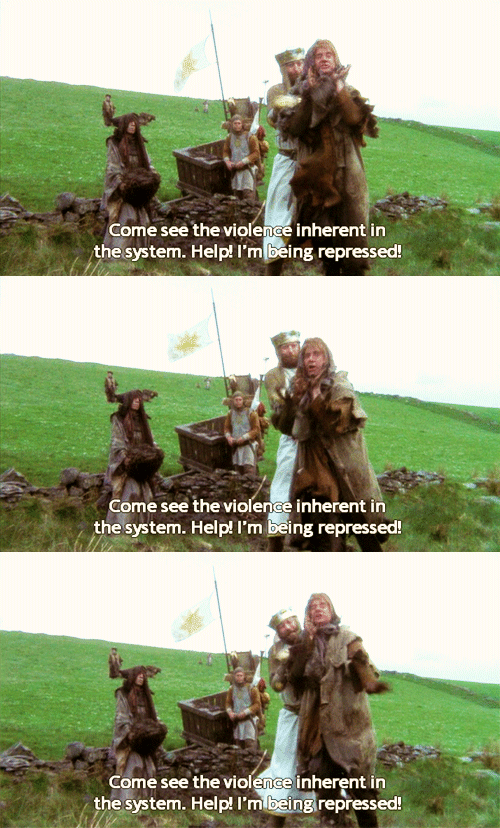
look at us, we’re the real victims here! they hated us for our hats! so unfair! come see the violence inherent in the system!
like their beloved Dear Leader, the cultists always imagine they’re the real victims — everything is unfair, and everything is rigged against them.
all we wanted was to hang out. the bartender was so mean to us.
MAGA, you are cordially invited to fuck straight off with your divisive hate. could you just fucking well leave people alone? they just want to live their lives in peace. next time you see a pride flag, just walk on by. the Earth won’t fall off its axis. I promise.
cultists, can we talk? you’re getting played by the ruling class, and you don’t even realize it. you’re being distracted from the real enemy.
‘keep the people ignorant and fighting each other, and they won’t notice the plutocrats picking their pockets’ is right on page one of the oligarch’s playbook.
and please shut the fuck up already about how unfairly you got treated. you acted like an asshole and you got treated like one.
you fucked around, and you found out. enjoy the tiniest of violins.
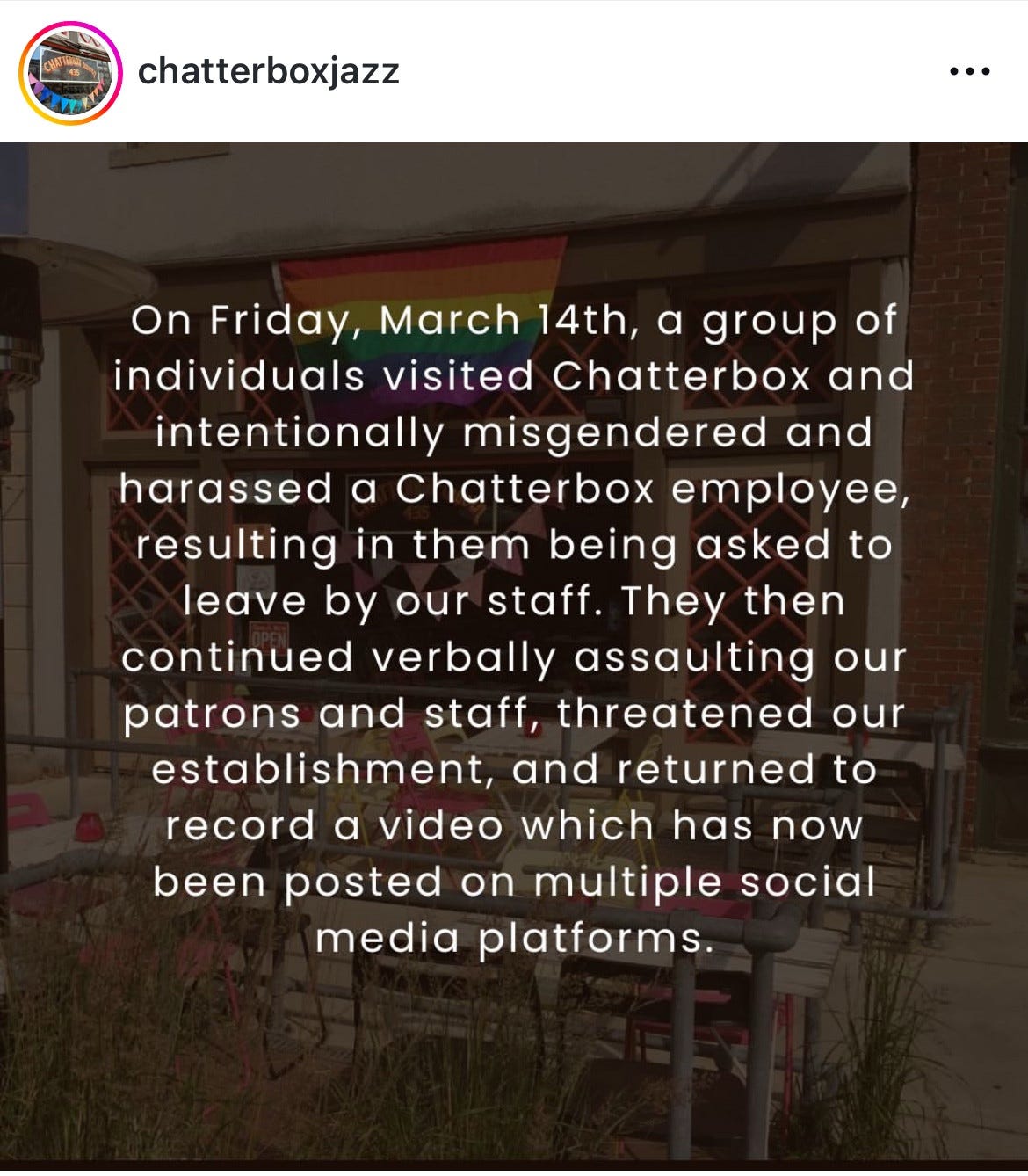
On Friday, March 14th, a group of individuals visited Chatterbox and intentionally misgendered and harassed a Chatterbox employee, resulting in them being asked to leave by our staff. They then continued verbally assaulting our patrons and staff, threatened our establishment, and returned to record a video which has now been posted on multiple social media platforms.
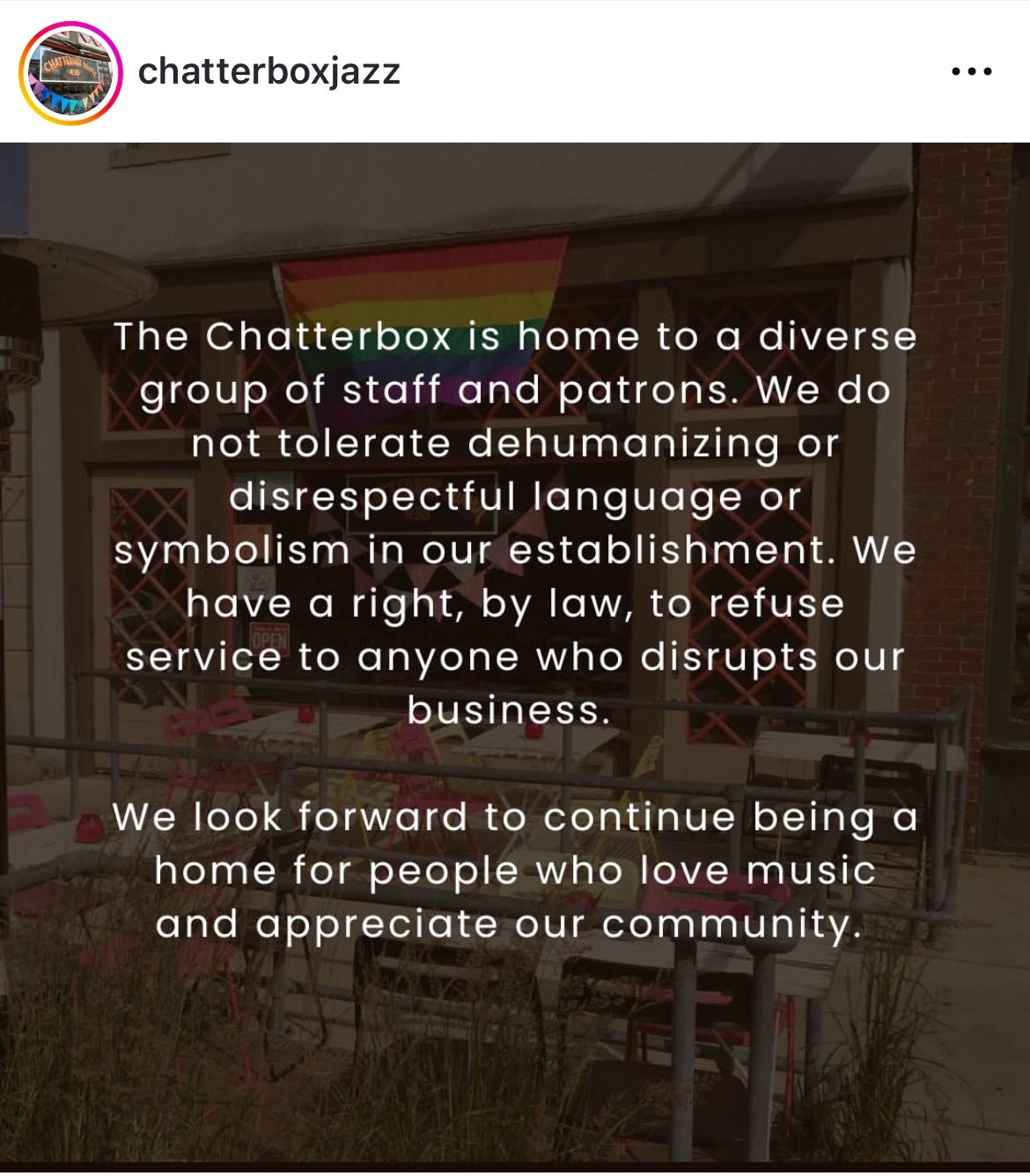
The Chatterbox is home to a diverse group of staff and patrons. We do not tolerate dehumanizing or disrespectful language or symbolism in our establishment. We have a right, by law, to refuse service to anyone who disrupts our business. We look forward to continue being a home for people who love music and appreciate our community.
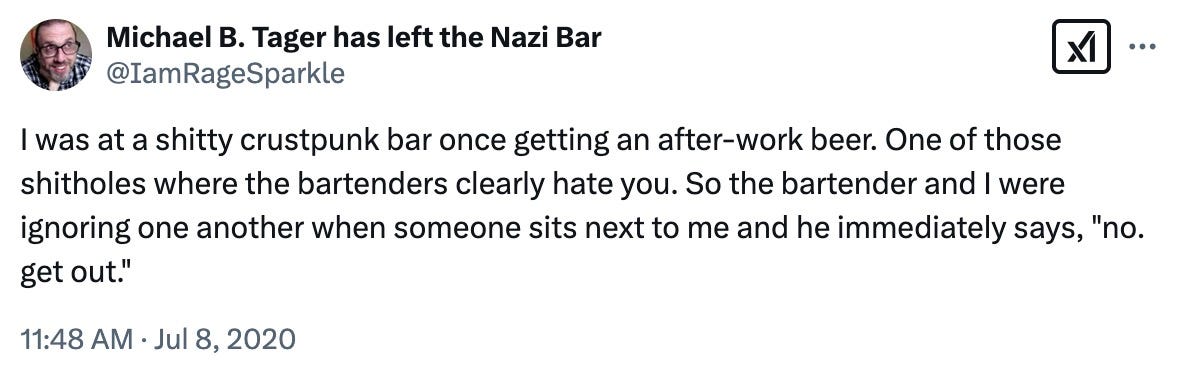
I was at a shitty crustpunk bar once getting an after-work beer. One of those shitholes where the bartenders clearly hate you. So the bartender and I were ignoring one another when someone sits next to me and he immediately says, “no. get out.”
And the dude next to me says, “hey i’m not doing anything, i’m a paying customer.” and the bartender reaches under the counter for a bat or something and says, “out. now.” and the dude leaves, kind of yelling. And he was dressed in a punk uniform, I noticed
Anyway, I asked what that was about and the bartender was like, “you didn’t see his vest but it was all nazi shit. Iron crosses and stuff. You get to recognize them.” And i was like, oh ok and he continues.
“you have to nip it in the bud immediately. These guys come in and it’s always a nice, polite one. And you serve them because you don’t want to cause a scene. And then they become a regular and after awhile they bring a friend. And that dude is cool too.”
“And then THEY bring friends and the friends bring friends and they stop being cool and then you realize, oh shit, this is a Nazi bar now. And it’s too late because they’re entrenched and if you try to kick them out, they cause a PROBLEM. So you have to shut them down.”
of course, what happened at the Chatterbox isn’t totally analogous — Fuckface von MAGA and her friends weren’t polite, and they certainly weren’t there to infiltrate — but the lesson is the same: you have to nip that shit in the bud. zero tolerance for Nazi assholes.
fuck around and find out is in short supply right now. let’s celebrate when it happens.
if you find yourself in Indianapolis, stop by the Chatterbox and show them your support.
here’s your daily reminder that I can be found on Blue Sky at this link.
this is going to be my closing message for the foreseeable future:
practice self-care. do what you need to do to keep sane. if that means you need to disengage with my daily posts for a while, I get it. this community of ours will still be here when you return.
to all the people who have signed on in the days since the election, welcome aboard. settle in as we all try to deal with the shitfuckery that’s ahead of us.
we are all in this together, and we are all here for each other.
Not about diversity; they have only a little to connect them other than I saw them and thought we’d be interested. I don’t know if I’m still recovering from DST, or if have come down with a weak little something, but I’ve been tired the past few days, and have some upcoming commitments, so will be taking things a little easier for a few days. Enjoy!
The United States Postal Service is under federal scrutiny. It’s not the first time.
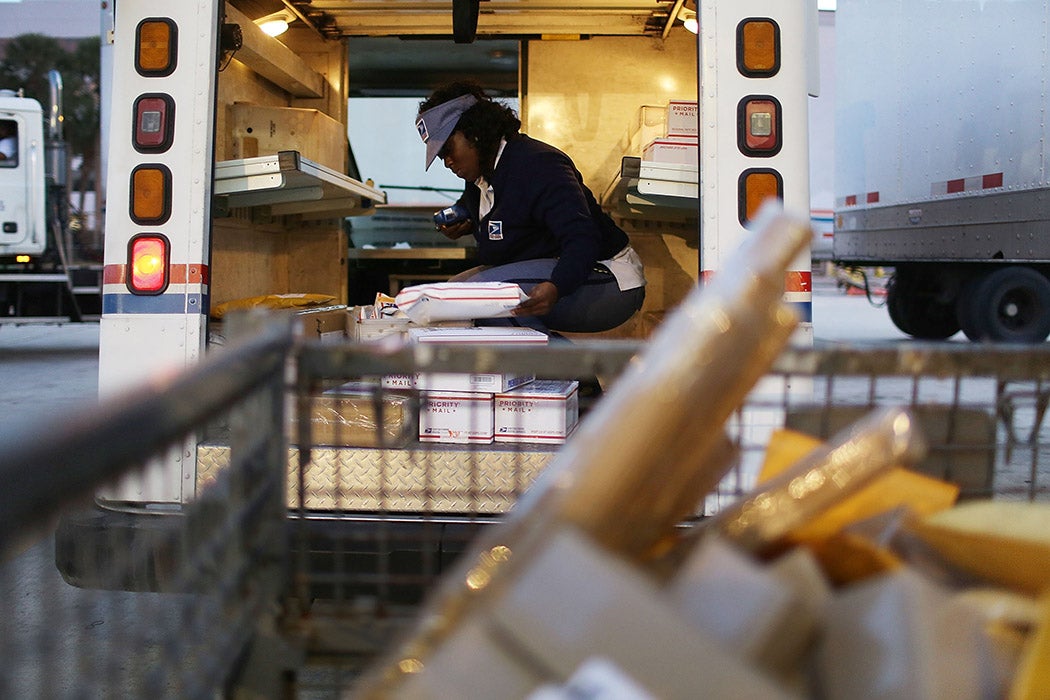
A United States Postal Service mail handler works to unload her mail truck at the Processing and Distribution Center in Miami, Florida. Getty
Though the Postal Service might not come to mind as a great factor in the long march toward social equity in the United States, its policies have had a serious impact on the rights of marginalized Americans since its inception in 1775. Activism, civil rights, and politics are ingrained—at least implicitly—in postal history.
Benjamin Franklin worked for the colonial postal service, controlled by the British, for years before he helped establish the independent American Post Office. Back in 1737, he ran the Philadelphia Post Office where he was focused more on the logistics of such a large operation than on how the institution might affect different demographic groups. Still, his work left a legacy of social transformation.
Many of these letters were delivered by enslaved African Americans, some of whom were forced in the years before emancipation to serve as messengers going relatively short distances between plantations and towns.
“If the inhabitants … should deem their letters safe with a faithful black, I should not refuse him,” Postmaster General Timothy Pickering wrote in 1794 regarding a mail route in Maryland. “I suppose the planters entrust more valuable things to some of their blacks.”
Yet this trust was soon eroded as slave rebellions increased throughout the Americas, and, in 1802, Black Americans were banned from carrying mail until Reconstruction.
The Post Office Department, like the rest of the federal government, updated its policies to become more inclusive in its hiring practices over the centuries. But the Post Office was unique in hiring Black Americans and white women beginning in significant numbers in the 1860s—before either group had been granted the right to vote nationwide (white women got it in 1920; Black men in 1870). Postal jobs were generally desirable. They were salaried and safe. (snip-MORE, and it’s good; not tl, dr)
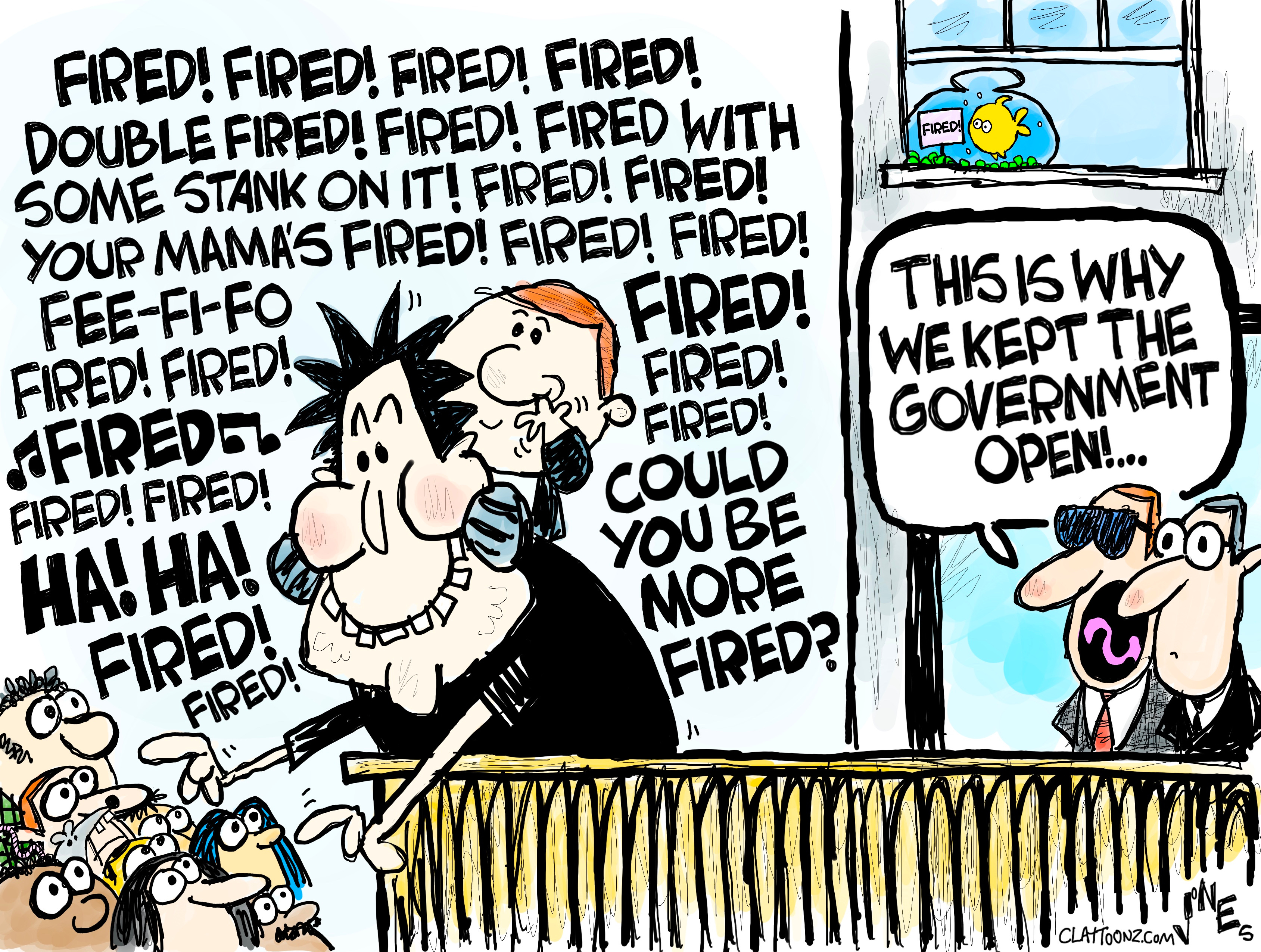
Republicans, with the help of a few Democrats, voted to keep the government open so they can keep destroying it.
It’s not like Republicans voted to keep the government open so they can do their jobs. They didn’t keep it open to provide oversight. They didn’t keep it open so they can serve as the third branch of the federal government. They didn’t even keep it open to do their job of restraining Elon Musk and DOGE.
DOGE is not an official agency of the government, meaning what it’s doing is not legal. A lot of lawsuits have been fired against the Trump administration over all the bullshit DOGE is doing, but there should be a lawsuit questioning DOGE’s existent.
The President can NOT create agencies or departments. Article 1, Section 1 of the United States Constitution gives that power to Congress. Donald Trump should not be able to create a new department and have it cut budgets and fire government employees. Not only is Congress allowing this happen, but they won’t even talk to Elon Musk about it in public.
Republicans in Congress have had a lunch with Elon but behind closed doors. Neither the Republican-controlled House nor the Republican-controlled Senate will even subpoena Elon. What’s even worse is that Elon is conducting all this business in secret. Saying you’re transparent doesn’t make you transparent.
It astounds me that there are so many Republicans who trust that DOGE is transparent just because Elon says it is. Don’t they have eyes? Haven’t they noticed they’re not seeing anything?
Trump and Republicans even use unelected bureaucrats to justify giving carte blanche to Elon, an unelected bureaucrat. You don’t replace a swamp with a bigger swamp.
Even while Elon is destroying our government and the lives of federal workers, Trump is building sympathy for him. You may have lost your job, but at least Trump got a brand new Tesla.
I can’t tell you how much sleep I’ve lost worrying about Elon’s finances. At least Germany only had ONE Hitler.
America, this is the beginning of the end.
Creative note: I started on this idea, but I wasn’t feeling great about it, so I started on another idea, finished drawing most of it, and realized I wasn’t loving it either. So, I came back to this, started feeling it, and the next thing I knew, it was after 5 p.m. on a Saturday. That’s why you got a short blog. I need food.
I’m punching out until tomorrow, when you will get TWO cartoons and blogs. I’m not reading any emails until Monday. I get 20 from readers on a slow day (though several of them are from the same readers).