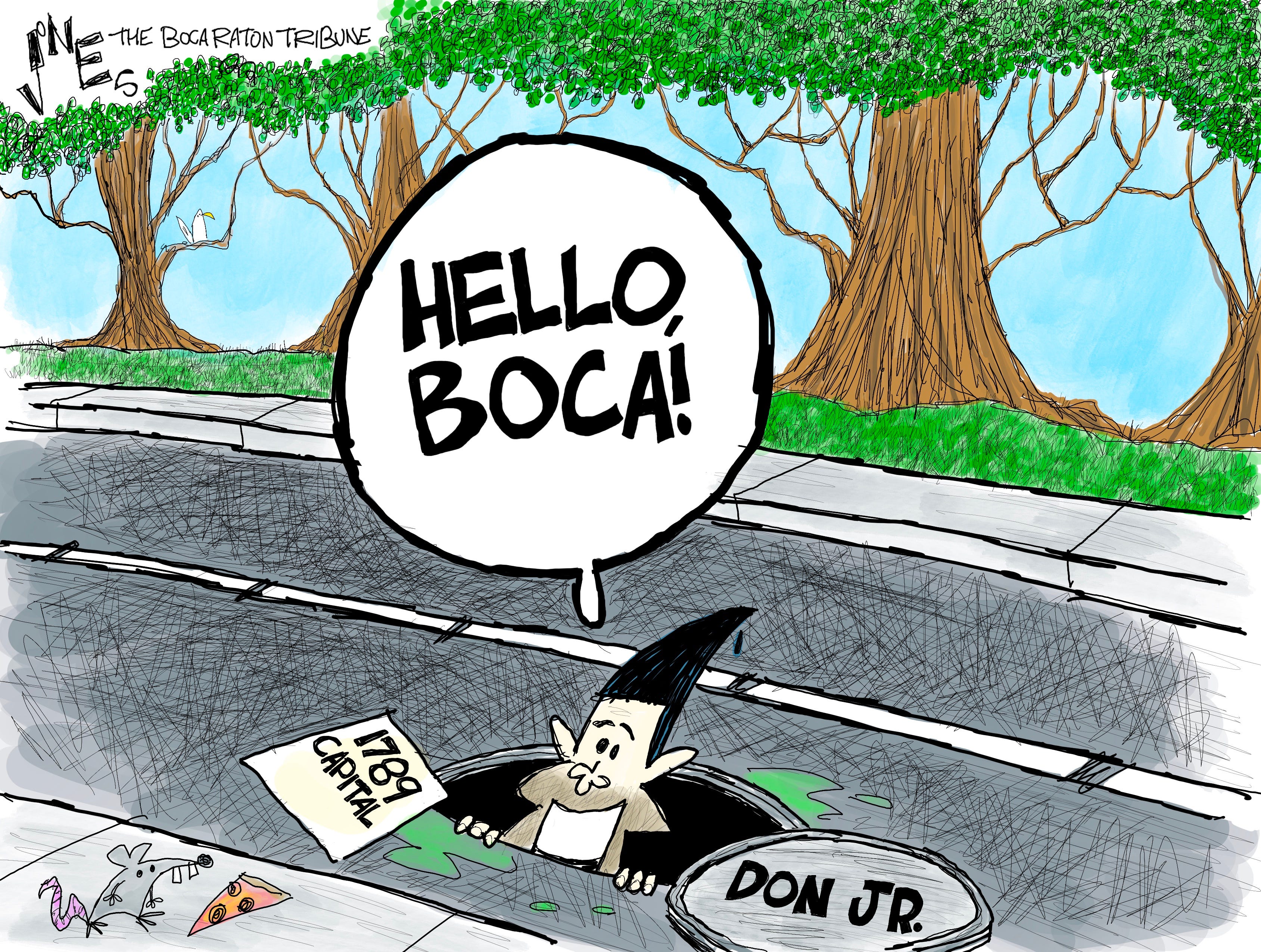
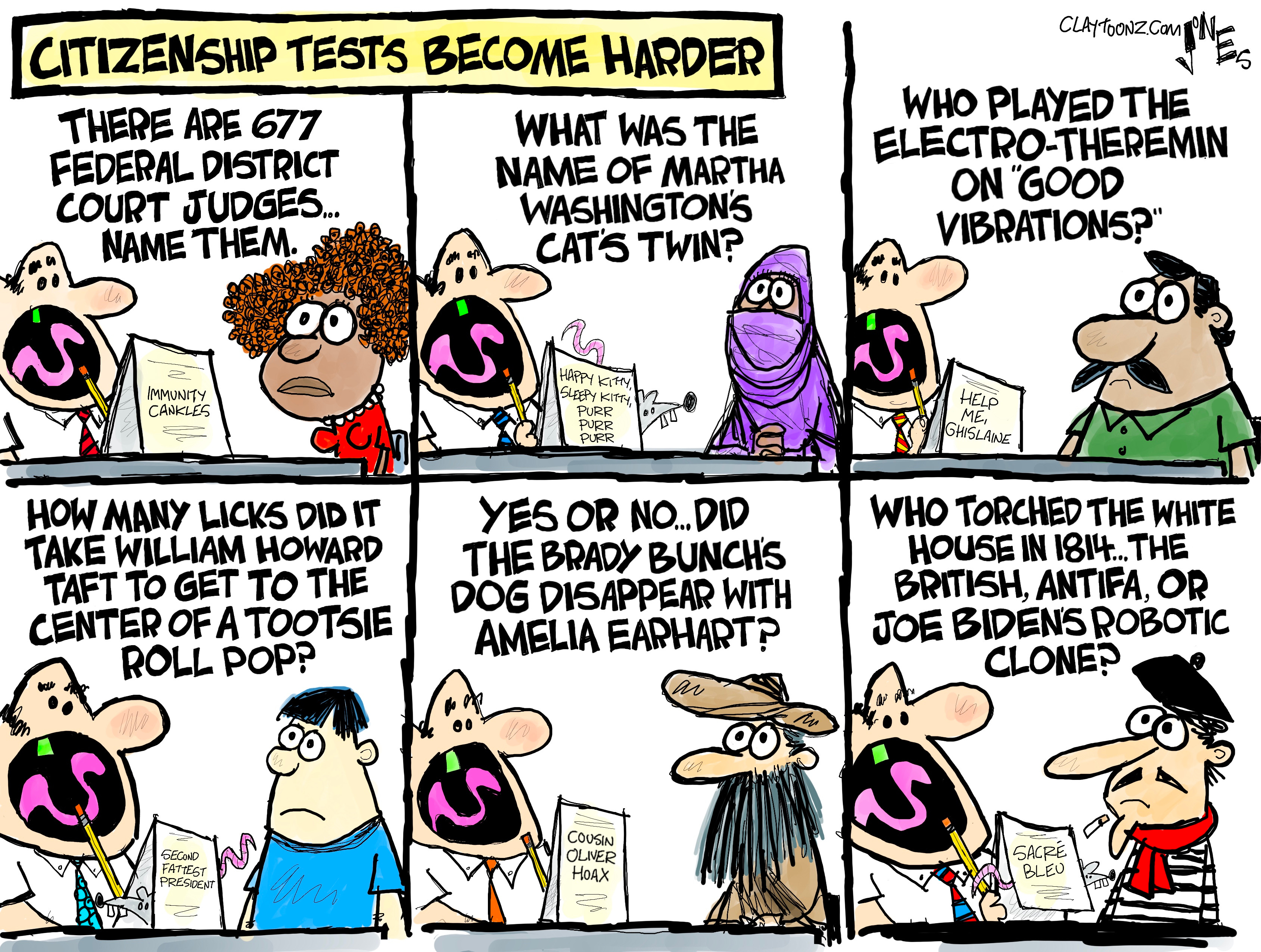
Well Done, Personnelente:

This Just Showed Up This Morning; It’s Funny-Enjoy!

Peace & Justice History for 6/20

June 20, 1960
Nobel Prize-winner in Chemistry Linus Pauling [for study of the nature of the chemical bond and the determination of the structure of molecules and crystals] defied the U.S. Congress by refusing to name circulators of petitions calling for the total halt of nuclear weapons testing. Pauling later won a second Nobel, a Peace Prize, for his work championing nuclear disarmament.

Linus Pauling
Interview with Linus Pauling on the peace movement, 1983
June 20, 1965
Hundreds protested following a military coup in Algiers, the capital of Algeria. The military, under chief of the armed forces Colonel Houari Boumedienne and his National Revolutionary Council, had deposed President Ahmed Ben Bella, the first president of an independent Algeria (following the withdrawal of French colonial control).
On the news at the time 
June 20, 1967
Boxer Muhammad Ali was convicted in Houston, Texas, of violating the Selective Service law by refusing induction into the U.S. Army (during the Vietnam War). The World Heavyweight Champion had claimed conscientious objector status on the basis that he was a Muslim minister. The conviction, for which Ali was sentenced to five years in prison and a $10,000 fine, was later overturned by the Supreme Court.

“I ain’t got no quarrel with those Vietcong.”
June 20, 1982
2500 were arrested during a two-day blockade of Lawrence Livermore National Laboratory, about 50 miles east of San Francisco, the principal American nuclear weapons research facility, operated by the University of California.
June 20, 1995
Shell Oil gave in to international pressure and abandoned its plans to dispose of the Brent Spar oil-drilling platform and its contents into the North Atlantic. The environmental group Greenpeace spearheaded the effort to prevent Shell from sinking the rig, its members boarding and occupying it as a tactic to stop the deep sea disposal, and to call attention to the issue peacefully.
Shell’s plan would have dumped toxic and radioactive sludge into the ocean just west of the British Isles. A month later, at the Oslo and Paris Commission (OSPARCOM) meeting, 11 out of 13 countries agreed to a moratorium on the “dumping” of offshore installations, pending agreement on an outright ban.

Greenpeace climbers on Brent Spar platform

Shell ships use water cannons against Greenpeace activists on board the rig.
Read more about Greenpeace and Brent Spar
June 20, 2002
The U.S. Supreme Court declared executing mentally retarded individuals convicted of capital crimes to be unconstitutionally cruel [Atkins v. Virginia]. Besides being in line with a consensus among state legislatures, the court found that “Their deficiencies [the mentally retarded] do not warrant an exemption from criminal sanctions, but diminish their personal culpability.”

https://www.peacebuttons.info/E-News/peacehistoryjune.htm#june20

Juneteenth & More, in Peace & Justice History for 6/19

June 19, 1865

Known among African Americans as Juneteenth (also Freedom Day, Jubilee Day, Liberation Day, or Emancipation Day), this is the day enslaved people in Texas and parts of Louisiana learned they had been freed by President Abraham Lincoln’s Emancipation Proclamation. 
U.S. Major General Gordon Granger landed at Galveston, Texas, and announced the order that the slaves had been freed. This was two-and-a-half years after the Proclamation had taken effect January 1, 1863. It had stated, “that all persons held as slaves” within the rebellious (Confederate) states “shall be then, thenceforward, and forever free.” This had been kept from the slaves so the slaveowners could reap additional harvests, or because there weren’t enough Union soldiers to enforce the order until Granger arrived, but Juneteenth is the celebration of that day….

A Junetheenth celebration Richmond. Photo from Library of Congress (maybe 1921)
Learn More About Juneteenth?  New York Times
“Black Joy—Not Corporate Acknowledgment—Is the Heart of Juneteenth”  The Atlantic
June 19, 1964

Two hundred college students left Oxford, Ohio’s Western College for Women to join hundreds of other civil rights volunteers in Mississippi as part of “Freedom Summer.”
Under the umbrella organization of COFO(Council of Federated Organizations) they worked on projects across the state.Led by SNCC (Student Non-Violent Coordinating Committee) and CORE (Congress of Racial Equality) field secretaries, they helped Negroes try to register to vote, they taught in Freedom Schools, participated in community organizing and, in doing so, endured the hostility toward civil rights work among whites in the deep South. “If we can crack Mississippi,” the students said, “we can crack segregation anywhere.”


Mississippi Freedom Summer Volunteers singing We Shall Overcome, 1964<
Student protestors are photographed by a policeman on Freedom Day in Greenwood, Mississippi in 1964.

ROBERT MOSES, director of the 1964 Mississippi Summer Project and leader of the training program in Oxford, is shown here during a break in a session which he conducted in Jackson, Mississippi, to prepare African-Americans for politically effective action.
more photos 
Good background on the need for a “Freedom Summer” 
June 19, 1964
The Civil Rights Act of 1964 was approved after surviving an 83-day filibuster in the United States Senate. The new law, initiated and passed through the determination of President Lyndon Johnson and Senate Republican leader Everett Dirksen of Illinois, guaranteed for the first time equal access to public accommodations “without discrimination or segregation on the ground of race, color, religion, or national origin.”

Massive demonstrations a year earlier ensured passage of the Acts
The Senate had never before voted to end the filibuster of a civil rights bill, all of which were consistently opposed by the bloc of senators from the South. Following Senator Robert Byrd’s (D-West Virginia) 14+ hour-long speech, Senator Dirksen rose to speak, “We dare not temporize with the issue which is before us. It is essentially moral in character. It must be resolved. It will not go away. Its time has come.”

About the Civil Rights Act 
June 19, 1982
One thousand landowners occupied key islands in protest against French nuclear weapons tests at Kwajalein Atoll.The atoll, part of the Marshall Islands in the western Pacific Ocean, is about 2100 miles [3400 km] southwest of Hawaii and 1400 miles [2250 km] east of Guam. The island is now home to USAKA (United States Army Kwajalein Atoll), the Ronald Reagan Ballistic Missile Defense Test Site, and about 2000 support personnel and family members on Kwajalein and the islands Roi and Namur.

Kwajalein Atoll
Struggles of Pacific Islanders to stop nuclear testing 
June 19, 1987
U.S. Supreme Court ruled teaching of creationism in public schools to be a violation of the U.S. constitution’s prohibition on establishment of religion by the government [Edwards v. Aguillard]. Students, parents and teachers had contested the Louisiana “Balanced Treatment for Creation-Science and Evolution-Science in Public School Instruction” law (Creationism Act). It required schools that taught evolution to also teach creation science. “The preeminent purpose of the Louisiana Legislature was clearly to advance the religious viewpoint that a supernatural being created humankind,” concluded Justice William Brennan in his majority opinion.
(I’m inserting this, because it’s not yet made it into the newsletter. -A)
June 17, 2021 (for June 19)
President Joe Biden declared Juneteenth a national holiday. Read a bit about the significance here, from the National Museum of African American History & Culture:
“This year marks the second anniversary since President Joe Biden named Juneteenth a federal holiday in 2021.
“As more Americans celebrate Juneteenth with family and community, it is vital to share the important historical legacy behind Juneteenth and recognize the long struggle to make it an officially recognized holiday. It is an opportunity to honor our country’s second Independence Day and reflect on our shared history and future. 
“The origins of Juneteenth date to June 1865. Even though the Emancipation Proclamation was signed by President Abraham Lincoln in 1863 and the Confederate army surrendered to the Union army in April 1865, enslaved people in Texas — the westernmost Confederate state — could not exercise their freedom until June 19, 1865. ‘On that date, Union General Gordon Granger led some 2,000 Union troops, many of whom were Black, into Galveston Bay, where they announced that the more than 250,000 enslaved Black people in the state were free by executive decree. This day came to be known as ‘Juneteenth,’ deriving its name from combining ‘June’ and ‘nineteenth.’” 

Read More

https://www.peacebuttons.info/E-News/peacehistoryjune.htm#june19

Clay Jones, Open Windows

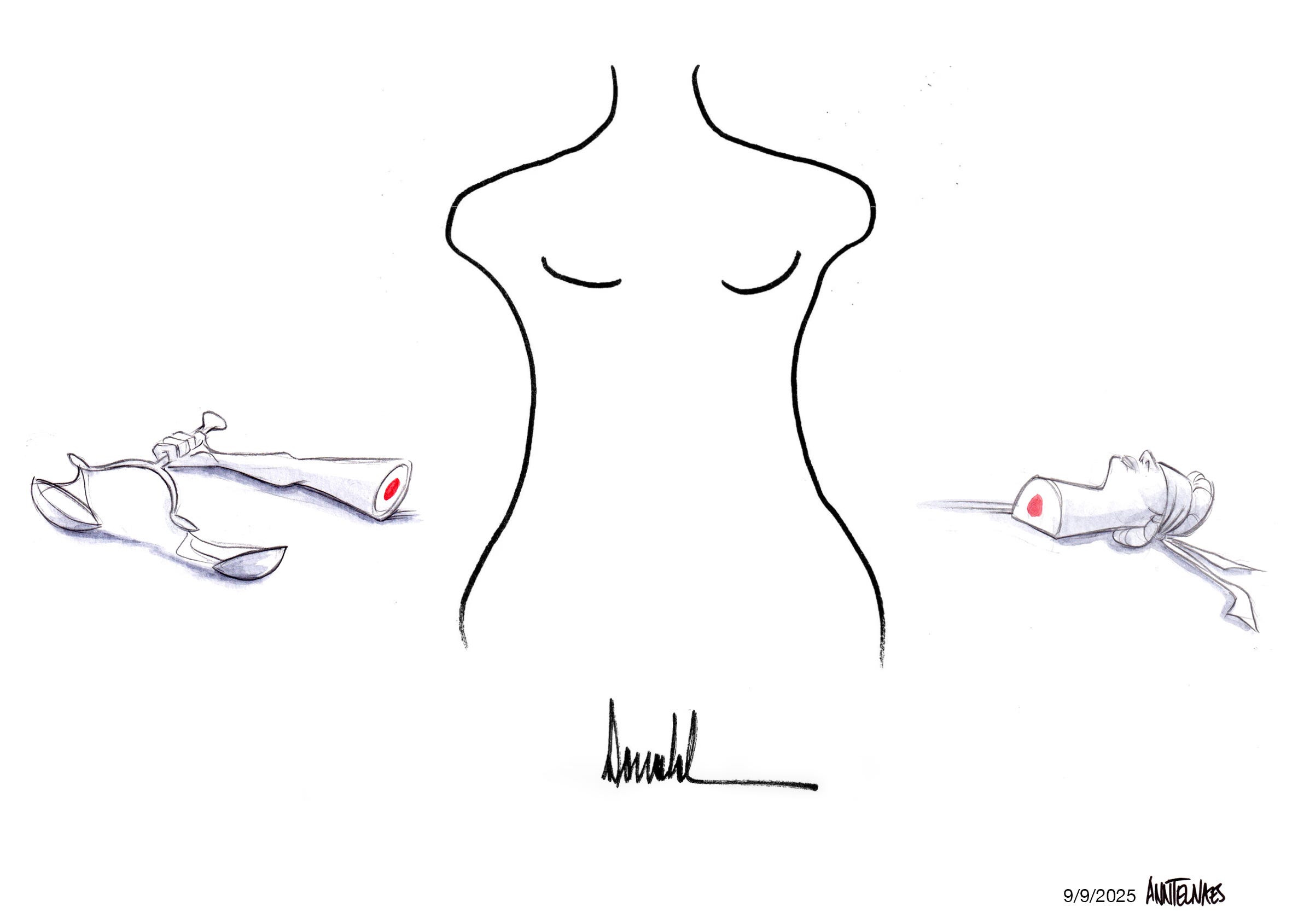
In the driver’s seat by Ann Telnaes

Trump changes direction on farm and hotel workers Read on Substack

Stephen Miller makes sure his vision for rounding up immigrants without due process continues.

(Meant to add this extra image- the thumbnail ideas in my sketchbook):

=====

The Peace Grifter by Clay Jones

Can you grift me now? Read on Substack

Here’s a fun fact: Between the 2024 presidential election and the inauguration on January 21, 2025, the Trump Store launched at least 168 new products. One product would have been weird.

This isn’t just a way to grift your supporters, but also to take bribes. The Trump Store isn’t run by the Trump Campaign, but by the Trump Organization. All the profits go directly to Donald Trump. These 168 products are in addition to the products launched before the election, like Trump Watches, Trump Shoes, Trump Bible, etc, etc. Now, we’re going to get Trump Mobile. I, for one, expect future commercials to be made even cheaper than those featuring Ryan Reynolds for Mint Mobile.

Trump Mobile will sell a gold (fake) cell phone for $500. Check it out. (snip-MORE)

Warrantless Goons by Clay Jones

The regime is arresting Democrats Read on Substack

They did it again. The goons have arrested a Democratic politician for being in the wrong place at the wrong time.

It was just last week when California Senator Alex Padilla was tackled and handcuffed in a federal building in Los Angeles during a press conference held by Kristi Noem, the Secretary of the Department of Homeland Security (DHS).

The excuses for handcuffing the senator have been lies and bullshit.

They said he “barged” into the press conference. He was escorted in by the FBI and the National Guard, which is not “barging.” The so-called barging is not on any of the videos I have seen.

They said he “lunged” toward Kristi Noem, but you don’t see that on any of the videos either. You just see the Secret Service grabbing him. Kristi Noem carries on speaking while the SS is grabbing the senator and dragging him out of the room. If she was “lunged” at, she didn’t seem to be rattled by it.

They say he took off his Senate pin. Even if this is true, so what? It’s not a factor, especially since he identified himself.

They say he didn’t identify himself. Look at the tapes. He identified himself multiple times. (snip-MORE)

Dimming The Glimmer

(Only yesterday, there was a glimmer of hope. Now, the step forward has gone backward on another aspect.)

It’s Still PRIDE Month! Here’s Peace & Justice History for 6/18. Now Have Some Big Fun!

June 18, 1571
King Sebastian of Portugal enacted penalties for violation of censorship legislation. The fines could be as much as a quarter or half of the violator’s legal possessions, plus the threat of exile to Brazil or an African colony. Death sentences were also not uncommon. Seized books were burned and burnings were supervised by Roman Catholic priests.
June 18, 1840
The Oberlin Non-Resistance Society was formed at the Ohio college by students who believed “that the Gospel of Jesus Christ inculcates the duty of peace and good-will.” They were inspired by abolitionist William Lloyd Garrison’s New England group of similar name.
They rejected all use of violence even in the name of duty to country. “We must submit to the ‘powers that be,’ and ‘obey magistrates,’ except when their requirements conflict with God’s laws; when we are meekly to endure the penalty of disobedience ‘threatening them not.’ ”
Though denounced by the faculty and ignored by the student newspaper, the group was among the first in a succession of peace- and justice-oriented organizations begun at Oberlin.

Oberlin’s peaceful tradition 
June 18, 1941
Less than two weeks before a scheduled march on Washington, its chief organizer, (Asa) A. Philip Randolph, was invited to the White House by President Franklin Roosevelt. Randolph was the president of the Brotherhood of Sleeping Car Porters, the first successful black trade union. He, along with activist and singer Bayard Rustin, had issued a “Call to Negro America to March on Washington for Jobs and Equal Participation in National Defense on July 1, 1941.”

Roosevelt was wary of the prospect of such a demonstration and desirous of developing support for a war effort. Randolph told Roosevelt he would abandon the march plans only if the president would stop job discrimination in both the defense industry and the government. Before the end of the month, Roosevelt signed Executive Order 8802, which barred government contractors from discriminating in hiring on the basis of race, color, creed or national origin.

A. Philip Randolph and Eleanor Roosevelt
The order, sometimes called a second emancipation proclamation, was the federal government’s most significant action on behalf of the rights of African Americans since post-Civil War reconstruction of the 1870s.
June 18, 1948
A United Nations commission approved and recommended to the General Assembly an International Declaration of Human Rights, recognizing that “the inherent dignity and . . . the equal and inalienable rights of all members of the human family is the foundation of freedom, justice and peace in the world . . . .”
Text of the Declaration:  . . .
June 18, 1970
The U.S. Congress passed the 26th amendment to the constitution, lowering the voting age to 18 for all elections—federal, state and local. The amendment went into effect just 100 days later after 38 state legislatures had ratified the amendment.
June 18, 1979
SALT II (Strategic Arms Limitation Treaty), an agreement to put limits on both America’s and the Soviet Union’s long-range missiles and bombers, was signed by Presidents Jimmy Carter and Leonid Brezhnev. This was the first arms-reduction treaty between the two superpowers. It was signed despite the Soviet invasion of Afghanistan the previous year.

Read more on SALT II’s control of weapons of mass destruction 

https://www.peacebuttons.info/E-News/peacehistoryjune.htm#june18

The Best Way To Learn About Autistic Pride Is To Learn It From Autistic People

That’s a thing I began learning during my years working in schools, but I’ve really picked up a great deal more from fellow blogger Barry. Here is his Autistic Pride Day blog post!

Well, I Suppose They Made An Effort? + More In Republican Prejudice

Tell-It Report: Army Renames Fort Lee After a Black Soldier to Maintain Confederate Fiction by Michael Harriot

Barred from using the names of Confederate soldiers, the Trump administration “restores” the names of seven military bases that once honored the losers of the Civil War. Read on Substack

In Gullah Geechee communities, a “tell-it” was a designated lookout, community warning system and the most trusted source for news and information. The Tell-It Report is ContrabandCamp’s weekly roundup of the Black stories that deserve more attention — from politics to entertainment.

President Donald Trump has reinstated the names of Army bases that once honored Confederate leaders. But, contrary to what he announced, Fort Lee won’t be named after Robert E. Lee, but a Black soldier named Fitz Lee.

Trump’s recent travel ban is preventing Haitian children scheduled to undergo heart surgery from traveling to the United States for their life-changing procedures.

The Grammys are adding a “traditional country” category just months after Beyoncé’s “Cowboy Carter” earned her Country Album of the Year.

Read the full stories below:

Trump renames Fort Lee after a Black soldier because he can’t use Robert E. Lee

Continuing President Trump’s efforts to remove diversity measures enacted by his predecessor, the Army announced it was reverting to the original names of seven bases whose names were changed in 2023 because they honored Confederate leaders. Despite his statement on Tuesday in which Trump said one base would be restored to Fort Robert E. Lee, it will not actually honor the Confederate general who led the fight to keep slavery legal.

Instead, Fort Lee in Prince George’s County will be named after a Black soldier, Pvt. Fitz Lee, the New York Times reports.

In 2023, the Biden administration renamed the bases honoring Confederate leaders. Fort Lee then became Fort Gregg-Adams to honor two Black leaders, Lt. Gen. Arthur J. Gregg and Lt. Col. Charity Adams. By law, names of Confederate soldiers can’t be used on military bases, hence the bait and switch.

Lee was a Buffalo soldier who fought in the Spanish-American War. Born in Virginia, he received the Medal of Honor in 1899 for risking his life to save wounded comrades in Cuba. Shortly after the mission, he suffered from vision loss, swollen limbs and abdominal pain stemming from kidney disease. He died at age 33.

Though the bases’ original names are back, like Fort Lee, they will not honor Confederate leaders. Instead, they will be named after the soldiers “who served in conflicts ranging from the Civil War to the Battle of Mogadishu,” the Army announced in a statement on Tuesday. No women are honored in the rebrand.

Along with the newly dubbed Fort Lee, bases included in the change are Fort Pickett, Fort Hood, Fort Gordon, Fort Polk, Fort Rucker and Fort A.P. Hill. Earlier this year, Defense Secretary Pete Hegseth changed the names of Fort Bragg and Fort Benning, now honoring World War I and II veterans, respectively, with the same last names instead of Confederate soldiers.

“We won a lot of battles out of those forts. It’s no time to change,” Trump said during the announcement, CBS News reports. “And I’m superstitious, you know? I like to keep it going, right? I’m very superstitious.”

The Department of Defense originally spent about $39 million to change the names of military installations named after Confederate figures, CBS 6 Richmond reports. Although the changes are expected to take effect immediately, no estimated cost for the revamp was announced, according to CBS News.

Trump’s travel ban is blocking Haitian children from getting stateside surgery

Lifesaving procedures for more than a dozen Haitian children and young adults with serious cardiac issues have been stalled or canceled due to Trump’s travel ban, NBC News reports

The ban, which went into effect on June 9, extends to 12 countries and bars foreigners seeking legal immigrant status as well as those seeking visas from entering the U.S., according to CBS News.

The International Cardiac Alliance is an aid organization that has sent more than 100 children from Haiti to the U.S. for heart surgery. Though a proclamation made some exemptions, including for U.S. citizens and those traveling for the World Cup and the Olympics, those undergoing medical procedures with the alliance’s help were not on that list, according to NBC. Its waitlist includes at least 316 Haitians in need of heart surgery, ranging from infants to young adults.

The organization’s executive director, Owen Robinson, told the New York Times that finding adequate medical help in other countries will be difficult.

Sixteen-year-old Fabienne Rene and her family were counting on travel to treat her rheumatic heart disease. Her father, Fignole Rene, told NBC that they don’t know what their alternative option would be.

“I was not waiting to hear something like that,” Rene told the outlet in Creole. “We know for sure that there is nowhere in Haiti we can have this possibility. The only option that we have was just waiting to have an open door from the Cardiac Alliance.”

According to the NYT, Trump’s decision to prevent Haitians from visiting is because they stayed in the states longer than their visas permitted 25% of the time. In addition to Haiti, the 12 countries on the travel ban list include Afghanistan, Myanmar, Chad, The Republic of the Congo, Equatorial Guinea, Eritrea, Iran, Libya, Somalia, Sudan and Yemen. Trump also issued partial suspensions for Burundi, Cuba, Laos, Sierra Leone, Togo, Turkmenistan and Venezuela.

Trump has restricted travel for these 19 Black and brown countries because he deemed them “high-risk.” However, just last month, he gave white South Africans asylum, claiming they were subject to “white genocide.”

His administration also rescinded Haitians’ temporary protected status, which prevented them from being deported, and revoked a program that allowed them to move to the U.S, according to the NYT.

Grammys to add ‘traditional country’ category after Beyoncé’s historic win

The Recording Academy announced that they would be breaking up the country album category, adding a “traditional” category and renaming the existing category to “contemporary.” And Beyoncé fans don’t think their decision’s timing — coming just months after “Cowboy Carter” won big — is coincidental.

“The community of people that are making country music in all different subgenres came to us with a proposal and said we would like to have more variety in how our music is honored,” the Academy CEO Harvey Mason told Billboard. “They said, we think we need more space for our music to be celebrated and honored.” According to the outlet, the new category was proposed in previous years.

Fans pointed to the not-so-subtle racist shade that they believe stemmed from “Cowboy Carter” winning both Best Country Album and Album of the Year, the first time Beyoncé has won in both categories.

An anonymous music executive told Phil Lewis that the academy’s intentions are clear. The executive pointed to the academy adding Best Dance Pop Recording category after Beyoncé’s “Renaissance” and “Break My Soul” won.

“Now, the same thing has happened again.” the executive explained for What I’m Reading.

“There are probably some country purists in power that aren’t happy with her winning Best Country Album — especially after she was snubbed completely from the CMAs — and suddenly the country album category is being divided into two categories.”

Beyoncé is currently on the Cowboy Carter World Tour. The show and album pay homage to country’s Black roots and call out the industry’s historic efforts to erase Black legacy and impact from the genre.

During her acceptance speech for Best Country Album, she expressed gratitude for those in the genre who accepted “Cowboy Carter.”

“We worked so hard on it,” she said. “I think sometimes genre is a code word to keep us in our place as artists, and I just wanna encourage people to do what they’re passionate about and to stay persistent.”

ICYMI

Former host of MTV’s “TRL” and BET’s “Teen Summit,” Ananda Lewis, has died at 52 on Wednesday after a long battle with breast cancer.

Sly Stone, the legendary frontman of Sly and the Family Stone, died on June 9 at age 82.

Silentó, the 27-year-old rapper who created a viral hit with “Watch Me (Whip/Nae Nae),” was sentenced to 30 years in prison after pleading guilty in the fatal shooting of his cousin.

A Milwaukee jury convicted Maxwell Anderson of killing 19-year-old Sade Robinson, whose body was found dismembered after she went on a first date with Anderson.

Misty Copeland announced that she is retiring after 25 years with the American Ballet Company.

Solange’s Eldorado Ballroom opens in Houston.

Included (and blamed!) In The Immigration Crackdown In Dem Cities: Trans People