Peace & Justice History for 4/4

A goodly number of events have happened on April 4.

April 4, 1958

Aldermaston March, 1st Day, 1958.
Four thousand began the first of eleven consecutive annual Easter protest marches. It took three days on foot from London to Aldermaston AWRE (Atomic Weapons Research Establisment) base in England.
Watch one of the marches
Interviews with participants 
———————————————————————————————
April 4, 1967

Reverend Martin Luther King, Jr., head of the Southern Christian Leadership Conference, in a speech to Clergy and Laity Concerned at the Riverside Church in New York City, called for common cause between the civil rights and peace movements. The Nobel Peace Prize winner proposed the United States stop all bombing of North and South Vietnam;

MLK delivering the important speech
declare a unilateral truce in the hope that it would lead to peace talks; set a date for withdrawal of all troops from Vietnam; and give the National Liberation Front a role in negotiations.” . . . this war is a blasphemy against all that America stands for . . . .”
Read the speech 
Or listen 
Impact of the speech 
———————————————————————————–
April 4, 1968

Martin Luther King, Jr., 39, was assassinated in Memphis, Tennessee, where he had come to help with a strike by sanitation workers.
Reverends Ralph Abernathy, Jesse Jackson, and King on the balcony of the Lorraine Motel shortly before he was shot.
Riots in reaction to the assassination broke out in over a hundred cities across the U.S., lasting up to a week; cities included Chicago, Baltimore, Washington, DC, Cincinnati, Boston, Detroit, Philadelphia, San Francisco, Toledo, Pittsburgh, and Seattle. The federal government deployed 75,000 National Guard troops. 39 people died and 2,500 were injured.
In Indianapolis, Indiana, Senator Robert F. Kennedy (D-New York) was campaigning for president. Learning about the assassination just before speaking to a large rally, he said,
 “we can make an effort, as Martin Luther King did, to understand and to comprehend, and replace that violence, that stain of bloodshed that has spread across our land, with an effort to understand, compassion and love.”
Indianapolis experienced no rioting that night.


Senator Robert Kennedy speaking to a large, mostly African-American rally
about the death of Dr. Martin Luther King, Jr.

Video and text of Kennedy’s speech 
The building now houses the National Civil Rights Museum; visit the museum 
James Earl Ray confessed to the slaying, was sentenced to 99 years in prison, but later recanted. Numerous people originally involved in investigating him have raised serious doubts about his involvement; after Ray’s death, a 1999 civil jury trial in Memphis concluded that Ray did not act alone.
—————————————————————————————-
April 4, 1969

CBS cancelled “The Smothers Brothers’ Comedy Hour,” a television show which featured edgy political satire and such rock bands as the Beatles, the Who, Jefferson Airplane and the Doors.

Smothers brothers
The brothers had refused to censor a comment made by Joan Baez. She wanted to dedicate a song to her husband, David, who was about to go to jail for objecting to the draft during the Vietnam War.

David Harris and Joan Baez
More about the show
Joan Baez and the Smothers Brothers sing Dylan’s “I Shall Be Released”
————————————————————————————————— 
April 4, 1984


The women of the main peace camp at Greenham Common in Berkshire, England, were evicted by British authorities. They had been encamped for over two years to oppose the presence of U.S. nuclear-armed cruise missiles at the military base there. They said their eviction would not end their protest.
Read more 

https://www.peacebuttons.info/E-News/peacehistoryapril.htm#april4

Allies Being Allies, Bravely

(It’s all here except a Facebook post, because the page is jam-packed with active ads. But this deserves to be known, wherever you read it. -A.

‘They belong here’: In defiance of Trump, Guster shares Kennedy Center stage with canceled children’s musical

Guster welcomed the cast of the children’s musical “Finn” to the Kennedy Center over the weekend after the center’s Trump-appointed board canceled its national tour.

Guster shared the Kennedy Center stage with the cast of children's musical "Finn" on Saturday, March 29.
Guster shared the Kennedy Center stage with the cast of children’s musical “Finn” on Saturday, March 29. Charles Sykes/Invision/AP

By Kevin Slane April 1, 2025 2 minutes to read

Guster won’t be playing PorchFest this year, but the alt-rock band originally formed in Somerville still knows how to draw headlines when it takes the stage.

When Guster performed at the Kennedy Center over the weekend with the National Symphony Orchestra, it brought out a special guest: The cast of the children’s musical “Finn.”

After opening at the Kennedy Center to strong reviews in November and December 2024, the Kennedy Center-commissioned musical was supposed to begin a national tour this year. “Finn” — about a young shark who “wants to let out his inner fish” — was co-created by Chris Nee, the openly gay creator of the popular children’s TV show “Doc McStuffins.”

But after President Donald Trump took over as chairman of the arts institute in February — firing its board of trustees and installing allies including White House Deputy Chief of Staff Dan Scavino and Fox News hosts Laura Ingraham and Maria Bartiromo in their place — the planned national tour for “Finn” was canceled.

“We will soon announce a new Board, with an amazing Chairman, DONALD J. TRUMP!” Trump wrote on Truth Social in February. “Just last year, the Kennedy Center featured Drag Shows specifically targeting our youth — THIS WILL STOP.”

According to Deadline, the new regime at the Kennedy Center cited financial considerations when canceling the musical’s planned tour, but “the musical’s theme of tolerance and acceptance – the young gray shark named Finn ultimately decides to let out his ‘inner fish’ by adopting a vibrantly colored and glittery new appearance – has been widely interpreted as at least a contributing factor in the tour’s axing.”

During Friday evening’s show, Guster brought the cast of “Finn” on stage to accompany the band on its song “Hard Times.”

Guster lead singer Ryan Miller addressed the audience before bringing the cast on stage, talking about his friendship with “Finn” co-creator Michael Kooman.

“As the new administration has made abundantly clear, ‘Finn’’s themes of inclusivity, love, and self-acceptance aren’t going to be welcome in this building while they are in control,” Miller said. “Tonight our band is here to say our stage is your stage. We are your allies, we stand with the LGBTQ community, and we want you to sing with us.

“Please welcome the cast of ‘Finn’ and composer Michael Kooman,” Miller concluded. “They belong here.”

In a Facebook post on Monday, the band wrote that it left the Kennedy Center “imbued with energy, purpose, and righteousness.”

“Reflecting on the weekend and feeling so grateful for our fans,” the band wrote. “Many of you were hesitant to enter the charged atmosphere at the Kennedy Center but trusted us to navigate these shows with purpose and showed up as your fullest most spirited selves.”

“I think all of us, and it’s like 5000 of us over the weekend, left that venue feeling the power of music to heal and refresh,” the post continued. “And the power of community to overcome. (snip unembeddable Facebook post)

Kevin Slane

Staff Writer

A Word From A Canadian

Long Live Freedoms? by Dr. Richard Francis Hogan

“Liberation Day”🤕? Read on Substack

Written: 🇨🇦 Wednesday, April 3rd, 2025 10:15

Is it long live freedom?

In the shadow of Wednesday, April 3rd, 2025 circum 4 p.m. EST, the idea of liberation unfolds with all its complexities, its light and its shadow. The declaration, bold and unyielding, seeks to redefine the pillars on which trade and economic power rest, claiming to usher in an era of self-reliance and prosperity. Yet, as with all acts of change, the effects are far-reaching, unpredictable, and deeply personal.

From the bustling markets of India to the quiet farmlands of Iowa, the world absorbs the shockwaves of an economic strategy that promises protection but risks isolation. In homes and factories, the air is thick with speculation—what will these tariffs bring? A renaissance of domestic manufacturing or a tightening of belts for families already stretched thin?

Global markets shift like tectonic plates beneath the surface, each country recalibrating its position in this delicate dance. Some see an opportunity to assert their own independence, while others grapple with the economic turbulence caused by disruption. The landscape becomes a chessboard, nations maneuvering for advantage, each move echoing through the corridors of diplomacy and trade.

And amidst this vast interplay of economies and geopolitics stands the human spirit. For the individuals whose lives are touched by these decisions, liberation is not just a political or economic act—it is deeply personal. It is the parent deciding how to stretch a paycheck further in the face of rising costs. It is the worker who watches as their factory doors reopen, bringing hope to their community. It is the farmer who wonders if their crop will find a buyer in a world now reshaped by tariffs.

Liberation, then, becomes a question of perspective. For some, it is a moment of pride, an assertion of independence in a globalized world. For others, it is a reminder of vulnerability, the realization that no nation or individual exists in isolation. It is the tension between self-sufficiency and interdependence, between the desire for control and the inevitability of connection.

As the world moves forward from this day of declaration, the real measure of “Liberation Day” will not be found in the speeches or the headlines—it will be in the lives it changes, the challenges it creates, and the resilience it inspires. For in the end, liberation is not just the act of breaking free—it is the courage to forge a path in the uncharted territories that freedom brings. However, as a Canadian, my speak 🗣️

Wednesday, April 3, 2025, the sun rises not simply over land and water but over a tapestry woven with threads of commerce, diplomacy, and shared destinies. Across the expanse of North America, two neighbors—Canada and the United States—stand as towering pillars of trade, their economies entwined like the roots of ancient oaks. Their shared border, stretching like an endless promise, hums with the rhythm of industry, each heartbeat pulsing with goods and ideas that flow seamlessly between them.

But today, the pulse quickens, and the air grows dense with the weight of a proclamation. “Liberation Day,” declared boldly, aims to sever dependence, a bid for sovereignty through tariffs as high as mountain peaks. The United States, seeking refuge from the vulnerabilities of interdependence, turns inward, its gaze fixed on rekindling domestic sparks. Factories stir with newfound hope, their machines roaring with ambition, while farms stretch toward the horizon, bracing for winds of change.

Canada watches, its heart a blend of steel and shadow. From Ottawa to Alberta, the land whispers of resilience—a quiet determination to adapt and endure. Trade routes that have thrived for centuries suddenly feel fragile, threatened by the force of protectionist winds. Yet in this fragility lies the essence of ingenuity, the spark that drives nations to seek partnerships beyond familiar shores. Diversification becomes Canada’s anthem, a melody sung to the world, a testament to its strength.

Across fields and highways, rivers and rails, the individual stories unfold. In bustling Toronto, a worker questions the fate of their factory, now tethered to uncertain exports. In rural Saskatchewan, a farmer gazes at their wheat, their crop a silent plea for markets that may no longer welcome it. In Michigan, an assembly line thrums with renewed vigor, yet the workers pause, wondering how long the momentum will last. It is here, in the lives of ordinary people, that the consequences of Liberation Day resonate most deeply.

The Canada-U.S. trade relationship—a partnership that has weathered storms and celebrated triumphs—now stands at a crossroads. It is a reflection of the paradox of liberation: to free oneself from dependency is to risk isolation; to assert sovereignty is to acknowledge vulnerability. Yet, amid the challenges, hope persists. It whispers through the rustle of maple leaves and echoes across the Rockies, a reminder that change, though disruptive, breeds possibility.

As the sun will set, painting the sky in hues of amber and ash, the world holds its breath. Liberation is not a moment—it is a journey, one of adaptation and resilience, of finding strength in the struggle and light in the uncertainty. Canada and the United States, like two dancers navigating a shifting melody, move forward—not as rivals but as partners, bound by history, trade, and the human spirit that seeks meaning even in the face of transformation. Is it long live freedom?

That is as much as I will say as a Canadian.

Three Bits I Ran Across Last Evening

Things Republicans Do:

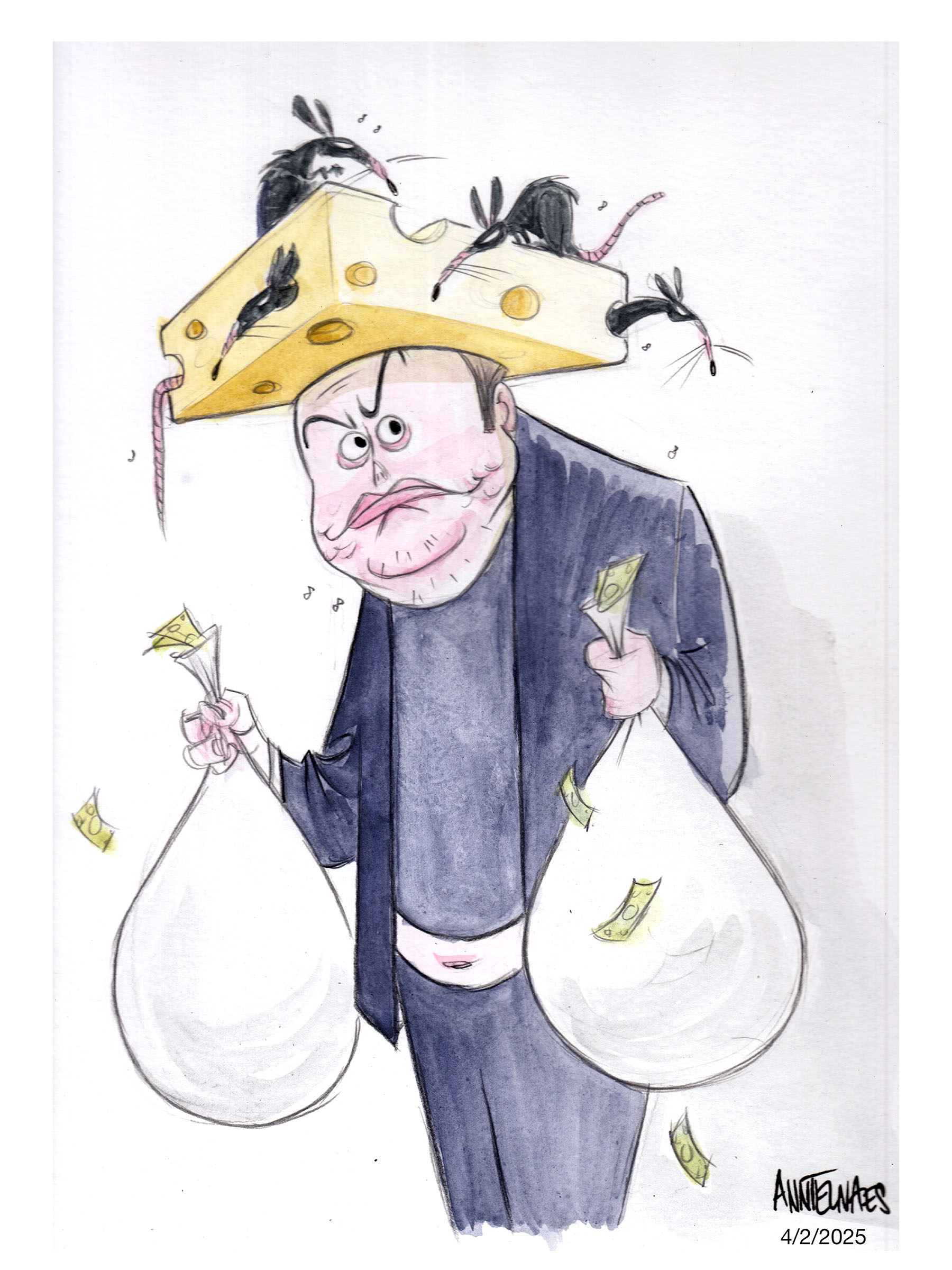
Trump’s loser by Ann Telnaes

Elon’s millions didn’t buy him the votes in Wisconsin Read on Substack

https://www.npr.org/2025/04/01/nx-s1-5345862/wisconsin-supreme-court-crawford-schimel-election-results

=========================

https://www.levernews.com/florida-is-going-medieval-on-labor-law/

Florida Is Going Medieval On Labor Law

Republican lawmakers in the Sunshine State are advancing a suite of bills making it easier for employers to exploit society’s most vulnerable.

Snippet (there’s much more, also about other subjects, on this page -A):

Make labor law feudal again. The Florida legislature is rapidly advancing a suite of bills allowing employers to underpay subminimum-wage workers — including children. One measure proposes undoing key child labor restrictions, like rules regulating maximum hours per week, banning overnight shifts, and guaranteeing teens get meal breaks. Another bill would permit employers to misclassify full-time workers as interns and apprentices to circumvent the state’s new minimum wage law. Both bills are part of the business lobby’s long war to decimate labor rights in the state; proponents are citing ongoing labor market disruptions caused in part by the Trump administration’s mass deportation program. 

Florida didn’t want this. In 2020, a supermajority of Floridians voted to pass a ballot initiative to raise the state’s minimum wage from $8.56 to $15 an hour by 2026. But business interests have tried to stop that law from ever fully going into effect. Last year, the legislature passed a carve-out for minor league baseball players, and this year, the business community is coming back with a more sweeping overhaul. The new bill exempts interns, apprentices, and work-study programs from the new wage standards, despite the fact that a minimum wage is supposed to raise the floor for the lowest-paid segments of the labor force. 

Internships forever. Critics of the legislation point out that the bill text does not define any criteria for what differentiates an employee from an intern or apprentice. Without clear guardrails, employers could use this exemption to underpay just about any entry-level position that requires some training. All they’d need to do is require the employee to sign a form waiving their right to the state minimum wage. 

Thanks, Florida Man. In a committee hearing earlier this month, the bill’s sponsor, state Rep. Ryan Chamberlin (R-Belleview), acknowledged that retailers like Target may exploit these loopholes as written. “It’s certainly not intended for Target to be able to do that,” he said in response to a Democratic lawmaker’s concerns, without denying that it’s a possibility. Meanwhile, critics argue that the legislation is patently unconstitutional and suspect that it’s meant to push for a ruling from the state’s high court, which is stacked with loyalists of Gov. Ron DeSantis (R), who has opposed the minimum-wage law. With a favorable ruling, business groups could weaken the law and undermine a guaranteed state minimum wage. (snip)

======================

Trump Reveals Real Reason for His Extreme Tariffs

Donald Trump continues to bully one of the America’s longest allies.

Donald Trump just made the rationale for his tariff “Liberation Day” crystal clear: revenge.

In a post on Truth Social late Tuesday, the president said that the tariffs were his administration’s “fight” against Democrats’ “wild and flagrant push to not penalize Canada for the sale, into our Country, of large amounts of Fentanyl, by Tariffing the value of this horrible and deadly drug in order to make it more costly to distribute and buy.”

Approximately 0.2 percent of American fentanyl seizures occur at the Canadian border, according to federal statistics.

But Trump’s aggressive rhetoric and high levies on Canada have practically shattered the two neighbors’ long-standing allyship. On Thursday, Canadian Prime Minister Mark Carney announced that his country’s cozy relationship with the U.S. had come to an end, and that Canada would wean itself off American products and services “at speeds we haven’t seen in generations.”

Trump singled out four Republican senators in particular who have pushed back against his tariffs. “They are playing with the lives of the American people, and right into the hands of the Radical Left Democrats and Drug Cartels,” he said, referring to Mitch McConnell, Susan Collins, Lisa Murkowski, and Rand Paul.

“The Senate Bill is just a ploy of the Dems to show and expose the weakness of certain Republicans, namely these four, in that it is not going anywhere because the House will never approve it and I, as your President, will never sign it,” Trump said. “Why are they allowing Fentanyl to pour into our Country unchecked, and without penalty. What is wrong with them, other than suffering from Trump Derangement Syndrome, commonly known as TDS?”

Trump and his allies have frequently accused anyone that critiques their work of being mentally ill, effectively undermining the legitimacy of critical thought in the groupthink of his already sycophantic base.

“Who can want this to happen to our beautiful families, and why? To the people of the Great States of Kentucky, Alaska, and Maine, please contact these Senators and get them to FINALLY adhere to Republican Values and Ideals,” Trump said. “They have been extremely difficult to deal with and unbelievably disloyal to hardworking Majority Leader John Thune, and the Republican Party itself. MAKE AMERICA GREAT AGAIN!”

(I find it rich that Trump thinks those Senators have not adhered to Republican values and ideals, especially McConnell and Collins. Paul is in a world of his own, most decidedly a Libertarian world. Sheesh. -A.)

So Who, Exactly, Is Being Punished Under This Government Edict?

I can’t think of a lot that a person can do about this. I started reading it hoping for an avenue for activism, then got caught up in the story, which is packed with info that we don’t get with stories about deportation flights. I’m sharing it because of the information. The information can help we the people’s kids who think they’re getting one job, only to find there’s another one, and it isn’t really civilian-type work. (And that is leaving the deportees aspect out of the picture, but …) The only thing I can think of to do that can eventually help is to take the info and share it with people during conversation, and such. This is another thing that, if people knew more about, they would not like it. -A.

Inside ICE Air: Flight Attendants on Deportation Planes Say Disaster Is “Only a Matter of Time”

by McKenzie Funk April 1, 2025, 6 a.m. EDT

ProPublica is a nonprofit newsroom that investigates abuses of power. Sign up to receive our biggest stories as soon as they’re published.

Reporting Highlights

  • Unexpected Role: Flight attendants were told they would fly rock bands, sports teams and sun-seekers. Then Global Crossing Airlines started expanding into federal deportation flights.
  • Human Struggles: Some flight attendants said they ignored orders not to interact with detainees. “I’d say ‘hola’ back,” said one flight attendant. “We’re not jerks.”
  • Safety Concerns: Flight attendants received training in how to evacuate passengers but said they weren’t told how to usher out detainees whose hands and legs were bound by shackles.

(snip)

The deportation flight was in the air over Mexico when chaos erupted in the back of the plane, the flight attendant recalled. A little girl had collapsed. She had a high fever and was taking ragged, frantic breaths.

The flight attendant, a young woman who went by the nickname Lala, said she grabbed the plane’s emergency oxygen bottle and rushed past rows of migrants chained at the wrists and ankles to reach the girl and her parents.

By then, Lala was accustomed to the hard realities of working charter flights for Immigration and Customs Enforcement. She’d learned to obey instructions not to look the passengers in the eyes, not to greet them or ask about their well-being. But until the girl collapsed, Lala had managed to escape an emergency.

Lala worked for Global Crossing Airlines, the dominant player in the loose network of deportation contractors known as ICE Air. GlobalX, as the charter company is also called, is lately in the news. Two weeks ago, it helped the Trump administration fly hundreds of Venezuelans to El Salvador despite a federal court order blocking the deportations, triggering a showdown that experts fear could become a full-blown constitutional crisis.

In interviews with ProPublica, Lala and six other current and former GlobalX flight attendants provided a window into a part of the deportation process that is rarely seen and little understood. For migrants who have spent months or years trying to reach this country and live here, it is the last act, the final bit of America they may experience.

An ICE detainee waves from inside a bus that transported passengers to the airport before departing from Seattle’s Boeing Field on a GlobalX deportation flight in February. Credit:Emily Schultz

All but one of the flight attendants requested anonymity or asked that only a nickname be used, fearing retribution or black marks as they looked for new jobs in an insular industry.

Because ICE, GlobalX and other charter carriers did not respond to questions after being provided with detailed lists of this story’s findings, the flight attendants’ individual accounts are hard to verify. But their stories are consistent with one another. They are also generally consistent with what has been said about ICE Air in legal filingsnews accountsacademic research and publicly released copies of the ICE Air Operations Handbook.

That morning over Mexico, Lala said, the girl’s oxygen saturation level was 70% — perilously low compared with a healthy person’s 95% or higher. Her temperature was 102.3 degrees. The flight had a nurse on contract who worked alongside its security guards. But beyond giving the girl Tylenol, the nurse left the situation in Lala’s hands, she recalled.

Lala broke the rule about talking to detainees. The parents told Lala their daughter had a history of asthma. The mom, who Lala said had epilepsy, seemed on the verge of her own medical crisis.

Lala placed the oxygen mask on the girl’s face. The nurse removed her socks to keep her from further overheating. Lala counted down the minutes, praying for the girl to keep breathing.

The stories shared by ICE Air flight attendants paint a different picture of deportations from the one presented to the public, especially under President Donald Trump. On social media, the White House has depicted a military operation carried out with ruthless efficiency, using Air Force C-17s, ICE agents in tactical vests and soldiers in camo.

The reality is that 85% of the administration’s “removal” flights — 254 flights as of March 21, according to the advocacy group Witness at the Border — have been on charter planes. Military flights have now all but ceased. While there are ICE officers and hired security guards on the charters, the crew members on board are civilians, ordinary people swept up in something most didn’t knowingly sign up for. (snip-MORE)

A Reblog From Barry-

Peace & Justice History for 4/2 (& 4/1)

When I went to Peace buttons Monday night, their site was down, or something, so no P&J 4/1 morning. However, keep scrolling; it’ll be after 4/2! -A

April 2, 1917

Jeannette Rankin, a Republican from Montana, took her seat in the U.S. House of Representatives. The first woman ever elected to Congress, she became the only member to vote against U.S. entry into both world wars.
Rankin lost her seat in the next election but was re-elected twenty years later when she opposed entry into World War II. She again served just one term.

Though American women weren’t guaranteed the right to vote for three more years with passage of the 19th amendment, women in Montana, Wyoming, Utah and Washington had full voting rights even before statehood.
Rankin was instrumental in passing laws that made married women citizens in their own right.

Jeannette Rankin biography 
April 2, 1966
One hundred thousand Vietnamese demonstrated in DaNang against both the U.S. and their South Vietnamese governments. Civil unrest spread also to Hue and the capital, Saigon.
April 2, 1970
Massachusetts, in the midst of the Vietnam war, enacted a law which exempted its citizens from having to fight in an undeclared war.
The U.S. Congress had never formally declared war on North Vietnam as required by Article 1, Section 8 of the U.S. Constitution.

April 1, 1841


Brook Farm, perhaps history’s most well-known utopian community, was founded by George and Sophia Ripley near West Roxbury, Massachusetts. Its primary appeal was to young Bostonians who were uncomfortable with the materialism of American life, and the community was a refuge for dozens of transcendentalists, including authors Ralph Waldo Emerson and Nathaniel Hawthorne.
Following four days of demonstrations against the Military Services Act that devolved into rioting in Quebec City, Canadian Prime Minister Robert Borden sent in troops from Ontario to stop the violence. Orders from the soldiers were read only in English to the mostly Francophone demonstrators, and when the they didn’t disperse, the troops fired, killing four and wounding 70.
[see March 28, 1918]


A memorial in Quebec to those who died protesting conscription into World War I
More about Brook Farm 
April 1, 1932
500 schoolchildren, in the depth of the Depression, paraded through Chicago’s downtown section to the Board of Education offices, demanding that the school system provide them with food.
April 1, 1955
The African National Congress had called on parents to withdraw their children by this day from South African schools in resistance to the Bantu Education Act. That 1953 law transferred education of the Bantu (blacks) from religious missions to state-controlled schools. Mission education, argued then-Minister of Bantu Education Dr. H.F. Verwoerd, not only tended to create “false expectations” amongst the natives, but was also in direct conflict with South Africa’s racially separatist apartheid policies.
Whites, who were in complete control of government and society, comprised only 14% of South Africa’s population. Verwoerd presented to Parliament:
“When I have control of native education, I will reform it so that natives will be taught from childhood to realize that equality with Europeans is not for them. There is no place for him (the black child) in European society above the level of certain forms of labour…What is the use of teaching a Bantu child mathematics when it cannot use it in practice?”
April 1, 1983
Tens of thousands in the United Kingdom formed a “peace chain” 22.5 kilometers (14 miles) long to express their opposition to nuclear weapons. The chain started at the American airbase at Greenham Common, passed the Aldermaston nuclear research center, and ended at the ordnance factory in Burghfield.

At the same time 15,000 people took part in the first of a series of anti-nuclear marches in West Germany. They were protesting the siting of American cruise missiles on West German territory.
Contemporaneous coverage of the Peace Chain 
April 1, 1985
The U.S. Environmental Protection Agency ordered an end to the dumping of sludge off the New Jersey coast into the Atlantic Ocean.
21st century sludge 

https://www.peacebuttons.info/E-News/peacehistoryapril.htm#april2

Eyebrow Raising

to say the least … 🤨 😠

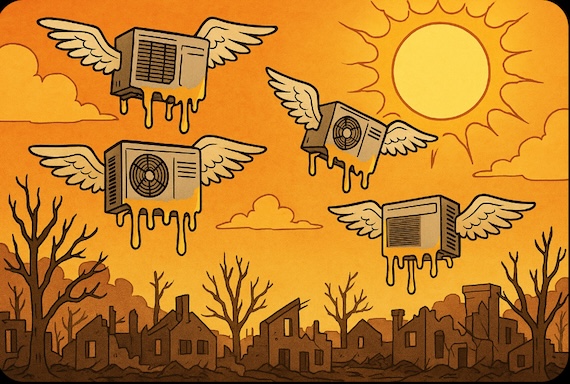
Big Banks accept a Catastrophic 5.4º F. Temperature Rise, Hope to sell People more Air Conditioners

Juan Cole 04/01/2025

Ann Arbor (Informed Comment) – Corbin Hiar reports at the Scientific American that the big banks are now banking on a 5.4º F. (3º Celsius) rise in global temperatures above the pre-industrial average.

Morgan Stanley let the conclusion slip in a report on air conditioner sales, which it expects to double, what with the extra heat. Hiar says that especially after the election of Trump, the banks accept that that is just the way it is going to be.

The stupidity hurts my brain.

Freakin’ air conditioners?

I’d like to direct readers (and any bankers among them) to a free book on what science tells us about a 3º Celsius world. It is Klaus Wiegandt, ed., 3 Degrees More: The Impending Hot Season and How Nature Can Help Us Prevent It (Springer Nature, 2024). It is a pretty horrifying prospect.

Air conditioners run on electricity, and reliable electricity may be a problem if the average temperature of the earth’s surface skyrockets 5.4º F.

Remember, that is an average increase. In some places it may be 10º or 15º F. That’s not going to be a pretty picture in Phoenix, Az., Miami, Fl. or for that matter Orlando, Fresno, Ca. and a bunch of other cities that are already sweltering in the summer

I’ve lived a lot of my life in hot places. I was in Cairo once in the summer and there was an article in the Arabic newspaper al-Ahram [The Pyramids] about the heat in Aswan in Upper Egypt, where it was about 115º F. The article said that there was a big electricity outage because the insulation of the electrical wires melted.

There are lots of ways ambient heat can interfere with the transmission wires. It can melt the insulation, or it can overheat components, it can cause oxidation. And here’s the thing. Hot wire shows more electrical resistance, which reduces its efficiency.

Moreover, overheated wires or components can cause fires. California is a big tinderbox at certain times of year, with dry forests, which overheated electrical wires can set off. The smart thing to do will be to bury all the electrical wires, but that is an expense the power companies do not want to bear. Another possibility is that people will put up solar panels and use home batteries, and disconnect from the grid.

Hot river water causes nuclear plants to go offline because they can’t cool the rods. Heat and droughts reduce hydro-electric production. Just generating electricity for the air conditioners can be a challenge. Your best bet will be solar panels, an industry Trump is trying to crush, and the banks are happy to help because of their fossil fuel investments and their willingness to kowtow to Trump’s diktats.

Then there is the air conditioner itself. It isn’t magic. AC’s don’t function well at over 100º F. They may break down. They may not be able to displace the heat outside. Cooling down things by more than 26º F. is a challenge. So if it is 120º F. out, don’t count an getting lower than the 90s inside.

In fact, it has recently been discovered that a combination of 122º F. and 80 percent humidity will just kill you dead right there.

All this is not to mention the massive hurricanes that will repeatedly knock down the electricity poles. Already, Duke Energy filed with the state of Florida for $1.1 billion in compensation for all the grid repair work it had to do after the 2024 hurricane season. What if the costs rise so much that the state can’t bear them, and Duke Energy goes bankrupt? I mean, these are little dinky storms compared to the ones we’ll be having if temperatures rise another couple degrees Fahrenheit. Some scientists argue that the Saffir-Simpson Hurricane Wind Scale, which only goes up to 5, is increasingly inadequate, and that we are already seeing sixes. Can force 7 hurricanes be far off?

Duke’s press release says, “Given the severity of these three storms, the filing covers a range of costs, such as deploying hundreds of Duke Energy crews from the entire span of the company’s service territories and acquiring significant mutual assistance from across the country and even Canada; standing up staging sites, basecamps and temporary lodging, while also providing meals for thousands of lineworkers and field personnel; and repairing, rebuilding and replacing critical infrastructure, including poles, wires and transformers, that were damaged and/or destroyed by catastrophic storm surge and wind.”

I don’t think they’re going to be getting that help from Canada anymore. And this is just the beginning.

Hurricanes are caused by warm ocean water. The oceans off Florida are already getting up to 100º F. in the summer. That kind of temperature whips up a lot of wind. It is now clear in the data that the intensity of hurricanes is increasing because we are burning so much coal, fossil gas and petroleum.

Not only will the hurricanes be fiercer, damaging homes and businesses and knocking down those made of wood, but they will dump more and more water, causing massive flooding.

Stefan Rahmstorf writes, “our planet’s current coastlines are home to more than 130 cities larger than a million inhabitants, plus other infrastructure such as ports, airports, and some 200 nuclear power plants with seawater cooling (such as Sizewell B on the British North Sea coast). Even 1 m [3 feet] of sea rise would be a disaster.”

Those banks that see a 5.4º F. temperature increase as an opportunity to sell more consumer goods such as air conditioners are not reckoning with the likelihood of climate chaos and climate breakdown at that level, of a sort that will make maintaining current levels of civilization challenging. We’ll survive it. We’re unlikely to survive it in style.

And the billionaires who think that they can sell us gasoline and coal and gas for another century and just protect their families with big mansions in the mountains or on islands are fooling themselves. The mansions will slide down the side of the mountain in a massive downpour, and the seas will swallow up the ones on islands with storm surges.

So, Everybody Who’s Got An Opportunity To Vote Today,

has voted, or has a solid plan to VoTe, yes? If not, get your AweSome Self out to vote, ASAP. Use It Or Lose It!!!

Amazing and True!