TOPEKA (KSNT) – Kansas’ attorney general and the Kansas Bureau of Investigation (KBI) have signed a deal to assist federal immigration forces in the Sunflower State.
Danedri Herbert with the Kansas Office of the Attorney General said in a press release on Monday, Feb. 17 that Attorney General Kris Kobach and the KBI have signed an agreement with the U.S. Department of Homeland Security (DHS). This will allow KBI agents to work alongside Immigrations and Customs Enforcement (ICE) to remove immigrants who are residing in Kansas illegally.
A limited number of KBI agents will receive ICE training that authorizes the agents to arrest immigrants who are in the U.S. illegally, serve and execute warrants for some immigration violations and issue immigration detainers, according to the press release. Herbert said a section of the Immigration and Nationality Act authorizes states and political subdivisions of a state to enter into agreements like this. (snip-MORE)
Oh, we’re helping Trump deport people for more minor offenses now, to avoid being ‘soft’ on immigration? Read on Substack
(I’m not putting the piece here, because it’s obvious to me that I’m not the only one who dislikes the news of the day. However, if your writingtapping fingers are warm or want to be, there’s an action within; writing or calling to our US Senators to oppose the Laken Riley Act. The article, couched in angry humor/humorous anger, gives good insight on the act, along with listing unintended consequences, because of course Republicans don’t read what they write and can’t think ahead about what words mean. Anyway, go read, or not; just call or email your Senators. And thanks!)
MEXICO CITY (AP) — Mexico is developing a cellphone app that will allow migrants to warn relatives and local consulates if they think they are about to be detained by the U.S. immigration department, a senior official said Friday.
The move is in response to President-elect Donald Trump’s threats to carry out mass deportations after he takes office on Jan. 20.
The app has been rolled out for small-scale testing and “appears to be working very well,” said Juan Ramón de la Fuente, Mexico’s secretary of foreign affairs.
He said the app would allow users to press a tab that would send an alert notification to previously chosen relatives and the nearest Mexican consulate. De la Fuente described it as a sort of panic button.
“In case you find yourself in a situation where detention is imminent, you push the alert button, and that sends a signal to the nearest consulate,” he said.
U.S. authorities are obliged to give notice to home-country consulates when a foreign citizen is detained. Mexico says it has beefed up consular staff and legal aid to help migrants in the legal process related to deportation.
De la Fuente expects the app to be rolled out in January. He didn’t say whether the app has a de-activation tab that would allow someone to rescind an alert if they weren’t really detained.
The government says it has also set up a call center staffed 24 hours a day to answer migrants’ questions.
The Mexican government estimates there are 11.5 million migrants with some form of legal residency in the United States, and 4.8 million without legal residency or proper documents.
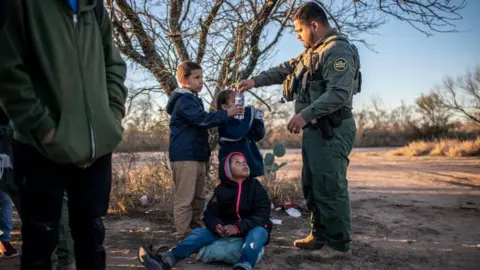
Unaccompanied children detained at the border are first processed by Customs and Border Patrol before being handed over to other US authorities.
Donald Trump’s incoming border tsar, Tom Homan, has said that the US government “can’t find” more than 300,000 migrant children – and that many have been lured into forced labour and sex trafficking.
President-elect Donald Trump and his political allies, including Vice-President-elect JD Vance, have repeatedly made similar claims.
Some experts have accused them of distorting statistics to suggest the children are “lost” and victims of crime, although there is agreement that aspects of the system need to be changed.
The incoming administration has made immigration enforcement a priority, promising to clamp down on the US-Mexico border and conduct mass deportations of undocumented immigrants.
Let’s take a look at the claims of missing migrant children.
What are the Trump team’s claims?
In an interview with Fox News on 26 November – just before a visit to the US-Mexico border in Texas – Homan accused the Biden administration of “bragging” about how quickly children are released from custody, as well as “not properly vetting” adult sponsors in the US.
“Shame on them,” he said of the Biden administration. “They have over 300,000 children that they have released [to] unvetted sponsors that they can’t find.”
“Many are going to be in forced labour. Many forced sex trade,” Homan added. “We need to save these children.”
In his October debate against Minnesota Governor Tim Walz, JD Vance also said that the Department of Homeland Security “effectively lost” a total of 320,000 migrant children.
Concerns over the plight of migrant children were also starkly highlighted earlier this week when authorities in Texas shared an image of a two-year-old girl from El Salvador found at the border clutching a piece of paper with a phone number.
“Putting optics over safety has led to countless children in danger or unaccounted for,” Tennessee Republican representative Mark Green told the New York Post.
“This refusal to protect vulnerable alien children from abuse, exploitation, and human trafficking will be one of the defining failures of the Biden-Harris administration.”
Are the children actually missing?
According to immigration experts and attorneys, the claims largely stem from an August report from the Department of Homeland Security’s inspector general’s office, which found that 32,000 unaccompanied minors failed to show up for court dates at immigration courts from 2019-23.
The report noted that 291,000 migrant children received no court notices at all. It also called on the US Immigration and Customs Enforcement (Ice) to “take immediate action to ensure the safety” of unaccompanied migrant children in the US.
Migrant children “who do not appear for court are considered at higher risk for trafficking, exploitation, or forced labor”, the inspector general’s office reported.
But Aaron Reichlin-Melnick, policy director at the American Immigration Council, a migrant advocacy group, told the BBC the figures are indicative of a bureaucratic “paperwork issue” rather than “anything nefarious”.
“When you hear the phrase ‘missing’, you think that there is a child that someone is trying to find and can’t,” he said.
“That’s not the case here. The government has not made any effort to find these children.”
Many of the children, experts say, may well be at the addresses that are on file with the government, but were simply unable to make their court dates.
“That doesn’t mean something bad happened to them,” Mr Reichlin-Melnick said. “It means you missed a court hearing.”
Mr Reichlin-Melnick added that there are “valid concerns” about exploitation.
“We cannot, however, suggest that all 320,000 of those children are being labour trafficked,” he said.
Eric Ruark, an immigration researcher with NumbersUSA – which calls for tighter border controls – said that the children are difficult to track “because of some combination of apathy, incompetence and bureaucratic inefficiency”.
“Many, hopefully even most, are safe with caring sponsors,” he added. “But the Biden administration can’t actually say one way or the other, and apparently doesn’t care enough to find out.”
What happens to children at the border?
Unaccompanied minors detained at the US-Mexico border go through a complicated process that begins with detention and processing by Customs and Border Patrol, or CBP.
If the child is from a foreign country that is not Mexico or Canada, they are placed into removal proceedings and transferred to the US Department of Health and Human Services, or HHS.
HHS, through its Office of Refugee Resettlement office, cares for the children in a network of state-licensed providers.
The office also seeks to reunify children with family members in the US or with individual or organizational sponsors – who in turn are obligated to ensure they arrive at immigration court dates.
What can the Trump administration do?
Homan and other Trump administration officials have so far not provided many details about how they plan to address the issues that plague the detention of undocumented minors.
Several immigration attorneys contacted by the BBC suggested that the administration is likely to make becoming a “sponsor” for undocumented children much more difficult, even if the sponsor is a member of their family.
In practice, this would mean that more undocumented children are kept in detention.
“They could do what the Obama administration did, and detain them,” said Alexander Cuic, an immigration attorney and professor at Case Western Reserve University.
The controversial “Remain in Mexico” programme could also be applied to children, forcing them to wait across the border for the outcome of immigration proceedings.
“I’m not sure even they know what they’re going to do with the kids,” Mr Cuic said of the Trump administration. “But there’s a border problem they’re trying to figure out first, and that’s the first concern before whether they’re going to be harsh to both children and adults.”
When the BBC asked the Trump transition team what plan they have for the undocumented migrant children, spokesman Taylor Rogers said only that “Democrats’ wide-open border policies” have led to the children going “missing”.
“President Trump and leaders in his administration will deliver on their promise to end the invasion at our southern border that puts innocent children in harm’s way,” she added.
The republican’s know their policies and ideas are very, very unpopular. They can’t win on them, so they are forced to cheat and drum up fake fears to scare voters to vote for them. Hugs. Scottie
‘Congratulations’ the fake letter reads, ‘you have been selected as a Wayward Steward exchange home for homeless immigrants and victims of foreign wars.’
A Bala Cynwyd couple received a fraudulent letter from the Pennsylvania Congressional Office of Immigration Affairs this week informing her that she’d been selected as a “wayward steward” to house five refugees. The office does not exist, nor does the program. Elizabeth Bennett holds the letter on Sept. 27, 2024.Read moreCharles Fox / Staff Photographer
A Bala Cynwyd voter got a detailed letter this week from the made-up Pennsylvania Congressional Office of Immigration Affairs notifying her that her household had been selected to house five migrant refugees.
No office exists, nor does such a government-mandated housing program, but the letter, doctored to look like an official government document, provided specific details designed to mislead someone less attuned to a scam — and laid the blame for the fake program at the feet of President Joe Biden and Vice President Kamala Harris during a heated and close election in which immigration has increasingly become a focal point.
“I’m concerned to find out how many people might have actually gotten it and to make sure the record’s set straight so people aren’t getting fearful or angry and deciding to vote another way,” Elizabeth Bennett, 62, said.
The letter says Bennett was selected as a “wayward steward” as part of “US5Ca12-B … written into Law by President Joe Biden and Vice President Kamala Harris.” No such law exists.
It advised Bennett she’d been selected based on property and income records and would receive an $80 weekly stipend for food costs. The letter suggested a “minimum of one bedroom be prepared with a minimum of 5 beds,” with a link to “government-approved” bunk beds.
The return address listed is for an intersection in front of the Capitol building in Harrisburg.
Neither the governor’s office nor the department of state immediately returned a request for comment.
Bennett is unsure why she was targeted. She has a large Harris/Walz sign in her front yard. Ironically, she’s also done volunteer resettlement work with immigrants for the last 30 years but she assumes that was just a coincidence.
“Of all the people they could send this to, I would be the one who is like, ‘OK let’s get the room set up, we gotta take care of these people,’” she said. But as she read on, she realized the program was fake and intended to scare people.
“I could definitely see, even for me reading this letter it felt threatening even though I’m very pro-immigrant because it felt like something that was being imposed on me,” she said.
It’s unclear if other Pennsylvanians received the letter. Bennett posted about it in small Facebook groups but hasn’t heard from others who received it.
But whoever created the letter took time to make it look like an official document, including an imprint of a fake Pennsylvania seal on the letterhead and a stamped date informing Bennett when to expect the migrants.
A listed phone number for the fake office, with a Harrisburg area code, goes to a voicemail for the named office where a messaging service invites the caller to press one for housing vouchers, two for reimbursements, and three to “expand your footprint to help more people.”
The letter Bennett received went on to specify garages or sheds without electricity and running water could not be used.
“Thank you for your dedication to the health and safety of these future Americans!” it concluded.
Misinformation about migrant resettlement and illegal immigration has been rampant in the campaign. Former President Donald Trump and his running mate JD Vance have made it a focus of their bid for the White House claiming that migrant resettlement has drained resources from small towns and that illegal immigration has driven crime and economic hardship, with little evidence.
The federal Office of Refugee Resettlement does invite people to be part of a government hosting program but participation is entirely optional.
State Rep. Joe Hohenstein (D., Philadelphia) is an immigration attorney who called the letter “a betrayal of the actual spirit of our country.”
“It’s definitely designed to make people think that there’s a broader government program to resettle refugees and my guess is that the intention is to stir up fear of immigrants and refugees,” he said. “That’s reprehensible It’s a betrayal of the actual spirit of our country of being a welcoming beacon to people who are seeking freedom.”
In the next week, Hohenstein is cosponsoring a bill to establish an Office of New Pennsylvanians, which would help provide support services for refugee businesses and migrants fleeing persecution in Pennsylvania.
“This would provide help to people who need it,” he said. “It would not be a mandate to anyone.”
I think this fits in as information relating to marginalized people. It is from a magazine that is religious, but it’s not pushy; I think everyone can read this article without feeling proselytized. It struck me as important, and overlooked. -A
That danger is amplified for the thousands of girls living in makeshift camps and tent cities along the U.S.-Mexico border without protection or accompanying support. According to the Washington, D.C.-based Kids In Need of Defense, “[u]naccompanied children are especially vulnerable to sexual violence, human trafficking, and exploitation by cartels and other criminal groups.”
Over the last few years, a group of Muslim women has stepped in to meet their needs in unique ways. Albergue Assabil (“the Shelter of the Path”), the first Muslim shelter along the U.S.-Mexico border, has been in operation since June 2022 under the leadership of Sonia Tinoco García, founder and president of the Latina Muslim Foundation. According to staff, the shelter served nearly 3,000 migrants in its first two years of operation. Many of those migrants have been women, attracted to the shelter because of its separate men’s and women’s facilities and the fact that Albergue Assabil is a female-led shelter.
And it’s not only Muslim women finding sanctuary under the shade of the shelter’s blue dome; there have also been other female immigrants looking to García and her team for assistance as they make the perilous journey north.
“A group of Muslim ladies”
When García first headed to the U.S.-Mexico border to help others in 2014, her goal was simple: to help women, especially mothers and unaccompanied children, in their attempts to claim asylum or start a new life in the United States. Having immigrated to the U.S. herself in the 1990s, García knew what it was like.
She also knew the statistics.
Though the share has fluctuated in recent decades, immigrant women and girls make up at least half of all migrants and asylum seekers, according to figures from the Migration Policy Institute. Women and girls made up a total of 53 percent of the immigrant population in 1980, 51 percent in 1990, 50 percent in 2000, and 51 percent in 2010 and 2022.
Given the scale, García gathered what she called “a group of Muslim ladies” from her mosque community in San Diego. Each had a profound understanding of the situation female immigrants were facing.
Angie Gely, who works in the office at Albergue Assabil, said being an immigrant who was deported back to Mexico and is now living in Tijuana, helps her understand what women in the shelter are going through — and what they face once they arrive in the U.S.
“Our families crossed the border to the U.S. too,” Gely said. “We can relate.”
Driven by their own past experiences and a deep desire to help female immigrants, García said she and other Muslim women started volunteering in Tijuana shelters, bringing food and clothing for people regardless of their religious, social, and cultural background.
Along the way, García and her “Muslim ladies” started noticing how many Muslims were mixed in with the larger population of immigrants and deportees. “It got my attention when I saw some women standing at the border with hijab,” García said. “I talked to them and discovered they were from Somalia, trying to go to the U.S. or Canada.”
The more time she spent in Tijuana, the more Muslims she saw arriving. At shelter after shelter, meanwhile, she witnessed staff too overwhelmed to cater to Muslim migrants’ unique needs.
“There were Muslims who didn’t feel safe in the shelters, because they were being discriminated against or questioned because of their faith,” Gely said. As a result, some would avoid the shelters altogether, struggling to find their own way on the streets or seeking help from Muslims at Centro Islámico de Baja — Tijuana’s only mosque at the time.
“The shelters didn’t have the time or money,” García said, “to provide halal food, to provide adequate space for prayer, or even understand their situations are different from those of migrants from Central America or elsewhere.”
Sonia Tinoco García, pictured, founded Albergue Assabil in 2022, with help of other Muslim women from San Diego, Calif., and Tijuana, Mexico. Ken Chitwood/Sojourners.
García and the others did what they could to serve the immigrants sent their way — covering the cost of hotel rooms, providing home-cooked halal meals, or connecting them to the legal aid they so desperately needed, in a language they could communicate in. Overwhelmed, they turned to their mosque communities in San Diego and Orange counties to raise funds and procure translators who could speak Arabic or Urdu, Farsi or French, and many dialects in between.
But the need continued to increase. More and more Muslim immigrants were making their way to Tijuana, and the “ladies” could only do so much. Shelters were overwhelmed, and García said she was scrambling to field the many calls.
That’s why, in 2017, they decided to do more. Founding a nonprofit organization — the Latina Muslim Foundation — they raised more than $200,000 (USD) to construct a purpose-built Muslim shelter. Situated in the border city’s Zona Norte neighborhood, the shelter features separate men’s and women’s facilities, a prayer area, halal food, Quran classes, and legal services to assist migrants.
The hope, García said, was to provide a humane and helpful place for Muslim migrants to land in Tijuana. They are there to help transform the border from a topography of inhumanity into a place of dignity and opportunity, García said.
A growing number of Mexican Muslim women
García said that as a child, she always dreamed of helping people. “I wanted to become a surgeon, but do surgery for free, because people need it to save their lives,” García said. “Or an attorney who did pro bono work, to help families who don’t have justice.”
García grew up in a large family in a village of 200 people near La Paz, in the very south of the Baja California peninsula. She did not know whether such dreams would — or could — come true. “We had a simple lifestyle. We were not rich people,” she said. “Because we were 11 siblings, not everyone got education.”
García was one of the lucky ones able to finish high school. She moved to Ensenada — an hour and a half south of Tijuana — and started working with a local orthodontist serving medical tourists from the U.S. When she was 21, she met a man named Abu Hamza, a medical tourist from Lebanon living in Los Angeles. Abu Hamza spoke no Spanish at the time, and she did not speak English, but they communicated with books and through other people. Twenty days after meeting, they were married.
García had grown up Catholic and knew little of Islam. But when she saw Abu Hamza, she said, “I saw Islam in him.” After moving to the Los Angeles area with Abu Hamza, she learned English and Islam at the same time.
García joined the growing ranks of Latina converts to Islam. The first Latina and Latino converts can be identified as far back as the 1920s; others converted in the 1960s and ’70s as part of Black Muslim movements such as the Nation of Islam and the Five Percent Nation. In 2011, 6 percent of Muslim Americans identified as Hispanic, according to the Pew Research Center; by 2017, it was 8 percent. The vast majority of this cohort of Hispanic American Muslims are women, many of them from Mexico or having Mexican heritage.
Muslims remain a small minority in Mexico, said Arely Medina, a professor at the University of Guadalajara. There are multiple small groups and communities made up of both migrants and individuals native to Mexico in the country’s interior, all of which have a relatively recent history, Medina said. “Thus, one cannot speak of a ‘Mexican Islam’ per se,” she said, “even though Muslims have a history here stretching back to the conquest of the Americas and continuing with a series of Arab immigrations in the 19th and 20th centuries.”
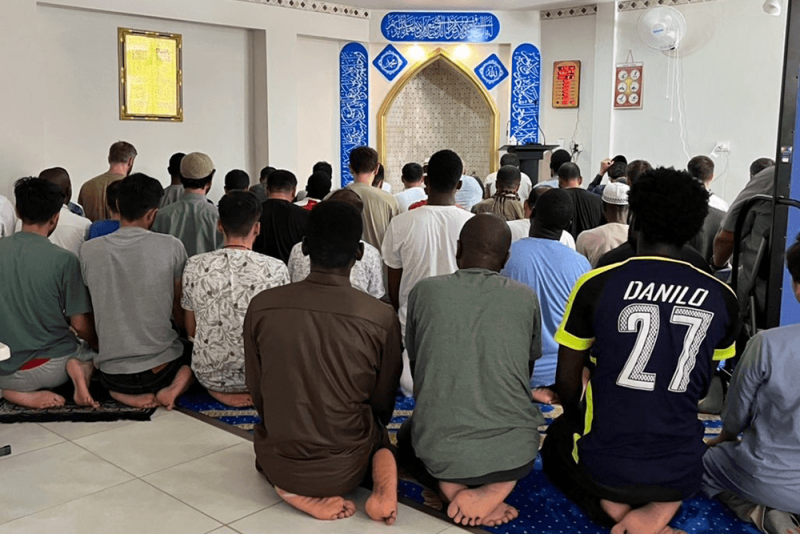
Migrants from numerous nations gather for Friday prayers inside the Albergue Assabil’s musallah, or prayer room. Ken Chitwood/Sojourners
According to Medina and other experts, most Mexican converts to Islam are women. Among them are sizable numbers of female Muslim immigrants from places such as Egypt, Morocco, Syria, Pakistan, Ghana, and Turkey who have made Mexico home. “Some hope to reach the United States and are concentrated along the northern border,” Medina said. “Others concentrate in places like Mexico City, Guadalajara, or Monterrey.”
It is difficult, if not impossible, to generalize these women’s motivations, plans, or situations, Medina said. As is true of those staying at Albergue Assabil, “There is not a single story,” she said. “Each one carries a narrative.”
Because these women face a variety of challenges — such as wearing the veil in a cultural context where Islam is not a prominent reference point or searching for a sense of freedom and security in the face of domestic violence and harassment — Medina said they find in each other a sense of solidarity. “They are in search of a better life,” she said. As Europe, the United Kingdom, and even the U.S. are experienced as less welcoming, Medina said, “Latin America is now seen as a place of possible openness.”
Empowered to help others
Whether local converts or newcomers from elsewhere, Muslim women have carved out their own spaces in Mexico, including the Albergue Assabil shelter and the Nur Ashki Jerrahi Sufi order in Mexico City, which is headed by a woman — Shaykha Amina Teslima.
García often reminds donors, partners, volunteers, journalists, and authorities that Albergue Assabil is a shelter run by women. And not just any women, but Muslim women.
That, she said, makes a difference.
“We found that Islam gives women rights; it gave us empowerment,” she said of her and the other women running the show at Albergue Assabil. “I could do whatever I wanted to do — more than what I could do with my own culture or my own religion before,” she said. “Islam says that women can go study; men cannot tell you no. Men know this. My husband knows he doesn’t own me. He is my support.”
Indeed, her husband, Abu Hamza, is supportive of García’s work. He is often seen around the shelter too, pulling up on a motorcycle with García, bringing in donations, making phone calls, and generally doing whatever needs to be done. When asked about the shelter, he insistently points to his wife. “She knows better than me,” he said.
García said part of the shelter’s work is passing their own empowerment on to women who arrive at their gates. “In the shelter, when women come, we give them tools to be able to continue their education: English, Spanish, computers, cooking,” she said. “We want to give them the basics so that they are not reliant on men. In the time they stay in the shelter, we teach them as much as we can so that they can live for themselves.”
Increasingly, said Gely, that means more and more women are finding their way to Albergue Assabil — Muslim and non-Muslim. “Just yesterday, three ladies from Russia came here looking for shelter,” Gely said. “They’re not Muslim, no. But they hear how nice it is and want to come. Of course we take them in.”
One of them is Amie. Amie has struggled getting an appointment through the U.S. Customs and Border Protection app CBP One. She has spent three months in Mexico so far, arriving at Albergue Assabil six weeks after bouncing from shelter to shelter in Tijuana. Sojourners is withholding Amie’s last name, at her request, to protect her immigration status.
“They’ve been so kind to me,” she said, “out on the street, in other shelters, I feared for my life, worried I would be tortured, abused, or killed. This shelter is the only place I feel I could survive.”
As we talk, two more young Russian women walk through the front doors. They too are looking for shelter. Amie tells them to take a seat. Gely or García will be here soon, she says.
“They’ll take care of you,” Amie said. “They always do.”

/cloudfront-us-east-1.images.arcpublishing.com/pmn/FAKIWMSCXVGIDIVVRUCZQ7NRIM.jpg)
/s3.amazonaws.com/arc-authors/pmn/b1bd3a0d-2d7c-4401-a7e3-5ae6984bf698.png)

 Scottie's Playtime