January 6 defendants pursue millions in claims through obscure federal process

We are seeing the tRump acting attorney general refuse to put in writing and under oath that the slush fund tRump “settled with himself” over.  The courts are demanding the DOJ and the Treasury swear under oath that the idea of such a fund controlled only by tRump is dead and never to be resurrected.  The current acting AG refuses because that was the tRump goal all along.  As soon as court scrutiny is droped they are planning to do the illegal act anyway.   These people don’t think laws and rules apply to them and especially never apply to their dear leader tRump.  Here is a slightly older article of their attempted work around if the courts stop them entirely.  From what I have read the Jan. 6th insurrectionists have already applied to this payout fund and that some may have gotten money from it.  Paid to be tRump thugs to do his bidding to stay in power.   Hugs.


https://www.theguardian.com/us-news/2026/jun/17/january-6-defendants-compensation-process?CMP=Share_iOSApp_Other


Federal Tort Claims Act, over which DoJ has total discretion, provides workaround to Trump’s $1.8bn slush fund

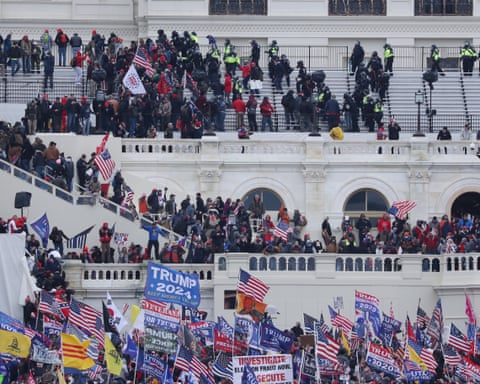
Pro-Trump protesters occupy the US Capitol.Pro-Trump protesters occupy the US Capitol, including the inaugural stage and viewing stands in Washington DC on 6 January 2021. Photograph: Michael Reynolds/EPA

January 6 defendants who assaulted police officers are pursuing legal claims for millions in compensation from the Trump administration using an obscure federal process with minimal oversight, but which offers the Trump administration a way to compensate those responsible for violence even after scrapping its “anti-weaponization fund”.

The defendants are pursuing their claims using the Federal Tort Claims Act (FTCA), which allows individuals wronged by the government to file claims for monetary damages. The justice department has complete and unchecked discretion over whether to settle the claims, giving the Trump administration a powerful vehicle to reward those responsible for violence on January 6. The claims would be paid out from the judgment fund, a perpetual appropriation allowed for by Congress and the same pot of money Trump’s $1.8bn slush fund was going to draw from. All of the defendants seeking compensation received a pardon from Trump.

There was fierce bipartisan pushback to the “anti-weaponization fund” proposed by the administration last month after Trump reached a settlement with the Internal Revenue Service. In particular, members of Congress were concerned that people who harmed law enforcement officers on January 6 might receive compensation. “If you’ve been convicted of assault on a cop … doesn’t seem to me like people who are victims,” Josh Hawley, a Republican senator from Missouri, told NBC News.

While the “anti-weaponization fund” appears to be on ice for now, FTCA claims and lawsuits could provide another avenue for payouts.

“It risks turning the judgment fund into exactly the sort of slush fund that the ‘anti-weaponization’ was going to be,” said Rupa Bhattacharyya, a former director in the civil division’s tort branch at the justice department, who worked on FTCA claims and now is the legal director at the Institute for Constitutional Advocacy and Protection at Georgetown Law.

“If the treasury department is not going to enforce the restrictions on the use of the judgment fund, which is to settle impending or imminent lawsuits where there’s some risk of liability, then there’s no limit on what you can use that judgment fund money for, so long as someone files a bogus claim,” she said.

The justice department agreed to settle FTCA claims filed by Michael Flynn, a former national security adviser, and Carter Page, Trump’s foreign policy adviser, for $1.25m each earlier this year.

Many of the January 6 defendants are represented by Peter Ticktin, a Florida attorney who is a longtime friend of Trump. He said he had filed about 400 FTCA claims on behalf of January 6 defendants and expects to start frequently filing lawsuits now that the six-month waiting period has expired.

There may also be advantages to pursuing compensation through FTCA claims instead of the weaponization fund, said Mark McCloskey, a Missouri attorney who is representing many January 6 defendants. There were no restrictions on who could apply to the weaponization fund, making the pool of applicants so big that it could lower the per capita recovery, he said.

“The weaponization fund, for the brief fleeting moment which it allegedly existed, had no policies, procedures, or anything that would indicate what kind of evidence they would have required, what kind of format of a filing they would have required, or anything like that,” he said. “I never thought the weaponization fund, as a practical matter, was very meaningful. Whereas the FTCA gives you a statute with teeth that you can, as long as you can prove your claim, you have a right to recovery.”

Among those seeking money are Kenneth Joseph Thomas, an Ohio man who was sentenced to nearly five years in prison after being found guilty for assaulting several police officersVideo showed him shoving multiple police officers and throwing himself into a line of officers as he shouted for other rioters to “hold the fucking line”. Also seeking compensation is John George Todd III, a Missouri man sentenced to five years in prison after being found guilty on several charges, including injuring a Capitol police officer.

Both men are among nine plaintiffs seeking at least $1m each in damages in an FTCA suit filed 29 May in Washington DC. They say they are entitled to damages because they were unfairly and vindictively prosecuted by the government.

Andrew Taake, a Houston man sentenced to six years in prison and who pleaded guilty to assaulting police officers with bear spray and a whip-like weapon, is also seeking at least $2.5m in damages. Taake is entitled to damages because he received inadequate medical treatment and an unfair trial, his lawyers said in their FTCA lawsuit, filed last September in Washington.

Bhattacharyya said she believed the justice department could defend itself against the “malicious prosecution type claims” the January 6 defendants were bringing, and she hoped it would do so. When Trump filed his $10bn lawsuit against the IRS, the justice department did not try to defend itself against the suit.

“Most of these plaintiffs were indicted by grand juries, brought before a court. Many of them pled guilty, others were convicted, they were sentenced by judges, and so those sorts of malicious prosecution claims are eminently defensible,” she said.

Those who pleaded guilty or were convicted of assaulting police officers should still be entitled to payouts, McCloskey said. “The vast majority of people that pled guilty to or were found guilty of such offenses were either coerced into confessions based on threats of life imprisonment and threats against their family or went to trial in courts where the evidence was faked, rigged, perjury was testified to and fair trials were not had,” he said. There is no evidence of wrongdoing in the January 6 prosecutions.

In Taake’s case, the Trump administration is defending itself against the claims and seeking to have them thrown out. In February, a federal prosecutor in Washington wrote that many of the claims should be thrown out since the lawsuit did not name proper defendants and certain requirements were not met before the suit was filed.

The Trump administration faced immediate and bipartisan backlash after it announced it was creating the loosely controlled $1.8bn fund to resolve a $10bn lawsuit filed by Trump related to the leak of his tax returns. Some Republicans objected strongly to the idea that those who assaulted police officers could receive payouts.

“The concern my constituents and I have is that money possibly going to folks who hit cops,” Nick LaLota, a Republican congressman from New York, told NBC News. “Especially when there is video evidence, they shouldn’t get a dime from our government.”

Adam Schiff, a Democratic senator from California, introduced legislation last month that would bar anyone convicted of an offense related to January 6 from receiving a payout from the federal government. Among other things, the bill would amend the FTCA to prohibit those who were pardoned for actions related to January 6 from being eligible for claims.

“President Donald Trump still wants to pay off violent insurrectionists who attacked police officers on January 6th, despite any claims from members of his administration that say otherwise,” Schiff said in a statement. “Our taxpayer dollars should not be used to pay out criminals, and we can pass a law right now to prevent this president or any future administration from paying off their friends and political allies.”

House Republicans are investigating Jan. 6. NPR fact-checked the first hearing

In order to please tRump and stave off the maga thugs republicans in elected office are trying desperately to change reality.  Some are doing it to practice what tRump is able to do which is to make people accept his version of reality even when it is completely false and made up.  No one but tRump can do that and he has been doing it since he was a kid.  He has the ability to convince himself that what he wants to believe is true is true because he wants it.  By the fact he was always wealthy or people thought he was it worked and twice he has had the power of the presidency along with the cult behind him.   Other republicans don’t have that ability and can not command the maga cult.  But that won’t stop them from trying.   Hugs.


Rep. Barry Loudermilk sits with a microphone in front of him.

Rep. Barry Loudermilk, R-Ga., is leading a congressional subcommittee reinvestigating the Jan. 6, 2021, attack on the U.S. Capitol. The Trump administration has promoted a distorted and whitewashed history of that day’s events.

Andrew Harnik/AP

A new Republican-led congressional subcommittee to investigate the Jan. 6, 2021, attack on the U.S. Capitol held its first public hearing this week. GOP lawmakers used the opportunity to criticize the Biden administration and, at times, promote conspiracy theories about the riot. An NPR fact check has identified multiple false and misleading claims from the hearing, which coincides with a broader effort by the Trump administration to rewrite the history of the attack.

The hearing unfolded against the backdrop of Trump’s mass pardons for the Jan. 6 defendants almost one year ago. Stewart Rhodes, the former leader of the Oath Keepers who was convicted of seditious conspiracy for his role in the attack and sentenced to 18 years in prison, appeared at the front of the audience. Rhodes is one of a small group of former defendants who did not receive a full pardon from Trump, and instead received a commutation. As a result, Rhodes was released from prison but his seditious conspiracy conviction remains on his record.

The official topic for Wednesday’s hearing was “Examining the Investigation into the DNC and RNC Pipe Bombs.” On Jan. 6, just as rioters began breaching the outer perimeter of the Capitol, two bombs were discovered outside the headquarters of the Republican and Democratic national committees, diverting law enforcement resources at a critical moment.

During the Biden administration, the investigation into who planted the bombs stalled, and the lack of an arrest fueled conspiracy theories. Dan Bongino, the conservative podcaster who would later become deputy director of the FBI, said on his show in November 2024 that he was certain the bombs were placed by “either a connected anti-Trump insider or this was an inside job.”

A year later, Bongino told a very different story.

WASHINGTON, DC - DECEMBER 4: FBI Deputy Director Dan Bongino (L), accompanied by, Attorney General Pam Bondi (C), and FBI Director Kash Patel (R), speaks during a news conference on an arrest of a suspect in the January 6th pipe bomb case at the Department of Justice on December 4, 2025 in Washington, DC. Federal agents have arrested a suspect they are charging with placing two pipe bombs, which never exploded, the night before the January 6th, 2021 U.S. Capitol attack. (Photo by Andrew Harnik/Getty Images)

Former FBI Deputy Director Dan Bongino confirming the arrest of a suspect in the Jan. 6 pipe bomb case at the Department of Justice in 2025.

Andrew Harnik/Getty Images

While serving as a top FBI official, he appeared at a press conference announcing charges against Brian Cole Jr., a 30-year-old man from Virginia accused of planting the bombs. Cole, who has pleaded not guilty, twice voted for Trump, according to his lawyer. Federal prosecutors allege that Cole confessed and said he believed votes had been “tampered” with in the 2020 election.

Bongino addressed his shifting stance on the pipe bomber case on Fox News in December 2025. “I was paid in the past for my opinions,” Bongino said, “but that’s not what I’m paid for now. I’m paid to be your deputy director.” Bongino left the FBI at the beginning of January 2026 and is set to return to podcasting.

Rep. Barry Loudermilk, R-Ga., who chairs the subcommittee, has made the pipe bomb case a central focus of his inquiry. He repeatedly criticized the FBI for failing to crack the case for nearly five years and said internal documents “paint a dismal picture” of the investigation during the Biden administration.

In one of the few moments of bipartisan agreement, Rep. Jamie Raskin, D-Md., praised the FBI under Director Kash Patel for making an arrest, calling it “a rare bright spot for federal law enforcement over the last year.”

But with the pipe bombing case now moving through the courts — rather than the political arena — lawmakers sometimes veered into claims that did not match the facts.

Trump supporters storm the U.S. Capitol on Jan. 6, 2021.

Trump supporters storm the U.S. Capitol on Jan. 6, 2021.

Samuel Corum/Getty Images

The claim: 

“The Biden FBI did have undercover agents and confidential informants embedded within the rally crowds,” said Rep. Clay Higgins, R-La. “And the Biden FBI did conspire to entrap MAGA Americans prior to J6 and then successfully entrapped several hundred Americans on J6.”

The facts: 

Joe Biden was not president on Jan. 6 — Donald Trump was.

At the time of the attack, the FBI was led by Christopher Wray, a Trump appointee.

Joe Biden took office on Jan. 20, 2021, two weeks after the riot, and Wray remained FBI director for the duration of his presidency.

A Department of Justice inspector general report examined the presence of confidential FBI sources in the crowds on Jan. 6 and found that “none of these FBI [Confidential Human Sources] was authorized by the FBI to enter the Capitol or a restricted area or to otherwise break the law on January 6, nor was any CHS directed by the FBI to encourage others to commit illegal acts on January 6.” The report also found no evidence “showing or suggesting that the FBI had undercover employees in the various protest crowds, or at the Capitol, on January 6.”

Higgins’ office did not respond to a request for comment.

The claim:

Raskin said Trump failed to act decisively to stop the riot and “did nothing to send out the National Guard under his unilateral direct control in the District of Columbia.”

In response, Loudermilk countered that Trump “cannot just send the National Guard unless the National Guard is requested by the legislative branch.”

Referring to former Capitol Police Chief Steven Sund, Loudermilk said, “There were multiple requests made by the former chief of police for National Guard before the request to call them was given. And that was only after shots were fired in the Capitol. That request was made to the Department of Defense in the one o’clock hour on Jan. 6.”

The facts:

The president has direct control of the D.C. National Guard, and the Capitol Police requested assistance from the guard prior to the breach of the building. Still, troops did not arrive until hours later.

Loudermilk appears to have jumbled the timeline of the National Guard’s response, which is laid out in reports from both the Capitol Police and Department of Defense Office of Inspector General.

  • At 1:09 p.m. and again at 1:22 p.m., former Capitol Police Chief Steven Sund asked the House and Senate sergeants at arms to declare an emergency and formally request help from the National Guard. By that point, rioters had breached the outer perimeter of the Capitol grounds and were assaulting police, but had not yet broken into the building. 
  • At 1:49 p.m., Sund called the commanding general of the D.C. National Guard directly to request the assistance of guard troops at the Capitol. 
  • At 2:10 p.m., Sund relayed that he received formal authorization from the Capitol Police Board.
  • At 2:13 p.m., rioters broke a Capitol window and began flooding into the building.
  • At 2:44 p.m., Capitol Police Officer Michael Byrd fired a single shot, striking rioter Ashli Babbitt as she attempted to breach a door to the Speaker’s Lobby, where members of Congress were trying to evacuate. Babbitt subsequently died. National Guard troops did not arrive at the Capitol until 5:55 p.m.

In an email to NPR, Loudermilk’s Deputy Chief of Staff Brandon Cockerham said that the congressman’s reference to a request made “only after shots were fired” was an allusion to a later moment in the timeline, when acting Defense Secretary Christopher Miller authorized the mobilization of the National Guard.

“I believe the Chairman meant to use the word ‘authorization’ instead of ‘request’ as he was alluding to the authorized mobilization of the D.C. National Guard which came at approximately 3:04 PM,” Cockerham wrote.

The claim:

Rep. Troy Nehls, R-Texas, criticized police officers who testified before the previous Jan. 6 select committee, which was led by Rep. Bennie Thompson, D-Miss., and former Rep. Liz Cheney, R-Wyo.

“They set out to have a highly pre-scripted hearing, designated to play on the emotions of Americans,” said Nehls. “For example, the hearing with Capitol Police officers Dunn, Gonell, Fanone, Hodges — four Trump haters who gave highly scripted and pre-planned testimonies.”

The facts:

Nehls was referring to testimony by Harry Dunn and Aquilino Gonell, who served with the Capitol Police, and Michael Fanone and Daniel Hodges, who served with D.C.’s Metropolitan Police Department.

All four officers have publicly criticized Trump, in large part because of the injuries and trauma they suffered defending the Capitol on Jan. 6.

But their politics are not as simple as Nehls suggested.

Fanone, who was dragged into the crowd and repeatedly beaten and shocked in the neck by a rioter with a Taser-style device, voted for Trump in 2016.

“I was looking for a candidate that supported law enforcement,” Fanone told NPR in an interview last year. “I regret the decision. It was clearly the wrong decision in hindsight.”

Fanone suffered a traumatic brain injury and a minor heart attack due to the assaults on Jan. 6.

Nehls’ office did not respond to NPR’s request for comment.