Jeannette Rankin, and FDR In Peace & Justice History for 3/4

March 4, 1917
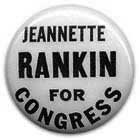
Montana elected Republican Jeannette Rankin as the first woman to sit in the U.S. House of Representatives three years before American women nationwide could legally vote.

Rep. Jeannette Rankin with her colleagues in the 61st Congress.
A persistent advocate for women’s rights, particularly suffrage, Rankin voted in Congress against American entry into both world wars, and late in life led marches against the
Vietnam war.

More about Jeanette Rankin
Visit the Jeanette Rankin Peace Center 
March 4, 1933
Franklin Delano Roosevelt was sworn in as president in the midst of the Great Depression. From his inaugural address:
“This is preeminently the time to speak the truth, the whole truth, frankly and boldly. Nor need we shrink from honestly facing conditions in our country today. This great Nation will endure, as it has endured, will revive and will prosper.
So, first of all, let me assert my firm belief that the only thing we have to fear is fear itself — nameless, unreasoning, unjustified terror which paralyzes needed efforts to convert retreat into advance. In every dark hour of our national life, a leadership of frankness and of vigor has met with that understanding and support of the people themselves which is essential to victory.”


President Franklin Delano Roosevelt delivering his first inaugural address
Audio and video of the speech 
March 4, 1965
Moved to action by President Lyndon Johnson’s sustained bombing of North Vietnam beginning two months before, Vietnam Day was declared by the Universities Committee, led by Wayne State University Professor Otto Feinstein. At about 100 college campuses nationwide, faculty, students and others gathered for lectures and meetings about the war. This occurred just three weeks before the first “teach-in” at the University of Michigan.
March 4, 1969


The Union of Concerned Scientists (UCS) was founded.
From its founding document“Misuse of scientific and technical knowledge presents a major threat to the existence of mankind. Through its actions in Vietnam our government has shaken our confidence in its ability to make wise and humane decisions. There is also disquieting evidence of an intention to enlarge further our immense destructive capability…”. . . continued here

The UCS today
March 4, 1978
40,000 demonstrated against the enlargement of the uranium enrichment plants in Almelo, Holland. Enrichment is the processing of uranium with gas cetrifuges to the level required for use as fuel in nuclear reactors.
March 4, 2011
A new Egyptian prime minister called on thousands of cheering protesters in Cairo’s Tahrir Square to rebuild their country. Essam Sharaf, appointed by the military, told the crowd:

Egypt’s new prime minister, Essam Sharaf, is greeted by supporters at Tahrir Square in Cairo. Photo: Amr Nabil/AP
“I salute the martyrs. Glory and respect to the families of the victims and a special salute to everyone who took part and gave for this white revolution. I am here to draw my legitimacy from you. You are the ones to whom legitimacy belongs.”

He ws appointed to replace deposed President Hosni Mubarak who had forced out of office by the widespread unrest that had spread from Tunisia, Egypt’s neighbor to the west. Sharaf was cheered and carried to and from the podium on the shoulders of protesters, escorted by military police.
March 4, 2011
In cities across Iraq demonstrators gathered for the second consecutive Friday to demand jobs, effective government services and an end to corruption. Inspired by movements elsewhere in the Arab world, 500 convereged in Liberation Square in the capital Baghdad, 1000 in Basra. Those in Baghdad were surrounded by at least as many security forces and overcame official resistance to the gathering including a citywide ban on vehicles. One protester had walked from Sadr City and had to pass through eight checkpoints.

https://www.peacebuttons.info/E-News/peacehistorymarch.htm#march4

Peace & Justice History for 12/7

December 8, 1886

Samuel Gompers, a founder and leader of the American Federation of Labor
The American Federation of Labor (AFL) was founded at a convention of union leaders in Columbus, Ohio. It was an alliance of autonomous unions, each typically made up of workers within a particular craft.
Samuel Gompers, a leader in the Cigarmakers’ union, was a key person in creating the AFL, was elected its first president, and served as such virtually continuously for nearly 40 years.

On Samuel Gompers from the AFL-CIO 

=====================================
December 8, 1941

Jeanette Rankin (R-Montana), the first woman elected to the U.S. Congress in 1916, cast the only vote (she was among eight women in the Congress at the time) opposing declaration of war against Japan, despite their attack on Pearl Harbor the previous day . She had also voted against the U.S. entering World War I (at the time called the war to end all wars). Rankin served served just two single terms in the House. She spent her early career working for women’s suffrage, later very active in several peace and justice organizations.

Jeannette Rankin in 1940
Jeanette Rankin timeline 
Chronology and oral history transcript of interview of Jeanette Rankin 
=====================================
December 8, 1953

U.S. President Dwight Eisenhower addressed the United Nations General Assembly, proposing the creation of a new U.N. atomic energy agency which would receive contributions of uranium from the United States, the Soviet Union, and other countries “principally concerned,” and would put this material to peaceful use.
The speech, known later as Atoms for Peace, included: “My country wants to be constructive, not destructive. It wants agreement, not wars, among nations. It wants itself to live in freedom, and in the confidence that the people of every other nation enjoy equally the right of choosing their own way of life.”

========================================
December 8, 1987

U.S. President Ronald Reagan and Soviet leader Mikhail Gorbachev signed the first treaty to reduce the nuclear arsenals of the two superpowers. The Intermediate Nuclear Forces (INF) Treaty eliminated and banned all ground-launched ballistic and cruise missiles with a range of 500-5,500 kilometers (300-3,400 miles). By May 1991, all intermediate- and shorter-range missiles, launchers, and related support had been physically dismantled.

=========================================
December 8, 1988

On the first anniversary of the INF (Intermediate Nuclear Force) Treaty, twelve Dutch peace activists, calling themselves “INF Ploughshares,” cut through fences to enter the Woensdrecht Air Force base in The Netherlands.
They made their way to cruise missile bunkers where they hammered on the missiles, carrying out the first disarmament action in Holland.

Read more about this action 

https://www.peacebuttons.info/E-News/peacehistorydecember.htm#december8

Peace & Justice History for 11/7:

Getting on with it.

November 7, 1837
Abolitionist, clergyman and editor Elijah P. Lovejoy, 34, was murdered by a pro-slavery mob in Alton, Illinois, as he defended his newly delivered printing press. 
 
Elijah P. Lovejoy

He had lost two other presses to mob attacks, but refused to surrender this one, which had been contributed by the Ohio Anti-Slavery Society. For this he was shot five times in the fatal attack. Lovejoy had moved 20 miles to Alton from St. Louis where, after denouncing the lynching and burning of a black man, a mob tore down his office.
 
Warehouse with Lovejoy’s press set ablaze by mob;
“We must stand by the Constitution and laws, or all is gone.” Elijah Lovejoy, The Observer
Read more 
November 7, 1862
1700 members of the Dakota Sioux, mostly women, children and the eldersly, were force-marched 150 miles (240 km) to a concentration camp at Fort Snelling in Minnesota. The four-mile-long (6.5 km) procession was subject to physical abuse by white residents of towns along the way. Governor Alexander Ramsey had committed himself to ridding the state of all the Dakota, raising the bounty on an Indian scalp to $200.
One of the prisoners at Fort Snelling
Simultaneously, 300 Dakota men were tried summarily (as many as 40 cases in a single day) and marched to another camp in Mankato.
They had surrendered to the U.S. Army at the end of the Dakota War, expecting to treated as prisoners of war.

Little War on the Prairie  (This American Life)
More on this forced march 
November 7, 1916
Jeannette Rankin, a Republican from Missoula, Montana, became the first woman elected to the U.S. Congress. American women in 19 states had no voting rights whatsoever until passage of the 19th amendment four years later. Female Montanans had full voting rights even before statehood (in 1889). 
 Read more 
November 7, 1919
Hundreds, presumed to be members of the Union of Russian Workers, were arrested in New York and other cities across the country on the second anniversary of the Russian Revolution. President Woodrow Wilson’s attorney general, A. Mitchell Palmer, and Intelligence Division chief, John Edgar Hoover, used the Sedition and Espionage Acts to thwart what they saw as a Communist plot to overthrow the government.
This was but one many assaults on radicals in what was known as the Palmer Raids. Thousands were arrested and thousands deported. It had been a year of significant labor unrest including steel, coal, and Boston police strikes, and a Seattle general strike. There was high unemployment in the wake of the demobilization after World War I. Around May Day there had been dozens of mail bombs, most of them intercepted, and a suicide bomber died outside Palmer’s Washington residence.
 
The Palmer Raids 
The first mass arrest of immigrant workers 
Attorney General Mitchell’s view 
November 7, 1973
New Jersey became the first state to allow girls to play Little League Baseball.

https://www.peacebuttons.info/E-News/peacehistorynovember.htm#november7