“A Purrrrfect Political Storm”

Crazy cat ladies have come to dominate this election season. It’s hardly the first time.

By: Natalie Kinkade  September 25, 2024 11 minutes

Before internet memes, postcards offered a popular, accessible, shareable means to combine image and word. Messages could be as simple as “wish you were here,” but in their “golden age” (circa 1898–1917), postcards provided a powerful way to promote political agendas, writes scholar Kenneth Florey. The golden age neatly coincided with the height of the women’s suffrage movement in the United States and Britain. More than a thousand varieties of pro- and anti-suffrage-themed postcards were produced then, 200 of which are included in “Votes and Petticoats,” a Johns Hopkins University digital collection available on JSTOR. Of these, a significant number, curiously, depict cats—both as women’s pets and as women.

Associations between ladies, cats, and cat ladies—childless and otherwise—are rooted in a long, complicated cultural history. In Edwardian times, cats were linked to women as creatures of the domestic domain: woman was Angel of the House, the cat her companion, both of them sweet, warm, helpful, and cute. At the same time, animal lovers, “spinsters,” and suffragists represented overlapping, suspect categories of womanhood. It’s the perennial paradox in which women find themselves: somehow looked down upon while also placed on a pedestal.
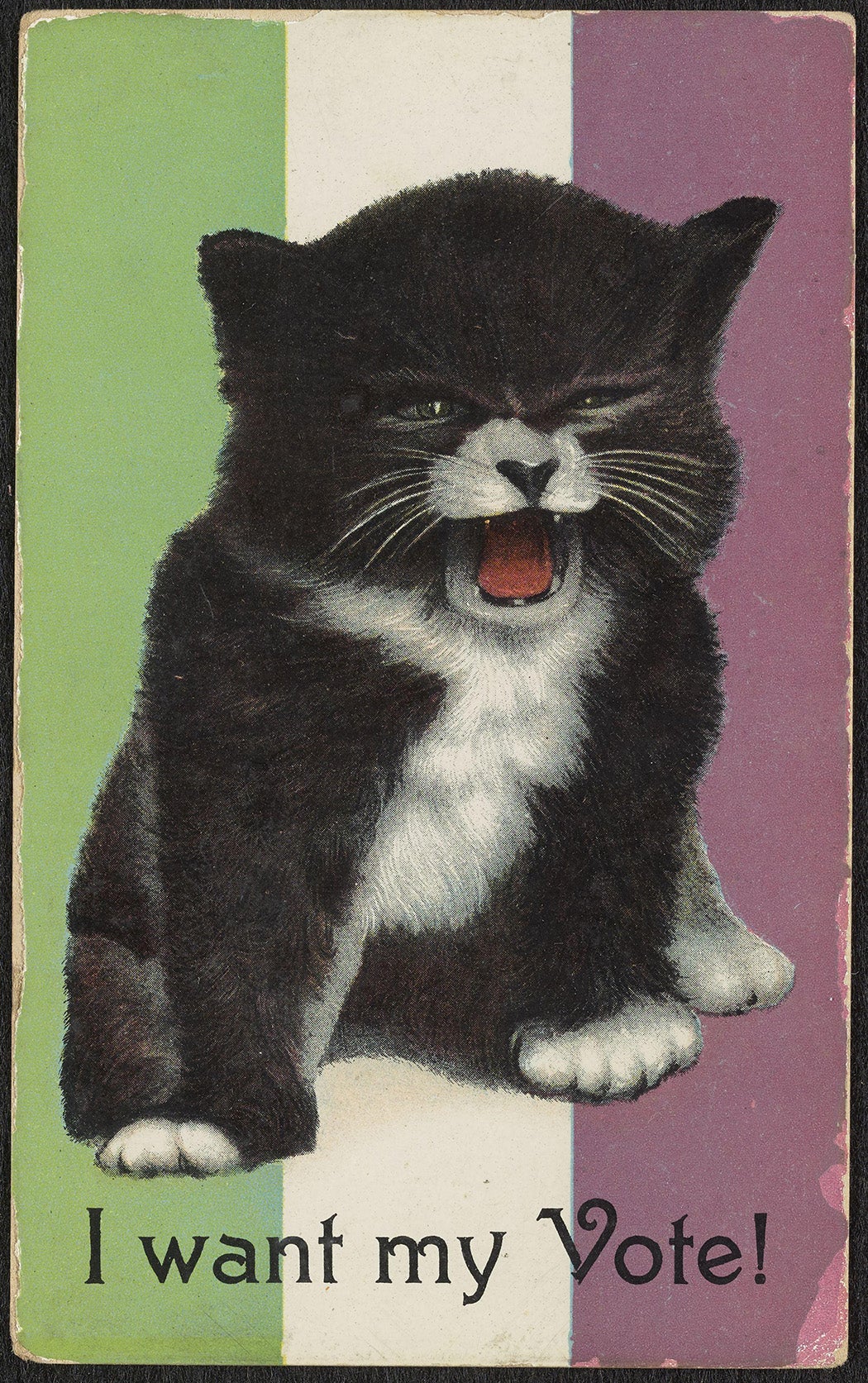
I Want My Vote! Courtesy Votes and Petticoats: Postcards, The Sheridan Libraries, Johns Hopkins University.

This postcard captures many of the themes that recur across the collection: it suggests that a woman demanding the vote is as silly as a kitten so doing, their protests as ineffective as the kitten’s mewls. The green, white, and purple stripes behind the kitten were the colors of the Women’s Social and Political Union (WSPU), one of the more militant British suffrage societies. Historian Krista Cowman interprets the sexism in this postcard as infantilizing though not especially cruel. Similarly, Florey describes the use of cats in suffrage postcards as softening a message that might otherwise seem harsh.
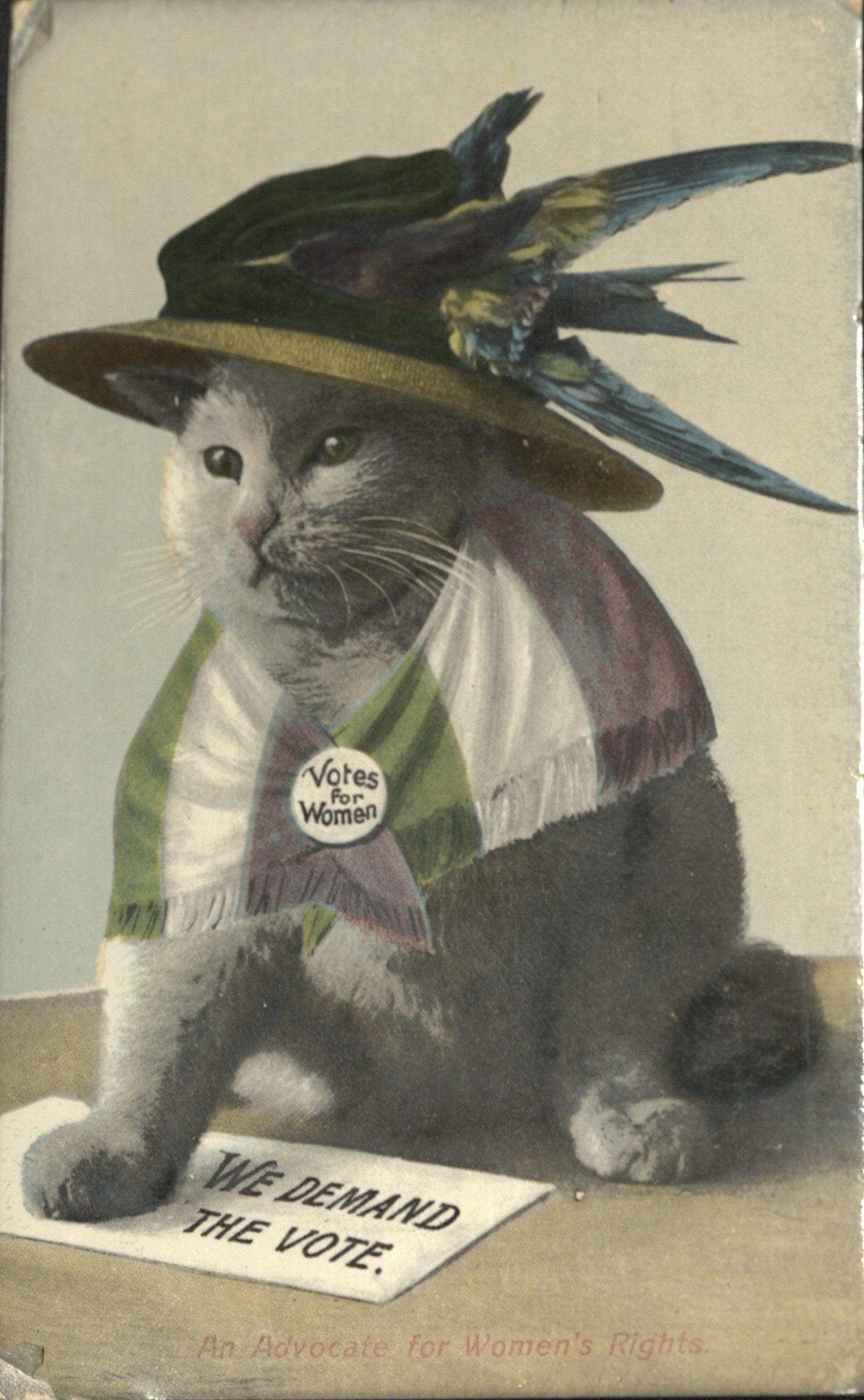
We Demand the Vote: An Advocate for Women’s Rights. Courtesy Votes and Petticoats: Postcards, The Sheridan Libraries, Johns Hopkins University.

In a similar vein, this cat is draped in the colors of the WSPU and wearing a fashionably magnificent hat. The message is ambiguous: Larissa Schulte Nordholt contends that it’s probably meant to satirize the concept of women participating in politics, the well-groomed, fat feline playing on the perception of suffragists as spoiled. It was published by a company that produced other, more clearly anti-suffrage postcards. But there’s a certain dignity in the cat’s determined forward gaze and assertive paw that perhaps suffragists could have embraced, regardless of the creator’s intention. Then again, that seriousness can also be interpreted as the very thing an anti-suffragist postcard maker was mocking by attaching it to a fluffy house cat.

Less whimsically, other postcards feature cats as pets in human scenes.
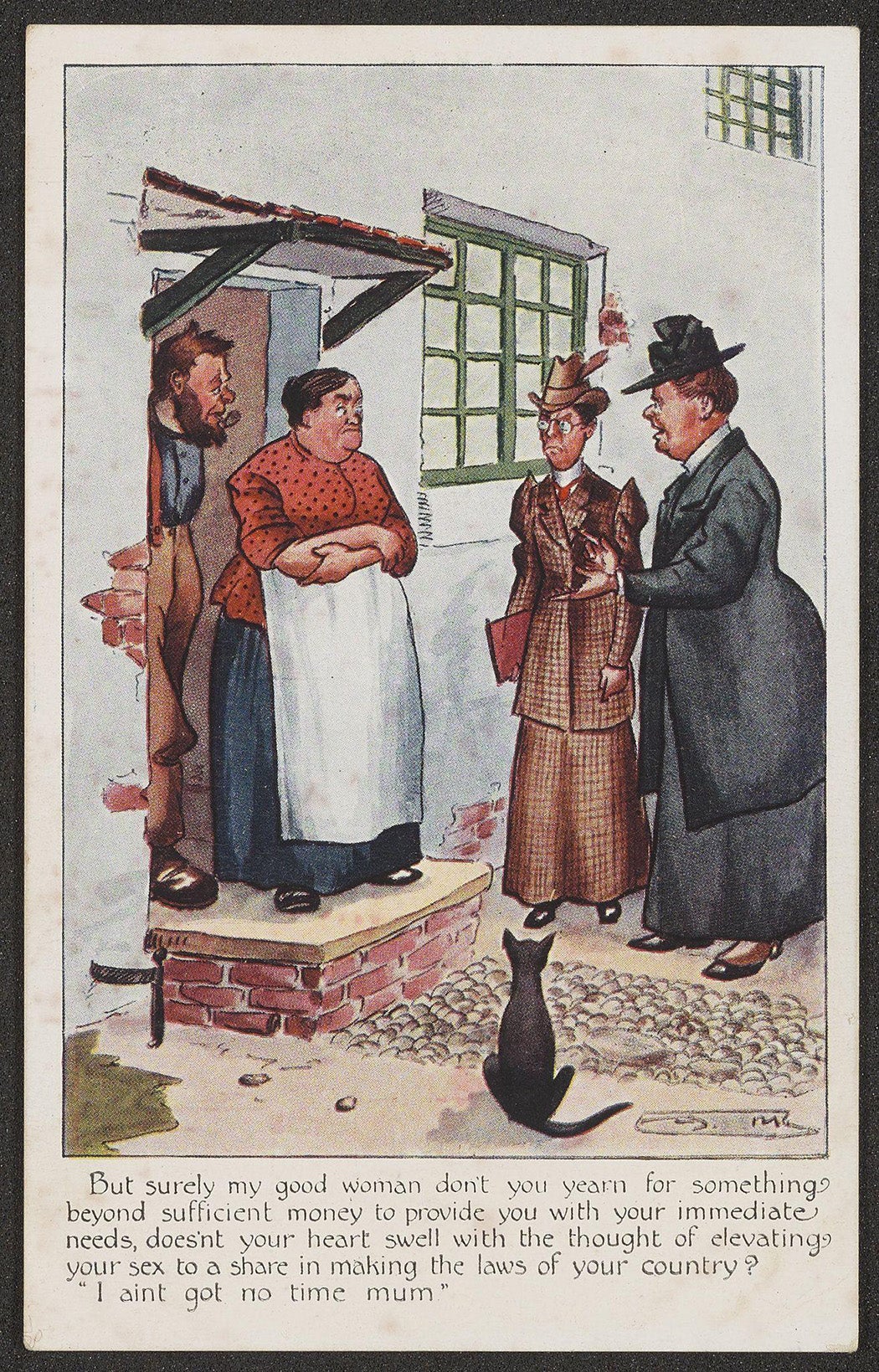
Courtesy Votes and Petticoats: Postcards, The Sheridan Libraries, Johns Hopkins University.

Here, the suffragists portrayed are mannish and middle-aged, typical of many negative suffragist depictions, stereotyping them as unsexed spinsters. While the housewife they address isn’t an idealized Angel of the House, she has a traditionally “motherly” figure and wears more feminine clothing. The suffragists, the viewer thus understands, are out of touch with what “real” working women want. If the suffragists had families to occupy them, they wouldn’t worry about the vote. And if lower-class women had the vote, they wouldn’t care to exercise it.

The cat in this postcard is outside the house and thus linked to the suffragists (it sits slightly apart, but arguably that positioning is dictated by compositional rather than symbolic reasons). The suffragists are “outdoor cats,” less benign and more feral—less feminine—than their indoor counterparts. It’s also worth noting that the cat is black, which taints it, and thus the suffragists, with associations of witchcraft and bad luck.
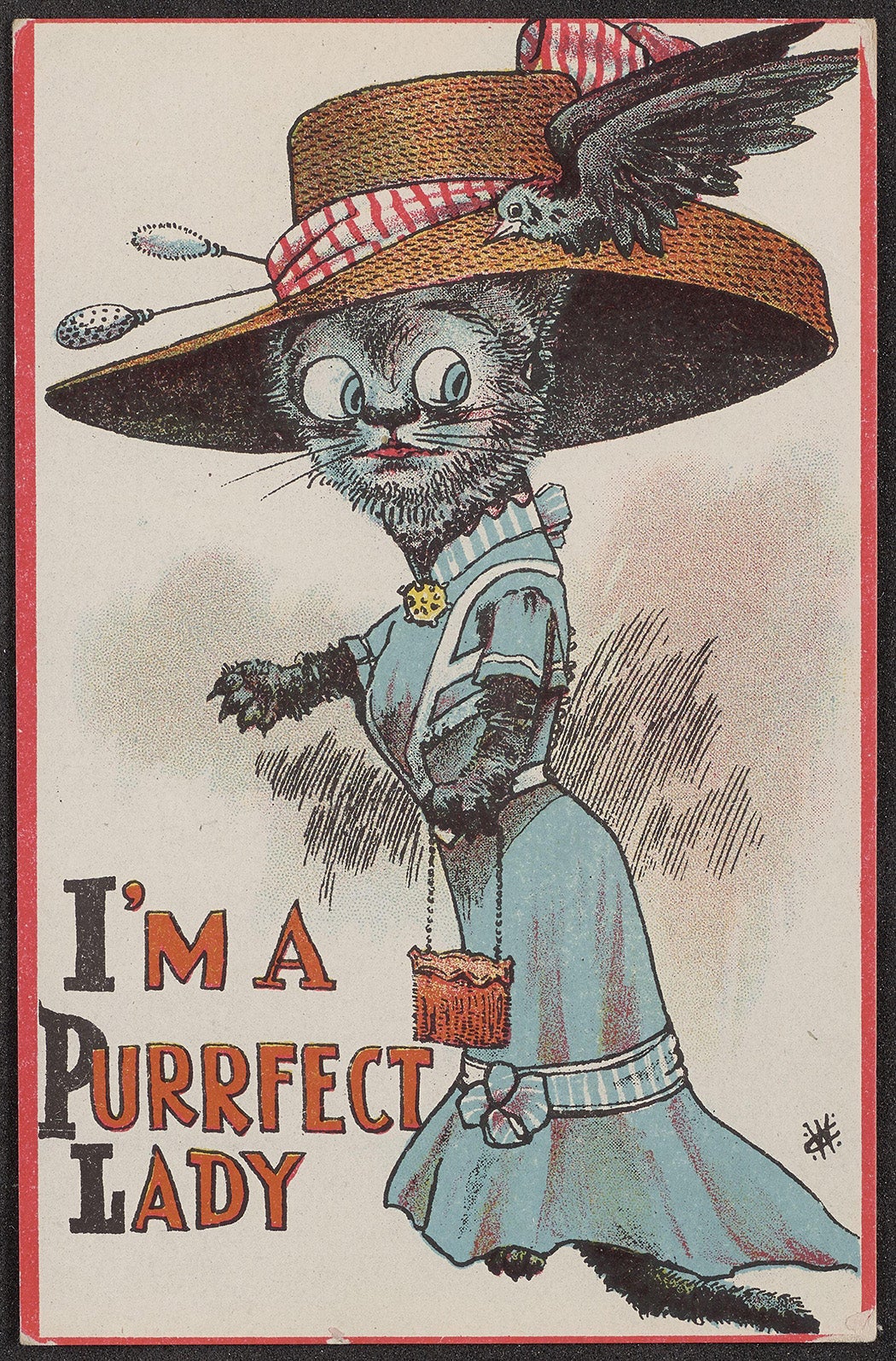
I’m a Purrfect Lady. Courtesy Votes and Petticoats: Postcards, The Sheridan Libraries, Johns Hopkins University.

Here too the suffragist is associated with a black cat, to unflattering, ridiculous effect. Although it was considered appropriately feminine for women to care for animals, women and femininity were also considered weaker, sillier, and more frivolous than men and masculinity; caring too much for other creatures came was considered a sign of fragility and triviality.

Tobias Menely has traced the disparagement of animal welfare through the evolution of gender norms in the modern period. As an early example, he cites a 1786 Scottish magazine story about a “Mrs. Sensitive” who dotes on a menagerie of pets yet cares little for “poor Christians.” In Menely’s analysis, Mrs. Sensitive is “immoral and unnatural, an ancestor of our own crazy cat ladies, women whose maternal instincts, we are led to believe, have been attenuated by an affinity for animals.”

By 1909, around the time these postcards were produced, sensitivity to animals was fully pathologized, as Menely relates: one doctor, Charles Dana, called it “zoöphilpsychosis” and published an article about it in the Medical Record. A case study pronounced a “childless woman who transformed her house into a hospital for sick felines” as “beyond medical redemption.” Sufferers of “zoöphilpsychosis” were described as “sentimental,” “weak,” and “hysterical”—terms loaded with sexist connotations.

These stereotypes are further repeated in conversations surrounding the anti-vivisection movement, another woman-dominated cause that reached its height in the Victorian and Edwardian eras.
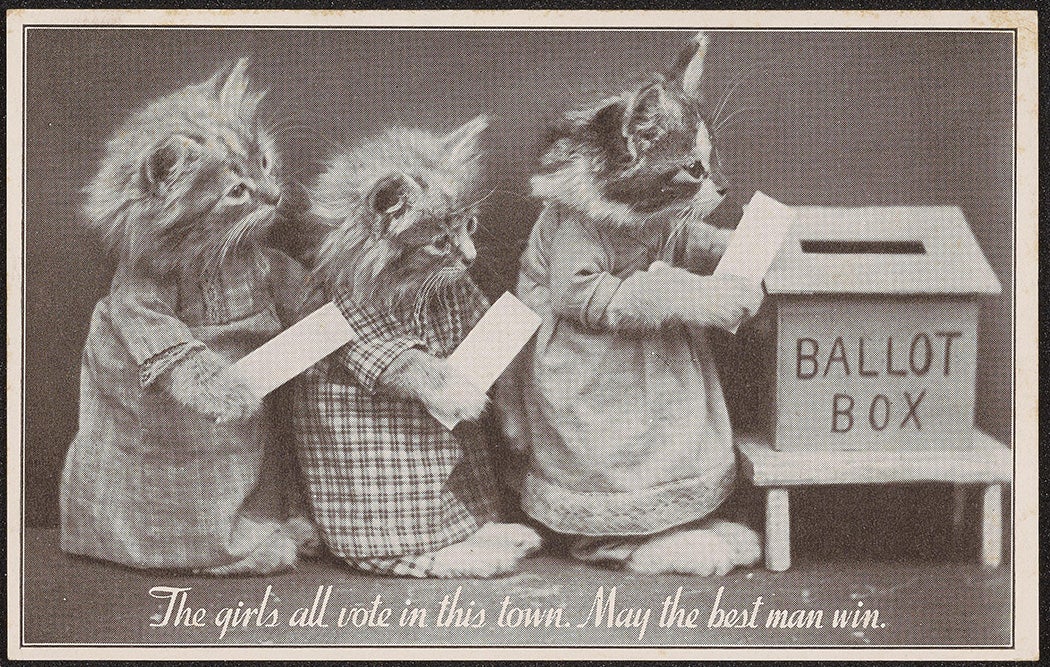
The Girls All Vote in This Town. May the Best Man Win. Courtesy Votes and Petticoats: Postcards, The Sheridan Libraries, Johns Hopkins University.

This is one of several suffrage postcards that feature photographs of live and presumably taxidermized kittens dressed up and posed. Although this postcard’s message could be interpreted multiple ways, Nordholt points out that the use of taxidermy speaks to the “synchronous oppressions of women and cats.”

Indeed, Susan Hamilton quotes a contemporary critic of anti-vivisection using misogyny to defend animal cruelty:

Is it necessary to repeat that women—or rather, old maids—form the most numerous contingent of [antivivisectionists]? Let my adversaries contradict me, if they can show among the leaders of the agitation one young girl, rich, beautiful, and beloved, or some young wife who has found in her home the full satisfaction of her affections!

Although suffragettes and antivivisectionists didn’t always align, the two movements had much in common, including the consistent stereotyping of their members as spinsters. And as we have seen in “But Surely My Good Woman…,” spinsters were objects of mistrust and derision.
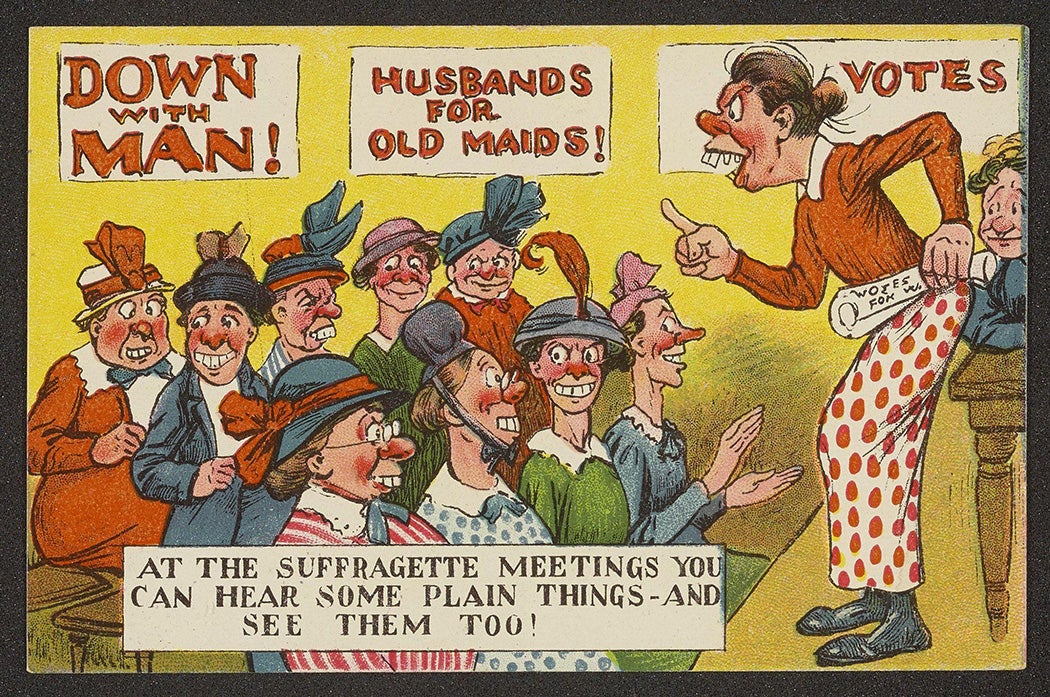
Courtesy Votes and Petticoats: Postcards, The Sheridan Libraries, Johns Hopkins University.

It wasn’t always that way. For a time in the nineteenth century, single women could claim feminine power through the “Single Blessedness” movement. Where women had long been shamed or pitied for not marrying, they began to frame their singleness as reflective of a higher calling: still nurturing, still Christian, but outside of marriage. Harriet Tubman, for example, spent eighteen of her most productive and prominent years without a husband. As a Black woman, Tubman faced extra scrutiny for being unmarried. She leveraged the concept of Single Blessedness for respectability.

As women began to agitate more for equal rights, however, Single Blessedness fell out of favor. Lee Chambers-Schiller provides an overview, writing that

[a]s the century wore on, spinsters were increasingly defined as unacceptable childcare providers, guardians, or even teachers of children. Their spinsterhood took on an ominous cast, their celibacy no longer evidence of pure, Christian love, but now suggestive of physical, emotional, and intellectual degeneracy.

It wasn’t just that spinsters lacked the feminine graces needed to attract a man—their “degeneracy” was a result of their childlessness:

The woman whose reproductive organs went unused would experience their atrophy and derangement, together with a painful menopause and general physical and mental deterioration. A spinster could look forward to a shortened life span and quite possibly insanity.
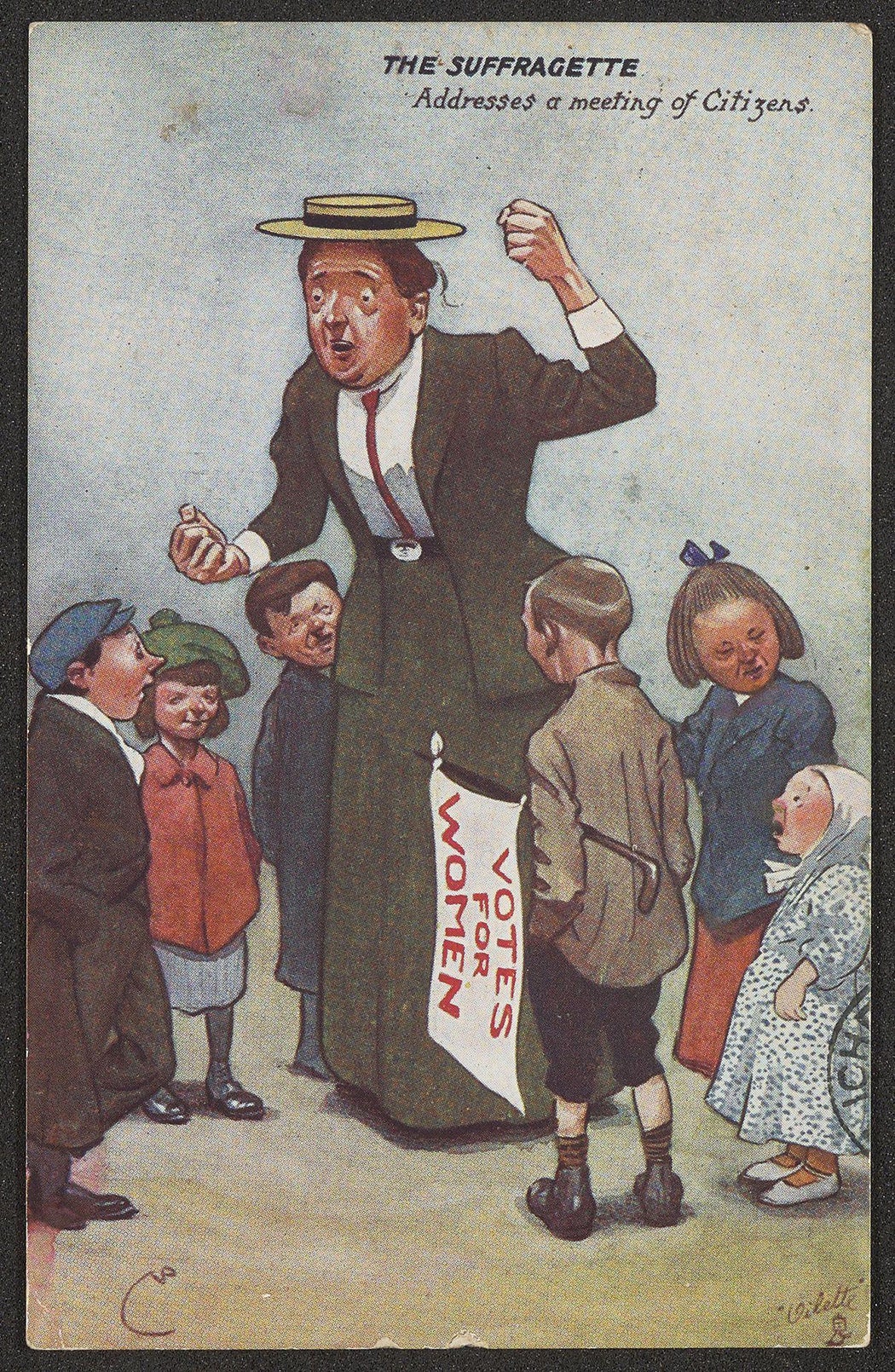
Courtesy Votes and Petticoats: Postcards, The Sheridan Libraries, Johns Hopkins University.

The suffragist in this postcard is marked as a spinster; her masculine features, hat, and clothing tell us as much. Wild-eyed and staring off the page, she’s so out of touch with reality and with her maternal instincts that she doesn’t even realize her audience of “Citizens” consists only of confused children.

Opponents of women’s suffrage argued that banning women from voting was actually a way of protecting them and preserving their angelic femininity. Politics, they claimed, was a nasty business that would take women away from their divine calling in the home, to the detriment of the race.
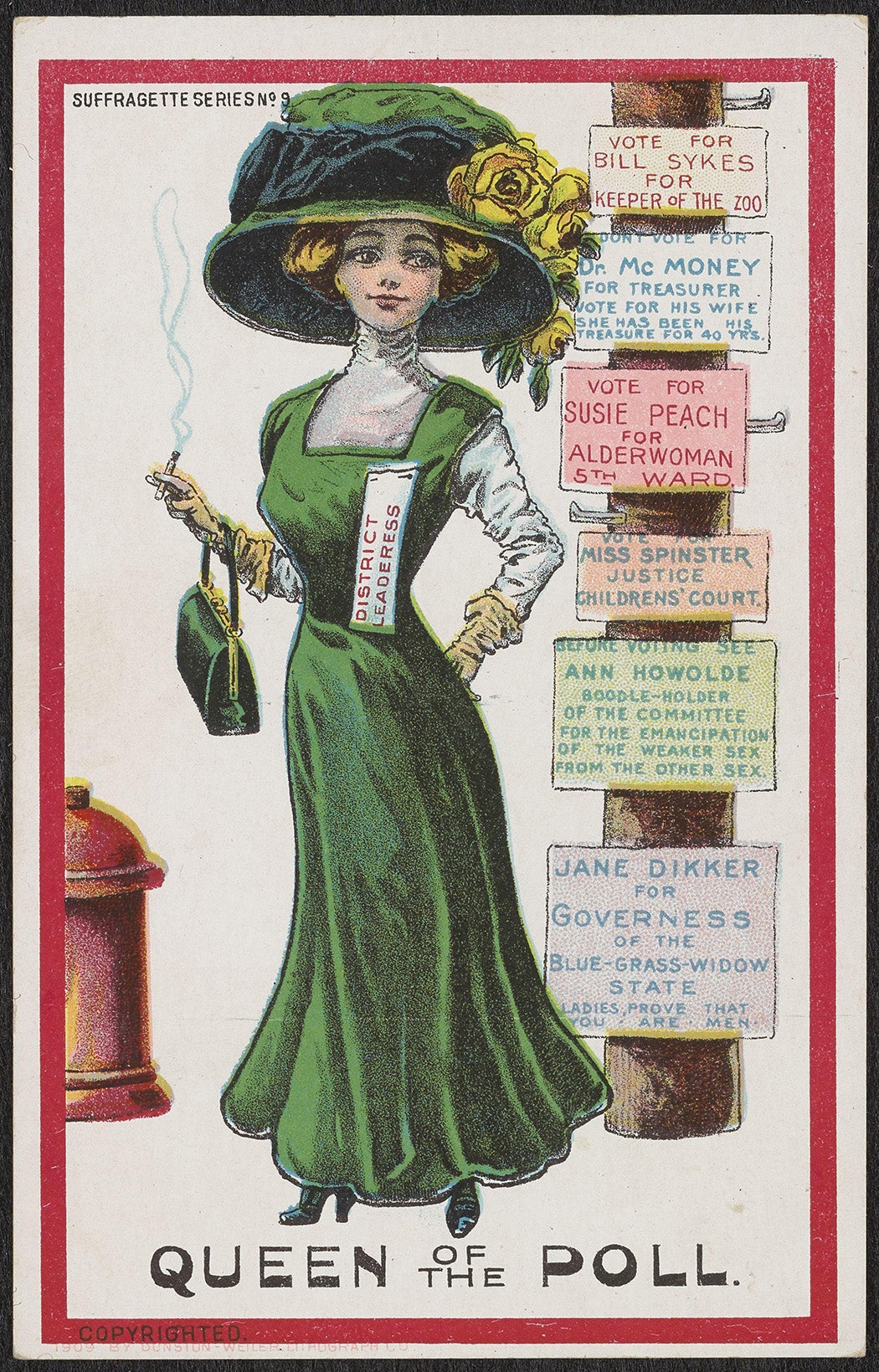
The Queen of the Polls. Courtesy Votes and Petticoats: Postcards, The Sheridan Libraries, Johns Hopkins University.

This woman represents anti-suffragists’ fears of what society would look like if women gained the vote. In contrast to the depictions of suffragists as dowdy old maids, the woman portrayed in this postcard is conventionally attractive and fashionably dressed. But her decadent New Woman status is given away by her cigarette—proper women didn’t smoke!—and her “District Leaderess” sash. The pole behind her is covered in campaign signs for mostly female candidates, including “Miss Spinster” for justice of the children’s court, which viewers are of course meant to interpret as an outrageous irony.

The role-reversal that women’s suffrage would supposedly bring about is communicated in several postcards, once again, through cat imagery.
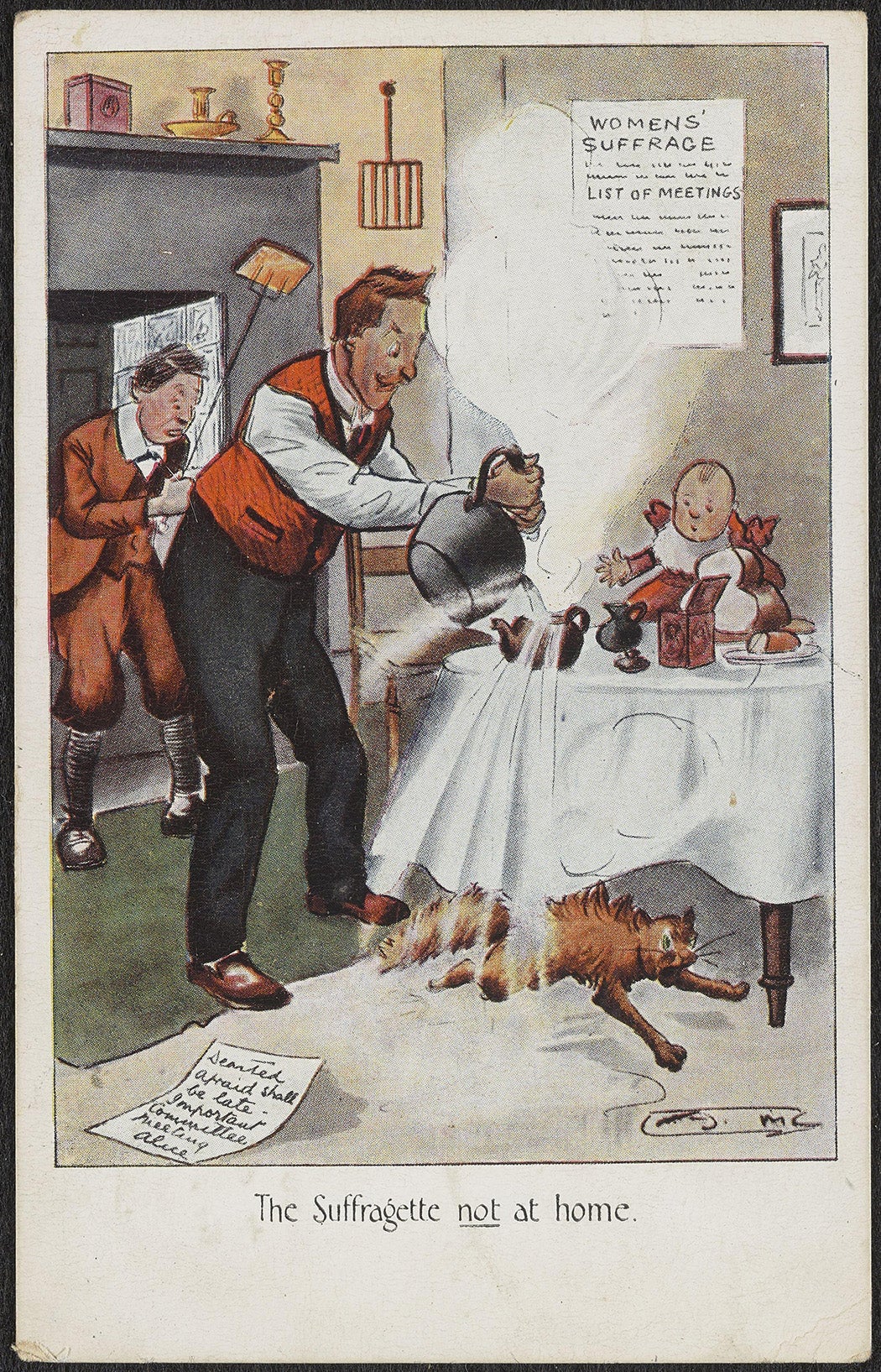
The Suffragette Not at Home. Courtesy Votes and Petticoats: Postcards, The Sheridan Libraries, Johns Hopkins University.Courtesy Votes and Petticoats: Postcards, The Sheridan Libraries, Johns Hopkins University.

Here, the man of the house is substituting for the absent woman by staying home, caring for the children, and making tea. The cat suffers the consequences of his ineptitude in the unnatural role.
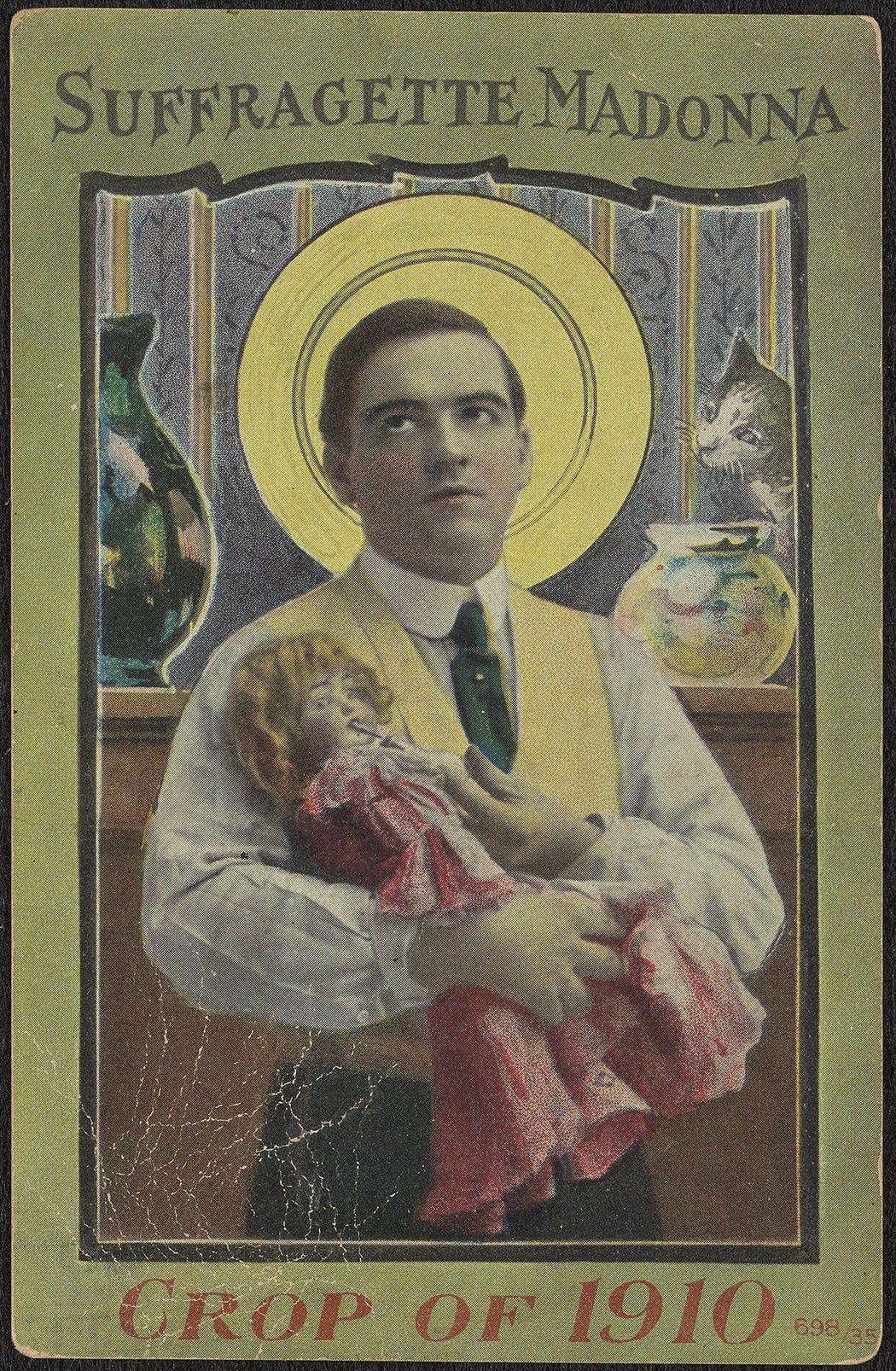
Suffragette Madonna Crop of 1910. Courtesy Votes and Petticoats: Postcards, The Sheridan Libraries, Johns Hopkins University.

Alternately, this man is taking good care of the home and family for his suffragist wife, but he’s thus emasculated. The halo of the golden plate, evoking the Virgin Mary, as well as the cat on the hearth behind him, emphasize his domesticity.

The absurdity of men in the women’s/cats’ sphere is surpassed by the absurdity of women/cats in the men’s sphere.
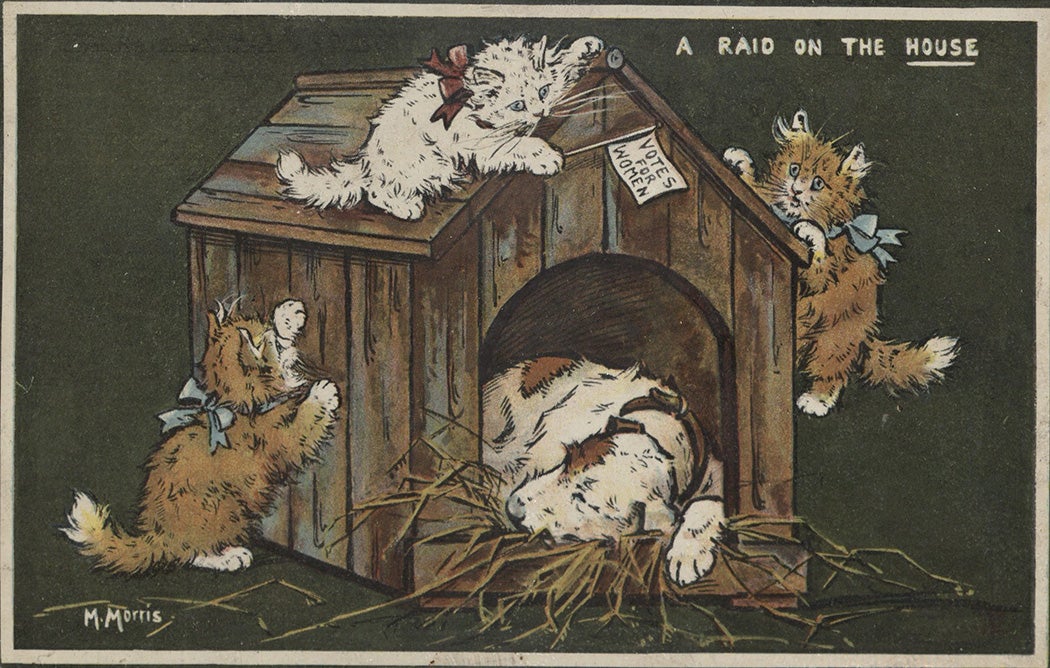
A Raid on the House. Courtesy Votes and Petticoats: Postcards, The Sheridan Libraries, Johns Hopkins University.

This British postcard seems to reference suffragists’ “raids” on the Houses of Parliament, during which women attempted to occupy the legislative chambers to protest their exclusion from them. The symbolism of this image is a striking echo of how the Daily Express described a suffrage raid in 1907: “[T]he sight reminded one very much of the removal of naughty kittens from a room in which they had been disporting themselves freely.” Cowman cites this description as example of voices in the press that often made light of the women’s suffrage movement, thus “making it appear over-feminine and consequently somewhat frivolous.”

Like “I Want My Vote!”, both this postcard and the Daily Express article infantilize women by portraying them as kittens. Viewers are meant to chuckle at the silly kittens’ attempt to infiltrate the doghouse—the kittens are cute, but they’ll never displace or even disturb the dog, who sleeps through their efforts.

“A Raid on the House” is particularly insulting when contrasted with the reality of the women’s suffrage movement, in which participants faced violent attacks. One march on the House of Commons in 1910 became known as “Black Friday” when suffragists were brutally beaten by police.
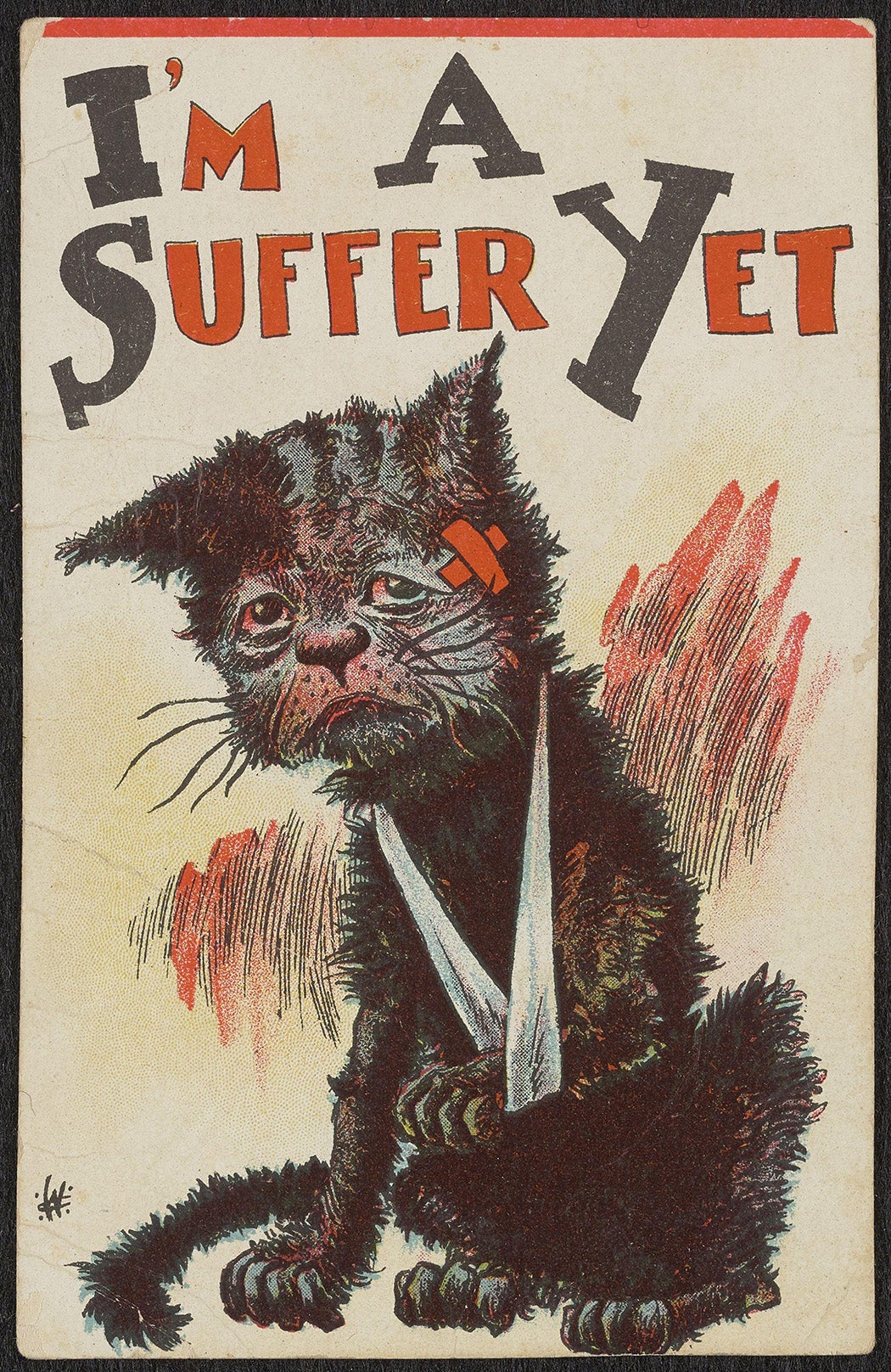
I’m A Suffer Yet. Courtesy Votes and Petticoats: Postcards, The Sheridan Libraries, Johns Hopkins University.

Bandaged and bruised, this bedraggled cat seems to represent a suffragist who has been beaten but is still dedicated to the cause. Whether the cat’s determination makes it sympathetic or stupid is a matter of interpretation.

Cats, as it turns out, are difficult to pigeonhole. So are women. According to Alleyn Diesel, the association between cats and women goes back at least as far as Ancient Egypt. Goddesses in ancient and contemporary religions have frequently been portrayed as either part-cat or accompanied by cats. And when it comes to goddesses, being catlike doesn’t mean being sweet and domestic. On the contrary, feline-linked deities are known for “self-reliance, elegance, and… willingness to be tamed strictly on their own terms”: powerful qualities that patriarchal societies mistrust in women.

When JD Vance questioned why a childless person would want to be a teacher or a leader, infamously calling Kamala Harris and her ilk “miserable” and “childless cat ladies,” he was invoking old, sexist stereotypes. The Harris campaign responded by selling “childless cat lady” merch. This tactic of reclaiming an insult and turning it into a badge of honor also has rich historical precedent.
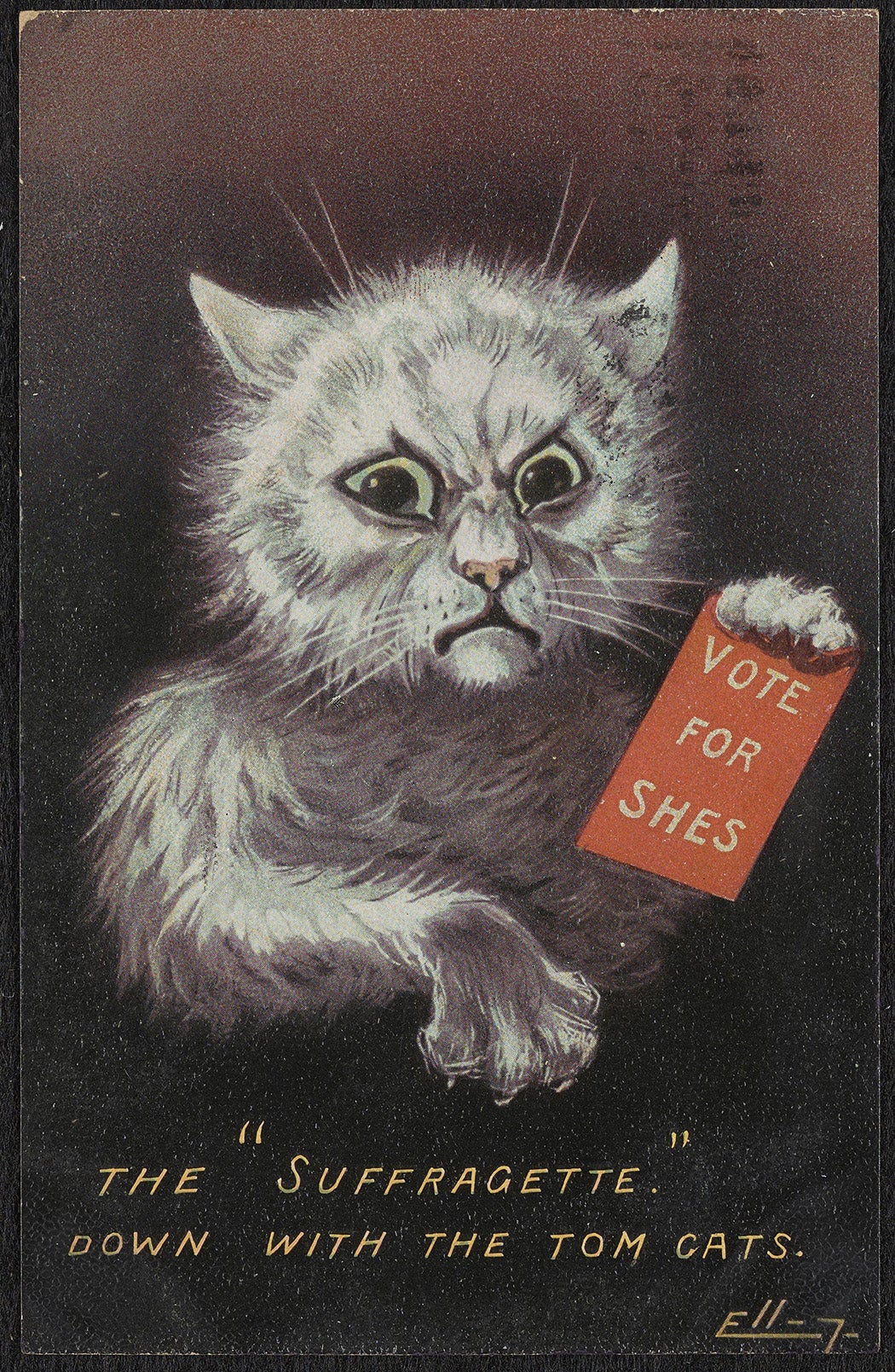
The Suffragette Down with the Tom Cats. Courtesy Votes and Petticoats: Postcards, The Sheridan Libraries, Johns Hopkins University.

The intention behind this final postcard may have been, yet again, to paint the fight for suffrage as absurd, to make suffragists seem like willful, unfeminine animals.

But the sender of the postcard wrote on the back, “See the expression: In town for the fight. Have used my night off for training my guns in the new campaign. Ha! Ha! You will see the signs soon.” We can’t be sure, but the writer seems to have been a suffragist, claws out.

Editor’s Note: Harry Whittier Frees, the likely photographer of the image depicting clothed kittens in line to vote, used live animals in his work, not taxidermy. The text has been amended to account for this fact.

Court refers Haitian group’s Springfield filing vs. Trump, Vance to prosecutor

(This is a good thing; read a little farther to see why. The system is working; the prosecutor will make a case where one can be made under law. -A)

Haitian Bridge Alliance seeks charges vs. Republican candidates; judges point toward strong constitutional protections afforded to political speech

 A panel of local judges referred the citizen-initiated criminal case against former President Donald Trump and his running mate U.S. Sen. JD Vance to Clark County prosecutor Dan Driscoll for investigation.

The case filed by the Haitian Bridge Alliance requests charges of felony inducing panic, disrupting public services, making false alarms, two counts of complicity, two counts of telecommunications harassment and aggravated menacing.

Those requests reference comments made by Trump and Vance about the Haitian community in Springfield killing and eating residents pets. Shortly after those claims were amplified by Trump, Vance and thousands of others online, the community was hit by a wave of bomb and safety threats.

“The conclusion of whether the evidence and causation necessary for probable cause exists to commence a prosecution of the alleged offenses is best left in the investigatory hands of the prosecution,” the judges wrote in their decision.

The judges said particular consideration should be given to “the strong constitutional protections afforded to speech, and political speech in particular.”

“The presidential election is less than 35 days away. The issue of immigration is contentious,” the ruling states. “Due to the proximity of the election, and the contentiousness concerning the immigration policies of both candidates, the Court cannot automatically presume the good faith nature of the affidavits.”

The court ruling states that this does not mean HBA executive director Guerline Jozef does not believe what she alleges, but brings into question whether her conclusions that Trump and Vance’s “political speech” are criminal are influenced by her personal experiences, “as opposed to an objective analysis of the alleged speech, the constitutional protections afforded to that speech, the alleged conduct occurring within the community, and a claimed nexus between the speech and that conduct.”

Under Ohio law, a private citizen seeking to “cause an arrest or prosecution” can file an affidavit with “a reviewing official” — a judge, prosecuting attorney or magistrate — to have them review the facts and decide if a complaint should be filed.

The Haitian Bridge Alliance asked the court to find probable cause for the charges and issue arrest warrants for Trump and Vance.

According to the document, in a felony case, if the court questions good faith or probable cause, it will refer the case to the prosecutor for further investigation. Unless it issues a warrant for Vance and Trump’s arrests, the court must refer the case to the prosecutor.

The HBA’s updated filing alleges that free speech cannot be used as a defense, as Trump and Vance’s actions disrupted public service.

“Trump and Vance engaged in a purposeful pattern of conduct to impede public services in Springfield. Despite seeing that Springfield was suffering from repeated bomb threats, evacuations, hospital lockdowns, necessity of state-trooper deployment, and closures of government buildings, they continued to double, triple, and quadruple down on their false claims,” the affidavit stated. ” … Trump’s and Vance’s refusals to stop, despite serious chaos they were inflicting and the governor’s and mayor’s pleas, highlights their criminal purpose in spreading these lies. The chaos caused was the purpose, and the First Amendment affords no protection for that campaign of criminal conduct.”

The affidavit alleges that Trump and Vance’s actions “were not just hateful, they were calculated to stir alarm and emotional distress in the community.”

The court ruling also raised the concern of strong constitutional protections of free and political speech.

According to a concurring opinion by Judge Stephen Schumaker, the case does not require a hearing. Schumaker’s opinion went further into the question of proving certain actions.

“The Court acknowledges the difficulties of proving a negative. There is significant difference however, between stating that there are no verifiable reports that a statement is true and proof and/or probable cause that a statement is false,” Schumaker wrote. “This Judge has tremendous respect for the officials making the above and similar statements but if any of the officials voiced the opinion that the statements at issue were false, those statements are in the form of opinion.”

https://www.springfieldnewssun.com/news/court-refers-haitian-groups-springfield-filing-vs-trump-vance-to-prosecutor/UL4CLLGV35ED7OTCW7MSI5BB4I/#

Peace & Justice History for 10/3:

October 3, 1967
Thich Nu Tri, a Buddhist nun, immolated herself in protest of the repression of the Government of (South) Vietnam. It had denied participation in recent elections of peace and neutralist elements. Buddhist leaders thus boycotted the elections, and the Ngo Dinh Diem regime received only 35% of the vote. Within four weeks, three more nuns followed Thich Nu Tri’s example (among them Thich Nu Hue and Thich Nu Thuong), all in an effort to bring peace to the their country, split in two and caught up in a war with their countrymen in the North, and the escalating presence of U.S. troops.
October 3, 1967
Woody Guthrie, 1912-1967
Folksinger/songwriter Woody Guthrie died in New York City at the age of 55. He had spent the last decade of his life in the hospital, suffering from Huntington’s chorea. Woody called his songs “people’s songs,” filled with stinging honesty, humor and wit, exhibiting Woody’s fervent belief in social, political, and spiritual justice.

Extensive bio with photos and Woody’s writing
October 3, 1972
The SALT I treaties, which placed the first limits on nuclear arsenals, went into effect. The Strategic Arms Limitation Talks succeeded when U.S. President Richard Nixon and Soviet General Secretary Leonid Brezhnev agreed to limit anti-ballistic missile systems, and to freeze the number of intercontinental and submarine-based missile launchers (1,710 for the United States, some of which had multiple warheads, and 2,347 for the Soviet Union).
October 3, 1981
Irish republicans at the Maze Prison near Belfast, Northern Ireland, ended seven months of hunger strikes that had claimed 10 lives.
The first to die was Bobby Sands, the imprisoned Irish Republican Army (IRA) leader who initiated the protest on March 1—the fifth anniversary of the British policy of “criminalisation” of Irish political prisoners.


Prior to 1976, Irish political prisoners were incarcerated under “Special Category Status,” which granted them a number of privileges that other criminal inmates did not enjoy.
Despite Sands’s election (while an inmate) as member of Parliament from Fermanagh and South Tyrone after the first month of his hunger strike, and his death from starvation a month later, the government of British Prime Minister Margaret Thatcher would not give in, and nine more Irish republicans perished before the strike was called off.
The dead included Kieran Doherty, who had been elected to Parliament in the Irish Republic during the strike. In the aftermath, the British government quietly conceded to some of the strikers’ demands, such as the rights to wear civilian clothing, to associate with each other, to receive mail and visits, and not to be penalized for refusing prison work.
October 3, 1994
The United States and South Africa signed a missile non-proliferation agreement committing South Africa to abide by the The Missile Technology Control Regime, and to end its missile program and its space-launch vehicle program.
More about MTCR 

https://www.peacebuttons.info/E-News/peacehistoryoctober.htm#october3

Peace & Justice History for 9/30

September 30, 1962
Hundreds of Ku Klux Klan members, white students and others, tried to keep a black student, James Meredith, 29, from attending classes at the University of Mississippi in Oxford. They were supported by the governor, Ross Barnett, who had explicitly resisted the order of the Federal Circuit Court.In spite of the efforts to block his court-ordered registration, a deal to allow Meredith to register was reached between U.S. Attorney General Robert Kennedy and Governor Barnett. Meredith was secretly escorted onto campus; deputy U.S. marshals, border patrolmen and federal prison guards were stationed on and around the campus to protect him. Those standing guard were assaulted throughout the night with guns, bricks, Molotov cocktails, and bottles.


James Meredith being escorted to his classes
by U.S.marshals and the military.
Tear gas was used to try and control the crowd. Federal troops arrived, bringing the total to 12,000 (President Kennedy had activated soldiers and national guardsmen totaling 30,000), and the mob finally retreated. In the end, two were dead, 160 U.S. Marshals were injured (28 shot), 200 others injured, and 300 arrested.
Integrating Ole Miss  
JFK Library
September 30, 2003
The FBI began a criminal investigation into whether White House officials had illegally leaked the identity of an undercover CIA officer, Valerie Plame, wife of diplomat Joseph C. Wilson, IV. In early 2002 the CIA had sent Wilson to look into the claim that Saddam Hussein had sought to acquire yellow-cake uranium from the African country of Niger. Ambassador Wilson found nothing to support the claim, and some of the documents cited as evidence for the claim were clearly shown to be forgeries.
President Bush, nonetheless, repeated the claim in his January, 2003, State of the Union address as part of his argument for war in Iraq.
Wilson wrote a column in the New York Times in July, 2003, entitled “What I Didn’t Find in Africa.”

 
 Columnist Robert Novak a few days later published Plame’s identity following conversation with Deputy Secretary of State Richard Armitage. Plame, who previously had worked on counter-proliferation, was in charge of operations for the CIA’s Joint Task Force on Iraq, formed the summer before 9/11.
September 30, 2004
The U.S. Navy announce the shutdown of Project ELF.
read more

https://www.peacebuttons.info/E-News/peacehistoryseptember.htm#september30

Peace & Justice History for 9/29:

September 29, 1923
Great Britain began to govern the formerly Turkish province of Palestine under a League of Nations mandate to create a Jewish national home.
The British Mandate For Palestine established at the San Remo Conference, 1920
(Note from A: I searched this link; the one Peace History had was no longer present on the site.)
September 29, 1943
Six conscientious objectors, imprisoned at Lewisburg, Pennsylvania, for refusing to serve in World War II, began a hunger strike against censorship of mail and reading material by federal prison authorities.
September 29, 1983
The municipal council of Woensdrecht, a southern Dutch town, voted against cooperating in the possible siting of 48 U.S. nuclear-tipped cruise missiles at the nearby air base.
The council voted Tuesday by 9 to 4 not to cooperate with the national government, and to stop any activities that might lead to the missiles being sited at the base.
September 29, 2002

A London crowd – estimated between 200,000 and 500,000 – protested British and U.S. plans for a “preemptive” (that is, without provocation) invasion of Iraq.

https://www.peacebuttons.info/E-News/peacehistoryseptember.htm#september29

Peace & Justice History for 9/28:

September 28, 1836
Cherokee Chief John Ross wrote a letter to both houses of the U.S. Congress stating that the Treaty of New Echota was not negotiated by any legitimate representatives of his nation.
Its terms required the Cherokees to relinquish all lands east of the Mississippi River for a payment of $5 million. Ross was the democratically chosen leader of a nation with its own language, its own newspaper, a bi-cameral legislature and a republican form of government.

Cherokee Chief John Ross
The Cherokee Nation celebrated its own arts and sports, and produced a wide variety of agricultural and commercial goods. I had twelve political units ranging from northern Alabama to western North Carolina.Writing from north Georgia, Ross said: “The makers of it [the treaty] sustain no office nor appointment in our Nation, under the designation of Chiefs, Head men, or any other title, by which they hold, or could acquire, authority to assume the reins of Government, and to make bargain and sale of our rights, our possessions, and our common country . . . .
“ We are despoiled of our private possessions, the indefeasible property of individuals. We are stripped of every attribute of freedom and eligibility for legal self-defence. Our property may be plundered before our eyes; violence may be committed on our persons; even our lives may be taken away, and there is none to regard our complaints. We are denationalized; we are disfranchised. We are deprived of membership in the human family!”

Full text of the letter 
September 28, 1917
166 people who were (or had been) active in the I.W.W. (Industrial Workers of the World, whose members were also known as Wobblies) were indicted for protesting World War I.They were accused of trying to “cause insubordination, disloyalty, and refusal of duty in the military and naval forces” in violation of the Espionage Act. One hundred and one defendants were found guilty, and received prison sentences ranging from days to twenty years, with accompanying fines of $10,000-$20,000. This was part of a successful U.S. government campaign to cripple the radical union movement.

The I.W.W. – A Brief History (U.S.) 
I.W.W. home 
September 28, 1943
In Denmark, underground anti-Nazi activists began systematic smuggling of Jews to Sweden. In just three weeks, all but 481 of Denmark’s 8000 Jews had been moved to safety.
Kim Malthe-Bruun, a 21-year-old Danish resistance fighter. Unfortunately one of the ones who did not make it.


A Danish Jewish family ready to go
Read more about Kim 
September 28, 2005
The lawyer who wrote the original legal complaint in the case of Brown v. Board of Education, Constance Baker Motley, died in New York City. She had led a remarkable career which began at the NAACP Legal Defense and Educational Fund (LDF) where she was their first female attorney. The first black woman to argue before the Supreme Court, she was successful in nine of her ten cases. Motley went on to achieve three more firsts as an African American woman: being elected to the New York State Senate and shortly thereafter to the Manhattan Borough presidency. Finally, Pres. Lyndon Johnson appointed her to the U.S. District Court for the Southern District of New York in 1966 where she served until her passing.

https://www.peacebuttons.info/E-News/peacehistoryseptember.htm#september28

Peace & Justice History for 9/27:

September 27, 1962
Rachel Carson’s book indicting the pesticide industry, Silent Spring, was published.

The scientist (17 years with the U.S. Fish and Wildlife Service) and writer demonstrated the connection between the excessive and ubiquitous use of DDT and its long-term effect on plants and animals.

Rachel Carson at work c. 1936
The impact of her book proved seminal to a new ecological awareness. But even 30 years later, Carson was denounced for “preservationist hysteria” and “bad science.” But she had said when the book was published: “We do not ask that all chemicals be abandoned. We ask moderation. We ask the use of other methods less harmful to our environment. Rachel Carson, her Silent Spring and its impact
 September 27, 1967
An advertisement headed “A Call To Resist Illegitimate Authority,” signed by over 320 influential people (professors, writers, ministers, and other professional people), appeared in the New Republic and the New York Review of Books, asking for funds to help youths resist the draft.
September 27, 1990
The last U.S. Pershing II tactical nuclear missiles were removed from Germany, fewer than ten years after their installation provoked a massive anti-nuclear movement across Europe.The range and accuracy of the Pershing II pushed the Soviet Union to negotiate the Treaty on Intermediate Range Nuclear Forces (INF) which completely eliminated all nuclear-armed ground-launched ballistic and cruise missiles with ranges between 500 and 5,500 kilometers (about 300 to 3400 miles) and their infrastructure.
The INF Treaty was the first nuclear arms control agreement to actually reduce nuclear arms, and the signatories destroyed almost 2700 nuclear weapons (including 234 Pershing II) by May of 1991.
September 27, 1991
President George H.W. Bush announced a major unilateral withdrawal of U.S. tactical nuclear weapons:
“I am . . . directing that the United States eliminate its entire worldwide inventory of ground-launched short-range, that is, theater, nuclear weapons. We will bring home and destroy all of our nuclear artillery shells and short-range ballistic missile warheads. We will, of course, insure that we preserve an effective air-delivered nuclear capability in Europe.
“In turn, I have asked the Soviets . . . to destroy their entire inventory of ground-launched theater nuclear weapons . . . .
“Recognizing further the major changes in the international military landscape, the United States will withdraw all tactical nuclear weapons from its surface ships, attack submarines, as well as those nuclear weapons associated with our land-based naval aircraft. This means removing all nuclear Tomahawk cruise missiles from U.S. ships and submarines, as well as nuclear bombs aboard aircraft carriers.”

https://www.peacebuttons.info/E-News/peacehistoryseptember.htm#september27

Peace & Justice History for 9/26:

September 26, 1909

International Ladies’ Garment Workers Union (ILGWU Local 25) began a strike against the Triangle Shirtwaist Company.
In November their strike would become part of the “Uprising of the 20,000,” during which 339 of 352 firms would be struck and reach agreements with the union over the following five months but Triangle was not one of them. The strike ended after thirteen weeks that saw over 700 striking workers arrested.

More info 
Chronology 
===========================
September 26, 1945
OSS (Office of Strategic Services, the precursor of the CIA) officer Lieutenant Colonel A. Peter Dewey became the first American to die in Vietnam. During unrest in Saigon, he was killed by Viet Minh guerrillas who mistook him for a French officer. Before his death, Dewey had filed a report on the deepening crisis in Vietnam, stating his opinion that the U.S. “ought to clear out of Southeast Asia.”
====================
September 26, 1957

The Buffalo Nuclear Test, Maralinga
Despite international protests, the United Kingdom began a series of atmospheric nuclear bomb tests beginning with Operation Buffalo on aboriginal land
at Maralinga, South Australia. The series of tests included dropping a bomb from a height of 30,000 feet. This was the first launching of a British atomic weapon from an aircraft.

=================
September 26, 1983

Five members of Puget Sound Women’s Peace Camp entered Boeing’s cruise missile production plant in Seattle, Washington, to leaflet the workers and were arrested.
In November of 1980 and 1981 the Women’s Pentagon Actions, where hundreds of women came together to challenge patriarchy and militarism, took place.A movement grew that found ways to use direct action to put pressure on the military establishment and to show positive examples of life-affirming ways to live together. This movement spawned women’s peace camps at military bases around the world from Greenham Common, England, to the Puget Sound Peace Camp, as well as camps in Japan and Italy, among others.


=======================
September 26, 1988

President Ronald Reagan urged the United Nations General Assembly to call a conference about the use of chemical weapons. Though the U.S. and other nations had signed the Geneva Protocol banning chemical (as well as bacteriological) arms, such weapons had been used repeatedly by Saddam Hussein’s Iraq in its war against Iran.
Background on the treaty and the issue 

https://www.peacebuttons.info/E-News/peacehistoryseptember.htm#september261909

Peace & Justice History for 9/25:

Jazz for Peace!

September 25, 1789
The first U.S. Congress passed the Bill of Rights, the first ten amendments to the Constitution, and sent them on to the states for ratification.
See the actual document and learn more 
September 25, 1957
Nine African-American children, protected by 300 members of the U.S. Army’s 101st Airborne Division, with fixed bayonets, entered the previously all-white Central High School in Little Rock, Arkansas.The troops were there to escort the children past white segregationists and the Arkansas Militia (National Guard) thatArkansas Governor Orval Faubus had activated to prevent its federal court-approved racial integration plan.
 
After a tense standoff, President Dwight D. Eisenhower federalized the Arkansas National Guard and sent troops to Little Rock to enforce the court order. The order to de-segregate the Little Rock schools flowed from the Supreme Court’s Brown v. Board of Education decision.
The troops remained for the entire school term.


Watch a video about the Little Rock 9 
September 25, 1961
Herbert Lee, a farmer who worked with civil rights leader Bob Moses to help register black voters, was killed by a state legislator, E. H. Hurst, in Liberty, Mississippi. Hurst claimed self-defense and was acquitted by a coroner’s jury the same day as the killing. Lewis Allen, who witnessed the shooting, said otherwise, and was himself murdered two years later.

Herbert Lee

More about Herbert Lee 
September 25, 2002
Rick DellaRatta and Jazz For Peace performed at the United Nations Headquarters in New York City. He led a band consisting of Israeli, Middle Eastern, European, Asian and American jazz musicians in concert for an international audience.
Jazz for Peace continues to perform concerts to raise money for non-profit organizations.


Rick DellaRatta

https://www.peacebuttons.info/E-News/peacehistoryseptember.htm#september25

Haitian group seeks criminal charges vs. Trump, Vance in Springfield court filing

News By Jessica Orozco Updated 41 minutes ago

The Haitian Bridge Alliance filed a bench memorandum and supporting affidavit in Clark County Municipal Court on Tuesday, asking local authorities to charge former President Donald Trump and Sen. JD Vance with multiple criminal offenses related to claims they made about Springfield’s Haitian community.

The memorandum was filed by Guerline Jozef on behalf of the national nonprofit the Haitian Bridge Alliance (HBA), asking a Municipal Court judge to charge Vance and Trump with disrupting public services, making false alarms, two counts of complicity, two counts of telecommunications harassment and aggravated menacing.

The filing asks that the court find probable cause for the charges and issue arrest warrants for Trump and Vance.

Under Ohio law, a private citizen seeking to “cause an arrest or prosecution” can file an affidavit with “a reviewing official” — a judge, prosecuting attorney or magistrate — to have them review the facts and decide if a complaint should be filed.

Springfield Mayor Rob Rue said Tuesday afternoon that while the city recognizes the serious nature of the allegations, “it is important to allow the legal process to unfold.” He said it is “critical that we’re sensitive to these issues like immigration” and are grounded in facts.

“Springfield remains dedicated to fostering constructive dialogue and addressing concerns with integrity,” Rue said. “Springfield’s priority continues to be the wellbeing of our residents, including the Haitian immigrant community. Any actions that disrupt public services or spread false alarms are taken seriously and we’ll continue to uphold our commitment to protect public order.”

This bench memorandum and affidavit comes through The Chandra Law Firm in Cleveland, and according to its website, Jozef, the HBA’s co-founder and executive director, is seeking Trump and Vance’s immediate arrest for:

  • Disrupting public service “by causing widespread bomb and other threats that resulted in massive disruptions to the public services;”
  • Making false alarms “by knowingly causing alarm in the Springfield community by continuing to repeat lies that state and local officials have said were false;”
  • Telecommunications harassment “by spreading claims they know to be false during the presidential debate, campaign rallies, nationally televised interviews, and social media;”
  • Aggravated menacing “by knowingly making intimidating statements with the intent to abuse, threaten, or harass the recipients, including Trump’s threat to deport immigrants who are here legally to Venezuela, a land they have never known” and “by knowingly causing others to falsely believe that members of Springfield’s Haitian community would cause serious physical harm to the person or property of others in Springfield;”
  • Complicity “by conspiring with one another and spreading vicious lies that caused innocent parties to be parties to their various crimes.”

“Because the prosecuting attorney has not yet acted to protect the community and hold Trump and Vance accountable for what they have instigated, Ms. Jozef asks the court to find probable cause based on the facts presented and issue arrest warrants for both Trump and Vance,” the law firm stated. “The prosecuting attorney then must make a public decision about whether that office stands for the rule of law — or whether it will further coddle Trump and Vance with complete inaction.”

Subodh Chandra, Jozef’s lead counsel, said in a statement that the Haitian community is “suffering in fear” due to Trump and Vance’s “relentless, irresponsible, false alarms, and public services have been disrupted.” Chandra said the two politicians “must be held accountable to the rule of law,” claiming that others who “have wreaked havoc” would have been arrested already.

“They think they’re above the law. They’re not,” Chandra said.

Trump campaign communications director Steven Cheung didn’t comment directly on the court filing, but said that Trump is “rightfully highlighting the failed immigration system that Kamala Harris has overseen, bringing thousands of illegal immigrants pouring into communities like Springfield and many others across the country.” (snip-More)

https://www.springfieldnewssun.com/news/haitian-group-seeks-criminal-charges-vs-trump-vance-in-springfield-court-filing/ZBLJL63EUBAQBJT2UOC7OSUJVM/#