U.S. v. Skrmetti, And More-

(And let me interject that I know that sometimes I’m a language/punctuation police officer, but I despise the term “reverse discrimination.” Either discrimination has happened, or it hasn’t, to be proven to whoever decides. There is no “reverse discrimination”. grr. Also, this is not a spoiler nor my opinion on the case, it’s simply that I guess it’s good for some people that I do not sit upon the SCOTUS, because I’d want to dismiss and tell them to use appropriate words so that the court could accurately decide based upon the evidence of discrimination, without being distracted by superfluous words. Please be at liberty to laugh at me about this. Then read all the following. -A)

The Week Ahead by Joyce Vance

June 1, 2025 Read on Substack

It’s June 1, and that means we’re starting the last month, more or less, of this Supreme Court term. The cases the Court has had briefing on and heard oral argument in will all be decided by the end of this month, although some years it spills over into the first week of July.

We never know which cases are coming next. The Court doesn’t decide them in the order they hear them argued. But usually the biggest, most impactful cases aren’t decided until the end.

This week for “The Week Ahead,” I’ve got a scorecard with some of the most important still-undecided cases for this term on it. The goal is to give you some background to refer to, so when you hear the Court has announced a decision in a certain case you’ll be prepared to understand its significance.

Here they are, in order of when they were argued, although that’s likely to have little to nothing to do with when we will see opinions.

U.S. v. Skrmetti

The issue in this case is whether states can ban gender-affirming care for trans youth in the context of a 2023 Tennessee law that bans gender-affirming care, like puberty blockers and hormone therapy, for transgender patients who are minors. The Biden administration intervened in the case and was a party along with three transgender teens and their parents. That changed with the change in administrations. The Trump Justice Department, as you would expect, is on the other side of the case.

A key issue in the case is whether denying treatment to trans youth that is available to their gender conforming peers violates the Constitution by denying them equal protection under the law. A federal district court judge held that it did. But the Court of Appeals reversed. About 25 other Republican dominated states have similar laws. The result in this case will apply beyond Tennessee.

At oral argument, the conservative Justices seemed disinclined to accept the argument that this law is a form of sex discrimination, even though cisgender kids will be able to access treatment that transgender people won’t be able to receive if these laws stand. But the votes seemed to be in place to permit Tennessee and other states to keep their restrictive laws in place.

Free Speech Coalition v. Paxton

The case involves a 2023 Texas law that is supposed to keep minors from accessing pornography online. It requires websites to verify a person’s age before they are admitted to the site. But an industry group that calls itself the Free Speech Coalition sued, claiming the law violates the rights of adults who want to access the content, an impermissible burden on free speech. The ACLU is on their side in the case.

There was at least some indication at oral argument that the Justices are aware we no longer live in a world of dial up internet connections and want to revisit the standards that are used to “protect kids.” The technical legal issue is whether the court of appeals used the wrong legal standard to decide the case. Instead of using the highest standard of review and requiring the Texas law to pass “strict scrutiny” before it could burden the adults’ right to have access to protected speech, they only required that there be a “rational basis” connecting the law to its intent to protect minors.

Ames v. Ohio Department of Youth Services

The Court’s decision in this case could potentially signal a sea change in reverse discrimination employment litigation. The case involves a straight woman who claims she faced “reverse discrimination” on the job because she wasn’t gay, leading her to be passed over for promotion opportunities. The issue is whether a plaintiff who is a member of a majority group has to show that her employer is the “unusual” one who discriminated against the majority, before bringing a case under Title VII of the Civil Rights Act of 1964. If she wins, this sort of reverse discrimination case could become easier to bring.

The plaintiff lost out on a promotion to a lesbian woman. She was subsequently demoted and the position she was removed from was given to a gay man. All of this started 13 years into her employment, after a new boss, who was a gay woman, became her supervisor.

There was speculation following oral argument that the plaintiff might win unanimously. Justice Sotomayor seemed to say she thought the plaintiff might have a valid claim, noting that based on the record before the Court, there was “something suspicious” about what happened. The consensus among the Justices seemed to be that everyone had to be treated equally.

Smith & Wesson Brands v. Estados Unidos Mexicanos

There are two technical legal issues in this case, but together, they add up to an answer to the question of whether Mexico can sue U.S. gunmakers for what it has long maintained is their responsibility for the epidemic of gun violence within its borders. Mexico argues that a number of U.S. gunmakers made it possible for traffickers to illegally purchase firearms in the U.S., only for them to be provided to Mexican drug cartels.

The Court will decide: (1) Whether the production and sale of firearms in the United States is the proximate cause of alleged injuries to the Mexican government stemming from violence committed by drug cartels in Mexico; and (2) whether the production and sale of firearms in the United States amounts to “aiding and abetting” illegal firearms trafficking because firearms companies allegedly know that some of their products are unlawfully trafficked.

If the Court decides in Mexico’s favor, its lawsuit against U.S. gun manufacturers will move forward.

Louisiana v. Callais

This is the Louisiana redistricting case. The issues revolve around whether a Louisiana congressional district created to comply with the Voting Rights Act resulted in an unconstitutional gerrymander that discriminates based on race. The Callais plaintiffs are a group of “non-African Americans” who say the redistricted map violates the Constitution because it takes race into account in violation of the 14th Amendment.

Although the Court may be inclined to do away with the Voting Rights Act at some point, this case is reminiscent of a 2023 gerrymandering case out of Alabama, where a 5-4 majority that included Chief Justice Roberts and Justice Kavanaugh upheld the Voting Rights Act and forced Alabama to comply with it, rejecting maps drawn by the state legislature that made it all but impossible for Black citizens to elect candidates of their choice to Congress.

This case might have a similar outcome. It has similarly complicated facts and an up-and-down history on appeal. It comes down to whether Louisiana, whose population is about 1/3 Black, will have a second Black opportunity district. The technical issues involve whether a three-judge district court in this case was mistaken when it ruled that race predominated in the Louisiana legislature’s decision on maps, whether it erred in finding those decisions couldn’t pass the strict scrutiny test and a set of preconditions known as the Gingles factors, and whether the case is the sort of “non-justiciable” matter that should be resolved through the political process, not decided in the courts.

Mahmoud v. Taylor

The issue here is whether religious parents’ rights are violated when a school board doesn’t give them the ability to opt out from having LGBTQ-themed books available to their children in elementary school. The issue is presented as: Whether public schools burden parents’ religious exercise when they compel elementary school children to participate in instruction on gender and sexuality against their parents’ religious convictions and without notice or opportunity to opt out.

At oral argument, the Court’s conservative majority seemed sympathetic toward the parents.

Trump v. CASA, Inc. (consolidated with Trump v. Washington and Trump v. New Jersey)

This is the birthright citizenship case that was argued only earlier this month. We discussed it here. The issue isn’t whether Trump can end birthright citizenship. Rather, it’s whether the Supreme Court should stay the district courts’ preliminary injunctions except as to the individual plaintiffs and identified members of the organizational plaintiffs or states while the litigation works its way through the courts.


It’s hard to believe that it was just over a year ago that I sat outside, across the street from the U.S. Supreme Court building in the Senate Swamp, listening to the oral argument and preparing to comment on it in real time. (snip)
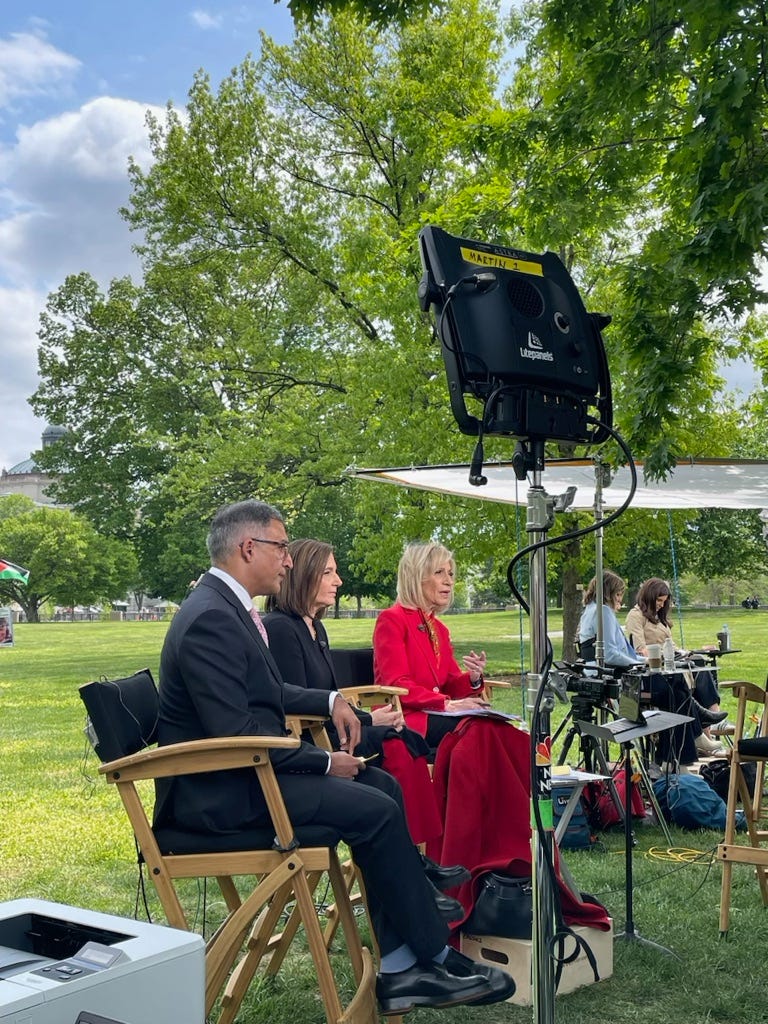
At the time, I wrote, “The case is all about Donald Trump and whether he can be prosecuted for the most serious of his crimes against the American people, trying to hold onto power after losing the 2020 election. It’s also about the legacy of the Roberts Court and whether history will view the already unpopular Justices as the Court that gave away democracy.”

Overall, there are more than 30 cases remaining on the Court’s dockets. There are also a number of procedural and other issues pending in cases that haven’t been fully briefed for a decision on the merits this term. This is the so-called shadow docket, where litigants ask the courts to make decisions in cases characterized as emergencies. Cases involving deportations and DOGE are among them. And also, the wild card, a number of cases still percolating through the lower courts where the issues aren’t yet ripe enough to be before the Supreme Court, but could become so in the next few months, at least enough to merit a trip to the shadow docket and interfere with the Supreme Courts’ summer break. The biggest question that remains for me is whether this Court will continue down the path it set itself upon last term, or will tell Trump no in a meaningful way?

Welcome to the new week. Thanks for being with me at Civil Discourse as we approach our third anniversary.

We’re in this together,

Joyce
Open Windows and Clay Jones

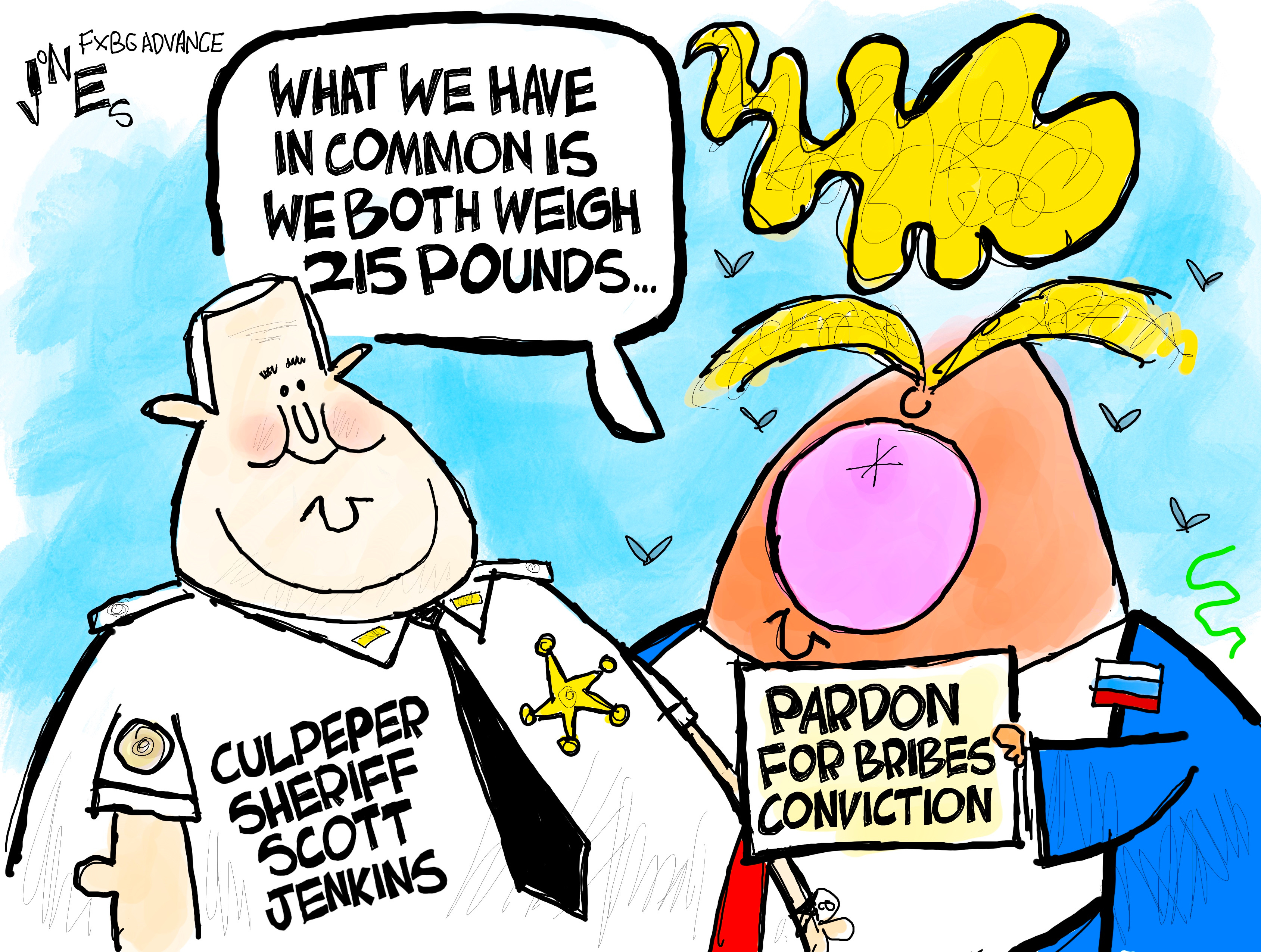
Bribe Bros by Clay Jones

Trump pardons a fellow briber Read on Substack

This cartoon was drawn for the FXBG Advance.

Last December, a Culpeper Jury (Trump country) found former Sheriff Scott Jenkins guilty of one count of conspiracy, four counts of honest services fraud, and seven counts of bribery. Fortunately for the corrupt sheriff, he’s a MAGAt.

In fact, Shurf Jenkins is a minor MAGAt celebrity, as he has pro-MAGA views that got him featured on Breitbart multiple times, was a guest on the Daily Signal podcast, and even got him an appearance on Fox & Friends after vowing to “deputize thousands of our law-abiding citizens to protect their constitutional right to own firearms.” This is kinda what got him into trouble.

By the way, nobody’s gun rights are in danger. Republicans use it as a fear tactic to win public office.

Jenkins accepted $75,000 worth of bribes. He took cash and campaign contributions from eight people, including two undercover FBI agents. In return, he gave them badges and made them auxiliary deputy sheriffs, despite not having any training for the position (it’s kind of an honorary position, but it gives them a lot of cop powers). He also pushed officials to restore one bribe-payer’s right to possess a gun as a convicted felon. He was also able to give some of his bribers the right to carry concealed weapons without permits.

What’s fucked up about that last part is it’s extremely easy to get a concealed-carry permit in Virginia. About the only thing that could stop a person from getting a concealed-carry permit in Virginia would be if they were a convicted felon or something. For example, Donald Trump would NOT be allowed to carry a concealed weapon in Virginia. (snip-click through to read on, it’s quite good!)

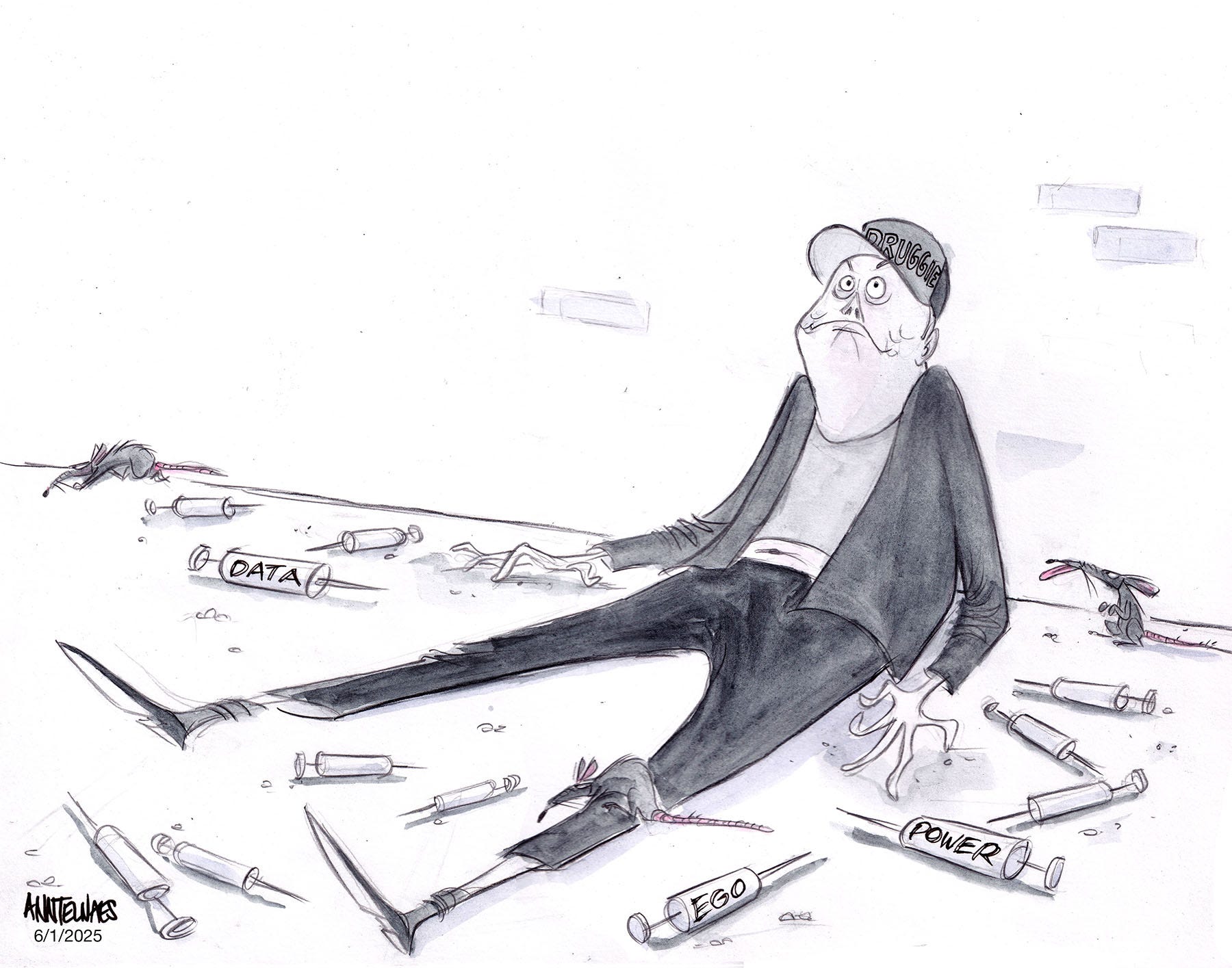
Elon Musk, drugged up by Ann Telnaes

The New York Times has an extensive piece on his drug use while campaigning for Trump Read on Substack

Trump, in his brilliant ability to read people (like Putin) gave Musk the power to indiscriminately cut federal programs and workers, destroying careers and affecting millions of Americans’ lives. Read the NYT article by investigative reporter Kirsten Grind and Megan Twohey, who was part of the team that broke the Harvey Weinstein story in 2017.

It’s Not Only June, It’s Pride Month

Pride Power! by Adam Parkhomenko

A Pride Month declaration from the cussing newsletter guys Read on Substack

It’s a safe bet this White House won’t be flying the rainbow flag this June.

But you can bet your hot asses we will.

June is Pride Month, a celebration of our LGBTQIA+ friends and a good damn reminder that for a free country to truly be free, people must be allowed to be themselves. It’s also a helluva party.

But this year’s Pride comes as the federal government has declared war on trans folks, banned books dealing with LGBTQIA+ issues and authors and made bigotry great again. Like with all things Trump, there ain’t much to celebrate. And that’s why we’re gonna be louder and prouder than we’ve ever been before.

If the president of the United States won’t stand up for our gay, lesbian and trans friends, then we sure as shit will. We’re proud of you, we’re happy to stand next to you and we love you. And like a lot of people who want to be allies, we can be clumsy as hell about it, so please don’t hesitate to tell us how we can do better.

So many Americans have seen their rights and protections either diminished or destroyed under Trump. It’s why so many people in this country are so scared right now. And sad. And angry.

Trump and the GOP have made trans people their personal punching bags. This week, Trump even threatened California over a 16-year-old trans athlete. That’s the president of the United States bullying a child simply because they are different from other kids. If you want to debate trans folks in sports, fine, but surely we can agree that the president shouldn’t be attacking teenagers who are just trying to be teenagers.

Whether it’s erasing the trans heroes from the memorial plaque at Stonewall or denying them the chance to serve in the military, Trump has made clear he will use our government to bully, harass and demean trans people. It’s cruel. It’s wrong. It’s un-American.

And we know it won’t stop there. Because it never does.

We’re already seeing Trump administration efforts to eliminate suicide hotlines and other resources for LGBTQIA+ youth. They’re salivating at the idea of bringing back cruel conversion therapy. And we’ve all heard the rumblings from people like Clarence Thomas about going after gay marriage.

Even as we write this, a gay barber sits in an El Salvadoran prison, sent there by Trump and abandoned by a country that hypocritically proclaims to the world that all men are created equal.

We should be welcoming Andry Hernandez Romero to our country, a land of freedom and opportunity where he can be himself without threats of anti-gay violence. Alas, we are not that America right now. The truth is we rarely have been.

So this will be a different kind of Pride Month. We might party a little less and march a little more. We will spend this June being tragically reminded that the voices of hate and bigotry are still very much alive and they have a pretty big microphone these days.

And that’s why we will spend this month shouting how much we love and support the LGBTQIA+ community. Because fuck the haters, and fuck their hate.

Let’s show the world how we do Pride Month in this country. And let’s remind the bigots what real freedom looks like.

To our LGBTQIA+ friends, we love you, we’re proud of you and we promise you are not alone. Happy Pride, everybody!

The latest from Adam

(And if you click through to the Substack, you can see the new “apology” video from Sen. Ernst, just after Pete’s Heat. Alt Media is an extremely worthy click. Sen. Ernst’s apology is not. -A.)

No Notes

Many Items in Peace & Justice History for 6/1

Also, I want to mention that I’ve been publishing here at Scottie’s Playtime since 7/10 or 11, and normally, have posted one of these each day. There hasn’t been much change or updating for a while; the newsletter and history website is Carl Bunin’s labor of love, depending upon the sales of buttons, pencils, and other merch. I’ve been reading these since 2001, and have noted it feels as if we here may have seen some of these before, and definitely will have by next month. So: should I continue after July 10th, or has everyone seen these, and enough is enough for a while? I don’t mind either way, but I don’t want to use up space and give people repeats. Just let me know in comments over the next few days, OK? And thanks for visiting Scottie’s Playtime!

June 1, 1845

Sojourner Truth (born Isabella Baumfree, but went by the name she believed God had given her as a symbolic representation of her mission in life) set out from New York City on a journey across America, preaching about the evils of slavery and promoting women’s rights. She had been a slave with several owners but was legally free when slavery was abolished in New York state.
Read more about Sojourner Truth (There’s a very cool yet somewhat incendiary comment there on this page; go see it.)
June 1, 1921
America’s worst race massacre, begun the day before over the threat of a lynching, culminated in the complete destruction of the African-American neighborhood of Greenwood in Tulsa leaving nearly 10,000 homeless.
The ruins of Tulsa Oklahoma’s Greenwood District following the assault by the white community.
Death in a Promised Land: The Tulsa Race Massacre of 1921  
read more 
Meet The Last Surviving Witness To The Tulsa Race Riot Of 1921 
June 1, 1932
Gay rights organizer Henry Gerber published an article in Modern Thinker magazine attacking the view that homosexuality is a neurosis.
In 1924, Henry Gerber, a postal worker in Chicago, started the Society for Human Rights, America’s first known gay rights organization.

“The Society for Human Rights is formed to promote and protect the interests of people who are abused and hindered in the legal pursuit of happiness which is guaranteed them by the Declaration of Independence, and to combat the public prejudices against them.”

After having created and distributed a newsletter called “Friendship and Freedom,” Gerber was arrested and held for 3 days without a warrant or being charged with any infractions. Upon release he lost his job for “conduct unbecoming a postal worker.”
Following the last of his three trials, in which the charges were ultimately dismissed, Gerber moved to new York City and re-enlisted in the U.S. Army, serving another 17 years. He lived until 1972, passing away at the the U.S. Soldiers’ and Airmen’s Home in Washington, D.C., living long enough to see the Stonewall Rebellion [see June 28, 1969], the beginning of the modern gay rights movement.
 
More on Henry Gerber 
June 1, 1942

On the advice of Nazi propaganda minister Joseph Goebbels, German Chancellor Adolf Hitler ordered all Jews in occupied Paris to wear an identifying yellow star on the left side of their coats.
The following month 13,000 French Jews were deported to the Auschwitz-Birkenau concentration camps.

June 1, 1950
Senator Margaret Chase Smith (R-Maine), then the only woman in the Senate, and just the second in U.S. history, denounced Senator Joseph McCarthy (R-Wisconsin) and his “red-baiting” tactics on the floor of the U.S. Senate, in a speech called “A Declaration of Conscience.”

“Those of us who shout the loudest about Americanism in making character assassinations are all too frequently those who, by our own words and acts, ignore some of the basic principles of Americanism—the right to criticize;
the right to hold unpopular beliefs;
the right to protest;
the right of independent thought.”

Text of the Senator Smith’s Declaration 
June 1, 1963
The U.S. Supreme Court ruled that recitation of the Lord’s Prayer and readings from the Bible in public schools violated the establishment clause of the first amendment to the U.S. Constitution in School Dist. Of Abington Township v. Schempp. The Court reasoned that the daily practice was unconstitutional because a public institution was conducting a religious exercise and “that public funds, though small in amount, are being used to promote” a particular religion. “It is not the amount of public funds expended; as this case illustrates, it is the use to which public funds are put . . . .”
The decision 
June 1, 1967
The Vietnam Veterans Against War (VVAW) was founded in New York City after six Vietnam vets marched together in a peace demonstration. The group was organized to give voice to the growing opposition to the escalating war in Indochina among returning servicemen and women.


VVAW, through open discussion of soldiers’ first-hand experiences, revealed the truth about the nature of U.S. involvement in Southeast Asia.
VVAW demonstrating against Iraq war 2004
The VVAW today 

https://www.peacebuttons.info/E-News/peacehistoryjune.htm#june1

And Another Young Candidate

Presuming we have elections, we’re gonna be rich in good people to elect. Here’s another one I’ve been watching and donating to for a couple of months. I may have posted about her here before, but I’m not certain.

Brown v. BOE, and more, in Peace & Justice History for 5/31

May 31, 1955
The U.S. Supreme Court ordered (in a unanimous decision known as Brown II after the 1954 decision Brown v. Board of Education) that school integration be implemented “with all deliberate speed,” ordering the lower federal courts to require the desegregation of public schools.
Between 1955 and 1960, federal judges held more than 200 school desegregation hearings. The decision reiterated “the fundamental principle that racial discrimination in public education is unconstitutional . . . . All provisions of federal, state or local law requiring or permitting such discrimination must yield to this principle.”

A timeline of school integration 
May 31, 1957

U.S. playwright Arthur Miller was convicted of contempt of Congress for refusing to reveal the names of associates who were alleged to be Communists.
The conviction was ultimately set aside on appeal.

More about Arthur Miller 
May 31, 1966
Nguyen Thi Can, a 17-year-old Buddhist girl, committed suicide by setting herself afire (self-immolation) on a street in the city of Hue, Vietnam. She was protesting against the South Vietnamese regime and the war being waged by the U.S., the separate armies of the north and south, and the insurgent Viet Cong; it was the fifth such death in three days.
May 31, 1973
A bipartisan majority (69-19) of the U.S. Senate voted to cut off funds for the bombing of Cambodia (Vietnam’s neighbor) despite pleas from U.S. President Richard Nixon’s Secretary of State, Henry Kissinger.

https://www.peacebuttons.info/E-News/peacehistorymay.htm#may31

Memorial Day actions in Peace & Justice History for 5/30

May 30, 1868
Memorial Day, originally known as Decoration Day, was first observed some say [see May 1, 1865] when two women in Columbus, Mississippi, placed flowers on the graves of Civil War soldiers, both Confederate and Union. War widow Augusta Murdoch Sykes, one of the Columbus planners, pointed out that “after all, they are somebody’s sons.” It is now celebrated to honor all those who have died in America’s wars.

“The 30th day of May, 1868, is designated for the purpose of strewing with flowers, or otherwise decorating the graves of comrades who died in defense of their country….” -from an order from the Grand Army of the Republic
=========================================================
May 30, 1937


1000 striking steel workers (and members of their families), on their way to picket at the Republic Steel plant in south Chicago where they were organizing a union, were stopped by the Chicago Police. In what became known as the “Memorial Day Massacre,” police shot and killed 10 fleeing workers, wounded 30 more, and beat 55 so badly they required hospitalization.
More on the incident 
Watch a video of oral history with historic footage

https://www.peacebuttons.info/E-News/peacehistorymay.htm#may30

Barbara Gittings, and More, in Peace & Justice History for 5/29

May 29, 1932
In the depths of the Great Depression, the “Bonus Expeditionary Force,” a group of 1000 World War I veterans seeking to cash in their veterans’ bonus certificates, arrived in Washington, D.C. Though issued to the veterans in 1924, the certificates were not scheduled to be paid until 1945. By mid-June, the vets had set up a massive “Hooverville,” a contemporary term for an encampment of the homeless.

The St. Louis contingent of the Bonus Expeditionary Force is pictured here as it starts for Washington, D.C., in May 1932.
One month later, other veteran groups made their way to the nation’s capital, swelling the Bonus Marchers to nearly 20,000 strong, most of them unemployed veterans in difficult financial straits.
President Herbert Hoover ordered the Army to clear out the veterans when they resisted being evicted by Washington police. Infantry and cavalry supported by six tanks were dispatched with Chief of Staff General Douglas MacArthur in command.

Major Dwight D. Eisenhower served as his liaison with Washington police and Major George Patton led the cavalry. This was a direct violation of the Posse Comitatus Act, which prohibits the armed forces’ being used against U.S. citizens. 
More on the Bonus Army 
May 29, 1965

In one of the first demonstrations promoting equal treatment of homosexuals, Jack Nichols, Barbara Gittings and others picketed in front of the White House.
Her sign read, “Sexual preference is irrelevant to federal employment.”
 
More about Barbara Gittings 
May 29, 1986
The Christic Institute filed a lawsuit charging U.S. government complicity in an assassination bombing at La Penca, Nicaragua, and that the CIA had a role in smuggling cocaine into the U.S. to fund the Contras, an insurgent military force working to bring down the government of Nicaragua.
Find out more about the Christic Institute 

https://www.peacebuttons.info/E-News/peacehistorymay.htm#may29

Women Fasted, Amnesty Int’l Founded, and Much More in Peace & Justice History for 5/28

May 28, 1892

The Sierra Club, America’s oldest, largest and most influential grassroots environmental organization, was organized in San Francisco with wilderness explorer John Muir as its first president. The organization’s initial effort was to defeat a proposed reduction in the boundaries of Yosemite National Park.
Muir introduced President Theodore Roosevelt to Yosemite the following year, inspiring him during his presidency to establish the U.S. Forest Service, create 5 national parks, and sign the 1906 Antiquities Act, under which he proclaimed 18 national monuments.

“Everybody needs beauty as well as bread, places to play in and pray in, where nature may heal and give strength to body and soul alike.”
– John Muir, The Yosemite (1912)

John Muir
The Sierra Club today
May 28, 1961

Amnesty International (AI) was founded on this date in Great Britain.
It is a worldwide movement of people who campaign for internationally recognized human rights, particularly as laid out in the United Nations Universal Declaration of Human Rights. Members of AI help maintain a media focus on political prisoners, and organize public pressure to afford them their legal rights and obtain their release.

Visit Amnesty International 
Read the Universal Declaration of Human Rights:
Amnesty International projects 
May 28, 1963
Black and white civil rights advocates were attacked as they sat-in at a Woolworth’s lunch counter in Jackson, Mississippi. They were defying state laws against serving “colored” citizens at “whites-only” public facilities.
According to John Salter, AKA Hunter Bear, one of those who sat in:
“This was the most violently attacked sit-in during the 1960s and is the most publicized. A huge mob gathered, with open police support while the three of us sat there for three hours. I was attacked with fists, brass knuckles and the broken portions of glass sugar containers, and was burned with cigarettes. I’m covered with blood and we were all covered by salt, sugar, mustard, and various other things.”

Attacked for trying to eat at Woolworth’s (L to R): John Salter (Hunter Bear), Joan Trumpauer (now Mulholland), and Anne Moody.
More photos and the story of the struggle against segregation 
Freedom Movement Bibliography 
May 28, 1982
Seven women fasted for 10 days in Springfield, Illinois, in support of ratification of the Equal Rights Amendment by the Illinois state legislature. The amendment had already been ratified by 35 other states of the 38 required.
May 28, 1998
Pakistan exploded five underground nuclear devices in response to India’s most recent nuclear tests.
 
Since the British partitioned the subcontinent in 1947, there have been three wars between the two countries and numerous border clashes over the disputed Kashmir province. Kashmir had a majority (77%) Muslim population at the time of partition, but became part of predominantly Hindu (80%), though constitutionally secular, India.

Dr. Abdul Qadeer Khan, widely proclaimed as the ” Father of Pakistan’s atomic bomb,” stands in the access tunnel inside the Chagai Hills nuclear test site before Pakistan’s
28 May 1998 underground nuclear test.
Read more 

https://www.peacebuttons.info/E-News/peacehistorymay.htm#may28