July 17, 1927 In a significant early use of close air support, a U.S. Marine squadron of seven airplanes dive-bombed rebels and peasants surrounding Marines and Nicaraguan military (then under direct U.S. control) in Ocotal, Nicaragua, killing more than 100. The rebels were opposed the presence of U.S. forces, essentially continuously in their country since 1909. Why was the U.S. in Nicaragua?
July 17, 1970 The Young Lords Party entered the Lincoln Hospital in the South Bronx, NYC. The hospital, located in a condemned and dilapidated building, was filled with pain, degradation, neglect, flies, and humiliation. The YLP set up care units in the Hospital, and drew attention to the abysmal conditions. The direct-action takeover prompted a response by the government, and the building of a new Lincoln Hospital. The Lincoln Hospital Offensive
=July 17, 1976 The opening ceremony of the 21st Olympic Games in Montreal was marked by the withdrawal of more than twenty African countries, Iraq and Guyana, and their 300 athletes. They had demanded that New Zealand be banned from participation because its national rugby team had toured South Africa, itself banned from the Olympics since 1964 for its refusal to end the racially separatist policy of apartheid. The Soweto Massacre, in which 150 children were killed by South African troops, had occurred just one month earlier. The apartheid government had been using international sport as a means to build respectability. The following year, however, in reaction to the Olympic boycott, the nations of the British Commonwealth (which includes New Zealand) adopted the Gleneagles Agreement, discouraging all sporting contacts with South Africa. African countries boycott Olympics Gleneagles Agreement (It’s a .pdf)
July 17, 1979 Fighters of the Sandinista National Liberation Front overthrew the U.S.-supported dictatorial regime of Anastasio Somoza in the Central American republic of Nicaragua and forced him to flee the country. The notorious and feared U.S.-trained National Guard crumbled and its surviving commanders negotiated a surrender, despite their superiority in armaments. The Sandanista Revolution Anastasio Somoza Girls born after the historic Sandinista victory. Legal voting age in Nicaragua is 16 years. The overthrow: Sandinista rebels take Nicaraguan capital
Pretty weird that Ghislaine Maxwell is currently serving 20 years for her involvement in a sex trafficking operation that was all in service to one man and no other clients and that man is now dead and the Department of Justice and FBI falsely claimed they released “raw” surveillance video of the area near his jail cell the night before he was found dead, which was later discovered by Wired to have been spliced and edited and inexplicably missing three minutes of footage and that man was a close friend of Trump for 15 years and Trump is actively trying to block Maxwell’s SCOTUS appeal on her conviction under a non-prosecution agreement that was previously reached with a U.S. Attorney who later became Trump’s Secretary of Labor and Trump now claims the whole thing is somehow a Democratic hoax perpetrated by Obama and Comey even though both of Epstein’s arrests by federal authorities happened under Republican presidents—the second one under Trump himself—and yet, the entire Republican Party—including Trump—and the rightwing media apparatus supporting them were somehow tricked by Democrats into specifically campaigning LAST YEAR for transparency on the Epstein scandal and pledging to release the files on the operation and his attorney general said the client list is on her desk and under review just a few months ago but now claims the client list never existed, which prompted the most intense infighting in the MAGA movement we’ve ever seen last week and it’s really anyone’s guess at this point why this is so but for some reason, Trump has no interest in releasing the files to clear his own name and the Republican Party have collectively decided to forget they’ve spent the past six years raising a ruckus over this very thing and House Republicans—again, many of whom have campaigned for transparency on this—just unanimously voted against releasing the files, without any real justification, except for the nine House Republicans who curiously declined to vote on it and refuse to offer a credible explanation for that decision while House Democrats unanimously voted for releasing the files despite being the party that’s behind said hoax.
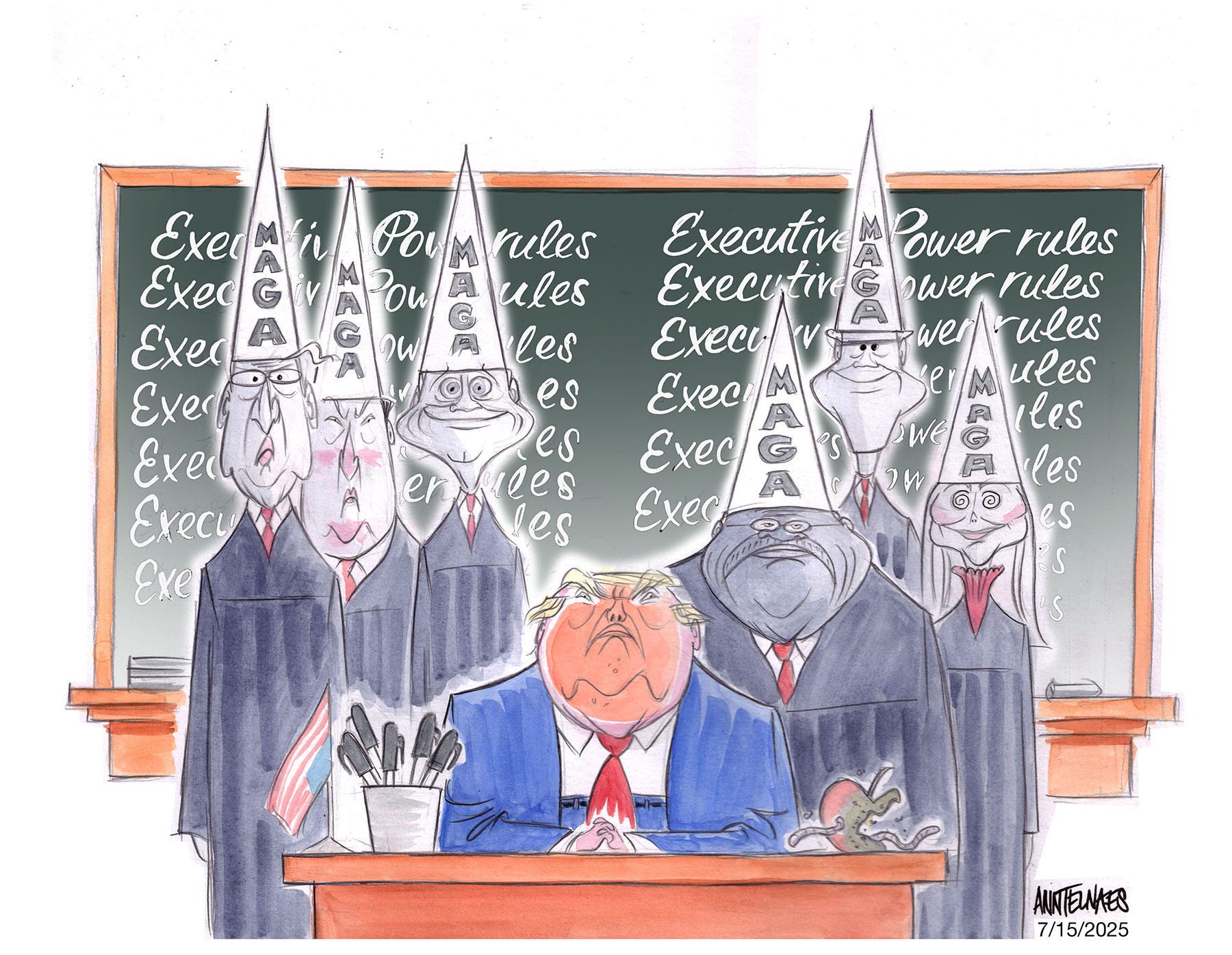
SCOTUS flunks Separation of Powers again by Ann Telnaes
Supposedly only Congress has the power to abolish the Department of Education Read on Substack
This is the result by the majority Supreme Court’s expansion of presidential power and a Congress who long ago failed to uphold its constitutional oath of office.
Steve Vladeck, a law professor at Georgetown University, is quoted in the Economist that there is “no rhyme or reason” in these rulings other than “enabling lawless behaviour by the Trump administration”. Vladeck has a substack about the U.S. Supreme Court I recommend following.
==================
Tanks For Nothing by Clay Jones
SCOTUS says Trump can dismantle the Education Department and Grok goes to war Read on Substack
It’s frustrating to watch Trump get everything he wants, from media outlets settling bogus lawsuits, to social media caving into his demands, to FIFA giving him a trophy while making the winners celebrate with a duplicate (he was even caught stealing a medal), to FIFA (again) renting office space in Trump Tower to kiss his ass, to the Supreme Court of the United States allowing him to deport whoever he wants and destroy any federal agency he wants.
Congress created the Department of Education by law, and Trump acted to destroy it. He was sued, and a lower federal court paused it. Now, SCOTUS ruled, 6-3 as usual, that Trump can continue to destroy it as the case makes its way through the lower courts. Even if SCOTUS says Trump can’t destroy the department by the time the case returns from the lower courts, it will probably be too late.
It will be like reversing the death penalty after the execution.
These rulings are partisan. When the Biden administration asked SCOTUS to unpause a lower court’s freeze on forgiving student loans, SCOTUS refused. But for Trump, they’re bending over backward. SCOTUS is officially saying, “It’s OK if a Republican does it.”
I thought SCOTUS was on a break. They are, but they figured it was an emergency, so they came back to help Trump destroy education. This shit doesn’t make America great again. They wouldn’t have done this for Biden, nor would they have ruled that Biden is immune from prosecution.
Hmmmm, what else happened yesterday? Oh, yeah. Grok, Elon’s AI product, has been given a $200 million contract with the Defense Department. This came one day after Grok went on an antisemitic rant on Twitter/X. Of course, only Elon could teach a robot to be a Nazi.
It’s bad enough we got Drunky Hegseth leading the department while spilling classified information and pausing arms shipments to Ukraine, and now we’re going to trust Artificial Intelligence.
The Pentagon also gave contracts to Google, Anthropic, and OpenAI. The federal government is hiring robots while the Education people are being dumped.
Did none of these bozos watch The Terminator? At what time does Skynet become self-aware? We’re all doomed. Doooooomed, I tell you. (snip-MORE)
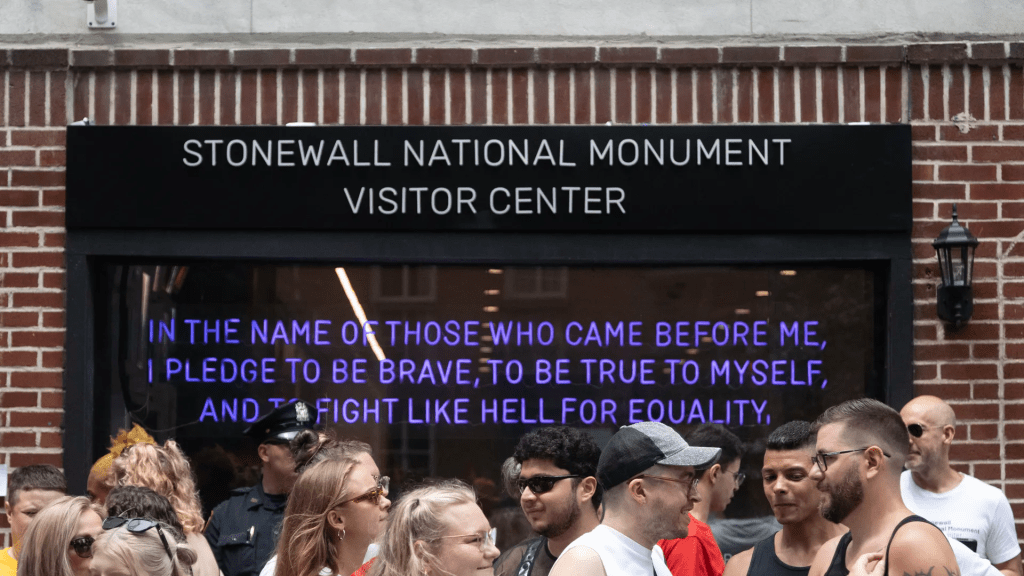
NEW YORK, NEW YORK – JUNE 30: People stand outside Stonewall National Monument Visitor Center during the 2024 NYC Pride March on June 30, 2024 in New York City. (Photo by Noam Galai/Getty Images)Noam Galai/Getty Images
The Stonewall National Monument website seemingly erased most mentions of bisexuality from its website right before Pride month. This comes after the site erased all mentions of trans people from the same “.gov” earlier this year.
The changes appear to have been made on May 27, according to the website itself, which notes the date that each page was last updated. But they largely went unnoticed until independent journalist Erin Reed reported on them on Thursday in a post on her Substack. As of July 11, the homepage on the website, which is run by the National Parks Service (NPS), reads, “Before the 1960s, almost everything about living authentically as a gay or lesbian person was illegal. The Stonewall Uprising on June 28, 1969 is a milestone in the quest for civil rights and provided momentum for a movement.”
But a version of the homepage from May 26, accessed via Wayback Machine, reveals a previous version of that same statement: “Before the 1960s, almost everything about living openly as a lesbian, gay, bisexual (LGB) person was illegal. The Stonewall Uprising on June 28, 1969 is a milestone in the quest for LGB civil rights and provided momentum for a movement.”
Similarly, the “history and culture” page on the website was also updated to remove references to bisexuality on May 27. Where an archived version of the page from May 26 uses the acronym “LGB” numerous times, the most recent version of the page says “gay and lesbian,” and even uses the euphemism “the Stonewall community” in one instance. However, the “virtual fence exhibit” page on the website, which was updated on May 13, still uses the “LGB” acronym, as does the education page. (Though only time will tell how long those mentions will stay.)
As previously reported by Them, these changes come after NPS removed most mentions of trans people from the Stonewall National Monument website in February.
In June, the NPS also told activist Steve Love Menendez, who has been installing hundreds of Pride flags at the monument annually since 2017, that he should only install rainbow flags this year, and that they would not be covering the cost of trans or progress Pride flags, as they had done since 2023. (Visitors brought their own trans flags to place at the monument anyway.)
Though it’s unconfirmed whether the Trump administration is directly responsible for these changes, they are in line with the anti-trans executive orders that the President issued earlier this year, which sought to redefine gender as binary and determined at birth on all federal websites, among other anti-DEI efforts.
The letter “T” was also removed from instances of the acronym “LGBTQ+.”
In a statement emailed to Them, Stacy Lentz, the co-founder and CEO of The Stonewall Inn Gives Back Initiative, took care to note that neither the bar itself nor its affiliated charity are associated with NPS. “That said, we find it deeply troubling that any government agency would erase bisexual people from their public-facing materials,” she said. “Stonewall has always welcomed and celebrated the full spectrum of our community — and that will never change.”
Kurt Kelly, owner of the Stonewall Inn, told Them, “The erasure of bisexual people from federal websites is not just a digital oversight — it’s a deliberate act of invisibility that harms an already marginalized part of our LGBTQ+ community.”
“We must unite as a community to always fight to ensure every identity under our rainbow is seen, heard, and protected. Bi visibility matters. Lives depend on it,” he added. “The fact they continue to do this on the Stonewall National Monument website is even more troubling knowing what Stonewall means to our community around the globe. “
Them has reached out to the National Parks Service for comment.
Writting and calling the US Senators about this. We’ve already paid for this money to be disbursed, with the understanding that it will be. This recission is UnAmerican.
President Trump’s proposal to rescind $9.4 billion in previously approved spending, which the Senate is expected to vote on this week, is a bad idea for several reasons, as noted in a recent CBPP report. The rescission package would significantly damage life-saving global health programs, peacekeeping efforts, and economic development abroad, and would hurt domestic community TV and radio stations supported by the Public Broadcasting Service and National Public Radio. It also builds on the Administration’s broader effort to illegally impound funds, which includes withholding for months the spending that was ultimately included in the rescissions package prior to the formal request and unlawfully delaying or blocking billions of dollars for other programs from going out.
What’s less obvious but no less important, the package — combined with the Administration’s broader campaign of illegally impounding funds — could also make it far more difficult for Congress to fund the government in a bipartisan way in the future.
Here’s why:
Most of the funds in the rescission package were enacted in March legislation that was passed by Congress — including on a bipartisan basis in the Senate — and signed into law by the President to fund the government for the rest of fiscal year 2025. To provide the 60 votes required to avoid a Senate filibuster, at least eight Democratic senators needed to join with 52 Republican senators to invoke cloture on the funding bill.
But presidential rescission requests operate under different rules and require only 51 votes to pass the Senate, so no Democratic votes are needed. If the Senate approves the package (which passed the House on a party-line vote), this would show that Republicans could quickly revise on a partisan basis, with merely 51 votes in the Senate, a bipartisan funding agreement reached only a few months earlier that required support from no fewer than 60 senators.
Nothing has changed about the provisions in the package since the funding was approved in March. They are simply policies President Trump has long opposed and doesn’t want to carry out. But that is not a justification for a rescissions request. After all, it’s typical in an appropriations deal that no one gets everything they want. That means congressional negotiators may get more or less funding than they prefer for a given agency; it also means the Administration may be required to implement programs it does not support.
But if Senate Republicans go along with the Administration’s efforts to simply remove spending they had earlier agreed to as part of the March deal, this would undermine the ability to strike future deals. Office of Management and Budget director Russell Vought has also indicated that the Administration “will strongly consider” sending further rescissions requests to Congress. And of course, the trust needed to make these deals is further undermined when the Administration also chooses to withhold money illegally without even submitting a rescissions package.
The result would likely be lasting damage to our ability to fund the government in a bipartisan way, and the consequences will become clearer in just the next few months. Enacting appropriations for fiscal year 2026, which starts October 1, will require Democratic senators to join with Republicans to reach the needed 60-vote threshold. This Democratic support may not materialize if Democrats believe the President and congressional Republicans will later undo, by rescission or impoundment, any agreement they sign onto.
More generally, there’s little reason for the minority party in Congress to agree to a deal when the Administration and the majority party can strip away funding they don’t like in a purely partisan way, or if the Administration may attempt unilaterally — and illegally — not to implement it at all, with no pushback from the majority party in Congress. As a result, it would be far more difficult to reach the bipartisan agreements necessary to fund the government on time and with the resources required to serve the country’s needs.
Senators should keep those consequences in mind as they consider the President’s current rescission request.
July 16, 1099 The Sacking of Jerusalem Soldiers from all over Catholic Europe, known as Crusaders, overtook the defenses of Jerusalem and slaughtered both the Jewish and Muslim populations. According to Fulk of Chartres in his contemporaneous account, “Many fled to the roof of the Temple of Solomon, and were shot with arrows, so that they fell to the ground dead. In this temple almost ten thousand were killed. Indeed, if you had been there you would have seen our feet colored to our ankles with the blood of the slain. But what more shall I relate? None of them were left alive; neither women nor children were spared.” Pope Urban II initiated this effort to wrest the Holy Land from the hands of the “Infidel” (the city had been under Islamic rule for 460 years) and assured those who joined the first crusade that God would absolve them from any sin associated with the venture. ———————————————————————————————————- July 16, 1877 Firemen and brakemen for the Pennsylvania and Baltimore & Ohio Railroads refused to work, and refused to let replacements take their jobs. They managed to halt all railroad traffic at the Camden Junction just outside of Baltimore. The railroad companies had cut wages and shortened the workweek. A contemporary artist’s rendering of the clash in Baltimore between workers and the Maryland Sixth Regiment during the Great Railroad Strike of 1877. The governor had called out the troops on behalf of the railroad company. After a second pay cut in June, Pennsylvania RR announced that the same number of workers would be expected to service twice as many trains. The work stoppage spread west and eventually became the first nationwide strike Background and growth of the Strike ——————————————————————————————————– July 16, 1945 The U.S. Army’s Manhattan Project succeeded as its first hand-made experimental atomic bomb, known as the “Gadget,” was successfully detonated at the top of a 30m (100 ft.) tower in the desert near Alamogordo, New Mexico (at the Trinity test site now part of the White Sands Missile Range). The original $6,000 budget for the intensive and secret weapons development program during World War II eventually ballooned to a total cost of nearly $2 billion (more than $25 billion in current dollars).
“Gadget” explodes The “Gadget” just before the Trinity test July 16, 1945. Assembled in the McDonald Ranch house nearby, the orange-sized plutonium core, weighing 6.1 kg (13.5 lbs.), yielded an explosive force of more than 20 kilotons (equivalent of 20,000 tons of TNT). Trinity Atomic Bomb (A good read -A.) What it’s like there today: “My Radioactive Vacation” ———————————————————————————————————- July 16, 1979 The largest release of radioactive material in the U.S. occurred in the Navajo Nation. More than 1200 metric tons (1,100 tons) of uranium tailings (mining waste) and 378 million liters (100 million gallons) of radioactive water burst through a packed-mud dam near Church Rock, New Mexico. The river contaminated by the spill, the Rio Puerco, showed 7,000 times the allowable standard of radioactivity for drinking water downstream from the broken dam shortly after the breach was repaired. A month later, only 5% of the tailings had been cleaned out. Warnings not to drink the contaminated water were issued by officials, but non-English-speaking Navajo never heard them, having no electrical power for TV or radio. Humans and livestock continued to drink the water. ———————————————————————————————————- July 16, 1979 Saddam Hussein became president of the Iraqi republic, secretary general of the Ba’ath Party Regional Command, chairman of the Revolutionary Command Council, and commander-in-chief of the armed forces. He had been the ambitious protegé of Ahmed Hassan al-Bakr, who resigned on this day. ———————————————————————————————————- July 16, 1983 During a time of increasing tension between the U.S. and the U.S.S.R. (Union of Soviet Socialist Republics), and an escalating nuclear arms race, 10,000 peace activists formed a human chain linking the two superpowers’ embassies in London, England. The same day, members of the Greenham Common Women’s Peace Camp painted the U.S. spy plane, Blackbird, and composed this song for their activities: [to the tune of Count Basie’s “Bye, Bye, Blackbird”] “Here I stand paint in hand Speaking low, here I go Bye bye blackbird Just a dab of paint or two Here I stand paint in hand Speaking low, here I go Bye bye blackbird Just a dab of paint or two Grounds you for a week or two Bye bye blackbird.No one in the base could undermine you Till we did some countersigning on you Now you’re just a silly joke Invented by some macho bloke Blackbird bye bye.”
July 15, 1834 The Spanish Inquisition, a centuries-long brutal effort by the Catholic Church to root out heresy, begun in 1481, was officially abolished by King Bonaparte. Spain’s King Ferdinand and Queen Isabella had chosen Catholicism as their religion and asked the pope to help purify the people of Spain. Many thousands were forced to convert, were tortured to encourage confession, or burned at the stake. Witch burning during the Inquisition More on the Inquisition
July 15, 1978 The Longest Walk, a peaceful transcontinental trek for Native American justice, which had begun with a few hundred departing Alcatraz Island, California, ended this day when they arrived in Washington, D.C. accompanied by 30,000 marchers. They were calling attention to the ongoing problems plaguing Indian communities throughout the Americas: lack of jobs, housing, health care, as well as dozens of pieces of legislation before Congress canceling treaty obligations of the U.S. government toward various Indian tribes. They submitted petitions signed by one-and-a-half million Americans to President Jimmy Carter. The Longest WalkZinn Project
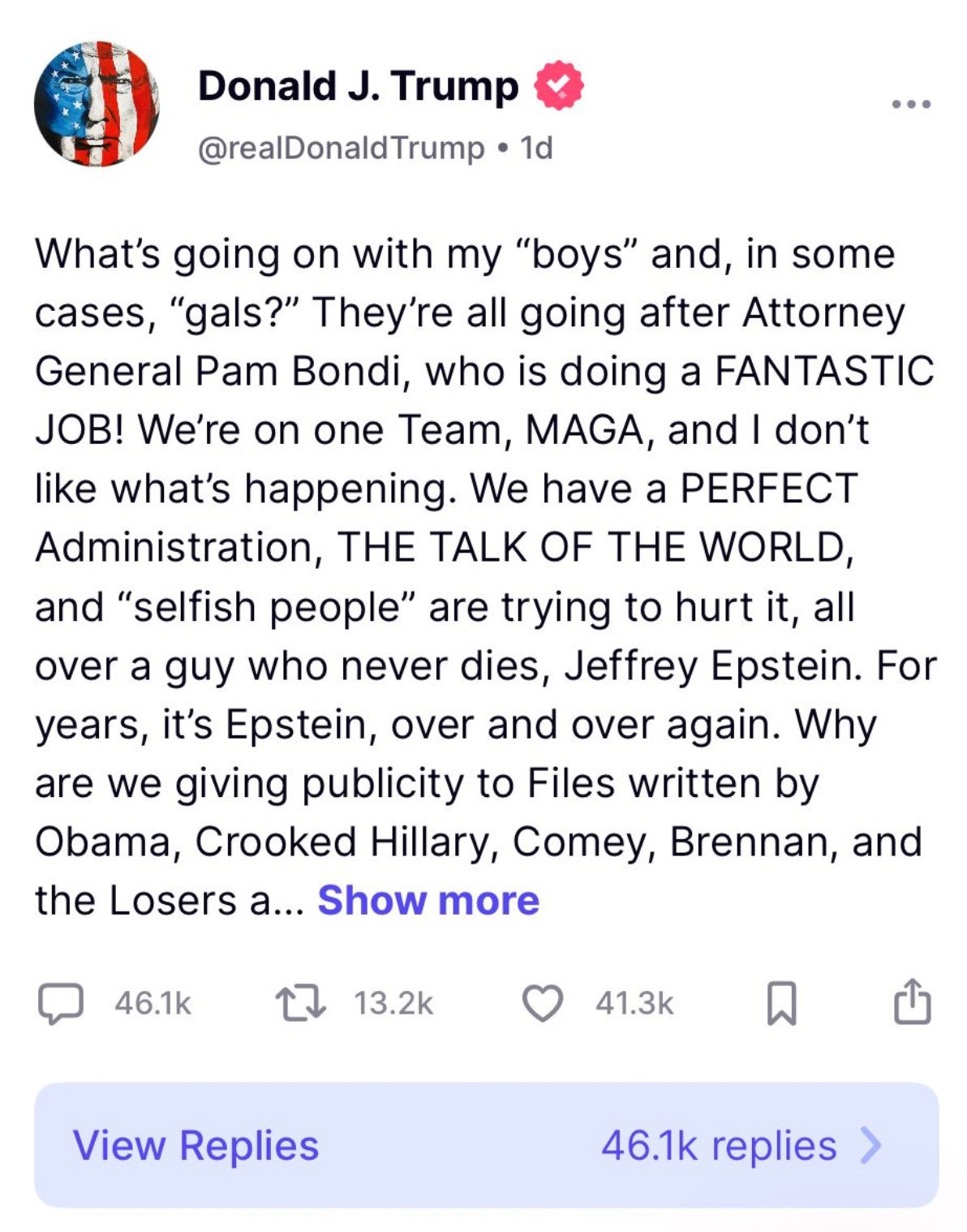
Donald Trump wants you to stop talking about Jeffrey Epstein.
First, what’s with that “boys and girls” crap? Does he still envision himself as the nation’s “daddy?” Second, a perfect administration? Sorry, TACO, but we’ve seen Pete Hegseth, Kristi Noem, Kash Patel, Pam Bondi, JD Vance, and others of your team in action. You have clearly stocked your pond with the least qualified and dumbest fish of all time.
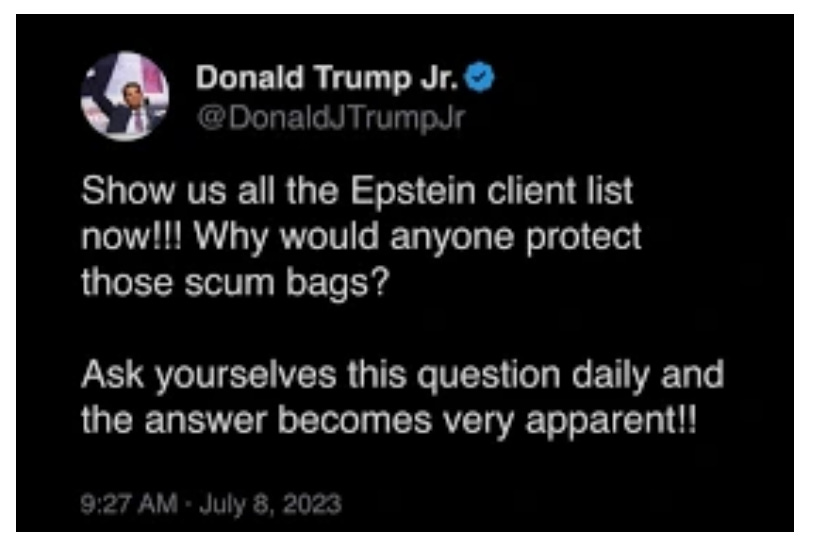
But I get it. Trump wants people to stop talking about Epstein, when previously, he encouraged his cult to talk about Epstein. Look at this tweet from his number one idiot offshoot from 2023.
Is Trump protecting “those scum bags” or is he one of those scumbags? Hmmm? Trump and Jeffers used to party together. Trump told us they were very similar, as they both liked women, with Epstein liking them on the younger side. Was Trump talking about young women, or did he make that statement because he knew about the pedophilia? What did Trump witness, or take part in, when he flew on Epstein’s plane?
Trump talked about his administration being “perfect,” while it was his stupid and unqualified Attorney General who went on Fox News and claimed the Epstein Client List was on her desk, and then later said it never existed. How is that perfect?
But ya know, I don’t think there ever was an Epstein Client List. When did we first hear of this supposed client list?
I believe it was MAGAts who first claimed that there’s an Epstein Client List, because they used it against Biden. But it’s been said so much, “clientlistclientlistclientlistclientlistclientlist,” that it has even gaslighted liberals.
I’m seeing memes from some of my liberal friends asking why Epstein co-conspirator Ghislaine Maxwell is in prison if there’s not a client list. If the only evidence against her is a client list, then she wouldn’t be in prison. How would a client list convict her? There’s a whole hell of a lot more evidence against Epstein than a supposed client list.
And what would the client list be for? He wasn’t in the business of pedophilia, right? It was an activity, a hobby. It was terrible and messed up, but that’s not how Epstein made his millions. I’m sure there is a list of his clients for his finance business.
Now, Trump is being yelled at by MAGAts. How sweet is that? They really want the client list released, which probably doesn’t even exist. It’s not the first time Trump claimed something that’s not true. Trump never did prove that Obama was born in Kenya. He never proved he won the 2020 election. He still hasn’t proven White Genocide in South Africa. We haven’t even seen all the fraud DOGE supposedly found.
But to MAGAts, not releasing the Epstein Client List, or the Epstein Files, makes Trump as bad as the Deep State, which, by the way, also hasn’t been proven to exist.
There are files on Epstein, and Bondi has said she’s not releasing those either. Fuck the client list, let’s see those files. While I don’t believe there is a client list, and feel free to disagree with me, there are Epstein files. Neither Trump nor Bondi has explained to us why those aren’t being released.
The best way to distract a MAGAt is with another conspiracy theory or bigotry. Remember, MAGAts love Trump because they hate the same people. So over the weekend, Trump threatened to revoke Rosie O’Donnell’s citizenship, even though a president doesn’t have that power. Did it work to distract the MAGAts. No, it just gave them something else to rave about while still howling for the Epstein Client List.
Good luck getting your base, Donald, to stop talking about the thing you wouldn’t shut up about. Usually, MAGAts do whatever you say. Maybe you need to remind them that they’re in a cult.
Squirrels: If you’ve ever visited the White House, you probably noticed the squirrels. There are a lot of squirrels at the White House. The fences that keep me and you out are ineffective against squirrel penetration. They go wherever they want. Ronald Reagan used to collect acorns from Camp David to feed the squirrels at the White House. Ike hated them because they would bury acorns in his golf green. But, there aren’t just grey squirrels at the White House, but also black squirrels. To be more specific, black Canadian squirrels.
Things like this fascinate me. I noticed them in Central Park too, but I haven’t researched that yet.
During the Theodore Roosevelt administration, the guy in charge of the National Zoo or the Smithsonian asked Canada for some black squirrels. They’re not native to the United States, though they’re the same squirrels as our grey ones except for the black coats, which might be thicker. It’s cold in Canada, yo.
So, we traded some grey squirrels for their black squirrels, and some either escaped from the zoo, or a few were released. One version explains that they were released at the zoo, with expectations that they would stay on the zoo grounds, but again….fences. Squirrels ignore them.
Today, Washington, DC has black squirrels, and they’re not going anywhere. It’s estimated that half of the squirrels in the city are descendants of the Canadian squirrels, even though the zoo originally only got a few of them. Squirrels are rodents, and rodents screw a LOT.
Not everyone feels the way Ike did, and there’s some civic pride in the black squirrels. There was even a bar in Adams Morgan named the Black Squirrel.
And that’s why there is a black squirrel in today’s cartoon.
What I hope is that Donald Trump notices all the Black immigrants all over his lawn that he can’t do anything about. (snip-MORE)
July 14, 1789 Bastille Day in France: Parisian revolutionaries and mutinous troops stormed and dismantled the Bastille, a former royal fortress converted to a state prison, that had come to symbolize the tyranny of the Bourbon monarchy. This dramatic action was proof that power no longer resided in the King as God’s representative, but in the people, and signaled the beginning of the French Revolution and the First Republic. Bastille Day for kids
July 14, 1798 A mere 22 years after the Declaration of Independence, Congress passed the Sedition Act, making it a federal crime to “. . . unlawfully combine or conspire together, with intent to oppose any measure or measures of the government of the United States . . . or to excite any unlawful combinations therein, for opposing or resisting any law of the United States, or any act of the President of the United States . . . .” The Declaration: “…whenever any Form of Government becomes destructive of these ends [life, liberty and the pursuit of happiness], it is the Right of the People to alter or to abolish it, and to institute new Government….” “An act for the punishment of certain crimes against the United States”
July 14, 1887 Adrian C. “Cap” Anson, both manager and captain of the Chicago Whitestockings (National League), refused to let his baseball team take the field as long as the Newark Little Giants included their starting pitcher, George Stovey, an African-American, in the lineup. “Get that nigger off the field!” Anson was heard to say. Newark refused to allow Anson to dictate the use of their personnel, but the game was ruled a forfeit to Chicago. At the time there were only 20 black players in all of professional baseball. The same day, the directors of the International League (which included Newark) barred any of their teams from hiring black players in the future. By the following year there were only six black players left on all the teams in four leagues. All-black teams were formed, but the last of them, the Acme Colored Giants from Celeron, New York, of the Iron and Oil (I&0) League, stopped playing in 1898. No African-American would play in white organized baseball again until Jackie Robinson nearly 50 years later.
July 14, 1955 The Air Pollution Control Act of 1955 became law, the first in a series of laws that ultimately became the Clean Air Act in 1963. This first law simply provided funding to the Public Health Service to conduct research. History of the Clean Air Act
July 14, 1958 King Faisal II A group of Iraqi army officers staged a coup in Iraq and overthrew the monarchy of King Faisal II (who had ascended to the throne at age four). The new government, led by Abdul Karim el Qasim, was ousted in 1963 by a coup helped by the CIA and led by the Arab Socialist Ba’ath Party—later dominated by Saddam Hussein. Read more
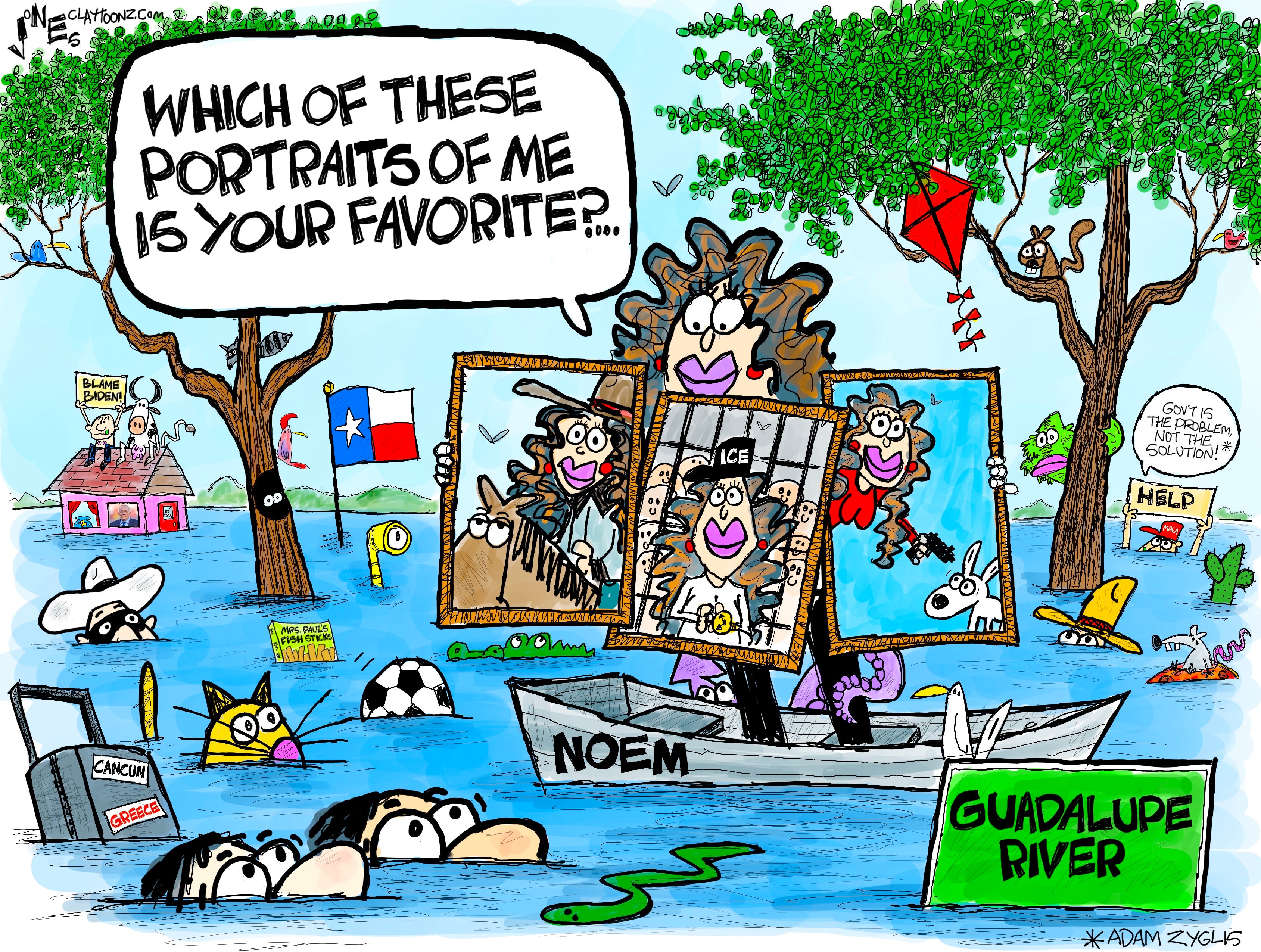
Noem is more interested in her face than in providing assistance to the Texas flood survivors Read on Substack
ICE Barbie, Kristi Noem, the Director of Homeland Security, is failing at her job miserably.
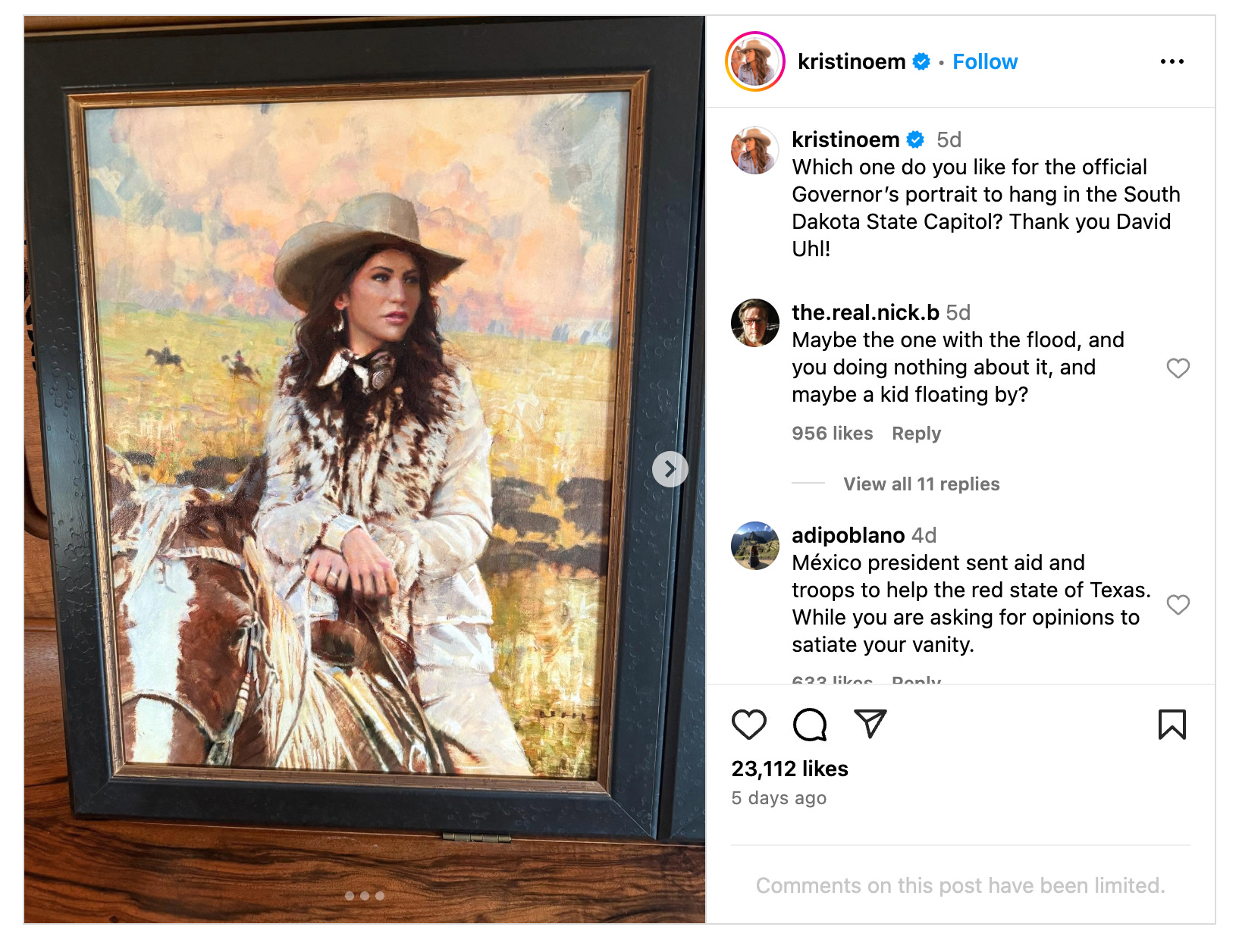
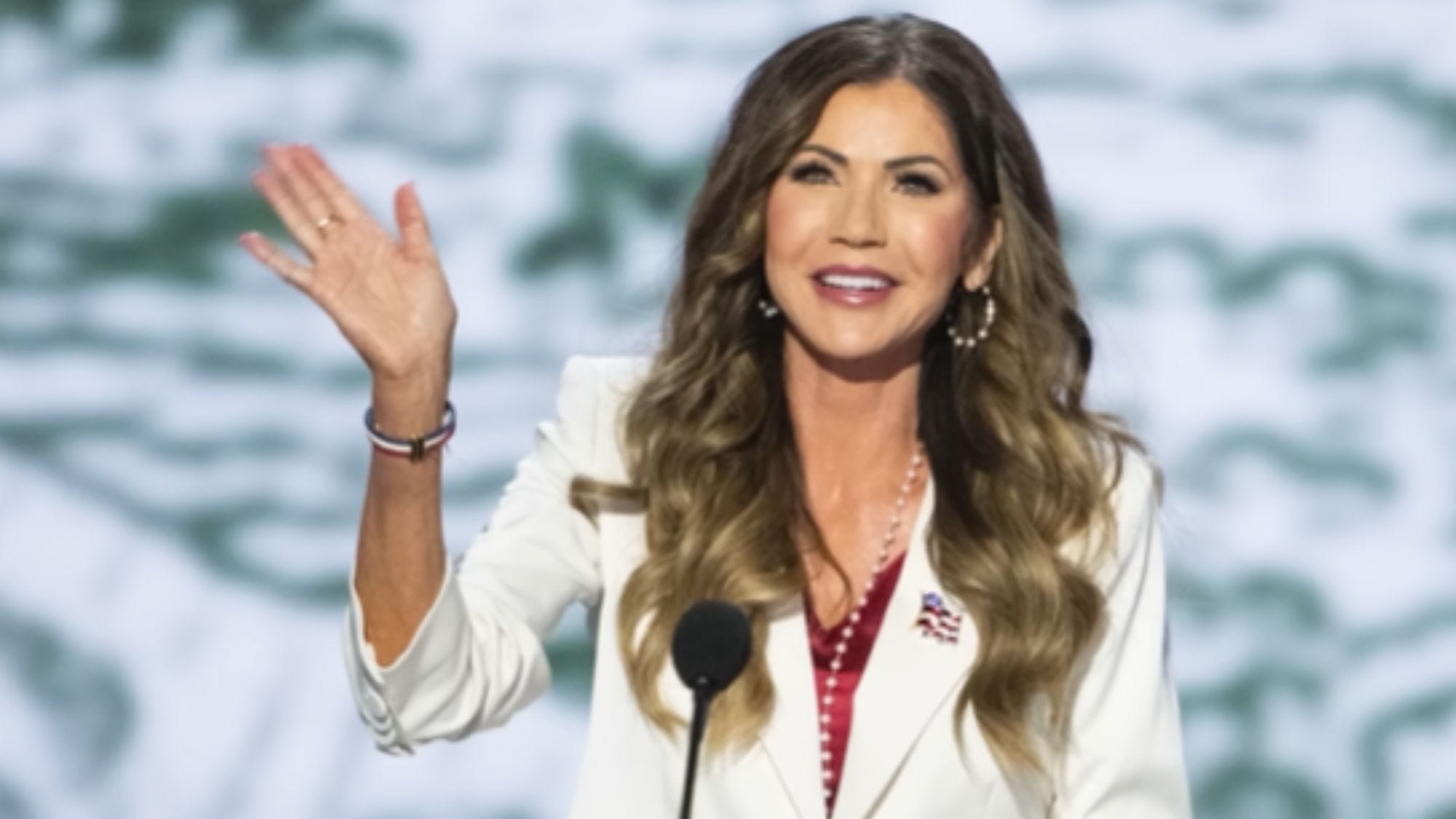
A portrait of Noem is going to be displayed in the South Dakota Capitol building, and there are three options. Who gives a shit, right? Kristi Noem, that’s who. Noem went on Instagram and posted to her creepy followers, “Which one do you like for the official Governor’s portrait to hang in the South Dakota State Capitol? Thank you David Uhl!” She added the three paintings of herself on horseback by artist David Uhl.”
She did this five days ago, during the floods in Texas that have killed at least 120 so far.
Here are the other two portraits.
I wonder how much South Dakota tax money was spent on this.
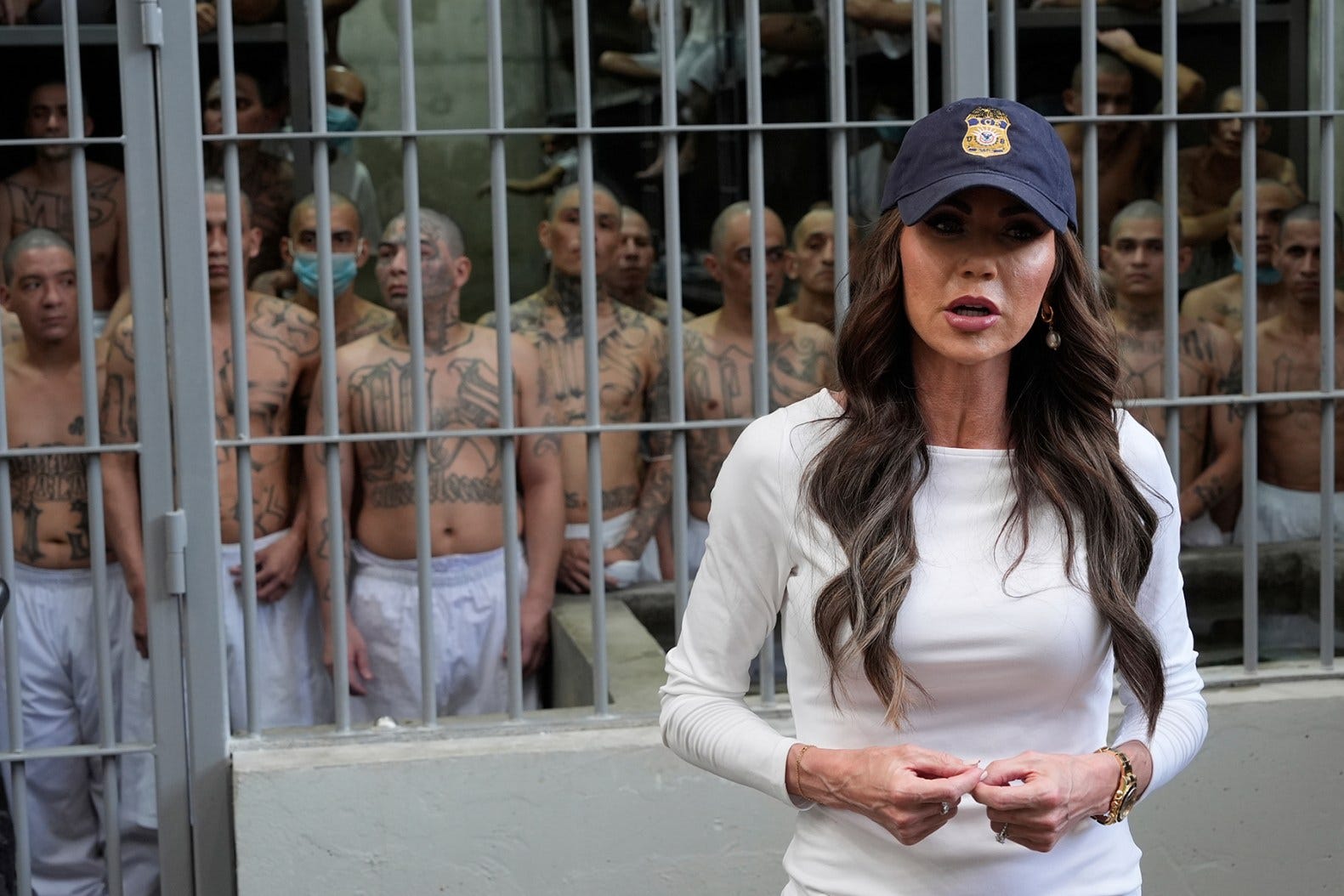
Before Noem’s survey about herself, Puppy-Killah Kristi did her stupid photo-op in El Salvador with the notorious prison behind her, with Trump deportees as props. She was in full makeup while making sure her shiny $10,000 Rolex was visible, which is probably less than her teeth cost.
She’s done other photos with guns, posing as an ICE agent. In one of them, she wasn’t holding the gun correctly and got roasted for it online. I bet she can’t ride a horse either.
We should be relieved that she didn’t shoot that ICE agent in the face. In her defense, she does know how to shoot a gun because that’s how she murdered her puppy. So there, critics.
Kristi is the kind of person that if you went out to dinner with her, she’d humbly say at some point, “Enough of me talking about myself. Now let’s hear you talk about me.” She can’t get over herself. She might be the female equivalent of Donald Trump. She already has the fake hair, and now she just needs the ridiculous tie, the orange make-up, and an adult diaper that hasn’t been changed since his first flip-flop on tariffs.
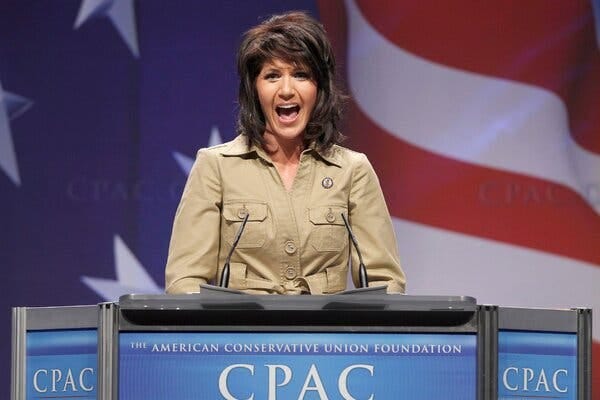
Remember, Kristi used to look like this…
…before she looked like this.
She definitely went for the Melania look, which is an improvement over the look for hunting wolves from a helicopter. She even got free dental work while she was governor, on the condition that she make a commercial for the Texas dentist who did her work.
It seems that’s the only time she’s interested in Texas, when she can get free dental work, but not when there’s a disaster.
According to The New York Times, two days after catastrophic floods roared through Central Texas, the Federal Emergency Management Agency (FEMA) did not answer nearly two-thirds of calls to its disaster assistance line.
An anonymous source close to the issue said the lack of responsiveness happened because the agency had fired hundreds of contractors at call centers.
FEMA, which is a part of Homeland Security (I have to include that because trolls are commenting on this cartoon on Facebook asking, “What’s DHS got to do with FEMA?”), laid off the contractors on July 5 after their contracts expired and were not extended, according to the documents and the person briefed on the matter. Noem, who has instituted a new requirement that she personally approve expenses over $100,000, did not renew the contracts until Thursday, five days after the contracts expired, and about a week after the floods started.
Where was ICE Barbie? She was probably spending her time looking at herself in a mirror, or maybe she confused Texas for one of the seven Native American tribes that banned her from their reservations.
Adam Zyglis: There’s a part of this cartoon that is my standing in solidarity with my colleague Adam Zyglis. So what happened with Adam? Adam, who works for the Buffalo News, drew a cartoon mocking Republican hypocrisy, asking for federal aid after protesting against federal disaster relief for other states. This has upset Republicans, which shows more hypocrisy for the gang that shouts “snowflake” at their political opponents. They even cried on Fox News about it.
Now, an event at the Buffalo History Museum by the Buffalo News Guild, which was to feature Adam among other journalists, has been postponed because of “credible” death threats toward Adam and his family.
And just today, a MAGAt posted on one of my client’s shares of a cartoon of mine about how Democrats are the violent ones. (snip-MORE, and it’s great)










 Scottie's Playtime