Democratic U.S. Sen. Alex Padilla on Thursday was forcefully removed from Homeland Security Secretary Kristi Noem’s news conference in Los Angeles and handcuffed by officers as he tried to speak up about immigration raids that have led to protests in California and around the country.
Video shows a Secret Service agent on Noem’s security detail grabbing Padilla, who represents California, by his jacket and shoving him from the room as he tried to interrupt Noem’s news conference in Los Angeles.
“I’m Sen. Alex Padilla. I have questions for the secretary,” he shouted in a halting voice.
The stunning scene of a U.S. senator being aggressively removed from a Cabinet secretary’s news conference prompted immediate outrage from his Democratic colleagues in the chamber. It comes as the Trump administration has aggressively targeted protesters in California who are demonstrating against immigration raids, including by sending in National Guard troops and Marines. (snip-MORE)
Missouri Gov. Mike Kehoe has activated the Missouri National Guard in anticipation of protests planned across the state.
Kehoe signed an executive order on Thursday, declaring a state of emergency and authorizing the Guard to support local law enforcement if necessary.
“We respect, and will defend, the right to peacefully protest, but we will not tolerate violence or lawlessness in our state,” Governor Kehoe said. “While other states may wait for chaos to ensue, the State of Missouri is taking a proactive approach in the event that assistance is needed to support local law enforcement in protecting our citizens and communities.”
“Mayor Lucas is concerned with enhanced state enforcement for one set of protestors, but no action or aid to local law enforcement when Neo-Nazis march through Missouri’s urban streets. The Mayor has confidence in responsible protestors to use their First Amendment rights peacefully and in compliance with the law. More than one thousand Kansas Citians protested peacefully and responsibly just days ago. For those who do not act responsibly, the Mayor stands by the women and men of local law enforcement at KCPD and other agencies to handle any necessary enforcement actions. Unnecessary escalation from our nation’s capital and state capitals undermines local law enforcement and makes all less safe.”
House Minority Leader Ashley Aune said it was a “preemptive” declaration of emergency.
Her statement:
“Governor Kehoe’s preemptive declaration of a state of emergency as Missourians prepare to protest an increasingly authoritarian presidential administration is a blatant attempt to intimidate and suppress First Amendment rights. The protests planned this weekend across Missouri and throughout the nation were sparked by the president’s unwarranted and heavy-handed military response to opposition to his policies. By doing the same, the governor will only heighten tensions and increase the possibility of conflict. Governor Kehoe should staunchly defend the rights of Missourians, not mimic the authoritarianism of the president.” (snip-MORE)
Here in America, Journalists have never had to worry so much for their physical safety. That’s one reason why political cartoonist, Cameron Cardow, pissed me off so much when he started working as “Rivers,” an anonymous cartoonist pretending his life was in danger for supporting Donald Trump with lies and conspiracy theories while being a Canadian pretending to be an American.
If anything, Cam working anonymously, with the aid of syndicate boss Daryl Cagle, was threatening journalism by telling editors that it wouldn’t violate their ethics policies because political cartoonists are not journalists. Rivers has since quit, but Cagle is still doing his best to undermine political cartoonists as journalists.
Just in case they’re reading this, Daryl, you’re a huge disappointment who fails to exercise responsibility or even quality control when distributing misinformation powered by racism. Next time we meet, we’re gonna have a talk. Cam, you’re just a lying piece of shit, but I’m thankful for your career change and hope you’re doing well, at least well enough not to come back to cartooning.
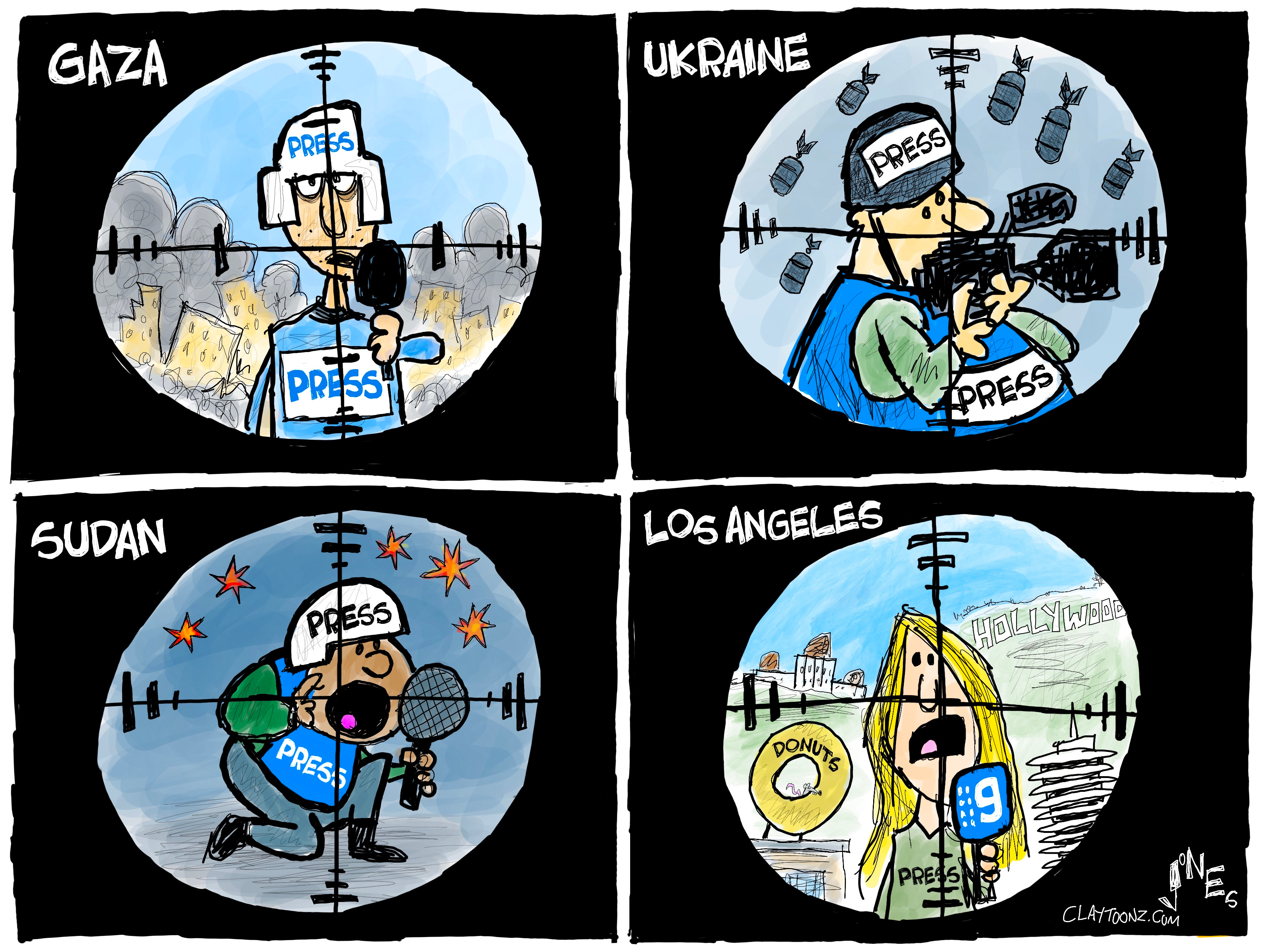
There are other places outside the United States where being a journalist can be very dangerous. Mexico can be a very bad place for journalists, not so much from the government but from drug cartels. Murderers of journalists in Haiti are likely to go unpunished. Pakistan is considered extremely dangerous for a reporter. The wars in Myanmar and Sudan are also killing journalists.
No deaths of journalists from White Genocide in South Africa have been reported, maybe because there’s no White Genocide in South Africa.
Since 2014, at least 17 journalists have been killed in the Russo-Ukrainian War. Since Hamas attacked Israel on October 7, 2023, at least 184 journalists and media workers have been killed in Gaza.
12 people were killed in Paris, which is not a war zone, in 2015 at the offices of satirical magazine Charlie Hebdo, by terrorists angered by cartoons of Muhammad in 2012. Five of the 12 killed were cartoonists.
Here in the United States, despite Rivers’ cowardice, a political cartoonist has never been assassinated. The biggest threat to our press freedom here comes from the owners of news outlets, as they all bow in fear before Tiny TACO. But that might be changing. (snip-MORE)
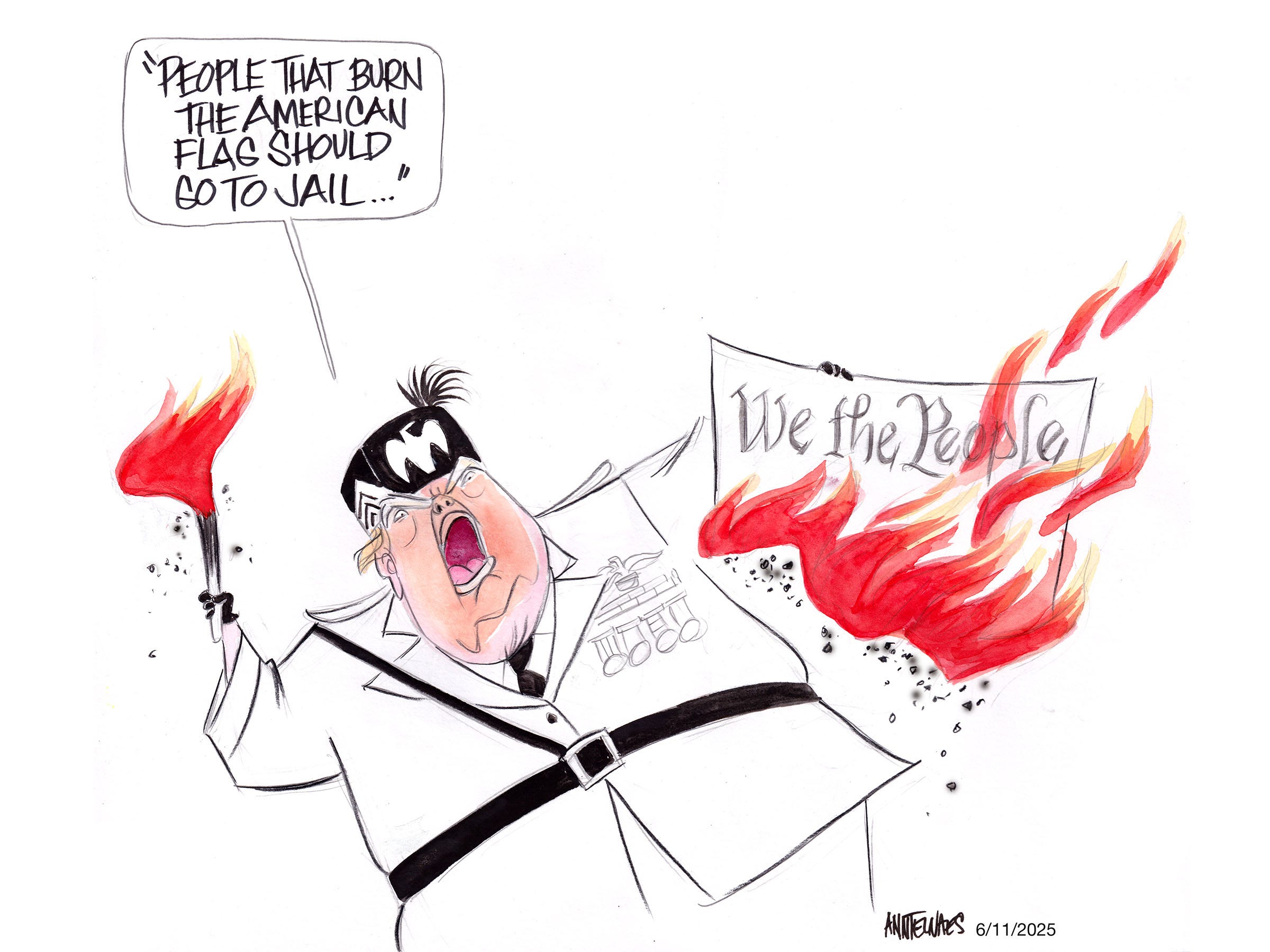
The one who should be going to prison by Ann Telnaes
Trump calls for jailing people who burn the U.S. flag Read on Substack
More proof Trump doesn’t respect the First Amendment and isn’t familiar with the Supreme Court decision protecting flag-burning.
June 12, 1963 In the driveway outside his home in Jackson, Mississippi, civil rights leader Medgar Evers was shot to death by white supremacist Byron De la Beckwith, who was not convicted until 1994 after an extensive investigation by Jackson, Mississippi’s Clarion-Ledger newspaper. He was tried and acquitted twice by with all-white juries, members of which had been influenced by the Ku Klux Klan. Following one of the trials, then-Mississippi Governor Ross Barnett stood by Beckwith’s side and shook his hand. The whole sad story The role of the Clarion-Ledger
June 12, 1964 Nelson Mandela, a 46-year-old lawyer and a leader of the opposition to South Africa’s racially separatist apartheid system, was convicted of sabotage in the Rivonia Trial and sentenced to life imprisonment. Nelson Mandela, 1963 From Mandela’s statement to the court prior to sentencing: “ I have fought against white domination, and I have fought against black domination. I have cherished the ideal of a democratic and free society in which all persons live together in harmony and with equal opportunities. It is an ideal which I hope to live for and to achieve. But if needs be, it is an ideal for which I am prepared to die.” The trial of Mandela and seven other African National Congress compatriots
June 12, 1967 The U.S. Supreme Court in Loving v. Virginia struck down state miscegenation laws, those that prohibited interracial marriage, as violations of a person’s right to equal protection under the law, as guaranteed under the 14th amendment. Mildred and Richard Loving In June of 1958, Richard Loving and Mildred Jeter, a white man and an African-American woman, had married in Washington, D.C. Upon return to their home state of Virginia, the couple was arrested, convicted of a felony, and sentenced to a year in prison. The appeal of their conviction led to the decision. Contemporary thoughts on the case “The freedom to marry has long been recognized as one of the vital personal rights essential to the orderly pursuit of happiness by free men.” From Chief Justice Earl Warren’s majority opinion in Loving v. Virginia Watch trailer for the movie “Loving” (recommended)
June 12, 1982 In the world’s largest-ever peace demonstration (until the U.S. invasion of Iraq), one million rallied in New York City’s Central Park to support the newly formed Nuclear Freeze Campaign which called for a halt to all nuclear weapons testing worldwide. The biggest demonstration on earth (until the global anti-Iraq war march of Feb 15 2003) took place in New York on June 12, 1982, when one million people gathered in support of the second UN Special Session on Disarmament and to protest nuclear weapons. The origins of the Nuclear Freeze Campaign The demonstration
And, since June is Pride month, there are a lot of Pride activities going on that date, too. Perhaps yours also overlap, and this sign will work for you, too!
Thanks to Chris for permission to share – this design is so great, I had to share it.
Stay safe out there, and wherever you are, please know that you are loved exactly as you are. Whether you can live your life openly or keep parts of yourself hidden, you’re seen and welcomed and loved.”
June 11, 1962 Students for a Democratic Society (SDS) held its founding convention in Michigan and issued The Port Huron Statement, laying out its principles and program. “In social change or interchange, we find violence to be abhorrent because it requires generally the transformation of the target, be it a human being or a community of people, into a depersonalized object of hate. It is imperative that the means of violence be abolished and the institutions—local, national, international—that encourage non-violence as a condition of conflict be developed.” Complete text of the Port Huron Statement (it’s a .pdf, in case you’re on a phone) Students for a Democratic Society: A Graphic History: Paul Buhle, Editor
June 11, 1963 Thich Quang Duc, a Buddhist monk from the Linh-Mu Pagoda in Hue, Vietnam, burned himself to death (self-immolation) in front of the U.S. embassy in downtown Saigon (now known as Ho Chi Minh City) to protest the the South Vietnamese regime the U.S. supported, and the war the Americans were waging. A painting of the scene on the street as Thich Quang Duc self-immolates in protest of the government and war in Vietnam
June 11, 1963 Vivian Malone (later Jones) preparing to enroll at Alabama with Deputy Attorney Gen, Nicholas Katzenbach (L) at her side. Alabama Governor George C. Wallace stood in the doorway of the University of Alabama in order to prevent the admission of two negro students in a failed attempt to maintain segregation in educational opportunities. He was forced to step aside later in the day when Vivian Malone and James Hood were registered as students.
June 11, 1968 Daniel Cohn-Bendit, known as Danny the Red, arrived in Britain, stirring up fears of campus unrest. The 23-year-old Paris law student had been given permission to remain in the U.K. just 24 hours, but immediately threatened to defy the authorities and out-stay his official welcome [his visit was later legally extended to 14 days]. Cohn-Bendit, a German citizen, had been expelled from France in May for being an organizer of the French student and worker demonstrations which almost brought that country to a standstill the previous month. Daniel Cohn-Bendit and a Paris policeman in 1968. “I don’t know how long I will stay. I think it’s a free country” -Daniel Cohn-Bendit He currently sits as a Green Party deputy in the European Parliament. The news at the time Daniel Cohn-Bendit today
June 11, 1970 Representative Martha Griffiths (D-Michigan) filed a discharge petition signed by a majority of all members of the U.S. House of Representatives, a seldom used parliamentary move, to bring the Equal Rights amendment to the House floor for consideration. She saw this as the only way to get the constitutional amendment out of the Judiciary Committee where it had been held by its chairman, Emmanuel Cellar (D-New York), who had refused to even hold hearings on the matter. Representative Griffiths had introduced the amendment every year since 1948. Representative Martha Griffiths from Detroit’s west side
June 11, 1988 100,000 marched from United Nations headquarters in New York City to Central Park during the 3rd U.N. Special Session on Disarmament. Though there had been progress in recent years on disarmament, the U.N. meeting yielded nothing but stalemate. Read more
June 11, 2010 Scientists studying the scale of the then-ongoing BP oil spill in the Gulf of Mexico doubled the previous estimate of the scale of the flow of oil into the Gulf. Initially, BP and the government had said that no more than 1000 barrels (42 U.S. gallons per barrel) per day were leaking, later raised to 5000. The fine for oil spills was $4300 per barrel. The new estimate was between 20,000 and 40,000 barrels per day. If the spill had been stopped that day (the well was not capped until early August), it would have exceeded the Exxon Valdez spill by a factor of eight.
Picture this: It’s 1970, and America’s movie theaters reek of stale popcorn, cigarette smoke, and something else—the acrid stench of fear. Fear of bodies that didn’t conform, desires that couldn’t be spoken, identities that existed only in shadows and whispered confessions. Then, like a fucking earthquake splitting the earth’s crust, came The Boys in the Band—not tiptoeing through Hollywood’s garden of heteronormative roses, but kicking down the door with combat boots and declaring war on silence.
William Friedkin’s adaptation of Mart Crowley’s play didn’t just put gay men on screen; it threw them there bleeding, bitching, and beautifully broken. The audience could taste the bitter cocktail of self-loathing mixed with razor-sharp wit, could feel the electric tension crackling between characters who wielded words like switchblades. This wasn’t representation—this was revolution disguised as entertainment, a Molotov cocktail hurled at the pristine facade of American cinema.
The psychological impact on LGBTQ+ viewers was seismic. For the first time, queers sitting in darkened theaters saw themselves reflected not as tragic figures destined for suicide or sanitized saints, but as complex, contradictory, gloriously fucked-up human beings. The film’s unflinching portrayal of internalized homophobia—characters tearing each other apart with vicious precision—served as both mirror and exorcism. Viewers could finally name the demons that had been eating them alive, could see their own struggles projected thirty feet high in Technicolor fury.
Trans Bodies on Fire: The Gender-Fucking Revolution
Before there was language, before there were support groups or pride parades, there was The Rocky Horror Picture Show—a glittering, sequined middle finger raised high against every gender binary that dared exist. Tim Curry’s Dr. Frank-N-Furter didn’t just cross-dress; he obliterated the very concept of fixed identity, serving looks that could melt steel and charm that could seduce a nun. The film became a weekly religious experience for outcasts and misfits, transforming movie theaters into sanctuaries where “abnormal” became sacrament.
The sensory assault was deliberate and intoxicating: the smell of cheap makeup mixing with nervous sweat, the sound of fishnet stockings ripping as audience members transformed themselves into their truest selves, the taste of liberation on tongues that had been silenced for too long. Rocky Horror created a space where gender became performance art, where conformity went to die, and where every Saturday night became a resurrection.
The psychological liberation was profound. Trans viewers found validation in Frank-N-Furter’s unapologetic embrace of fluidity, while questioning viewers discovered permission to explore identities they’d never dared name. The film’s interactive nature—audiences shouting back at the screen, participating in the narrative—created a communal catharsis that individual therapy could never match.
Orlando arrived two decades later like a ethereal fever dream, with Tilda Swinton embodying centuries of gender transformation through Sally Potter’s lens. Here was gender not as costume but as evolution, not as crisis but as natural progression. The film’s languid pacing forced viewers to marinate in ambiguity, to sit with discomfort until it transformed into acceptance, then into celebration.
The Crying Game hit different—like a sucker punch followed by a tender kiss. Neil Jordan’s thriller weaponized audience assumptions, then forced viewers to confront their own transphobia in real-time. The revelation about Dil became a cultural watershed moment, dividing film history into before and after. Suddenly, dinner table conversations across America were grappling with questions that had never been asked out loud.
The psychological impact on trans viewers was complex and often contradictory. Some found validation in seeing trans characters as more than punchlines or victims, while others felt exploited by the shock-value treatment of trans identity. The film sparked conversations that were long overdue, even when those conversations were messy, uncomfortable, and occasionally hostile.
Leather, Longing, and the Masculine Mystique
Cruising descended into theaters like a demon emerging from hell’s own basement, dragging audiences through New York’s leather underground with the subtlety of a sledgehammer to the skull. William Friedkin didn’t just film gay culture; he dissected it with surgical precision, exposing the raw nerves where desire meets violence, where identity becomes performance, where the line between hunter and hunted dissolves in strobe lights and poppers.
The film’s sensory assault was overwhelming: the throb of disco basslines that you felt in your chest cavity, the smell of leather and sweat and something darker, the visual overload of bodies in motion, muscles straining against restraints both literal and metaphorical. Al Pacino’s descent into this world became every viewer’s journey into their own shadow self, the parts of desire that polite society pretended didn’t exist.
The psychological effects were explosive and divisive. Gay men in theaters found themselves simultaneously aroused and terrified, seeing their community’s most extreme margins projected for mainstream consumption. Some felt exposed, violated, their private world stripped naked for heterosexual titillation. Others felt liberated by the film’s refusal to sanitize gay desire, its acknowledgment that sexuality could be dangerous, transgressive, and transformative.
Sunday Bloody Sunday offered a different kind of revelation—mature, sophisticated, unapologetically honest about love’s messy realities. John Schlesinger’s triangular love story featuring Peter Finch as an openly gay man navigating desire without shame created a new template for queer cinema. This wasn’t tragedy or comedy; this was life, served neat without the chaser of societal judgment.
The film’s matter-of-fact treatment of gay relationships was revolutionary in its ordinariness. No coming-out trauma, no tragic endings, no apologetic explanations—just human beings loving, losing, and continuing to breathe. For LGBTQ+ viewers, this representation was oxygen for souls that had been suffocating on a diet of tragic queers and comedic stereotypes.
Lesbian Desire: From Shadows to Sunlight
Lesbian cinema in this era moved from whispered suggestions to bold declarations, from tragic endings to triumphant beginnings. The Killing of Sister George emerged from the underground like a feral cat, all claws and snarls and magnificent rage. Robert Aldrich’s brutal examination of lesbian relationships didn’t flinch from ugliness—the manipulation, the internalized homophobia, the way oppression could turn love into a weapon.
Beryl Reid’s performance was a masterclass in controlled demolition, watching a woman destroy everything she touched while desperately grasping for connection. The film’s unflinching portrayal of lesbian relationships—complex, messy, and occasionally toxic—provided representation that was real rather than idealized. For lesbian viewers, seeing their community portrayed with full humanity, including its shadows, was both painful and profoundly validating.
Desert Hearts offered redemption and possibility, Donna Deitch’s adaptation of Jane Rule’s novel serving up hope like cold water in a desert. Set in 1950s Reno, the film followed an academic’s journey from divorce to self-discovery, from social conformity to authentic desire. The Nevada landscape became a metaphor for internal transformation—vast, beautiful, and dangerous.
The sensory details were crucial: the crack of pool balls echoing like gunshots, the smell of cigarettes and whiskey mixing with perfume and possibility, the heat radiating from skin finally allowed to want what it wanted. For lesbian viewers, Desert Hearts offered a template for their own coming-out narratives—messy, beautiful, and ultimately triumphant.
Lianna brought lesbian experience into the suburban mainstream with John Sayles’ sensitive direction. The film’s psychological realism was groundbreaking—showing the internal process of sexual awakening without sensationalizing or pathologizing it. Viewers could taste the protagonist’s confusion, feel her excitement and terror as she navigated new desires while dismantling old assumptions about herself.
The AIDS Crisis: Love in the Time of Dying
Longtime Companion arrived like a punch to the solar plexus, chronicling AIDS’ devastating impact on a circle of gay friends with unflinching honesty. Norman René’s ensemble piece transformed personal tragedy into universal human drama, forcing audiences to confront the epidemic’s toll not through statistics but through faces, voices, and stories.
The film’s emotional brutality was necessary and healing. Viewers experienced the full spectrum of grief—denial, anger, bargaining, depression, and something resembling acceptance. The beach scene, where surviving characters imagine their dead friends joining them one last time, became a collective catharsis for a community drowning in loss.
For LGBTQ+ viewers, Longtime Companion provided validation for their grief, rage, and resilience. The film acknowledged that gay relationships were worth mourning, that gay lives had value, that gay love deserved recognition. In a world that often seemed indifferent to queer suffering, the film became a memorial, a battle cry, and a love letter all at once.
Parting Glances offered a different perspective on the crisis—intimate, funny, and heartbreakingly human. Bill Sherwood’s New York snapshot captured gay life with humor and tenderness, refusing to let AIDS define the entire gay experience. The film’s portrayal of friendship, love, and community in the face of mortality provided a blueprint for survival.
International Voices: Expanding the Revolution
The revolution wasn’t contained by borders. My Beautiful Laundrette mixed racial politics with queer desire against Thatcherite Britain’s backdrop, creating social dynamite that exploded conventions about class, race, and sexuality. Stephen Frears’ direction transformed a love story between Omar and Johnny into a meditation on identity, economics, and the price of conformity.
The film’s sensory details were crucial—the smell of industrial detergent mixing with forbidden desire, the sound of washing machines providing rhythm for secret encounters, the visual contrast between public respectability and private rebellion. For viewers navigating multiple marginalized identities, the film offered recognition that oppression could be intersectional and resistance could be revolutionary.
Entre Nous explored female friendship and desire in post-war France with Diane Kurys’ autobiographical honesty. The film’s examination of emotional intimacy challenging conventional marriage provided a template for understanding relationships that existed outside traditional categories. The psychological complexity of female friendship—its intensity, its potential for transformation, its threat to established order—was portrayed with rare sensitivity.
The Aesthetic Revolution: Beauty as Resistance
These films didn’t just tell different stories; they created new visual languages for desire, identity, and rebellion. The Adventures of Priscilla, Queen of the Desert transformed the Australian outback into a canvas for drag performance and self-discovery, proving that authenticity could flourish in the most unlikely places.
The film’s sensory explosion was deliberate—the clash of sequins against red dirt, the sound of high heels on desert sand, the taste of dust and dreams mixing in the desert air. For drag performers and gender-nonconforming viewers, Priscilla offered validation that their art was transformative, their visibility was revolutionary, their existence was celebration.
Death in Venice provided a different aesthetic—operatic, obsessive, and devastatingly beautiful. Luchino Visconti’s adaptation of Thomas Mann’s novella used Gustav Mahler’s music to underscore Dirk Bogarde’s descent into forbidden desire on plague-ridden Italian shores. The film’s lush visuals and overwhelming music created a sensory experience that bypassed rational thought, speaking directly to the subconscious where desire lives.
Psychological Warfare: The Internal Revolution
The psychological impact of these films on LGBTQ+ viewers cannot be overstated. For generations raised on invisibility or tragic representation, seeing complex, fully-realized queer characters was transformative therapy. These films provided:
Validation: Characters who experienced similar struggles, desires, and triumphs Language: Words and concepts for experiences that had been nameless Community: The knowledge that others shared these experiences Hope: Evidence that queer lives could include joy, love, and fulfillment Rage: Permission to be angry about oppression and discrimination Pride: Models for living authentically despite social pressure
The films also created psychological discomfort that was productive. They forced viewers to confront internalized homophobia, challenge assumptions about gender and sexuality, and grapple with the contradictions between public personas and private desires.
Cultural Warfare: Changing Hearts and Minds
These 24 films didn’t just reflect cultural change; they catalyzed it. Each screening became an act of resistance, each ticket purchase a vote for visibility, each conversation sparked by these films a crack in the foundation of heteronormative assumptions.
The films created cultural currency for LGBTQ+ experiences. References to Rocky Horror became shorthand for gender fluidity. The Boys in the Band provided vocabulary for gay male relationships. Desert Hearts offered a template for lesbian coming-out narratives. These films became cultural touchstones, reference points for understanding and discussing queer experience.
The broader cultural impact was seismic. Mainstream audiences encountered LGBTQ+ characters as fully-realized human beings rather than stereotypes or cautionary tales. The films forced conversations that hadn’t happened before, challenged assumptions that had gone unquestioned, and planted seeds of empathy in hostile soil.
The Legacy: Revolution Continues
These 24 films from 1970-1995 created the foundation for everything that followed. They proved that LGBTQ+ stories could be commercially viable, critically acclaimed, and culturally significant. They trained audiences to expect complexity rather than stereotypes, authenticity rather than exploitation.
The psychological impact on LGBTQ+ viewers created ripple effects that continue today. Viewers who found validation in these films went on to create art, build families, fight for rights, and live openly. The films provided models for resistance, templates for authenticity, and permission to exist unapologetically.
The cultural impact was equally profound. These films shifted the conversation from whether LGBTQ+ people deserved representation to how that representation should evolve. They created space for the explosion of queer cinema that followed, from Brokeback Mountain to Moonlight to The Danish Girl.
Conclusion: The Ongoing Revolution
These 24 films didn’t just entertain; they waged war against invisibility, fought battles against shame, and won victories for authenticity. They transformed movie theaters into battlegrounds, screens into mirrors, and stories into weapons of mass liberation.
The revolution they started continues in every Pride parade, every coming-out conversation, every film that dares to show LGBTQ+ characters as complex, worthy, and fully human. These films proved that visibility is power, that stories can change hearts, and that cinema can be a force for liberation.
For LGBTQ+ viewers who discovered these films in darkened theaters, on late-night television, or through word-of-mouth recommendations, the impact was profound and lasting. These films didn’t just reflect their experiences; they validated their existence, honored their struggles, and celebrated their humanity.
The blood, sweat, and tears that went into making these films—both literally and metaphorically—created a legacy that continues to inspire, challenge, and transform. They remind us that art can be revolutionary, that visibility is political, and that sometimes the most radical act is simply refusing to disappear.
These 24 films blazed a trail through the wilderness of cultural invisibility, creating a path that others could follow. They proved that LGBTQ+ stories weren’t just worth telling; they were essential to telling the complete story of human experience. The revolution they started continues, and their impact will be felt for generations to come.
Citations
Rich, Ruby B. 2013 “New Queer Cinema: The Director’s Cut“
Turner, K. 2023 “The Queer Film Guide: 100 great movies that tell LGBTQIA+ stories”
And now Trump is deploying the Marines. There is no need for this, and it’s illegal.
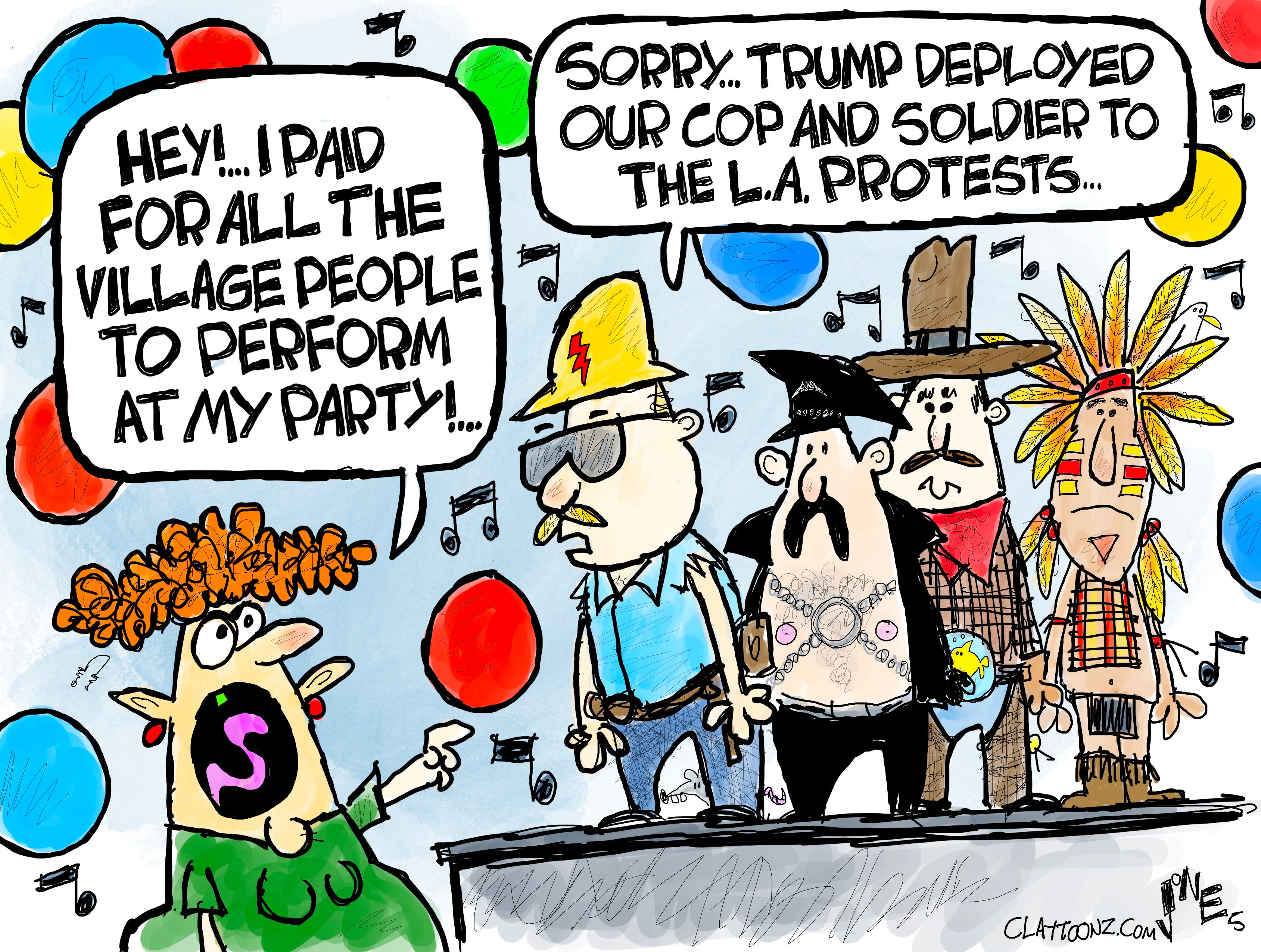
The situation in Los Angeles doesn’t require military assistance. There are already 2,100 guard troops in the area with another 2,000 on the way, and now 700 Marines will join the party at a cost of around $134 million to taxpayers, which is five Trump golf trips, or three Trump birthday parades.
The military is deploying 9,000 troops for the parade.
Back to LA, these are protests, not riots. But Trump’s trying to create a riot.
Trump posted on Monday, “IF THEY SPIT, WE WILL HIT, and I promise you they will be hit harder than they have ever been hit before. Such disrespect will not be tolerated!” Remember, this is the guy who pardoned White nationalists MAGAt terrorists who attacked cops on January 6, 2021. They did a lot more than spitting.
Trump is also praising himself, saying that Los Angeles would have “burned to the ground” if he hadn’t called in the National Guard. The protests are in a small area in the city of 4 million people. There were only around 400 protesters when Trump decided he should call in the military.
Trump wants a riot because it’ll give him more excuses to expand his power and extend his authoritarianism. Calling in more soldiers and Marines creates a much more hostile atmosphere, and creates more protests in other cities, which Trump will use to deploy more of the military to fight civilians. Trump is fanning the flames. In another post, he said we will “Liberate Los Angeles from the Migrant Invasion, and put an end to these Migrant riots. Order will be restored, the Illegals will be expelled, and Los Angeles will be set free.”
That post is designed to create riots. (snip-MORE, and it’s on point)
Ever since Donald Trump came down his racist escalator and vaulted himself to become leader of the Republican Party in 2015, a popular theory has taken hold in liberalism and particularly at the highest levels of the Democratic Party: “Distraction.”
The idea goes something like this: Because Trump is a creature of the modern media environment and because we are constantly bombarded with narrative after narrative, Trump and his acolytes within the GOP are regularly setting off distraction bombs, meant to keep us occupied while they’re up to no good behind closed doors.
There were two recent invocations of distraction theory worth noting. First, the fight between Elon Musk and Donald Trump was purportedly a distraction from the harm of the “Big Beautiful Bill” that intends to destroy the social safety net. A few days later, some Democratic leaders argued that the attempted military incursion of Los Angeles over immigration was also a “distraction” from the bill. It was also argued by California Gov. Gavin Newsom – who is directly involved in the Los Angeles “distraction,” ironically – that the deportation of Kilmar Abrego Garcia to El Salvador was also a “distraction.”
If it isn’t already clear, I think this theory of the world is very stupid and frankly counterproductive. It operates as if we are still somewhere in the distant past, when only a few narratives could ever operate at one time, usually with a clear “A” story and one or more less important “B” stories. But it is 2025 and that method of operation has long been obsolete.
We are in an ideological war with the American right. They are attacking everything good and right about America and are trying their damnedest to drag us back to the stone age when women, minorities, and LGBTQ people were a subordinate slave class to the whims of wealthy, straight, white men.
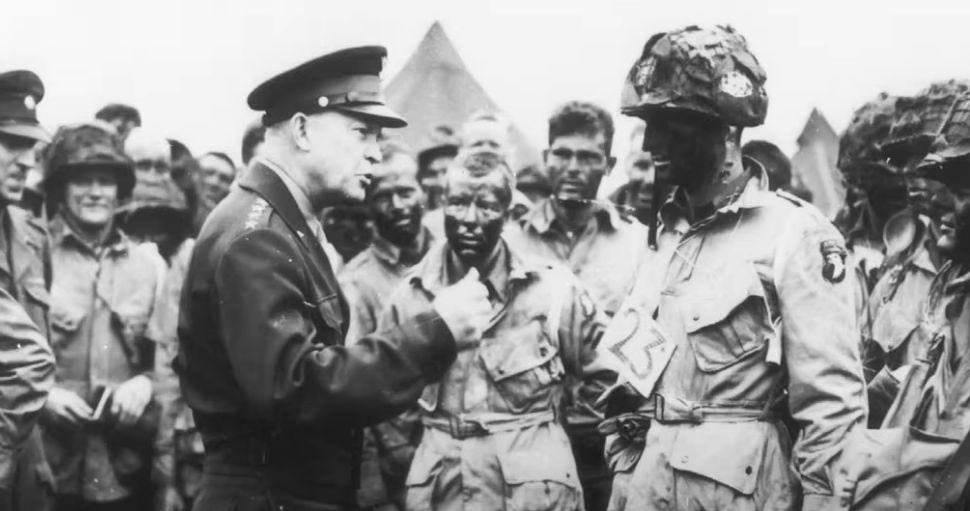
These things aren’t distractions. They are fronts. America fought war on two fronts during World War II, taking on the Axis powers in the European and Pacific theaters. There wasn’t any choice in the matter. There were American soldiers island hopping toward Japan and there were soldiers landing on the beaches of France and Italy on their way to Berlin. Leaders like Franklin Roosevelt and General Dwight D. Eisenhower, while they had to prioritize targets and objectives, didn’t have the luxury of saying the war couldn’t be fought on either side of the U.S. It was an existential battle for survival and they were victorious on both sides.
That is the situation we are in now against conservatism and Republicans. Liberals have to make the case, over and over, that these people are unfit to rule and shouldn’t be allowed anywhere near the levers of power. Every action that liberals and its representatives within the Democratic Party undertake should underscore that clear goal.
That means war on multiple fronts. Sometimes that means pushing legislation and investigation. Sometimes that means a press conference or media briefing. And yes, sometimes that means childish insults, memes, and trash talk.
WASHINGTON — Bradley Bondi, the brother of Attorney General Pam Bondi, lost his bid for president of the D.C. Bar, receiving 3,490 votes compared with opponent Diane Seltzer’s 34,982.
Seltzer, an employment lawyer who ran a campaign focused on supporting members of the organization at a time of “governmental chaos,” said after the results were announced Monday that she credited the D.C. Bar’s members with showing up and saying what kind of leader they wanted.
“We’ve got to make sure that we hang on to the rule of law and that we can practice law safely,” Seltzer told NBC News. “That we can represent who we want without worrying about retaliation, and that judges can issue fair and impartial rulings without worrying about being intimidated or retaliated against.”
The result came amid the Trump administration’s attacks on judges who have ruled against its policies, as well as on law firms that have represented causes or clients President Donald Trump doesn’t like. Last month, federal judges struck down Trump’s executive orders against Jenner & Block and Perkins Coie, finding the orders unconstitutional. (snip-MORE)






 Scottie's Playtime