The Society for Human Rights, the first gay rights organization in the U.S., was founded in Chicago by Henry Gerber, a German immigrant. He had been inspired by Germany’s Scientific Humanitarian Committee, formed to oppose the oppression of men and women considered “sexual intermediates.”
Henry Gerber–founder of the Society for Human Rights
November 9-10, 1938 Nazis looted and burned synagogues and Jewish-owned stores and homes, and beat and murdered Jewish men, women, and children across Germany and Austria. Known as Kristallnacht, it was a night of organized violence against Jews marking the beginning of the Holocaust with the killing of 91 and the deportation of 30,000 to concentration camps. The German word translates to “the Night of Broken Glass,” so called because of the vast number of broken windows in Jewish shops, 5 million marks worth ($1,250,000). Read more
November 9, 1965 At the first draft-card burning [see November 6, 1965], a heckler shouted that they should burn themselves, not their draft cards. Three days later Roger LaPorte, a student of religion and a Catholic Worker volunteer, poured gasoline on himself and struck a match to it in front of the United Nations headquarters in New York. Police managed to douse the flames. Roger LaPorte On his way to the hospital he said, “I’m a Catholic Worker. I’m against war, all wars. I did this as a religious action.” He died 33 hours later. Dorothy Day, founder of the Catholic Worker movement and a speaker on the 15th, wrote that she believed that LaPorte knew it was wrong to take his own life. But she explained his desire to end the Vietnam War; in the previous few days, six massive air strikes had made it the deadliest week since the war began. Read more
November 9, 1984 U.S. peace activists sailed a shrimp boat into the Port of Corinto to confront U.S. warships threatening Nicaragua. The U.S. had mined the harbor in violation of international law, and had invaded Nicaragua through this port in 1896 and 1910.
November 9, 1989 For the first time since World War II, free travel between East and West Germany was allowed. The Berlin Wall, built to stop the exodus from the Communist-controlled East in 1961, was opened in response to nonviolent popular action.
November 9, 2002 Somewhere between 450,000 and a million Europeans in Florence, Italy, peacefully protested the threatened U.S. invasion of Iraq. Florence, Italy 11.9.2002 The inaugural meeting of the European Social Forum had just concluded there.It was a regional part of the framework established at the World Social Forum which had met in Porto Alegre, Brazil, first in 2001. Read more about this protest The Forum is a citizens’ movement exploring alternatives to globalization and the inhumane consequences of the changing world order. They focus on sustainable development, social and economic justice. Those who were part of the Forum come from a broad range of civil society, including: pacifists; environmentalists; those in nonprofit, volunteer and non-governmental organizations; representatives of religious and lay groups; those in the anti-globalization and anti-capitalist movements; and, for the first time in Florence (Firenze), significant involvement of the labor movement, notably the European Trade Union Confederation (ETUC), and trade unions or national confederations from nine European countries, including Russia.
By just do something … everything he says is tell them what progressive policies you will push to help them in their lives. That is what the people needed to hear, progressive polices to take the country back from the wealthy and lift up the hurting lowering incomes. Again as he mentions the first openly trans person was elected to the US congress. Democratic candidates need to stop following the right ever more to the right moving to a mythical center and go openly and decisively to the progressive helping the working / low income people that they used to champion. Hugs
Rep. Marjorie Taylor Greene, R-Ga. speaks during the first day of the Republican National Convention.
Fresh off of her Election Night victory, anti-LGBTQ+ Rep. Marjorie Taylor Greene (R-GA) has expressed excitement that she, President-elect Donald Trump, and their MAGA cohorts will no longer tolerate “turning our kids trans.”
“I am so excited!” Greene said from Trump’s Mar-a-Lago Election Night party to convicted former Trump advisor Steve Bannon on the Real Americas Voice network. “America will no longer tolerate this communist regime, ripping our border wide open, turning our kids trans, and promoting abortion as reproductive rights. The American people are fed up with a weaponized government. President Trump is going back to the White House!”
She said that “Big Pharma” is lying to people about gender-affirming care.
She also claimed that Republicans will have to “continue to fight for election integrity…. because the Democrats will steal elections if they’re given the opportunity.” She and Trump have baselessly claimed that Trump only lost the 2020 election due to an unprecedented nationwide conspiracy of voter fraud that only occurred in the states that Trump lost.
She also said that Trump will pardon the insurrectionists who were jailed for the January 6, 2021 attack on the U.S. Capitol, “end the climate change scam,” and “go after the people” who persecuted Trump and his supporters, including former U.S. Rep. Liz Cheney (R-WY), U.S. Attorney for the District of Columbia Matthew Graves, U.S. Rep. Bennie Gordon Thompson (D-MS), and former House Speaker Nancy Pelosi (D-CA). Trump has referred to Pelosi as a “sick, crazy b**ch” and “an enemy from within.”
In July, Greene spoke at a press conference heralding the start of Bannon’s four-month sentence in the Danbury Federal Correctional Institution today for defying a congressional subpoena investigating his assistance in inciting the January 6, 2021 Capitol riots.
Greene has previously said that an airplane never hit the Pentagon during the September 11 terrorist attacks, claimed that all school shootings are fake, said that California wildfires were started by a Jewish-owned space laser, and accused former Secretary of State Hillary Clinton of slicing off a child’s face and wearing it.
Trump has promised to ban gender-affirming care for minors nationwide and prohibit federal agencies from “promot[ing] the concept of sex and gender transition at any age.” He has pledged to deny federal funding to schools that push “radical gender ideology, and other inappropriate … sexual or political content on our children.” He has also promised to repeal Biden-era protections for LGBTQ+ students “on Day One.”
Trump insulted Bannon when he was convicted of a crime
On the last day of Trump’s presidency, he pardoned Bannon who served as chief executive officer of Trump’s 2016 presidential campaign. Bannon also served as White House chief strategist and senior counselor to Trump from January 2017 until August 18, 2017, when Trump fired him.
In August 2020, Bannon was indicted by a federal grand jury for allegedly spending $1 million of a $25 million GoFundMe campaign to help Trump construct a U.S.-Mexico border wall. Bannon pleaded not guilty and was set to face trial in May 2021 before Trump pardoned him.
Trump initially said the Mexican government would pay for the wall — they never did, and Trump only built 458 total miles of barriers, PolitiFact reported.
In January 2018, Trump and Bannon’s relationship soured after Bannon was quoted in Michael Wolff’s book Fire and Fury: Inside the Trump White House as calling the president’s daughter Ivanka Trump “dumb as a brick” and calling Trump “a crooked business guy” and a “scumbag.”
In response, Trump said in a statement, “Steve Bannon has nothing to do with me or my Presidency. When he was fired, he not only lost his job, he lost his mind,” adding, “Steve had very little to do with our historic victory.” Trump later referred to Bannon as “Sloppy Steve” on Twitter (now X) and claimed that Bannon “cried when he got fired and begged for his job.”
Donald Trump has been outspoken against the LGBTQ+ community. (Getty)
At the time of writing, it seems almost inevitable that Donald Trump will become the 47th President of the United States, meaning LGBTQ+ rights are under serious threat.
The election was one of the closest in history according to voting polls over the past few weeks, with polling group FiveThirtyEight reporting that Harris just barely reached a 1.2 per cent lead on Trump a day before the results were counted.
The last Trump presidency led to a roll-back of protections and anti-discrimination laws for LGBTQ+ people, and it doesn’t look as if a second term would be any different if he is re-elected, based on campaign promises and the detailed policy proposals outlined in Project 2025 – although Trump has tried to distance himself from the right-wing proposals.
In anticipation of a Trump win, the American Civil Liberties Union (ACLU) suggested a new Trump administration would “reinstate and significantly escalate the removal of anti-discrimination policies… proactively require discrimination by the federal government [and] weaponize federal law against transgender people across the country”.
So, what are Trump’s views about LGBTQ+ rights, and what exactly might he do?
Erase federal non-discrimination protections for LGBTQ+ people
Trump’s first term was extremely detrimental to the rights and protections of LGBTQ+ people, and a second term could roll back protections once again.
LGBTQ+ people might no longer be guaranteed to be free of discrimination across several federal government programs, such as Social Security, Medicare, housing and employment.
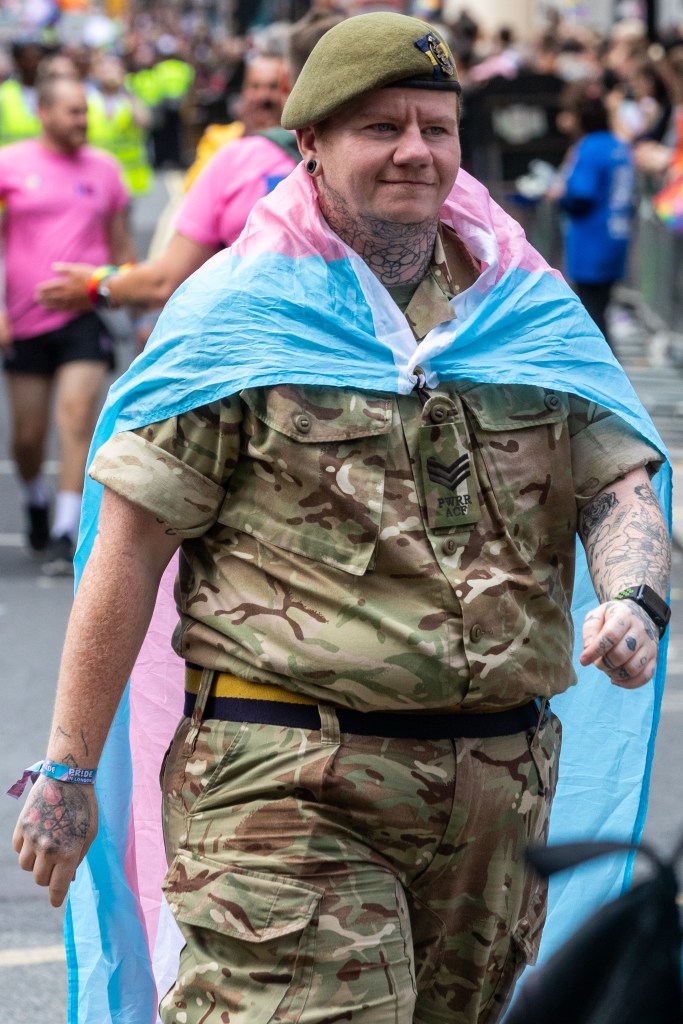
Exclude openly transgender people from the military
The first Trump administration reversed policies allowing trans people to serve in the military, and it is not difficult to foresee the president doing so again.
Another ban on trans people in the military would force out active-duty transgender service personnel as well as prevent trans people enlisting in the future.
This is despite a report in 2016 revealing that trans-inclusive policies have “little or no impact on unit cohesion, operational effectiveness, or readiness”.
In fact, trans-inclusive military policies could benefit all active service members by “creating a more inclusive and diverse force.”
Trans people could once again be banned from serving. (Getty)
Withhold federal funding if school officials affirm transgender students
Trump has said he would act to stop any school district introducing or maintaining trans-inclusive policies and practices.
This would include withholding federal funding that allow trans students to use toilets and changing rooms that align with their gender identity, or even acknowledging that they are trans, as well as arguing that trans-inclusive policies violate the rights of cisgender pupils.
Discrimination against trans students, causing significant harm to the community as a whole, would be the likely result of such a move.
During a recent campaign rally, Trump said he was not going to “let” trans women compete in sporting events at all if he becomes president again.
He said invoking the ban would “not [be] a big deal”, citing recent sporting events in which trans women competed against cisgender women, claiming that the trans athlete had a competitive edge over their opponent.
“Physically, from a muscular standpoint… look at what’s happened in swimming. Look at the records that are being broken,” he said.
Prohibit gender-affirming care in federal healthcare programmes
His website also promises that on his first day in the Oval Office, he would issue an executive order “instructing every federal agency to cease all programs that promote the concept of sex and gender transition, at any age”.
The administration would also probably deny Medicaid funding for hospitals that provide gender-affirming care, forcing medics to deny trans people the care they require.
Access to healthcare for more than 100,000 transgender youngsters in 24 states has already been halted in the past three years.
Allow employers to discriminate against LGBTQ+ staff
A second Trump administration could bring in provisions to allow employers to discriminate against LGBTQ+ members of staff based on the boss’ stated religious beliefs, a reversal of existing non-discrimination laws.
This would not require congress or bipartisan support, and could be pushed through using an executive order from the president.
The administration could go one step further to prevent state and local governments enforcing non-discrimination laws if the defendant says the discrimination was based on religious belief.
Laws protecting LGBTQ+ people and other minorities from discrimination based on protected characteristics might also disappear.
Donald Trump has continued to target the LGBTQ+ community. (Getty)
Criminalize gender-non-conformity in public life
Project 2025 – a hard-line right-wing blueprint for a future Republican president – suggests the use of criminal laws to punish gender-non-conformity in public life, with pornography being the crux of the issue.
The authors of the plan, the Heritage Foundation, inexplicably link pornography with “transgender ideology” and argue that neither has a “claim to First Amendment protection” and therefore should be outlawed.
“The people who produce and distribute it should be imprisoned,” they demand. “Educators and public librarians who purvey it should be classed as registered sex offenders, and telecommunications and technology firms that facilitate its spread should be [closed down].”
That means any discussion of transgender people in schools and libraries could be criminalized, and trans people might face jail time for being themselves.
Trump would only be able to put this into practice with congress’ approval and there is unlikely to be bipartisan support for such a law, but even the slim possibility is terrifying.
Finally – could gay marriage be reversed?
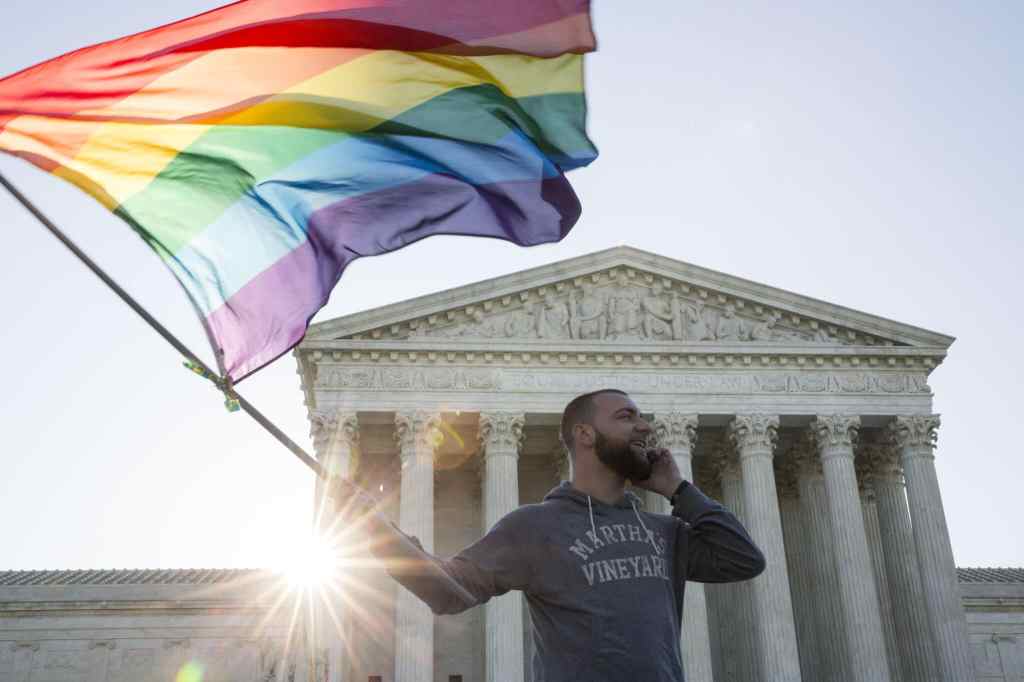
Same-sex marriage supporter Vin Testa, of Washington DC, waves a rainbow pride flag near the Supreme Court. (Drew Angerer/Getty Images)
Unfortunately, yes, it could.
After crucial abortion legislation Roe v. Wade was overturned by the Supreme Court, many people said that next, they would be coming for Windsor and Obergefell and Lawrence – three rulings that unlocked a national right to same-sex marriage.
Whether a same-sex couple could marry varied by state before 2015. With its 5-4 decision in Obergefell v. Hodges, the Supreme Court extended the full federal right to marry to all same-sex couples.
So would – or could it be taken away? Many people think that the Supreme Court wouldn’t dare. Same-sex marriage is now too accepted in American society, they argue. It would cause “legal chaos.”
However, it remains the case that some justices, particularly Samuel Alito and Clarence Thomas, appear to be itching to overturn Obergefell. In 2022, Justice Thomas said the Supreme Court “should reconsider” its past rulings codifying rights to contraception access, same-sex relationships and same-sex marriage.
It’s important to remember in all of this Pride is a protest, and it continues to be. We can fight any and all of these attacks by standing up, speaking out and refusing to stay silent.
Beautiful art and non-snarky commentary. If the Support Free Content banner is up (I use AdBlock plus, but I turn it off on many sites, including SBTB,) just tell it you’ll fix it next time. It should only pop up if your ad blocker is on. This is worth it, and the ads, well, after I turned my blocker off, I still didn’t get ads. These covers are fabulous.)
The NSW equality bill brings the state into line with others. Photograph: Dean Lewins/AAP
Rights and protections for LGBTQ+ people in New South Wales have been strengthened with the passing of a bill in the state parliament late on Thursday, after the legislation was watered down to gain Labor support.
The equality bill will give transgender people the ability to have their sex changed on their birth certificates without undergoing invasive surgery, bringing the state in line with others, and non-binary will become a gender option for birth certificates.
There were cheers in the chamber when the bill passed about 8.40pm. The independent MP Alex Greenwich, who introduced the package a year ago, embraced the leader of the government in the upper house, Penny Sharpe after the vote that succeeded without the opposition’s support.
Greenwich said the changes would “improve LGBTIQA+ dignity, safety and equality” and thanked Sharpe for her work getting the legislation through the upper house.
“We’ve got more work to do and we start that work now with new confidence from these significant wins for our community,” he said on Thursday night.
After months of stagnation, Greenwich convinced the premier, Chris Minns, to support the bill by making a number of major concessions, including dropping changes to the anti-discrimination act.
While advocates welcomed the remaining elements of the bill, many also raised concerns that protections for LGBTQ+ teachers and students at private schools had been dumped.
The Equality Australia chief executive, Anna Brown, thanked community members who shared their stories and all those who campaigned to garner support for the changes.
“These new laws will have no impact on the lives of most people in our state, but for a small number of people it will make their lives immeasurably better,” she said after the bill passed.
“It’s a journey that continues as we turn our attention to the state’s anti-discrimination laws and our ongoing efforts to protect vulnerable teachers and students in religious and private schools across the state.”
Greenwich had hoped the Coalition would allow MPs a conscience vote on the bill but earlier in the week the opposition leader, Mark Speakman, confirmed his party would stand against the reforms.
Despite that, the Liberal MP for the North Shore, Felicity Wilson, crossed the floor.
“Just because your party doesn’t have a conscience vote doesn’t mean you don’t have a conscience,” she told ABC Radio Sydney earlier in the week.
Greenwich said on Wednesday that the Coalition was moving further to the right and “using my community as a political football, as a political punching bag”.
“I am concerned that we are seeing a rightwing trend developing within the Coalition,” he said. “No other leader has denied their members a conscience vote on LBGT issues.”
The opposition attorney general, Alister Henskens, held a news conference with religious figures and community members opposed to the reforms earlier in the week.
Among the concerns he raised was about the “impact upon the privacy of women’s spaces”.
“It’s moving too far and it’s moving too quickly,” he said.
But the attorney general, Michael Daley, said the opposition was misrepresenting the package.
The bill also repealed offences for living off the earnings of a sex worker and made threatening to “out” a person’s LGBTIQA+ status an offence.
It has struck me that we need a reduce-stress-be-in-the-moment-self-care sort of thing. Some of us have chronic conditions, some are recovering from surgery, some of us are physically fine other than great stress that may be getting the better of us, and some of us may have a combination of some or all, or even something else. I’m pretty sure we’re all aware of tools, but sometimes things are so worrying that we forget about that, as we urgently try to fix things, or even submit to our brains’s workings with cortisol and fear and what all. So. I don’t know what, if any of this, might help someone, but I gotta try. So here’s what’s likely gonna be a long post, with a mixed bag of stuff. Actually, I think it may turn into 2 separate posts, because I see I’ve only got one item covered, and it’s already post-length. So there may be Part 2. And maybe yet another one.
I think I should first refer people to the hotlines where professionals want to and can help. Maybe someone thinks they don’t need or want to call, or maybe someone thinks they’re not there yet. It’s just good to have the resource at hand, is all. Some gain strength from knowing they can call. So, of course, there’s 911, or whatever the 3 digit emergency number is where you live. Then, more specifically, there are numbers for mental health assistance, like 988 where you can text Q to 988 if you want an LGBTQI+ affirming counselor. National Domestic Violence Hotline , (800) 799-7233. Crisis Text Line ,Text HOME to 741741. National Sexual Assault Hotline , (800) 656-4673. SAgE’s Farmer Support Hotline , 833-381-SAGE. Veterans Crisis Line , 988, then PRESS 1 Text 838255, Chat online. Much more at https://www.apa.org/topics/crisis-hotlines . Also, https://glaad.org/resourcelist/ . No doubt I’ve missed something, so please put it in comments.
I will share a bit about myself here. I’ve been diagnosed with generalized anxiety. Could be brain chemistry, could be that my life has not been a calm flow, both, something else. Whatever it is, I have it. Having treated and therapized, I know which tools work for me, and I use them, sometimes unconsciously. Anyway, I don’t like seeing people having trouble, or being troubled, or being hungry, sick, cold, hot, traumatized by war, etc., etc. My mindset has always been to do all I can to fix. Mostly to fix things immediately for the people I’m trying to help, but also the bigger working to fix. We’ve all seen my posts where I’ve shared some of the issues and items on which I work.
The thing about that is, it helps me to feel like I’m doing something that can help somebody else. It overrides anxiety and introversion when I have a reason to be “bothering” people for the greater good.
In regard to current events stress, which is weighing on all people everywhere, there are many of us around the world who are able to do just that one thing that seems so tiny-an hour on the phone, say-to make a difference, and reduce our concerns and stress. So, here is the volunteer page for the Harris-Walz campaign: https://go.kamalaharris.com/ . They still need people to make calls. Making calls to voters in other states is one of my favorite parts of helping a campaign! With a cell phone it’s almost cost and pain-in-the-neck free. Again, I’m aware of various medical issues around the commentary; that’s why I say even one hour will help the campaign, and will also help us. In addition or instead of this, one could contact campaigns of legislative candidates, like Sen. Brown, Sen. Baldwin, Rep. Sharice Davids, Colin Allred, and so many more. An hour of calls will help. And, again, you will feel better having spoken with people to further the greater good.
Now calling is a thing I’m putting forward. To me, it’s personal for each of us, what and how much we’re doing about the stress of the things in the world. I neither need nor want to know if/what anybody’s doing. I’m only putting this out as a thing from which to take our power, to put our power to work.
Since this is this long, I’ll put the first post I read this morning, it inspired me. It’s good-one of those things I needed to read, though I didn’t know it until I got started. It reminded me that while I didn’t necessarily learn or have these experiences in the same way or as early in life, I know these things, and I can do them when needed. I bet we all do, and can. I’m going to share a goodly snippet, but we should read it all if we can. Then, I’ll stop for lunch, then bring back another post part. Well, unless any- or everyone comments that they’re good, and please no more! 🌞 😄 And now from Vixen Strangely:
I tell this about myself because its true and a little weird, but when I was small, my dad taught me how to hook my fingers up and around an eyeball in its socket–just in case I ever had to. I knew what a xyphoid process was at six years old. I knew where to drive the heel of my hand into a human nose. I was taught that I didn’t have the physical strength advantage in life, so I had to have the will. I was taught that you have to walk in awareness. I was taught you watch your drink. I was taught to carry improvised weapons. I was taught to see the world in terms of potential improvised weapons.
I was taught this because some boys never get told what they should never try. Or get told but don’t really learn it. (You don’t use your knee–it’s inexact. You grab them by it. You can squeeze and disrupt a generation of losers. And I never had to do any of that. Not once. Because it’s really only a small percentage of men who are actual monsters–most are reasonable and not actual sociopaths. I like men, really. They are interesting enough and some have valuable skills. They care for the people around them and often are smarter than they think they are. It’s a confidence issue. When you are told to value muscle over brain, you know.)
I was raised to think, more or less, there wasn’t anything I couldn’t do. Math, science, art, politics. Sports. And it simply never occurred to me women were just out there, somewhere, either not voting because their husbands said they couldn’t or voting for exactly what their husbands told them to, until I heard about that in my early adulthood–because why? That’s crazy: we’re fully-fledged adult people, right? Even if I knew I was born just before Roe and just before women generally could even get credit in our own names.
I’ve been married twice. The idea of a man not knowing what he’s even getting politically going into a relationship is weird to me–this is me. We are talking politics. You don’t know me and not know my politics.
I was told to put in the work. Show it. Show up. I learned how to put a little bass in my voice. I learned respect is earned, not one time, but every time.
Donald Trump never had to earn the respect that he has from the bottom up, in any environment where respect wasn’t just his for showing up. Women can see through it. Do you not see his relationship with Jeffery Epstein? The couple dozen claims of sexual harassment or assault? How he speaks about women all the time? The religious right (that he has allied with) desire to end no-fault divorce and the grinning sadist desire to monitor our menses and try to punish us for our fertility and even stop us from travelling to other states to save our lives? (snip-More)
The stakes in United States v. Skrmetti are even higher than most Americans realize and could have wide-reaching consequences if the court rules to keep the ban on gender-affirming care in place.
This piece was published in partnership with The 19th, a nonprofit newsroom covering gender, politics, and policy. Sign up for their newsletter here.
A Supreme Court case that will decide whether Tennessee can continue to ban gender-affirming care for transgender youth could imperil the ability of all Americans to make decisions about their health care, experts say. The outcome depends on how far the court is willing to stretch its ruling that overturned federal abortion rights.
In United States v. Skrmetti, the court has agreed to take up the question of whether gender-affirming care bans for trans youth are unconstitutional, in response to the Biden administration petitioning on behalf of trans youth and their families in Tennessee — one of 26 states that has bannedsuch care for minors. The outcome of the case will grant much-needed clarity in a political landscape that has thrown the lives of trans people across the country into turmoil, as hospitals turn patients away, pharmacies deny prescriptions and families travel hundreds of miles to find care.
But with the case set for oral arguments on December 4, the stakes are even higher than most Americans realize, legal and policy experts say. Tennessee has banned gender-affirming care, such as puberty blockers and hormone replacement therapy, for a specific demographic — trans youth — while allowing those same treatments for cisgender youth. If the Supreme Court allows the state to keep its ban in place, that could imperil everyone’s access to health care.
“What the state of Tennessee is arguing is really dangerous for any person who has any sort of medical condition,” says Ezra Young, a civil rights lawyer and constitutional scholar. Tennessee is dictating what medical treatments people should or should not be allowed to have, Young said; that goes well beyond states’ authority to regulate medicine, specifically because giving health care to trans people is not a public health concern.
“The state can make sure that the doctor you see has a medical degree and has an active medical license, for instance,” he says. “What the state can’t do is micromanage the medical decision-making of patients or doctors, and that’s for good reason. Bureaucrats or lawmakers aren’t medical experts.”
Yet in half of U.S. states, Republican lawmakers have banned or restricted medical care that many trans people need to live, over the protests of the American Medical Association, American Psychiatric Association, and other leading medical groups. Federal judges have attempted to block these bans from taking hold, finding them to be likely unconstitutional. Appeals court judges have disagreed and overturned those decisions. Now, the Supreme Court will have the final say.
“If we don’t win here, it’s going to be open season on any health care related to transgender people,” says Shannon Minter, legal director of the National Center for Lesbian Rights. If the Supreme Court holds that banning gender-affirming care is not discriminatory, then trans people would no longer be protected under the Affordable Care Act, he argues. States and private insurers would be able to exclude gender-affirming care from coverage plans.
“It would be devastating. I mean, absolutely catastrophic,” Minter says.
Ultimately, the outcome of this case will have a wider impact beyond gender-affirming care. A Supreme Court ruling endorsing Tennessee’s argument that the state can ban safe medical care — just because it disagrees with who that treatment is being given to — would enable the government to control people’s health decisions and enact other blatantly discriminatory policies, legal experts say.
“I think this case has bigger and broader implications than a lot of people realize, even frankly within the legal community,” says Michael Ulrich, an associate professor of health law, ethics and human rights at Boston University’s School of Public Health and School of Law. If the Supreme Court agrees with Tennessee’s ban, there’s nothing stopping states from banning or restricting other kinds of health care, he said — like what gets covered under Medicaid.
Solicitor General Elizabeth Prelogar’s office, representing the Biden administration, will split argument time before the Supreme Court with Chase Strangio, co-director of the American Civil Liberties Union’s LGBTQ & HIV Project.
The United States v. Skrmetti case is focused on whether Tennessee’s gender-affirming care ban violates the 14th Amendment’s equal protection clause, which prohibits discrimination on the basis of sex. The state insists that its ban has nothing to do with sex and that it does not target trans people. Instead, the law “sets age and use-based limits,” Tennessee’s attorney general argues. Minors can still access hormones and puberty blockers for medical purposes, as long as those treatments are not being used as part of a gender transition or to alleviate gender dysphoria. The state claims such a distinction is not based on sex because “neither boys nor girls can use these drugs for gender transition.”
In Dobbs v. Jackson Women’s Health Organization, the Supreme Court found that there is no constitutional right to an abortion in the United States. This ruling overturned Roe v. Wade, the landmark case that had guaranteed the right to an abortion since 1973. When writing the majority opinion in Dobbs, Supreme Court Justice Samuel Alito briefly addressed a theory that suggests abortion could be covered under the 14th Amendment’s equal protection clause. This idea is not part of Roe, or at issue in Dobbs, but was invoked in a separate “friend of the court” brief. Alito dismissed it, saying that state regulations on abortion do not discriminate based on sex.
“So that’s what the state of Tennessee is now latching on to, this passing reference, this brief statement in Dobbs, and they’re pinning their whole argument on it,” says Minter. “Everything hinges on it.”
In Dobbs, Alito wrote that abortion cannot be protected under the 14th Amendment’s equal protection clause, citing the arcane Geduldig v. Aiello — a case about pregnancy-related disability benefits — and Bray v. Alexandria Women’s Health Clinic, a case dealing with the rights of anti-abortion protesters. These rarely cited cases found that state regulations on abortion and pregnancy, or opposing abortion, are not sex discrimination. Tennessee is now using this framework to argue that “any disparate impact on transgender-identifying persons” caused by its law does not single trans people out for discrimination in ways covered by the 14th Amendment.
If the state’s gender-affirming care ban is found by the Supreme Court to be discriminatory under the 14th Amendment, it is subject to heightened scrutiny — a more rigorous review to determine whether a law is constitutional or not. In that scenario, Tennessee is more likely to lose.
Using abortion case law to support bans on gender-affirming care is especially dangerous, experts say. Tennessee is taking the Supreme Court’s own decision in Dobbs out of context, according to lawyers who have worked in LGBTQ+ rights cases for decades. And, if the justices read Tennessee’s law, it is obvious that banning gender-affirming care for trans people is discriminating based on sex, they say.
The United States v. Skrmetti case is focused on whether Tennessee’s gender-affirming care ban violates the 14th Amendment’s equal protection clause, which prohibits discrimination on the basis of sex. The state insists that its ban has nothing to do with sex and that it does not target trans people. Instead, the law “sets age and use-based limits,” Tennessee’s attorney general argues. Minors can still access hormones and puberty blockers for medical purposes, as long as those treatments are not being used as part of a gender transition or to alleviate gender dysphoria. The state claims such a distinction is not based on sex because “neither boys nor girls can use these drugs for gender transition.”
But, although the question before the court has become more specific, this ruling still has the potential to broadly set back LGBTQ+ rights.
Tennessee argues that the Supreme Court’s 2020 ruling in Bostock v. Clayton County, which found that employment discrimination against LGBTQ+ workers is sex-based discrimination prohibited under the Civil Rights Act, has nothing to do with this case. But going down this road leads to more questions, Ulrich says: Is discriminating due to sexual orientation also not considered sex-based discrimination?
“Then you can see just a proliferation of discriminatory laws that are coming out thereafter,” he says. “That’s a really dangerous proposition for the entire LGBTQ+ community and it’s setting us back significantly.”
Sruti Swaminathan, an ACLU staff attorney who has been counsel in this case from the beginning, said United States v. Skrmetti will test how far the Supreme Court is willing to stretch its Dobbs decision. They are well aware that the outcome of this case could curtail bodily autonomy for everyone. And taking this challenge before a conservative-majority Supreme Court has stoked fears among trans people of worst-case scenarios.
“We’re already at the place where half the country has banned this care. We need to not let the 6th Circuit decision stand idly and be utilized in the way it has,” Swaminathan says.
But Tennessee’s tactics, and the consequences that they could have during a time when laws targeting reproductive and transgender health care are proliferating, still worry them.
“I’m terrified. What we learned from Dobbs is that these attacks won’t stop with abortion,” Swaminathan says. “Banning abortion seems to be one pillar of an effort to write outdated gender norms into the law.”
U.S. v. Skrmetti began as a lawsuit against Tennessee’s ban on gender-affirming care for minors.
Tennessee’s argument in this case illustrates a larger coordinated effort to attack abortion access alongside gender-affirming care, says Logan Casey, director of policy research at the Movement Advancement Project, a nonprofit that tracks LGBTQ+ legislation.
States across the country have attempted to define sex based on reproductive capacity at birth. These efforts open transgender people up to discrimination and ignore the realities of intersex people, as well as cisgender women with conditions like primary ovarian insufficiency. Proponents of gender-affirming care bans inaccurately portray the effects of hormone replacement therapy on trans people’s reproductive ability by conflating the treatment with sterilization.
This Supreme Court case exemplifies a much larger argument that’s been a through line across attacks on transgender care and trans issues across the country, Casey says: What is sex, and who is protected when we think about that?
“Many of these state actors and politicians and extremists are clearly very invested in the concept of sex and defining sex in a very restricted and extraordinarily old-fashioned way that focuses only on people’s reproductive capacity, and then they use that argument in whatever context they can to advance the policies that would match that worldview,” he says.


 Florence, Italy 11.9.2002






 Scottie's Playtime