(The Harvest [full] Moon is fullest at 10:47PM CDT tonight.)

https://www.gocomics.com/arloandjanis/2025/10/06

(The Harvest [full] Moon is fullest at 10:47PM CDT tonight.)
https://www.gocomics.com/arloandjanis/2025/10/06
It is simply magnificent.
Yeah, me, neither. Also! I am not, and never was, a KISS fan. I always thought they were bubble gum. Needless to say, I enjoy Clay Jones’s commentary re KISS!
MAGA KISS by Clay Jones
MAGA can kiss my arse Read on Substack
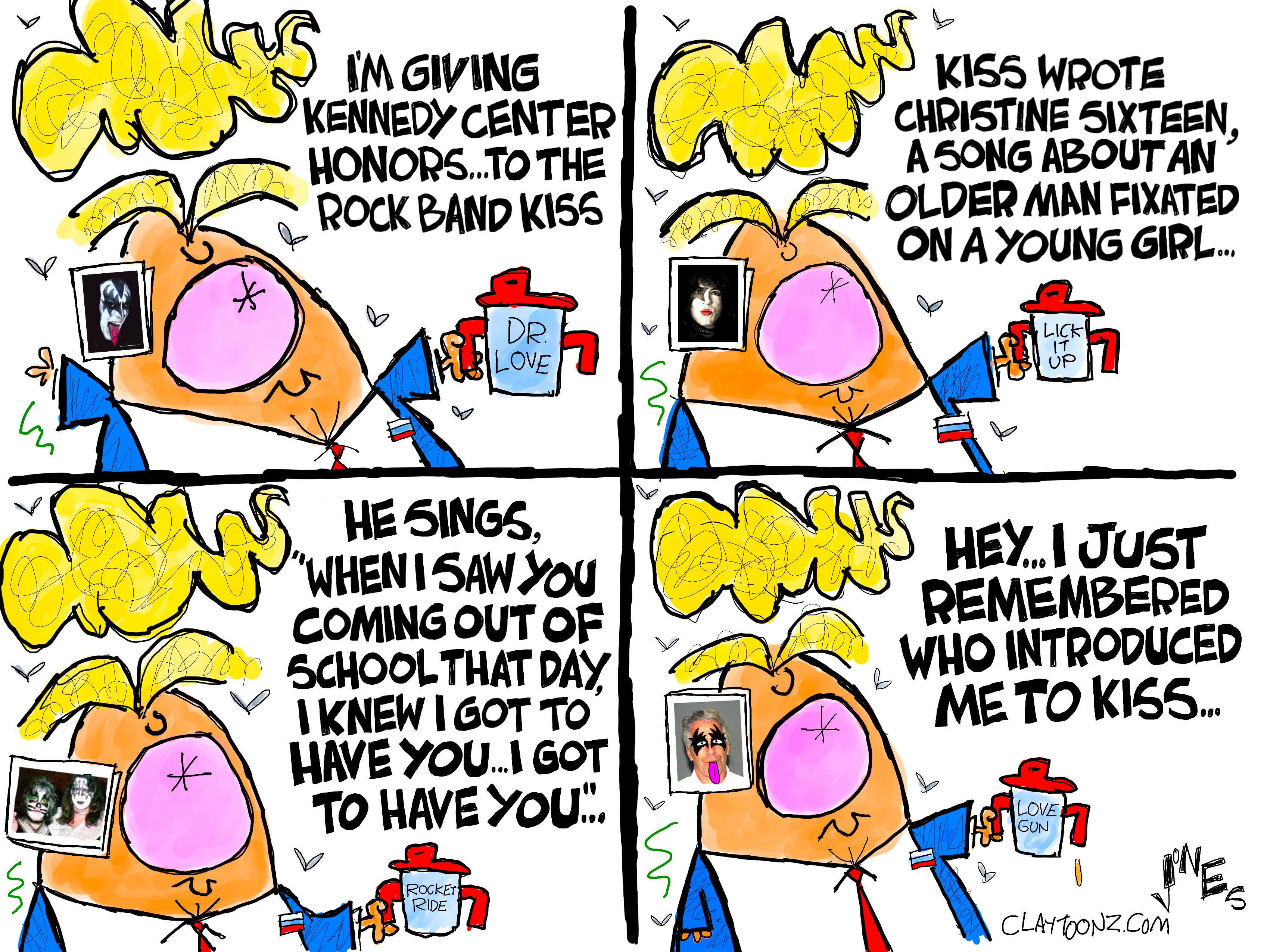
I’m a KISS fan, to an extent. When I was in the 4th or 5th grade, a friend introduced me to KISS, and I was hooked. I had posters and albums. I wanted to be Ace Frehley and started playing guitar. I was obsessed with KISS. Other than my guitar obsession (I’m still obsessed), all that was over by the time I hit the 8th grade. With a bit more maturity, I had become more interested in not just the current music of the time, like Van Halen, but another friend had introduced me to The Beatles, and I think I discovered the Rolling Stones on my own. I started paying attention to my mom’s music and got into CCR.
A few years later, I was walking through the music department of K-Mart, and saw the album cover for KISS’s latest album, Lick It Up, and learned that they had a couple of replacement members and had taken the makeup off. This was huge news in KISS world, but I was out of the KISS ARMY (that was the fan club) by that point.
And that’s the thing about KISS. Their audience was mostly little boys, such as myself. While KISS looked like a dangerous rock and roll band, at least at the beginning, they had become more of a marketing product than a rock and roll band. In addition to the posters I had, KISS were marketing lunch boxes, action figures, trading cards, bed sheets, pillows, comic books, and even had made a TV movie, KISS Meets the Phantom of the Park, which might be the worst TV movie ever.
KISS may have been serious about their music, but they weren’t taken seriously, which is difficult to obtain when each member is face-painted like a clown. The Insane Clown Posse is probably more respected. And while there are some gems in their catalog, most of their songs actually sucked. KISS chased trends. They started as a rock band striving to be on Led Zeppelin’s level, but they didn’t have the songwriting chops or musicianship, despite Ace Frehley being a badass (when he was sober enough to play on the albums, and didn’t force the band to use a hidden replacement for his lead guitar playing). KISS went from trying to be the next Beatles to producing a disco track, to chasing hair metal in the 80s, to writing songs with Michael Bolton and Bryan Adams, to making a grunge album. Critics didn’t like them, and they never made the cover of Rolling Stone during their prime (but did make it decades later for an article that was mostly retrospective).
They were more noted for their theatrics, fire-breathing, blood-spitting, and smoke pouring out of Frehley’s guitar than for their music.
Most musicians in respected rock bands are invited to play on other artists’ albums, such as Bob Seger, members of Fleetwood Mac, Mike Campbell of Tom Petty and the Heartbreakers, and every member of The Eagles. Even members of Cheap Trick got invites, and even lured Beatles producer George Martin to produce their albums. But I can’t think of a member of KISS who has ever played on another artist’s album. After leaving KISS, Ace Frehley called John Waite (the Missing You guy) to see if he’d like to start a band with him, and never got a return call. And Ace was the most successful solo artist to come out of the band (though his last album was embarrassing). Peter Criss’ albums are unlistenable.
Gene Simmons was not a good songwriter (sample lyric: “Let me put my log into your fire”), and his bass playing is still mocked today (they often used a hidden replacement, or Paul and Ace would play bass on the songs they wrote). Paul Stanley had an operatic voice (that didn’t have a natural sound), but he tried too hard to show it off, and his guitar playing and songwriting were cheesy. Peter Criss was more of a jazz drummer than a heavy rock guy like John Bonham of Zeppelin, and he had timing issues, but his voice had an amazing sound, especially considering that he was tone deaf. Ace Frehley, who is unfortunately a racist who used to get drunk and bang on his Jewish bandmates’ hotel room doors dressed as a Nazi (really. They used to call him RACE Frehley), inspired millions with his guitar playing, but his skills decreased due to his laziness and addictions. By hiring studio musicians to pretend to be Criss, Frehley, and Simmons on their albums and hiding it from the fans, KISS didn’t even take themselves seriously.
KISS was never a great band. So why are they the first to be honored by Donald Trump since he made himself the head of the Kennedy Center? Because Trump has no culture (ketchup on burnt steaks), and he has the maturity of a 12-year-old boy.
Trump will be hosting the ceremony for these “honors,” which will be interesting. People will probably tune in because folks love a good train wreck.
Each member of KISS expressed how honored and humbled they are for receiving these “honors,” but boys…being “honored” by Donald Trump isn’t really an honor.
That’s another difference between KISS and bands taken seriously. Musicians sue Trump to stop playing their music at his rallies.
And, yes. KISS has a song glorifying pedophilia. Gene Simmons wrote it. I had to adjust the lyrics for space, but those cited in the cartoon say,
“I don’t usually say things like this to girls your age,
But when I saw you coming out of the school that day,
That day I knew, I knew,
I’ve got to have you, I’ve got to have you.”
Even as a kid, I thought it was weird that Gene only saw Christine because he was hanging outside her school. (snip-MORE)
Hi Everyone. I’d like to share an artist that I think many will like. I enjoy learning of great singers that don’t seem to hit the radio. This is Dave Fenley. He’s got a great soulful and gravelly voice.

In the history and cultural impact of disco music, the 1977 blockbuster Saturday Night Fever, starring John Travolta as working-class “dance king” Tony Manero, wasn’t only notable for bringing the disco sound and culture to mainstream audiences, translating Vince Aletti’s writings for The Village Voice, Rolling Stone, and Record World for a much wider public, it also made a strong case for the cross-pollination of disco and perhaps its most antithetical genre: classical music.
“To a large degree, it was never a completely unified or singular style. Disco resulted in a global, Esperanto-like music that would be shared by, and marketed to, the world,” writes music historian Ken McLeod.
In the case of Saturday Night Fever, “[t]he use of disco-inflected classical music in the film represents the economic and social success to which Tony and his friends ultimately aspire,” argues McLeod. “The disco milieu represents one form of illusion—the illusion of power in the outside ‘real’ world that Tony imagines.”
Indeed, classical music represents an exotic world of sophistication, elitism, and wealth which, especially when merged with a homogeneous disco beat, becomes an enticing symbol of the unattainable, illusory, and artificial nature of Tony’s dreams.
Walter Murphy’s “A Fifth of Beethoven” makes its appearance when Tony and his friends arrive at the 2001 Oddyssey (sic) disco club.
“To some extent he is represented as the new heir to the cultural prestige of classical music,” writes McLeod of Tony’s appearance. The soundtrack, with its
seemingly contradictory and almost synthetically forced fusion of classical music and disco underlines the artificiality of his entrance and of the world into which he has crossed. It is likely no accident that the famous “fate” motive, heard here near the beginning of the movie, functions as a foreshadowing of the dramatic events that will soon unfold within this world.
“A Fifth of Beethoven” is easily the highest-profile instance of disco appropriation of classical music. Beethoven’s Symphony No. 5 is typically associated with notions of monumentality, heroism, fate, and relentless transcendence of the will. And while Beethoven’s version is about transcending humanity, Murphy’s is steeped in humanity, as it represents acceptance of common human desires—such as dancing—rather than superhuman transcendence of them.
The soundtrack also featured another instrumental disco–classical interpretation: David Shire’s “Night on Disco Mountain,” which adapts Mussorgsky’s orchestral tone poem Night on Bald Mountain (which is also the Chernabog segment in Disney’s Fantasia). “Night on Disco Mountain” is heard when Tony and his friend pretend to jump off the Verrazzano-Narrows Bridge.
“The faked suicides are symbolized by the ‘fake’ classical music,” writes McLeod.
Shire’s track adds another layer of grotesque ambient sounds to further heighten the atmosphere of chaos and alienation, producing what McLeod calls “an international and futuristic potpourri of sounds.”
“A Fifth of Beethoven” and “Night on Disco Mountain” weren’t isolated instances of classical–disco fusion. Wendy Carlos’s Switched-On Bach and Switched-On Brandenburgs recordings became instant commercial radio and dance hits. K-Tel Records initiated their popular Hooked on Classics series that combined classical music with elements of disco and pop music. This trend spawned a number of disco–classical albums such as Klassiks Go Disko, featuring “A Sixth of Tchaikovsky” and “Brahms’s Disco Dance No. 5,” and Saturday Night Fiedler, an album of disco arrangements by the Boston Pops.
“Many of classical music’s qualities, such as structural complexity and cultural prestige, were natural targets for simplification, reduction, and transmission to a mass audience,” argues McLeod. Artificiality is another common thread, as both genres thrive on the notion. “As in a discotheque,” he writes, “classical music is often enjoyed and appreciated in escapist settings by wealthy, well-dressed devotees.”
There are also similarities between classical and disco compositional style.
Not a big fan, but I enjoyed the Osbournes as a family and individually, and I wish peace and comfort to those who love Ozzy.
Ozzy by Clay Jones
RIP, Prince of Darkness Read on Substack

I was not a massive fan of Ozzy Osbourne, but I was still a fan. When I got a news alert in a text while on the city bus (see? I get news alerts, people) telling me he had passed, and just a few weeks after his final performance, I knew I had to honor him.
I was never really a metal head, but Ozzy ruled. Even if I didn’t like him, I was in a scene where everyone else did. I was very much in the know about Ozzy. If nothing else, I liked him solo more than I liked Black Sabbath.
Randy Rhoads is why I’m an Ozzy fan, and I still listen to him after Randy’s tragic death in 1982 from a plane crash. Randy’s career was just getting started with a bright future in front of him.
So, did Ozzay really bite the head off a bat? I have been hearing different versions of this story for years. But yes, it appears that he actually did. Reportedly, it wasn’t a stunt.
Ozzy used to throw out real animal parts during a tour in the early 80s. Fans learned about this, so they were prepared when they went to his shows. Somewhere in Iowa, a 17-year-old Ozzy fan threw a bat on stage. Ozzy thought it was fake and bit its head off. In one version, he said he discovered it was real when it was in his mouth and he tasted “warm, gloopy liquid,” and the head twitched. He claimed it was a live bat.
In a different version, he said it was dead. The kid who brought the bat also said it was dead.
Ozzy also told two different stories about biting the heads off doves at a meeting with CBS executives. In one version, he brought three live doves, and being drunk (Oz had substance issues), he bit the heads off all three of the LIVE doves.
In a second version, he brought one to release at the end of the meeting, but it died, so waste not, want not….he made use of it by biting its head off. I don’t know what actually happened. I wasn’t there.
Ozzy had just done his final performance a few weeks ago at a concert billed as “Back To The Beginning: Ozzy’s Final Bow,” in Birmingham, England, in front of 42,000. He sang from a custom-built throne as he had been suffering from Parkinson’s Disease for the past five years, and walking was extremely difficult for him. (snip-MORE)
==========
Snippet:
“This is supposed to be my farewell tour,” says Ozzy Osbourne in a clip included in the Biography television documentary above. He then gives the finger and adds, “We’ll see.” The year was 1993, and indeed, there turned out to have been much more to come for the former frontman of Black Sabbath, the band that opened the floodgates — or perhaps hellgates — of heavy metal. After an impoverished childhood spent playing in the bomb sites of postwar Birmingham, Osbourne hopped from job to job, including one failed stint at a slaughterhouse and another as a criminal. He then turned singer, receiving a PA system from his father and forming a blues group with a few local musicians. People pay good money to see scary movies, they one day reckoned, so why not make scary music?
The time was the late nineteen-sixties, when listeners approached record albums as quasi-cinematic experiences. Taking their name from Mario Bava’s anthology horror film, which had come out a few years before, Black Sabbath delivered on expectations many weren’t even aware they had. Today, anyone can put on an early Black Sabbath album and identify the music as heavy metal, not a world apart from any of its newer variants. (snip-MORE)
If asked to pick one Lady Gaga song to encapsulate who she is and what she stands for, you’d be hard pressed to come up with a better choice than “Born This Way.” Released in 2011, the song is a vibrant, full-body dance anthem that calls on listeners to celebrate who they are. “God makes no mistakes,” she sings in the refrain. “I’m on the right track, baby / I was born this way.” The song was immediately embraced upon release, particularly by the LGBTQ+ community.
As it turns out, this wasn’t the first time a song by that name made that kind of impact. In 1977, Motown Records released the disco anthem “I Was Born This Way,” an upbeat tune featuring a largely unknown Black gospel singer who responds to critics with a refrain that was a head-turner for its time: “I’m happy. I’m carefree. And I’m gay. I was born this way.”
READ: You Don’t Have To Understand Everything About Trans People To Love Us
In 2021, Gaga directed people’s attention to that song, saying it was the inspiration for her own hit. And in the new documentary I Was Born This Way, which premiered at the Tribeca Film Festival in June, directors Daniel Junge and Sam Pollard shine a light on its creation and its singer, Carl Bean, an extraordinary individual who spent his life serving his LGBTQ+ community.
Junge and Pollard’s film starts with the story of Bean’s childhood in Baltimore. And many of the main moments are unforgiving: His mother abandons him at birth because she doesn’t feel ready to have a child; his uncle sexually assaults him for years; Bean attempts to kill himself as a teenager after his previously loving adoptive father hits him for being gay.
Bean, who died in 2021 at age 77, faced hardships in his life, many of which the film explores. But none of the horrors of Bean’s life land with the kind of bleakness one might expect. It’s not that the documentarians pull their punches, either. It’s Bean — there’s a persistent lightness to his spirit, the quiet joyfulness of someone who by some miracle is able to see a broader perspective. Those qualities so suffuse the story of his life that no darkness can overcome them.
And that faith sustained him when he moved first to New York City, where he would sing with Harlem’s Christian Tabernacle Choir, and then when he moved to Los Angeles and started writing his own songs. In New York, he worked at Macy’s and became lifelong friends with Cissy Houston, Estelle Brown, and Dionne Warwick; in Los Angeles, he signed a record deal but then discovered they only saw him as a gospel singer. And then, out of nowhere, Motown Records reached out.
The song “I Was Born This Way” has its own interesting history, which Junge and Pollard track. It was originally written years earlier by Bunny Jones, a New York City beautician who was friends with Stevie Wonder and later became a promoter. She wrote the song for one of her acts, a gay performer. But it wasn’t until two years later, when Motown reworked the song for disco and gave it to Bean to sing (with his friend Estelle Brown on backup), that it took off.
“There was such a feeling of freedom and relief and release when you danced to that song,” Minority AIDS Project program director Mike Jones says in the documentary. “All of the things we were trying to say throughout our lives to many of our friends and family that we could not say were in that song.”
While the collapse of disco would see the song fade from people’s memories, the film reveals the ways it continued to quietly live on. Musician and record producer Questlove talks about how often it has been sampled in other work over the decades. Among other places, you can hear it on Debbie Gibson’s “One Step Ahead,” Deee-Lite’s “Good Beat (Turn Up the Radio Mix),” and Rick Wade’s “Free.” The song, he says, “is the music equivalent of the Giving Tree.”
Meanwhile, Bean faced an unexpected fork in the road. Motown offered him the chance to do another big song. But “I Was Born This Way” had changed his perspective on the meaning and purpose of his life. “I had found my niche,” he said. “I knew my gig was to be a change agent in our society.”
And the film recounts how that choice led him down a path he could not have expected. Seeing how little was being offered to people of color when the AIDS pandemic erupted in the early ’80s, Bean started making visits on his own, traveling from person to person he learned about on Los Angeles city buses. Eventually he founded the Minority AIDS Foundation, which provided a hotline for information and to arrange visits.
When he learned from social workers that he would gain greater access to those who were sick if he became clergy, he also got ordained. Unexpectedly, some of those he visited asked for an Easter service. He provided it, not realizing it would be such a positive experience that they would aske him to lead to more services. Eventually, he started his own church, Unity Fellowship, an African American Christian community specifically for LGBTQ+ people.
Bean’s decades of generosity would eventually cost him. In his later years, he found himself unable to move his lower body. “All of those years of racism, of homophobia, all of that death and dying, it had an effect on my mind, my spirit, my being,” he said. “My body shut down.” The revelation is stunning — there’s been no sign over the course of the film that he has been suffering or overwhelmed with grief.
It’s a telling reminder of the sacrifices and generosity of so many queer people like Bean, whose stories are not well known. It’s also a testament to their irrepressible joy: At the end of the film, asked whether he has any last words for the camera, Bean offers a simple thought that pours directly out of the work of his life, including his famous song. “Find the place in you that allows you to love yourself and others,” he says. “It begins with love and ends with love.”
Then, as the film crew starts to pack up, he starts laughing warmly. There’s no reason. He just has so much to give.
 Scottie's Playtime