October 12, 1492 Natives of islands off the Atlantic shore of North America came upon Italian explorer Christopher Columbus, who was searching for a water route to India for Spanish Queen Isabella.
October 12, 1945 Pfc. Desmond Doss became the first conscientious objector ever to be awarded the Congressional Medal of Honor. Doss, a Seventh Day Adventist, enlisted in 1942 but refused to carry a rifle or train on Saturdays. On the island of Okinawa, under heavy Japanese fire, he saved the lives of 75 sick and wounded soldiers by lowering them, one by one, down a 400-foot cliff. The guest house at Walter Reed Army Medical Center is Doss Memorial Hall in his honor. Read more (includes movie trailer)
October 12, 1958 A Reform Jewish Temple in Atlanta (the city’s oldest) was firebombed with fifty sticks of dynamite in retaliation for Jewish support of local black civil rights activists. The Temple’s Rabbi, Jacob Rothschild, was outspoken in his support of civil rights and integration, and was a friend of Reverend Martin Luther King, Jr. before he became well known nationally. From Georgia PBS
October 12, 1967 British zoologist Desmond Morris stunned the world with his book, “The Naked Ape,” a frank study of human behavior from a zoologist’s perspective. Morris had earlier studied the artistic abilities of apes and was appointed Curator of Mammals at the London Zoo. Read more
October 12, 1967 “A Call to Resist Illegitimate Authority” appeared in The Nation and the New York Review of Books. 20,000 signed it, including academics, clergymen, writers. It urged “that every free man has a legal right and a moral duty to exert every effort to end this war [Vietnam], to avoid collusion with it, and to encourage others to do the same.” This document became the main basis for the federal government’s criminal prosecution (for encouraging draft evasion) of five of the signers: Dr. Benjamin Spock, Marcus Raskin, Mitchell Goodman, Michael Ferber, and the Reverend William Sloane Coffin. Read the Call
October 12, 1970 Lt. William Calley was court-martialled for the massacre of 102 civilians in the Vietnamese village of My Lai; far more actually died during the incident. The full sad story Lt. Calley
October 12, 1977 “Regents of the University of California v. Bakke” was argued in front of the U.S. Supreme Court. The question: Did the University of California violate the Fourteenth Amendment’s equal protection clause, and the Civil Rights Act of 1964, by practicing an affirmative action policy that resulted in the repeated rejection of Bakke’s application for admission to its medical school? Read more
Telling of the Scuba Spider & the Slow-Motion Climate Crisis Storm by Jerileewei
How a French Quarter Phantasm Teaches Writers to Stop Drowning Their Audience Read on Substack
Recently some of the Cajun Chronicles Podcast Corporation writer staff enjoyed a well attended writers conference at a ritzy island resort about as far away from Louisiana as you can get. Some of us were aware of the show Mother Nature was putting on there. Not only in terms of their native flowers and fruits, but also the job certain natural Apex Micro-Predators play around the world in the grand scheme of pest control and climate change globally.
Once home, those lessons and lessons about writing creative technical content were sources of wonderment and inspiration. Louisiana is no stranger to all things buggy, nor the climate change side-effects we have always been experiencing with rising waters all around us. Similarly, those among us struggle with solutions to writing and broadcasting the messages we all need to heed on such important topics.
A Fishing Spider Story Exercise In Creative Nonfiction Oddity
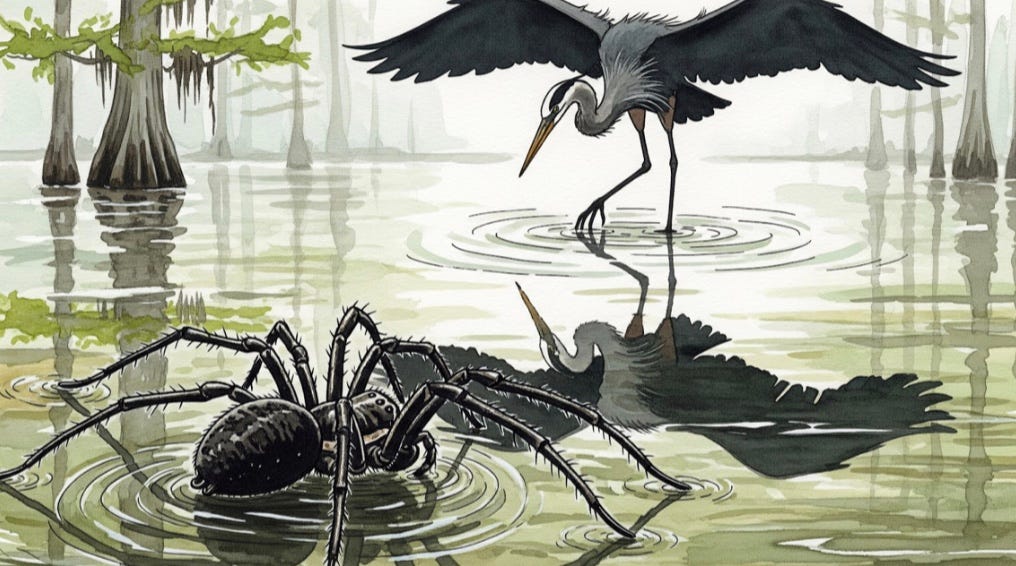
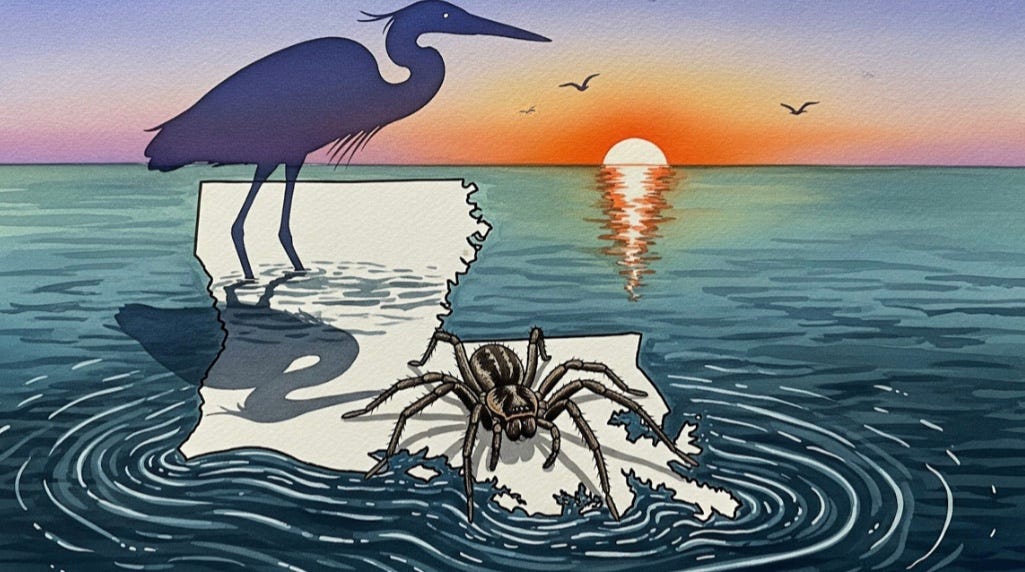
The thing about the Louisiana bayou country is that its weirdness is not just for show, cher. It’s a matter of absolute, high-stakes survival. It is an ecosystem that has perfected the art of the improbable. Take the Dark Fishing Spider,Dolomedes tenebrosus, the one whose leg span can cover half your hand. She is one of the largest spiders in North America, yet she operates with the silent precision of a naval scout.
You’re floating placidly in the moss-draped gloom of the Atchafalaya Basin, and there she is, perched carrément (directly) on a gnarled bald cypress knee. Her nickname is Scuba Spider. Unlike her cousin, the Six-spotted Fishing Spider (D. triton), who is a permanent waterside resident, D. tenebrosus often wanders about. She’s basically a French Quarter phantasm land tourist with aquatic superpowers. Uniquely, her front four long legs still rest on the water like silent radar antennae.
Here’s the first oddity: She doesn’t spin a trap-web to catch supper. She uses the very surface of the water as a vast, vibrating, liquid snare. That surface tension, which allows a single droplet of dew to hold its perfect sphere, is her hunting ground. To your amazement, a Yellow Fever (Aedes aegypti) mosquito lands, an unlucky Cocahoe Minnow (Fundulus grandis) minnow surfaces, or you see a mayfly struggling.
Those water disturbances, even a tiny ripple, are all the information she needs. She bolts across the water, comme ça (like that), defying gravity and the laws of physics with a waxy-haired gait, grabs her prey, and retreats just as swiftly. She is an apex-predator extraordinaire! As an Eight-Legged Lagniappe
The truly bizarre part of her story happens when danger comes. If a hungry Great Heron swoops too close, or a massive Alligator Gar glides by, this spider doesn’t run toward the shore. She, as we say in Cajun French, simply plonges (plunges/dives). Happily, for her, she’s not drowning. She’s engaging in a peculiar act of biological brilliance.
Her entire body is covered in fine, dense hairs. As she slips beneath the surface, these hairs trap a thin, glistening layer of air, her personal silvery scuba suit, that surrounds her like a portable bubble. She becomes a living submarine. She can cling to an underwater root, or the submerged bark of a Bald Cypress tree.
There she sits, breathing her little pocket of swamp-air, and waiting out the trouble for up to half an hour. She makes the L’Affaire Fini threat simply disappear. That fact, c’est vrai (that’s true), is a mighty fine trick.
Now, here is where the bayou’s natural spider oddity connects to a deeper, more human reality. She shows how to tell scientific facts about climate change and its effect on nature factually without putting your audience to sleep. That’s because the constantly-evolving existential crisis of the climate often feels a lot like that of the ol’ White Heron. It’s a huge bad case of the vois-là, an inevitable danger that you can’t run away from.
The way some creative technical writers are trying to capture that reality is just as strange as a certain spider species’ scuba dive. When you can’t outrun the misère (misery/trouble), you have to find a new way to tell the story.
This is so much like very act of writing creative nonfiction through the climate crisis has its own set of odd, profound, and fun facts:
Odd Fun Facts of Writing the Existential Reality
1. The “Slow Violence” Problem Demands New Forms
The climate crisis rarely involves a neat, dramatic explosion. It’s mostly “slow violence.” The gradual, almost invisible rising of the water, the creeping salinity, the erosion of the marsh. The odd challenge for the Louisiana writer, is that they have to invent entirely new, often experimental, narrative techniques just to make a slow-motion disaster feel as urgent as a gunshot.
This is why you sometimes see writers like us using techniques like fractured chronology, list-memoirs, or braided essays. They are desperate attempts to make the un-dramatic and continuous nature of environmental trauma feel viscéral (visceral) to the reader.
2. The Rise of the “Carrier Bag Narrative”
Forget the epic traditional story of the single hero conquering the storm. Many climate writers are advocating for author Ursula K. Le Guin’s concept of the “Carrier Bag Theory of Fiction.” The odd fun fact here is that the best climate stories shouldn’t have a single, satisfying plot arc (a triumph!). They should be a messy “bag” full of diverse voices, ongoing processes, small acts of loss, and fragments of hope.
Strive for mirroring the complex, non-linear reality of the crisis. This form rejects the idea that a single person can ‘solve’ the problem, instead emphasizing the power of collective, ongoing endurance. (snip)
More than half a million people flooded Washington, D.C., demanding civil rights for gay and lesbian Americans, now celebrated each year as National Coming Out Day. Many of the marchers objected to the government’s response to the AIDS crisis, as well as the Supreme Court’s 1986 decision to uphold sodomy laws in Bowers v. Hardwick.
The NAMES Project AIDS Memorial Quilt was first displayed there, bringing national attention to the impact of AIDS on gay communities, a tapestry of nearly two thousand fabric panels each a tribute to the life of one who had been lost in the pandemic.
<–The AIDS quilt, first displayed in 1987 in Washington, DC
October 8, 1945 President Harry S. Truman announced that the secret of the atomic bomb would be shared only with Great Britain and Canada.
October 8, 1982 The Polish Parliament overwhelmingly approved a law banning Solidarnos´c´ (Solidarity), the independent trade union that had captured the imagination and allegiance of nearly 10 million Poles. Solidarnosc leader Lech Walesa, 1982 The law abolished all existing labor organizations, including Solidarity, whose 15 months of existence brought hope to people in Poland and around the world but drew the anger of the Soviet and other Eastern-bloc (Warsaw Pact) governments. The parliament created a new set of unions with severely restricted rights.
October 7, 1989 Tens of thousands (estimates ranged from 40,000 to 150,000) from all over the country marched on Washington, lobbied Congress and Housing Secretary Jack Kemp to provide affordable housing for the homeless. Some of the signs read, “Build Houses, Not Bombs.” Kemp signed a letter committing the George H.W. Bush administration to several steps to help the homeless, including setting aside about 5000 government-owned single-family houses for them.
October 7, 1998 Matthew Shepard Matthew Shepard, a gay student at the University of Wyoming, was beaten, robbed and left tied to a wooden fence post outside Laramie, Wyoming; he died five days later. His death helped awaken the nation to the persecution of homosexuals and their victimization as objects of hate crimes. A play about the incident, and later an HBO movie, “The Laramie Project,” has been performed all over the country. Watch a preview MatthewShepard.org Matthew’s Place
“Every day that you choose inclusivity over segregation, you actively redirect evolution from a human-looking species to human species.
Grown adults never try to fit into childhood clothes, then why should grown humans try to fit into tribal customs!” ― Abhijit Naskar, Sonnets From The Mountaintop
I’m so glad the newsletter is back! I’d missed it in my Inbox. Although, we can see all of it anytime we want to, at The Year In Peace & Justice History. That’s where I got them for a few months before I took a break on them. I figure it’s a sign I should pick it back up, that I’m getting newsletters again.
October 6, 1683 Thirteen Mennonite families from the German town of Krefeld arrived in Philadelphia on the ship Concord. Having endured religious warfare in Europe, the Mennonites were pacifists, similar to the Society of Friends (often known as Quakers) who opposed all forms of violence. The first Germans in North America, they established Germantown which still exists as part of Philadelphia. Modern Mennonite peace activism: (The page is from Quaker History.) More about the Mennonites in America
October 6, 1955 Poet Allen Ginsberg read his poem “Howl” for the first time at Six Gallery in San Francisco. The poem was an immediate success that rocked the Beat literary world and set the tone for confessional poetry of the 1960s and later. “Howl and Other Poems” was printed in England, but its second edition was seized by customs officials as it entered the U.S. City Lights, a San Francisco bookstore, published the book itself to avoid customs problems, and storeowner (and poet) Lawrence Ferlinghetti was arrested and tried for obscenity, but defended by the American Civil Liberties Union (ACLU). Working on Howl in San Francisco, circa June, 1956 Following testimony from nine literary experts on the merits of the book, Ferlinghetti was found not guilty. Lawrence Ferlinghetti outside City Lights More about City Lights Read Howl Read more about Allen Ginsberg
October 6, 1976 An airliner, Cubana Airlines Flight 455, exploded in midair, killing 73 mostly young passengers including the entire Cuban youth fencing team. The plot was engineered by Orlando Bosch and Luis Posada Carriles, a Cuban former CIA agent, who was based in Venezuela at the time. The Posada Carriles file from the National Security Archive (It’s still there!)
October 6, 1978 346 protestors were arrested at the site of the proposed Black Fox Nuclear Power Plant in Inola, Oklahoma. In 1973 Public Service of Oklahoma announced plans to build the Black Fox plant about 15 miles from Tulsa. It was also near Carrie Barefoot Dickerson’s family farm. She became concerned, as a nurse and a citizen, about the potential health hazards. Carrie Barefoot Dickerson Through her group, Citizens’ Action for Safe Energy (CASE), and the consistent opposition of informed and persistent allies, the project was canceled in 1982. There are no nuclear plants in the state of Oklahoma, and no nuclear plant has been built in the U.S. since then. Carrie Dickerson Foundation
October 6, 1979 Seabrook Nuclear Power Plant protest – late 1970s Over 1400 were arrested at Seabrook, New Hampshire, the construction site of two new nuclear power plants. The occupation was organized by the Clamshell Alliance. Clamshell history
October 4, 1976 Earl Butz resigned as President Gerald Ford’s agriculture secretary with an apology for what he called the “gross indiscretion” of uttering a racist remark.
October 4, 1997 Demonstrations across the country occurred protesting the scheduled launch of the space probe Cassini because its power source was three plutonium-fueled Radioisotope Thermoelectric Generators.The probe carried 72.3 pounds of plutonium, the most ever put on a device to be launched into space. The concern was for an accidental release in the event of a launch mishap. Plutonium is the most toxic substance known. “It is so toxic,” says Helen Caldicott, president emeritus of Physicians for Social Responsibility, “that less than one-millionth of a gram is a carcinogenic dose. One pound, if uniformly distributed, could hypothetically induce lung cancer in every person on Earth.” The Risk of Cassini Probe Plutonium An interview with Dr. Caldicott






 Scottie's Playtime