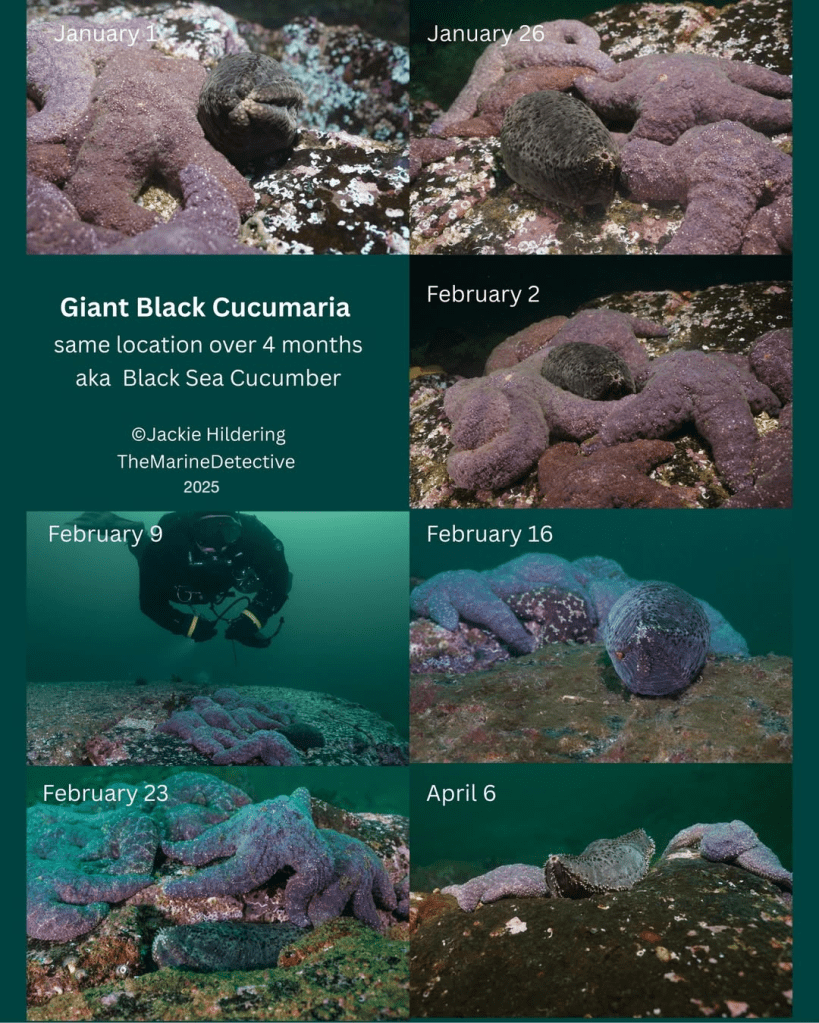
Last week when I was flying home I was scanning the ocean because I’m always certain that I’ll see Godzilla or a sea serpent if I look hard enough, but instead I saw a rainbow from the plane window and it was a perfect circle over the ocean. I was so excited I hit my head on the window and scared the person behind me. I didn’t have time to capture it on my phone but I shook Victor awake and was like, “YOU’LL NEVER BELIEVE WHAT I JUST SAW OUTSIDE THE WINDOW” and he said, “Was it a colonial woman churning butter on the wing?” and I was like, “…yep…that’s exactly what it was” because a circular rainbow feels anticlimactic after that guess.
Aaanyway, that leads to this week’s drawing, which I’m fairly certain counts as a scientific illustration:
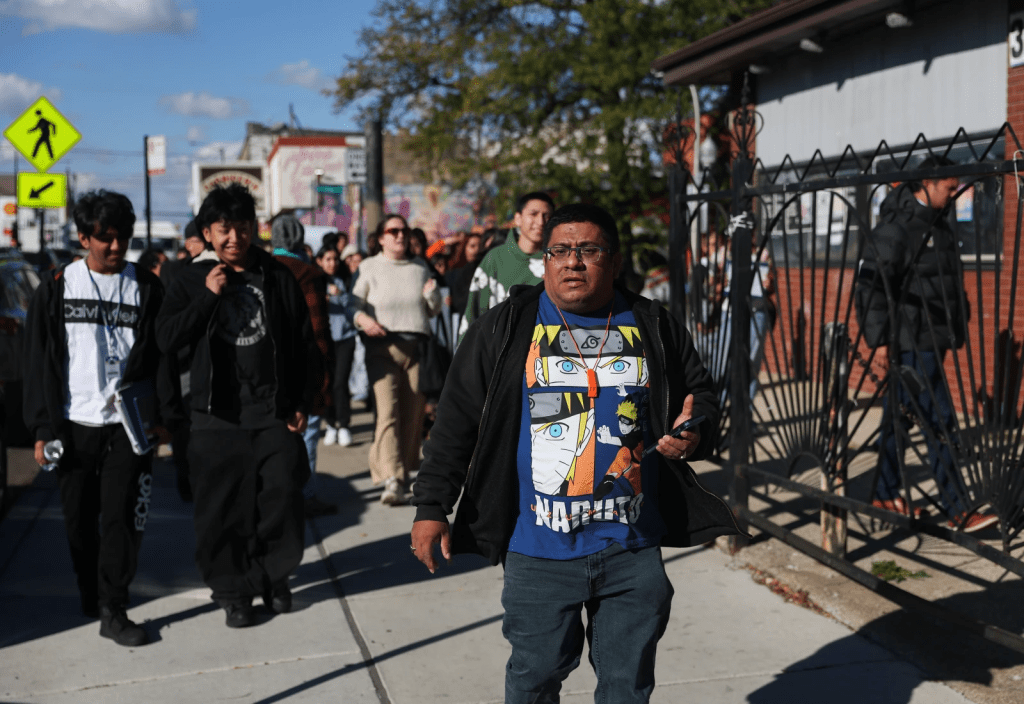
CHICAGO (AP) — Baltazar Enriquez starts most mornings with street patrols, leaving his home in Chicago’s Little Village on foot or by car to find immigration agents that have repeatedly targeted his largely Mexican neighborhood.
Wearing an orange whistle around his neck, the activist broadcasts his plans on Facebook.
“We don’t know if they’re going to come back. All we know is we’ve got to get ready,” he tells thousands of followers. “Give us any tips if you see any suspicious cars.”
Moments later, his phone buzzes.
As an unprecedented immigration crackdown enters a third month, a growing number of Chicago residents are fighting back against what they deem a racist and aggressive overreach of the federal government. The Democratic stronghold’s response has tapped established activists and everyday residents from wealthy suburbs to working class neighborhoods.
They say their efforts — community patrols, rapid responders, school escorts, vendor buyouts, honking horns and blowing whistles — are a uniquely Chicago response that other cities President Donald Trump has targeted for federal intervention want to model.
“The strategy here is to make us afraid. The response from Chicago is a bunch of obscenities and ‘no,’” said Anna Zolkowski Sobor, whose North Side neighborhood saw agents throw tear gas and tackle an elderly man. “We are all Chicagoans who deserve to be here. Leave us alone.”
Baltazar Enriquez, president of the Little Village Community Council, walks with a Chicago Public School’s student walkout in protest against U.S. Immigration and Customs Enforcement (ICE) agents around Chicago’s Little Village neighborhood, Wednesday, Oct. 29, 2025. (AP Photo/Talia Sprague)
The sound of resistance
Perhaps the clearest indicator of Chicago’s growing resistance is the sound of whistles.
Enriquez is credited with being among the first to introduce the concept. For months Little Village residents have used them to broadcast the persistent presence of immigration agents.
Furious blasts both warn and attract observers who record video or criticize agents. Arrests, often referred to as kidnappings because many agents cover their faces, draw increasingly agitated crowds. Immigration agents have responded aggressively.
Officers fatally shot one man during a traffic stop, while other agents use tear gas, rubber bullets and physical force. In early November, Chicago police were called to investigate shots fired at agents. No one was injured.
Activists say they discourage violence.
“We don’t have guns. All we have is a whistle,” Enriquez said. “That has become a method that has saved people from being kidnapped and unlawful arrest.”
By October, neighborhoods citywide were hosting so-called “Whistlemania” events to pack the brightly colored devices for distribution through businesses and free book hutches.
“They want that orange whistle,” said Gabe Gonzalez, an activist. “They want to nod to each other in the street and know they are part of this movement.”
Midwestern sensibilities and organizing roots
Even with its 2.7 million people, Chicago residents like to say the nation’s third-largest city operates as a collection of small towns with Midwest sensibilities.
People generally know their neighbors and offer help. Word spreads quickly.
When immigration agents began targeting food vendors, Rick Rosales, enlisted his bicycle advocacy group Cycling x Solidarity. He hosted rides to visit street vendors, buying out their inventory to lower their risk while supporting their business.
Irais Sosa, co-founder of the apparel store Sin Titulo, started a neighbor program with grocery runs and rideshare gift cards for families afraid of venturing out.
“That neighborhood feel and support is part of the core of Chicago,” she said.
Enriquez’s organization, Little Village Community Council, saw its volunteer walking group which escorts children to school, grow from 13 to 32 students.
Many also credit the grassroots nature of the resistance to Chicago’s long history of community and union organizing.
Trump’s “border czar” Tom Homan said Chicago area residents were so familiar with their rights that making arrests during a different operation this year was difficult.
So when hundreds of federal agents arrived in September, activists poured energy into an emergency hotline that dispatches response teams to gather intel, including names of those detained. Volunteers would also circulate videos online, warn of reoccurring license plates or follow agents’ cars while honking horns.
Protests have also cropped up quickly. Recently, high school students have launched walkouts.
Delilah Hernandez, 16, was among dozens from Farragut Career Academy who protested on a school day.She held a sign with the Constitution’s preamble as she walked in Little Village. She knows many people with detained relatives.
“There is so much going on,” she said. “You feel it.”
A difficult environment
More than 3,200 people suspected of violating immigration laws have been arrested during the so-called “ Operation Midway Blitz.” Dozens of U.S. citizens and protesters have been arrested with charges ranging from resisting arrest to conspiring to impede an officer.
The Department of Homeland Security defends the operation, alleging officers face hostile crowds as they pursue violent criminals.
Gregory Bovino, the Border Patrol commander who’s brought controversial tactics from operations in Los Angeles, called Chicago a “very non permissive environment.” He blamed sanctuary protections and elected leaders and defended agents’ actions, which are the subject of lawsuits.
DHS, which oversees CBP and Immigration and Customs Enforcement, has said operations won’t end in Chicago.
Interest nationwide
Alonso Zaragoza, with a neighborhood organization in the heavily immigrant Belmont Cragin, has printed hundreds of “No ICE” posters for businesses. Organizers in Oregon and Missouri have asked for advice.
“It’s become a model for other cities,” Zaragoza said. “We’re building leaders in our community who are teaching others.”
The turnout for virtual know-your-rights trainings offered by the pro-democracy group, States at the Core, doubled from 500 to 1,000 over a recent month, drawing participants from New Jersey and Tennessee.
“We train and we let go, and the people of Chicago are the ones who run with it,” said organizer Jill Garvey.
Awaiting the aftermath
Enriquez completes up to three patrol shifts daily. Beyond the physical exertion, the work takes a toll.
Federal agents visited his home and questioned family members. A U.S. citizen relative was handcuffed by agents. His car horn no longer works, which he attributes to overuse.
“This has been very traumatizing,” he said. “It is very scary because you will remember this for the rest of your life.”
My selection is one many young adults at the time took as an anthem; it was a very real every day concern then, and that concern does seem to be back with us now, though maybe people aren’t as concerned as before. There is good reason for concern, and for de-proliferation, and peace.
And now, the music. I’m putting both the German version (best one!) and the English language version, which is also just fine to dance to. “You can’t dance and stay uptight.”
November 15, 1917 About 20 women peacefully picketing for universal suffrage (right to vote), who had been arrested in front of the White House a few days earlier, were subjected to beatings and torture at Occoquan workhouse in Virginia. The National Women’s Party and other organizations had been picketing the White House and President WoodrowWilson as he traveled around the country ever since the inauguration of his second term. Mary Winsor The incident became known as the “night of terror.” Wilson had led the country into the European war (later called World War I), by characterizing the U.S. mission as “making the world safe for democracy.” The women demonstrating outside in Lafayette Square called attention to the need for complete democracy at home, where half of its citizens lacked complete voting rights. Many women, including Lucy Burns and Alice Paul, had been arrested several times, usually for obstructing the sidewalk, and imprisoned before. When a judge learned of the abuse he freed the women. Public outrage over their treatment increased sympathy for the suffrage movement. . left: Lucy Burns in Occoquan Workhouse, Washington, DC right: Alice Paul, New Jersey, National Chairman, Congressional Union for Woman Suffrage; Member, Ex-Officio, National Executive Committee, Woman’s Party, ca 1915 Amazing resources from the Library of Congress on women’s suffrage (It’s still all there-go see!)
November 15, 1940 75,000 men were called to Armed Forces duty under the first peacetime conscription. Draft inductees leaving Wilmington, Delaware in November, 1941
November 15, 1943 Heinrich Himmler, Adolf Hitler’s head of the SS (Schutzstaffel or protective rank), Gestapo, the Waffen SS and the Death’s Head units that ran the concentration camps, made public an order that “Gypsies”-more properly, the Roma-and those of mixed Roma blood were to be put on “the same level as Jews and placed in concentration camps.” “Gypsy” prisoners arriving at a Concentration Camp Himmler was determined to prosecute Nazi racial policies, which dictated the elimination from Germany and German-controlled territories of all races deemed “inferior,” as well as “asocial” types, such as hardcore criminals. “Gypsies” fell into both categories according to the thinking of Nazi ideologues and had been executed in droves both in Poland and the Soviet Union. The order of November 15 was merely a more comprehensive program, as it included the deportation to the Auschwitz death camp of “Gypsies” already in labor camps. The Gypsies in Germany Gypsies: Forgotten Victims of the Holocaust
November 15, 1957 U.S. Committee for a Sane Nuclear Policy (SANE) was founded. Thirty years later on November 20, SANE merged with the Nuclear Freeze organization (dedicated to freezing all nuclear weapons testing worldwide) at a joint convention in Cleveland to form SANE/FREEZE. Its successor is known as Peace Action, the largest U.S. peace organization. Sane Nuclear Policy poster, 1960 SANE history-Peace Action
November 15, 1969 Following a symbolic three-day “March Against Death,” the second national “moratorium” against the Vietnam War opened with massive and peaceful demonstrations in San Francisco and Washington, D.C. Organized by the New Mobilization Committee to End the War in Vietnam (“New Mobe”), an estimated 500,000 demonstrators participated as part of the largest such gathering to date. It began with a march down Pennsylvania Avenue in front of the White House (while Pres. Nixon watched the Purdue-Ohio State football game on TV) to the Washington Monument, where a mass rally with speeches was held. Pete Seeger, Arlo Guthrie, Peter, Paul and Mary, and four different touring casts of the musical “Hair” entertained the demonstrators. The rally concluded with nearly 40 hours of continuous reading of known U.S. deaths (to that date) in the Vietnam War.
November 15, 1986 A government tribunal in Nicaragua convicted American Eugene Hasenfus, a CIA operative, of delivering arms to Contra rebels and sentenced him to 30 years in prison. He had been arrested when his plane was shot down by Sandanista troops. He was pardoned a month after his conviction (his last name means “rabbit’s foot” in German). Hasenfus under arrest
Off Trøndelag’s coast, long lines of kelp now do double duty. They grow fast. They also lock away carbon. A new pilot farm near Frøya aims to turn that promise into measurable removal of CO₂ from the air, according to DNV.
The site spans 20 hectares and carries up to 55,000 meters of kelp lines. First seedlings went in last November. The goal is proof of concept, then scale.
How the Pilot Works
The three-year Joint Industry Project, JIP Seaweed Carbon Solutions, brings SINTEF together with DNV, Equinor, Aker BP, Wintershall Dea, and Ocean Rainforest, with a total budget of NOK 50 million, Safety4Sea reports.
Researchers expect an initial harvest of about 150 tons of kelp after 8–10 months at sea. Early estimates suggest that biomass could represent roughly 15 tons of captured CO₂. This is a test bed for methods that can be replicated and expanded, DNV explains.
There’s a second step, as kelp becomes biochar. That process stabilizes carbon for the long term and can improve soils on land, SINTEF’s team told Safety4Sea. The project is designed to test both the removal and the storage.
A Long History, A New Mission
Seaweed isn’t new here. Norwegians have cultivated kelp since the 18th and 19th centuries for fertilizer and feed. Scientists advanced modern methods in the 1930s, laying the groundwork for today’s farms, according to SeaweedFarming.com. Cold, nutrient-rich waters support species like Laminaria and Saccharina. They grow quickly and draw down dissolved carbon and nitrogen.
The country’s aquaculture backbone also helps. Norway already runs one of the world’s most advanced seafood sectors. That expertise now extends to macroalgae.
Policy, Permits, and Ecosystems
Commercial cultivation began receiving specific permits in 2014, and activity has expanded across several coastal counties, according to a study in Aquaculture International. Researchers detailed the risks that accompany scale: genetic interaction with wild kelp, habitat impacts, disease, and space conflicts. Integrated Multi-Trophic Aquaculture, where seaweed grows alongside finfish, can recycle nutrients from farms and reduce eutrophication pressures.
Engineering for Open Water
Getting beyond sheltered bays is crucial. One path is the “Seaweed Carrier,” a sheet-like offshore system that lets kelp move with waves in deeper, more exposed water. It supports mechanical harvesting and industrial output without using land, Business Norway explains. The same approach can enhance water quality by absorbing CO₂ and “lost” nutrients.
The Frøya project is small in tonnage but big in intent. It links Norway’s long kelp lineage with new climate tech: fast-growing macroalgae, verified carbon accounting, and durable storage as biochar. If these methods prove reliable at sea and on shore, Norway will have more than a farm. It will have a blueprint for ocean-based carbon removal that others can copy.
November 14, 1910 Eugene Ely performed the first airplane takeoff from a ship. His Curtiss pusher flew from the deck of the U.S.S. Birmingham in Hampton Roads, Virginia.By January he would execute the first (takeoff and) landing on a warship, the U.S.S. Pennsylvania. Captain Washington I. Chambers of the Navy Department had been interested in the military uses for the seven-year-old invention. Naval flight training started shortly thereafter. More of the whole story.
November 14, 1954 “Ten Million Americans Mobilized for Justice” began a campaign to collect 10 million signatures on a petition urging the Senate not to censure Senator Joseph McCarthy (R-Wisconsin). The motion of censure against Senator McCarthy was for obstructing a Senate committee and for acting inexcusably and reprehensibly toward a U.S. soldier appearing before his own committee. McCarthy had used his Senate Permanent Investigations Subcommittee to publicly denounce thousands as subversive, especially within the federal government, many without any justification. The political views of most were painted as treasonable and conspiratorial, rather than differing political views. The petition effort fell about nine million signatures short. More on Joe McCarthy
November 14, 2000 Florida Secretary of State Katherine Harris, simultaneously co-chair of George W. Bush’s Florida presidential campaign organization and the public official responsible for the conduct of the election itself, certified Governor Bush’s fragile 300-vote lead over Vice President Al Gore in the 2000 presidential election. Katherine Harris Florida Judge Terry Lewis gave Harris the authority to accept or reject a follow-up manual recount from some counties where the count was open to question. Harris rejected the manual recounts.
from the end of the shutdown,-and I have huge hope that we the people will continue to stand together to help each other through the days!-we do get the Astronomy Photo of the Day again!
Explanation: Few cosmic vistas can excite the imagination like The Great Nebula in Orion. Visible as a faint, bland celestial smudge to the naked-eye, the nearest large star-forming region sprawls across this sharp colorful telescopic image. Designated M42 in the Messier Catalog, the Orion Nebula’s glowing gas and dust surrounds hot, young stars. About 40 light-years across, M42 is at the edge of an immense interstellar molecular cloud only 1,500 light-years away that lies within the same spiral arm of our Milky Way galaxy as the Sun. Including dusty bluish reflection nebula NGC 1977, also known as the Running Man nebula at left in the frame, the natal nebulae represent only a small fraction of our galactic neighborhood’s wealth of star-forming material. Within the well-studied stellar nursery, astronomers have also identified what appear to be numerous infant solar systems.
Two from Bee; she participates in the blog strike on Thursdays, for Gaza. Both excellent pieces; one from Pink, one from Alicia Keys, each with some info about the artist and her music.