December 11, 1946 The General Assembly of the United Nations voted to establish the United Nations International Children’s Emergency Fund (UNICEF) to provide health and rehabilitation to children living in countries devastated by World War II. What does UNICEF do today?
December 11, 1961 Two U.S. Army air cavalry helicopter companies arrived in Vietnam, including 33 Shawnee H-21C helicopters and 425 ground and flight crewmen. They were to be used to airlift South Vietnamese Army troops into combat, the first direct military combat involvement of U.S. military personnel.President Kennedy had sent them to bolster the U.S. advisors, in the country since the 1950s, in light of the inability of the Government of Vietnam’s armed forces to resist the Viet Cong insurgency movement and the Army of the Republic of [North] Vietnam. Shawnee helicopter
December 11, 1961 A U.S. Supreme Court decision outlawed the use of disorderly conduct statutes as grounds for arresting African Americans sitting-in at segregated public facilities to obtain equal service. The case began in Baton Rouge, Louisiana, where a group of negro Southern University students bought some items then sat at the lunch counter of Kress Department Store. Their polite requests to order food were ignored because the lunch counter was only for the use of whites, and police arrived to arrest them. Convicted of “disturbing the peace,” they were expelled from Southern University and barred from all public colleges and universities in the state of Louisiana. The Court overturned their convictions because there was no evidence indicating a breach of the peace. The decision in Garner v. Louisiana
December 11, 1972 New Zealand Prime Minister Norman Kirk (Labour Party) announced withdrawal of his country’s troops from Vietnam and a phase-out of his country’s draft just three days after taking office. Prime Minister Norman Kirk
Anti-War demo Parliament Buildings in Wellington, 1969 3,890 New Zealand military personnel had served there, suffering 37 dead and 187 wounded. This had given rise to a large and vocal anti-war movement. History of the anti-war movement in New Zealand
December 11, 1984 More than 20,000 women turned out for an anti-nuclear demonstration at Greenham Common Air Base in England, where U.S. nuclear-armed cruise missiles were deployed. Some tried to rip down the fence surrounding the base. Poster of Broken Missile taped to the fence of Greenham Common by a protester, 1982 A Greenham Peace Camp scrapbook
December 11, 1994 In the largest Russian military offensive since its 1979 invasion of Afghanistan, thousands of troops and hundreds of tanks crossed the border into the Muslim republic of Chechnya. Just two weeks prior, a Russian covert operation to undermine the government in Grozny, the capital, had been foiled and Dzhokhar Dudaev, Chechnya’s first elected president, had threatened to have the perpetrators executed.The Chechens had declared their independence from the Commonwealth of Independent States, comprising Russia and most of the countries previously part of the Soviet Union. Chechnya had been a Russian colony since 1859, and in 1943 Josef Stalin deported the population en masse, their return to their homeland not allowed until 1957.
Russian President Boris Yeltsin, who ordered the invasion, would not deal with Dudaev, and had raised him to the rank of chief enemy, ignoring Chechen-Russian history. The main attack was halted by the deputy commander of Russian ground forces, Colonel-General Eduard Vorobyov, who resigned in protest, stating that he would not attack fellow Russians. Yeltsin’s advisor on nationality affairs, Emil Pain, and Russia’s Deputy Minister of Defense, Colonel-General Boris Gromov (esteemed hero of the Soviet-Afghan War), also resigned in protest of the invasion, as did Major-General Borys Poliakov. More than 800 professional soldiers and officers refused to take part in the operation. Of these, 83 were convicted by military courts, and the rest were discharged.
December 10, 1948 The General Assembly of the United Nations adopted and proclaimed the Universal Declaration of Human Rights. Following this historic act the Assembly called upon all Member countries to publicize the text of the Declaration and “to cause it to be disseminated, displayed, read and expounded principally in schools and other educational institutions, without distinction based on the political status of countries or territories.” Since 1950 the anniversary of the declaration has been known as Human Rights Day. Human Rights Day
December 10, 1950 Ralph Bunche the Peacemaker Detroit-born U.N. diplomat Ralph J. Bunche became the first Black American to win the Nobel Peace Prize. The award was in recognition of his peace mediation during the first Arab-Israeli war in 1948.From his acceptance speech in Oslo, Norway. “There are some in the world who are prematurely resigned to the inevitability of war. Among them are the advocates of the so-called “preventive war,” who, in their resignation to war, wish merely to select their own time for initiating it. To suggest that war can prevent war is a base play on words and a despicable form of warmongering. The objective of any who sincerely believe in peace clearly must be to exhaust every honorable recourse in the effort to save the peace. The world has had ample evidence that war begets only conditions which beget further war.”
December 10, 1961 Chief Albert Luthuli, President-General of the banned African National Congress, appealed for racial equality in racially separatist apartheid South Africa after accepting the Nobel peace prize for 1960 in Oslo, Norway. Albert Luthuli Mr. Luthuli said he considered the award “a recognition of the sacrifices made by the peoples of all races [in South Africa], particularly the African people who have endured and suffered so much for so long.” “It may well be that South Africa’s social system is a monument to racialism and race oppression, but its people are the living testimony to the unconquerable spirit of mankind. Down the years, against seemingly overwhelming odds, they have sought the goal of fuller life and liberty, striving with incredible determination and fortitude for the right to live as men – free men.”
December 10, 1964 Reverend Martin Luther King, Jr. was awarded Nobel Peace Prize. From his speech in Oslo: “After contemplation, I conclude that this award which I receive on behalf of that [civil rights] movement is profound recognition that nonviolence is the answer to the crucial political and moral question of our time — the need for man to overcome oppression and violence without resorting to violence and oppression. Civilization and violence are antithetical concepts.” King’s Nobel acceptance speech:
December 10, 1997 Julia Butterfly Hill, age 23, climbed “Luna,” a 1,000-year-old California redwood, to protect it from loggers. She stayed up in the tree for more than two years. Julia Butterfly Hill atop Luna Julia’s web site
December 10, 2003 Shirin Ebadi Iranian democracy activist Shirin Ebadi, the first Muslim woman (first Iranian and only the third Muslim) to win the Nobel Peace Prize, accepted the award in Oslo, Norway “for her efforts for democracy and human rights. She has focused especially on the struggle for the rights of women and children.” More about Shirin Ebadi
I stay at an underwater hotel My room cost $40,000 per night But I used my hotel points I earned From all the traveling I have done over the years My room’s floor-to-ceiling windows look out into the royal purple waters A Convict Surgeonfish swims by Its electric blue body tilts as it veers to my left Two snorkelers dive below me Paying close attention to the rapidly changing current
And watching out for the camouflaged stone fish Whose spine releases a poison that can cause paralysis There is no antidote for its venom Glad that I’m far from the crowds And in my room relaxing
I dine at the underwater hotel My table placed against the glass windows The deep waters below me And shallow waters above me I look through the glass ceiling And see a white light at the top, Which is a reflection of the sunlight
I visit the underwater hotel’s spa Tucked underneath white sheets With hot stones placed on my upper back, neck and shoulders I close my eyes Hearing the sounds of rainfall, breaking waves, wind, Landslides and earthquakes from the depths below As I get massaged by candlelight
I depart the underwater hotel The boat taking me back to shore Where I meet a taxi that takes me to the airport We glide over turquoise, shallow waters I look behind me I see the hotel becoming smaller and smaller And the deep waters becoming a darker and darker blue A storm is approaching The sky reflects how I feel Now that my solo vacation has come to an end
Don Schoendorfer’s nonprofit delivers more than free wheelchairs to people in developing countries. It delivers dignity and hope — and transforms lives.
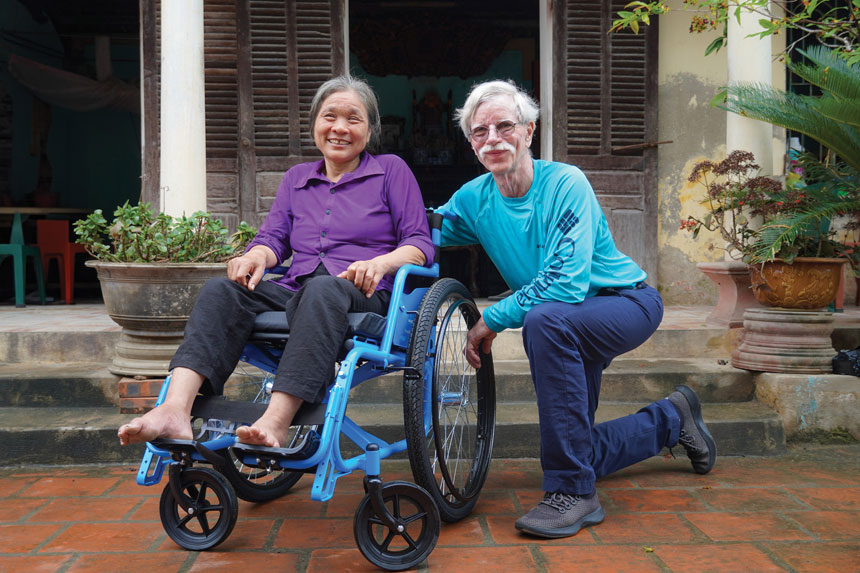
Wheel man: Don Schoendorfer shows off his foldable, third-generation wheelchair, which his charity distributes for free around the world. (Photo courtesy Free Wheelchair Mission)
The first thing they see are our feet,” says Don Schoendorfer. The organization he founded, Free Wheelchair Mission (FWM), delivers wheelchairs to people with disabilities in developing nations, from Uganda to Brazil. When Schoendorfer and his team arrive, recipients are often on the ground, lying on their stomachs. Some drag themselves with their hands.
“They’ve looked up at people their whole lives,” Schoendorfer says. “When you get them into a chair, they often break out in happy tears. And they look different than when they were on the ground. Suddenly the dignity they never had is coming back. You give them a hug and they don’t want to let go because they’re crying. And you look around and the whole family is crying.”
Schoendorfer has seen this “phenomenal change” on multiple continents. FWM has distributed over 1.4 million wheelchairs in 95 countries since he founded the nonprofit in 2001, driven by the low-cost wheelchair he designed and constructed in his garage. The wheelchairs have improved over the past 23 years, but they’re still cost-efficient. For just $96, the Irvine, California-based organization can build, ship, and deliver a wheelchair anywhere around the world.
Schoendorfer was the right man for this globe-trotting mission. “He has this scrappiness — he can make something out of nothing,” says Nuka Solomon, the organization’s CEO. And he was born to build: His father was a machinist for the New York Central Railroad.
“My father taught me and my two older brothers about mechanical things,” he says of family life in Ashtabula, Ohio. “I knew I was going to be an engineer.”
It wasn’t easy. When his two brothers went to college — one became a civil engineer, the other a chemical engineer — his parents told the then-eight-year-old Schoendorfer that little money would remain for his education. He needed to improve his grades and start saving money, Mom and Dad said. He did both. For 10 years, the future engineer had a paper route. He earned an undergraduate degree from Columbia University and a Ph.D. in mechanical engineering from MIT.
Two years later, he experienced a life-changing moment. He and his wife, Laurie, were on vacation in Tétouan, Morocco, when they saw a woman on the ground, crawling with her fingernails, digging them into a dirt road.
“She was pulling herself, one hand at a time, a few inches,” he remembers. “I suspect she had polio. She was bleeding. Her clothes were shredded. And people were stepping over her, not wanting to touch her, not wanting to help her, not wanting to talk to her.”
The woman disappeared down an alley. Schoendorfer and Laurie looked at each other and thought: Why did we see this?
The image was planted in his mind. But for the next 20 years, Schoendorfer continued a career in biomedicine. He enjoyed the work and holds more than 60 biomedical patents. His life started to change when the oldest of his three daughters, then 13, began a long struggle with bulimia. Schoendorfer had always been religious — his father was the sexton of a small Congregational Church — and as their daughter fought her illness, he and his wife “surrendered to the Lord.”
“I think we need to do this,” he told Laurie. “We’ve got to figure out how to get help from God.”
The battle with bulimia, he says, was a “dreadful” time for his family. But they were going to church on Sundays, and his spirituality was deepening. And then, God spoke to him.
“The way I sum it up, it was like a phone call in the middle of the night,” he says. The voice told him he was wasting his time; that he wasn’t using his gifts. “And then this vision of the woman trying to get across the dirt road was right in front of me,” he recalls. “It had been sitting there for 20 years.”
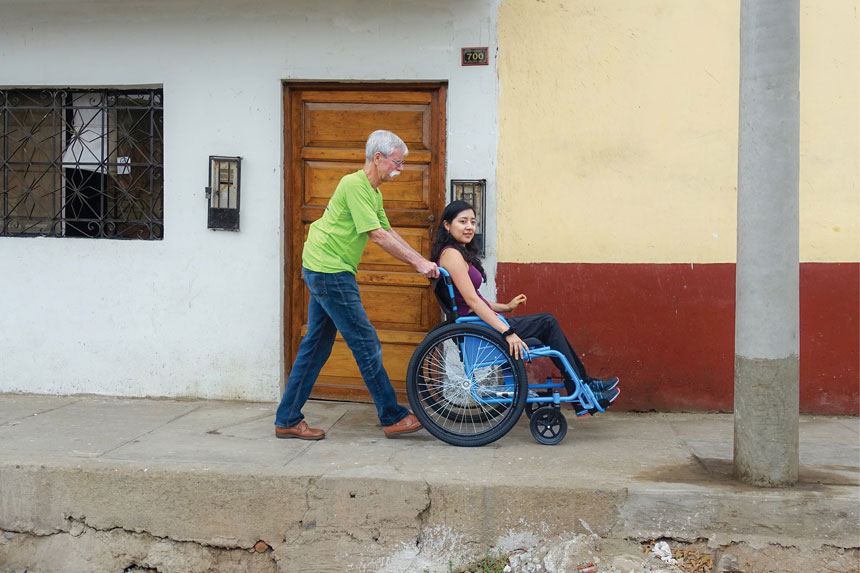
A world of difference: Free Wheelchair Mission has touched 95 countries, including Armenia, Morocco, Vietnam, and (shown here) Peru. (Photo courtesy Free Wheelchair Mission)
His priorities changed. Schoendorfer identified around 20 organizations that distributed wheelchairs. Together, however, the nonprofits had only donated about 100,000. That number seemed low. His idea: To increase donations by developing a less-expensive wheelchair.
He started at a local shopping center. Home Depot had white resin lawn chairs for $4 each. Toys’R’Us sold bicycles made in China for $60.
“From what I know about manufacturing, those wheels probably cost about $3 each to make in China,” he says. “So for $10, I had the two most important parts: The chair and the back wheels.”
He showed a prototype to the pastor of his church, who had just returned from a mission trip to the Democratic Republic of Congo. The timing was remarkable. The pastor had seen numerous people who needed wheelchairs — and it had weighed on him.
“There were people crawling, and here you walk in with a solution three days later,” the pastor told Schoendorfer.
That moment convinced Schoendorfer to keep working. Soon he had 100 homemade wheelchairs in his garage. Then his wife saw an announcement for a medical outreach trip to Chennai, India. He could only take four wheelchairs with him — and his fellow volunteers, mostly doctors and nurses, were not impressed.
“It didn’t even look like a wheelchair to them,” he says. “It was a bright white patio chair with mountain bike tires. And they tried to make me come to my senses by asking logical questions like, ‘Who’ll do the training? Where’s the money coming from? Who’s going to give them out? How are you going to deal with repairs?’ And I said, ‘Listen, my main point here is to prove this works.’”
That opportunity came on a visit to Chennai’s suburbs. A family had carried their son three miles on a dirt road to reach the team’s makeshift clinic. The son had advanced cerebral palsy. He seemed agitated. He had uncontrolled contractures of his arms and his legs, and he’d been carried by a hot body in 100-degree heat and 100 percent humidity. Schoendorfer pulled down a wheelchair from the top of the medical team’s white bus.
“The mom put her son in the wheelchair. She started pushing it around and he started to calm down,” he says.
They drove the family back to their village. The home was a roughly 8-by-10-foot cinderblock structure with a corrugated tin roof. Inside was a hammock and a pen on the dirt floor for their son. They were thrilled by the wheelchair — but suddenly, the medical mission’s director told Schoendorfer they needed to leave. Now. The team had forgotten to ask the elders for permission to enter the village. The group scrambled into their bus, but villagers blocked their path.
And then the boy’s mom approached with two glasses of water.
“We were leaving without the wheelchair, so she realized it was a gift,” he says. “And in her culture, you had to repay a gift with a gift. The only thing she could afford to give us was water.”
After that first experience — and similar emotional encounters when he distributed the other three wheelchairs — Schoendorfer’s mission changed. Originally he planned to conduct clinical trials in India and write a paper. But the medical mission’s local partners drove him through Chennai to show how many people were disabled.
“They wanted to be a distribution partner,” he says. “They wanted more wheelchairs. They were so far ahead of me. I never thought of anything like that. I wanted to just write that paper.”
Fate intervened. Two weeks later, back in California, Schoendorfer returned to work. It was a Monday morning, but the parking lot was empty: The company had gone bankrupt while he was in India. Meanwhile, at his church, the story of his donations had spread through the congregation. Schoendorfer planned to get another job — his wife wasn’t working at the time — but his fellow parishioners shared a different vision.
“They said, ‘No, no, you can’t do that. This is going to be your job,’” he says. “They knew what God was doing. I didn’t. They said, ‘These aren’t coincidences. I’m going to send you some money so you can make more wheelchairs.’ And I said, ‘Please don’t — I’ve still got 96 in the garage.’ But I started to think. … Maybe this is what God wanted me to do.”
After 15 years as a stay-at-home mom, Laurie went back to work, and Schoendorfer focused on wheelchairs. He bought a book — Nonprofits For Dummies — and founded FWM. That same year, he found a manufacturer in China.
The wheelchairs are distributed by local partners in each country where they work. “We’re giving them out as quickly as we can have them made — and as quickly as we can get the money to have them made,” Schoendorfer says.
The wheelchairs have evolved since that first simple model. The next two versions were more adjustable, more comfortable, and built to last in tough terrains. The third-generation model has a fold-up design, which makes it easier to carry on buses.
“We’ve also learned the importance of adjusting the wheelchair and training people on how to use it. That was something we didn’t do in the beginning,” he says. “If it doesn’t fit right, they won’t use it.”
The demand remains great. Roughly 80 million people worldwide — most in developing countries — need a wheelchair, according to the World Health Organization.
“It’s an emotional event because many have been waiting their whole life for a wheelchair,” Schoendorfer says. “And when they get one, many of them tell me… This is a miracle.”
(Note from me: This is not a religious post. Though helpful people feel that they’ve been led to do things, they did the things themselves. Either way, a great, great service is being done! That’s why I posted this story.)
December 9, 1917 British troops, known as the Egyptian Expeditionary Force and under the command of General Edmund Allenby, entered Jerusalem, ending 700 years of Muslim rule of the city, 400 under the Ottoman Turks. The Turkish army withdrew, the city surrendered without a battle. Thus began 30 years of British control over Palestine.
December 9, 1949 U.S. Representative John Parnell Thomas, former chairman of the House Un-American Activities Committee (HUAC), was sentenced to 6 to 18 months in federal prison for “padding” Congressional payrolls and using the money himself (embezzlement). He had pled no contest to the charges, and was pardoned by President Harry Truman shortly before the end of his presidency. John Parnell Thomas
December 9, 1961 Members of the National Committee of 100, a movement of non-violent resistance to nuclear war and to the manufacture and use of all weapons of mass extermination, joined with the Campaign for Nuclear Disarmament (CND) and held demonstrations at various U.S. air and nuclear bases in Britain. Bertrand Russell and the “Committee of 100″at an earlier action in 1961. Members of the Committee of 100, including Bertrand Russell, considered civil disobedience a legitimate means in their struggle. The CND avoided all illegal activities. The CND is still active today
December 9, 1990 Solidarity trade union founder and leader Lech Walesa won Poland’s presidential runoff election in a 3-1 landslide. He thus became the first directly elected Polish leader. Poland only became an independent country at the end of World War I. About Lech Walesa
Oh! All things are long passed away and far. A light is shining but the distant star From which it still comes to me has been dead A thousand years . . . In the dim phantom boat That glided past some ghastly thing was said. A clock just struck within some house remote. Which house?—I long to still my beating heart. Beneath the sky’s vast dome I long to pray . . . Of all the stars there must be far away A single star which still exists apart. And I believe that I should know the one Which has alone endured and which alone Like a white City that all space commands At the ray’s end in the high heaven stands.
This poem is in the public domain. Published in Poem-a-Day on December 8, 2024, by the Academy of American Poets.
There was always waiting in our mother’s eyes, Anxiety and wonder and surmise, Through the long days, and in the longer, slow, Still afternoons, that seemed to never go, And in the evening, when she used to sit And listen to our casual talk, and knit. And when the day was dark and rainy, and Not fit to be abroad in, she would stand Beside the window, and peer out and shiver, As small sleek raindrops joined to make a river That rushed, tempestuous, down the window pane, And say, “I wonder what they do in rain? Is it wet there in the trenches, do you think?” And she would wonder if he had his ink And razor blades and toothpaste that she sent; And if he read much in his Testament, Or clean forgot, some mornings, as boys will. But always the one wonder in her eyes Was, “Is he living, living, living, still Alive and gay? Or lying dead somewhere Out on the ground, and will they find him there?” She closed her lids each night upon that look Of waiting, as a hand might close a book But never change the words that were within. And when the morning noises would begin A new day, and a young sun touched the skies, Again she woke with waiting in her eyes.
But that is over now. She does not read The lists of casualties, since that one came A week or two ago. There is no need. She’s making sweaters now for other men And knitting just as carefully as then. There is no change, except that as she plies Her needles, swift and rhythmic as before, There is no waiting in our mother’s eyes, Anxiety or wonder any more.
This poem is in the public domain. Published in Poem-a-Day on December 7, 2024, by the Academy of American Poets.
December 8, 1886 Samuel Gompers, a founder and leader of the American Federation of Labor The American Federation of Labor (AFL) was founded at a convention of union leaders in Columbus, Ohio. It was an alliance of autonomous unions, each typically made up of workers within a particular craft. Samuel Gompers, a leader in the Cigarmakers’ union, was a key person in creating the AFL, was elected its first president, and served as such virtually continuously for nearly 40 years. On Samuel Gompers from the AFL-CIO
===================================== December 8, 1941 Jeanette Rankin (R-Montana), the first woman elected to the U.S. Congress in 1916, cast the only vote (she was among eight women in the Congress at the time) opposing declaration of war against Japan, despite their attack on Pearl Harbor the previous day . She had also voted against the U.S. entering World War I (at the time called the war to end all wars). Rankin served served just two single terms in the House. She spent her early career working for women’s suffrage, later very active in several peace and justice organizations. Jeannette Rankin in 1940 Jeanette Rankin timeline Chronology and oral history transcript of interview of Jeanette Rankin ===================================== December 8, 1953 U.S. President Dwight Eisenhower addressed the United Nations General Assembly, proposing the creation of a new U.N. atomic energy agency which would receive contributions of uranium from the United States, the Soviet Union, and other countries “principally concerned,” and would put this material to peaceful use. The speech, known later as Atoms for Peace, included: “My country wants to be constructive, not destructive. It wants agreement, not wars, among nations. It wants itself to live in freedom, and in the confidence that the people of every other nation enjoy equally the right of choosing their own way of life.”
======================================== December 8, 1987 U.S. President Ronald Reagan and Soviet leader Mikhail Gorbachev signed the first treaty to reduce the nuclear arsenals of the two superpowers. The Intermediate Nuclear Forces (INF) Treaty eliminated and banned all ground-launched ballistic and cruise missiles with a range of 500-5,500 kilometers (300-3,400 miles). By May 1991, all intermediate- and shorter-range missiles, launchers, and related support had been physically dismantled.
========================================= December 8, 1988 On the first anniversary of the INF (Intermediate Nuclear Force) Treaty, twelve Dutch peace activists, calling themselves “INF Ploughshares,” cut through fences to enter the Woensdrecht Air Force base in The Netherlands. They made their way to cruise missile bunkers where they hammered on the missiles, carrying out the first disarmament action in Holland. Read more about this action




 Scottie's Playtime