
Tag: People Helping People
Here’s a cool thing-
Wheels of Good Fortune: Transforming Lives Through Free Wheelchairs
Don Schoendorfer’s nonprofit delivers more than free wheelchairs to people in developing countries. It delivers dignity and hope — and transforms lives.
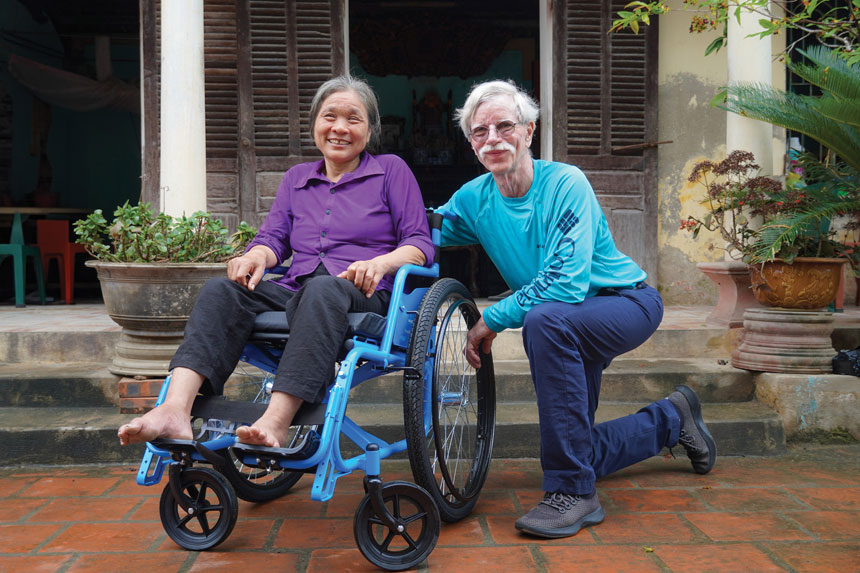
Wheel man: Don Schoendorfer shows off his foldable, third-generation wheelchair, which his charity distributes for free around the world. (Photo courtesy Free Wheelchair Mission)
The first thing they see are our feet,” says Don Schoendorfer. The organization he founded, Free Wheelchair Mission (FWM), delivers wheelchairs to people with disabilities in developing nations, from Uganda to Brazil. When Schoendorfer and his team arrive, recipients are often on the ground, lying on their stomachs. Some drag themselves with their hands.
“They’ve looked up at people their whole lives,” Schoendorfer says. “When you get them into a chair, they often break out in happy tears. And they look different than when they were on the ground. Suddenly the dignity they never had is coming back. You give them a hug and they don’t want to let go because they’re crying. And you look around and the whole family is crying.”
Schoendorfer has seen this “phenomenal change” on multiple continents. FWM has distributed over 1.4 million wheelchairs in 95 countries since he founded the nonprofit in 2001, driven by the low-cost wheelchair he designed and constructed in his garage. The wheelchairs have improved over the past 23 years, but they’re still cost-efficient. For just $96, the Irvine, California-based organization can build, ship, and deliver a wheelchair anywhere around the world.
Schoendorfer was the right man for this globe-trotting mission. “He has this scrappiness — he can make something out of nothing,” says Nuka Solomon, the organization’s CEO. And he was born to build: His father was a machinist for the New York Central Railroad.
“My father taught me and my two older brothers about mechanical things,” he says of family life in Ashtabula, Ohio. “I knew I was going to be an engineer.”
It wasn’t easy. When his two brothers went to college — one became a civil engineer, the other a chemical engineer — his parents told the then-eight-year-old Schoendorfer that little money would remain for his education. He needed to improve his grades and start saving money, Mom and Dad said. He did both. For 10 years, the future engineer had a paper route. He earned an undergraduate degree from Columbia University and a Ph.D. in mechanical engineering from MIT.
Two years later, he experienced a life-changing moment. He and his wife, Laurie, were on vacation in Tétouan, Morocco, when they saw a woman on the ground, crawling with her fingernails, digging them into a dirt road.
“She was pulling herself, one hand at a time, a few inches,” he remembers. “I suspect she had polio. She was bleeding. Her clothes were shredded. And people were stepping over her, not wanting to touch her, not wanting to help her, not wanting to talk to her.”
The woman disappeared down an alley. Schoendorfer and Laurie looked at each other and thought: Why did we see this?
The image was planted in his mind. But for the next 20 years, Schoendorfer continued a career in biomedicine. He enjoyed the work and holds more than 60 biomedical patents. His life started to change when the oldest of his three daughters, then 13, began a long struggle with bulimia. Schoendorfer had always been religious — his father was the sexton of a small Congregational Church — and as their daughter fought her illness, he and his wife “surrendered to the Lord.”
“I think we need to do this,” he told Laurie. “We’ve got to figure out how to get help from God.”
The battle with bulimia, he says, was a “dreadful” time for his family. But they were going to church on Sundays, and his spirituality was deepening. And then, God spoke to him.
“The way I sum it up, it was like a phone call in the middle of the night,” he says. The voice told him he was wasting his time; that he wasn’t using his gifts. “And then this vision of the woman trying to get across the dirt road was right in front of me,” he recalls. “It had been sitting there for 20 years.”
His priorities changed. Schoendorfer identified around 20 organizations that distributed wheelchairs. Together, however, the nonprofits had only donated about 100,000. That number seemed low. His idea: To increase donations by developing a less-expensive wheelchair.
He started at a local shopping center. Home Depot had white resin lawn chairs for $4 each. Toys’R’Us sold bicycles made in China for $60.
“From what I know about manufacturing, those wheels probably cost about $3 each to make in China,” he says. “So for $10, I had the two most important parts: The chair and the back wheels.”
He showed a prototype to the pastor of his church, who had just returned from a mission trip to the Democratic Republic of Congo. The timing was remarkable. The pastor had seen numerous people who needed wheelchairs — and it had weighed on him.
“There were people crawling, and here you walk in with a solution three days later,” the pastor told Schoendorfer.
That moment convinced Schoendorfer to keep working. Soon he had 100 homemade wheelchairs in his garage. Then his wife saw an announcement for a medical outreach trip to Chennai, India. He could only take four wheelchairs with him — and his fellow volunteers, mostly doctors and nurses, were not impressed.
“It didn’t even look like a wheelchair to them,” he says. “It was a bright white patio chair with mountain bike tires. And they tried to make me come to my senses by asking logical questions like, ‘Who’ll do the training? Where’s the money coming from? Who’s going to give them out? How are you going to deal with repairs?’ And I said, ‘Listen, my main point here is to prove this works.’”
That opportunity came on a visit to Chennai’s suburbs. A family had carried their son three miles on a dirt road to reach the team’s makeshift clinic. The son had advanced cerebral palsy. He seemed agitated. He had uncontrolled contractures of his arms and his legs, and he’d been carried by a hot body in 100-degree heat and 100 percent humidity. Schoendorfer pulled down a wheelchair from the top of the medical team’s white bus.
“The mom put her son in the wheelchair. She started pushing it around and he started to calm down,” he says.
They drove the family back to their village. The home was a roughly 8-by-10-foot cinderblock structure with a corrugated tin roof. Inside was a hammock and a pen on the dirt floor for their son. They were thrilled by the wheelchair — but suddenly, the medical mission’s director told Schoendorfer they needed to leave. Now. The team had forgotten to ask the elders for permission to enter the village. The group scrambled into their bus, but villagers blocked their path.
And then the boy’s mom approached with two glasses of water.
“We were leaving without the wheelchair, so she realized it was a gift,” he says. “And in her culture, you had to repay a gift with a gift. The only thing she could afford to give us was water.”
After that first experience — and similar emotional encounters when he distributed the other three wheelchairs — Schoendorfer’s mission changed. Originally he planned to conduct clinical trials in India and write a paper. But the medical mission’s local partners drove him through Chennai to show how many people were disabled.
“They wanted to be a distribution partner,” he says. “They wanted more wheelchairs. They were so far ahead of me. I never thought of anything like that. I wanted to just write that paper.”
Fate intervened. Two weeks later, back in California, Schoendorfer returned to work. It was a Monday morning, but the parking lot was empty: The company had gone bankrupt while he was in India. Meanwhile, at his church, the story of his donations had spread through the congregation. Schoendorfer planned to get another job — his wife wasn’t working at the time — but his fellow parishioners shared a different vision.
“They said, ‘No, no, you can’t do that. This is going to be your job,’” he says. “They knew what God was doing. I didn’t. They said, ‘These aren’t coincidences. I’m going to send you some money so you can make more wheelchairs.’ And I said, ‘Please don’t — I’ve still got 96 in the garage.’ But I started to think. … Maybe this is what God wanted me to do.”
After 15 years as a stay-at-home mom, Laurie went back to work, and Schoendorfer focused on wheelchairs. He bought a book — Nonprofits For Dummies — and founded FWM. That same year, he found a manufacturer in China.
The wheelchairs are distributed by local partners in each country where they work. “We’re giving them out as quickly as we can have them made — and as quickly as we can get the money to have them made,” Schoendorfer says.
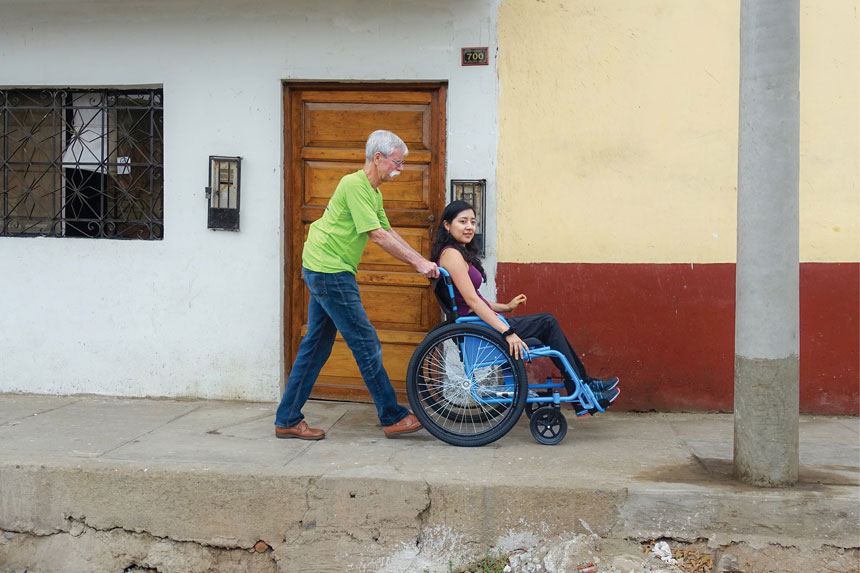
The wheelchairs have evolved since that first simple model. The next two versions were more adjustable, more comfortable, and built to last in tough terrains. The third-generation model has a fold-up design, which makes it easier to carry on buses.
“We’ve also learned the importance of adjusting the wheelchair and training people on how to use it. That was something we didn’t do in the beginning,” he says. “If it doesn’t fit right, they won’t use it.”
The demand remains great. Roughly 80 million people worldwide — most in developing countries — need a wheelchair, according to the World Health Organization.
“It’s an emotional event because many have been waiting their whole life for a wheelchair,” Schoendorfer says. “And when they get one, many of them tell me… This is a miracle.”
(Note from me: This is not a religious post. Though helpful people feel that they’ve been led to do things, they did the things themselves. Either way, a great, great service is being done! That’s why I posted this story.)

