
The Black one looks just like our Chrissy, who lived to 21 yo before passing during April of 2020. This riff is so awful, yet so cute, and has the holiday spirit.
Tag: Peace
Peace & Justice History for 10/23:
| October 23, 1915 33,000 women marched in New York City demanding the right to vote. Known as the “banner parade” because of the multitude of flags and banners carried, it began at 2 o’clock in the afternoon and continued until long after dark, attracting a record-breaking crowd of spectators. Motor cars brought up the rear decorated with Chinese lanterns; once darkness fell, Fifth Avenue was a mass of moving colored lights.  The history of women’s suffrage in the U.S. The history of women’s suffrage in the U.S. |
| October 23, 1945 Jackie Robinson and pitcher John Wright were signed by Branch Rickey, president of the Brooklyn Dodgers Baseball Club, to play on a Dodger farm team, the Montreal Royals of the International League.Robinson became the first black baseball player to play on a major league team.  Jackie Robinson Jackie Robinson |
| October 23, 1947 The NAACP filed formal charges with the United Nations accusing the United States of racial discrimination. “An Appeal to the World,” edited by W.E.B. DuBois, was a factual study of the denial of the right to vote, and grievances against educational discrimination and lack of other social rights. This appeal spurred President Truman to create a civil rights commission. |
| October 23, 1956 The Hungarian revolution began with tens of thousands of people taking to the streets to demand an end to Soviet rule. More than 250,000 people, including students, workers, and soldiers, demonstrated in Budapest in support of the insurrection in Poland, demanding reforms in Hungary.  Hungarian students,1956 Hungarian students,1956 Hungarian revolution monument Hungarian revolution monumentThe day before, the students had produced a list of sixteen demands, including the removal of Soviet troops, the organization of multi-party democratic elections, and the restoration of freedom of speech. On the evening of the 23rd a large crowd pulled down the statue of Josef Stalin in Felvonulási Square. Hungary 1956 and the Political Revolution More |
| October 23, 1984 The Fact-Finding Board looking into the assassination of Filipino democratic leader Benigno Aquino confirmed that his death was the result of a military conspiracy, and indicted Chief-of-Staff General Fabian Ver, the first cousin of dictator Ferdinand Marcos. Marcos had blamed the chair of the Communist Party for the assassination, despite the fact that Aquino had been in the custody of the Aviation Security Command and surrounded by military personnel as he disembarked from the plane returning him to the Philippines. The chair of the Board, Corazon J. Agrava, was pressured into submitting a minority report clearing General Ver. He and the 25 other military officials charged were all acquitted. |
https://www.peacebuttons.info/E-News/peacehistoryoctober.htm#october23
Peace & Justice History for 10/22:
| October 22, 1963 200,000 students boycotted Chicago schools to protest de facto segregation. Why MLK Encouraged 225,000 Chicago Kids to Cut Class in 1963 |
| October 22, 1968 More than 300,000 protesters marked International Antiwar Day in Japan. The U.S. war in Vietnam and the ongoing (since the end of World War II) and massive American military presence on the Japanese island of Okinawa helped swell the ranks of the demonstrators; nearly 1400 were arrested. |
October 22, 1979 The deposed Shah of Iran, Mohammed Reza Pahlavi, arrived in New York for medical treatment from Mexico. He received permission to do so from the U.S. government (which had installed him as shah in a 1954 coup) despite warning from the newly established Islamic republic in Iran demanding that the Shah be turned over to them for trial. More on the Shah |
| October 22, 1983 Capping a week of protests, more than two million people in six European cities marched against U.S. deployment of Cruise and Pershing nuclear missiles: 1.2 million Germans, including 180,000 in Bonn; a 64-mile human chain between Stuttgart and New Ulm (and Hamburg, W. Berlin); 350,000 Rome; 100,000 Vienna; 25,000 Paris; 20,000 Stockholm; 4000 Dublin; plus 140 sites in U.S. In London, the Campaign for Nuclear Disarmament (CND) held its biggest protest ever against nuclear missiles with an estimated one million people taking part. Read more |
https://www.peacebuttons.info/E-News/peacehistoryoctober.htm#october22
Peace & Justice History for 10/21:
October 21, 1837 Osceola painted by George Catlin, 1838 The U.S. Army, enforcing President Andrew Jackson’s 1830 Indian Removal Act, captured Seminole Indian leader Osceola (meaning “Black Drink”) by inviting him to a peace conference and then seizing him and nineteen others, though they had come under a flag of truce. Under the law, they and the others of the “Five Tribes” (Choctaws, Chickasaws, Creeks and Cherokees) were to be moved, by force if necessary, west of the Mississippi to Indian Territory (Arkansas and Oklahoma). The Seminole had moved to Florida (then under the control of Spain) from South Carolina and Georgia as they were forced from their ancestral lands, then forced further south into the Everglades where they settled. Read more about Osceola |
| October 21, 1967 In Washington, D.C., more than 100,000 demonstrators from all over the country surrounded the reflecting pool between the Washington and Lincoln monuments in a largely peaceful protest to end the Vietnam War.It was organized by “the Mobe,” the National Mobilization Committee to End the War in Vietnam. Some then marched on, encircled and attempted to storm the Pentagon in what some considered to be civil disobedience; 682 were arrested and dozens injured. This protest was paralleled by demonstrations in Japan and Western Europe, the most violent of which occurred outside the U.S. Embassy in London where 3,000 demonstrators attempted to storm the building. 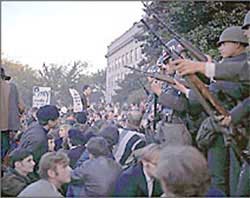 at the Pentagon at the PentagonRead two different accounts of the day with photographs: |
| October 21, 1983 In the first public action of the new Seattle Nonviolent Action Group (SNAG), 12 people blockaded the Boeing Cruise Missile plant in Kent, Washington; none were arrested. |
| October 21, 1994 In an “Agreed Framework” to “freeze” North Korea’s nuclear program, the United States and North Korea (Democratic Peoples’ Republic of Korea or DPRK) agreed over the next 10 years to construct two new proliferation-resistant light water-moderated nuclear power reactors (LWRs) in exchange for the shutdown of all their existing nuclear facilities. The DPRK also agreed to allow 8,000 spent nuclear reactor fuel elements to be removed to a third country; to remain a party to the Nuclear Non-Proliferation Treaty (NPT); and to allow inspections by the International Atomic Energy Agency. In the deal negotiated by Ambassador at Large Robert Gallucci, the U.S. agreed to normalize economic and diplomatic relations with Pyongyang and to provide formal assurances against the threat or use of nuclear weapons by the United States. The details of the agreement and what has followed Interview with Robert Gallucci, Dean, Walsh School of Foreign Service, Georgetown U. |
https://www.peacebuttons.info/E-News/peacehistoryoctober.htm#october21
Peace & Justice History for 10/20:
October 20, 1947 The House Un-American Activities Committee (HUAC) opened public hearings into alleged Communist influence in Hollywood. To counter what they claimed were reckless attacks by HUAC, a group of motion picture industry luminaries, led by actor Humphrey Bogart and his wife, Lauren Bacall, John Huston, William Wyler, Gene Kelly and others, established the Committee for the First Amendment (CFA). Read more ================= October 20, 1962 A folk music album, “Peter, Paul and Mary,” hit No. 1 on U.S. record sales charts. The group’s music addressed real issues – war, civil rights, poverty – and became popular across the United States. The trio’s version of “If I Had A Hammer” (originally recorded by The Weavers, which included the song’s composers, Pete Seeger and Lee Hays) was not only a popular single, but was also embraced as an anthem by the civil rights movement.  About Peter, Paul and Mary  ================== October 20, 1967 The biggest demonstration to date against American involvement in the Vietnamese War took place in Oakland, California. An estimated 5,000-10,000 people poured onto the streets to demonstrate in a fifth day of massive protests against the conscription of soldiers to serve in the war. [see October 16, 1967] Read more ================ October 20, 1973 In what was immediately called the “Saturday Night Massacre,” President Richard Nixon’s Press Secretary, Ron Ziegler, announced that Special Watergate Prosecutor Archibald Cox had been dismissed. Cox had been investigating Nixon, his administration and re-election campaign. Nixon had demanded that he rescind his subpoena for White House recordings.  Archibald Cox Archibald Cox  Richard Nixon Richard NixonEarlier in the day, Attorney General Elliot Richardson had resigned, and Deputy Attorney General William Ruckelshaus had been fired, both for refusing to dismiss Cox. Solicitor General Robert Bork, filling the vacuum left by the departure of his two Justice Department superiors, fired Cox at the president’s direction. |
https://www.peacebuttons.info/E-News/peacehistoryoctober.htm#october20
This Is Nice
Peace & Justice History for 10/19:
| October 19, 1923 The War Resisters League was founded in New York City.  WRL history  Above: One of the founders, Jessie Wallace Hughan (r), 1942 photo: WRL/Swarthmore Peace Collection The War Resisters League home |
October 19, 1960 Martin Luther King, Jr., and 36 others were jailed after being arrested during a sit-in at the snack bar of Atlanta’s Rich’s department store where they requested service and were refused on account of their race. More about this arrest |
| October 19, 1980 J.P. Stevens & Co. was forced to sign its first contract with a union after a 17-year struggle in North Carolina and other southern states. The workers, organized by the Amalgamated Clothing & Textile Workers Union, were supported by a widespread boycott of Stevens products by labor, progressive and religious organizations.  Read more about the struggle and the movie “Norma Rae” |
https://www.peacebuttons.info/E-News/peacehistoryoctober.htm#october19
Peace & Justice History for 10/18:
Woot! The first labor union is born in Boston!
October 18, 1648 I. Marc Carlson I. Marc Carlson The Shoemakers Guild of Boston became the first labor union in the American colonies. Labor organization in colonial times |
| October 18, 1929 The Persons Case, a legal milestone in Canada, was decided. Five women from Alberta, later known as the Famous Five, asked the Supreme Court of Canada to rule on the legal status of women. Some decisions of Magistrate Emily Murphy had been challenged on the basis that she was not a legal person, and she was a candidate for appointment to the Canadian Senate. After the Supreme Court ruled against them, they appealed to the British Privy Council.The Privy Council found for the women on this day (eight years after the case began and eleven years after women received the federal vote), declaring that women were persons under the law. October 18 has since been celebrated as Persons Day in Canada, and October as Women’s History Month.  Sculpture by Barbara Paterson of the Famous Five in Ottawa, first on Parliament Hill to honor women Sculpture by Barbara Paterson of the Famous Five in Ottawa, first on Parliament Hill to honor womenThe other women activists in the Famous Five: Henrietta Muir Edwards, Nellie McClung, Louise McKinney, and Irene Parlby. The Persons Case |
https://www.peacebuttons.info/E-News/peacehistoryoctober.htm#october18
Peace & Justice History for 10/17:
| October 17, 1898 The U.S. took control of Puerto Rico. One year after Spain granted Puerto Rican self-rule, following their rout in the Spanish-American War, troops raised the U.S. flag over the Caribbean island nation, formalizing American authority over the island’s one million inhabitants. Puerto Rico became a self-governing commonwealth, though the U.S. controls all aspects of its military, trade, media, banking and international affairs. Though Puerto Ricans are citizens, they don’t pay income taxes, nor are they represented in Congress or able to vote for president.  Timeline: Puerto Rico |
| October 17th, every year International Day for the Eradication of Poverty was designated by the United Nations in 1992. It began in 1987 when 100,000 people gathered in Paris and declared poverty a violation of human rights. This year’s theme “Building a sustainable future: Coming together to end poverty and discrimination” |
https://www.peacebuttons.info/E-News/peacehistoryoctober.htm#october17
Peace & Justice History for 10/16:
It is World Food Day. (Among other things; this is a busy date!)
| October 16, 1649 The British colony of Maine granted religious freedom to all citizens the same year that King Charles I was excommunicated from the Roman Catholic church. |
| October 16, 1859 Abolitionist John Brown led a group of 21 other men, five black and sixteen white, in a raid on the U.S. arsenal at Harper’s Ferry, Virginia. They had hoped to set off a slave revolt — throughout the south — with the weapons they had planned to seize.  John Brown John BrownVirtually all his compatriots were killed or captured by General Robert E. Lee’s troops; Brown was wounded and arrested, and hanged for treason within two months. Read more  The Tragic Prelude (John Brown)mural by John Steuart Curry (1937-1942) Former slave and abolitionist leader Frederick Douglass said of Brown that he was a white man “in sympathy a black man, as deeply interested in our cause as though his own soul had been pierced with the iron of slavery.” |
October 16, 1901 President Theodore Roosevelt President Theodore RooseveltPresident Theodore Roosevelt invited Booker T. Washington, founder of the Tuskegee Institute and the most prominent African American of his time, to a meeting in the White House. The meeting went long and the president asked Washington to stay for dinner, the first black person ever to do so. Newspapers in the both the South and North were critical, but the South with more venom. The Memphis “Scimiter” said that it was “the most damnable outrage that has ever been perpetrated by any citizen of the United States.” Roosevelt claimed he had invited a friend to dinner with his family and it was no one else’s business.  Booker T. Washington Booker T. Washington |
| October 16, 1934 Dick Sheppard, who volunteered and joined the Army as a chaplain in World War I, started the Peace Pledge Union in England. In a letter published in The Guardian newspaper and elsewhere, Sheppard, a well-known priest in the Church of England, invited those who would be willing to join a public demonstration against war to send him a postcard. Within a few weeks he had received 30,000 replies. Members of the Peace Pledge Union vowed to “renounce war and never again to support another.”   Reverend Sheppard had been the first ever to broadcast religious services on the radio and, when Vicar of St. Martin-in-the Fields, Trafalgar Square, he had opened the building to the homeless of London.“Up to now the peace movement has received its main support from women, but it seems high time now that men should throw their weight into the scales against war.” -Dick Sheppard Read more about the Peace Pledge Union |
| October 16, 1964 China detonated its first atomic bomb, becoming the fifth nuclear-armed nation. The 20-kiloton fission device (equivalent to 20,000 tons of TNT) was detonated in the vicinity of Lop Nor, a lake in a remote region of the Central Asian province of Sinkiang. ” To defend oneself is the inalienable right of every sovereign State. And to safeguard world peace is the common task of all peace-loving countries. China cannot remain idle and do nothing in the face of the ever-increasing nuclear threat posed by the United States.China is forced to conduct nuclear tests and develop nuclear weapons . . . In developing nuclear weapons, China’s aim is to break the nuclear monopoly of the nuclear Powers and to eliminate nuclear weapons.” Chou En-lai, the Chinese Prime Minister, sent messages to all heads of government for a world summit conference on nuclear disarmament. U.S. Secretary of State Dean Rusk told a news conference that the United States did not regard Communist China’s proposal “as having any practical value.”  Deng Jiaxian. The father of the chinese bomb. Deng Jiaxian. The father of the chinese bomb.TRINITY AND BEYOND™ (The Atomic Bomb Movie), a documentary by Peter Kuran |
October 16, 1967 Joan Baez the day after the arrest Folksinger Joan Baez was arrested in a peace demonstration as rallies took place across America during “Stop the Draft Week.” 1158 young men returned their draft cards in eighteen U.S. cities. Baez was among 122 anti-draft protesters arrested for sitting down at the entrance of the Armed Forces Induction Center in Oakland, California; she was sentenced to 10 days in prison. Read more |
| October 16, 1968 During medal presentations at the 1968 Summer Olympic Games in Mexico City, winning sprinters Tommie Smith (Gold) and John Carlos (Bronze) raised their black-gloved fists while the U.S. national anthem was played. They were suspended from the team at the insistence of the International Olympic Committee, and expelled from the Games two days later. Smith later told the media that he raised his right fist in the air to represent black power in America while Carlos’s left fist represented unity in black America. They were wearing just socks to represent world poverty.  Peter Norman (silver medalist, left) from Australia also wears an OPHR (Olympic Project for Human Rights) badge in solidarity with Smith and Carlos. He was castigated upon return to Australia and throughout his life for his support of these two brave athletes. Read more |
October 16, 1973 Henry Kissinger Henry KissingerU.S. Secretary of State Henry Kissinger, though accused of war crimes by some for the massive bombing of Laos and Cambodia, was awarded the Nobel Peace Prize jointly with North Vietnam’s Le Duc Tho (who refused the honor) for the cease-fire agreement they had negotiated. This occurred just a month after the bloody military coup, fully supported by the Nixon administration and aided by the CIA, that overturned the democratically elected government of Chile, and installed General Augusto Pinochet as military dictator for the next 17 years. |
October 16, 1984 Desmond Tutu, the archbishop of South Africa, was awarded the Nobel Peace Prize for his work in fighting apartheid. He has gone on to be a relentless advocate for justice around the world. Desmond Tutu – Nobel peace prize recipient |
| October 16, 1998 In a human rights and international law breakthrough, British authorities, after receiving an extradition request from Spanish Judge Baltasar Garzon, placed former Chilean dictator, and senator-for-life, General Augusto Pinochet under arrest for “crimes of genocide and terrorism that include murder.” Augusto Pinochet and Margaret Thatcher  Chronology of Pinochet’s rule |
| October 16th every year United Nations’ World Food Day is recognized every year. About the annual day of hunger awareness |
https://www.peacebuttons.info/E-News/peacehistoryoctober.htm#october16

