
Tag: Political
The Danger of Kash Patel
I’m reading through the Morning Memo from TPM (yeah, it’s 4PM; so what?🌞) and see a bit about an Atlantic article written by Elaina Plott Calabro. It’s a profile of Kash Patel. I’ve used up my Atlantic freebies, but am providing links here, plus a copy-paste of a thread that’s available for free. The link to the thread is just below the one for the Morning Memo, both beneath the copy-paste. Either the event detailed has somehow slipped my mind, or this is yet another example of how the Don’s administration was dangerous to US national security.
=====================
In the course of reporting on Patel, and the threat that he and other loyalists like him would pose to the country in a second Trump term, I struggled to shake what I learned about a series of events that took place on October 30, 2020. I want to share them with you here.
(snip-embedded tweet visible on the page)
On that Friday, according to multiple reported accounts, SEAL Team 6 was awaiting the green light on a rescue mission in West Africa. The admin had recently learned where gunmen were holding an American who had been kidnapped that week from his farm near the Niger/Nigeria border.
As multiple agencies coordinated on final details for the evening operation, the State Department worked to resolve the last outstanding task: securing airspace permission from Nigerian officials.
Around noon, Patel called the Pentagon with an update: Secretary of State Mike Pompeo, he said, had gotten the approval. The mission was a go.
The SEALs were close to landing in Nigeria when DOD discovered that State had not, in fact, secured the clearance, as Patel had claimed. The aircraft were quickly diverted, and flew in circles for the next hour as officials scrambled to alert the Nigerian gov’t to their position.
With the operation window narrowing, Esper and Pompeo called the Situation Room to put the decision to the president: Either they abort the mission and risk their hostage being killed, or they proceed into foreign airspace and risk their soldiers being shot down.
But then, suddenly, the deputy secretary of state was on the line, Esper later wrote in his memoir: They’d been cleared, and the rescue operation was ultimately a success. But back in Washington, the celebration was checked by anger. How to make sense of Patel’s bad report?
Two people familiar with the exchange told me that Tony Tata, the Pentagon official and retired Army general to whom Patel had originally given the green light, confronted Patel in a rage. “You could’ve gotten these guys killed!” he shouted. “What the fuck were you thinking?”
Patel’s response: “If nobody got hurt, who the fuck cares?”
Through a spokesperson, Patel denied saying this, or making up the approval story. But three former senior administration officials independently cited the near catastrophe in West Africa as one of their foremost recollections from Patel’s tenure.
They remain unsettled by Patel’s actions, they told me, in large part because they have no clue what motivated them. If Patel had in fact just invented the story, as Esper’s team concluded, then why?
Was it because the election was in four days, and Patel was simply that impatient to set in motion a final potential victory for Trump, whatever the risk — was it as darkly cynical as that? Did his lack of experience mean he just had no grasp of the consequences?
I don’t know the answers to these questions. But three months of reporting later, they’re the questions I can’t stop thinking about it — particularly as Patel, in a second Trump term, could very well assume remarkable power atop America’s national security establishment.
Anyway, if you’ve made it this far, I hope you’ll read the whole story, from our October issue, here:

The Man Who Will Do Anything for TrumpWhy Kash Patel is exactly the kind of person who would serve in a second Trump administrationhttps://www.theatlantic.com/magazine/archive/2024/10/kash-patel-trump-national-security-council/679566/?gift=PtjScmMpxEiEcpa5Z2F__gB8wOaSeKCNP9BBei0XHi0&utm_source=copy-link&utm_medium=social&utm_campaign=share
• • •
https://morningmemo.talkingpointsmemo.com/p/the-colossal-systemic-failure-in
With thanks to personnelente-
an important read from Army Times.
Are the Democrats and Kamala Harris anti-LGBTQ+, anti-trans, anti-Palestinians
Vance’s Trumped-Up Economics
Robert Reich Aug 25, 2024 (Posting Monday AM)
Friends,
Sorry to interrupt your Sunday but I think it useful in these final weeks before the election to give you the truth on important matters of public policy.
Today, Republican vice-presidential nominee JD Vance told NBC News that the tariffs Trump imposed during his term in office had not raised prices for Americans but had brought a significant number of jobs back to the United States.
Wrong on both counts.
In a careful analysis, researchers found the cost of Trump’s tariffs were “almost entirely borne by U.S. firms and consumers.”
That’s not surprising; tariffs function like taxes by raising the costs of imported goods. Trump’s proposal to raise tariffs on all imports as a means of raising revenue to offset a tax cut is obviously absurd.
Vance is also wrong about employment. Research clearly shows that the Trump tariffs did not bring jobs back to the United States.
Tariffs may be necessary for national security to protect critical industries such as semiconductors. But no one should be fooled into thinking they’re costless for consumers, or good for workers. The 1930 Smoot-Hawley tariff made the Great Depression far worse than it already was.
That Vance would make these claims — which have been so convincingly debunked — should cause all of us some concern. He seems as unreliable as the person who named him his running-mate.
https://robertreich.substack.com/p/vances-trumped-up-economics
Women’s Equality Day!
(Some references, and resources for the day, and every day to come!
Thanks and h/t to Women for Kansas -A)
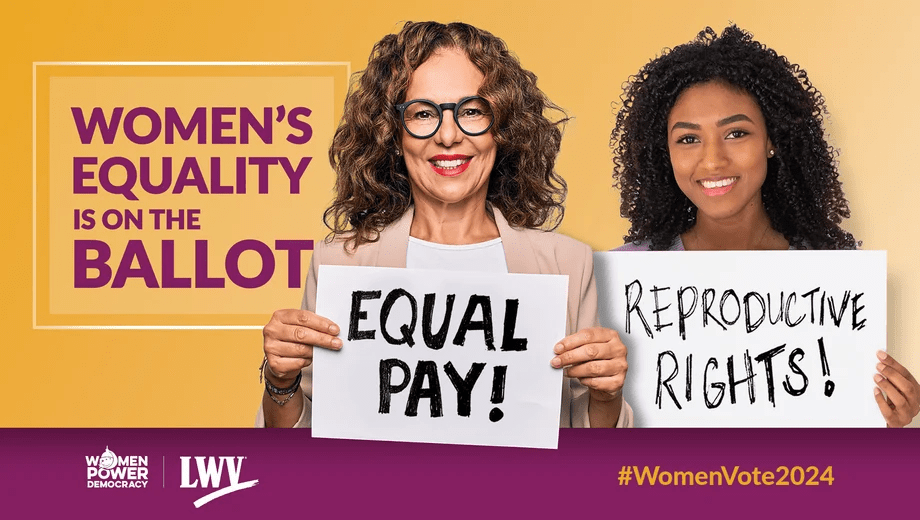
August 26, otherwise known as Women’s Equality Day, marks the anniversary of the certification of the 19th Amendment, which granted some women the right to vote.
Yet today, women have fewer rights than they’d had in decades. To recognize this, we acknowledge Women’s Inequality Day.
Empowering Women Voters in 2024
Women still aren’t equal under the law.
Inequality impacts our health: although women pay $15 million more each year for health care than men, we spend more of our lives in poor health. Those who may experience pregnancy no longer have reproductive freedom; and when we do give birth, we (particularly women of color) face high rates of maternal mortality.
It impacts our work: we’re paid less than our male counterparts and are underrepresented in leadership roles. We also deal with workplace harassment, insufficient maternal leave, and disproportionate caretaking responsibilities that affect our ability to work.
It impacts our representation: women are severely underrepresented in politics, making up only 25% of the Senate, 29% of the House, and 31.9% of statewide elective executives.
How can we make policies that protect and serve women without more women in office? And in an age where our basic freedoms and bodily autonomy are under fire, how can we ensure our rights aren’t degraded further?
The 2024 federal election is a critical moment in the fight for our equality.
The people we elect in November will be in charge of our rights – including the right to reproductive freedom – for the next four years.
So when you cast your vote in 2024, will you vote for someone who defends those rights? Or someone who wants to take them away?
Our 2024 campaign centers around empowering women to make their voices heard at the ballot box by equipping them with essential voter information. We’re highlighting our free, bilingual one-stop-shop for nonpartisan election information, VOTE411.org.
This year’s Women’s Inequality “Day” campaign will take place from August 26-30, with unique calls to action engaging voters every day! Get involved by sharing content via our social toolkit.
=====
International Women’s Day 2024 campaign theme is ‘Inspire Inclusion’
The campaign theme for International Women’s Day 2024 was Inspire Inclusion.
When we inspire others to understand and value women’s inclusion, we forge a better world.
And when women themselves are inspired to be included, there’s a sense of belonging, relevance, and empowerment.
Collectively, let’s forge a more inclusive world for women.
Read more about a definition of what it means to inspire inclusion here.
https://www.internationalwomensday.com/Theme
=====
BAD ROMANCE: WOMEN’S SUFFRAGE
Soomo, youtube.com
“Bad Romance: Women’s Suffrage is a parody music video paying homage to Alice Paul and the generations of brave women who joined together in the fight to pass the 19th Amendment, giving women the right to vote in 1920.” Watch here.
=====
| WOMEN’S PROGRESS THROUGH THE YEARS… |
| Prior to 1918 Doctor’s weren’t allowed to advise married patients about birth control. Prior to 1920 Women couldn’t vote in all elections until 19th Amendment was ratified. Prior to WWII Female teachers couldn’t be married. During 1950’s Domestic abuse was not considered a crime but a’family matter’. Prior to 1963 Equitable wages for the same work, regardless of race, color, religion, national origin, or sex of the workers were not promised until passage of Equal Pay Act. Prior to 1964 Discrimination on the basis of race, color, religion, national origin, or sex was not prohibited until passage ofthe Civil Rights Act. Prior to 1965 State laws could prohibit the prescription or use of contraceptives by married couples. In some states, the woman needed her husband’s permission to purchase contraceptives. Prior to 1969 Yale and Princeton didn’t accept female students. Prior to 1969 Women couldn’t work at jobs that had been for men only. Prior to 1971 Women with a law degree could be denied the right to plead a client’s case in court. Prior to 1971 Private employers could refuse to hire women with pre-school children. Prior to 1972 The Boston Marathon was an all-male event. There was no Women’s Division. Prior to 1972 The right to privacy didn’t encompass an unmarried person’s right to use contraceptives. Prior to 1972 Title IX of the Education Amendment didn’t exist. Schools that received Federal support didn’t need to provide the same programs to women as they did men. | Prior to 1973 Abortions weren’t legal in the entire U.S. until Roe v. Wade decision by Supreme Court declared the U.S. Constitution protected a woman’s right to terminate an early pregnancy. Prior to 1974 Housing discrimination on the basis of sex and credit discrimination against women existed. Prior to 1974 It was legal to force pregnant women to take maternity leave on the assumption they were incapable of working in their physical condition. Prior to 1974 Single, widowed, or divorced women had to bring a man along to open a bank account or to cosign any credit application. Married women couldn’t open a bank account without their husband’s permission. Prior to 1975 Women were excluded from serving on juries. Prior to 1976 West Point Academy didn’t admit female students. Prior to 1977 Harvard didn’t admit female students. Prior to 1978 There was no ban on discrimination against women on the basis of pregnancy, childbirth, or related medical issues. Prior to 1984 Women were not allowed to join all-male organizations (Jaycees, Kiwanis, Rotary, Lions) Prior to 1994 There were no funded services for victims of rape or domestic violence. Prior to 2013 Women in the military were banned from combat positions. Prior to 2022 Since the 1973 Supreme Court decision (Roe v. Wade), a woman’s right to terminate a pregnancy was protected by the U.S. Constitution. This decision was reverse by the current U.S. Supreme Court in 2022. Information provided by Soroptimist site. Learn more about Soroptimist’s by visiting their site here. |
LEARN MORE ABOUT THE HISTORY OF WOMEN’S EQUALITY DAY
National Women’s History Alliance
Read more here.
The Shinbone Star
I read these whenever I get ’em. I think everyone should, so give it a try when you get a few minutes. Well, unless you already did; I’m a few days late reading this one! 🌞
Still haven’t seen that coffee, but this is a most excellent blog post:
This is good-enjoy!
The Best And Blackest Moments From The Democratic National Convention
From Kamala Harris’ surprise appearance to honoring Jesse Jackson, the DNC had a celebratory start..
By Candace McDuffie Published Tuesday 11:48 AM
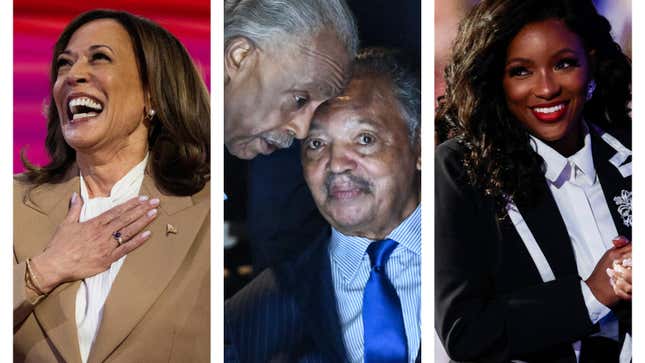
The Democratic National Convention kicked off in Chicago on Monday (August 19) at United Center and was quite the celebration. President Joe Biden gave the final address of the night, which was full of resilience and reassurance that Vice President Kamala Harris is going to be our next President Of The United States.
Biden was also proud of his own legacy, which he expressed by sharing a quote from the song “American Anthem” by Gene Scheer: “What shall our legacy be, what will our children say, let me know in my heart when my days are through, America, America, I gave my best to you.”
In addition, the night contained a myriad of moments that uplifted the Black community. Here are the best and Blackest moments from Day 1 at the DNC.
Chicago Mayor Brandon Johnson gave VP Harris a galvanizing endorsement.
As one of the night’s earliest speakers, former teacher and Chicago Mayor Brandon Johnson declared his city as the greatest in the world before recognizing the contributions of journalist Ida B. Wells, Rev. Jesse Jackson and this country’s first Black president Barack Obama.
He also expressed excitement about his daughter being able to see a “reflection of herself in the White House” before giving a galvanizing endorsement of Harris.
“What will it take to defeat MAGA Republicans and move our country forward and not backward? It will take everyone, and let me tell you all: Kamala, she’s got us,” Johnson said. “Together, we will build a better, brighter future.”
The great Rev. Jesse Jackson was honored for paving the way for Kamala Harris.
Iconic civil rights leader Rev. Jesse L. Jackson Sr. received a standing ovation when he made an appearance on the first night of the Democratic National Convention.
Jackson, who stepped down as president of the Chicago-based Rainbow PUSH Coalition last year, made history as the second Black American to seek a major-party nomination for President when he ran as a Democrat in 1984.
His historic contributions made it possible for Harris to run today. Jackson, who is currently living with Parkinson’s disease, did not give a speech Monday evening. Instead, he waved and gave a thumbs-up from his wheelchair as he enjoyed the celebration.
Vice President Kamala Harris made a surprise appearance
The Democratic presidential nominee is scheduled to give a speech at the DNC Thursday night, but Harris made a surprise appearance on Monday to honor President Biden and thank him for everything he’s done for his country.
Entering the stage to Beyoncé’s “Freedom” wearing a tan pantsuit (which some thought was a nod to former President Barack Obama’s biggest fashion moment in 2014), Harris remarked: “Joe, thank you for your historic leadership, for your lifetime of service to our nation, and for all you will continue to do, we are forever grateful to you.”
She then added: “With optimism, hope and faith, so guided by our love of country, knowing we all have so much more in common than what separates us, let us fight for the ideals we hold dear. And let us always remember when we fight, we win.”
Rep. Jasmine Crockett reads Donald Trump for absolute filth
In a speech delivered Monday night, U.S. Rep. Jasmine Crockett boldly contrasted Vice President Kamala Harris’ record to that of her presidential opponent Donald Trump. “She became a career prosecutor while he became a career criminal — with 34 felonies, two impeachments and one porn star to prove it!” Crockett said.
She didn’t stop there. “She’s lived the American dream while he’s been America’s nightmare. America, looking at the two choices before you, who would you hire? Donald Trump or Kamala Harris? Kamala Harris has a résumé — Donald Trump has a rap sheet.”
She concluded her speech with a nod to her viral Marjorie Taylor Greene “bleach blonde, bad-built butch body” insult from earlier this year.
“The question before us is: Will a vindictive vile villain violate voters’ vision for a better America or not?” Crockett said to raucous cheers from the Chicago audience. “I hear alliterations are back in style.”
Raphael Warnock transforms the stage into his pulpit during moving address
Georgia Sen. Raphael Warnock, who is also the senior pastor at Ebenezer Baptist Church in Atlanta, preached to DNC attendees about unifying for the greater good of the country.
“I’m convinced tonight that we can lift the broken even as we climb. We can heal the wounds that divide us. We can heal a planet in peril. We can heal the land,” he stated. Warnock’s emotional address was exactly what Democrats needed. He also addressed the culture of MAGA and its followers’ attack at the U.S. Capitol building in 2021.
“The line of logic of Jan. 6 is a sickness, is a kind of cancer metastasized into dozens of voter suppression laws all across our country,” Warnock said. “And we must be vigilant tonight, because these anti-democratic forces are at work right now in Georgia and across the country.”
https://www.theroot.com/the-best-and-blackest-moments-from-day-1-at-the-democra-1851626788
Coincidence? Well,
I don’t believe it is.
MIT’s Black student enrollment drops significantly after Supreme Court affirmative action ruling
The university’s white and Asian American student populations have increased, while all others have declined — some even down to zero, according to MIT.
Aug. 21, 2024, 3:33 PM CDT By Char Adams
Enrollment for Black and Latino students dropped at the Massachusetts Institute of Technology in the first class formed after the Supreme Court found race-conscious admissions in colleges unconstitutional.
The university’s admissions department on Wednesday released its first-year class profile, showing a sharp drop in its Black student population. About 5% of MIT’s incoming class of 2028 is Black, a significant drop from its 13% average in recent years. Latino students make up 11% of the class of 2028, compared to a 15% average in recent years. Overall, 1,102 students make up the incoming class.
Stu Schmill, MIT’s dean of admissions, attributed the drop to the high court’s 2023 decision to end consideration of race in the admissions process.
“We expected that this would result in fewer students from historically underrepresented racial and ethnic groups enrolling at MIT,” Schmill said of the ruling. “That’s what has happened.”
The white and Asian American student populations have increased, while all other groups have declined — some even down to zero, the profile shows. (snip-More) (grrrr)

