These bans have been successful in part because of a toxic and ruthless ecosystem of far-right influencers, like Riley Gaines, who have formed entire careers around attacking trans athletes by prioritizing hate and misinformation.
“So much of what we see … just seems like it’s wrapped up in really hateful and negative messages that aren’t good for anyone,” says Mary Fry, a professor of sport and exercise psychology at the University of Kansas. “We’re creating issues where maybe we don’t need to.”
The anti-trans attacks in sports are also affecting cis women. Ayala, a competitive cyclist, remembers one race where she and her trans friend both made the podium. When photos of the event were posted on Facebook, people accused her of being trans, and she was added to a “list of males who have competed in female sports” maintained by Save Women’s Sports.
Earlier this year, 16-year-old AB Hernandez became the target of nationwide hate and harassment when the president of a local school board publicly doxxed the track and field athlete and outed her as transgender. Right-wing activists misgendered her and called her mom “evil;” swarms of adults showed up to heckle her at games; Charlie Kirk pushed state governor Gavin Newsom to condemn her; and President Donald Trump threatened to withhold federal funding from California over her participation.
While transgender athletes are very rare, this type of harassment towards them is playing out across the country and internationally. A trans girl was harassed at a soccer game in Bow, New Hampshire, by adult protestors wearing XX/XY armbands, representing an anti-trans sports clothing brand. And in British Columbia, a 9-year-old cis girl was accosted by a grown man who accused her of being trans and demanded that she prove her sex to him.
While research into the relative athletic capabilities of trans and cis women is ongoing, far-right groups, including the Alliance Defending Freedom and the Leadership Institute, have been putting hate before science to turn the public against trans athletes since at least 2014. And it’s working.
Laws, rules or regulations currently ban trans athletes from competing in sports consistent with their gender identity in 29 states, with 21 beginning the ban in kindergarten. The majority-conservative Supreme Court announced this month that it’ll be taking on the question of the constitutionality of the bans. Meanwhile, the federal government is pressuringstates without bans to change their policies in compliance with a Trump executive order that attempts to institute a nationwide ban.
Trump signs an executive order calling for bans on trans women and girls from women’s sports. Photo by: The White House.
These bans have been successful in part because of a toxic and ruthless ecosystem of far-right influencers, like Riley Gaines, who have formed entire careers around attacking trans athletes by prioritizing hate and misinformation.
“So much of what we see … just seems like it’s wrapped up in really hateful and negative messages that aren’t good for anyone,” says Mary Fry, a professor of sport and exercise psychology at the University of Kansas. “We’re creating issues where maybe we don’t need to.”
Harassment and Mental Health
Grace McKenzie has been deeply affected by these hate campaigns. A lifelong athlete, McKenzie has stayed healthy by playing multiple sports where she’s met “amazing people.” Shortly after she transitioned in 2018, she was thrilled when she was invited to join a women’s rugby team at the afterparty of a Lesbians Who Tech conference.
Grace McKenzie. Photo courtesy of McKenzie.
“Rugby became my home, it was my first queer community, it was the space where I really discovered my own womanhood,” McKenzie told Uncloseted Media. “I could be the sometimes-masculine, soft-feminine person who play[s] rugby and loves sports.”
But that started to change in 2019, when McKenzie and others on her team started to hear rumors that World Rugby was considering a ban on trans athletes. Fearing the loss of her community, she started a petition that racked up 25,000 signatures—but it wasn’t enough, and the ban took effect in 2020.
As anti-trans rhetoric in sports has ramped up, McKenzie says she’s had soul-crushing breakdowns that have left her “sobbing uncontrollably and unconsolably.”
“It would be these waves of such intense despair and rage—it was like going through grief for five years,” she says. “I have to wake up every single day and read about another state or another group of people who say that they don’t want me to exist.”
While McKenzie says she’s found the strength to keep playing where she can, sports psychologist Erin Ayala has seen clients leave sports altogether due to the hate toward trans athletes.
“It can be really difficult when they feel like they’re doing everything right … and they still don’t belong,” says Ayala, the founder of the Minnesota-based Skadi Sport Psychology, a therapy clinic for competitive athletes. “Depression can be really high. They don’t have the strength to keep fighting to show up. And then that can further damage their mental health because they’re not getting the exercise and that sense of social support and community.”
That was the story of Andraya Yearwood, who made national headlines in high school when she and another trans girl placed first and second in Connecticut’s high school track competitions. The vitriol directed at her was intense: Parents circulated petitions to have her banned; crowds cheered for her disqualification; the anti-LGBTQ hate group Alliance Defending Freedom launched a lawsuit against the state for letting her play; and she faced a torrent of transphobic and racist harassment.
“It’s a very shitty experience,” Yearwood, now 23, told Uncloseted Media.
Fearing more harassment, she quit running in college.
“I understood that collegiate athletics is on a much larger and much more visible scale. … I just didn’t want to go through all that again for the next four years,” she says. “Track obviously meant a lot to me, and to have to let that go was difficult.”
It’s understandable that Yearwood and other trans athletes struggle when they have to ditch their favorite sport. A litany of research demonstrates that playing sports fosters camaraderie and teamwork and improves mental and physical health. Since trans people disproportionately struggle from poor mental health, social isolation and suicidality, these benefits can be especially crucial.
“In some of these cases, kids have been participating with a peer group for years, and then rules were made and all of a sudden they’re pulled away,” says Fry. “It’s a hard world to be a trans individual in, so it’d be easy to feel lonely and separated.”
Caught in the Crossfire
The anti-trans attacks in sports are also affecting cis women. Ayala, a competitive cyclist, remembers one race where she and her trans friend both made the podium. When photos of the event were posted on Facebook, people accused her of being trans, and she was added to a “list of males who have competed in female sports” maintained by Save Women’s Sports.
Ayala isn’t alone. Numerous cis female athletes have been “transvestigated,” or accused of being trans, including Serena Williams and Brittney Griner. During the 2024 Paris Olympics, Donald Trump and Elon Musk publicly accused Algerian boxer Imane Khelif of being trans after her gold medal win, as part of a wave of online hate against her. She would later file a cyberbullying complaint against Musk’s X.
While women of all races have been targeted, Black women have faced harsher scrutiny due to stereotypes that portray them as more masculine.
Yearwood remembers posts that would fixate on her muscle definition and compare her to LeBron James.
“I think that is attributed to the overall hyper-masculinization and de-feminization of Black women, and I know that’s a lot more prevalent for Black trans women,” she says. “It made it easier to come for us in the way that they did.”
Subscribe
A Big Distraction
Joanna Harper, a post-doctoral scholar at Oregon Health & Science University and one of the world’s leading researchers on the subject, says that the jury is still out on whether the differences in athletic performance between trans and cis women are significant enough to warrant policy changes.
“People want simple solutions, they want things to be black and white, they want good guys and bad guys,” Harper says, adding that the loudest voices against trans women’s participation do not actually care about what the science says.
“This idea that trans women are bigger than cis women, therefore it can’t be fair, is a very simple idea, and so it is definitely one that people who want to create trans people as villains have pushed.”
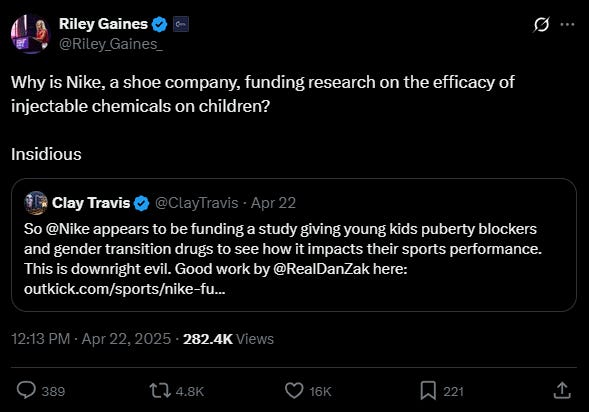
Even Harper herself has been the victim of the far-right’s anti-trans attacks. Earlier this year, she was featured in a New York Times article where she discussed a study she was working on with funding from Nike into the effects of hormone replacement therapy (HRT) on adolescents’ athletic performance.
Riley Gaines and OutKick founder Clay Travis attack Harper’s study on X.
“That Nike chose to fund a study on trans athletes doesn’t actually say that they’re supporting trans athletes. They’re merely supporting research looking into the capabilities of trans athletes,” Harper says. “You don’t know what the research will show until you get the data … but the haters don’t want any data coming out that doesn’t support what they want to say.”
Harper says this anti-trans fervor and HRT bans are making it more difficult to conduct studies in the first place.
And while the far-right argues that they are “protecting women’s sports” in their war on trans athletes, multiple athletes and experts told Uncloseted Media that this distracts from bigger issues in women’s sports, including sexualharassment by coaches and a lack of funding.
“If the real goal was to help women’s sports, they would try to increase funding [and] support for athletes,” says Harper, noting that women’s sports receive half as much money as men’s sports at the Division I collegiate level. “But that’s not what they’re doing, and it becomes pretty evident the real motivation behind these people.”
Since Trump’s reelection, Grace McKenzie has somewhat resigned herself to the likelihood of attacks on trans people getting worse. Despite this, she finds hope in building community with other trans athletes, such as the New York City-based trans basketball league Basketdolls.
“If that’s the legacy that [the anti-trans movement] wants to leave behind, good for them,” McKenzie says. “Our legacy is going to be one about hope, and collective solidarity, and mutual aid, and I would much rather be on that side of the fence.”
Meanwhile, Fry remains hopeful that conflicts can be resolved and that trans people may be able to find a place in sports over time.
“If we could all have more positive conversations and not create such a hateful environment around this issue, it would just benefit everyone.”
If objective, nonpartisan, rigorous, LGBTQ-focused journalism is important to you, please consider making a tax-deductible donation through our fiscal sponsor, Resource Impact, by clicking this button:
What is it that Republicans do not want children learning, exactly? That white men enslaved Africans? That the founding “fathers’ owned slaves? Most history is a hard pill to swallow. That is why we learn from it our entire lives!
Providing objective, nonpartisan, rigorous, original journalism that investigates America’s anti-LGBTQ landscape and elevates everyday American heroes. Expect two rigorously reported stories every weekend.
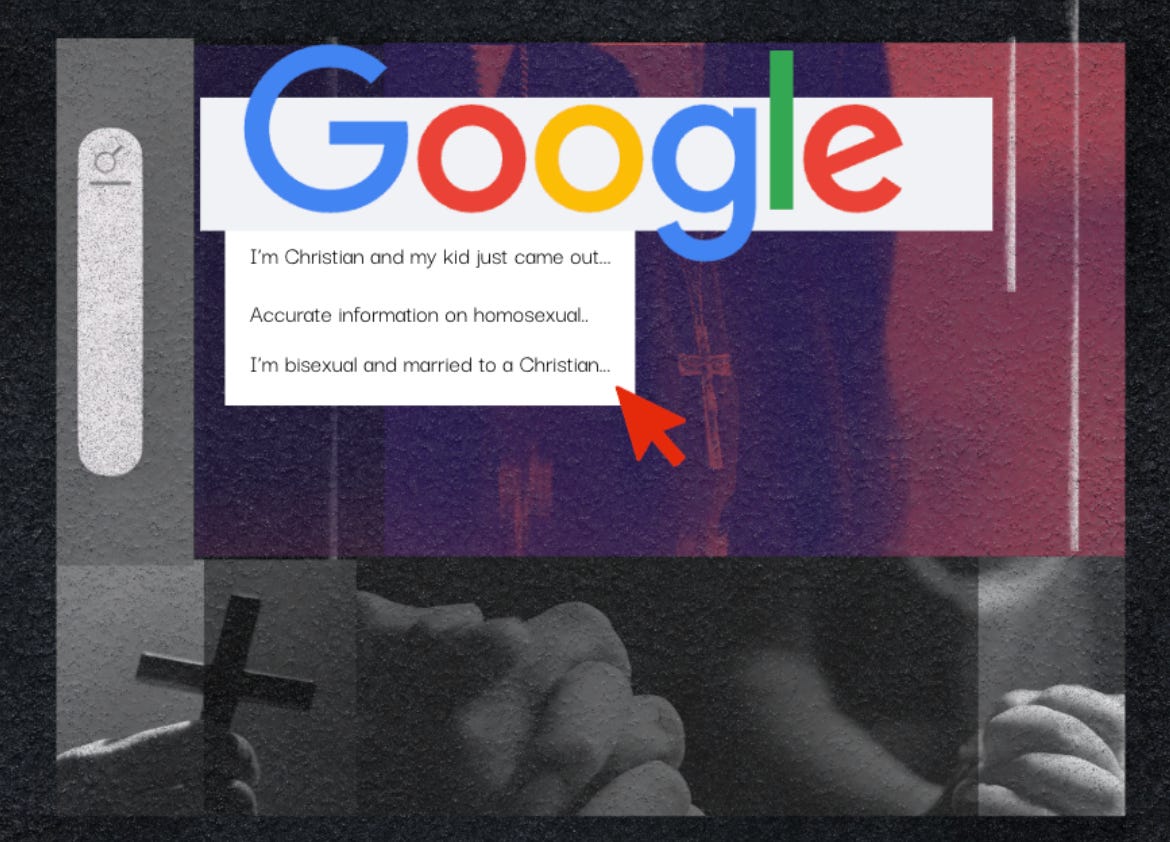
But how does Google’s algorithm decide which results show up? And how do these results influence LGBTQ kids, their parents and Americans at large who are searching for help?
Uncloseted Media asked five Americans from around the country to Google five common queries related to LGBTQ identity, religion and parenting.
The results were alarming and raised an urgent question: With nearly 40% of LGBTQ youth seriously considering suicide just last year, what happens when a queer teen or the parent of a gay kid in crisis turns to Google?
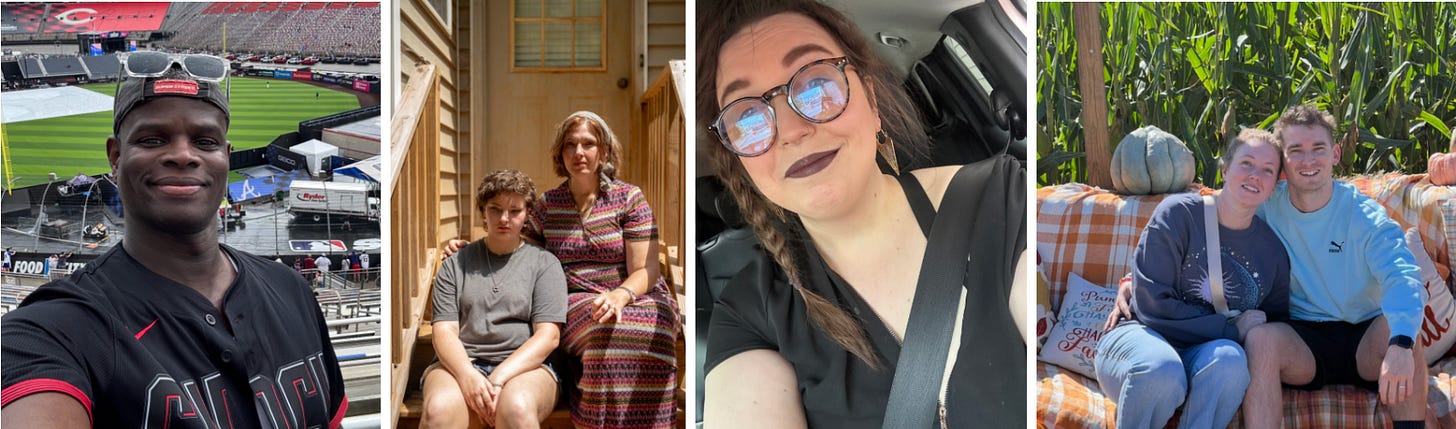
Photos courtesy of participants Mark Just, Genna and Melanie Brown, April Samberg, Tommy O’Neil. Photo of Genna and Melanie by Kaoly Gutteriez.
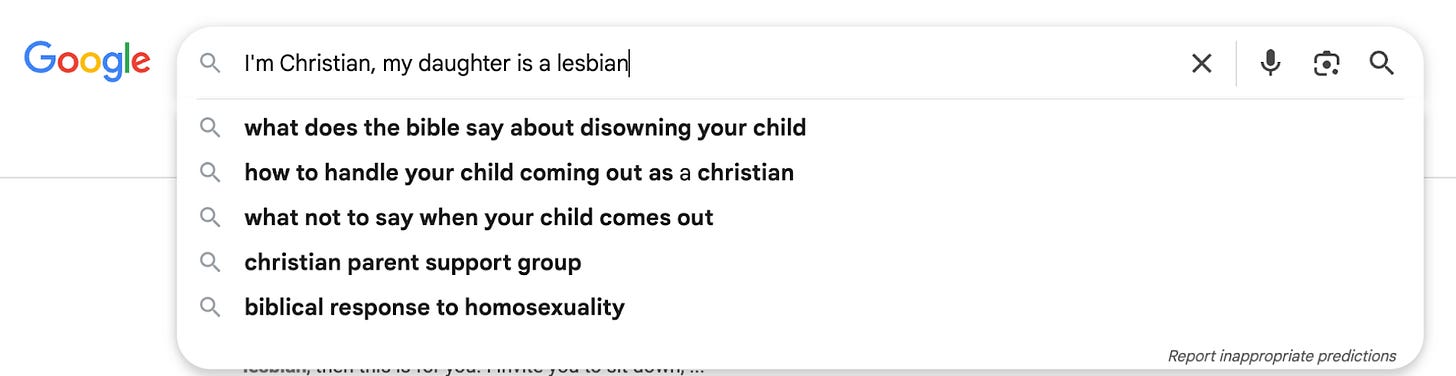
“I’m Christian, my daughter is a lesbian,” Melanie Brown, a Southern Baptist from High Point, North Carolina, types into Google.
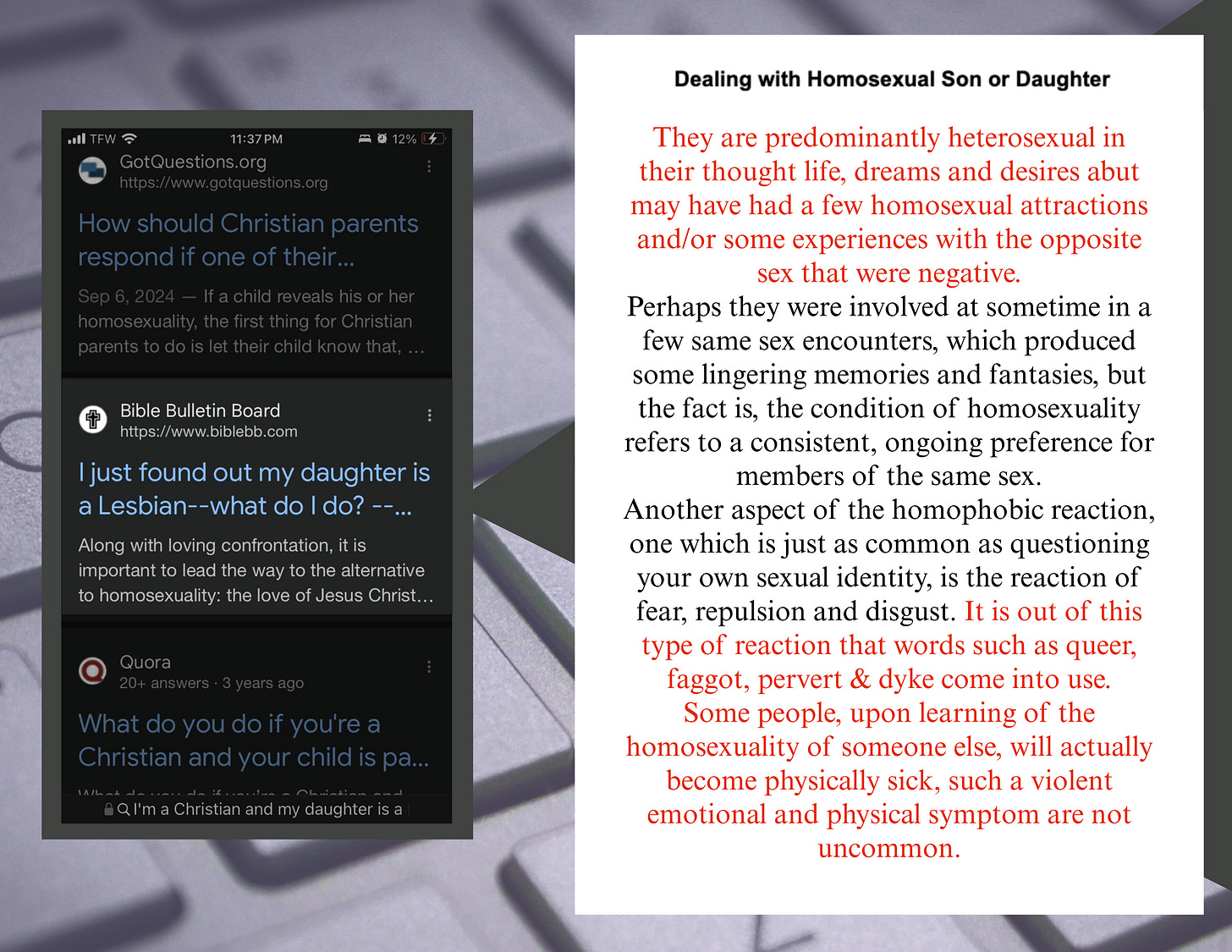
When Brown presses enter, Bible Bulletin Board comes up as the third result, with the suggestion of “offering hope for change,” and “lead[ing] the way to the alternative to homosexuality.” It goes on to explain that “homosexuality is contrary to God’s Word. It is sin and as always results in sin’s destructive effects on the individual and on those close to them.”
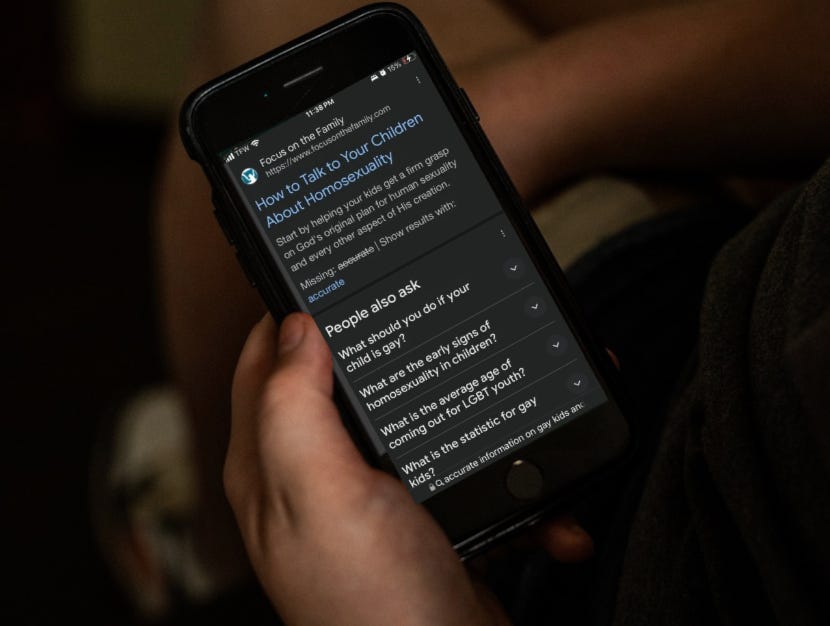
In the living room, Brown’s 15-year-old daughter Genna, with her dog on her lap, Googles “accurate information on gay kids and what to do.”
Focus on the Family (FOTF) is the first result. She clicks the link and lands on the platform of a hyper-religious organization known for promoting conversion therapy and labeling her sexuality as sinful.
The site, which presents itself as a reputable religious source, features a tab titled “Understanding Homosexuality” and a section under their resources for “Homosexuality.” It states: “[FOTF] is committed to upholding God’s design for the expression of human sexuality: a husband and wife in a marriage.”
It offers suggested reading on “redemption” from a gay lifestyle, along with 11 counseling resources aimed at changing sexual orientation, including The Alliance for Therapeutic Choice and Scientific Integrity, which guarantees “professional assistance … for persons who experience unwanted homosexual attractions.”
The language is intentionally padded, which means Genna and her mom—and many of the other millions of Christian parents of queer kids—may never know that Google led them to a Southern Poverty Law Center-designated anti-LGBTQ hate group. FOTF is known for its long-standing opposition to LGBTQ rights, for spreading anti-LGBTQ disinformation and for framing homosexuality and transgender identity as sinful and disordered.
Screenshot courtesy of Genna Brown. Photo by Kaoly Gutierrez.
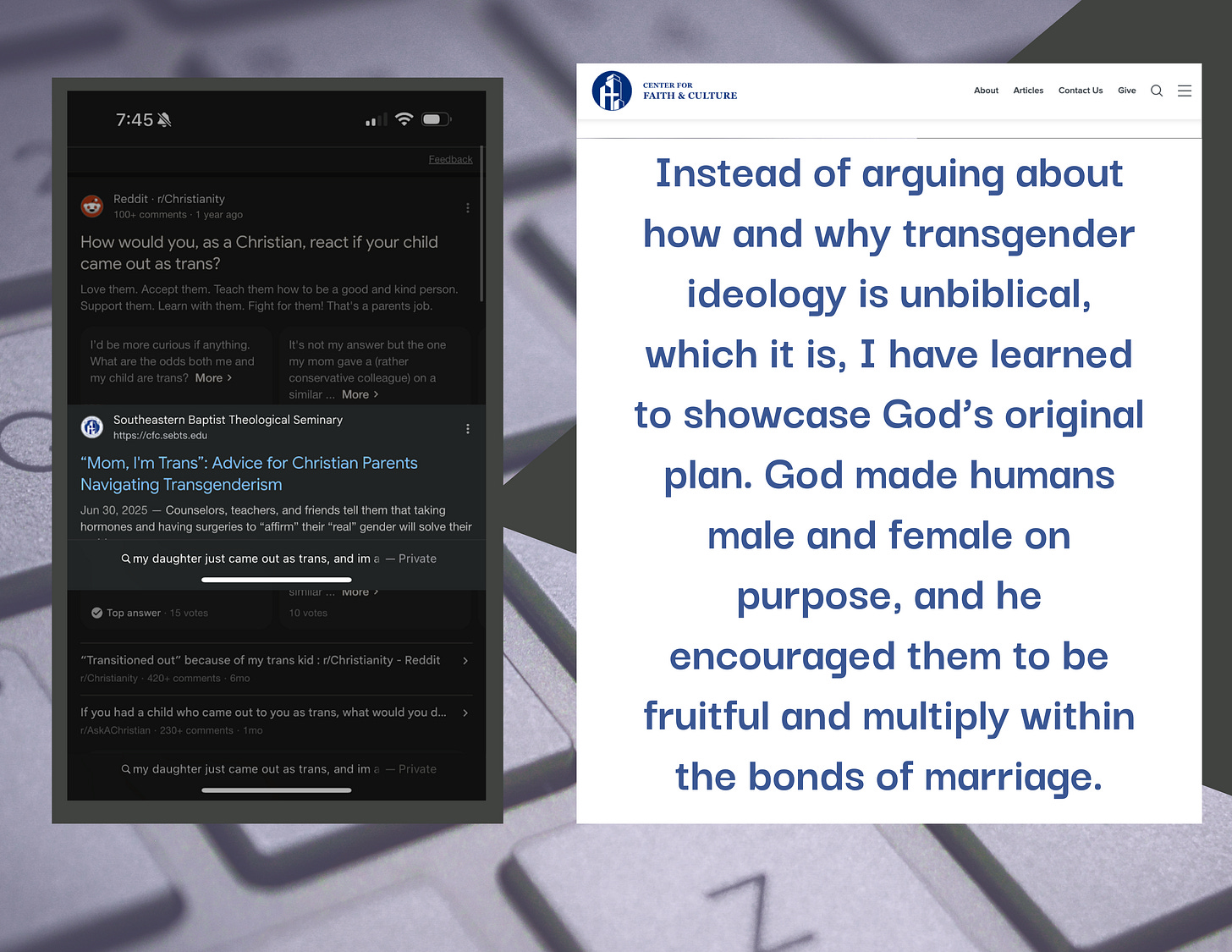
In South Boston, Virginia, Tommy O’Neil Googles, “My daughter just came out as trans and I’m a Christian.” As a father of two, he wants what’s best for his kids. According to Southeastern Baptist Theological Seminary, Google’s second result, O’Neil should recognize that God doesn’t make mistakes when assigning sex and give sympathy for those who are indoctrinated in the “transgender cult.”
Thousands of miles away in Anchorage, Alaska, 38-year-old bisexual woman April Samberg Googles, “I am bisexual and have a husband who is Christian, am I going to hell?”
The third result is once again an article by FOTF that tells April that “same-sex-attracted strugglers” and “transgender and homosexual lust and behavior are wrong.”
In Cincinnati, 44-year-old Mark Just Googles, “accurate information on homosexual kids and what to do.” FOTF is the top search result.
“I don’t feel good about it,” Just told Uncloseted Media. “It’s disturbing because if there are people out there who want to accept and understand their children or loved ones, this is what they’re being pointed to.”
“[I feel] fear for the queer kids with Christian parents who will be seeing that and thinking it’s good advice, and sorrow for the kids with parents who already have,” says Genna Brown, who was a “self-loathing, suicidal kid” who thought God would punish her for being gay before she came out to her now accepting parents. “It’s pretty awful that this is what’s being pushed for advice. This has no doubt harmed people.”
Uncloseted Media also asked folks in Taiwan, Lebanon, China, Hong Kong, Canada and India to Google similar queries. All of them had FOTF turn up as a top search result.
Subscribe
Why Does Google Allow This?
Google, like other search engines, compiles information and directs users to various websites by referencing the titles of web pages that it judges to be most reflective of what was searched.
“Google’s algorithm is notoriously a black box,” says Jesse Ringer, founder of Method and Metric, a search engine optimization (SEO) growth company. “That’s intentional to keep their competitive advantage.”
What we do know is that Google ranks search results by first crawling the web with an automated program called “spiders” to follow links from page to page and collect data.
It uses text matching to identify documents that it thinks are relevant to a query and then ranks them based on a combination of popularity, freshness, location and previous links clicked.
But for people searching for reliable information, its process can be problematic.
“Google doesn’t rank based on accuracy, but on popularity and query matching,” says Dirk Lewandowski, professor of information research and retrieval at the Hamburg University of Applied Sciences. “This is based on clicks and a network of how many other links are directed to this website. … Of course, users click what is shown in the first position. So we have kind of a rich get richer.”
How to Get a High Ranking
As websites with the highest rankings continue to receive more clicks, websites like FOTF can also employ other tactics to keep their prominent placement.
Backlinking—the process of having other web pages hyperlink back to your site—is one of the ways to maintain your high ranking.
“Backlinks are a big part of popularity. So the relationship between other websites linking to this source is a big part of Google’s algorithm,” says Ringer. “There are SEO businesses that build link farms so that the content of their clients can go higher. They create a network effect and they link to each other. It is not unreasonable to think that [FOTF] has hired either an SEO person or they’ve hired an external agency to contribute to that.”
According to Francesca Tripodi, assistant professor at the University of North Carolina School of Information and Library Science, ranking can also be gamed by matching keywords to content. Tripodi looked at the metadata of progressive and conservative companies and found that conservative content creators “are much better at doing this.”
“They are savvy at creating new sets of words and tagging their content with them,” she says. “That’s not something I’m seeing with progressive content creators.”
Tripodi says that not only does conservatism thrive online, it might be the only perspective returned.
Subscribe
“They are well-funded companies with large production budgets and effective digital marketing teams,” she wrote in a 2019 testimony about conservatism and Google searches. “This is why when you search for liberal phrases like ‘gender identity’ or ‘social justice’ the top returns … are conservative content creators.”
Google declined to speak on record with Uncloseted Media for this story.
In an email, a spokesperson said: “Like any search engine, Google indexes the content that’s available on the open web, relying on systems like keyword matching to surface relevant results. We are largely guided by local law when it comes to removing pages from search results.”
What If It’s Harmful or Illegal?
The United States notoriously protects harmful or misleading content—including anti-LGBTQ hate speech—under the First Amendment.
“The situation in [other countries] is a bit different than in America,” Lewandowski says. “For instance, Holocaust denial is illegal in Germany. So Google bans these sites, but they don’t ban them in the U.S.”
Section 230 of the U.S. law protects Americans’ freedom of expression online by implying that we should all be responsible for our own actions and statements on the internet. This law largely takes legal pressure off of Google.
And in 2003, an Oklahoma court ruled that Google’s rankings are subjective opinions and thus constitutionally protected.
Google’s policies for tamping down on harmful content “don’t apply to web results.” Thus, there is little moderation on the web pages that pop up for Americans who use the search engine.
The spokesperson for Google says that “[they] hold themselves to a high standard when it comes to legal requirements to remove pages from Google search results” and that “they don’t remove web results except for child sexual abuse, highly personal information, spam, site owner requests, and valid legal requests.”
But according to the company, “determining whether content is illegal is not always a determination that Google is equipped to make.”
Tripodi says this might be why groups like FOTF are still showing up, even though conversion therapy is illegal in 23 states. She says these groups may have found a loophole in Google’s policy by “tricking” the search engine into thinking they are providing “resources” and not simply a recommendation for conversion therapy.
Subscribe
What Can Google Do to Fix This?
“Google has a responsibility for what is coming up in their results because people trust [them],” says Lewandowski. “They think something is correct or accurate because it is number one in Google.”
Fifteen-year-old Genna Brown is one of the 85% of Americans who feel this way, according to a 2025 study.
“Isn’t the first result typically ranked most credible?” she says. “Because I typically trust the first result more.”
“It’s pretty concerning what comes up when you search for these things,” Ringer says. “There needs to be more done to educate the people who are doing the searches on understanding news and information.”
But vulnerable groups, like LGBTQ kids who are living in households where they are told they are going to hell and parents who are often confused and in crisis themselves, are being led by Google’s algorithm to believe that being queer is wrong.
“1000% yes, these results concern me,” says Genna Brown. “We’re talking about organizations that promote practices like conversion therapy, which is insane. … I wish there was some disclaimer. Like, ‘Google has determined this to be a subjective query. As such, we can’t verify the following results. Proceed with caution.’”
Tripodi says she thinks consumers are responsible for about 20% of the burden by researching and verifying the sources they learn from. But she agrees with Brown in that Google carries an ethical responsibility for the content it chooses to rank and promote.
“As a global corporation that gobbles up all other possibilities for information, Google has a responsibility to ensure that its content is accurate and not harmful,” Tripodi says. “[It’s their job] to ensure that the information that they surface is accurate and reliable because we know people trust that information.”
Uncloseted Media reached out to Focus on the Family, Southeastern Baptist Theological Seminary, and Bible Bulletin Board. They did not respond to our request for comment.
Additional reporting by Sophie Holland and Spencer Macnaughton.
If objective, nonpartisan, rigorous, LGBTQ-focused journalism is important to you, please consider making a tax-deductible donation through our fiscal sponsor, Resource Impact, by clicking this button:
From left: Sen. Elizabeth Warren, Sen. Bernie Sanders, and Former Speaker of the House Nancy Pelosi, photos by Gage Skidmore, Sen. Joe Manchin, photo by Benedikt von Loebell | CC
According to End the Bribe System, “A ‘corporate democrat’ is a term used to describe a politician or political candidate who is associated with the Democratic Party in the United States and who is perceived to be more aligned with corporate interests than with progressive or left-leaning values.” The term is generally used by individuals critical of those politicians, who they believe prioritize the interests of corporations over their ordinary constituents.
These politicians are generally seen in the mainstream media as more moderate or centrist, and they are more likely to support policies that are beneficial to corporations, such as deregulation and tax cuts. Some corporate Democrats also call themselves “New Democrats.”
They also receive campaign contributions from large corporations and wealthy donors, which creates the perception that they are beholden to their donors rather than their constituents.
The term “corporate democrat” tends to be used by those on the left of the political spectrum who are critical of the influence of corporate money in politics and who support more progressive policies. They might view these politicians as too willing to compromise on important issues, or as not doing enough to address issues such as income inequality, climate change, or access to healthcare.
Although this term can be used in a derogatory manner, not all politicians within the Democratic Party who receive corporate donations are necessarily “corporate Democrats.”
There are different definitions of what a “corporate Democrat” is depending on who you ask. Some argue that a corporate Democrat is any politician who supports corporations, but that is not the best definition. End the Bribe System defines corporate Democrats as “…any Democratic Politician who accepts money from rich donors for favors (but claims it doesn’t influence them).”
Although corporate Democrats may support some policies their constituents want, when they have to make a decision, they will do what their wealthy donors prefer.
Most Republicans today can be considered “corporate Republicans,” given the majority of them accept corporate PAC money, and their policies almost always favor the desires of corporations, rather than their constituents.
Although the common wisdom is that Republicans raise more corporate political donations than Democrats, the actual difference is less dramatic when it comes to PACs. In 2022, Republicans received 55% of their contributions from corporate PACs and business-related associations while Democrats received 45%.
According to the Othering & Belonging Institute, Corporate Democrats have employed a narrative of pragmatism in the face of increasing political polarization. They see themselves as the brokers between Republicans and progressive Democrats. They also claim not to tow party lines and to only vote with their constituents’ interests.
Corporate Democrats see themselves as bipartisan and willing to compromise with Republicans to enact legislation in a time of partisan gridlock.
Examples of corporate Democrats on the state level include California Assembly members Rudy Salas, Adam Gray, and Jim Cooper, who describe themselves as fiscally conservative, “middle of the road”, and voices for the “silent majority,” as in the middle and working-class people who are not represented by the liberal coastal elite.
On the federal level, some examples of centrist or corporate Democrats include Senator Joe Manchin (D-W.Va.), Senator Dianne Feinstein (D-Calif.) and former Speaker of the House Nancy Pelosi (D-Calif.). Senator Kyrsten Sinema from Arizona was also a notorious corporate Democrat until she recently became an independent.
Progressive Senator Bernie Sanders even attacked Senator Kyrsten Sinema in 2022, calling her a “corporate Democrat” who “sabotaged” party priorities following her announcement that she was becoming an Independent.
Sanders said Sinema did not have the guts to take on special interest groups while attacking Sinema’s voting record.
“She is a corporate Democrat who has, in fact, along with Sen. [Joe] Manchin [D-W.Va.] sabotaged enormously important legislation,” Sanders said.
According to the Othering & Belonging Institute, Corporate Democrats say increasing government regulations on corporations negatively impacts job prospects for their middle-class and low-income constituents.
Despite the fact that some of them use anti-elite, populist rhetoric, corporate Democrats consistently vote in direct opposition to the well-being of their working-class constituents. Many progressives even argue that corporate Democrats’ failure to deliver for the working class for decades led to Trump getting elected president.
There is also some empirical evidence of the existence of corporate Democrats. According to a Princeton University study in 2014, there is no correlation between what the average American wants policy-wise and what is adopted. But there is a high correlation between what special interest groups and rich Americans prefer, and what policies are adopted.
Some political scientists argue that the study, along with others, provides enough evidence to conclude that the United States is not really even a representative democracy, Rather, it would be more accurately described as an oligarchy with democratic features.
Some Democrats have decided the only way to combat this issue of money in politics is to pledge not to accept any corporate PAC money. In 2022, more than 70 members, almost all Democrats, said they would not accept such contributions.
“Refusing corporate PAC money is one way to show a commitment to addressing the problem of money in politics, and its popularity helps keep the issue at the top of the agenda,” said Adam Bozzi, vice president for communications at End Citizens United, a group aligned with Democrats that tracks which members pledge to decline donations from corporate PACs.
“We expect the trend to continue to grow, and it will help us work toward progress on anti-corruption legislation, like ending dark money,” Bozzi said, using a term for committees that spend money to influence elections or policy but do not disclose their donors.
It is unclear if there will be any real widespread change though anytime soon, given major campaign finance reform or legislative changes have not even been proposed or voted on.
This is an article but one I wanted to share as I will soon be posting on what is a corporate democrat. The Democratic Party went to the right under Pelosi’s management / guidance. She pushed that for two reasons, one to chase the mythical center voters that as the republicans went ever harder right the center moved and the Democratic Party rather than staying where they were moved right to keep the “center voters”. Also Pelosi and the older elected members of congress felt they needed corporate money so they had to stop fighting businesses so hard to help the workers and the poor to instead play nice with the upper incomes. Hugs
Ever since Donald Trump won the election last month, bringing the GOP not just the White House but the House, the Senate, and the popular vote for the first time in 20 years, Democratic pundits, consultants, elected officials, and influencers have written think pieces, taken to social media, and sat down on podcasts to theorize why Democrats lost in the spectacular fashion they did. They blame this constituency group or that constituency group, this policy tweak or that policy tweak, this campaign decision or that campaign decision, but the truth is very simple:The Democratic Party is trying to serve two masters—the people and the corporate donors. And until it picks the people over its corporate masters, the Democratic Party will keep losing.
For as long as I can remember, the Democratic Party has marketed itself as the party of working class people, while the Republican Party has been painted as the out-of-touch, elitist, uncool party. When you’ve marketed yourself as the party of the working class, you cannot spend years in power and say the economy is booming while people struggle to afford rent and groceries. It was out of touch, and Democrats lost credibility by claiming “Bidenomics” was successful.
While some will point to the fact that the U.S. economy fared better than others during the pandemic in terms of inflation, that does not mean the economy is “good.” Working-class Americans from all backgrounds have been hurting. I cannot go to someone’s doorstep in my hometown of Cleveland, Ohio, one of the poorest big cities in America where one out of every two children lives in poverty, and tell them that the economic pain they are feeling is not bad because other countries have it worse.
US President Joe Biden speaks to the press during his visit to the National Slavery Museum in Morro da Cruz, near Luanda, on December 3, 2024. ANDREW CABALLERO-REYNOLDS/AFP via Getty Images
Democrats should have spent the past four years tackling corporate greed aggressively, fighting for those communities hit hardest by this greed. They should have championed bold policies like Medicare for All and tuition-free college, things that would ease economic burdens on working class Americans.
“You should not go into debt if you get sick or pursue an education” would be one hell of a rallying cry for the Democratic Party. Currently, the Democratic Party cannot stand for policies that get at the root causes of corporate greed.
Why? Because the corporate donor class, those who write the checks, have ensured that those who hold titles in the Democratic Party do not champion policies that might hurt their profits.
When I hear from Democratic voters as I travel this country, I notice that most believe that Democrats broadly support things like universal healthcare and raising the minimum wage, but the Republican Party is standing in the way. While the Republican party does stand in the way of those policies, so too does the Democratic Party establishment. For instance, when Democrats held power in the Senate in 2021, the unelected Senate Parliamentarian, the official advisor to the United States Senate on the interpretation of Standing Rules of the United States Senate and parliamentary procedure, would not allow the Senate to vote on raising the federal minimum wage to $15 per hour. However, the Senate Parliamentarian can be overruled by the Vice President. The Biden-Harris administration decided against overruling the decision and allowing the Democratic-controlled Senate to vote on raising the minimum wage.
Decisions like these are made with donors in mind. I always say that inaction is bought. Eventually in politics, inaction catches up to you. On November 5, inaction caught up to the Democratic Party.
Everyday Americans do not live the same lives as the ultra-wealthy donor class. Everyday Americans sit at tables and make tough budget cuts for things they may need because bills start piling up. Sixty percent of Americans are living paycheck to paycheck. If Democrats continue to prioritize policies that benefit their ultra-wealthy donors over policies that help the working class, they can expect to see Republicans harness the anger of those feeling left behind.
On February 1, the Democratic National Committee will meet in Maryland to elect a new party Chair. Currently, the DNC Chairman is Jaime Harrison, formerly a lobbyist for tobacco companies, coal producers, and big banks. These are industries that have repeatedly hurt the working class.
If Democrats want to win back the trust of the people, they must champion bold policies that help people. To do that, they cannot take money from the very corporations that stand in the way of those bold policies.
When the Democratic National Committee votes on a new chair, it must be someone who commits to getting corporate money out of the party. Otherwise, Democrats will be stuck in the same position: fighting for corporate interests while trying to convince the people the party is on the side of the working class.
Nina Turner is a former Ohio state senator, a senior fellow at the Institute on Race, Power and Political Economy at the New School, and the founder of We Are Somebody.
The views expressed in this article are the writer’s own.



















































 Newsweek Is A Trust Project Member

