“In almost every single case, the reason was anti-trans discrimination in the form of pressure to ‘detransition’ from one’s family, friends, or community.”
Erin In The Morning is a reader-supported publication. To receive new posts and support my work, consider becoming a subscriber.
Upgrade to paid
A report on the largest survey ever of trans Americans’ health was released on Wednesday, June 11, and its findings reaffirmed what many academics, health care providers and trans people already know: gender-affirming care saves and improves lives, but transphobia often dissuades people from pursuing or continuing it when they need it most.
Over 84,000 trans, nonbinary and gender nonconforming people aged 18 and up responded to the 2022 U.S. Transgender Survey, spearheaded by Advocates for Trans Equality (A4TE). Of respondents who had transitioned, 9% had gone back to living as their sex assigned at birth at some point in their lives, at least for a short while—but in almost every single case, the reason was anti-trans discrimination from one’s family, friends, or community.
“Social and structural explanations dominated the reasons why respondents reported going back to living in their sex assigned at birth at some point,” the report found. “Only 4% of people who went back to living in their sex assigned at birth for a while cited that their reason was because they realized that gender transition was not for them. When considering all respondents who had transitioned, this number equates to only 0.36%.”
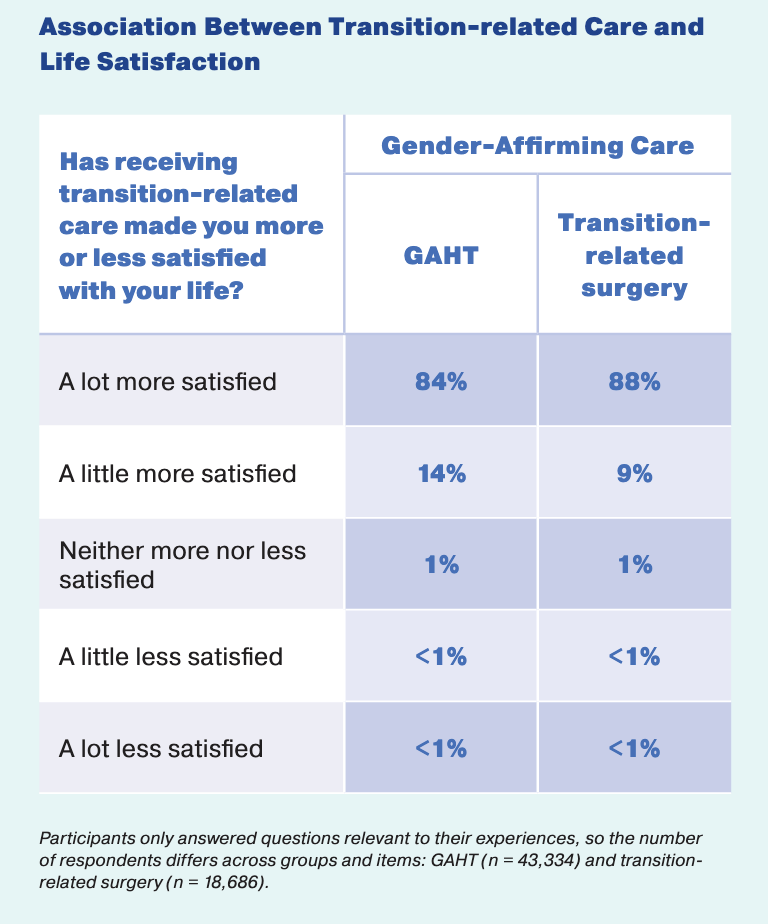
Meanwhile, respondents who received gender-affirming hormone therapy (GAHT) or gender-affirming surgery overwhelmingly reported feeling “more satisfied” with their lives—98% and 97% respectively.
Graphic courtesy of the 2022 U.S. Transgender Survey – Health and Wellbeing Report
This watershed report contradicts the popular narrative being circulated by mainstream media, far-right politicians and anti-trans groups that transgender people are “detransitioning” en masse due to life-shattering “transition regret.” In reality, it shows gender diverse people are living rich and vibrant lives—so long as they are provided the space, support and care they need from their health care providers and communities.
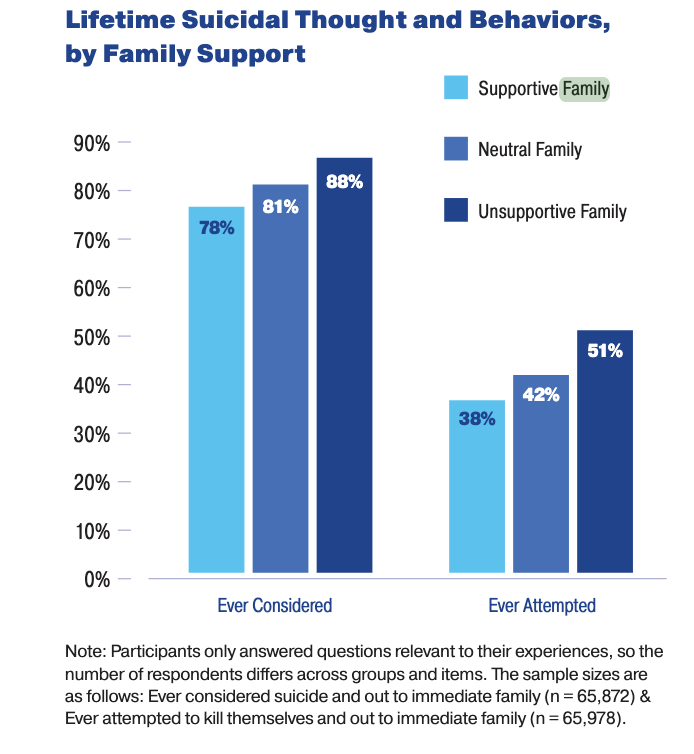
The survey found a trans person’s overall health and wellbeing also heavily depends upon rates of familial support, a factor that has a profound influence over a trans person’s lifetime experience of suicidality.
Graphic courtesy of the 2022 U.S. Transgender Survey – Health and Wellbeing Report
The survey has been released in increments as researchers at A4TE wade through the unprecedented amounts of data from trans people who lent their voice to the project. It is a much-needed, comprehensive overview on the challenges—and victories—seen in trans health care since the prior iteration of the study. The report is especially vital considering the Trump Administration moved to remove transgender people from the U.S. Census and other government websites, rendering trans communities potentially invisible, and robbing researchers of crucial data informing public policy decisions.
“Having real concrete and rigorous data about the realities of trans people’s day-to-day lives is also a vital part of dispelling all of those assumptions and stereotypes that plague the public discourse about our community,” said Olivia Hunt, A4TE’s Director of Federal Policy, during a press briefing this week.
The report also touched upon trans people’s access to health care, which increased between 2015 and 2022; the quality of care, as trust between doctors and trans patients has improved; disparities between trans people across racial groups, which showed trans people of color are generally more prone to experience discrimination compared to white trans people; and the mental health challenges facing the trans community, as 44% of respondents met the criteria for serious psychological distress, compared to less than 4% of the general U.S. population.
Many of these issues have likely been exacerbated since the data was collected. The lead-up to President Donald Trump’s return to the Oval Office incited a new wave of anti-trans animus, impeding access to care and stirring up transphobic vitriol and harassment.
“From 2015 to 2022, state-level policy environments became more protective in some ways for trans people; however, in 2022 alone, when the USTS was administered, 315 anti-LGBTQ bills were introduced across the country, many of which harm trans and nonbinary people’s access to healthcare, participation in sports, access to public facilities, or other facets of public life,” the report says.
“This political landscape has only worsened since the administration of the 2022 USTS, with the introduction of 571 anti-LGBTQ nationwide in 2023 and 489 in 2024,” it continues. “At the time of writing, data on trans and nonbinary people has been erased from federal health surveys. As funding for LGBTQ research is stripped away, the USTS has become an ever more critical resource on the lived experiences of trans and nonbinary people.”
Nonetheless, trans life and trans joy has persisted, as testimonies featured in the U.S. Trans Survey demonstrate.
“I have thrived in the past 12 months in transition, I have a genuine smile on my face most days & laugh with genuine joy,” wrote Charlotte, a trans woman, in her survey response. “I have grown into the woman I was meant to be.”
And as Roo, a nonbinary person, wrote: “Once I learned what it meant to be trans, I never looked back. I traded in my Regina George-esque life for a future with a balding head and a predisposition for a beer gut. I’ve never been more happy to be alive—every single day. ”
Erin In The Morning is a reader-supported publication. To receive new posts and support my work, consider becoming a subscriber.
Galactic bones, filaments of radio-wave-emitting particles, run through our galaxy, and one of them has a fracture. New analysis suggests collision with a neutron star may have caused it.
A photo of the galactic bone known as The Snake. Photograph: NASA/CXC/Northwestern University
If you look at the Milky Way through a powerful telescope, you’ll notice that close to the center of the galaxy there are elongated filaments that seem to outline its spiral shape. Scientists have a nickname for these structures: “galactic bones.” Recently, astronomers found that one of the Milky Way’s bones is “fractured,” and they believe they’ve now found a possible culprit: a neutron star that may have collided with it.
According to NASA, these bones are huge elongated formations of energized particles that spiral along magnetic fields running through the galaxy. The particles release radio waves, and so are detectable using radio telescopes.
Scientists have found several such bones in the galaxy, but one of the most striking is called G359.13142-0.20005, also known as “the Snake.” It is a 230-light-year-long filament that appears to have a fracture. It is also one of the brightest. One of the first explanations was that some as yet undetected body had disturbed the filament.
A study by Harvard University, published in the journal Monthly Notice of the Royal Astronomical Society, set out to test this hypothesis. The research team involved found signs of a pulsar, a neutron star spinning at high speed, in the same region as the broken bone. These stars are extremely dense, and are the small remnants left after the explosion of a supermassive star.
Using NASA’s Chandra X-ray Observatory, which orbits Earth, along with the MeerKAT telescope array in South Africa and the Very Large Array in New Mexico—two systems that detect radio waves—scientists found what appear to be traces of a pulsar in the filament. Based on data from these observatories, they estimate that this pulsar impacted the bone at a speed of between 1,609,000 and 3,218,000 kilometers per hour. The suspected collision is thought to have distorted the magnetic field of the bone, causing its radio signal to deform.
The structure G359.13, with the fracture visible on its right-hand side. Photograph: NASA/CXC/Northwestern University
In the above image provided by NASA, the Snake can be seen, and there is a body that appears to be interacting with the structure, in the middle of its length. It is possibly the aforementioned neutron star.
Pulsars are alternative versions of a neutron star where, in addition to being compact objects, they rotate at high velocities and produce strong magnetic fields. At the moment there is no instrument that can see them directly due to their size and distance, but radio telescopes can detect the electromagnetic waves they emit and hear them by converting these into sound.
This story originally appeared onWIRED en Españoland has been translated from Spanish.
Chilean flamingo. Credit: Victor Ortega Jiménez, UC Berkeley
Flamingos are known for posing serenely on one leg in extreme wetlands, placidly bobbing their heads into the shallow water to feed. But a new study has revealed there’s more going on beneath the surface than meets the eye.
It seems flamingos create controlled underwater chaos to actively trap their prey, according to the research in the journal Proceedings of the National Academy of Sciences
They use a repertoire of behaviours, including stomping feet, jerking heads, and chattering beaks, to create swirling “underwater tornadoes” that concentrate and funnel prey into their mouths.
“Flamingos are actually predators, they are actively looking for animals that are moving in the water,” says lead author of the paper Victor Ortega Jiménez, an assistant professor of integrative biology at the University of California Berkeley in the US.
“The problem they face is how to concentrate these animals, to pull them together and feed. Flamingos are using vortices to trap animals, like brine shrimp.
“It’s not just the head, but the neck, their legs, their feet and all the behaviours they use to effectively capture these tiny and agile organisms.”
Ortega Jiménez and his collaborators trained Chilean flamingos at the Nashville Zoo to feed from a shallow aquarium.
They used high speed cameras and laser light to view the gas bubbles created in the water to visualise the animals’ feeding behaviour. They then confirmed their observations using fluid dynamics computer simulations and experiments using 3D printed models of flamingo beaks and feet.
They found that flamingos stomp their floppy webbed feet to churn up the sediment beneath them, propelling it forward in whorls.
The birds then draw these vortexes towards the water’s surface by jerking their heads upward at speeds of about 40cm/s, creating mini tornadoes that concentrate particles of food.
These small vortices are strong enough to trap even agile invertebrates, such as brine shrimp and microscopic crustaceans called copepods.
The flamingos’ heads remain upside down within this watery vortex, with their unique beaks angled so that the flat front end stays parallel to the bottom. They then “chatter”, clapping the lower beak open and shut about 12 times every second, to create smaller vortices that direct sediment and food into their mouths.
Experiments with 3D replicas of flamingo beaks revealed that chattering increases the number of brine shrimp captured by the beak seven-fold.
They found that flamingos also use a technique called “skimming”, which involves pushing the head forward while chattering to create sheet-like vortices – called von Kármán vortices.
“We observed when we put a 3D printed model in a flume to mimic what we call skimming, [it produces] symmetrical vortices on the sides of the beak that recirculate the particles in the water, so they actually get into the beak,” Ortega Jiménez says.
“It’s this trick of fluid dynamics.”
The team believes that their findings could be used to design better systems for concentrating and sucking up particles, such as microplastics, from water.
Next, Ortega Jiménez aims to determine the role of the flamingo’s piston-like tongue and how the comb-like edges of the beak filter prey out of the water.
“This is a once-in-a-century brain gain opportunity.”–Australian Strategic Policy Institute, urging its government to woo U.S.-based scientists and researchers caught in the Trump II attack on research and development
Black holes are one of our favorite cosmic objects
So we created Black Hole Week to celebrate them.
Throughout the week, science communicators from across the globe will be sharing news, videos, and social media posts about black holes. Our goal is that no matter where people turn that week, they’ll run into a black hole. (Figuratively, of course — we don’t want anyone falling in!) (snip)
=====
=====
First Tip: Don’t Visit Black Holes!
But if you must, read our safety guide.
Learn more about black holes, how to find them, and how to stay safe on your travels!Read More snip) Enjoy!
Snippet-go read this, the videos are delightful- Sen. Prof. Warren remains outstanding!
Oh yeah, baby, talk dirty to us.
Professor Senator Elizabeth Warren stopped by CNBC’s “Squawk on the Street”on Friday for some chattin’ and some rantin’ and some tarriffsplainin’ for the benefit of the show’s blow-dried hosts. We don’t normally watch financial news shows, because what are we, the Vanderbilts? But put Warren on anytime, and we’ll consider tuning in more. She can be entertaining!
Especially if your anchor isn’t following her argument, which sends her into her professorial did-you-not-do-the-reading voice. Which is what happened to Sara Eisen, who must have thought for one moment that she was back at the Medill School and had skipped that week’s assignment. (snip)
Black Mirror, eat your heart out. Researchers have apparently just figured out how to make people see a color completely new to humanity.
Scientists at the University of California, Berkeley conducted the research, published Friday in Science Advances. Using a technique called Oz, the research team induced human volunteers into seeing a color beyond the “natural human gamut.” Oz could allow scientists to conduct experiments previously not possible before, the authors say, and the lessons we learn from it might even someday help color-blind people regain their missing color vision.
Our retinas contain certain photoreceptive cells, known as cones, that allow us to see color. There are three cone types that correspond to different wavelengths of light: short-wavelength (S) cones, medium-wavelength (M) cones, and long-wavelength (L) cones.
Typically, when we try to reproduce color in front of someone’s eyes, we do so by manipulating the spectrum of light seen by the retina’s cones. But since some of our cones, particularly M cones, share overlap in how they respond to certain wavelengths, there are theoretically colors out there that our eyes can never truly see. The UC Berkeley researchers, based on their earlier work studying cone cells, say they’ve found a way around this limitation. (snip)
What is the South African Renewable Energy Masterplan?
It is an industrial strategy that sets out how South Africa can set up a new manufacturing industry in renewable energy and battery storage value chains.
The masterplan was developed by the government, some sections of organised labour, a non-profit organisation advocating for renewable energy, and representatives of the renewable energy industries. It sets out a framework to produce renewable technologies locally. These include solar photovoltaic panels, wind turbines and batteries.
The masterplan has been drawn up so that it aligns with South Africa’s existing national target of adding 3–5 gigawatts of renewable energy capacity each year to 2030. This is a scale that can support the development of local manufacturing hubs. (One gigawatt can supply electricity to about 700,000 average homes.) This steady supply will be enough to give businesses and investors the confidence to commit to long-term investments in local manufacturing hubs. These are zones where renewable systems and components are produced or assembled for domestic and export markets.
The state-owned electricity company, Eskom, has not directly guaranteed that it will buy 3-5 gigawatts of renewable energy each year. But the government’s national electricity plan (the Integrated Resource Plan) provides a strong indication of future demand. (snip)
Bill Nye the Science Guy speaks to people protesting the Trump administration’s federal funding cuts during the Stand-Up for Science Rally in Washington DC, Friday, March 7, 2025. Photo by Dominic Gwinn.
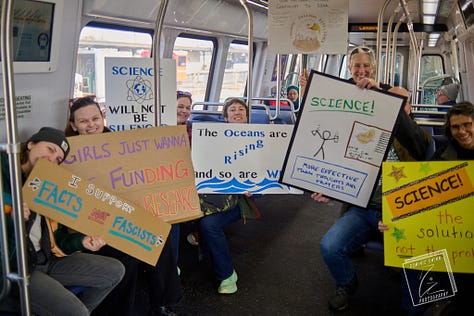
On Friday, nerds all over the US staged rallies to protest the Trump administration’s cuts to federal funding research. Thousands rallied on the steps of the Lincoln Memorial in Washington DC to plead about the benefits of funding science and research in the knowns, known-unknowns, and unknown-unknowns.
Like so many DC rallies before it, the steps of the Lincoln Memorial were transformed into a temporary stage. There wasn’t a big, black riser with rows of cameras and media crews. There weren’t throngs of journalists roaming around and shoving microphones in the faces of flag waving attendees. The crowd didn’t have any kind of uniform apparel, like colored hats and/or armbands.
With a few exceptions, like Bill Nye the Science Guy, and patients who owe their lives to federally funded medical research, a number of speakers were fairly boring. They stood awkwardly at podium and told corny jokes that fell flat. At one point, some of the older folks sang out-of-tune folk songs.
These were scientists. They proudly identify as nerds. They’ve dedicated their careers to saving lives and the planet we’ve all been mucking up for generations. And now many of them were facing unemployment because a merry band of bigots, buffoons, and bros decided science is, like, queer, or whatever.
People in the crowd cheered on speakers — their colleagues and fellow researchers — who lamented the loss of funding that didn’t just help find cures for cancers and disease, create new technologies, or reveal secrets of the universe; they were pissed there was no money for things like coolant used in specialized freezers that preserve decades of biological specimens.
Dr. Allison Agawu speaks to people protesting the Trump administration’s federal funding cuts during the Stand-Up for Science Rally in Washington DC, Friday, March 7, 2025. Photo by Dominic Gwinn.
“This will lead to more deaths,” summarized Dr. Allison Agawu, Professor of Adult and Pediatric Infectious Diseases at Johns Hopkins University School of Medicine. “Science is a beautiful art built on a canvas of ideas. The best science comes from diverse ideas, from diverse people with diverse perspectives, spurring innovation and progress … We collectively reject that inclusion, diversity, equity and access are bad words. In fact, programs championing these ideals should be celebrated and expanded, as that is how we get the best science and the best outcomes.”
A retired mathematician from the National Security Agency explained that it could be difficult for people to understand why research jobs were important. Not everything can be easily described in an elevator pitch. “Are there places we could cut,” they said, “Sure, but people just don’t understand what we do. We can’t talk about it. I know my work saved lives.”
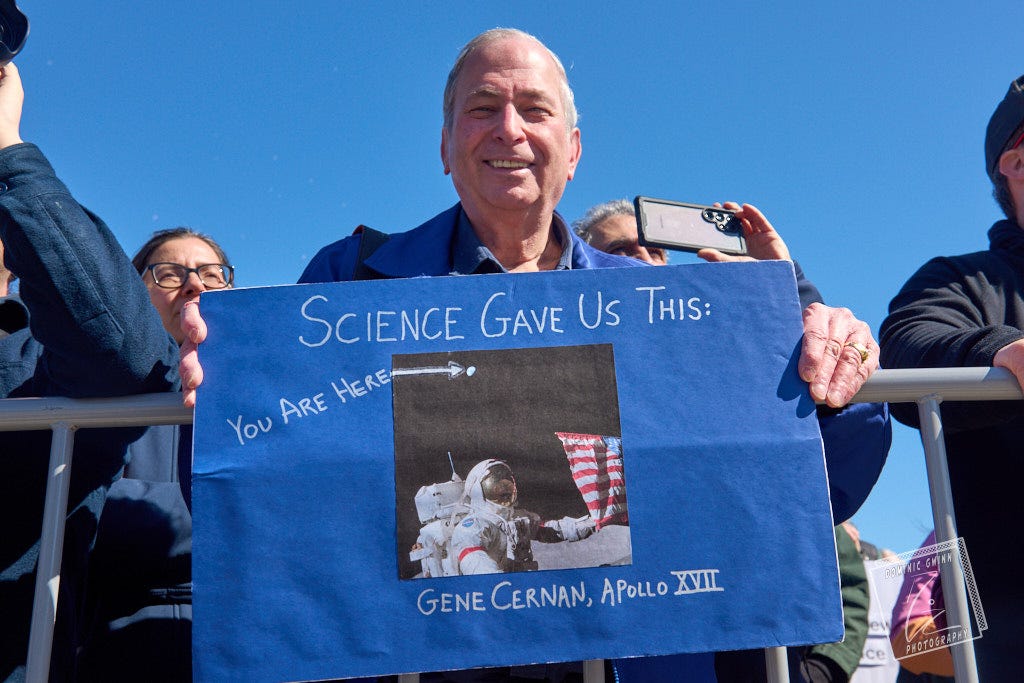
Lloyd Franklin, 64, stood at the front of the stage wearing a blue NASA jacket. He is a retired aerospace engineer who, like many kids, grew up wanting to be an astronaut. He held a sign with a photo of Apollo astronaut Gene Cernan from 1972. Cernan is taking a selfie while holding the American flag as the Earth, a pale blue dot, floats in over his shoulder. It was the last time humans walked on the Moon.
Above the photo on Franklin’s sign were the words: “Science gave us this.”
“I know this is important,” Franklin said. “I know we have to make a stand.”
Lloyd Franklin, 64, protests the Trump administration’s federal funding cuts during the Stand-Up for Science Rally in Washington DC, Friday, March 7, 2025. Photo by Dominic Gwinn.
These types of protests have been happening almost daily over the last few weeks. Much of this is being carried out by federal workers themselves through private, encrypted chats and public message boards. Mustering a sizable crowd on short notice in the middle of the week in DC can be a Herculean task, but they have been showing up to protest regularly since congressional Republicans turned a blind-eye to Donald Trump’s sweeping cuts to federal agencies.
If they get any media attention, it’s from struggling freelancers or niche bloggers. National broadcasters or their local affiliates are not really showing up to show hundreds of federal workers protesting on the evening news. There’s a massacre being carried out in broad daylight and the pathetic reality is that much of the DC press corps is either too scared to do their jobs, or they just don’t care.
The earliest evidence that humans inhabited rainforests has been found in Africa, a surprising find which pushes human settlement in these habitats much further back than previously thought.
Modern humans, Homo sapiens, evolved about 300,000 years ago in Africa. The ecological and environmental circumstances in which our species evolved are still not well understood.
It is likely that our ape-like ancestors millions of years ago did live in dense rainforests. But the retreat of Africa’s forests and the spread of savannah and grasslands as Earth’s climate dried is usually linked to the evolution of bipedalism in early human ancestors as far back as 7 million years ago.
As a result, rainforests have often been overlooked as important habitats in the evolution of early modern humans.
New research published in Nature has put a dent in this assumption.
The evidence comes from a site which dates to 150,000 years ago in present-day Côte d’Ivoire on the southern coast of West Africa.
“Before our study, the oldest secure evidence for inhabitation in African rainforests was around 18,000 years ago and the oldest evidence of rainforest inhabitation anywhere came from southeast Asia at about 70,000 years ago,” says lead author Eslem Ben Arous, from Spain’s National Centre for Human Evolution Research (CENIEH) and the Max Planck Institute of Geoanthropology in Germany.
The site was first investigated in the 1980s when ancient stone tools were discovered. But the age of the tools and the ancient ecology couldn’t be determined with the technology of the day.
The trench initially excavated by Professor Guédé’s team was overgrown when researchers returned for the current study. Credit: Jimbob Blinkhorn, MPG.
“Several recent climate models suggested the area could have been a rainforest refuge in the past as well, even during dry periods of forest fragmentation,” says senior author Eleanor Scerri, from the Max Planck Institute of Geoanthropology. “We knew the site presented the best possible chance for us to find out how far back rainforest inhabitation extended.”
The anthropologists used several dating techniques including optically stimulated luminescence and electron-spin resonance to determine the stone tools were 150,000 years old.
Stone tools like this one, excavated at the Anyama site, reveal that humans were present at the rainforested site roughly 150,000 years ago. Credit: Jimbob Blinkhorn, MPG.
Sediment samples also showed the region was heavily wooded, with pollen and leaf waxes typically found in humid West African rainforests. Low levels of grass pollen show it wasn’t a narrow strip of forest either, but in a dense woodland.
This evidence suggests that some early modern humans lived in rainforests while others stuck to their grassland and savannah homes.
“Convergent evidence shows beyond doubt that ecological diversity sits at the heart of our species,” says Scerri. “This reflects a complex history of population subdivision, in which different populations lived in different regions and habitat types.
“We now need to ask how these early human niche expansions impacted the plants and animals that shared the same niche-space with humans. In other words, how far back does human alteration of pristine natural habitats go?”
“This exciting discovery is the first of a long list as there are other Ivorian sites waiting to be investigated to study the human presence associated with rainforest,” says Guédé.
The site which yielded these stone tools has since been destroyed by mining.